1
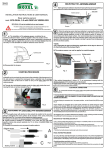
6. FINAL TESTING PROCEDURE
A) Turn on the key, press the push-button. In a fraction of second the WARNING
control unit performs a check of the functionality of the system and, if
everything has been done correctly, the transducer emits an acoustic
1. In presence of rain or high moisture weather, the system
sound of "OK" (one note). Once you have this signal the system becomes
reduces
his sensibility automatically in order to eliminate a part of
operational.
Possible problems and their solutions
1. If the acoustic transducer does not emit any signal check all the
connections.
2. If the transducer emits an audible warning signal consisting of 2 notes
(one high and one low) repeated 3 times) check the connection of RF
cable.
false alarms that could be given by movement of water on the
bumper.
2. As soon as the system is activated an acknowledgment of the
surrounding of the bumper is made.
Consequently it is quite important, during testing operation, not
to switch on the system while you are very close to the antenna
sensor in order not to have false information on the working
B) Starting from about 1 metre away from the centre of the bumper, slowly
capability
of the system.
approach both hands to simulate a parking manouevre. At a distance of
about 30/40 cm will be heard the first intermittent signals and then a
continuos higher frequency sound at about 10-15 cm from the bumper.
ALARM SIGNAL
RISK OF CONTACT SIGNAL
WARNING: The PD1-FRONT must be switched off when driving in
order not to be cause of useless warnings.
C) If the system shows to work regularly it is possible to fix definitely the
bumper.
NOTE: PD1- FRONT starts to give the signalling only when the
vehicle is being approached to the obstacle; a fixed object in front of the
bumper, for instance the hauls hook and a bull bar or the sides walls of a
car box, is not signalled and it is not bothered the normal operation of the
device.
USER MANUAL
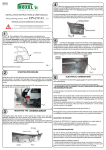
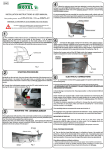
Fig. 6
(OPERATING PRINCIPLE)
PD1-FRONT is an innovative parking sensor that uses low
energy electromagnetic waves and is able to detect the
approach of any kind of obstacle . The activation of the device is
Switch position
(white color)
-
Antenna sensor
Sensibility 1
obtained by pressing the activation button and confirmed by a signal
of “OK". Once activated, the PD1-FRONT generates around the
bumper, on which is installed, a protection zone (Fig. 6).
When any obstacle present in the protection zone tends to approach the
bumper you will hear a series of beeps.
Central module
(ECU)
Sensibility 2
1
2
WORKING EXAMPLE
Sensibility 3
A) As soon as the PD1-FRONT is activated the control
functionality of the system is carried out in a fraction os second.
In case of anomalies the speaker emits an audible warning
signal consisting of 2 notes (one high and one low) repeated 3
times. If this happens check the antenna connection to the
ECU. If the control is OK you hear a signal of a single
note to confirm the proper functioning of the system.
B) When approaching an obstacle the system activates the
acoustic signal at a distance between the bumper and obstacle
(measured in the central area of the bumper) of about 30/40 cm
with 2 types of sounds:
1) an increase in sequence of "BIP" (alert) when the obstacle
To push-button switch
Buzzer
Sensibility 4
Block schematic
TECHNICAL CHARACTERISTICS
- Operating range from 9,5 to 18V - Operating temperature from -20 to +90 °C
- Max current absorption
70 mA - Max. distance to begin detection 50-60 cm
comes close to the bumper at a distance between 15 and 40 cm
measured on the middle of bumper and in function of the choosed
sensibility.
2) a continuous sound at a more low frequency (risk of contact)
when an obstacle is very close to the bumper (10-15 cm).
Buzzer Cable
Push button
NOTE:
RF Cable
Buzzer
Power Cable
- The device should be activated only during parking maneuvers.
- The distances will vary depending on the size of the obstacle and
correspond to the central zone of the bumper; on the lateral edges the
distances is less (see Figure 6)
- The alert occurs only when the vehicle is approaching an obstacle, a
fixed object in front of the bumper is only detected after the first
movement of approach.
Sticking material
Antenna sensor
Central unit
+