1
Regatta Processor
8.3
Calibration of the compass
For this sensor, refer to the calibration chapter of the sensor’s manual.
8.4
Calibration of the heel and pitch
These parameters can be calibrated using a digital or laser level. Place the reference level
on the reference surface given by the architect and check that no large metal mass, such
as a pontoon or a cargo ship, is withi n 20 metres of the 3D Sensor. The boat must be
balanced, check that no heavy object such as sails, anchor… is on one side of the boat,
thus leading it to heel. The best option is to perform this test empty, without sails, no
victualling… For this test, the sea must be flat.
Enter the calibration offsets in the menus of the Gyrographic:
Page ► Configuration ► Calibration ►Heel ►Offset
Page ► Configuration ► Calibration ►Trim angle ►Offset
8.5
Calibration of the boat’s speed
The speed measured at the boundary layer is turbulent and depends on the type of boat
and its shape. 60-foot type monohulls with flat bottom and bilges present the heel with a
wet surface, the longitudinal axis of which is not the boat’s longitudinal axis (like a
catamaran with non parallel hulls). The speedometer cannot have an alignment with the
correct advancement axis both flat and heeled.
Vaned rotor speedometers measure speed in an accelerated and disturbed flow. The
measuring error can be increased according to the heel. The measurement is not linear.
Ultrasonic speedometers measure a speed around ten centimetres from the hull. The flow
is laminar and a lot less disturbed. The measurement is linear. However, the
measurement can be 1 to 2% optimistic with strong heel in relation to a calibration carried
out flat because of the accumulation of errors in the alignment and increasing thickness of
the boundary layer.
There are two levels of calibration:
Simple calibration with a calibration coefficient that can be entered using the Gyrographic
Pilot. In this case, the coefficient is entered in the sensor.
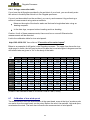
Advanced calibration which uses calibration tables by speedometer and a calibration table
for the boat speed according to the heel. The tables are kept and used by the Regatta
Processor.
8.5.1 Speedometer calibration method (simple calibration):
The most optimum method consists in making back and forth trips, ideally close to normal
sailing speed and opposite heading so as to eliminate the current. The boat must move
forward in a straight line and start its “run” with stabilised speed and heading. Both tacks
must have approximately the same length. The reference is the bottom speed which is
given by the GPS. The calibration is made according to the average of the bottom speed
and the average of the surface speed.
21