1
Illustration: Harold A. Perry; photo: Jupiter Images
vehicles. It includes access to ABS, air
bag, instrument cluster, transmission
and other controllers on all supported
makes. Key features include fully translated Mode 6 data, bidirectional controls that can be operated from any window, live data in graph, grid and meter
formats, and color-coded results for
quicker data interpretation.
The hardware is a Plug-n-Play USB
2.0 device for backwards compatibility
and faster throughput. It requires no
device drivers or complex installation
process. The software interface includes VIN decoding to help you retrieve the proper vehicle model information, perform network tests to verify system availability before a selected
system is accessed, and the ability to
retrieve/clear DTCs from all systems
with a single request. Live data
screens can be printed to create extensive trouble code and emissions reports for customers. The software is
updated as often as four times a year,
with free updates to the enhanced interfaces for the first year.
Tools available from Autoland Scientech range from OBD II-generic
and oil reset scan tools to dealer-level
diagnostics. The company stresses its
ability to provide the aftermarket with
such dealer-specific applications as
coding and programming. Scan tools
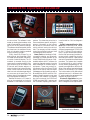
offered include the VeDiS, iScan
(CS2000), VScan and D21. Most recently, the company has added coding
for European models, as well as
OEM-specific functionality for driveby-wire systems, steering angle sensors, throttle body relearn procedures,
tire pressure monitors, seat sensor calibration, key programming, brake
bleeding and deactivation of Sensotronic brake control and more.
The Autologic Diagnostic System is
designed to replicate the functionality
of OEM tools used by dealer techs. The
system is designed to run on the same
platform as Autologic for BMW, and
adds dealer-level software for Mercedes-Benz, Jaguar, Land Rover and
Volvo vehicles. Autologic provides
datastream, reading and clearing of diagnostic trouble codes and component
activation. The system also provides access to immobilizer key coding, module
replacement (including coding and programming) and performance tuning.
A built-in data logger records software data transfer and unidentified
ECUs and e-mails the details to the Autologic technical support center. Utilizing Internet communication with the
Autologic system, a fix file is created
and e-mailed back to the user, usually
within 24 hours. Subsequently, a new
software version is then created and
posted for all users to download.
All Autologic software revisions and
upgrade modules are available free
during the warranty period, via the
website. Technical support/updates for
the Autologic tool are available to customers within the U.S., and factorytrained, master technicians are available to answer vehicle-specific questions and/or concerns.
Automotive Electronics Services
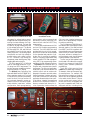
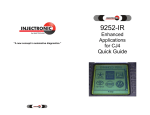
(AES) has introduced the LineSpi, an
OBD II DLC breakout box. The LineSpi includes LEDs to monitor power,
grounds and OBD II data lines. The
tool includes two modes of operation—
diagnostic mode and activity mode.
In diagnostic mode, the tool decouples the OBD II line LEDs from the
data lines so they don’t interfere with
any diagnostics—such as looking for an
open or short. In activity mode, the
dataline LEDs are active, allowing you
to monitor scan tool/data line activity.
The tool’s ground LEDs (pins 4 and
5) allow you to quickly determine if
there’s a current flow problem. The
power LED (pin 16) allows you to
quickly determine if there’s a power
source problem, such as a blown fuse. If
there’s a blown fuse to pin 16, you can
jumper power into the breakout box to
power up your scan tool. All data lines
can be monitored with a lab scope while
a scan tool is connected. Use the breakout box any time you need to jumper
pins at the DLC without having to
crawl under the dash or risk shorting
the wrong pins together.
Automotive Test Solutions (ATS)
has introduced several new pieces of
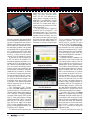
equipment. The first is the EScan with
Sharpshooter technology. This scan
tool has the ability to convey critical information on the fuel injection system
to the technician. It accomplishes this
through alert lights and special testing
features such as: decrypted Mode 6
data, load charts for fuel trim, vacuum,
volumetric efficiency, catalytic converter and temperature, and the soon-tobe-enabled automated troubleshooting
capability. This tool will connect to all
bus types from 1996 to 2007.
The second new tool is a Pressure
Transducer Kit. These pressure transducers open up a variety of new diagnostic possibilities. By placing a transducer in the spark plug hole, the valve
timing can be viewed. Another transducer is a new style exhaust pressure
transducer designed specifically to
dampen the exhaust fluctuation and
amplify the misfiring cylinder. When
connected to a vacuum source on the
intake manifold, these pressure transducers can determine if the engine has
valve deposits or intake guide problems.
They’ll also indicate which cylinder has
a blown head gasket. In the case where
the pressure transducer is connected to
the dipstick hose, a piston blowby problem can quickly be evaluated. There are
many other uses for these devices.
The third tool is the EScope Limited,
a four-channel, dual-time-base, 14-bit
PC-based oscilloscope. The tool has the
ability to power, ground and read the
signals of up to four pressure transduc-
April 2007
37