1
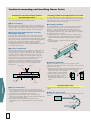
■ When the cable is movable
When the detector head is movable, it carries the signal cable
with it during operation. Take care, in such a case, that the
radius of curvature of the signal cable is not smaller than
100mm and excessive force is not applied to the cable. It is a
good idea to protect the cable with a flexible support cover.
Flexible cover
Detector head
Radius: 100mm or larger
Note: Take care that the signal cables does not interfere or are
not rubbed with any part of the machine.
■ Other considerations
The signal cable is durable enough to withstand repeated
bending up to approximately 2 million times (when the
bending radius is 100mm). When repeated bending
exceeding 2 million times is expected, the signal cable should
be considered as a consumable part. Have an extension cable
ready in such a case so that the slider unit can be replaced to
facilitate maintenance.
Resonance point of Linear Scale
Each object has a natural frequency, depending on its shape,
length, and the type of material. The Linear Scale frame is not
an exception. It has its natural frequency and thereby
resonates at a certain frequency. In general, this will not
cause a problem, since a machine tool and the Linear Scale
frame have different natural frequencies under normal
machining conditions. However, when the natural frequency
of the machine tool body and the Linear Scale coincide due
to a special processing condition, the following countermeasures can be taken:
[What to do when the machine and the Linear Scale
have the same natural frequency]
1. Increase rigidity of the mounting bracket for the scale.
2. Add a mid-support to the middle of the scale to shift its
resonance point.
3. Mount the Linear Scale at a place where the frequency of
the machine tool cannot be easily transmitted.
4. Limit the machine process conditions to be within a specific
range in which the natural frequencies of the machine tool
and the scale do not coincide.
Maintenance of Dust-proof rubber lips
In order to maintain and extend the life of the dust-proof
rubber lips, it is recommended that a small amount of silicon
lubricant be applied to the joint of the rubber and the
detector head once a year.
Greasing
Improving the dust- and splash-proofing
On the assembly type Linear Scale AT102 the dustproofing
and splashproofing can be improved by supplying dry and
clean air into the spar. Pipe to either of the screw holes (M5)
located on the both ends of the main scale for the air supply.
• Applicable Linear Scale: AT102
• Supplied air pressure: 0.1MPa (approx. 1kgf/cm2)
• Air flow rate: 10 to 20 liters/min.
15mm
or less
Detector
head
Rubber lip
Apply silicone grease
to the overall length
with a close or paper.
Recommended air supply system
(4)
Scale main unit
(7)
(5)
(2)
Air supply equipment
(1) Air filter A
(2) Air filter B
(3) Air filter C
(4) Differential pressure
gage
(5) Air regulator
(6) Flow control valve
(7) Pressure gage
(3)
(6)
Linear Scale
Specifications
Filterability: 5µm
Filterability: 0.3µm,
Oil removal rate: 99.9% or more
Filterability: 0.01µm,
Oil removal rate: 99.9999% or more
For monitoring the life of the air filter C
Pressure setting: 0.1MPa (1kgf/cm2)
Flow setting: 10 to 20 liters/min.
Pressure: 0.1MPa (1kgf/cm2)
Note 1: Do not supply excessive amount of air, since this may draw in the dust
around the scale unit.
Note 2: When air in the air supply system contains humidity, connect an air
dryer to the front of (1) Air filter A and dry the air.
Linear Scale Evaluation Methods
• Testing within the operation temperature range
The test has proven that there is no abnormality of functions
and signals when the Linear Scale is used within the
specified operating temperature range.
• Temperature cycle (dynamic characteristics) test
The test has proven that there is no abnormality when the
Linear Scale is used under the condition of which the
ambient temperature continuously changes within the
specific range.
• Vibration test (Sweep test)
The test has proven that Linear Scale functions without
abnormality when used within the frequency range
between 30Hz and 300Hz at a given acceleration (3G).
• Noise test
In accordance with the EMC Directives, EN55011:1991
Group 1 Class B, and EN50082-1:1992
• Crate Drop Test
In accordance with the heavy equipment drop test
(JISZ0200) specified in the JIS.
Appendix
(1)
DRO System
33