1
have heard of disagreements with grazing contracts based around meter readings
where each party thinks a different formula should be used. The answer is
unbiased—for the most accurate formula, cut, dry and weigh a sample (See
“Cutting Quadrats” in the Addendum). This weight is then compared with a meter
reading for the same sample, using the various formulas, to see which one most
closely matches the weight of the sample.
Remember—be Consistent with your farm walk and formulas and you will end
up with records which are meaningful, comparable and very useable.
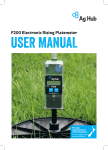
Using Your Plate Meter
TAKING PADDOCK READINGS (THE FARM WALK)
1.
Switch the unit on using the toggle switch at the back.
2.
Reset by holding the ‘Reset’ button until the display changes to ‘0’. This
should be accompanied by 2 short beeps.
3.
Walk across the paddock taking readings every few paces. You will hear
a beep every time a reading is stored. The average kgDM/ha is immediately
recalculated and displayed. The number of samples (plonks) to be taken
should range between 20 and 40 per paddock however this will be determined by the variance existing in the cover. You will hear 3 short beeps when you have completed 29 plonks and one long beep when you
reach 30. This is the recommended number of readings. Plonks need to be
taken on a regular basis e.g. every three paces to even out any variations,
however avoid stock camp areas, tracks or uncharacteristic areas. The greater the variability the greater the number of plonks you should take.
4.
If you need to negotiate an obstacle (e.g. fence or creek) switch the unit off
so that no readings are taken if the plate moves. On the other side of the
obstacle, switch the unit back on and continue taking readings.
5.
When you have completed the paddock, read off the average pasture cover.
6.
Write down the average height and/or the average cover in the All Weather
Note Book.
7.
Repeat instructions 4 to 8 until you have completed every paddock.
8.
Switch the unit off using the toggle switch at the back.
PRINCIPAL OF USE
Place the meter squarely on the ground. The plate will "rise" as it rests on the
grass, giving a reading of grass height (½ cm increments) on the bottom counter.
At each measurement, click the top (sample) counter to record the total number
of samples taken.
TECHNIQUE
Practice the technique of an interrupted slow walking pace, taking care not to
"roll" the meter. This is where the plate is not square to the ground and it will
provide a false HIGH reading. Go ahead: try "rolling" and compare the results
with placing the meter squarely on the ground. See what we mean? The meter
should also be lowered consistently—not gentle but not forced into the ground
either.
FARM WALK
The more regularly you take readings the better. Astute farmers will take readers
weekly, sometimes more often during critical times of the year and less frequently
during times of static conditions.
The more samples taken per paddock the less margin of error. We recommend 20
to 40 samples per paddock but if you have bad conditions ie. pugged paddocks,
then more samples should be taken.
Most paddocks will have areas of good growth and areas of poor growth. If
recently grazed, the pasture may be clumpy. Ensure that your walk includes
representative samples of both areas. Avoid tracks, stock camp sites and other
uncharacteristic areas.
Undo Feature: You can “undo” the last plonk or reading by holding down the
“Height” button as you switch on the counter. The count will now be one less than
what it was and the dry matter reading will also change to the previous reading. You
can continue taking more readings if you wish.
Take samples every 3 paces or so, rather than choosing by eye the spot to sample.
This removes operator preference for long or short patches.
Results from your feed budgeting will assist you in making important management
decisions such as:
Be consistent. Plan the same walk every time although it can be done in reverse.
This allows each walk to be compared with another.
11
12