1
4.2
Operation check
The operation of the meter can be checked with the following simple procedure:
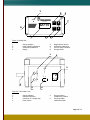
1. Switch on the generator. Observe the two red indicator lights on the side panel (Fig. 4: 2). The other should
light when switching the unit on and go out after a few seconds. If this happens, the generator is probably
operational. Another method to check the operation of the generator is to measure the output voltage which
should be around 1.4 … 1.5 VAC with the frequency of 111.86 Hz. The indicator lights can be on if the load is
too high or in short-circuit. If the battery is discharged, the generator will not start, in this case charge the
battery.
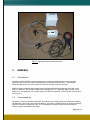
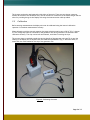
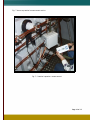
2. Switch on the display unit and clip the current clamp around the carrying handle of the generator as
presented in section 2.3. The display should indicate a reading close to the capacitance of the calibration
capacitor adjustable to the correct value with the calibration pushbuttons.
3. Switch off the generator. The display should decrease to zero.
4. If the display unit operates as described in 2. and 3., it is in working condition.
4.3
Operations of maintenance
Generator Unit:
If the output voltage of the unit is measured to be zero, the internal protection fuse is probably blown. Open
the cover and check the fuse on the circuit board. Replace with a new one when required. The fuse rating is
6.3 x 32 mm 7 A, fast acting.
Display Unit:
There are no user-maintainable parts in the unit.
Current clamp (concerns model Midori CT-65):
The air gaps of the current clamp must be held clean. Dust and foreign particles can cause erraneous
readings. The gaps can be cleaned e.g. by drawing a piece of paper through the gaps. No abrasive material,
e.g. sandpaper must not be used.
The thin plates can bend easily and the clamp will not close properly. In this case the plates must be carefully
realigned in order to close without using excessive force. Opening and closing can be facilitated by a squeeze
of lubricating oil (CRC-56 or equivalent) between the plates.
Check regularly the condition of all the cables of the meter.
If the meter has got wet e.g. in field use, do not store it tightly closed but first let the moisture to evaporate.
If the meter is to be stored for a long period of time, the batteries must be fully charged prior to storing.
4.4
Destruction and recycling
The cases of the Display and Generator units are made of ABS plastic and can be recycled or destructed in
accordance with the local regulations.
The carrying case is made mostly of aluminium and can be recycled.
The printed circuit boards contain no recyclable parts and must be disposed as electronics waste.
The batteries are to be treated as hazardous waste and must be disposed accordingly.