1
4)
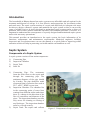
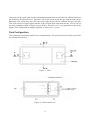
and stores sewage from the households. The septic tank contains anaerobic bacteria that
decomposes or disintegrates the sewage. The material used in the construction of septic
tank range from stone or brick masonry to concrete for a bigger community septic tank.
It is usually buried underground.
Soak Pit: The effluent (clarified wastewater) from the septic tank flows into the soak pit.
The soak pit is a covered walled chamber that is porous and allows wastewater to slowly
soak into the ground after a secondary treatment.
Septic Tank
Functions of a Septic Tank
The septic tank provides a number of important functions in terms of physical and biological
changes. The essential functions of a septic tank are:
•• To collect wastewater from the house.
•• To act as a sedimentation tank. As the sewage enters the tank, the rate of flow is reduced
so that the larger solids in the sewage sink to the bottom of the tank.
•• For primary treatment of wastewater in the tank, as the solids and the liquids are partially
decomposed by anaerobic bacteria and other natural processes.
•• To provide a storage space for the separated solids (sludge and scum).
•• To pass the effluent into the soak pit for final treatment and disposal.
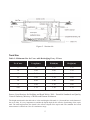
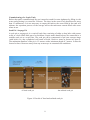
Different layers of sewage in the septic tank
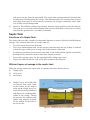
When the sewage enters into septic tank, it separates into three distinct layers:
a)
b)
c)
Sludge layer
Clear zone
Scum layer
a)
Sludge Layer: All solids that
are heavier than water settle
at the bottom of the tank to
make up the sludge layer. The
anaerobic bacteria breakdown
and digest the biodegradable
solids in the sludge. During
the process, the solids become
lighter and migrate upwards
to the middle of the tank or
the clear zone.
Outlet tee
Figure 2. Different layers of septic tank
2