1
OBJ_BUCH-1513-003.book Page 20 Monday, January 16, 2012 11:29 AM
20 | English
Always lightly move the hoses.
This will lead to better cleaning results.
– Clean the paint applicator and the paint roll: See “Cleaning
the Paint Applicator and the Paint Roll”, page 20.
– Allow all components to dry thoroughly.
If possible, hang up the paint roll 16 to dry.
If the paint roll is placed down to dry, the pile will be deformed. This may lead to an uneven surface quality when
using the paint roller the next time.
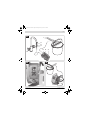
Cleaning the Paint Applicator and the Paint Roll
(see figures I1–I3)
After flushing the system, some of the components still have
to be cleaned manually.
– Remove paint remainders from paint applicator 3 using a
brush.
– Pull paint distributor 36 out of the paint chamber 37.
For easier cleaning, turn the paint distributor by 90°.
– Remove the distributor plate 38 from the paint distributor
36.
For this, lift the distributor plate on one side and pull it laterally out of the retaining clamps.
– Remove paint remainders from of the distributor plate 38,
the paint distributor 36 and from of the paint chamber 37
using a small brush.
– Wash out the paint roll 16 thoroughly.
Storage
Before storing, the electric paint roller must be properly
cleaned and all components dried.
– Slide distributor plate 38 laterally into the retaining clamps
in paint distributor 36.
– Clip paint distributor 36 into the paint chamber 37.
– Wind up feed hose 2 around the base unit 5 and affix it with
holding clamp 21.
– Slide down paint-bucket coupling 29 completely to the
bottom.
– Insert paint roll 16 into paint applicator 3 (see “Changing
the Paint Roll”, page 18).
Material Disposal
Paint and dried paint remainders must be disposed of in an
environmentally-friendly manner. Observe the manufacturer’s instructions for disposal and the local regulations for hazardous waste disposal.
Chemicals harmful to the environment may not be disposed
of into soil, groundwater or bodies of water. Never pour
chemicals harmful to the environment into the sewerage system!
Maintenance
If the replacement of the supply cord is necessary, this has to
be done by Bosch or an authorized Bosch service agent in order to avoid a safety hazard.
If the machine should fail despite the care taken in manufacturing and testing procedures, repair should be carried out by
an after-sales service centre for Bosch power tools.
In all correspondence and spare parts order, please always include the 10-digit article number given on the type plate of
the machine.
2 609 005 736 | (16.1.12)
After-sales Service and Customer Assistance
Our after-sales service responds to your questions concerning maintenance and repair of your product as well as spare
parts. Exploded views and information on spare parts can also be found under: www.bosch-pt.com
Our customer service representatives can answer your questions concerning possible applications and adjustment of
products and accessories.
Great Britain
Robert Bosch Ltd. (B.S.C.)
P.O. Box 98
Broadwater Park
North Orbital Road
Denham
Uxbridge
UB 9 5HJ
Tel. Service: +44 (0844) 736 0109
Fax: +44 (0844) 736 0146
E-Mail: [email protected]
Ireland
Origo Ltd.
Unit 23 Magna Drive
Magna Business Park
City West
Dublin 24
Tel. Service: +353 (01) 4 66 67 00
Fax: +353 (01) 4 66 68 88
Australia, New Zealand and Pacific Islands
Robert Bosch Australia Pty. Ltd.
Power Tools
Locked Bag 66
Clayton South VIC 3169
Customer Contact Center
Inside Australia:
Phone: +61 (01300) 307 044
Fax: +61 (01300) 307 045
Inside New Zealand:
Phone: +64 (0800) 543 353
Fax: +64 (0800) 428 570
Outside AU and NZ:
Phone: +61 (03) 9541 5555
www.bosch.com.au
Republic of South Africa
Customer service
Hotline: +27 (011) 6 51 96 00
Gauteng – BSC Service Centre
35 Roper Street, New Centre
Johannesburg
Tel.: +27 (011) 4 93 93 75
Fax: +27 (011) 4 93 01 26
E-Mail: [email protected]
Bosch Power Tools