1
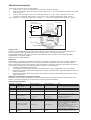
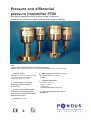
Transmitter types, description:
Threaded transmitter R 1/2" and
NPT 1/2”. (1 and 2)
The threaded transmitter with
connection to R 1/2” thread is
intended for clean media. At a
media temperature higher than
90ºC, a cooling pipe is used to
prevent too high temperature at
the sensor.
The threaded connection is
normaly sufficient to keep the
transmitter in place. At specific
conditions or wall installation the
transmitter can be supported and
reinforced with an installation
kit.
(Exceptions: Normally not available
with tantalum diaphragm.)
the limits depends on flange type.)
Hygienic clamp connected
transmitter.
Clamp38, Clamp51, hygienic front
connection and Varivent. (9, A, P
and V)
A clamp connected transmitter is
used when special hygiene
requirements are needed, such as
those in the food and pharmaceutical industry. The design meets
ISO 2852 and the transmitter is easy
to install and remove.
If clamp 38 connection is not
available, the optional connector
piece, clamping ring and gasket
ring may be used. Connection
details for clamp 51, hygienic front
Threaded transmitter with
connection and Varivent is available
extended diaphragm, R1 ½ ”.
upon request but not available from
(3)
stock.
This transmitter connection with (Exceptions: Normaly not available
a connection to a 1½” thread is
with tantalum or stainless steel
intended for fibre-rich and viscous diaphragm.
media. The extended front
The highest pressure range for
diaphragm is in connection with
clamp 38/51 and Varivent is 2 MPa.
the media without any pocket
Note that the limits depends on
inside the tank or pipe.
clamping ring type.)
An optional adapter is available
for connection to a 2" thread and
Hygienic screw connected
an optional welding sleeve for
transmitter.
R1½”. There are no additional
DIN11851/40 mm, SMS Rd60-6,
requirements on the installation. DIN11851/50 mm. (7, 8, C, E)
The transmitter may also be
A screw connected transmitter
connected inside a threaded
giving a hygienic connection, for
R1½” cylinder, such as a pipe
example, used in the Dairy
sleeve or shut-off valve.
industry. The exposed diaphragm
(Exceptions:
has direct contact with the media
Not available with tantalum
which make it possible for the
diaphragm and pressure range 14
transmitter to measure even
and 35 kPa.
viscouse liquid media, without
The highest pressure range for this becoming silted up.
connection type is 4 MPa).
The transmitter is installed in
accordance with the Rd 60-6
Flange connected transmitter.
connection of SMS 1146, DIN 405
Flange 80 mm/3”, Flange 50
and DIN 11851. The transmitter is
mm/2” and DRD flange. (4, 5
screwed to the connector.
and D)
(Exceptions: Normaly not available
A flange connected transmitter is with tantalum or stainless steel
intended for level measurement in diaphragm.
open tanks with liquid media,
The highest pressure range for
even with fibre rich and/or
DIN11851/40 is 2 MPa. The highest
viscous media. The risk of
pressure range for SMS Rd60-6 is 8
blockage is eliminated by the
MPa.)
large area of the exposed
diaphragm.
Transmitter removable during
The transmitter is clamped
operation. (6)
between standard flange rings.
This transmitter type is intended
The transmitter fits slip-on
for liquid media, even with
flanges of ANSI or DIN type. For
viscous or fibre-rich media. The
transmitters with flange
extended diaphragm is in
connection, the type of flange has connection with the media
to be stated at the time of order.
without any pocket inside the
(see Accessories).
tank or pipe.
PT60 with flange 50 mm/2" and six
The transmitter can be exchanged
holes, for use with MWP10 is
during operation and comprises
supplied upon request.
three parts; the transmitter, a ball
(Exceptions: Not available with
valve and a welded casing/
tantalum diaphragm combined
compression flange. This
with pressure range 14 and 35 kPa. compression flange is designed to
The highest pressure range for this
fit an ANSI or DIN 80 mm/3”
connection type is 4 MPa. Note that
flange and may be installed to
measure levels according to the
hydrostatic principle.
(Exceptions: Normaly not available
with tantalum diaphragm.
The highest pressure range for this
transmitter type is 2 MPa.)
Differential pressure
transmitter. (G, H and T)
Differential pressure transmitters
is used to meausre the difference
between two pressures. The
transmitter types G and H can
withstand high static pressures,
both one- and doublesided, (up to
15 MPa). The transmitter type G
has threaded connection and type
H has one side threaded and the
other side with flange 80 mm.
They are used for level
measurements in pressure vessels
and flow measurements of gases,
liguids and vapour. Other
application areas are differential
pressure measurements across
filters or heat exchangers, and
pressure measurements with
narrow measurement ranges
where there is a danger of high
one-sided pressure overload.
The differential pressure
transmitter type T can be
delivered with two process
connections 3-9, A, C, D, E och V.
One side is directly connected to
the transmitter and the other side
with a capillary tube (normal
lenght of the capilary tube is 2000
mm, other length upon request).
(Execeptions: Type G: Threaded
connection is not available with
tantalum or stainless steel
diaphragm. Flange connection is
not available with Tantalum
diaphragm.The highest pressure
range is 0,8 MPa.
Type T: Highest static pressure is
the same as the overload for the
pressure range. Same exceptions as
for the choosen process connection.)
Transmitter with capillary
tube. (N)
This transmitter type is designed
with the connection (with the
measuring diaphragm) separated
from the transmitter housing.
The media pressure is transferred
via a capillary tube (normal
lenght of the capi lary tube is 1000
mm, other length upon request) to
the sensor located in the
transmitter housing. This type
can be delivered with process
connections 3-9, A, C, D, E and V.
The transmitter type is designed
for applications with high
vibration levels or high ambient
temperatures.
Withstands extremly high media
temperartures (max 275 degrees C).
(Exceptions: Same exceptions as for
the choosen process connection.)