1
Section 1 : Introduction
1.01 Description of Equipment
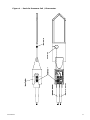
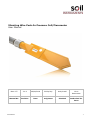
The Push-In Pressure Cell consists of a pointed rectangular spade shaped oil filled chamber
formed from two sheets of steel welded around the edge. The dimensions of the active part of
the pressure cell are approximately 100 x 200mm by 6.4mm thick.
The oil filled cell is connected by a short length of steel tube to a Vibrating Wire Transducer,
thus forming a sealed hydraulic system. The cell is welded to a support plate and connector
boss onto which the installation pipes are attached.
A porous filter disc is incorporated in the support plate and is connected to a second Vibrating
Wire Transducer thus providing an integral piezometer. The two Vibrating Wire Transducers
are mounted in parallel behind the spade-cell and are protected within the protective pipe.
Each transducer is fitted with PVC sheathed, screened, electrical cable which extends beyond
the top of the borehole to enable future termination or extensions.
1.02 Applications
The Push-In Pressure Cell/piezometer is suitable for measuring total earth pressures in clay
soils up to shear strength of approximately 300 kN/m. The incorporation of a Vibrating Wire
Piezometer in the instrument enables pore water pressure to be measured and therefore the
effective stress can be determined.
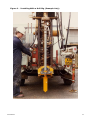
The cells can also be installed permanently and used to monitor changes in earth pressure
associated with, for example, construction of an excavation.
When installed in vertical boreholes total horizontal stresses are measured by the pressure
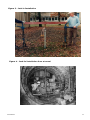
cell. They are often installed in stiff clay behind and in front of retaining walls, in soft puddle
clay cores of old embankment dams and in glacial till adjacent to sea cliffs.
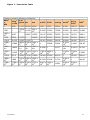
The cells have also been installed in horizontally drilled boreholes from tunnels and cliff faces.
In these situations both horizontal and vertical stresses can be measured by the appropriate
orientation of a number of cells.
The cells may be used as a site investigation tool to measure the in-situ stresses in the
ground prior to any disturbance. In this case the cells need only be left in for a few weeks.
User Manual
3