1
TECH SHOWCASE
An Innovative License-Free
Alternative To FRS/GMRS
The TriSquare TSX300 900-MHz FHSS
Handheld Transceiver Is Positioned
To Dominate The Consumer Two-Way
Radio Market
by Bernard Bates
P
opComm’s November 2007 cover
story, “Digital Two-Way Radio
Technology Reaches Consumer
Market” covered the emerging trend
of new 900-MHz FHSS (FrequencyHopping Spread-Spectrum) radios
becoming a serious license-free alternative to FRS/GMRS radios. Picking up
where that article left off, this article will
review one such radio, the TriSquare
TSX300.
This new handheld transceiver sets a
new price/performance standard, using
innovative digital technologies to offer
many features we’re accustomed to seeing only in PCS/cellular handsets. It’s
about time two-way radio users and hobbyists started benefiting from these
exciting new personal communications
technologies.
FRS/GMRS Problems Create
Opportunity
Back in 1999, TriSquare was a major
OEM manufacturer of FRS/GMRS radios
for several companies marketing under
various well-known brand names. As the
popularity of FRS/GMRS radios skyrocketed over the next five years, the market approached saturation and profit margins dropped to unsustainably low levels.
And, not surprisingly, the widespread use
of 50 to 80 million FRS/GMRS radios created severe congestion on the 22
FRS/GMRS channels at crowded events,
metropolitan areas, and elsewhere. Tens
of millions of users, including many large
Bernard Bates holds a degree in
Telecommunications Engineering from
Penn State University. His interests
include volunteering, radio communications, and lunar astronomy.
20 / POP’COMM / March 2008
and small businesses, blatantly violated
FCC regulations by using GMRS channels without obtaining the required $75
license, or by using FRS channels for
business purposes.
At the same time, many FRS/GMRS
radio users became increasingly aware of
the glaring feature disparity between their
simple two-way radios and their featurerich cell phones (which offered private
and interference-free voice communications, text-messaging, caller ID, call waiting, contacts lists, hands-free operation,
ringtones, vibrating alerts, etc.).
Engineering A Solution
In 2004 TriSquare started engineering
a solution. Its years of experience designing DSP (Digital Signal Processing) and
SDR (Software-Defined Radio) technologies into consumer two-way radios,
and the falling cost of digital components
needed to implement these technologies,
convinced the company that it was feasible to build feature-rich FHSS two-way
radios for the consumer market to supplant FRS/GMRS. DSP and SDR technologies allow advanced features and
functions to be designed and implemented in software, and then duplicated in
firmware, at far lower cost than using
many dedicated electronic components.
Fortunately, the FCC had issued its
Part 15.247 regulations, which authorize
unlicensed 1-watt FHSS voice and limited data transmissions in the 902–928
MHz ISM (Industrial, Scientific, and
Medical) band if certain challenging technical requirements are met.
Was a practical solution buried in these
obscure FCC regulations? Since FHSS
can effectively create a nearly unlimited
number of “virtual” radio channels (by
using many different hopping sequences)
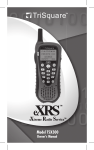
Photo A. The TSX300 eXRS (eXtreme Radio
Service) Handheld Frequency-Hopping
Spread-Spectrum (FHSS) Transceiver.
Never before has so much sophisticated radio
communications technology with so many
advanced features been available in a twoway radio priced for consumers.
it could solve the severe channel overcrowding and privacy problems vexing
tens of millions of FRS/GMRS radio
users. Because ISM spectrum is unlicensed, FCC licensing requirements
wouldn’t be an issue.
eXtreme Radio Service
Is Born
Armed with its two-way radio engineering expertise and these new FCC regulations, TriSquare filed 33 U.S. patent
claims and bowed out of the FRS/GMRS
OEM market in 2005 to focus on what it
saw as a huge market opportunity for lowcost, license-free, short-range two-way
voice and text-messaging products that
Scan Our Web Site
clips, a dual desktop drop-in charging bay
with AC adapter, and one illustrated
user’s manual.
After installing the two 4.8V,
750mAH NiMH battery packs and dropping the radios into the dual desktop trickle charger for the night, I noted it had
built-in protection against overcharging
and short-circuiting batteries. The charger takes about 12 hours to fully replenish
battery packs that are fully discharged.
The next morning (about 11 hours later)
the radio’s LCD battery gauge indicated
they were fully charged.
A nice feature is the option to use three
standard AA alkaline cells instead of the
included NiMH pack, so in an emergency
you’re never at the mercy of the slow
trickle charger. Additional NiMH battery
packs are sold separately, in case you
want to keep a spare set charging and
ready for action at all times. The plastic
battery cover fit loosely, but TriSquare
informed me this was an early production
problem that has since been fixed. Rated
NiMH battery life is 15 hours based on a
5/5/90 duty cycle (5% transmit, 5%
receive, 90% standby), while standard
AA alkaline cells should provide about
45 hours of 5/5/90 use. My test results
were consistent with those ratings.
Physical Features And
User Interface
Figure 1. A page from the TriSquare user manual depicting some of the TSX300’s many
features and controls.
are practically immune to channel overcrowding and interference.
TriSquare trademarked the names
“eXtreme Radio Service” and “eXRS”
for its new technology and made plans to
overtake the stagnating FRS/GMRS radio
market in just two to three years with a
line of portable FHSS transceivers—
starting with its flagship TSX300 (Photo
A) and its entry-level TSX100 (which has
a very limited feature set but is about onethird the price). TriSquare also laid plans
to establish eXRS as a de facto standard
for licensing to other companies.
These are ambitious goals, but
TriSquare is gambling that its patentwww.popular-communications.com
pending eXRS technology—and the many
new features it makes possible—will be a
big hit with a general public accustomed
to cell phone features and ergonomics, and
who desire a private two-way radio solution with similar features.
Complete Package
Pop’Comm asked TriSquare to send
me an early production TSX300-2VP
“Value Pack” for review (see Photos B
and C), which is a retail peg-display package containing two TSX300 radio transceivers, two PTT/VOX headsets, two
NiMH battery packs, two swivel belt
The TSX300’s appearance and user
interface blurs the distinctions between
two-way radios and cell phone handsets
(see Figure 1). It not only looks a lot like
some cell phones, it also shares many of
their features. The housing is rugged
ABS/PC plastic and slightly larger than a
second-generation non-flip PCS/cellular
handset. Its sides curve slightly inward
and are ribbed to fit comfortably in your
hand, so you can operate the full keypad
one-handed with your thumb.
For day/night readability the 16-button
keypad has silver-painted translucent silicone keys, which are laser-etched with
numerals and all letters of the alphabet. An
Up/Down button and two Left/Right
“Softkeys” allow selection of dynamically displayed functions and menu
options—similar to how many cell phone
menus work. Above the keypad is the large
backlit bitmapped LCD that displays up to
seven lines of text and icons, depending on
the screen and function being viewed.
Other TSX300 cell phone-like features include SMS-like text messaging
with message-waiting indicator, ringMarch 2008 / POP’COMM / 21
TriSquare TSX300 Features:
• 900-MHz FHSS Frequency-Hopping Spread-Spectrum
technology (less interference and potentially better
propagation than FRS/GMRS)
• 10 billion virtual channels (good privacy; not easily
monitorable)
• License-free, unrestricted personal & business use
• NiMH battery pack - or use (3) AA alkaline cells
• Wireless cloning of contacts & configuration
• NOAA weather receiver (no SAME decoder)
• Hands-free (VOX) w/3 sensitivity levels
• VOX/PTT headset w/boom microphone
• Private "one-to-one" or "one-to-many" voice/text
communications
• Real-time communications (no appreciable vocoder latency)
• Backlit LCD (bitmapped w/up to 7 lines of text & icons)
• Backlit 16-button alphanumeric keypad with 2 Softkeys
• Contact List: 100 names (up to 8 alphanumeric chars)
• SMS-like text messaging (up to 80 chars)
• Page/call alert (ringtone or vibrate)
• Caller ID w/name
• Call waiting w/name
• Non-volatile memory
• 5 ringtones (not assignable)
• Transmitter timeout (0–120 sec)
• Battery meter w/low battery alert
• Dual drop-in desktop trickle charger
• Standard 2.5-mm headset jack
• Keypad lock
• Roger beep
• Keybeep
• Removable swivel belt clip
• One-year manufacturer’s warranty
TriSquare TSX300 Specifications:
• FCC ID: O9GTSX300
• Transmitter: 1-watt ERP; FHSS 906.275–923.750 MHz
• 700 hopping frequencies; 25-kHz spacing, 400-msec/hop
• 10 billion virtual channels (unique frequency-hopping
patterns)
• Transmission protocol: Half-duplex TDMA
• 4.0 kHz FM RF deviation (nominal)
• 3.0 kHz compressed audio bandwidth (nominal)
• Receiver: (nominal specifications)
• Sensitivity (12 dB SINAD): -124 dBm
• Adjacent channel rejection: 50 dB
• Audio output @10% THD: 330 mW
• S/N ratio: 60 dB
• NOAA WX sensitivity (12 dB SINAD): -118 dBm (nominal)
• NOAA WX selectivity (adjacent channel): 60 dBm (nominal)
• Battery types: NiMH 4.8V 750mAH or (3) AA Alkaline cells
• Battery life: NiMH pack: 15 hrs; AA alkaline cells: 45 hrs
(5/5/90 duty cycle)
• Dimensions: 4-3/4 x 2 x 1-1/4 inches HWD (not incl. 1-inch
non-removable antenna)
• Weight: 4 oz. (113grams) without batteries
Figure 2. TriSquare TSX300 features and specifications.
tones or silent (vibrate) alert, hands-free
operation, caller ID with name, call waiting with name, and voice/text privacy.
(See Figure 2 for a complete list of
TSX300 features and specifications.)
The TSX300 comes from the factory
with its default “My Radio” channel set
to 0, but you can assign any channel from
0 to 9999999999 (that’s 10 billion channels). The radio will constantly monitor
that channel, regardless of what “Group
Channel” you happen to be using. Group
Channels, or Contacts, are used for communicating between groups of people and
are not the same as the “My Radio” channel on your or others’ radios, which are
always used for Private Channels. It’s a
little confusing at first, but after reading
the illustrated step-by-step manual and
navigating through the fairly intuitive
menus it becomes clear. To paraphrase an
old advertising slogan, “This is not your
father’s two-way radio.”
TriSquare suggests using your 10digit telephone number as your unique
“My Radio” 10-digit channel code
because it’s unique and easy to remember. But if communications security
(COMSEC) is a concern, such a publicly
22 / POP’COMM / March 2008
available number would be a poor choice.
One hundred Group Channels (i.e.,
Contacts) can be entered and labeled with
up to eight alphanumeric characters, such
as George, Basecamp, Warehouse,
Security, and A-Team.
Theory Of Operation
The TriSquare TSX300 is a hybrid
digital/analog two-way radio designed to
make the best and most economical use
of both technologies. Its proprietary
eXRS FHSS scheme uses 700 frequencies spaced 25 kHz apart between
906.275 and 923.750 MHz. Heavy concentrations of cordless telephone traffic
around the top and bottom of the licensefree 902–928 MHz ISM band led
TriSquare engineers to avoid interference
on those frequencies, as well as with the
most commonly used portions of the 33cm amateur radio band, which is allocated on a shared/secondary basis (many of
TriSquare’s engineers are hams).
Depending on which 10-digit channel
code is chosen, an embedded pseudorandom number generator algorithm selects
a different set of 50 frequencies to hop
and cycle through every 20 seconds. Each
400-millisecond hop frame contains both
voice and data.
Since each radio “knows” (based on the
channel selection) what the hopping frequencies are as well as their order, the
receiving radio(s) need only know when
to start hopping to remain synchronized.
The receiver starts hopping when the preamble signal is received, and stops hopping 20 seconds after no signal is received.
The transmitter’s microphone audio is digitized, modified by a DSP algorithm to
extract only the most useful information,
summed with a digital timing and position
signal, and time-compressed to allow
proper hop framing and provisioning of
the control data (caller ID, private call,
etc.) within each frame. The receiver’s
DSP extracts the modified audio, performs
digital noise reduction, and expands it
back to the original voice signal timing
(slightly delayed after processing).
This scheme is less DSP-intensive
than full-fledged vocoders, such as
VSELP (Vector Sum Excited Linear
Predictive) used by Motorola’s DTR
series of two-way 902–928 MHz FHSS
radios (see “The Motorola DTR410
Scan Our Web Site
Photo B. The TSX300-2VP “Value Pack” includes two TSX300 two-way radios and a complete set of accessories: two VOX/PTT headsets,
two NiMH battery packs, a dual desktop drop-in charger with AC adapter, and illustrated users manual. Radios and accessories are also
available individually, so you don’t have to buy unwanted replacements.
Frequency-Hopping Radio,” December
2007, Pop’Comm). As a result, the
TSX300’s audio reproduction sounds less
synthetic and isn’t severely distorted by
non-speech background sounds. It’s also
near real-time audio, so there’s no annoying delay caused by vocoder latency.
Audio Quality
TSX300 audio is quite intelligible but
sounds slightly “fuzzy,” like low bitrate
compressed audio. Speech sounds relatively natural compared to the synthetic
speech sound of some vocoders and has
ample volume except in very noisy environments (where the included PTT/VOX
headset can be used.) Hands-free (VOX)
has three sensitivity settings and works in
either speakerphone or headset mode,
although the most sensitive isn’t very. The
included PTT/VOX headset fits comfortably around your earlobe and into your
ear canal and has an inline PTT/VOX
mode switch and momentary PTT button.
By de facto design convention, the
TSX300 works with many third-party
audio accessories, such as XLT
Communications’ line of single 2.5-mm
plug speaker mics, earbud mics, and
www.popular-communications.com
throat mics designed for Motorola and
Cobra FRS/GMRS radios.
Channel Overcrowding
Solved?
FRS channel overcrowding and mass
unlicensed use of GMRS channels has
frustrated many FRS/GMRS radio users
over the years, but TriSquare’s eXRS
technology could alleviate that.
According to TriSquare, and the Kansas
State University engineering study it
commissioned, more than 100,000 eXRS
users within talk range can enjoy uninterrupted communications in the
902–928 MHz ISM band. By comparison, several dozen FRS/GMRS users
within the same talk range could render
their bands unusable. Channel overcrowding, as we know it, could become a
thing of the past.
Operational Range
There are many variables that determine the effective range of two-way
radios, but TriSquare took the high road
by refusing to make any specific distance
claims—unlike so many FRS/GMRS
vendors that make outlandish claims like
“range up to 25 miles and more!” Instead,
TriSquare guarantees its eXRS radios will
“meet or exceed the range performance of
other UHF HTs.” Testing confirmed this
claim, with range comparable to a pair of
2-watt 70-cm amateur radio HandieTalkies in simplex mode. Outdoors over
flat terrain the TSX300’s effective range
was about one and a half miles, and over
three miles from hill to hill.
These radios performed particularly
well inside tall office buildings. From the
55th floor of Philadelphia’s Liberty Place
tower, usable voice and text communications with another TSX300 in the lobby
was achieved. Whether the 900-MHz signals bounced around inside the structure
or outside and back in is unknown, but neither a pair of FRS/GMRS radios nor the
aforementioned pair of 70-cm amateur
HTs could accomplish this. Perhaps the
TSX300’s 33-cm band wavelength, which
is much shorter than the lower frequencies
used by those other two-way radios, passes more easily through a tall building’s
metal framework and window frames.
Obviously, the TSX300 would be an excellent business radio in a multi-floor office
building where other two-way radios can’t
cut it and where COMSEC is a concern.
March 2008 / POP’COMM / 23
On the road between automobiles, the TSX300’s range was
reduced to less than a mile, probably due to signal attenuation
by vehicles’ steel bodies and other obstructions.
Text Messaging
Upper-case text messages of up to 80 characters can be sent
between TSX300 radios. Four custom text messages can be stored
for repeat sending, plus there are six permanent “canned” text
messages to choose from (YES, NO, OK, WHERE ARE YOU?,
CAN YOU TALK? CAN’T TALK RIGHT NOW). A triple-beep
and/or vibrate alert tells you when a text message is received, and
a message-waiting envelope icon is displayed until the message
is read. Text messages are sent “in the blind”; there’s no errorcorrection or handshaking to acknowledge a message was
received accurately or at all. Half-duplex synchronous data
transmission makes this impossible in real time, but it would be
nice if the TSX300 could automatically transmit an
ACKnowledgement signal to the sender after receiving a text
message. If the radios are within range, text-message delivery
shouldn’t be a problem. Oddly, the character set’s punctuation is
limited, offering just !?.,’@#$&().
Cloning
The settings of one TSX300 can be wirelessly cloned to another TSX300 held next to it. Selected Contacts, the full Contacts
list, or the entire radio configuration can be cloned. This feature
can save lots of time and aggravation for a group of users or a
business needing to program several radios for interoperability.
Plus, there’s no cloning cable to buy or lose. Neat!
NOAA Weather Receiver
The built-in NOAA weather receiver works, but is not very
sensitive. It receives strong local stations fine, but not weaker
distant NOAA stations that most scanners and dedicated weather radios can pull in. The 900-MHz antenna probably has lots
to do with this. Still, it’s a nice extra feature in strong signal
areas, but I wouldn’t trust my life with it hiking or camping in
the remote wilderness far from any NOAA stations.
Documentation
As with any feature-rich digital consumer electronics product, reading the manual is worthwhile. The most basic two-way
radio features are intuitive enough to use right away. The 35page owner’s manual is well written and walks the user through
the TSX300’s many features with illustrated step-by-step
instructions, but the small booklet isn’t much bigger than the
radio itself so its small print may be hard for some people to
read. Fortunately, it can be downloaded in PDF format from
TriSquare’s website and enlarged as necessary. It’s interesting
reading if you’re simply curious about the coming trend of FHSS
two-way radio for the masses.
What I Liked
There’s a lot to like in the TSX300 (see Figure 2), and its
many features make it an exceptional price/performance
value. It’s clear that much thought went into the design of this
24 / POP’COMM / March 2008
Photo C. The TSX300-2VP “Value Pack” in its retail packaging. It’s
a sign of the times when a complete and highly sophisticated FHSS
voice/data radio communications system is sold on retail peg displays
for less than $100. Until recently, two-way radios with similar
advanced technology cost thousands of dollars and were generally
available only to government and military users.
radio and its accessories. Following are some features I particularly liked:
• Exceptional communications privacy
• No interference from other users
• Advanced technology made easy
• All accessories included
• Geek/coolness appeal
• Good ergonomics
• No license required
• Non-volatile memory
• NiMH or alkaline batteries
What I Disliked
The more features any product has, the more likely there’ll
be some nitpicking, so here’s mine:
• Ringtones cannot be assigned to specific callers, and the five
ringtones are similar-sounding and unimaginative.
• NOAA weather receiver is insensitive and cannot receive weaker distant stations.
• Text-messaging character set is missing several commonly
used punctuation characters like the semicolon, colon, quotation marks.
Scan Our Web Site
• Text-messaging message triple-beep alert is too brief and quiet,
and the vibrating alert is too brief compared to cell phone handsets’ vibrating alerts.
• VOX sensitivity is low; the most sensitive of three settings
isn’t very sensitive.
• NOAA SAME decoder with alarm
• Increased NiMH battery mAh capacity
• Charging/Charged indicator on drop-in charger
• Rubber overmolding for better grip and drop protection
• USB PC interface for storing different radio configurations,
firmware updates, and for dispatching text messages from a connected PC (which could be automated)
• User-definable ringtones, assignable to specific callers
• Repeater capability (no restrictions under FCC Part 15.247)
• Transmitter lock (for use as a room or baby monitor)
the extensive digital feature set may be overkill for some users,
it’s a good balance between what’s possible and what people will
really use.
If the general public discovers it can enjoy private and interference-free two-way radio communications—with an operational range comparable to FRS/GMRS but with many more
useful features, TriSquare’s patented eXRS technology might
just catch on and become the new preferred medium. Conveying
the benefits of this advanced technology to average consumers
might be challenging in the face of notorious false claims made
by FRS/GMRS resellers (i.e., fantastical range claims and socalled “Privacy Codes”—which provide no privacy at all).
But TriSquare is ahead of the curve with its TSX300. Its
innovative and unprecedented range of features stands apart
from all other consumer two-way radio offerings. There’s nothing remotely like it, except perhaps Motorola’s DTR business
series, which offers fewer features, less privacy, and costs several times as much.
Final Thoughts
Pricing And Warranty
The TSX300 is a very cool two-way radio with unprecedented privacy and other features. The more I used it, the more I liked
its design and capabilities. This is an excellent first-generation
implementation of consumer FHSS two-way radio technology
and is an exceptional value (price/features/performance.) While
Suggested retail price for the TSX300-2VP “Value Pack” is
$99.99, but some online resellers are advertising it for even less.
It has a one-year limited manufacturer’s warranty against
defects. More information can be found on TriSquare’s website
at www.trisquare.us.
Features I’d Like To See
Two-Way Radio Privacy For The Paranoid
There are lots of reasons people might want private two-way radio communications, including for personal or family matters, proprietary business operations, secret hunting and fishing spots, outdoor action/strategy games, political/social direct
actions, etc. With CB/MURS/FRS/GMRS radios, all of that is easily and likely to be overheard on a handful of public channels. Worse, your kids could be subjected to unsavory messages by strangers, or even lured by criminals monitoring those channels. Granted, this is not a widely documented problem, but why risk it if you don’t have to?
Until very recently, “privacy” and “consumer two-way radios” were contradictory terms. Now there’s a paradigm shift that
people will have to get used to. For instance, with 10 billion eXRS channels you won’t be able to find and make new friends
like you can by randomly overhearing people on CB/MURS/FRS/GMRS channels, or be able to scan and listen to what they’re
saying and doing. COMSEC can be a double-edged sword.
Arguably, TriSquare’s eXRS technology might offer the general public more short-range COMSEC than landline or cellular/PCS network phone calls, which can now be remotely and instantly monitored by many people at local, state, and federal government agencies thanks to CALEA (Communications Assistance for Law Enforcement Act) and the Patriot Act. Not that most
of us worry about that sort of thing, but being “off the network” can offer peace of mind to the paranoid among us.
If it’s privacy you want, you may feel reassured knowing how unlikely it is that another eXRS radio user could monitor your
communications without knowing your radios’ 10-digit channel codes. An eXRS channel code is somewhat like a simple
encryption key with 10 billion (109) permutations—far more than any other eXRS radio user could try manually in a lifetime.
Neither scanners nor other manufacturers’ two-way radios can receive eXRS’ FHSS radio signals—further reducing the likelihood of interception. The characteristic of FHSS that rapidly slices and scatters a signal to appear as noise across a wide swath
of radio spectrum makes it inherently difficult to track and demodulate.
Still, if you’re really paranoid, you should know that a well-equipped and determined eavesdropper could use a highly specialized surveillance receiver like the WJ-8654 Microceptor to track and demodulate eXRS’ FHSS radio signals. More affordable fast-sweeping receivers like those from Optoelectronics aren’t quite fast enough to track and demodulate a 400-msec FHSS
signal. But if you’re worried about that, you probably won’t be using inexpensive consumer two-way radios anyway.
It’s safe to say the TriSquare TSX300 offers unprecedented two-way radio communications privacy to consumers, who can
feel safe from eavesdropping by all but the most determined and well-funded spooks.
Reprinted with permission from the March 2008 issue of Popular Communications. Copyright 2008, CQ Communications, Inc.
www.popular-communications.com
March 2008 / POP’COMM / 25