1
1.2 Overview and Features
4
2. Nonlinear quadratic integrate-and-fire model
3. Hodgkin-Huxley model
4. FitzHugh-Nagumo model
5. Morris-Lecar model
6. Canonical phase model
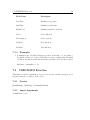
7. Izhikevich model
Users can define other special neuron models easily. It is also possible to
define different functions for threshold and reset behavior of a neuron (if
needed).
• Some predefined Post-Synaptic-Potential (PSP) behavior is available in the
library:
1. Two different versions of α-function
2. Simple synaptic weight summation for spike inputs
Again user defined synapses are possible.
• Users can define adaptation mechanisms for synaptic weights, transmission delays, and spike detection thresholds and any other parameter in the
network.
• The simulation process of the network is based on a event driven system,
meaning that the simulation stops for special computations such as calling
reset or adaptation functions whenever an action potential is generated in
the network. As a result the simulation speed depends highly on the rate
of the spike generation rather than complexity of the models or the number
of neurons in the network.
• For neuron models based on differential equations, simulation system uses
MATLAB’s powerful ODE solvers. Users have the chance to select various
solvers provided for stiff and non-stiff problems. For continuous time equation models (such as SRM), a special function will be written to solve the
model in next release.
• It is possible to provide static or dynamic external inputs to the network.
Static inputs do not change over the simulation process of the model, but
dynamic inputs may change according to the time or system state variables.
• During the simulation process, it is possible to call some user defined functions for specific tasks not included in the toolbox.