1
A
M
E
R
S
H
A
M
B
I
O
S
C
I
E
N
C
Transphor
TE 42, TE 52X, TE 62, TE 62X Transfer Electrophoresis
Units and TE 50X Power Lid
User Manual
80-6272-47
TE42&-IM/Rev C2/12-98
E
S
T E
4 2
5 2 X
6 2
6 2 X
a n d
5 0 X
U s e r
M a n u a l
Transfer Unit Function and Description . . . . . . . . . . . . . . 1
Specifications . . . . . . . . . . . . . . . . . . . . . . . . . . . . . . . . . . . . . . . . . . . . . . . . . . 2
Important Information. . . . . . . . . . . . . . . . . . . . . . . . . . . . . . . . . . 4
Operating Instructions . . . . . . . . . . . . . . . . . . . . . . . . . . . . . . . . . . . . . . . . . . . . 5
Care and Maintenance . . . . . . . . . . . . . . . . . . . . . . . . . . . . . . . . . . . . . . . . . 11
Troubleshooting . . . . . . . . . . . . . . . . . . . . . . . . . . . . . . . . . . . . . . . . . . . . . . . . . . . . . 13
Electrotransfer Notes . . . . . . . . . . . . . . . . . . . . . . . . . . . . . . . . . . . . . . . . . . . . 15
Bibliography and References . . . . . . . . . . . . . . . . . . . . . . . . . . . . . . 19
Customer Service Information . . . . . . . . . . . . . . . . . . . . . . . . . . . . 20
T E
4 2
5 2 X
6 2
6 2 X
a n d
Important user information
Please read this entire manual to fully understand the safe and effective use of this product.
5 0 X
U s e r
English
The exclamation mark within an equilateral triangle is
intended to alert the user to the presence of important operating and maintenance instructions in the literature accompanying the instrument.
The lightning symbol within an equilateral triangle is
intended to alert the user to the risk of exposure to high
voltages.
Should you have any comments on this manual, we will be pleased to
receive them via email at [email protected] or at:
Amersham Biosciences
Marketing Department
654 Minnesota Street
San Francisco, CA 94107 USA
Amersham Biosciences reserves the right to make changes in the
specifications without prior notice.
Warranty and Liability
Amersham Biosciences guarantees that the product delivered has
been thoroughly tested to ensure that it meets its published specifications. The warranty included in the conditions of delivery is valid only
if the product has been installed and used according to the instructions
supplied by Amersham Biosciences .
Amersham Biosciences shall in no event be liable for incidental
or consequential damages, including without limitation, lost profits, loss
of income, loss of business opportunities, loss of use and other related
exposures, however caused, arising from the faulty and incorrect use of
the product.
Copyright© 1998 Amersham Biosciences
All rights reserved. No part of this publication may be reproduced,
stored in a retrieval system or transmitted in any form by any means,
without permission in written form from the company.
M a n u a l
T E
4 2
5 2 X
6 2
Renseignements importants d’utilization
Pour une bonne compréhension et une utilisation en sécurité maximale, il convient de lire
entièrement ce manuel.
6 2 X
Français
a n d
5 0 X
U s e r
M a n u a l
Wichtige Benutzerinformationen
Deutsch
Für ein vollständiges Verständnis und eine
sichere Handhabung dieses Produktes ist es
notwendig, daß der Benutzer dieses Handbuch vollständig durchliest.
Dans la documentation qui accompagne l’instrument un
point d’exclamation dans un triangle équilatéral a pour but
d’attirer l’attention de l’utilisateur sur des instructions importantes de fonctionnement ou de maintenance.
Ein Ausrufezeichen in einem gleichseitigen Dreieck soll den
Benutzer auf die Anwesenheit wichtiger Betriebs- und
Wartungsanweisungen in der dem Gerät beiliegenden
Dokumentation hinweisen.
Le symbole de l’éclair dans un triangle équilatéral a pour
objet d’attirer l’attention de l’utilisateur sur un danger d’exposition à la haute tension.
Ein Blitzsymbol in einem gleichseitigen Dreieck soll den
Benutzer auf die Gefahr anliegender Hochspannungen hinweisen.
Tous vos commentaires sur ce manuel seront les bienvenus et veuillez les
adresser à:
Amersham Biosciences Inc.
Marketing Department
654 Minnesota Street
San Francisco, CA 94107 USA
Amersham Biosciences se réserve le droit d’effectuer des modifications de ces spécifications sans aucun préavis.
Wenn Sie Anmerkungen zu diesem Handbuch haben, dann senden Sie
diese bitte an:
Amersham Biosciences Inc.
Marketing Department
654 Minnesota Street
San Francisco, CA 94107 USA
Amersham Biosciences behält sich das Recht vor, die
Spezifikationen ohne vorhergehende Ankündigung zu ändern.
Garantie et responsabilité
Gewährleistung and Haftung
Amersham Biosciences garantit à l’utilisateur que le produit livré a
subi avec succès tous les essais prévus pour s’assurer qu’il est conforme
aux spécifications et normes en vigueur. La garantie incluse dans les conditions de livraison n’est valable que si le produit a été installé et utilisé
conformément aux instructions fournies par Amersham Biosciences.
La société Amersham Biosciences ne sera en aucun cas responsable
de tout dommage causé directement ou indirectement par toute utilisation incorrecte ou non approuvée du produit ou découlant de cette utilisation, y compris toute perte de bénéfice ou de recettes, toute perte de
perspectives commerciales, tout empêchement d’utilisation et tout autre
risques ayant un rapport avec l’utilisation du produit, mais sans aucune
limitation quant à la nature de ces dommages.
Copyright© 1998 Amersham Biosciences
Tous droits réservés. La reproduction, le stockage dans un système de récupération d’informations ou la transmission sous quelque forme que ce soit et par
quelque moyen que ce soit de la présente publication en totalité ou en partie
sont strictement interdits sans autorisation préalable écrite de la société.
Información importante para el usuario
Para comprender el producto y utilizarlo con
seguridad es necesario leer este manual en su
totalidad.
Español
El signo de admiración en un triángulo equilátero en el manual, advierte al usuario sobre la presencia de instrucciones
importantes de operación y mantenimiento del aparato.
El símbolo del rayo en un triángulo equilátero alerta al
usuario sobre el riesgo de exposición a altas tensiones.
Si desearan hacer algún comentario sobre este manual, tengan la amabilidad de remitirlo a:
Amersham Biosciences Inc.
Marketing Department
654 Minnesota Street
San Francisco, CA 94107 USA
Amersham Biosciences se reserva el derecho a modificar las especificaciones sin previo aviso.
Garantía y responsabilidad
Amersham Biosciences garantiza que el producto entregado ha
sido probado a fondo para comprobar el cumplimiento de las especificaciones publicadas. La garantía incluida en las condiciones de entrega sólo
es válida si el producto se ha instalado y utilizado de acuerdo con las
instrucciones entregadas por Amersham Biosciences.
AmershamBiosciences no será responsable, bajo ningún concepto,
de daños directos o indirectos, incluyendo sin limitación la pérdida de
beneficios, la pérdida de ingresos, la pérdida de oportunidades de negocio,
la pérdida de utilización y otras consecuencias relacionadas, cualquiera
que sea la causa, que se deban a la utilización defectuosa e incorrecta del
producto.
Copyright© 1998 Amersham Biosciences
Reservados todos los derechos. No está permitida la reproducción, ni el
almacenaje en un sistema de recuperación, ni la transmisión de parte
alguna de esta publicación sin la autorización por escrito de la empresa.
Amersham Biosciences garantiert, daß das gelieferte Produkt
sorgfältig auf die Einhaltung der veröffentlichten Spezifikationen getestet
wurde. Die in den Lieferbedingungen näher erläuterten
Gewährleistungsansprüche gelten nur dann, wenn das Produkt gemäß
den von Amersham Biosciences gelieferten Anweisungen installiert und benutzt wurde.
Amersham Biosciences übernimmt keinerlei Haftung für Schäden
oder Folgeschäden, einschließlich, aber nicht begrenzt auf
Gewinneinbußen, Einkommensverluste, entgangene Geschäftsabschlüsse,
Verlust der Gebrauchsfähigkeit oder andere Verluste, die wie auch immer
durch eine fehlerhafte oder unsachgemäße Verwendung des Produkts
verursacht wurden.
Copyright© 1998 Amersham Biosciences
Alle Rechte vorbehalten. Die vorliegende Veröffentlichung darf nur mit
vorhergehender schriftlicher Genehmigung durch das Unternehmen
vervielfältigt, in einem Abrufsystem gespeichert oder in irgendeiner Form
oder mit irgendwelchen Mitteln übertragen werden.
Informazioni importanti per l’operatore
Per un utilizzo sicuro del prodotto, leggere
attentamente l’intero contenuto del presente
manuale.
Italiano
Il punto esclamativo all’interno di un triangolo equilatero
indica all’operatore la presenza di importanti istruzioni di
funzionamento e manutenzione nella documentazione allegata al prodotto.
Il simbolo del fulmine all’interno di un triangolo equilatero
indica all’utente la presenza di un rischio di esposizione ad
alte tensioni.
Si prega di inviare eventuali commenti al presente manuale a:
Amersham Biosciences Inc.
Marketing Department
654 Minnesota Street
San Francisco, CA 94107 USA
Amersham Biosciences si riserva il diritto di apportare modifiche
ai dati tecnici senza preavviso.
Garanzia e responsabilitá
Amersham Biosciences garantisce che prima della consegna il
prodotto è stato collaudato a fondo per soddisfare i requisiti specificati.
La garanzia inclusa nelle condizioni di consegna risulta valida solamente
se il prodotto è stato installato ed utilizzato nel rispetto delle istruzioni
fornite da Amersham Biosciences .
Amersham Biosciences non potrà essere ritenuta responsabile di
incidenti o danni consequenziali, inclusi’ma non limitati’a perdite di
profitti, mancato guadagno, perdite di affari, difetti di funzionamento e
relative esposizioni, dovuti ad un utilizzo non corretto del prodotto.
Copyright© 1998 Amersham Biosciences
Tutti i diritti riservati. Nessuna parte della presente pubblicazione può
essere riprodotta, conservata in sistemi di gestione dati o trasmessa in alcun
forma né per nessuno scopo senza autorizzazione scritta del produttore.
T E
4 2
5 2 X
6 2
6 2 X
a n d
5 0 X
U s e r
M a n u a l
Transfer Electrophoresis Unit
Function and Description
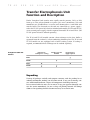
Hoefer Transphor Tank transfer units rapidly transfer proteins, DNA, or RNA
from up to four polyacrylamide or agarose gels onto a membrane. Gels and
membranes are assembled into a cassette and submerged in a tank filled with
transfer buffer. The electrodes in the tank are connected to a power supply—
either the TE 50X power lid, which is included with models TE 52X and TE 62X,
or an external power supply, which is required for models TE 42 and TE 62. (The
TE 50X power lid can be ordered separately.)
The TE 62 and TE 62X models contain a heat exchanger in the base. Buffer is
separated from the coolant by a heat-conducting alumina plate. The TE 42 and
TE 52X models are not equipped with a buffer cooling system. If cooling is
required, an immersible heat exchanger can be ordered separately.
built-in heat
exchanger for cooling
Transphor models and
features
TE 50X power lid
included
external power
supply required
✓
TE 42
✓
TE 52X
TE 62
✓
TE 62X
✓
✓
✓
Unpacking
Unwrap all packages carefully and compare contents with the packing list or
ordering information, making sure all items arrived. If any part is missing, contact Amersham Biosciences . Inspect all components for damage that may
have occurred while the unit was in transit. If any part appears damaged, contact the carrier immediately. Be sure to keep all packing material for damage
claims or for repacking should it become necessary to return the unit.
T E
4 2
5 2 X
6 2
6 2 X
a n d
5 0 X
U s e r
M a n u a l
TE 42, 52X, 62, and 62X
Gel size
up to four 15×21 cm gels or
up to sixteen 7×10 cm mini-gels
Max. wattage
200 W
Max. voltage
100 V~
Max. amperage
2A
Max. temperature
45 °C
Buffer required
4–5 liters, depending on the number of cassettes in
place
Environmental operating conditions
Indoor use: 4–40 °C
Humidity up to 80%
Altitude up to 2000 m
Installation category
II
Pollution degree
2
Dimensions (w × d × h)
TE 42: 28×13×30.5 cm (11×5.1×12 in.)
TE 52X: same as TE 42 plus power lid below
TE 62: 28×16.5×32 cm (11×6.5×12.5 in.)
Product certifications
EN61010–1, UL3101–1, CSA C22.2 1010.1, CE
Power lid
Max. power consumption
200 W
Max. voltage output
100 V~
Max. amperage output
1.5 A (constant current)
Fuses
Output fuse, both models: T 1.6 A 250V, 5×20 mm
Input fuse, 115 V model: T 3A, 259 V, 5×20 mm
Input fuse, 230 V model: T 1.6A, 259 V, 5×20 mm
Environmental operating conditions
Indoor use: 4–40 °C
Relative humidity up to 90%, noncondensing
Altitude up to 2000 m
Installation category
II
Pollution degree
2
Dimensions (w × d × h)
29.3×2.4×10.7 cm (11.5×6.1×4.2 in.)
Product certifications (pending)
UL3101–1, CSA C22.2 1010.1, CE
This declaration of conformity is only valid for the instrument when it is:
2
◗
used in laboratory locations,
◗
used as delivered from Amersham Biosciences except for alterations described in
the User Manual, and
◗
connected to other CE labeled instruments or products recommended or approved by
Amersham Biosciences.
T E
4 2
5 2 X
6 2
6 2 X
a n d
5 0 X
U s e r
M a n u a l
Transphor main
components
Note
Unless the power lid is used,
an external power supply is
required.
The TE 50X power lid is included with
the TE 52X and TE 62X. (The power
lid can also be ordered separately.)
—OR—
TE 42 and TE 62 lid
Color-coded leads
Color-coded electrode panels (2)
Tank fill levels
Cassette hook and holder
TE 62 and TE 62X:
coolant safety valve
and
coolant ports (2)
Note
An immersible heat exchanger (Code No. 80-6207-49) can
be ordered separately for the
TE 42 and TE 52X.
T E
4 2
5 2 X
6 2
6 2 X
a n d
5 0 X
U s e r
M a n u a l
Important information
Informations importantes
➧
The safety lid must be in place before connecting
the power leads to a power supply.
➧
Le couvercle de sécurité doit être en place avant de
brancher les prises au générateur.
➧
Turn all power supply controls off and disconnect
the power leads before removing the safety lid.
➧
Eteindre le générateur et débrancher les prises avant
d’enlever le couvercle de sécurité.
➧
The electric components in the power lid must
not become wet. Do not immerse any part of
the lid in water.
➧
Les components électriques du couvercle ne doivent
pas être mouillés. N'immerser aucun des components
du couvercle dans l'eau.
➧
Rinse only the electrodes (not the banana plugs)
with distilled water before use.
➧
Rinser seulement les électrodes (pas les "bananaplugs") avec de l'eau distillée juste avant l'utilisation.
➧
Circulate only water or 50/50 water/ethylene glycol through the heat exchanger. Never introduce
anti-freeze or any organic solvent into any part of
the instrument. Organic solvents will cause
irreparable damage to the unit!
➧
Faire circuler seulement de l’eau ou 50/50 d’eau et
d’éthylène glycol dans l’échangeur vertical à cirulation d’eau. Ne jamais utiliser d’anti-gel ou tout autre
solvant organique avec cet instrument. Les solvants
organiques causeraient des dommages irréparables à
l’appareil.
➧
Do not operate with buffer temperature above
45 °C. All plastic parts are rated for 45 °C continuous duty.
➧
Ne pas utiliser avec un tampon à une température
au dessus de 45 °C. Toutes les piéces en plastique
sont prévues pour résister à une température constante de 45 °C.
TE 42 and TE 52X: For longer runs you can control heating somewhat by chilling the buffer
before use, running the unit in a cold room, or
both. Overheating will cause irreparable damage
to the unit!
TE 42 and TE 52X: Pour des coulages plus long, on
peut aussi contrôler la température en refroidissant le
tampon avant l’utilisation et/ou en utilisant l’instrument dans une chambre froide. Un surchauffement
peut causer des dommages irréparables à l’instrument.
TE 62 and TE 62X: Circulate coolant through the
heat exchanger to minimize heating.
Overheating will cause irreparable damage to the
unit! Do not connect the heat exchanger to a
water tap or any coolant source where the water
pressure is unregulated.
TE 62 and TE 62X: Faire circuler l’eau dans
l’échangeur vertical pour minimiser l’échauffement
afin d’éviter des dommages irréparables à l’instrument. Ne pas connecter l’échangeur vertical à circulation d’eau à un robinet ou quelque source de
refroidissement dont la pression n’est pas régulière.
➧
When assembling the transfer cassette, use only
the required amount of gel support materials
(sponges and blotting paper) to prevent overstuffing the cassette. Excess materials may
result in cassette damage.
➧
Utiliser uniquement la quantité prescrite d'éponges et
de papier filtre afin que la cassette ne soit pas trop
pleine. Trop de materiels peut endommager la cassette.
➧
If this equipment is used in a manner not specified by the manufacturer, the protection provided by the equipment may be impaired.
➧
Si l'instrument n'est pas utilisé en conformité avec les
recommandations du fabriquant, les protections de
sécurité qui équipent cet appareil peuvent être rendues inéfficaces.
➧
Only accessories and parts approved or supplied
by Amersham Biosciences may be used
for operating, maintaining, and servicing this
product.
➧
Seulement les accessoires et piéces detachées approuvés ou fournis par Amersham Biosciences sont
recommandés pour l’utilisation, l’entretien et réparation de cet appareil.
T E
4 2
5 2 X
6 2
6 2 X
a n d
5 0 X
U s e r
M a n u a l
Operating Instructions
Transfer the sample as soon as possible after electrophoresis to avoid sample diffusion within the gel. Each step is described below.
Prepare the buffer
Note
Refer to the Electrotransfer
Notes section for a discussion
of membranes and buffers.
Prepare a minimum of 5 liters of the appropriate transfer buffer. Chill before use
if possible.
Prepare the unit
1 Rinse the the transfer tank and cassettes with distilled water.
2 Active cooling is optional but strongly recommended. If no active cooling will
be used, go to step 3.
Note:
Connect the heat exchanger to a circulator bath such as the MultiTemp III.
Circulate only water or 50/50 water/ethylene glycol to prevent damage to the unit.
The circulator pump must not generate a pressure greater than 0.7 bar (10 psi)
above atmospheric pressure.
Set the temperature to 10 °C or higher if circulating only water. If using 50/50 ethylene glycol/water, the temperature can be set lower.
Start the circulator bath at the same time as the transfer.
TE 42/52X: Lower the heat exchanger (ordered separately, or, use the heat
exchanger supplied with the Hoefer SE 600 Gel Electrophoresis Unit if you have
one) into the lower chamber, fitting the ports into the notches in the rim.
Prepare two lengths of 10–12 mm i.d. (3/8–½”) vinyl or silicone tubing for the
cooling circuit and skip to “Attach tubing” below.
Note
The relief valve opens if the
pressure in the heat exchanger exceeds 0.7 bar (10 psi)
above atmospheric pressure.
Note
For quick and easy
connections, install Quick-disconnect fittings with valves.
Note
Even if no cooling is required
for your system, the buffer
should be circulated with a
stirrer to avoid buffer depletion at the electrodes.
TE 62/62X: First attach tubing to the red pressure relief valve between the
water inlet and outlet ports and insert the free end into the bath or other container or drain to catch any pressure relief overflow. Prepare two lengths of
9 mm (3/8”) vinyl or silicone tubing and see “Attach tubing” below for instructions on fitting it to the ports of the heat exchanger in the base of the unit.
Attach tubing. Slide hose clamps (4 total) onto each end of two lengths of tubing. Attach one end of each length of tubing to a heat exchanger port. Attach
the free ends of each length of tubing to the circulator bath ports; one to the
inlet and the other to the outlet. Secure the connections with the hose clamps.
3 Place (do not drop) a magnetic stirring bar in the buffer tank. (Dropping objects
onto the alumina plate in the TE 62 or TE 62X may cause the plate to crack.) Set
the unit onto a magnetic stirrer. Fill transfer buffer to the "Start fill level" line.
(This requires approximately 3.8 liters.) Set the stirrer to low-medium, which creates buffer circulation without forcing buffer through assembled cassettes.
T E
4 2
5 2 X
6 2
6 2 X
a n d
5 0 X
U s e r
M a n u a l
Assemble the transfer cassette
Note
Always wear gloves when
handling membranes to
avoid getting fingerprints on
them.
1 Pre-wet nitrocellulose or nylon membranes with distilled water. Pre-wet PVDF or
other hydrophobic membranes in methanol. Then soak all membrane types in
transfer buffer for 2–5 minutes.
2 Open the cassette by releasing both latch tabs along the edge opposite the hinges.
Place the opened cassette into a tray filled with at least 3 cm of transfer buffer.
3 Assemble the transfer stack so that molecules will migrate toward the membrane.
For negatively charged macromolecules (such as nucleic acids and most proteins),
build the stack on the grey half of the cassette (and then later position the assembled cassette in the tank so that this side faces the grey anode (+) panel, which
connects to the red lead):
Important
Take great care in removing
all air at each step because
the presence of air bubbles,
especially between the membrane and gel, blocks transfer.
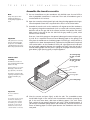
Transfer stack
assembly
Assemble the cassette in a
tray containing transfer buffer
about 3 cm deep.
Cassette panels are color coded:
black (top) = cathode side
grey (bottom) = anode side
The stack is oriented so that
negatively charged molecules
migrate toward the grey
anode.
Place one 3 mm-thick sponge on the opened submerged cassette and press gently until all air is expelled. Place one sheet of blotting paper on the sponge, and
then place the membrane on the blotting paper. Place the gel—which contains a
sample that has been electrophoretically separated and equilibrated (if required)
with transfer buffer—on the membrane. Gently roll a glass pipet or test tube over
the gel to expel trapped air between the membrane and gel. Cover the gel with a
sheet of blotting paper and then place a sponge of the proper thickness (see diagram below), again pressing gently to expel trapped air.
one 3 mm sponge
for gels >1.5 mm
—OR—
one 6 mm sponge
for gels £1.5 mm.
Blotting paper
Gel
Membrane
Blotting paper
one 3 mm sponge
Important
Do not overstuff the
cassette!
Try to place the gel correctly
the first time because proteins may begin to transfer
immediately; once transfer
has begun, moving the gel
will distort results or cause
“shadow bands” on the blot.
4 Close the cassette and press lightly to lock the tabs. The assembled cassette
should hold the gel in firm contact with the membrane without squeezing the
gel. If the stack seems loose, add sheets of blotting paper; if the stack seems
tight, replace the top sponge (above the gel) with a sheet of blotting paper. If
you remove the bottom sponge (below the membrane), substitute at least two
sheets of blotting paper to create space between the membrane and the cassette panel.
T E
4 2
5 2 X
6 2
6 2 X
a n d
5 0 X
U s e r
M a n u a l
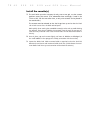
Install the cassette(s)
1 The tank holds up to four cassettes; for only one or two gels, use the cassette
positions nearest the center. (The submersible heat exchanger, if used in the
TE 42 or 52X, fills the two center slots, so only two cassettes can be placed in
the outside slots.)
The cassettes must be oriented so that the hinges face up and so that the black
side of each cassette faces the black cathode panel.
Work quickly when moving the assembled cassette(s) to the tank to avoid draining
the sponges: Place the tray holding the cassette(s) near the tank, lift out one cassette at a time, and slide it into a set of vertical slots. Do not discard the buffer in
the tray.
2 Once in place, tap each cassette lightly until most air bubbles are dislodged. (A
few small bubbles in the sponges are unlikely to interfere with the transfer.)
3 Inspect the buffer level. Add or remove buffer as required so that the level falls
between the minimum and maximum buffer level lines. (Buffer above the maximum buffer level line may cause corrosion of the electrical contacts.)
T E
4 2
5 2 X
6 2
6 2 X
a n d
5 0 X
U s e r
M a n u a l
Transfer
Take care in orienting all system components so that the electric field applied
causes all species to migrate toward the membrane. The migration direction
depends on both the characteristics of the sample and the pH of the transfer
buffer. If the species of interest is negatively charged in the transfer buffer and
the stack is assembled so that the membrane is nearest the grey side of the cassette, then this side faces the anode (+). Most proteins migrate toward the anode
in the Towbin Tris/glycine/methanol buffer system (independent of the presence of SDS), and under most conditions, nucleic acids are negatively charged
and also migrate toward the anode.
Important
Never allow the buffer
temperature to exceed
45 °C . Excessive heat
will cause the unit to
warp.
Typical transfer
parameters
Use empirically-determined
parameters for different
buffers and sample types.
Cooling is strongly recommended. Any setting that results in higher than 5 W
of power will generate enough heat to require active heat control. A refrigerated
circulator bath should be set to cool to about 10 °C. (If using 50/50 ethylene glycol/water, the temperature can be set lower.) Chill buffer before use if possible.
Recommended power settings. Most transfers are complete within one hour, but
larger molecules or thicker gels may require longer transfer times; the optimum
transfer time for each system must be determined empirically. Transfers left to
run overnight should be set to a constant current setting no higher than 0.1 A.
Buffer
Current (A)
Voltage (V)
Transfer time
Coolant temp.
Protein
Nucleic acids
Towbin
1X TBE
0.8–1.0
0.9–1.0
70–80
50
~1 hour
~1 hour
10 °C
10 °C or less
T E
4 2
5 2 X
6 2
6 2 X
a n d
5 0 X
U s e r
M a n u a l
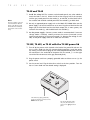
TE 42 and TE 62
1 Install the safety lid. The cassettes and electrode panels are color coded to
Note
The two red caps on the lid
accommodate the banana
plugs on the SE 600 model
immersible heat exchanger
(irrespective of the orientation).
match the leads in the lid: Orient the lid so that the grey half of the cassettes
and the grey anode panel face the anode (+), or red lead, and the black half of
the cassettes and the black cathode panel face the cathode (-), or black lead.
2 Use only an approved power supply such as the Hoefer EPS 2A200. Make sure the
power supply is off and all controls are set to zero. Plug the red lead into the red
output jack and the black lead into the black output jack. In most systems, the
red lead is the anode (+), and the black lead is the cathode (–).
3 Set the power supply. Constant current mode is recommended. If constant
voltage mode is selected, carefully monitor the current (increased current
increases Joule heating). If the current exceeds 1 A, decrease the voltage. If available, set the power supply timer for no more than two hours.
TE 52X, TE 62X, or TE 42 with the TE 50X power lid
1 Turn off (o) the power switch located at the back of the power lid and turn the
knob into the fully counter-clockwise position. Install the power
lid, making sure the banana plugs on the color-coded electrode panels seat into
the connectors in the underside of the power lid. (The anode, +, is at the right
rear of the lid and connects to the grey electrode panel.)
ADJUST CURRENT
2 Plug the power cord into a properly grounded outlet and then turn on (–) the
power switch.
3 Set the current level. Flip the METER READ switch to the AMPS position. Turn the
ADJUST CURRENT knob until the desired setting is displayed.
The cathode (–) plug, (underside,
front), fits onto the connector on the
black electrode panel.
The anode (+) plug, underside, rear) fits onto the connector on the grey electrode
panel.
T E
4 2
5 2 X
6 2
6 2 X
a n d
5 0 X
U s e r
M a n u a l
After the transfer is complete
1 Turn the voltage and current settings to zero and turn off the power supply.
Note
It is a good idea to stain the
gel to determine the completeness of the transfer.
Disconnect the leads from the power supply jacks.
2 Lift off the lid. Use the plastic hook (stored in the holder at the side of the unit)
to lift up a cassette just far enough to be able to grab it and place it into a tray.
3 Open each cassette carefully and remove the gels and membranes. Label each
membrane and indicate the sample side. Lift membrane(s) with blunt forceps and
air dry, or follow the instructions of your protocol.
Note
Do not store used buffer in
the transfer tank. Chill buffer
to 10 °C before reuse.
4 Discard the blotting paper, but reuse the sponges.
5 Rinse the unit immediately after use. (See the Care and Maintenance Section
below.)
T E
4 2
5 2 X
6 2
6 2 X
a n d
5 0 X
U s e r
M a n u a l
Care and Maintenance
Cleaning
◗
◗
◗
◗
Do not autoclave or heat any part above 45 °C.
Do not expose to organic solvents!
Never use abrasive detergents.
If using radioactive reagents, decontaminate the unit with a cleaning agent
such as Count-off™.
Rinse the tank, cassettes, and sponges with distilled water immediately after
each use. Allow the unit to air dry completely. Periodically wash with a dilute
solution of a mild detergent.
When cleaning the unit, leave the electrode panels in place. If they must be
switched (not recommended), take great care to not stretch or break the platinum wire: carefully pull the panel forward far enough to clear the retaining lip
(<5 mm). With one hand grab the banana plug support (not the banana plug)
and with the other hand grab the panel at a point well away from the wire. Lift
the panel out.
TE 50X Power Lid—Replacing fuses
There are two sets of power lid fuses; the output fuse is located in a receptacle
on the back of the lid, and the input fuses are located in the mains power module (see the next section).
Output fuse
115 V~ and 230 V~ models: T 1.6A 250V, 5x20 mm
1 Caution: Set the power switch to off and detach the power cord before replacing the fuse.
2 Insert a small flat-blade screwdriver into the slot on the fuse module, depress
slightly, and turn it ¼-turn counterclockwise. The spring-loaded module cap will
loosen and you can then pull the cap/fuse holder out.
3 Pull the fuse out of its holder and inspect. If the fuse element is burned or broken, replace the fuse with an identical type. If the fuse appears to be intact,
check it with a multi-meter. (A reading of 1 W or less indicates the fuse is still
usable.)
4 Insert the fuse into the holder and then insert this assembly back into the unit.
Seat the module by inserting the screwdriver into the slot, pressing gently, and
turning the cap ¼-turn clockwise.
T E
4 2
5 2 X
6 2
6 2 X
a n d
5 0 X
U s e r
M a n u a l
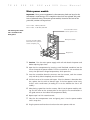
Mains power module
Important: Fuses protect equipment by disconnecting loads too large for the
instrument's circuit design, so it is imperative that fuses are replaced only with
fuses of identical rating. The mains power module, located at the back of the
power lid, contains two input fuses:
115 V~ model: T 3A 250, 5x20 mm
230 V~ model: T 1.6A 250V, 5x20 mm
Insert screwdriver in this
notch to open the cover.
The mains power module is located on the
back panel.
Insert the screwdriver blade
behind the arrow to pull the
cassette completely out.
Mains power switch
Hinged cover
1 Caution: Turn the mains power supply switch off and detach the power cord
before replacing input fuses!
2 Open the fuse compartment by inserting a small flat-blade screwdriver into the
slot at the top of the power module. Twist the screwdriver 1/8–turn to release the
cover, then pull out the hinged compartment, which opens out.
3 Insert the screwdriver above the arrow on one fuse cassette, catch the cassette
end, and slowly slide it completely out of the module.
4 Pull the fuse out of its cassette and inspect. If the fuse element is burned or broken, replace the fuse with an identical type. If the fuse appears to be intact,
check it with a multi-meter. (A reading of 1 W or less indicates the fuse is still
usable.)
5 After placing a good fuse into the cassette, slide it into the power module, making sure the arrow on the cassette points to the right (in the same direction as
the guide arrows on the inside of the compartment door).
6 Repeat steps 3 to 5 for second cassette.
7 Close the fuse compartment cover and gently press it into the power module
until it snaps shut.
8 Plug the power cord into the unit and turn the mains power switch on.
T E
4 2
5 2 X
6 2
6 2 X
a n d
5 0 X
U s e r
M a n u a l
Troubleshooting
Incomplete transfer
Blank areas on the membrane
✔
Remove all trapped air pockets in the transfer stack assembly: assemble the
stack while it is submerged in transfer buffer, gently press on each sponge
as it is added to the stack, and roll a glass pipette or test tube over the
membrane and gel to eliminate all air bubbles.
✔
Reduce the stirring speed to prevent turbulence.
✔
Process only one strip or membrane in each tray or cassette to prevent overlapping.
✔
Use buffer with a lower ionic strength.
✔
Check electrode continuity. During the transfer, a continuous stream of gas
is released along the entire length of the electrodes. If bubbles do not form
along the entire length of the electrode, replace the electrode.
✔
If cassettes are bowed when empty, replace. Overpacking the cassette causes it to bow; see the recommended assembly instructions on page 6.
Grid pattern on membrane
✔
Add extra sheets of blotting paper to increase the clearance between the
cassette panel and the gel. Take care not to overstuff the cassette; the gel
should be held firmly and evenly between the sponges, but not so tightly
that it is squeezed.
Molecules do not migrate out of gel
✔
Increase the field strength.
✔
Increase the transfer period. (Try doubling it.)
✔
Do not use staining or fixing agents on the gel before transfer.
✔
Use a thinner gel.
✔
Reduce the gel acrylamide concentration.
✔
Check that the buffer pH is close to the intended pH. Most buffers should
not be titrated; make fresh buffer.
✔
Use 3.5 mM SDS (0.1%) in the transfer buffer.
✔
Avoid including methanol in the transfer buffer or reduce the amount to the
absolute minimum.
✔
Use reagent-grade chemicals.
✔
Increase the length of time Southern blots are depurinated.
✔
Increase the net charge on the protein by changing to a transfer buffer with
a different pH. Lower pH (<6–7) increases the positive charge on proteins;
higher pH (>6–7) increases the negative charge on proteins.
Continued
T E
4 2
5 2 X
6 2
6 2 X
a n d
5 0 X
U s e r
M a n u a l
Diffuse band patterns
✔
Run the transfer immediately after electrophoretic separation. If equilibrating before the transfer, shorten or eliminate the equilibration time or move
the gel to the cold room during equilibration.
✔
If transfer buffer contains methanol (³10%), equilibrate the gel in transfer
buffer for 30 minutes to allow it to shrink before assembling the stack.
Note: Because methanol causes the gel to shrink slightly, large molecules
may migrate more slowly.
✔
Take care that the gel is held firmly against the membrane and that it does
not shift once contact is made.
✔
If excess heating occurs during the transfer, lower the temperature of the
cooling fluid in the heat exchanger.
✔
Check that the preferred binding surface of the membrane (if any) contacts
the gel.
Inefficient binding to membrane
Chemical parameters
✔
Fix or crosslink the molecule onto the membrane according to the requirements of the nucleic acid, protein, or membrane type.
✔
Prepare protein transfer buffer without SDS.
✔
Verify the optimal amount of methanol required for the membrane type
and check the buffer solution. Add 10–20% methanol to the transfer buffer
to enhance binding to nitrocellulose.
Membrane parameters
For more troubleshooting
hints, refer to Bjerrum, O.J. et
al. (1988).
✔
Wear gloves when handling membranes.
✔
Store membranes at ambient temperature out of direct sunlight to keep the
membranes activated.
✔
Use a membrane with a smaller pore size (0.10–0.20 µm) if proteins pass
through the membrane, or use a different membrane type.
✔
Place a membrane both over and under the gel if you suspect one protein is
moving in the opposite direction from the majority of the proteins. Check
both membranes for protein(s).
✔
Check if too much sample is available for the binding surface area by applying two membranes instead of one. If "blow through" occurs, reduce the
sample load.
T E
4 2
5 2 X
6 2
6 2 X
a n d
5 0 X
U s e r
M a n u a l
Electrotransfer Notes
Electrophoretic transfer advantages
Electrophoretic transfer of proteins and nucleic acids is much faster than the
blotting methods first described by Southern for DNA, Alwine et al. for RNA, or
Renart et al. for proteins. The tank transfer method uses high current to reduce
the transfer time of most samples to 45–60 minutes.
Electrophoretic transfer can improve transfer efficiency over non-electrophoretic
blotting, especially for proteins, but no quantitative transfer technique has yet
been developed due to the complexity of the reactions. Quantitative recovery is
actually not required for most purposes because binding macromolecules to a
membrane increases the sensitivity of detection methods such as autoradiography. This method also permits detection of specific proteins by antibodies or
affinity labels and detection of specific nucleic acids by hybridization with complementary strands of RNA or DNA.
The buffer can be chosen to result in a transfer toward either the cathode or the
anode. The buffer pH must be such that all species of interest are charged and
migrate in the same direction. The ionic strength should not be too high, since
this will produce excessive current and heat. For this reason, the high salt conditions used by Southern for capillary blotting of DNA cannot be used. The most
widely used buffer systems are those of Towbin et al. for transferring proteins,
and of Bittner et al. for transferring nucleic acids. Buffer systems for transfer of
each type of sample are listed later in this section.
Factors affecting the transfer
Parameters such as sample characteristics, membrane type, gel pore size, and the
transfer buffer used all contribute to the transferability of macromolecules, and
should be kept in mind when developing a protocol. Very small molecular
species, for instance, migrate quickly but often do not bind as well as larger molecules; large molecules bind more efficiently but do not elute from the gel as
rapidly. The rate of elution is also affected by the pore size of the gel and the orientation of the molecules.
Further, the degree to which molecules bind to the membrane is influenced by
membrane characteristics such as pore size and type, and buffer characteristics
such as pH, salt type and concentration, and the presence of detergents such as
sodium dodecyl sulfate (SDS). Conditions required for efficient elution may not
coincide with optimal conditions for binding. To find the optimum conditions
for transferring your sample, balance these effects: If the sample elution rate is
T E
4 2
5 2 X
6 2
6 2 X
a n d
5 0 X
U s e r
M a n u a l
slow, a longer transfer period may be required. (In our experience, low voltage
transfers for longer periods do not offer much improvement.) If sample binding
is inadequate, try different buffer conditions. For a comprehensive review, see
Gershoni and Palade (1983).
If the transfer buffer system is different from the electrophoresis buffer system,
the gel should be equilibrated with the transfer buffer before the transfer to
ensure swelling or shrinking occurs before the gel contacts the transfer membrane. If this step is skipped, band distortion or loss of resolution could result.
Instrument guidelines
Cooling
Considerable Joule heat is generated during any transfer because of the high current employed, so active cooling is recommended, especially for transfers requiring more than one hour, protein transfers where biological activity must be
retained, or transfer of nucleic acids. (The high conductivity of the phosphate
buffer used by Bittner et al. (1980) leads to a relatively rapid temperature rise.)
Buffer temperature should not exceed 45 °C because the cassettes and electrode
supports may warp. Use a circulator bath set to 10 °C if using water as a coolant.
(You can use a lower setting if the coolant is 50/50 ethylene glycol/water.) Never
leave the unit unattended for more than one hour under high power conditions
(>0.5 A).
Power setting
If using a power supply that can be set to either constant current or constant
voltage mode, we recommend that it be set to operate in constant current mode.
Buffer conductivity increases with temperature. During blotting in an uncooled
chamber, Joule heating and rising conductivity may result in dangerous overheating if the power supply is set to maintain constant voltage. If a constant
voltage power supply must be used, monitor and adjust the voltage to maintain
a current at or below 1 A.
Protein transfers
Study summaries
Gershoni and Palade (1982) investigated factors affecting protein recovery from
SDS gels to nitrocellulose or DBM paper. According to their findings, methanol
in the Towbin buffer system is necessary to achieve efficient binding to nitrocellulose. Methanol improves binding in part by removing protein-bound SDS. In
the absence of methanol, labeled bovine serum albumin (BSA) passes through at
least five layers of membranes. Methanol may cause a gel to shrink, however, so
T E
4 2
5 2 X
6 2
6 2 X
a n d
5 0 X
U s e r
M a n u a l
the elution rate decreases. By using a cationic membrane (such as nylon), which
binds the proteins more efficiently, and omitting methanol from the transfer
buffer, Gershoni and Palade obtained a much more quantitative transfer. The
disadvantage of cationic membrane is that protein stains also bind well, so that
the staining background tends to be very high. Properly quenched, however,
this paper can be used for antibody detection or other overlay methods of protein identification. A summary of membrane type and recommended methanol
concentration follows:
Membrane type
Charged nylon
Nitrocellulose
PVDF
Methanol %
0
£ 20
£ 15
Some workers have reported to us that a low concentration of SDS (0.1%)
improves the transfer of protein from an SDS gel. Burnette (1981) and
Symington et al. (1981) investigated the effect of the molecular weight of protein. Gibson (1981) describes a method to increase the extent of transfer of large
proteins by limited cleavage with pronase during transfer.
Transfer buffers (protein)
Use a buffer with low ionic strength, such as the two listed below, to prevent
overheating. Use the alternate CAPS buffer when Tris cannot be used, as in peptide sequencing. CAPS can improve transfer because of its effect on the charge of
the protein (see Matsudaira, 1987). For native proteins, we suggest using the
electrophoresis buffer for transfer as well. Use the Towbin buffer to transfer SDSdenatured proteins toward the anode.
Towbin buffer
(25 mM Tris, 192 mM glycine, 20% v/v methanol, pH 8.3, 6 liters)
Tris (FW 121.1)
Glycine (FW 75.07)
SDSa (FW 288.4)
25 mM
192 mM
0.1% (3.5 mM)
18.2 g
86.5 g
6.0 g
Dissolve in 4 liters distilled water. Add methanol as required.b
Bring to 6 liters with distilled water. Do not adjust the pH, which should be between 8.2 and 8.4.
Optional: Chill before use.
a
Optional: Adding SDS can improve transfer efficiency.
Depending on the membrane type selected, adding methanol can improve the transfer results (see discussion and table above). Because buffers containing methanol may deteriorate if stored for long periods,
add methanol as required just prior to transfer.
b
CAPS buffer, 1X
(10 mM CAPS, pH 11.0, 5 liters)
CAPS (FW 221.3)
10 mM
11.1 g
[3-(cyclohexylamino)-1-propanesulfonic acid]
Dissolve in 4.5 liters distilled water, adjust to pH 11.0 with conc. HCl. Adjust volume to 5.0 liters.
T E
4 2
5 2 X
6 2
6 2 X
a n d
5 0 X
U s e r
M a n u a l
Nucleic acid transfers
Nucleic acids normally must be transferred in denatured form for most efficient
binding. RNA is normally denatured with glyoxal before separation or separated
in denaturing gels containing formaldehyde or methyl mercury. However, double stranded DNA is usually denatured in the gel with NaOH. The alkali must be
neutralized and the gel equilibrated in transfer buffer before electrotransfer. For
both DNA and RNA gels, any SDS must also be removed to assure efficient binding. Bittner et al. (1980) wash gels three times, 20 minutes each, to assure complete removal of denaturants and detergents.
See Bittner et al. for a study of the transfer efficiency for DNA of different sizes.
The Bittner transfer buffer contains 25 mM sodium phosphate, pH 6.5. Also
described is a method for the introduction of nicks by limited nuclease action in
order to facilitate transfer of larger DNA fragments.
Recommended DNA buffers include the Bittner sodium phosphate buffer (see
reference) and TBE. For RNA, TAE is recommended. TBE and TAE stock recipes
are listed below. These buffers are most often diluted to 1X, but the concentration can range down to 0.1X. Cooling is strongly recommended for these
buffers, especially at higher concentrations.
EDTA solutiona
(0.5 M EDTA, pH 8.0, 100 ml)
Na2EDTA·2H2O (FW 372.2)
0.5 M
18.6 g
Dissolve in 70 ml distilled water. Adjust to pH 8.0 with 10 M NaOH (approx. 5 ml), then add distilled water
to 100 ml.
DNA transfer buffer, 10X
a
(10X Tris-borate-EDTA (TBE) , pH ~8.2, 1 liter)
Tris (FW 121.1)
Boric acid (FW 61.83)
EDTA solution (0.5 M, pH 8.0)
900 mM
900 mM
20 mM
109.0 g
55.6 g
40.0 ml
Distilled water to 1.0 liter. Do not adjust pH.
Dilute to 1X before use to yield 90 mM Tris, 90 mM boric acid, and 2 mM EDTA. This dilution is commonly used, but dilutions down to 0.1X may be used should it be necessary to decrease the amount of
current in the system in order to control overheating.
RNA transfer buffer, 10X
b
(10X Tris-acetate-EDTA (TAE) , pH ~8.4, 1 liter)
Tris (FW 121.1)
Acetic acid, glacial (~17.4 M)
EDTA solution (0.5 M, pH 8.0)
400 mM
~200 mM
10 mM
48.4 g
11.4 ml
20.0 ml
a
Distilled water to 1.0 liter. Do not adjust pH.
b
Dilute to 1X before use to yield 40 mM Tris, ~20 mM acetate, and 1 mM EDTA. This dilution is commonly used, but dilutions down to 0.1X may be used should it be necessary to decrease the amount of
current in the system in order to control overheating.
Current Protocols in Molecular
Biology (1993), A.2.1.
Sambrook, J., et al. (1989)
Molecular Cloning: A
Laboratory Manual, B.23.
T E
4 2
5 2 X
6 2
6 2 X
a n d
5 0 X
U s e r
M a n u a l
Bibliography and References
Alwine, J.C., Kemp, D.J., and G.R. Stark, Method for detection of specific RNAs in agarose gels by transfer
to DBM paper and hybridization with DNA probes. Proc. Natl. Acad. Sci. USA. 74, 5350–5354
(1977).
Bittner, M., Kupferer, P., and Morris, C.F., Electrophoretic transfer of proteins and nucleic acids from slab
gels to diazobenzyloxymethyl cellulose or nitrocellulose sheets. Anal. Biochem. 102, 459–471 (1980).
Bjerrum, O.J., Larsen, K., and Heegaard, N., CRC Handbook of Immunoblotting of Proteins Vol. 1, Section 7.
CRC Press (1988).
Burnette, W.N., Western blotting electrophoretic transfer of proteins from sodium dodecyl sulfate-polyacrylamide gels to unmodified nitrocellulose and radiographic detection with antibody and radioiodinated protein A. Anal. Biochem. 112, 195 (1981).
Gallagher, S., Winston, S.E., Fuller, S.A. and Hurrell, J.G.R., Immunoblotting and Immunodetection. In
Current Protocols in Molecular Biology. 10.8.1–10.8.17. Greene Publishing and Wiley-Interscience, NY
(1993).
Gershoni, J.M., Davis, F.E. and Palade, G.E. Protein blotting in uniform or gradient electric fields. Anal.
Biochem. 144, 32–40 (1985).
Gershoni, J.M., and Palade, G.E. Electrophoretic transfer of proteins from sodium dodecyl sulfate-polyacrylamide gels to a positively charged membrane filter. Anal. Biochem. 124, 396–405 (1982).
Gershoni, J.M., and G.E. Palade (1983) Protein Blotting: Principles and Applications. Anal. Biochem.
131:1–15.
Gibson, W. Protease-facilitated transfer of high molecular weight proteins during electrotransfer to nitrocellulose. Anal. Biochem. 118, 1 (1981).
Lin, W., and Kasamatsu,H., On the electrotransfer of polypeptides from gels to nitrocellulose membranes.
Anal. Biochem. 128, 302–311 (1983).
Matsudaira, P. Sequence from Picomole Quantities of Proteins Electroblotted onto Polyvinylidene
Difluoride Membranes. J. Biol Chem. 262, 10035 (1987).
Ohmsted, J.B., Affinity purification of antibodies from diazotized paper blots of heterogeneous protein
samples. J. Biol. Chem. 256, 11955 (1981).
Renart, Reiser, J. and Stark, G.R. Transfer of proteins from gels to DBM paper and detection with antisera:
a method for studying antibody specificity and structure. Proc. Natl. Acad. Sci. USA 76, 3116 (1979).
Sambrook, J., et al. Molecular Cloning: A Laboratory Manual, Cold Spring Harbor Laboratory Press, B.23
(1989).
Southern, E.M. Detection of specific sequences among DNA fragments separated by gel electrophoresis. J.
Molec. Biol. 98 (3):503–517 (1975).
Stellway, E.J., and Dahlberg, A.E. Electrophoretic transfer of DNA, RNA, and protein onto DBM paper.
Nucleic Acids Res. 8, 299 (1980).
Symington, J., Green, M., and Brackmann, K., Immunological detection of proteins after electrophoretic
transfer from gels to diazo paper: analysis of adenovirus encoded proteins. Proc. Natl. Acad. Sci. USA
78, 177–181 (1981).
Towbin, H., Staehelin,T., and Gordon, J., Electrophoretic transfer of proteins from polyacrylamide gels to
nitrocellulose sheets: procedure and some applications. Proc. Natl. Acad. Sci. USA. 76, 4350–4354
(1979).
T E
4 2
5 2 X
6 2
6 2 X
a n d
5 0 X
U s e r
M a n u a l
Customer Service Information
Technical Service and Repair
Amersham Biosciences offers complete technical support for all our products. If you have any questions about how to use this product, or would like to
arrange to repair it, please call or fax your local Amersham Biosciences
representative.
Important: Request a copy of the Amersham Biosciences “Health and
Safety Declaration” Form before returning the item. No items can be accepted
for servicing or return unless this form is properly completed.
Ordering Information
Qty.
Code No.
TE 62X Transphor II Cooled Transfer Electrophoresis Unit and Power Lid.
115 V~
230 V~
Includes TE 50X Power Lid, 4 gel cassettes, 8 foam sponges
3-mm thick, 4 foam sponges 6-mm thick, 25 sheets of blotter paper.
TE 62 Transphor II Cooled Transfer Electrophoresis Unit.
1
1
80-6209-77
80-6209-96
1
80-6209-58
1
1
80-6208-63
80-6208-82
1
80-6205-97
1
1
80-6207-87
80-6208-06
Includes safety lid with power cables, 4 gel cassettes, 8 foam sponges
3-mm thick, 4 foam sponges 6-mm thick, 25 sheets of blotter paper.
TE 52X Transphor Transfer Electrophoresis Unit and Power Lid.
115 V~
230 V~
Includes TE 50X Power Lid, 2 gel cassettes 4 foam sponges 3-mm
thick, 2 foam sponges 6-mm thick, 25 sheets of blotter paper.
TE 42 Transphor Transfer Electrophoresis Unit.
Includes safety lid with power cables, 2 gel cassettes, 4 foam
sponges 3-mm thick, 2 foam sponges 6-mm thick, 25 sheets of
blotter paper.
TE 50X Transphor Power Lid, 100 V, 1.5 A, constant current.
115 V~
230 V~
T E
4 2
5 2 X
6 2
6 2 X
a n d
5 0 X
U s e r
M a n u a l
Qty.
Code No.
1
1
1
1
1
2
4
4
1
1
1
2
2
4m
80-6207-49
80-6206-16
80-6206-35
80-6206-54
80-6210-15
80-6206-73
80-6206-92
80-6207-11
80-6207-68
80-6176-71
80-6176-90
80-6115-15
80-6115-53
80-1106-56
25
10
10
15
1
1
80-6220-79
80-6221-17
80-6220-41
80-1098-90
80-6221-55
80-1247-86
15
1
80-1098-91
80-6220-22
1
1
1
80-6221-93
80-1247-87
80-6221-74
50
50
80-6205-40
80-6207-30
1
1
80-6274-18
80-6274-37
1
1
80-6038-96
80-6244-92
1
1
80-6041-81
80-6242-00
Accessories and Replacement Parts
Glass heat exchanger for TE 42 or TE 52X.
Electrode panel, black
Electrode panel, grey
Gel cassette, 2 foam sponges 3-mm thick, 1 foam sponge 6-mm thick.
Lower buffer tank with heat exchanger for TE 62 and TE 62X.
Sponges, Dacron, 6-mm thick.
Sponges, foam, 6-mm thick.
Sponges, foam, 3-mm thick.
Lid with cables for TE 42 or TE 62.
High voltage lead with jacks, red.
High voltage lead with jacks, black.
Quick-fit coupler body, female, to fit 9.5 mm( 3/8”) ID tubing.
Quick-fit coupler body, male, to fit 9.5 mm( 3/8”) ID tubing.
Tubing for coolant, silicone, 8–12 mm
Transfer Membranes
Nitrocellulose Sheets and Rolls
0.45 µm pore size
7 x 8 cm
9 x 10.5 cm
15 x 15 cm
15 x 20 cm (ProBind)
33 cm x 3 m, roll
20 cm x 3 m, roll (ProBind)
0.2 µm pore size
15 x 20 cm (ProBind)
33 cm x3 m, roll
Nylon Membrane Rolls, 0.45 µm pore size
Nylon Standard 33 cm x 3 m, roll
Nylon Standard (GeneBind) 20 cm x 3 m, roll
Nylon Plus, 33 cm x 3 m, roll
Blotter Paper
Blotter paper, sheets, 9 x 10.5 cm
Blotter paper, sheets, 14.5 x 21.5 cm, equiv. to Whatman #1MM.
Companion Products
Hoefer EPS 2A200 Power Supply
115 V~
230 V~
Hoefer HB 1100D Red Roller II
115 V~
230 V~
Hoefer HB 400 Mini-Hydribization Oven
115 V~
230 V~
Amersham Biosciences UK Limited Amersham Place Little Chalfont Buckinghamshire England HP7 9NA
Amersham Biosciences AB SE-751 84 Uppsala Sweden
Amersham Biosciences Inc 800 Centennial Avenue PO Box 1327 Piscataway NJ 08855 USA
Hoefer and Transphor are trademarks of Amersham Biosciences Limited or its subsidiaries.
Amersham and Amersham Biosciences is a trademark of Amersham plc
All other trademarks and registered trademarks are the property of their respective companies or organizations.
All goods and services are sold subject to the terms and conditions of sale of the company within the
Amersham Biosciences group which supplies them. A copy of these terms and conditions is available on request.
© Amersham Biosciences 1998—All rights reserved.
Printed in the USA