1
behaviour. One-to-one adult cycle training is
available in Bristol, often for free. See
www.lifecycleuk.org.uk for information.
Braking
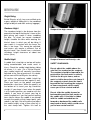
Bristol Bicycles are equipped with very
powerful brakes. Apply the brakes smoothly
and gradually, and do not grab the levers or
squeeze them too hard. The left-hand lever
operates the rear brake and the right-hand
lever operates the front. Sudden, powerful
braking with the left-hand lever can easily
cause the rear wheel to skid, which can be
difficult to control. Sudden or powerful
squeezing of the right-hand lever could
cause a front-wheel skid, which is almost
impossible to control and will normally either
throw you over the handlebars or cause you
to fall sideways from the bike.
The brakes will be less powerful in wet
weather. A wet road or loose gravel will have
less traction than dry tarmac, making
skidding much more likely. Before the wheels
have a chance to skid, ease off the brakes
slightly and then reapply. A skidding wheel
does little to slow the bike and means you
have no steering control.
Hard braking will throw your weight forward,
so when you apply the brakes extend your
arms slightly and move your weight
backwards on the saddle.
Changing gear
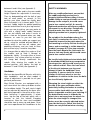
Bristol Bicycles have a very wide range of
gears for tackling Bristol's hilly terrain. The
right-hand shifter operates the smaller rear
gears, and the left-hand shifter operates the
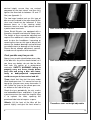
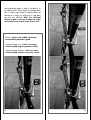
three large front gears. Each shifter has two
levers: a thumb lever under the handlebar to
change the gears in one direction, and a
finger lever above the handlebar to change
the gears in the other direction. As with all
derailleur gear systems, you must pedal
forwards whilst changing gear, but do not
12
pedal too hard. Ideally you should anticipate
your gear changes before you need them,
and then keep the pedals spinning whilst
changing gear but gently ease the pressure
off the pedals for one or two revolutions to
allow the gears to change smoothly. Avoid
sudden shifts or changing too many gears at
once because the chain may hesitate or jam.
Plan ahead and change into an easy gear
before coming to a stop. Do not change
gear whilst the bicycle is stationary or
whilst not pedalling. Do not backpedal
whilst changing gear, nor immediately
afterwards.
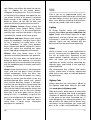
For normal, fairly flat terrain we suggest you
set off with the left-hand shifter in number 2,
and the right-hand shifter somewhere in the
middle of its range, around gear 3 or 4. As
you accelerate or try a gentle downhill slope
and find your legs spinning faster, you can
change the right-hand shifter to a higher
gear. As you slow down again, change the
right-hand shifter to a lower gear again
before coming to a stop.
Now try a gentle uphill slope. You may find
that gear 3 or 4 is too difficult. If so, change
into a lower gear on the right-hand shifter:
gear 2 or even 1 will make the hill easier. In
this way, flat terrain and gentle uphill and
downhill slopes can be tackled easily.
For a steeper uphill gradient you may find
that even gear number 1 on the right-hand
shifter does not make the hill easy enough.
In that case, also shift the left-hand shifter
into gear 1. With both shifters now displaying
gear 1, the bike is in its lowest gear and
should make even the steepest hills possible.
When the left-hand shifter is in gear 1, do
not change the right-hand shifter into a
gear higher than 4 or 5.
On a long, fast downhill gradient you may
find that even the highest gear on the righthand shifter is not enough when the left-hand
shifter is only in gear 2. In that case, shift the
left-hand shifter into gear 3. With the shifters
13