1
1 Product Description
The ECD-2-DL electrochemical dilatometer is dedicated to the measurement of
charge-induced strain (expansion and shrinkage) of electrodes down to the submicrometer range. The ECD-2-DL has been particularly developed for the
investigation of Li-ion battery and other insertion-type electrodes. It may, however,
also be used for many other electrochemical systems utilizing organic as well as
aqueous electrolyte solutions. The electrode materials used can either be bound film
or single crystals/grains (e.g. HOPG or graphite flakes). The maximum sample size is
10 mm x 1 mm (diameter x thickness).
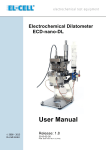
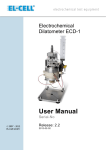
The heart of the ECD-2-DL is an electrochemical cell, hermetically sealed against
ambient atmosphere. The two electrodes inside are separated by a stiff glass frit that
is fixed in position. The upper working electrode (WE) is sealed by means of a thin
metal foil, through which any charge-induced height change is transmitted towards
the sensor/load unit above. This working principle allows determining the height
change of the working electrode without any interference from that of the counter
electrode (CE).
A high-resolution displacement (LVDT) transducer detects dimensional changes of
the WE ranging from 100 nanometers up to 500 micrometers during one and the
same experiment that may last between a few minutes to many days.
The ECD-2-DL features an integrated USB data logger for recording the electrode
displacement, temperature, cell potentials and current. Analog outputs of
displacement and temperature are provided for integration with external instruments.
For best accuracy and drift stability, the dilatometer is to be operated inside a
temperature controlled chamber.
Page 4 of 34
ECD-2_manual / 27/02/2015