1
PR-TN 2009/00597
Unclassified
Abstract:
Light-based hair removal (photoepilation) has been applied by dermatologists and in beauty
parlours since more than a decade. A few photoepilation devices for at-home use have been
commercialized quite recently or will be available soon. For these it is a major challenge to
reduce the time needed for treating large areas of the body like the legs.
Operating these devices in Track-and-Flash mode instead of Step-and-Flash mode can
contribute significantly to achieving this goal. (In Track-and-Flash mode the device is tracked
across the skin and flashes are released automatically at equal intervals. In Step-and-Flash
mode the device is placed on the skin, a flash is released, and these steps are repeated on
adjacent spots on the skin.)
Whilst the Track-and-Flash concept is well known, hitherto no attempt has been made to
actually implement it. This report (master thesis of Dipen Parikh) describes the first steps
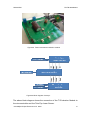
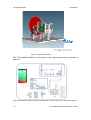
taken towards implementing the Track-and-Flash concept: A Philips Twin Eye Laser Sensor
measures the motion of a rotating disk and this information is used to trigger commercially
available flash lamp modules at equal intervals.
Conclusions:
The Philips Twin Eye Laser Sensor has been used successfully to realise a tracking system.
The functionality of the tracking system was tested and proven on the experimental setup and
also on different surfaces.
The Track-and-Flash concept has been successfully introduced on the experimental setup.
Flashes are being triggered on predefined safe conditions and at fixed intervals based on the
displacement being monitored by the sensor. Although from observations it can be stated that
flashes are being generated at equal distances travelled by the sensor, due to the limited energy generated by the flash modules available the overlapping of flashes could not be validated
with the means of a thermal camera.
iv
©
Koninklijke Philips Electronics N.V. 2009