1
Numbering Systems
G--3
Hexadecimal Numbering System
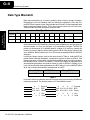
The binary numbering system can be difficult and cumbersome to interpret for some
users. Therefore, the hexadecimal numbering system was developed as a
convenience for humans since the PLC (computer) only understands pure binary.
The hexadecimal system is useful because it can represent every byte (8 bits) as two
consecutive hexadecimal digits. It is easier for us to read hexadecimal numbers than
binary numbers.
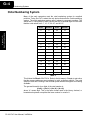
Decimal Hex
Decimal Hex
0
0
9
9
1
1
10
A
2
2
11
B
3
3
12
C
4
4
13
D
5
5
14
E
6
6
15
F
7
7
16
10
8
8
17
11
Table 3
Note that “10” and “11“ in hex are not the same as “10“ and “11“ in decimal. Only the
first ten numbers 0--9 are the same in the two representations. For example,
consider the hex number “D8AF“. To evaluate this hex number use the same method
used to write decimal numbers. Each digit in a decimal number represents a multiple
of a power of ten (base 10). Powers of ten increase from right to left. For example, the
decimal number 365 means 3x10² + 6x10 + 5. In hex each digit represents a multiple
of a power of sixteen (base 16). Therefore, the hex number D8AF translated to
decimal means 13x163 + 8x162 + 10x16 + 15 = 55471. However, going through the
arithmetic for hex numbers in order to evaluate them is not really necessary. The
easier way is to use the calculator that comes as an accessory in Windows. It can
convert between decimal and hex when in “Scientific“ view.
Note that a hex number such as “365“ is not the same as the decimal number “365“.
Its actual value in decimal terms is 3x162 6x16 + 5 = 869. To avoid confusion, hex
numbers are often labeled or tagged so that their meaning is clear. One method of
tagging hex numbers is to append a lower case “h“ at the end. Another method of
labeling is to precede the number with 0x. Thus, the hex number “D8AF“ can also be
written “D8AFh“, where the lower case “h” at the end is just a label to make sure we
know that it is a hex number. Also, D8AF can be written with a labeling prefix as
“0xD8AF”.
DL105 PLC User Manual, 3rd Edition
Appendix G
Numbering Systems
The hexadecimal numbering system uses 16 characters (base 16) to represent
values. The first ten characters are the same as our decimal system, 0--9, and the
first six letters of the alphabet, A--F. Table 3 lists the first eighteen decimal numbers;
0--17 in the left column and the equivalent hexadecimal numbers are shown in the
right column.