1
Relay contact output
The Intercom Station board comprises a relay contact which can be activated from a
remote telephone or telephone system. This relay can control for example electric
door entry mechanism, signaling and other electrical devices. The voltage at the relay
contact terminals shall not exceed 60 VDC or 30 VAC. The maximum power is
30 W. The maximum current is 1 A. Another cable gland is needed to connect a cable
to the relay contacts. Exchange it with the sealing plug.
The operating of the relay is described below. In all cases the relay will be deactivated
on hanging up.
Note:
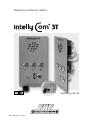
If the switch on button an the chosen direct dialing button will be touch
successively, IntellyCom 3T dials the programmed number or sends a short
signal that the storage space of the touched button is empty. In the last case the
Intercom communication terminal remains occupied and waits for a new touch
of a direct dialing button.
The intercom station disconnects automatically when you and your speaking
partner pause for longer than the programmed pause limit (*13xx*), when your
speaking partner hangs up and IntellyCom 3T detects the telephone’s busy
signal, or when the programmed conversation duration limit (*12xx*) has
expired.
The intercom station mutes the microphone or undoes a previous muting if the
on/off button is pressed briefly during the conversation. IntellyCom 3T’s loop
current indicator light displays a blinking light to indicate that the microphone
is switched to mute, or a continuous light to indicate the active state.
Attention!
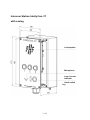
To guarantee the protection against contact a voltage equalizing cable has to be
connected to the voltage equalizing screw of the casing or in case of the built-in
unit to the corresponding mounting tab on the inside of the built-in unit.
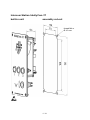
The IntellyCom 3T complies with the casing design of the casing kind of
protection IP66. For the built-in version the installer has to take care that the
desired protection against water and dust will be achieved by appropriate seals.
In case of deficient built-ins the installer assumes the entire responsibility.
For the casing construction the distance to other live components has to be
constructed safely in built-in condition, see EN 60950-1!
6 / 16