1
Adjustments
The unit can be adjusted in 1/3 stop increments and will automatically switch to 1/2 stop
increments if the camera has been set for 1/2 stop adjustments.
Wireless Triggering Mode
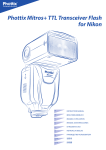
The Mitros can be triggered as an Optical Slave (OS) and the configuration is similar to the
Canon flash set-up. To fire the Mitros as slaves, a master unit must be used. This can be a oncamera pop-up featured on most prosumer and consumer Canon bodies or another Mitros.
For non optical wireless triggering the Phottix Odin Master and Slave units allow for true radio
frequency based wireless control.
In Optical Slave (OS) Mode the unit will operate in the manual mode based on the settings for
power output.
In Master mode the unit can be set to Master with flash firing or without flash.
While setting the unit for Master or Slave operation you can also set the channels and groups.
Transmission channels
The Phottix Mitros Wireless system has four transmission channels: 1, 2, 3 and 4. and 3 Groups
A, B and C.
Using Wireless Triggering
Set one flash unit to Master mode and mount it on camera, set remote flashes to Slave mode.
Now pressing the shutter button fires the Master flash (if set to Master with flash) and fwill
trigger the slaves that are within line of sight and within the range of the Master flash. The
camera and flash will meter the scene and fire flashes in TTL mode to properly expose the scene.
Ratio Modes
Slave flashes can be controlled by the master flash in different ratio modes.
The following tests were conducted:
The Mitros was tested as a single on/off camera flash (using a off camera flash cord) with a
Canon 5D Mk III.
One Mitros was set as the master (no flash), one flash on a stand as the Key light and one as a fill
light.
7