1
Days Healthcare Standard Steel Wheelchairs
User’s Guide
Safety Guidelines
Do not exceed the following weight limits:
Standard range: 115 kg (18 stone).
Heavy duty range: 140 kg (22 stone).
Do not use on the road, except when crossing between pavements.
When crossing the carriageway of a public road always take extra care and
observe the Highway code
Do not ride over deep, soft terrain (soft dirt, loose gravel, deep grass)
Do not attempt to mount a kerb without assistance
Do not carry passengers
We recommend that you do not sit on your wheelchair when in a vehicle, but
transfer to a vehicle seat
Always engage a slow speed when going down gradients
Do not ride in reverse down a slope or kerb
Always keep your feet on the footplate when moving
Do not stand on the footplate when getting in or out of the chair
We recommend the use of safety belt
Always keep your pneumatic tyres to the correct pressures
Do not use parts, accessories or adapters other then those authorised by Days
Healthcare Ltd
Keep the wheelchair away from children. It is not intended to be used as a toy
The manual parking brakes are not designed for slowing-down
Do not attempt to lift a wheelchair by lifting on the armrests or leg rests if
they are removable (detachable) type. Doing so may result in injury to the
user or damage to the wheelchair
-6-
Wheelchair Assistance
Practical Use
Many activities require the wheelchair owner to reach, bend and transfer in and
out of the wheelchair. These movements will cause a change to the normal
balance, the centre of gravity and weight distribution of the wheelchair.
To determine and establish your particular safety limits, activities involving
reaching, bending and transferring should first be practised with a qualified
health care professional.
Tilting
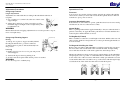
WARNING! Do not tilt the wheelchair without assistance.
1) The attendant should grasp the push handles securely,
making sure that the handle grips are firmly attached.
2) Inform the chair occupant before tilting the chair and
remind him/her to lean back. Be sure the occupant’s feet
and hands are clear of all wheels.
3) Place one foot on the tipping lever and apply a continuous motion until the
balance point is achieved. At this point, the attendant will feel a difference in
weight distribution (this usually occurs at about 14° angle).
4) Turn the wheelchair in the direction required.
5) Lower the front end, placing one foot on the tipping lever and grasping the
push handles to slowly lower to the ground.
NOTE: After mastering the techniques of tilting the chair, use this procedure to
tackle kerbs, steps, etc.
Kerbs
1) The attendant should stand on the pavement and turn the
chair so that the rear wheels are against the kerb.
2) The chair should be tilted back to the balance point and in
one continuous movement, the rear wheels should be pulled
up and over the kerb.
NOTE: We recommend that two attendants are utilised for this
procedure.
- 11 -