1
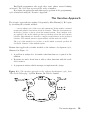
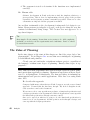
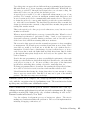
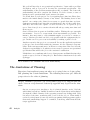
Leo Brodie
THINKING
FORTH
A Language
and Philosophy
for Solving Problems
Includes interviews with Forth’s inventor, C HARLES H.
M OORE, and other Forth thinkers
Leo Brodie is a writer, programmer, consultant, teacher, and world-renowned
authority on Forth. He was a technical writer for Forth, Inc., and has been
an independent consultant (since 1981) for such clients as IBM, NCR, and
Lockheed. He is also the author of Starting Forth (Prentice-Hall, 1982).
Leo Brodie
THINKING
FORTH
A Language
and Philosophy
for Solving Problems
c
1984,
1994, and 2004 by Leo Brodie
Attribution-NonCommercial-ShareAlike 2.0
You are free:
• to copy, distribute, display, and perform the work
• to make derivative works
Under the following conditions:
Attribution. You must give the original author credit.
Noncommercial. You may not use this work for commercial
purposes.
Share Alike. If you alter, transform, or build upon this work,
you may distribute the resulting work only under a license
identical to this one.
• For any reuse or distribution, you must make clear to others the license
terms of this work.
• Any of these conditions can be waived if you get permission from the
copyright holder.
Your fair use and other rights are in no way affected by the above.
This is a human-readable summary of the Legal Code (the full license).
You can download the electronic version from
http://thinking-forth.sourceforge.net/
ISBN 0-13-917568-7
It is impossible to disassociate language from science or science
from language, because every natural science always involves three
things: the sequence of phenomena on which the science is based
the abstract concepts which call these phenomena to mind, and the
words in which the concepts are expressed. To call forth a concept,
a word is needed; to portray a phenomenon, a concept is needed.
All three mirror one and the same reality.
—Antoine Lavoisier, 1789
Contents
Contents, vii
Preface to the 1994 Edition, xi
Preface, xiii
The Philosophy of Forth, 1
An Armchair History of Software Elegance, 2
The Superficiality of Structure, 18
Looking Back, and Forth, 19
Component Programming, 20
Hide From Whom?, 24
Hiding the Construction of Data Structures, 25
But Is It a High-Level Language?, 27
The Language of Design, 31
The Language of Performance, 32
Summary, 34
References, 35
Analysis, 37
The Nine Phases of the Programming Cycle,
The Iterative Approach,
The Value of Planning,
The Limitations of Planning,
The Analysis Phase,
Defining the Interfaces,
Defining the Rules,
Defining the Data Structures,
Achieving Simplicity,
Budgeting and Scheduling,
Reviewing the Conceptual Model,
References,
38
39
40
42
45
49
52
59
60
66
68
69
Preliminary Design/Decomposition, 71
Decomposition by Component,
Example: A Tiny Editor,
Maintaining a Component-based Application,
Designing and Maintaining a Traditional Application,
The Interface Component,
Decomposition by Sequential Complexity,
The Limits of Level Thinking,
Summary,
For Further Thinking,
72
74
78
80
85
88
90
95
95
Detailed Design/Problem Solving, 99
Problem-Solving Techniques,
Interview with a Software Inventor,
Detailed Design,
Forth Syntax,
Algorithms and Data Structures,
Calculations vs. Data Structures vs. Logic,
Solving a Problem: Computing Roman Numerals,
Summary,
References,
For Further Thinking,
100
107
110
110
119
120
122
133
133
133
Implementation: Elements of Forth Style, 135
Listing Organization,
An Alternative to Screens: Source in Named Files,
Screen Layout,
Comment Conventions,
Vertical Format vs. Horizontal Format,
Choosing Names: The Art,
Naming Standards: The Science,
More Tips for Readability,
Summary,
References,
136
144
146
150
159
163
167
169
170
170
Factoring, 171
Factoring Techniques,
Factoring Criteria,
Compile-Time Factoring,
The Iterative Approach in Implementation,
viii
Contents
172
178
188
192
References, 195
Handling Data: Stacks and States, 197
The Stylish Stack,
The Stylish Return Stack,
The Problem With Variables,
Local and Global Variables/Initialization,
Saving and Restoring a State,
Application Stacks,
Sharing Components,
The State Table,
Vectored Execution,
Using DOER/MAKE,
Summary,
References,
198
206
207
210
210
213
213
215
219
220
226
226
Minimizing Control Structures, 227
What’s So Bad about Control Structures?,
How to Eliminate Control Structures,
A Note on Tricks,
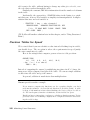
Decision Tables for Speed,
Summary,
References,
For Further Thinking,
228
231
242
248
259
259
259
Forth’s Effect on Thinking, 261
Appendix A Overview of Forth (For Newcomers),
Appendix B Defining DOER/MAKE,
Appendix C Other Utilities Described in This Book,
Appendix D Answers to “Further Thinking” Problems,
Appendix E Summary of Style Conventions,
Index,
265
269
275
279
283
289
Contents
ix
PREFACE TO THE 1994
EDITION
I’m honored that the Forth Interest Group is reprinting Thinking Forth. It’s
gratifying to know that the book may have value to appreciators and users of
Forth.
This edition is a reproduction of the original edition, with only minor
typographical corrections. A lot has happened in the ten years since the book’s
original publication, rendering some of the opinions obsolete, or at best archaic.
A “revised, updated edition” would have entrailed a rewrite of many sections,
a larger effort than I’m able to make at the time.
Off all the opinions in the book, the one that I most regret seeing gin
print is my criticism of object-oriented programming. Since penning this book,
I’ve had the pleasure of writing an application in a version of Forth with support for object-oriented programming, developed by Digalog Corp. of Ventura,
California. I’m no expert, but it’s clear that the methodology has much to
offer.
With all this, I believe that many of the ideas in Thinking Forth are as
valid today as they were back then. Certainly Charles Moore’s comments
remain a telling insight on the philosophy that triggered the development of
Forth.
I with to thank Marlin Ouverson for his excellent job, patiently struggling against incompatible file formats and OCR errors, to bring this reprint
to life.
PREFACE
Programming computers can be crazy-making. Other professions give you the
luxury of seeing tangible proof of your efforts. A watchmaker can watch the
cogs and wheels; a seamstress can watch the seams come together with each
stitch. But programmers design, build, and repair the stuff of imagination,
ghostly mechanisms that escape the senses. Our work takes place not in RAM,
not in an editor, but within our own minds.
Building models in the mind is both the challenge and the joy of programming. How should we prepare for it? Arm ourselves with better debuggers,
decompilers, and disassemblers? They help, but our most essential tools and
techniques are mental. We need a consistent and practical methodology for
Thinking about software problems. That is what I have tried to capture in
this book. Thinking Forth is meant for anyone interested in writing software
to solve problems. It focuses on design and implementation; deciding what
you want to accomplish, designing the components of the system, and finally
building the program.
The book stresses the importance of writing programs that not only work,
but that are also readable, logical, and that express the best solution in the
simplest terms.
Although most of the principles described here can be applied to any
language, I’ve presented them in the context of Forth. Forth is a language,
an operating system, a set of tools, and a philosophy. It is an ideal means for
thinking because it corresponds to the way our minds work. Thinking Forth
is thinking simple, thinking elegant, thinking flexible. It is not restrictive, not
complicated, not over-general. You don’t have to know Forth to benefit from
this book. Thinking Forth synthesizes the Forth approach with many principles
taught by modern computer science. The marriage of Forth’s simplicity with
the traditional disciplines of analysis and style will give you a new and better
way to look at software problems and will be helpful in all areas of computer
application.
If you want to learn more about Forth, another book of mine, Starting
Forth, covers the language aspects of Forth. Otherwise, Appendix A of this
book introduces Forth fundamentals.
A few words about the layout of the book; After devoting the first chapter to fundamental concepts, I’ve patterned the book after the software development cycle; from initial specification up through implementation. The
appendixes in back include an overview of Forth for those new to the language,
code for several of the utilities described, answers to problems, and a summary
of style conventions. Many of the ideas in this book are unscientific. They are
based on subjective experience and observations of our own humanity. For this
reason, I’ve included interviews with a variety of Forth professionals, not all
of whom completely agree with one another, or with me. All these opinions
are subject to change without notice. The book also offers suggestions called
“tips.” They are meant to be taken only as they apply to your situation. Forth
thinking accepts no inviolable rules. To ensure the widest possible conformity
to available Forth systems, all coded examples in this book are consistent with
the Forth-83 Standard. One individual who greatly influenced this book is the
man who invented Forth, Charles Moore. In addition to spending several
days interviewing him for this book, I’ve been privileged to watch him at work.
He is a master craftsman, moving with speed and deftness, as though he were
physically altering the conceptual models inside the machine—building, tinkering, playing. He accomplishes this with a minimum of tools (the result of
an ongoing battle against insidious complexity) and few restrictions other than
those imposed by his own techniques. I hope this book captures some of his
wisdom. Enjoy!
Acknowledgments
Many thanks to all the good people who gave their time and ideas to this book,
including: Charles Moore, Dr. Mark Bernstein, Dave Johnson, John
Teleska, Dr. Michael Starling, Dr. Peter Kogge, Tom Dowling,
Donald Burgess, Cary Campbell, Dr. Raymond Dessy, Michael Ham,
and Kim Harris. Another of the interviewees, Michael LaManna, passed
away while this book was in production. He is deeply missed by those of us
who loved him.
xiv
Preface
ONE
The Philosophy
of Forth
Forth is a language and an operating system. But that’s not all; It’s also
the embodiment of a philosophy. The philosophy is not generally described
as something apart from Forth. It did not precede Forth, nor is it described
anywhere apart from discussions of Forth, nor does it even have a name other
than “Forth.”
What is this philosophy? How can you apply it to solve your software
problems?
Before we can answer these questions, let’s take 100 steps backwards and
examine some of the major philosophies advanced by computer scientists over
the years. After tracing the trajectory of these advances, we’ll compare—and
contrast—Forth with these state-of-the-art programming principles.
An Armchair History of Software Elegance
In the prehistoric days of programming, when computers were dinosaurs, the
mere fact that some genius could make a program run correctly provided great
cause for wonderment. As computers became more civilized, the wonder waned.
Management wanted more from programmers and from their programs.
As the cost of hardware steadily dropped, the cost of software soared. It
was no longer good enough for a program to run correctly. It also had to be
developed quickly and maintained easily. A new demand began to share the
spotlight with correctness. The missing quality was called “elegance.”
In this section we’ll outline a history of the tools and techniques for
writing more elegant programs.
Memorability
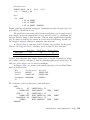
The first computer programs looked something like this:
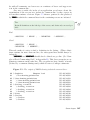
00110101
11010011
11011001
2
The Philosophy of Forth
Programmers entered these programs by setting rows of switches—“on” if the
digit was “1,” “off” if the digit was “0.” These values were the “machine instructions” for the computer, and each one caused the computer to perform some
mundane operation like “Move the contents or Register B to Register A,” or
“Add the contents of Register C into the contents of Register A.”
This proved a bit tedious.
Tedium being the stepmother of invention, some clever programmers realized that the computer itself could be used to help. so they wrote a program
that translated easy-to-remember abbreviations into the hard-to-remember bit
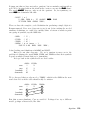
patterns. The new language looked something like this:
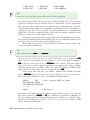
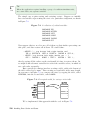
MOV B,A
ADD C,A
JMC REC1
The translator program was called an assembler, the new language assembly
language. Each instruction “assembled” the appropriate bit pattern for that
instruction, with a one-to-one correspondence between assembly instruction
and machine instruction. But names are easier for programmers to remember.
For this reason the new instructions were called mnemonics.
Power
Assembly-language programming is characterized by a one-for-one correspondence between each command that the programmer types and each command
that the processor performs.
In practice, programmers found themselves often repeating the same sequence of instructions over and again to accomplish the same thing in different
parts of the program. How nice it would be to have a name which would
represent each of these common sequences.
This need was met by the “macro assembler,” a more complicated assembler that could recognize not only normal instructions, but also special names
(“macros”). For each name, the macro assembler assembles the five or ten machine instructions represented by the name, just as though the programmer
had written them out in full.
Abstraction
A major advance was the invention of the “high-level language.” Again this
was a translator program, but a more powerful one. High-level languages make
it possible for programmers to write code like this:
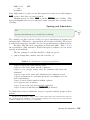
X = Y (456/A) - 2
which looks a lot like algebra. Thanks to high-level languages, engineers, not
just bizarre bit-jockeys, could start writing programs. BASIC and FORTRAN
are examples of high-level languages.
Power
3
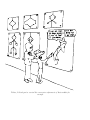
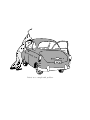
So then I typed GOTO 500—and here I am!
High-level languages are clearly more “powerful” than assembly languages
in the sense that each instruction might compile dozens of machine instructions.
But more significantly, high-level languages eliminate the linear correspondence
between source code and the resulting machine instructions.
The actual instructions depend on each entire “statement” of source code
taken as a whole. Operators such as + and = have no meaning by themselves.
They are merely part of a complex symbology that depends upon syntax and
the operator’s location in the statement.
This nonlinear, syntax-dependent correspondence between source and object code is widely considered to be an invaluable step in the progress of programming methodology. But as we’ll see, the approach ultimately offers more
restriction than freedom.
Manageability
Most computer programs involve much more than lists of instructions to work
down from start to finish. They also involve testing for various conditions
and then “branching” to the appropriate parts of the code depending upon the
outcome. They also involve “looping” over the same sections of code repeatedly,
usually testing for the moment to branch out of the loop.
Both assembler and high-level languages provide branching and looping
capabilities. In assembly languages you use “jump instructions;” in some highlevel languages you use “GO TO” commands. When these capabilities are used
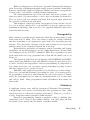
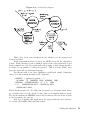
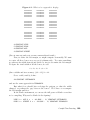
in the most brute-force way, programs tend to look like the jumble you see in
Figure 1.1.
This approach, still widely used in languages like FORTRAN and BASIC,
suffers from being difficult to write and difficult to change if corrections need to
be made. In this “bowl-of-spaghetti” school of programming, it’s impossible to
test a single part of the code or to figure out how something is getting executed
that isn’t supposed to be getting executed.
Difficulties with spaghetti programs led to the discovery of “flow charts.”
These were pen-and-ink drawings representing the “flow” of execution used by
the programmer as an aid to understanding the code being written. Unfortunately the programmer had to make the translation from code to flow chart
and back by hand. Many programmers found old-fashioned flow charts less
than useful.
Modularity
A significant advance arose with the invention of “Structured Programming,”
a methodology based on the observation that large problems are more easily
solved if treated as collections of smaller problems [1]. Each piece is called a
module. Programs consist of modules within modules.
Structured programming eliminates spaghetti coding by insisting that
control flow can be diverted only within a module. You can’t jump out from
the middle of one module into the middle of another module.
Manageability
5
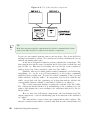
Figure 1.1: Unstructured code using jumps or “GOTOs.”
INSTRUCTION
INSTRUCTION
INSTRUCTION
INSTRUCTION
INSTRUCTION
INSTRUCTION
TEST
JUMP
INSTRUCTION
INSTRUCTION
INSTRUCTION
INSTRUCTION
INSTRUCTION
INSTRUCTION
INSTRUCTION
INSTRUCTION
INSTRUCTION
INSTRUCTION
INSTRUCTION
INSTRUCTION
JUMP
INSTRUCTION
INSTRUCTION
INSTRUCTION
INSTRUCTION
INSTRUCTION
INSTRUCTION
TEST
JUMP
TEST
JUMP
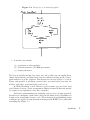
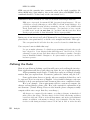
For example, Figure 1.2 shows a structured diagram of a module to “Make
Breakfast,” which consists of four submodules. Within each submodule you’ll
find a whole new level of complexity which needn’t be shown at this level.
A branching decision occurs in this module to choose between the “cold
cereal” module and the “eggs” module, but control flow stays within the outer
module
Structured programming has three premises:
1. Every program is described as a linear sequence of self-contained functions, called modules. Each module has exactly one entry point and one
exit point.
2. Each module consists of one or more functions, each of which has exactly
one entry point and one exit point and can itself be described as a module.
6
The Philosophy of Forth
Figure 1.2: Design for a structured program
3. A module can contain:
(a) operations or other modules
(b) decision structures (IF THEN statements)
(c) looping structures
The idea of modules having “one-entry, one-exit” is that you can unplug them,
change their innards, and plug them back in, without screwing up the connections with the rest of the program. This means you can test each piece by itself.
That’s only possible if you know exactly where you stand when you start the
module, and where you stand when you leave it.
In “Make Breakfast” you’ll either fix cereal or make eggs, not both. And
you’ll always clean up. (Some programmers I know circumvent this last module
by renting a new apartment every three months.)
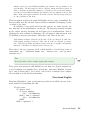
Structured programming was originally conceived as a design approach.
Modules were imaginary entities that existed in the mind of the programmer or
designer, not actual units of source code. When structured programming design
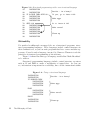
techniques are applied to non-structured languages like BASIC, the result looks
something like Figure 1.3.
Modularity
7
Figure 1.3: Structured programming with a non-structured language
o
10
INSTRUCTION
Decide – in a hurry?
20
INSTRUCTION
30 IF H=TRUE THEN GOTO 80
If yes, go to instr.# 80
)
40
INSTRUCTION
50
INSTRUCTION
Make eggs
60
INSTRUCTION
70 GOTO 110
Go to instr.# 110
)
80
INSTRUCTION
90
INSTRUCTION
Make cereal
00
INSTRUCTION
)
10
INSTRUCTION
20
INSTRUCTION
Clean up
30
INSTRUCTION
Writeability
Yet another breakthrough encouraged the use of structured programs: structured programming languages. These languages include control structures in
their command sets, so you can write programs that have a more modular appearance. Pascal is such a language, invented by Niklaus Wirth to teach the
principles of structured programming to his students.
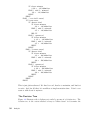
Figure 1.4 shows how this type of language would allow “Make Breakfast”
to be written.
Structured programming languages include control structure operators
such as IF and THEN to ensure a modularity of control flow. As you can
see, indentation is important for readability, since all the instructions within
Figure 1.4: Using
INSTRUCTION
INSTRUCTION
IF HURRIED THEN
INSTRUCTION
INSTRUCTION
INSTRUCTION
ELSE
INSTRUCTION
INSTRUCTION
INSTRUCTION
ENDIF
INSTRUCTION
INSTRUCTION
8
The Philosophy of Forth
a structured language.
o
Decide – in a hurry?
)
Make eggs
)
Make cereal
o
Clean up
each module are still written out rather than being referred to by name (e.g.,
“MAKE-CEREAL”). The finished program might take ten pages, with the ELSE on
page five.
Designing from the Top
How does one go about designing these modules? A methodology called “topdown design” proclaims that modules should be designed in order starting with
the most general, overall module and working down to the nitty-gritty modules.
Proponents of top-down design have witnessed shameful wastes of time
due to lack of planning, They’ve learned through painful experience that trying
to correct programs after they’ve been written—a practice known as “patching”
—is like locking the barn door after the horse has bolted.
So they offer as a countermeasure this official rule of top-down programming:
Write no code until you have planned every last detail.
Because programs are so difficult to change once they’ve been written, any
design oversight at the preliminary planning stage should be revealed before
the actual code-level modules are written, according to the top-down design,
Otherwise, man-years of effort may be wasted writing code that cannot be used.
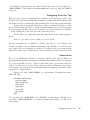
Subroutines
We’ve been discussing “modules” as abstract entities only. But all high-level
programming languages incorporate techniques that allow modules of design to
be coded as modules of code—discrete units that can be given names and “invoked” by other pieces of code. These units are called subroutines, procedures,
or functions, depending on the particular high-level language and on how they
happen to be implemented.
Suppose we write “MAKE-CEREAL” as a subroutine. It might look something like this:
procedure make-cereal
get clean bowl
open cereal box
pour cereal
open milk
pour milk
get spoon
end
We can also write “MAKE-EGGS” and “CLEANUP” as subroutines. Elsewhere we
can define “MAKE-BREAKFAST” as a simple routine that invokes, or calls, these
subroutines:
Designing from the Top
9
Software patches are ugly and conceal structural weaknesses.
procedure make-breakfast
var h: boolean (indicates hurried)
test for hurried
if h = true then
call make-cereal
else
call make-eggs
end
call cleanup
end
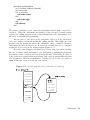
The phrase “call make-cereal” causes the subroutine named “make-cereal” to be
executed. When the subroutine has finished being executed, control returns
back to the calling program at the point following the call. Subroutines obey
the rules of structured programming.
As you can see, the effect of the subroutine call is as if the subroutine
code were written out in full within the calling module. But unlike the code
produced by the macro assembler, the subroutine can be compiled elsewhere
in memory and merely referenced. It doesn’t necessarily have to be compiled
within the object code of the main program (Figure 1.5).
Over the years computer scientists have become more forceful in favoring
the use of many small subroutines over long-winded, continuous programs.
Subroutines can be written and tested independently. This makes it easier to
reuse parts of previously written programs, and easier to assign different parts
of a program to different programmers. Smaller pieces of code are easier to
think about and easier to verify for correctness.
Figure 1.5: A main program and a subroutine in memory.
Subroutines
11
When subroutines are compiled in separate parts of memory and referred
to you can invoke the same subroutine many times throughout a program
without wasting space on repeated object code. Thus the judicious use of
subroutines can also decrease program size.
Unfortunately, there’s a penalty in execution speed when you use a subroutine. One problem is the overhead in saving registers before jumping to
the subroutine and restoring them afterwards. Even more time-consuming is
the invisible but significant code needed to pass parameters to and from the
subroutine.
Subroutines are also fussy about how you invoke them and particularly
how you pass data to and from them. To test them independently you need to
write a special testing program to call them from.
For these reasons computer scientists recommend their use in moderation.
In practice subroutines are usually fairly large between a half page to a full page
of source code in length.
Successive Refinement
An approach that relies heavily on subroutines is called “Successive Refinement”
[2]. The idea is that you begin by writing a skeletal version of your program
using natural names for procedures for data structures. Then you write versions
of each of the named procedures. You continue this process to greater levels of
detail until the procedures can only be written in the computer language itself.
At each step the programmer must make decisions about the algorithms
being used and about the data structures they’re being used on. Decisions
about the algorithms and associated data structures should be made in parallel.
If an approach doesn’t work out the programmer is encouraged to back
track as far as necessary and start again.
Notice this about successive refinement: You can’t actually run any part
of the program until its lowest-level components are written. Typically this
means you can’t test the program until after you’ve completely designed it.
Also notice: Successive refinement forces you to work out all details of
control structure on each level before proceeding to the next lower level.
Structured Design
By the middle of late ’70s, the computing industry had tried all the concepts
we’ve described, and it was still unhappy. The cost of maintaining software—
keeping it functional in the face of change—accounted for more than half of
the total cost of software, in some estimates as much as ninety percent!
Everyone agreed that these atrocities could usually be traced back to
incomplete analysis of the program, or poorly thought-out designs. Not that
there was anything wrong with structured programming per se. When projects
came in late, incomplete, or incorrect, the designers took the blame for not
anticipating the unforeseen.
12
The Philosophy of Forth
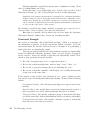
Tobias, I think you’ve carried the successive refinement of that module far
enough.
Scholars naturally responded by placing more emphasis on design. “Next
time let’s think things out better.”
About this time a new philosophy arose, described in an article called
“Structured Design” [3]. One of its principles is stated in this paragraph:
Simplicity is the primary measurement recommended for evaluating alternative
designs relative to reduced debugging and modification time. Simplicity can be
enhanced by dividing the system into separate pieces in such a way that pieces
can be considered, implemented, fixed and changed with minimal consideration
or effect on the other pieces of the system.
By dividing a problem into simple modules, programs were expected to be
easier to write, easier to change, and easier to understand.
But what is a module, and on what basis does one make the divisions?
“Structured Design” outlines three factors for designing modules.
Functional Strength
One factor is something called “functional strength,” which is a measure of
the uniformity of purpose of all the statements within a module. If all the
statements inside the module collectively can be thought of as performing a
single task, they are functionally bound.
You can generally tell whether the statements in a module are functionally
bound by asking the following questions. First, can you describe its purpose
in one sentence? If not, the module is probably not functionally bound. Next,
ask these four questions about the module:
1. Does the description have to be a compound sentence?
2. Does it use words involving time, such as “first”, “next”, “then,” etc.?
3. Does it use a general or nonspecific object following the verb?
4. Does it use words like “initialize” which imply a lot of different functions
being done at the same time?
If the answer to any of these four questions is “yes,” you’re looking at some
less cohesive type of binding than functional binding. Weaker forms of binding
include:
Coincidental binding: (the statements just happen to appear in the same
module)
Logical binding: (the module has several related functions and requires a
flag or parameter to decide which particular function to perform)
Temporal binding: (the module contains a group of statements that happen at the same time, such as initialization but have no other relationship)
Communicational binding: (the module contains a group of statements
that all refer to the same set of data)
14
The Philosophy of Forth
Sequential binding: (where the output of one statement serves as input
for the next statement)
Our “MAKE-CEREAL” module exhibits functional binding, because it can be
thought of as doing one thing, even though it consists of several subordinate
tasks.
Coupling
A second tenet of structured design concerns “coupling,” a measure of how
modules influence the behavior of other modules. Strong coupling is considered
bad form. The worst case is when one module actually modifies code inside
another module. Even passing control flags to other modules with the intent
to control their function is dangerous.
An acceptable form of coupling is “data coupling,” which involves passing
data (not control information) from one module to another. Even then, systems
are easiest to build and maintain when the data interfaces between modules
are as simple as possible.
When data can be accessed by many modules (for instance, global variables), there’s stronger coupling between the modules. If a programmer needs
to change one module, there’s a greater danger that the other modules will
exhibit “side effects.”
The safest kind of data coupling is the passing of local variables as parameters from one module to another. The calling module says to the subordinate
module, in effect, “I want you to use the data I’ve put in these variables named
X and Y, and when you’re done, I expect you to have put the answer in the
variable named Z. No one else will use these variables.”
As we said, conventional languages that support subroutines include elaborate methods of passing arguments from one module to another.
Hierarchical Input-Process-Output Designing
A third precept of structured design concerns the design process. Designers
are advised to use a top-down approach, but to pay less attention initially
to control structures. “Decision designing” can wait until the later, detailed
design of modules. Instead, the early design should focus on the program’s
hierarchy (which modules call which modules) and to the passing of data from
one module to another.
To help designers think along these new lines, a graphic representation
was invented, called the “structure chart.” (A slightly different form is called the
“HIPO chart,” which stands for “hierarchical input-process-output.”) Structure
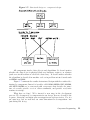
charts include two parts, a hierarchy chart and an input-output chart.
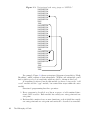
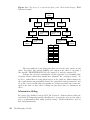
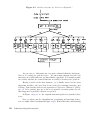
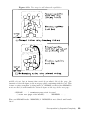
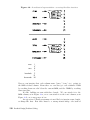
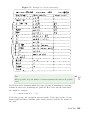
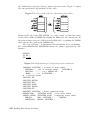
Figure 1.6 shows these two parts. The main program, called DOIT,
consists of three subordinate modules, which in turn invoke the other modules
shown below them. As you can see, the design emphasizes the transformation
of input to output.
Coupling
15
Figure 1.6: The form of a structured chart, from “Structured Design,” IBM
Systems Journal.
DOIT
5
6 ...
7
...
...
TRANSFORM
TO D
GETC
3
TRANSFORM
TO C
GETB
1
PUTD
8
4
9
TRANSFORM
TO E
PUTE
10
2
.
.
.
11
.
.
.
TRANSFORM
TO B
TRANSFORM
TO F
WRITE
READ
IN
1
2
3
4
5
6
7
8
9
10
11
A
B
C
D
D
E
E
F
OUT
A
B
B
C
C
D
E
F
The tiny numbers of the hierarchy chart refer to the lines on the in-out
chart. At point 1 (the module READ), the output is the value A. At point 2
(the module TRANSFORM-TO-B), the input is A, and the output is B.
Perhaps the greatest contribution of this approach is recognizing that
decisions about control flow should not dominate the emerging design. As
we’ll see, control flow is a superficial aspect of the problem. Minor changes in
the requirements can profoundly change the program’s control structures, and
“deep-six” years of work. But if programs are designed around other concerns,
such as the flow of data, then a change in plan won’t have so disastrous an
effect.
Information-Hiding
In a paper [4] published back in 1972, Dr. David L. Parnas showed that the
criteria for decomposing modules should not be steps in the process, but rather
pieces of information that might possibly change. Modules should be used to
hide such information.
16
The Philosophy of Forth
Let’s look at this important idea of “information-hiding”: Suppose you
are writing a Procedures Manual for your company. Here’s a portion:
Sales Dept. takes order
sends blue copy to Bookkeeping
orange copy to Shipping
Jay logs the orange copy in the red binder on his desk, and completes packing
slip.
Everyone agrees that this procedure is correct, and your manual gets distributed
to everyone in the company.
Then Jay quits, and Marilyn takes over. The new duplicate forms have
green and yellow sheets, not blue and orange. The red binder fills up and gets
replaced with a black one.
Your entire manual is obsolete. You could have avoided the obsolescence
by using the term “Shipping Clerk” instead of the name “Jay,” the terms “Bookkeeping Dept. copy and” “Shipping Dept. copy” instead of “blue” and “orange,”
etc.
This example illustrates that in order to maintain correctness in the face
of a changing environment, arbitrary details should be excluded from procedures. The details can be recorded elsewhere if necessary. For instance, every
week or so the personnel department might issue a list of employees and their
job titles, so anyone who needed to know who the shipping clerk was could look
it up in this single source. As the personnel changes, this list would change.
This technique is very important in writing software. Why would a program ever need to change, once it’s running? For any of a million reasons. You
might want to run an old program on new equipment; the program must be
changed just enough to accommodate the new hardware. The program might
not be fast enough, or powerful enough, to suit the people who are using it.
Most software groups find themselves writing “families” of programs; that is,
many versions of related programs in their particular application field, each a
variant on an earlier program.
To apply the principle of information-hiding to software, certain details
of the program should be confined to a single location, and any useful piece of
information should be expressed only once. Programs that ignore this maxim
are guilty of redundancy. While hardware redundancy (backup computers,
etc.) can make a system more secure, redundancy of information is dangerous.
As any knowledgeable programmer will tell you, a number that a program
uses and that might conceivably change should be made into a “constant” and
referred to throughout the program by name, not by value. For instance, the
number of columns representing the width of your computer paper forms should
be expressed as a constant. Even assembly languages provide “EQU”s and labels
for associating values such as addresses and bit-patterns with names.
Any good programmer will also apply the concept of information-hiding
to the development of subroutines, ensuring that each module knows as little as
Information-Hiding
17
possible about the insides of other modules. Contemporary programming languages such as C, Modula 2, and Edison apply this concept to the architecture
of their procedures.
But Parnas takes the idea much further. He suggests that the concept should be extended to algorithms and data structures. In fact, hiding
information—not decision-structure or calling-hierarchy—should be the primary basis for design!
The Superficiality of Structure
Parnas proposes two criteria for decomposition:
1. possible (though currently unplanned) reuse, and
2. possible (though unplanned) change.
This new view of a “module” is different than the traditional view. This “module” is a collection of routines, usually very small, which together hide information about some aspect of the problem.
Two other writers describe the same idea in a different way, using the
term “data abstraction” [5]. Their example is a push-down stack. The stack
“module” consists of routines to initialize the stack, push a value onto the stack,
pop a value from the stack, and determine whether the stack is empty. This
“multiprocedure module” hides the information of how the stack is constructed
from the rest of the application. The procedures are considered to be a single
module because they are interdependent. You can’t change the method for
pushing a value without also changing the method for popping a value.
The word uses plays an important role in this concept. Parnas writes
in a later paper [6]:
Systems that have achieved a certain “elegance”. . . have done so by having
parts of the system use other parts. . .
If such a hierarchical ordering exists then each level offers a testable and usable
subset of the system. . .
The design of the “uses” hierarchy should be one of the major milestones in a
design effort. The division of the system into independently callable subprograms has to go in parallel with the decisions about uses, because they influence
each other.
A design in which modules are grouped according to control flow or sequence
will not readily allow design changes. Structure, in the sense or control-flow
hierarchy, is superficial.
A design in which modules are grouped according to things that may
change can readily accommodate change.
18
The Philosophy of Forth
Looking Back, and Forth
In this section we’ll review the fundamental features of Forth and relate them
to what we’ve seen about traditional methodologies.
Here’s an example of Forth code;
: BREAKFAST
HURRIED?
IF
CEREAL
ELSE
EGGS
THEN CLEAN ;
This is structurally identical to the procedure MAKE-BREAKFAST on page 8. (If
you’re new to Forth, refer to Appendix A for an explanation.) The words
HURRIED?, CEREAL, EGGS, and CLEAN are (most likely) also defined. as colon
definitions.
Up to a point, Forth exhibits all the traits we’ve studied: mnemonic value,
abstraction, power, structured control operators, strong functional binding,
limited coupling, and modularity. But regarding modularity, we encounter
what may be Forth’s most significant breakthrough:
The smallest atom of a Forth program is not a module or a subroutine or a
procedure, but a “word.”
Furthermore, there are no subroutines, main programs, utilities, or executives,
each of which must be invoked differently. Everything in Forth is a word.
Before we explore the significance of a word-based environment, let’s first
study two Forth inventions that make it possible.
Implicit Calls
First, calls are implicit. You don’t have to say CALL CEREAL, you simply say
CEREAL. In Forth, the definition of CEREAL “knows” what kind of word it is and
what procedure to use to invoke itself.
Thus variables and constants, system functions, utilities, as well as any
user-defined commands or data structures can all be “called” simply by name.
Implicit Data Passing
Second, data passing is implicit. The mechanism that produces this effect is
Forth’s data stack. Forth automatically pushes numbers onto the stack; words
that require numbers as input automatically pop them off the stack; words
that produce numbers as output automatically push them onto the stack. The
words PUSH and POP do not exist in high-level Forth.
Thus we can write:
: DOIT
GETC
TRANSFORM-TO-DO PUT-D ;
confident that GETC will get “C”, and leave it on the stack. TRANSFORM-TO-D will
pick up “C” from the stack, transform it, and leave “D” on the stack. Finally,
Looking Back, and Forth
19
PUT-D will pick up “D” on the stack and write it. Forth eliminates the act of
passing data from our code, leaving us to concentrate on the functional steps
of the data’s transformation.
Because Forth uses a stack for passing data, words can nest within words.
Any word can put numbers on the stack and take them off without upsetting
the f1ow of data between words at a higher level (provided, of course, that the
word doesn’t consume or leave any unexpected values). Thus the stack supports structured, modular programming while providing a simple mechanism
for passing local arguments.
Forth eliminates from our programs the details of how words are invoked
and how data are passed. What’s left? Only the words that describe our
problem.
Having words, we can fully exploit the recommendations of Parnas—
to decompose problems according to things that may change, and have each
“module” consist of many small functions, as many as are needed to hide information about that module. In Forth we can write as many words as we need
to do that, no matter how simple each of them may be.
A line from a typical Forth application might read:
20 ROTATE LEFT TURRET
Few other languages would encourage you to concoct a subroutine called LEFT,
merely as a modifier, or a subroutine called TURRET, merely to name part of
the hardware.
Since a Forth word is easier to invoke than a subroutine (simply by being
named, not by being called), a Forth program is likely to be decomposed into
more words than a conventional program would be into subroutines.
Component Programming
Having a larger set of simpler words makes it easy to use a technique we’ll call
“component programming.” To explain, let’s first reexamine these collections
we have vaguely described as “things that may change.” In a typical system,
just about everything is subject to change: I/O devices such as terminals and
printers, interfaces such as UART chips, the operating system, any data structure or data representation, any algorithm, etc.
The question is: “How can we minimize the impact of any such change?
What is the smallest set of other things that must change along with such a
change?”
The answer is: “The smallest set of interacting data structures and algorithms that share knowledge about how they collectively work.” We’ll call this
unit a “component.”
A component is a resource. It may be a piece of hardware such as a
UART or a hardware stack. Or the component may be a software resource
such as a queue, a dictionary, or a software stack.
20
The Philosophy of Forth
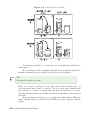
Figure 1.7: Structured design vs. component design.
All components involve data objects and algorithms. It doesn’t matter
whether the data object is physical (such as a hardware register), or abstract
(such as a stack location or a field in a data base). It doesn’t matter whether
the algorithm is described in machine code or in problem-oriented words such
as CEREAL and EGGS.
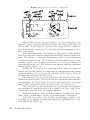
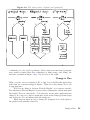
Figure 1.7 contrasts the results of structured design with the results of designing by components. Instead of modules called READ-RECORD, EDIT-RECORD,
and WRITE-RECORD, we’re concerned with components that describe the structure of records, provide a set of editor commands, and provide read/write
routines to storage.
What have we done? We’ve inserted a new stage in the development
process: We decomposed by components in our design, then we described the
sequence, hierarchy, and input-process-output in our implementation. Yes, it’s
an extra step, but we now have an extra dimension for decomposition—not
just slicing but dicing.
Component Programming
21
Figure 1.8: A lexicon describes a component.
Suppose that, after the program is written, we need to change the record
structure. In the sequential, hierarchical design, this change would affect all
three modules. In the design by components, the change would be confined to
the record-structure component. No code that uses this component needs to
know of the change.
Aside from maintenance, an advantage to this scheme is that programmers on a team can be assigned components individually, with less interdependence. The principle of component programming applies to team management
as well as to software design. We’ll call the set of words which describe a component a “lexicon.” (One meaning of lexicon is “a set of words pertaining to a
particular field of interest.”) The lexicon is your interface with the component
from the outside (Figure 1.8).
In this book, the term “lexicon” refers only to those words of a component
that are used by name outside of a component. A component may also contain
definitions written solely to support the externally visible lexicon. We’ll call
the supporting definitions “internal” words.
The lexicon provides the logical equivalents to the data objects and algorithms in the form of names. The lexicon veils the component’s data structures
and algorithms—the “how it works.” It presents to the world only a “conceptual
model” of the component described in simple words—the “what it does.”
These words then become the language for describing the data structures
and algorithms of components written at a a higher level. The “what” of one
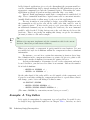
component becomes the “how” of a higher component.
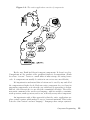
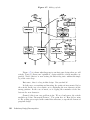
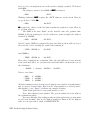
Written in Forth, an entire application consists of nothing but components. Figure 1.9 show show a robotics application might be decomposed.
You could even say that each lexicon is a special-purpose compiler, written solely for the purpose of supporting higher-level application code in the
most efficient and reliable way.
22
The Philosophy of Forth
Figure 1.9: The entire application consists of components.
By the way, Forth itself doesn’t support components. It doesn’t need to.
Components are the product of the program designer’s decomposition. (Forth
does have “screens.” however—small units of mass storage for saving source
code. A component can usually be written in one or two screens of Forth.)
It’s important to understand that a lexicon can be used by any and all of
the components at higher levels. Each successive component does not bury its
supporting components, as is often the case with layered approaches to design.
Instead, each lexicon is free to use all of the commands beneath it. The robotmovement command relies on the root language, with its variables, constants,
stack operators, math operators, and so on, as heavily as any other component.
An important result of this approach is that the entire application employs a single syntax, which makes it easy to learn and maintain. This is why
I use the term “lexicon” and not “language.” Languages have unique syntaxes.
Component Programming
23
This availability of commands also makes the process of testing and debugging a whole lot easier. Because Forth is interactive, the programmer can
type and test the primitive commands, such as
RIGHT SHOULDER 20 PIVOT
from the “outside” as easily as the more powerful ones like
LIFT COFFEE-POT
At the same time, the programmer can (if he or she wants) deliberately seal
any commands, including Forth itself, from being accessed by the end user,
once the application is complete.
Now Forth’s methodology becomes clear. Forth programming consists of
extending the root language toward the application, providing new commands
that can be used to describe the problem at hand.
Programming languages designed especially for particular applications
such as robotics, inventory control, statistics, etc., are known as “applicationoriented languages.” Forth is a programming environment for creating application-oriented languages. (That last sentence may be the most succinct
description of Forth that you’ll find.)
In fact, you shouldn’t write any serious application in Forth; as a language it’s simply not powerful enough. What you should do is write your own
language in Forth (lexicons) to model your understanding of the problem, in
which you can elegantly describe its solution.
Hide From Whom?
Because modern mainstream languages give a slightly different meaning to the
phrase “information-hiding,” we should clarify. From what, or whom are we
hiding information?
The newest traditional languages (such as Modula 2) bend over backwards to ensure that modules hide internal routines and data structures from
other modules. The goal is to achieve module independence (a minimum coupling). The fear seems to be that modules strive to attack each other like alien
antibodies. Or else, that evil bands of marauding modules are out to clobber
the precious family data structures.
This is not what we’re concerned about. The purpose of hiding information, as we mean it, is simply to minimize the effects of a possible design-change
by localizing things that might change within each component.
Forth programmers generally prefer to keep the program under their own
control and not to employ any techniques to physically hide data structures.
(Nevertheless a brilliantly simple technique for adding Modula-type modules
to Forth has been implemented, in only three lines of code, by Dewey Val
Shorre [7].)
24
The Philosophy of Forth
Hiding the Construction of Data Structures
We’ve noted two inventions of Forth that make possible the methodology we’ve
described—implicit calls and implicit data passing. A third feature allows the
data structures within a component to be described in terms of previouslydefined components. This feature is direct access memory.
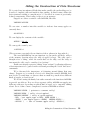
Suppose we define a variable called APPLES, like this:
VARIABLE APPLES
We can store a number into this variable to indicate how many apples we
currently have:
20 APPLES !
We can display the contents of the variable:
APPLES ? 20 ok
We can up the count by one:
1 APPLES +!
(The newcomer can study the mechanics of these phrases in Appendix A.)
The word APPLES has but one function: to put on the stack the address
of the memory location where the tally of apples is kept. The tally can be
thought of as a “thing,” while the words that set the tally, read the tally, or
increment the tally can be considered as “actions.”
Forth conveniently separates “things” from “actions” by allowing addresses
of data structures to be passed on the stack and providing the “fetch” and “store”
commands.
We’ve discussed the importance of designing around things that may
change. Suppose we’ve written a lot of code using this variable APPLES. And
now, at the eleventh hour, we discover that we must keep track of two different
kinds of apples, red and green!
We needn’t wring our hands, but rather remember the function of APPLES:
to provide an address. If we need two separate tallies, APPLES can supply two
different addresses depending on which kind of apple we’re currently talking
about. So we define a more complicated version of APPLES as follows:
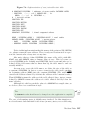
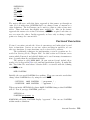
VARIABLE
VARIABLE
VARIABLE
: RED (
: GREEN
: APPLES
COLOR ( pointer to current tally)
REDS ( tally of red apples)
GREENS ( tally of green apples)
set apple-type to RED) REDS COLOR ! ;
( set apple-type to GREEN) GREENS COLOR ! ;
( -- adr of current apple tally) COLOR @ ;
Hiding the Construction of Data Structures
25
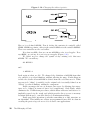
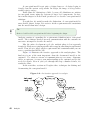
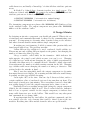
Figure 1.10: Changing the indirect pointer.
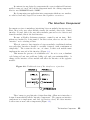
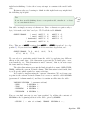
Here we’ve redefined APPLES. Now it fetches the contents of a variable called
COLOR. COLOR is a pointer, either to the variable REDS or to the variable GREENS.
These two variables are the real tallies.
If we first say RED, then we can use APPLES to refer to red apples. If we
say GREEN, we can use it to refer to green apples (Figure 1.10).
We didn’t need to change the syntax of any existing code that uses
APPLES. We can still say
20 APPLES !
and
1 APPLES +!
Look again at what we did. We changed the definition of APPLES from that
of a variable to a colon definition, without affecting its usage. Forth allows us
to hide the details of how APPLES is defined from the code that uses it. What
appears to be “thing” (a variable) to the original code is actually defined as an
“action” (a colon definition) within the component.
Forth encourages the use of abstract data types by allowing data structures to be defined in terms of lower level components. Only Forth, which
eliminates the CALLs from procedures, which allows addresses and data to be
implicitly passed via the stack, and which provides direct access to memory
locations with @ and !, can offer this level of information-hiding.
Forth pays little attention to whether something is a data structure or
an algorithm. This indifference allows us programmers incredible freedom in
creating the parts of speech we need to describe our applications.
26
The Philosophy of Forth
I tend to think of any word which returns an address, such as APPLES,
as a “noun,” regardless of how it’s defined. A word that performs an obvious
action is a “verb.”
Words such as RED and GREEN in our example can only be called “adjectives” since they modify the function of APPLES. The phrase
RED APPLES ?
is different from
GREEN APPLES ?
Forth words can also serve as adverbs and prepositions. There’s little value
in trying to determine what part of speech a particular word is, since Forth
doesn’t care anyway. We need only enjoy the ease of describing an application
in natural terms.
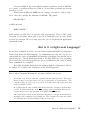
But Is It a High-Level Language?
In our brief technical overview, we noted that traditional high-level languages
broke away from assembly-language by eliminating not only the one-for-one
correspondence between commands and machine operations, but also the linear
correspondence. Clearly Forth lays claim to the first difference; but regarding
the second, the order of words that you use in a definition is the order in which
those commands are compiled.
Does this disqualify Forth from the ranks of high-level languages? Before
we answer, let’s explore the advantages of the Forth approach.
Here’s what Charles Moore, the inventor of Forth, has to say:
You define each word so that the computer knows what it means. The way it
knows is that it executes some code as a consequence of being invoked. The
computer takes an action on every word. It doesn’t store the word away and
keep it in mind for later.
In a philosophical sense I think this means that the computer “understands”
a word. It understands the word DUP
DUP, perhaps more profoundly than you do,
because there’s never any question in its mind what DUP means.
The connection between words that have meaning to you and words that have
meaning to the computer is a profound one. The computer becomes the vehicle
for communication between human being and concept.
But Is It a High-Level Language?
27
Two points of view.
One advantage of the correspondence between source code and machine execution is the tremendous simplification of the compiler and interpreter. This
simplification improves performance in several ways, as we’ll see in a later section.
From the standpoint of programming methodology, the advantage to the
Forth approach is that new words and new syntaxes can easily be added. Forth
cannot be said to be “looking” for words—it finds words and executes them.
If you add new words Forth will find and execute them as well. There’s no
difference between existing words and words that you add.
What’s more, this “extensibility” applies to all types of words, not just
action-type functions. For instance, Forth allows you to add new compiling
words—like IF and THEN that provide structured control flow. You can easily
add a case statement or a multiple-exit loop if you need them, or, just as
importantly, take them out if you don’t need them.
By contrast, any language that depends on word order to understand a
statement must “know” all legal words and all legal combinations. Its chances
of including all the constructs you’d like are slim. The language exists as
determined by its manufacturer; you can’t extend its knowledge.
Laboratory researchers cite flexibility and extensibility as among Forth’s
most important benefits in their environment. Lexicons can be developed to
hide information about the variety of test equipment attached to the computer. Once this work has been done by a more experienced programmer, the
researchers are free to use their “software toolbox” of small words to write simple programs for experimentation. As new equipment appears, new lexicons
are added.
Mark Bernstein has described the problem of using an off-the-shelf
special-purpose procedure library in the laboratory [8]: “The computer, not
the user, dominates the experiment.” But with Forth, he writes, “the computer
actually encourages scientists to modify, repair, and improve the software, to
experiment with and characterize their equipment. Initiative becomes once
more the prerogative of the researcher.”
For those purists who believe Forth isn’t fit to be called a high-level language, Forth makes matters even worse. While strong syntax checking and data
typing are becoming one of the major thrusts of contemporary programming
languages, Forth does almost no syntax checking at all. In order to provide
the kind of freedom and flexibility we have described, it cannot tell you that
you meant to type RED APPLES instead of APPLES RED. You have just invented
syntax!
Yet Forth more than makes up for its omission by letting you compile each
definition, one at a time, with turnaround on the order of seconds. You discover
your mistake soon enough when the definition doesn’t work. In addition, you
can add appropriate syntax checking in your definitions if you want to.
But Is It a High-Level Language?
29
Two solutions to the problem of security.
An artist’s paintbrush doesn’t notify the artist of a mistake; the painter
will be the judge of that. The chef’s skillet and the composer’s piano remain
simple and yielding. Why let a programming language try to out think you?
So is Forth a high-level language? On the question of syntax checking,
it strikes out. On the question of abstraction and power, it seems to be of
infinite level—supporting everything from bit manipulation at an output port
to business applications.
You decide. (Forth doesn’t care.)
The Language of Design
Forth is a design language. To the student of traditional computer science,
this statement is self-contradictory. “One doesn’t design with a language, one
implements with a language. Design precedes implementation.”
Experienced Forth programmers disagree. In Forth you can write abstract, design-level code and still be able to test it at any time by taking
advantage of decomposition into lexicons. A component can easily be rewritten, as development proceeds, underneath any components that use it. At first
the words in a component may print numbers on your terminal instead of controlling stepper motors. They may print their own names just to let you know
they’ve executed. They may do nothing at all.
Using this philosophy you can write a simple by testable version of your
application, then successively change and refine it until you reach your goal.
Another factor that makes designing in code possible is that Forth, like
some of the newer languages, eliminates the “batch-compile” development sequence (edit-compile-test-edit-compile-test). Because the feedback is instantaneous, the medium becomes a partner in the creative process. The programmer using a batch-compiler language can seldom achieve the productive state
of mind that artists achieve when the creative current flows unhindered.
For these reasons, Forth programmers spend less time planning than their
classical counterparts, who feel righteous about planning. To them, not planning seems reckless and irresponsible. Traditional environments force programmers to plan because traditional programming languages do not readily accommodate change.
Unfortunately, human foresight is limited even under the best conditions.
Too much planning becomes counterproductive.
Of course Forth doesn’t eliminate planning. It allows prototyping. Constructing a prototype is a more refined way to plan, just as breadboarding is
in electronic design.
As we’ll see in the next chapter, experimentation proves more reliable in
arriving at the truth than the guesswork of planning.
The Language of Design
31
The Language of Performance
Although performance is not the main topic of this book, the newcomer to Forth
should be reassured that its advantages aren’t purely philosophical. Overall,
Forth outdoes all other high-level languages in speed, capability and compactness.
Speed
Although Forth is an interpretive language, it executes compiled code. Therefore it runs about ten times faster than interpretive BASIC.
Forth is optimized for the execution of words by means of a technique
known as “threaded code” [9], [10], [11]. The penalty for modularizing into very
small pieces of code is relatively slight.
It does not run as fast as assembler code because the inner interpreter
(which interprets the list of addresses that comprise each colon definition) may
consume up to 50% of the run time of primitive words, depending on the
processor.
But in large applications, Forth comes very close to the speed of assembler. Here are three reasons:
First and foremost, Forth is simple. Forth’s use of a data stackgreatly
reduces the performance cost of passing arguments from word to word. In most
languages, passing arguments between modules is one of the main reasons that
the use of subroutines inhibits performance.
Second, Forth allows you to define words either in high-level or in machine
language. Either way, no special calling sequence is needed. You can write
a new definition in high level and, having verified that it is correct, rewrite
it in assembler without changing any of the code that uses it. In a typical
application, perhaps 20% of the code will be running 80% of the time. Only
the most often used, time-critical routines need to be machine coded. The Forth
system itself is largely implemented in machine-code definitions, so you’ll have
few application words that need to be coded in assembler.
Third, Forth applications tend to be better designed than those written
entirely in assembler. Forth programmers take advantage of the language’s
prototyping capabilities and try out several algorithms before settling on the
one best suited for their needs. Because Forth encourages change, it can also
be called the language of optimization.
Forth doesn’t guarantee fast applications. It does give the programmer
a creative environment in which to design fast applications.
Capability
Forth can do anything any other language can do—usually easier.
32
The Philosophy of Forth
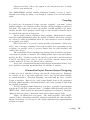
The best top-down designs of mice and young men.
At the low end, nearly all Forth systems include assemblers. These support control-structure operators for writing conditionals and loops using structured programming techniques. They usually allow you to write interrupts—
you can even write interrupt code in high level if desired.
Some Forth systems are multitasked, allowing you to add as many foreground or background tasks as you want.
Forth can be written to run on top of any operating system such as RT11, CP/M, or MS-DOS—or, for those who prefer it, Forth can be written as
a self-sufficient operating system including its own terminal drivers and disk
drivers.
With a Forth cross-compiler or target compiler, you can use Forth to
recreate new Forth systems, for the same computer or for different computers.
Since Forth is written in Forth, you have the otherwise unthinkable opportunity
to rewrite the operating system according to the needs of your application.
Or you can transport streamlined versions of applications over to embedded
systems.
Size
There are two considerations here: the size of the root Forth system, and the
size of compiled Forth applications.
The Forth nucleus is very flexible. In an embedded application, the part
of Forth you need to run your application can fit in as little as 1K. In a full
development environment, a multitasked Forth system including interpreter,
compiler, assembler, editor, operating system, and all other support utilities
averages 16K. This leaves plenty of room for applications. (And some Forths
on the newer processors handle 32-bit addressing, allowing unimaginably large
programs.)
Similarly, Forth compiled applications tend to be very small—usually
smaller than equivalent assembly language programs. The reason, again, is
threaded code. Each reference to a previously defined word, no matter how
powerful, uses only two bytes.
One of the most exciting new territories for Forth is the production of
Forth chips such as the Rockwell R65F11 Forth-based microprocessor [12]. The
chip includes not only hardware features but also the run-time portions of the
Forth language and operating system for dedicated applications. Only Forth’s
architecture and compactness make Forth-based micros possible.
Summary
Forth has often been characterized as offbeat, totally unlike any other popular
language in structure or in philosophy, On the contrary, Forth incorporates
many principles now boasted by the most contemporary languages. Structured
design, modularity, and information-hiding are among the buzzwords of the
day.
34
The Philosophy of Forth
Some newer languages approach even closer to the spirit of Forth. The
language C, for instance, lets the programmer define new functions either in
C or in assembly language, as does Forth. And as with Forth, most of C is
defined in terms of functions.
But Forth extends the concepts of modularity and information-hiding
further than any other contemporary language. Forth even hides the manner
in which words are invoked and the way local arguments are passed.
The resulting code becomes a concentrated interplay of words, the purest
expression of abstract thought. As a result, Forth programmers tend to be
more productive and to write tighter, more efficient, and better maintainable
code.
Forth may not be the ultimate language. But I believe the ultimate
language, if such a thing is possible, will more closely resemble Forth than any
other contemporary language.
References
[1] O.J. Dahl, E.W. Dijkstra, and C.A.R. Hoare, Structured Programming, London, Academic Press, 1972.
[2] Niklaus Wirth, “Program Development by Stepwise Refinement,” Communications of ACM, 14, No. 4 (1971), 221-27.
[3] W.P. Stevens, G.J. Myers, and L.L. Constantine, “Structured Design,” IBM Systems Journal, Vol. 13, No. 2, 1974.
[4] David L. Parnas, “On the Criteria To Be Used in Decomposing Systems
into Modules,” Communications of the ACM, December 1972.
[5] Barbara H. Liskov and Stephen N. Zilles, “Specification Techniques for Data Abstractions,” IEEE Transactions on Software Engineering, March 1975.
[6] David L. Parnas, “Designing Software for Ease of Extension and Contraction,” IEEE Transactions on Software Engineering, March 1979.
[7] Dewey Val Shorre, “Adding Modules to Forth,” 1980 FORML Proceedings, p. 71.
[8] Mark Bernstein, “Programming in the Laboratory,” unpublished paper,
1983.
[9] James R. Bell, “Threaded Code,” Communications of ACM, Vol. 16,
No. 6, 370-72.
[10] Robert B.K. DeWar, “Indirect Threaded Code,” Communications of
ACM, Vol. 18, No. 6, 331.
[11] Peter M. Kogge, “An Architectural Trail to Threaded-Code Systems,”
Computer, March, 1982.
[12] Randy Dumse, “The R65F11 Forth Chip,” Forth Dimensions, Vol. 5, No.
2, p. 25.
References
35
TWO
Analysis
Anyone who tells you there is some definite number of phases to the software
development cycle is a fool.
Nevertheless . . .
The Nine Phases of the Programming Cycle
As we’ve seen, Forth integrates aspects of design with aspects of implementation
and maintenance. As a result, the notion of a “typical development cycle” makes
as much sense as a “typical noise.”
But any approach is better than no approach, and indeed, some approaches have worked out better than others. Here is a development cycle
that represents an “average” of the most successful approaches used in software
projects:
Analysis
1. Discover the Requirements and Constraints
2. Build a Conceptual Model of the Solution
3. Estimate Cost/Schedule/Performance
Engineering
4. Preliminary Design
5. Detailed Design
6. Implementation
Usage
7. Optimization
8. Validation and Debugging
9. Maintenance
In this book we’ll treat the first six stages of the cycle, focusing on analysis,
design, and implementation.
In a Forth project the phases occur on several levels. Looking at a project
from the widest perspective, each of these steps could take a month or more.
One step follows the next, like seasons.
38
Analysis
But Forth programmers also apply these same phases toward defining
each word. The cycle then repeats on the order of minutes.
Developing an application with this rapid repetition of the programming
cycle is known as using the “Iterative Approach.”
The Iterative Approach
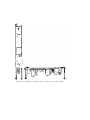
The iterative approach was explained eloquently by Kim Harris [1]. He begins
by describing the scientific method:
. . . a never-ending cycle of discovery and refinement. It first studies a natural
system and gathers observations about its behavior. Then the observations are
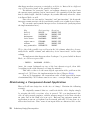
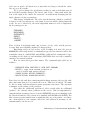
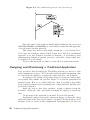
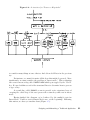
modeled to produce a theory about the natural system. Next, analysis tools
are applied to the model, which produces predictions about the real system’s
behavior. Experiments are devised to compare actual behavior to the predicted
behavior. The natural system is again studied, and the model is revised.
The goal of the method is to produce a model which accurately predicts all
observable behavior of the natural system.
Harris then applies the scientific method to the software development cycle,
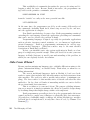
illustrated in Figure 2.1:
1. A problem is analyzed to determine what functions are required in the
solution.
2. Decisions are made about how to achieve those functions with the available resources.
3. A program is written which attempts to implement the design.
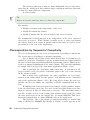
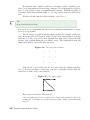
Figure 2.1: The iterative approach to the software development cycle, from
“The Forth Philosophy,” by Kim Harris, Dr. Dobb’s Journal.
The Iterative Approach
39
4. The program is tested to determine if the functions were implemented
correctly.
Mr. Harris adds:
Software development in Forth seeks first to find the simplest solution to a
given problem. This is done by implementing selected parts of the problem
separately and by ignoring as many constraints as possible. Then one or a few
constraints are imposed and the program is modified.
An excellent testimonial to the development/testing model of design is evolution. From protozoa to tadpoles to people, each species along the way has
consisted of functional, living beings. The Creator does not appear to be a
top-down designer.
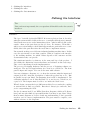
Tip
2.1
Start simple. Get it running. Learn what you’re trying to do. Add complexity
gradually, as needed to fit the requirements and constraints. Don’t be afraid
to restart from scratch.
The Value of Planning
In the nine phases at the start of this chapter we listed five steps before “implementation.” Yet in Chapter One we saw that an overindulgence in planning
is both difficult and pointless.
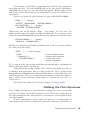
Clearly you can’t undertake a significant software project—regardless of
the language—without some degree of planning. Exactly what degree is appropriate?
More than one Forth programmer has expressed high regard for Dave Johnson’s meticulous approach to planning. Johnson is supervisor at Moore Products Co. in Springhouse, Pennsylvania. The firm specializes in industrial instrumentation and process control applications. Dave has been using Forth
since 1978.
He describes his approach:
Compared with many others that use Forth, I suppose we take a more formal
approach. I learned this the hard way, though. My lack of discipline in the
early years has come back to haunt me.
We use two tools to come up with new products: a functional specification and
a design specification. Our department of Sales & Applications comes up with
the functional specification, through customer contact.
Once we’ve agreed on what we’re going to do, the functional specification is
turned over to our department. At that point we work through a design, and
come up with the design specification.
40
Analysis
Up to this point our approach is no different from programming in any language.
But with Forth, we go about designing somewhat differently. With Forth you
don’t have to work 95% through your design before you can start coding, but
rather 60% before you can get into the iterative process.
A typical project would be to add a functional enhancement to one of our
products. For example, we have an intelligent terminal with disk drives, and
we need certain protocols for communicating with another device. The project
to design the protocols, come up with displays, provide the operator interfaces,
etc. may take several months. The functional specification takes a month; the
design specification takes a month; coding takes three months; integration and
testing take another month.
This is the typical cycle. One project took almost two years, but six or seven
months is reasonable.
When we started with Forth five years ago, it wasn’t like that. When I received
a functional specification, I just started coding. I used a cross between topdown and bottom-up, generally defining a structure, and as I needed it, some
of the lower level, and then returning with more structure.
The reason for that approach was the tremendous pressure to show something
to management. We wound up never writing down what we were doing. Three
years later we would go back and try to modify the code, without any documentation. Forth became a disadvantage because it allowed us to go in too
early. It was fun to make the lights flash and disk drives hum. But we didn’t
go through the nitty-gritty design work. As I said, our “free spirits” have come
back to haunt us.
Now for the new programmers, we have an established requirement: a thorough
design spec that defines in detail all the high-level Forth words—the tasks that
your project is going to do. No more reading a few pages of the functional
specification, answering that, reading a few more, answering that, etc.
No living programmer likes to document. By ensuring the design ahead of time,
we’re able to look back several years later and remember what we did.
I should mention that during the design phase there is some amount of coding
done to test out certain ideas. But this code may not be part of the finished
product. The idea is to map out your design.
Johnson advises us to complete the design specification before starting to
code, with the exception of needed preliminary tests. The next interview backs
up this point, and adds some additional reasons.
John Teleska has been an independent software consultant since 1976, specializing in custom applications for academic research environments. He enjoys
providing research tools “right at the edge of what technology is able to do.”
Teleska works in Rochester, New York:
I see the software development process as having two phases. The first is
making sure I understand what the problem is. The second is implementation,
including debugging, verification, etc.
The Value of Planning
41
My goal in Phase One is an operational specification. I start with a problem
description, and as I proceed it becomes the operational specification. My
understanding of the problem metamorphoses into a solution. The better the
understanding, the more complete the solution. I look for closure; a sense of
having no more questions that aren’t answered in print.
I’ve found that on each project I’ve been putting more time into Phase One,
much to the initial dismay of many of my clients. The limiting factor is how
much I can convince the client it’s necessary to spend that time up front.
Customers generally don’t know the specifications for the job they want done.
And they don’t have the capital—or don’t feel they do—to spend on good
specs. Part of my job is to convince them it will end up costing more time and
money not to.
Some of Phase One is spent on feasibility studies. Writing the spec unearths
uncertainties. I try to be as uncertain about uncertainties as possible. For
instance, they may want to collect 200,000 samples a second to a certain accuracy. I first need to find out if it’s even possible with the equipment they’ve
got. In this case I’ve got to test its feasibility by writing a patch of code.
Another reason for the spec is to cover myself. In case the application performs
to the spec but doesn’t fully satisfy the customer, it’s the customer’s responsibility. If the customer wants more, we’ll have to renegotiate. But I see it as the
designer’s responsibility to do whatever is necessary to generate an operational
specification that will do the job to the customer’s satisfaction.
I think there are consultants who bow to client pressure and limit the time they
spend on specs, for fear of losing the job. But in these situations nobody ends
up happy.
We’ll return to the Teleska interview momentarily.
The Limitations of Planning
Experience has taught us to map out where we’re going before we begin coding.
But planning has certain limitations. The following interviews give different
perspectives to the value of planning.
Despite Teleska’s preference for a well-planned project, he suggests that the
choice between a top-down and bottom-up approach may depend on the situation:
On two recent projects involving a lot of technical interface work, I did the
whole thing bottom-up. I milled around in a bunch of data-sheets and technical
descriptions of little crannies of the operating system I was dealing with. I felt
lost most of the time, wondering why I ever took the job on. Then finally I
reached a critical mass of some sort and began putting small programs together
that made small things happen. I continued, bottom-up, until I matched the
target application.
42
Analysis
My top-down sense was appalled at this procedure. But I’ve seen me go through
this process successfully too many times to discount it for any pedagogical
reasons. And there is always this difficult phase which it seems no amount of
linear thinking will penetrate. Programming seems a lot more intuitive than
we, in this business, tell each other it ought to be.
I think if the application elicits this sense of being lost, I proceed bottom-up. If
the application is in familiar territory then I’ll probably use a more traditional
by-the-book approach.
And here’s another view:
At the time I interviewed him, Michael Starling of Union Carbide was
putting the final touches on two applications involving user-configurable laboratory automation and process control automation systems. For the pilot plant
system, Starling designed both the hardware and software to known requirements; on the laboratory automation system he also defined the requirements
himself.
His efforts were extremely successful. On one project, the new system
typically costs only 20% as much as the equivalent system and requires days,
instead of months, to install and configure.
I asked him what techniques of project management he employed.
On both of these projects much design was needed. I did not follow the traditional analysis methods, however. I did employ these steps:
First, I clearly defined the boundaries of the problem.
Second, I determined what the smaller functional pieces, the software subsystems, had to be.
Third, I did each piece, put them together, and the system ran.
Next, I asked the users “Does this meet your requirements?” Sometimes it
didn’t, and in ways that neither the users nor the specification designers could
have anticipated.
For instance, the designers didn’t realize that the original specification wouldn’t
produce pleasing, human-oriented graphics displays. After working with the
interactive graphics on the first version, users were applying arbitrary scales
and coming up with oddball displays.
So even after the basic plot algorithm was designed, we realized we needed
auto-scaling. We went back in and analyzed how human beings plot data and
wrote a first level plot function that evaluates the x and y data and how much
will fit on the graph.
After that, we realized that not all the data taken will be of interest to experimenters. So we added a zoom capability.
This iterative approach resulted in cleaner code and better thought out code.
We established a baseline set of goals and built a minimal system to the users’
The Limitations of Planning
43
known requirements. Then we’d crank in the programmer’s experience to improve it and determine what the users forgot they needed when they generated
the specs.
The users did not invent most of the new ideas. The programmers did, and they
would bounce these ideas off the users. The problem definition was a two-way
street. In some cases they got things they didn’t know they could do on such
a small computer, such as applying digital filters and signal processing to the
data.
One of the things about Forth that makes this approach possible is that primitives are easily testable. It takes some experience with Forth to learn how to
take advantage of this. Guys from traditional environments want to write ten
pages of code at their desk, then sit down to type it in and expect it to work.
To summarize my approach: I try to find out from the users what they need,
but at the same time recognizing its incompleteness. Then I keep them involved
in the design during the implementation, since they have the expertise in the
application. When they see the result, they feel good because they know their
ideas were involved.
The iterative approach places highest value on producing a good solution to
the real problem. It may not always give you the most predictable software
costs. The route to a solution may depend upon your priorities. Remember:
Good
Fast
Cheap
Pick any two!
As Starling observes, you don’t know completely what you’re doing till you’ve
done it once. In my own experience, the best way to write an application is to
write it twice. Throw away the first version and chalk it up to experience.
Peter Kogge is Senior Technical Staff in the IBM Federal Systems Division,
Oswego, New York:
One of the key advantages I find in Forth is that it allows me to very quickly
prototype an application without all the bells and whistles, and often with
significant limitations, but enough to wring out the “human interface” by handson trial runs.
When I build such a prototype, I do so with the firm constraint that I will use
not a single line of code from the prototype in the final program. This enforced
“do-over” almost always results in far simpler and more elegant final programs,
even when those programs are written in something other than Forth.
44
Analysis
Our conclusions? In the Forth environment planning is necessary. But it should
be kept short. Testing and prototyping are the best ways to discover what is
really needed.
A word of caution to project managers: If you’re supervising any experienced Forth programmers, you won’t have to worry about them spending too
much time on planning. Thus the following tip has two versions:
Tip
For newcomers to Forth (with “traditional” backgrounds): Keep the analysis
phase to a minimum.
2.2
For Forth addicts (without a “traditional” background): Hold off on coding as
long as you can possibly stand it.
Or, as we observed in Chapter One:
Tip
Plan for change (by designing components that can be changed).
2.3
Or, simply:
Tip
Prototype.
2.4
The Analysis Phase
In the remainder of this chapter we’ll discuss the analysis phase. Analysis is
an organized way of understanding and documenting what the program should
do.
With a simple program that you write for yourself in less than an hour,
the analysis phase may take about 250 microseconds. At the other extreme,
some projects will take many man-years to build. On such a project, the
analysis phase is critical to the success of the entire project.
We’ve indicated three parts to the analysis phase:
1. Discovering the requirements and constraints
2. Building a conceptual model of the solution
3. Estimating cost, scheduling, and performance
Let’s briefly describe each part:
The Analysis Phase
45
Discovering the Requirements
The first step is to determine what the application should do. The customer,
or whoever wants the system, should supply a “requirements specification.”
This is a modest document that lists the minimum capabilities for the finished
product.
The analyst may also probe further by conducting interviews and sending
out questionnaires to the users.
Discovering the Constraints
The next step is to discover any limiting factors. How important is speed?
How much memory is available? How soon do you need it?
No matter how sophisticated our technology becomes, programmers will
always be bucking limitations. System capacities inexplicably diminish over
time. The double-density disk drives that once were the answer to my storage prayers no longer fill the bill. The double-sided, double-density drives I’ll
get next will seem like a vast frontier—for a while. I’ve heard guys with 10megabyte hard disks complain of feeling cramped.
Whenever there’s a shortage of something—and there always will be—
tradeoffs have to be made. It’s best to use the analysis phase to anticipate
most limitations and decide which tradeoffs to make.
On the other hand, you should not consider other types of constraints
during analysis, but should instead impose them gradually during implementation, the way one stirs flour into gravy.
The type of constraint to consider during analysis includes those that
might affect the overall approach. The type of defer includes those that can be
handled by making iterative refinements to the planned software design.
As we heard in our earlier interviews, finding out about hardware constraints often requires writing some test code and trying things out.
Finding out about the customer’s constraints is usually a matter of asking
the customer, or of taking written surveys. “How fast do you need such-andsuch, on a scale of one to ten?”, etc.
Building a Conceptual Model of the Solution
A conceptual model is an imaginary solution to the problem. It is a view of
how the system appears to work. It is an answer to all the requirements and
constraints.
If the requirements definition is for “something to stand on to paint the
ceiling,” then a description of the conceptual model is “a device that is freestanding (so you can paint the center of the room), with several steps spaced
at convenient intervals (so you can climb up and down), and having a small
shelf near the top (to hold your paint can).”
46
Analysis
Refining the conceptual model to meet requirements and constraints.
A conceptual model is not quite a design, however. A design begins to
describe how the system really works. In design, the image of a step ladder
would begin to emerge.
Forth blurs the distinction a little, because all definitions are written
in conceptual terms, using the lexicons of lower level components. In fact,
later in this chapter we’ll use Forth “pseudocode” to describe conceptual model
solutions.
Nevertheless, it’s useful to make the distinction. A conceptual model is
more flexible than a design. It’s easier to fit the requirements and constraints
into the model than into a design.
Tip
2.5
Strive to build a solid conceptual model before beginning the design.
Analysis consists of expanding the requirements definition into a conceptual
model. The technique involves two-way communication with the customer in
successive attempts to describe the model.
Like the entire development cycle, the analysis phase is best approach
iteratively. Each new requirement will tend to suggest something in your mental
model. Your job is to juggle all the requirements and constraints until you can
weave a pattern that fits the bill.
Figure 2.2 illustrates the iterative approach to the analysis phase. The
final step is one of the most important: show the documented model to the
customer. Use whatever means of communication are necessary—diagrams,
tables, or cartoons—to convey your understanding to the customer and get the
needed feedback. Even if you cycle through this loop a hundred times, it’s
worth the effort.
In the next three sections we’ll explore three techniques for defining and
documenting the conceptual model:
Figure 2.2: An iterative approach to analysis.
48
Analysis
1. defining the interfaces
2. defining the rules
3. defining the data structures.
Defining the Interfaces
Tip
First, and most importantly, the conceptual model should describe the system’s
interfaces.
2.6
Teleska:
The “spec” basically deals with WHAT. In its most glorious form, it describes
what the system would look like to the user—you might call it the user’s manual.
I find I write more notes on the human interaction—what it will look like on the
outside—than on the part that gets the job done. For instance, I’ll include a
whole error-action listing to show what happens when a particular error occurs.
Oddly, this is the part that takes the most time to implement anyway.
I’m currently working on a solid-state industrial washing-machine timer. In this
case, the user interface is not that complex. What is complex is the interface
to the washing machine, for which I must depend on the customer and the
documentation they can provide.
The significant interface is whatever is the arms and legs of the product. I
don’t make the distinction between hardware and software at this early stage.
They can be interchanged in the implementation.
The process of designing hardware and the process of designing software are
analogous. The way I design hardware is to treat it as a black box. The front
panel is input and output. You can do the same with software.
I use any techniques, diagrams, etc., to show the customer what the inputs and
outputs look like, using his description of what the product has to do. But
in parallel, in my own mind, I’m imagining how it will be implemented. I’m
evaluating whether I can do this efficiently. So to me it’s not a black box, it’s
a gray box. The designer must be able to see inside the black boxes.
When I design a system that’s got different modules, I try to make the coupling
as rational and as little as possible. But there’s always give and take, since
you’re compromising the ideal.
For the document itself, I use DFDs [data-flow diagrams, which we’ll discuss
later], and any other kind of representation that I can show to my client. I show
them as many diagrams as I can to clarify my understanding. I don’t generally
use these once it comes to implementation. The prose must be complete, even
without reference to the diagrams.
Defining the Interfaces
49
Tip
2.7
Decide on error- and exception-handling early as part of defining the interface.
It’s true that when coding for oneself, a programmer can often concentrate first
on making the code run correctly under normal conditions, then worry about
error-handling later. When working for someone else, however, error-handling
should be worked out ahead of time. This is an area often overlooked by the
beginning programmer.
The reason it’s so important to decide on error-handling at this stage is
the wide divergence in how errors can be treated. An error might be:
• ignored
• made to set a flag indicating that an error occurred, while processing
continues
• made to halt the application immediately
• designed to initiate procedures to correct the problem and keep the program running.
There’s room for a serious communications gap if the degree of complexity
required in the error-handling is not nailed down early. Obviously, the choice
bears tremendous impact on the design and implementation of the application.
Tip
2.8
Develop the conceptual model by imagining the data traveling through and
being acted upon by the parts of the model.
A discipline called structured analysis [2] offers some techniques for describing
interfaces in ways that your clients will easily understand. One of these techniques is called the “data-flow diagram” (DFD), which Teleska mentioned.
A data-flow diagram, such as the one depicted in Figure 2.3, emphasizes
what happens to items of data as they travel through the system. The circles represent “transforms,” functions that act upon information. The arrows
represent the inputs and outputs of the transforms.
The diagram depicts a frozen moment of the system in action. It ignores
initialization, looping structures, and other details of programming that relate
to time.
Three benefits are claimed for using DFDs:
First, they speak in simple, direct terms to the customer. If your customer
agrees with the contents of your data-flow diagram, you know you understand
the problem.
Second, they let you think in terms of the logical “whats,” without getting
caught up in the procedural “hows,” which is consistent with the philosophy of
hiding information as we discussed in the last chapter.
50
Analysis
Figure 2.3: A data-flow diagram.
Third, they focus your attention on the interfaces to the system and
between modules.
Forth programmers, however, rarely use DFDs except for the customer’s
benefit. Forth encourages you to think in terms of the conceptual model, and
Forth’s implicit use of a data stack makes the passing of data among modules
so simple it can usually be taken for granted. This is because Forth, used
properly, approaches a functional language.
For anyone with a few days’ familiarity with Forth, simple definitions
convey at least as much meaning as the diagrams:
: REQUEST ( quantity part# -- )
ON-HAND? IF TRANSFER ELSE REORDER THEN ;
: REORDER
AUTHORIZATION? IF P.O. THEN ;
: P.O.
BOOKKEEPING COPY
RECEIVING COPY
VENDOR MAIL-COPY ;
This is Forth pseudocode. No effort has been made to determine what values
are actually passed on the stack, because that is an implementation detail.
The stack comment for REQUEST is used only to indicate the two items of data
needed to initiate the process.
(If I were designing this application, I’d suggest that the user interface
be a word called NEED, which has this syntax:
Defining the Interfaces
51
NEED 50 AXLES
NEED converts the quantity into a numeric value on the stack, translates the
string AXLES into a part number, also on the stack, then calls REQUEST. Such a
command should be defined only at the outer-most level.)
Johnson of Moore Products Co. has a few words on Forth pseudocode:
IBM uses a rigorously documented PDL (program design language). We use
a PDL here as well, although we call it FDL, for Forth design language. It’s
probably worthwhile having all those standards, but once you’re familiar with
Forth, Forth itself can be a design language. You just have to leave out the
so-called “noise” words: C@, DUP, OVER, etc., and show only the basic flow. Most
Forth people probably do that informally. We do it purposefully.
During one of our interviews I asked Moore if he used diagrams of any sort to
plan out the conceptual model, or did he code straight into Forth? His reply:
The conceptual model is Forth. Over the years I’ve learned to think that way.
Can everyone learn to think that way?
I’ve got an unfair advantage. I codified my programming style and other people
have adopted it. I was surprised that this happened. And I feel at a lovely
advantage because it is my style that others are learning to emulate. Can they
learn to think like I think? I imagine so. It’s just a matter of practice, and I’ve
had more practice.
Defining the Rules
Most of your efforts at defining a problem will center on describing the interface.
Some applications will also require that you define the set of application rules.
All programming involves rules. Usually these rules are so simple it hardly
matters how you express them: “If someone pushes the button, ring the bell.”
Some applications, however, involve rules so complicated that they can’t
be expressed in a few sentences of English. A few formal techniques can come
in handy to help you understand and document these more complicated rules.
Here’s an example. Our requirements call for a system to compute the
charges on long-distance phone calls. Here’s the customer’s explanation of its
rate structure. (I made this up; I have no idea how the phone company actually
computes their rates except that they overcharge.)
All charges are computed by the minute, according to distance in hundreds of
miles, plus a flat charge. The flat charge for direct dial calls during weekdays
between 8 A.M. and 5 P.M. is .30 for the first minute, and .20 for each additional
minute; in addition, each minute is charged .12 per 100 miles. The flat charge
for direct calls during weekdays between 5 P.M. and 11 P.M. is .22 for the first
52
Analysis
minute, and .15 for each additional minute; the distance rate per minute is .10
per 100 miles. The flat charge for direct calls late during weekdays between 11
P.M. or anytime on Saturday, Sundays, or holidays is .12 for the first minute,
and .09 for each additional minute; the distance rate per minute is .06 per 100
miles. If the call requires assistance from the operator, the flat charge increases
by .90, regardless of the hour.
This description is written in plain old English, and it’s quite a mouthful. It’s
hard to follow and, like an attic cluttered with accumulated belongings, it may
even hide a few bugs.
In building a conceptual model for this system, we must describe the
rate structure in an unambiguous, useful way. The first step towards cleaning
up the clutter involves factoring out irrelevant pieces of information—that is,
applying the rules of limited redundancy. We can improve this statement a lot
by splitting it into two statements. First there’s the time-of-day rule:
Calls during weekdays between 8 A.M. and 5 P.M. are charged at “full” rate.
Calls during weekdays between 5 P.M. and 11 P.M. are charged at “lower”
rate. Calls placed during weekdays between 11 P.M. or anytime on Saturday,
Sundays, or holidays are charged at the “lowest” rate.
Then there’s the rate structure itself, which should be described in terms of
“first-minute rate,” “additional minute rate,” “distance rate,” and “operatorassistance rate.”
Tip
Factor the fruit. (Don’t confuse apples with oranges.)
2.9
These prose statements are still difficult to read, however. System analysts use
several techniques to simplify these statements: structured English, decision
trees, and decision tables. Let’s study each of these techniques and evaluate
their usefulness in the Forth environment.
Structured English
Structured English is a sort of structured pseudocode in which our rate statement would read something like this:
IF full rate
IF direct-dial
IF first-minute
.30 + .12/100miles
ELSE ( add’l- minute)
.20 + .12/100miles
ENDIF
ELSE ( operator )
Structured English
53
IF first-minute
1.20 + .12/100miles
ELSE ( add’l- minute)
.20 + .12/100miles
ENDIF
ENDIF
ELSE ( not-full-rate)
IF lower-rate
IF direct-dial
IF first-minute
.22 + .10/100miles
ELSE ( add’l- minute)
.15 + .10/100miles
END IF
ELSE ( operator)
IF first-minute
1.12 + .10/100miles
ELSE ( add’l- minute)
.15 + .10/100miles
ENDIF
ENDIF
ELSE ( lowest-rate)
IF direct-dial
IF first-minute
.12 + .06/100miles
ELSE ( add’l- minute)
.09 + .O6/100miles
ENDIF
ELSE ( operator)
IF first-minute
1.02 + .O6/100miles
ELSE ( add’l- minute)
.09 + .06/100miles
ENDIF
ENDIF
ENDIF
ENDIF
This is just plain awkward. It’s hard to read, harder to maintain, and hardest
to write. And for all that, it’s worthless at implementation time. I don’t even
want to talk about it anymore.
The Decision Tree
Figure 2.4 illustrates the telephone rate rules by means of a decision tree. The
decision tree is the easiest method of any to “follow down” to determine the
54
Analysis
Figure 2.4: Example of a decision tree.
result of certain conditions. For this reason, it may be the best representation
to show the customer.
Unfortunately, the decision tree is difficult to “follow up,” to determine
which conditions produce certain results. This difficulty inhibits seeing ways to
simplify the problem. The tree obscures the fact that additional minutes cost
the same, whether the operator assists or not. You can’t see the facts for the
tree.
The Decision Table
The decision table, described next, provides the most usable graphic representation of compound rules for the programmer, and possibly for the customer
as well. Figure 2.5 shows our rate structure rules in decision-table form.
In Figure 2.5 there are three dimensions: the rate discount, whether an
operator intervenes, and initial minute vs. additional minute.
Drawing problems with more than two dimensions gets a little tricky.
As you can see, these additional dimensions can be depicted on paper as subdimensions within an outer dimension. All of the subdimension’s conditions
appear within every condition of the outer dimension. In software, any number
of dimensions can be easily handled, as we’ll see.
All the techniques we’ve described force you to analyze which conditions
apply to which dimensions. In factoring these dimensions, two rules apply:
The Decision Table
55
Figure 2.5: The decision table.
First, all the elements of each dimension must be mutually exclusive. You
don’t put “first minute” in the same dimension as “direct dial,” because they
are not mutually exclusive.
Second, all possibilities must be accounted for within each dimension. If
there were another rate for calls made between 2 A.M. to 2:05 A.M., the table
would have to be enlarged.
But our decision tables have other advantages all to themselves. The
decision table not only reads well to the client but actually benefits the implementor in several ways:
Transferability to actual code. This is particularly true in Forth, where
decision tables are easy to implement in a form very similar to the drawing.
Ability to trace the logic upwards. Find a condition and see what factors
produced it.
Clearer graphic representation. Decision tables serve as a better tool for
understanding, both for the implementor and the analyst.
Unlike decision trees, these decision tables group the results together in
a graphically meaningful way. Visualization of ideas helps in understanding
problems, particularly those problems that are too complex to perceive in a
linear way.
For instance, Figure 2.5 clearly shows that the charge for additional minutes does not depend on whether an operator assisted or not. With this new
understanding we can draw a simplified table, as shown in Figure 2.6.
It’s easy to get so enamored of one’s analytic tools that one forgets about
the problem. The analyst must do more than carry out all possibilities of
a problem to the nth degree, as I have seen authors of books on structured
analysis recommend. That approach only increases the amount of available
detail. The problem solver must also try to simplify the problem.
56
Analysis
Figure 2.6: A simplified decision table.
Tip
You don’t understand a problem until you can simplify it.
2.10
If the goal of analysis is not only understanding, but simplification, then perhaps we’ve got more work to do.
Our revised decision table (Figure 2.6) shows that the per-mile charge
depends only on whether the rate is full, lower, or lowest. In other words, it’s
subject to only one of the three dimensions shown in the table. What happens
if we split this table into two tables, as in Figure 2.7?
Figure 2.7: The sectional decision table.
The Decision Table
57
Figure 2.8: The decision table without operator involvement depicted.
Now we’re getting the answer through a combination of table look-up
and calculation. The formula for the per-minute charge can be expressed as a
pseudoForth definition:
: PER-MINUTE-CHARGE ( -- per-minute-charge)
CONNECT-CHARGE MILEAGE-CHARGE + ;
The “+” now appears once in the definition, not nine times in the table.
Taking the principle of calculation one step further, we note (or remember
from the original problem statement) that operator assistance merely adds a
one-time charge of .90 to the total charge. In this sense, the operator charge is
not a function of any of the three dimensions. It’s more appropriately expressed
as a “logical calculation”; that is, a function that combines logic with arithmetic:
: ?ASSISTANCE
( direct-dial-charge -- total-charge)
OPERATOR? IF .90 + THEN ;
(But remember, this charge applies only to the first minute.)
This leaves us with the simplified table shown in Figure 2.8, and an
increased reliance on expressing calculations. Now we’re getting somewhere.
Let’s go back to our definition of PER-MINUTE-CHARGE:
: PER-MINUTE-CHARGE ( -- per-minute-charge)
CONNECT-CHARGE MILEAGE-CHARGE + ;
Let’s get more specific about the rules for the connection charge and for the
mileage charge.
The connection charge depends on whether the minute is the first or an
additional minute. Since there are two kinds of per-minute charges, perhaps it
will be easiest to rewrite PER-MINUTE-CHARGE as two different words.
58
Analysis
Let’s assume we will build a component that will fetch the appropriate
rates from the table. The word 1MINUTE will get the rate for the first minute;
+MINUTES will get the rate for each additional minute. Both of these words
will depend on the time of day to determine whether to use the full, lower, or
lowest rates.
Now we can define the pair of words to replace PER-MINUTE-CHARGE:
: FIRST ( -- charge)
1MINUTE ?ASSISTANCE
MILEAGE-CHARGE + ;
: PER-ADDITIONAL ( -- charge)
+MINUTES MILEAGE-CHARGE + ;
What is the rule for the mileage charge? Very simple. It is the rate (per
hundred miles) times the number of miles (in hundreds). Let’s assume we can
define the word MILEAGE-RATE, which will fetch the mileage rate from the table:
: MILEAGE-CHARGE ( -- charge)
#MILES @ MILEAGE-RATE * ;
Finally, if we know the total number of minutes for a call, we can now calculate
the total direct-dial charge:
: TOTAL
( -- total-charge)
FIRST
( #minutes) 1PER-ADDITIONAL *
+ ;
(
(
(
(
first minute rate)
additional minutes)
times the rate)
added together)
We’ve expressed the rules to this particular problem through a combination of
simple tables and logical calculations.
(Some final notes on this example: We’ve written something very close to
a running Forth application. But it is only pseudocode. We’ve avoided stack
manipulations by assuming that values will somehow be on the stack where the
comments indicate. Also, we’ve used hyphenated names because they might be
more readable for the customer. Short names are preferred in real code—see
Chapter Five.)
We’ll unveil the finished code for this example in Chapter Eight.
Defining the Data Structures
After defining the interfaces, and sometimes defining the rules, occasionally
you’ll need to define certain data structures as well. We’re not referring here to
the implementation of the data structures, but rather to a description of their
conceptual model.
If you’re automating a library index, for instance, a crucial portion of
your analysis will concern developing the logical data structure. You’ll have to
Defining the Data Structures
59
decide what information will be kept for each book: title, author, subject, etc.
These “attributes” will comprise an “entity” (set of related records) called BOOKS.
Then you’ll have to determine what other data structures will be required to
let the users search the BOOKS efficiently.
You may need another entity consisting of authors’ names in alphabetical
order, along with “attribute pointers” to the books each author has written.
Certain constraints will also affect the conceptual model of the data structure. In the library index example, you need to know not only what information
the users need, but also how long they’re willing to wait to get it.
For instance, users can request listings of topics by year of publication—
say everything on ladies’ lingerie between 1900 and 1910. If they expect to get
this information in the snap of a girdle, you’ll have to index on years and on
topics. If they can wait a day, you might just let the computer search through
all the books in the library.
Achieving Simplicity
Tip
2.11
Keep it simple.
While you are taking these crucial first steps toward understanding the problem,
keep in mind the old saying:
Given two solutions to a problem, the correct one is the simpler.
This is especially true in software design. The simpler solution is often more
difficult to discover, but once found, it is:
• easier to understand
• easier to implement
• easier to verify and debug
• easier to maintain
• more compact
• more efficient
• more fun
One of the most compelling advocates of simplicity is Moore:
You need a feeling for the size of the problem. How much code should it take
to implement the thing? One block? Three? I think this is a very useful design
tool. You want to gut-feel whether it’s a trivial problem or a major problem,
how much time and effort you should spend on it.
60
Analysis
Given two adequate solutions, the correct one is the simpler.
When you’re done, look back and say, “Did I come up with a solution that
is reasonable?” If your solution fills six screens, it may seem you’ve used a
sledgehammer to kill a mosquito. Your mental image is out of proportion to
the significance of the problem.
I’ve seen nuclear physics programs with hundreds of thousands of lines of FORTRAN. Whatever that code does, it doesn’t warrant hundreds of thousands of
lines of code. Probably its writers have overgeneralized the problem. They’ve
solved a large problem of which their real needs are a subset. They have violated
the principle that the solution should match the problem.
Tip
2.12
Generality usually involves complexity. Don’t generalize your solution any more
than will be required; instead, keep it changeable.
Moore continues:
Given a problem, you can code a solution to it. Having done that, and found
certain unpleasantnesses to it, you can go back and change the problem, and
end up with a simpler solution.
There’s a class of device optimization—minimizing the number of gates in a
circuit-where you take advantage of the “don’t care” situation. These occur
either because a case won’t arise in practice or because you really don’t care.
But the spec is often written by people who have no appreciation for programming. The designer may have carefully specified all the cases, but hasn’t told
you, the programmer, which cases are really important.
If you are free to go back and argue with him and take advantage of the “don’t
cares,” you can come up with a simpler solution.
Take an engineering application, such as a 75-ton metal powder press, stamping
out things. They want to install a computer to control the valves in place of
the hydraulic control previously used. What kind of spec will you get from
the engineer? Most likely the sensors were placed for convenience from an
electromechanical standpoint. Now they could be put somewhere else, but the
engineer has forgotten. If you demand explanations, you can come closer to
the real world and further from their model of the world.
Another example is the PID (proportional integration and differentiation) algorithm for servos. You have one term that integrates, another term that
differentiates, and a third term that smooths. You combine those with 30%
integration, 10% differentiation, or whatever. But it’s only a digital filter. It
used to be convenient in analog days to break out certain terms of the digital
filter and say, “This is the integrator and this is the differentiator. I’ll make
this with a capacitor and I’ll make that with an inductor.”
Again the spec writers will model the analog solution which was modeling the
electromechanical solution, and they’re several models away from reality. In
62
Analysis
fact, you can replace it all with two or three coefficients in a digital filter for a
much cleaner, simpler and more efficient solution.
Tip
Go back to what the problem was before the customer tried to solve it. Exploit
the “don’t cares.”
2.13
Moore continues:
Sometimes the possibilities for simplification aren’t immediately obvious.
There’s this problem of zooming in a digitized graphics display, such as CAD
systems. You have a picture on the screen and you want to zoom in on a portion
to see the details.
I used to implement it so that you move the cursor to the position of interest,
then press a button, and it zooms until you have a window of the desired size.
That was the way I’ve always done it. Until I realized that that was stupid. I
never needed to zoom with such fine resolution.
So instead of moving the cursor a pixel at a time, I jump the cursor by units of,
say, ten. And instead of increasing the size of box, I jump the size of the box.
You don’t have a choice of sizes. You zoom by a factor of four. The in-between
sizes are not interesting. You can do it as many times as you like.
By quantizing things fairly brutally, you make it easier to work with, more
responsive, and simpler.
Tip
To simplify, quantize.
2.14
Moore concludes:
It takes arrogance to go back and say “You didn’t really mean this,” or “Would
you mind if I took off this page and replaced it with this expression?” They
get annoyed. They want you to do what they told you to do.
LaFarr Stuart took this attitude when he redesigned Forth [3]. He didn’t
like the input buffer, so he implemented Forth without it, and discovered he
didn’t really need an input buffer.
If you can improve the problem, it’s a great situation to get into. It’s much
more fun redesigning the world than implementing it.
Achieving Simplicity
63
An overgeneralized solution.
Effective programmers learn to be tactful and to couch their approaches in
non-threatening ways: “What would be the consequences of replacing that
with this?” etc.
Yet another way to simplify a problem is this:
Tip
To simplify, keep the user out of trouble.
2.15
Suppose you’re designing part of a word processor that displays a directory of
stored documents on the screen, one per line. You plan that the user can move
the cursor next to the name of any document, then type a one-letter command
indicating the chosen action: “p” for print, “e” for edit, etc.
Initially it seems all right to let the user move the cursor anywhere on
the screen. This means that those places where text already appears must be
protected from being overwritten. This implies a concept of protected fields”
and special handling. A simpler approach confines the cursor to certain fields,
possibly using reverse video to let the user see the size of the allowable field.
Another example occurs when an application prompts the user for a numeric value. You often see such applications that don’t check input until you
press “return,” at which time the system responds with an error message such
as “invalid number.” It’s just as easy—probably easier—to check each key as
it’s typed and simply not allow non-numeric characters to appear.
Tip
To simplify, take advantage of what’s available.
2.16
Michael LaManna, a Forth programmer in Long Island, New York, comments:
I always try to design the application on the most powerful processor I can
get my hands on. If I have a choice between doing development on a 68000based system and a 6809-based system, I’d go for the 68000-based system. The
processor itself is so powerful it takes care of a lot of details I might otherwise
have to solve myself.
If I have to go back later and rewrite parts of the application for a simpler
processor, that’s okay. At least I won’t have wasted my time.
A word of caution: If you’re using an existing component to simplify your
prototype, don’t let the component affect your design. You don’t want the
design to depend on the internals of the component.
Achieving Simplicity
65
Budgeting and Scheduling
Another important aspect of the analysis phase is figuring the price tag. Again,
this process is much more difficult than it would seem. If you don’t know the
problem till you solve it, how can you possibly know how long it will take to
solve it?
Careful planning is essential, because things always take longer than you
expect. I have a theory about this, based on the laws of probability:
Tip
2.17
The mean time for making a “two-hour” addition to an application is approximately 12 hours.
Imagine the following scenario: You’re in the middle of writing a large application when suddenly it strikes you to add some relatively simple feature. You
think it’ll take about two hours, so without further planning, you just do it.
Consider: That’s two hours coding time. The design time you don’t count
because you perceived the need—and the design—in a flash of brilliance while
working on the application. So you estimate two hours.
But consider the following possibilities:
1. Your implementation has a bug. After two hours it doesn’t work. So you
spend another two hours recoding. (Total 4.)
2. OR, before you implemented it, you realized your initial design wouldn’t
work. You spend two hours redesigning. These two hours count. Plus
another two hours coding it. (Total 4.)
3. OR, you implement the first design before you realize the design wouldn’t
work. So you redesign (two more hours) and reimplement (two more).
(Total 6.)
4. OR, you implement the first design, code it, find a bug, rewrite the code,
find a design flaw, redesign, recode, find a bug in the new code, recode
again. (Total 10.)
You see how the thing snowballs?
5. Now you have to document your new feature. Add two hours to the
above. (Total 12.)
6. After you’ve spent anywhere from 2 to 12 hours installing and debugging
your new feature, you suddenly find that element Y of your application
bombs out. Worst yet, you have no idea why. You spend two hours
reading memory dumps trying to divine the reason. Once you do, you
spend as many as 12 additional hours redesigning element Y. (Total 26.)
Then you have to document the syntax change you made to element Y.
(Total 27.)
66
Analysis
Conventional wisdom reveres complexity.
That’s a total of over three man-days. If all these mishaps befell you at once,
you’d call for the men with the little white coats. It rarely gets that bad, of
course, but the odds are decidedly against any project being as easy as you
think it will be.
How can you improve your chances of judging time requirements correctly? Many fine books have been written on this topic, notably The Mythical
Man-Month by Frederick P. Brooks, Jr. [4]. I have little to add to this
body of knowledge except for some personal observations.
1. Don’t guess on a total. Break the problem up into the smallest possible
pieces, then estimate the time for each piece. The sum of the pieces is
always greater than what you’d have guessed the total would be. (The
whole appears to be less than the sum of the parts.)
2. In itemizing the pieces, separate those you understand well enough to
hazard a guess from those you don’t. For the second category, give the
customer a range.
3. A bit of psychology: always give your client some options. Clients like
options. If you say, “This will cost you $6,000,” the client will probably
respond “I’d really like to spend $4,000.” This puts you in the position
of either accepting or going without a job.
But if you say, “You have a choice: for $4,000 I’ll make it walk through
the hoop; for $6,000 I’ll make it jump through the hoop. For $8,000 I’ll
make it dance through the hoop waving flags, tossing confetti and singing
“Roll Out the Barrel.”
Most customers opt for jumping through the hoop.
Tip
2.18
Everything takes longer than you think, including thinking.
Reviewing the Conceptual Model
The final box on our iterative analytic wheel is labeled “Show Model to Customer.” With the tools we’ve outlined in this chapter, this job should be easy
to do.
In documenting the requirements specification, remember that specs are
like snowmen. They may be frozen now, but they shift, slip, and melt away
when the heat is on. Whether you choose data-flow diagrams or straight Forth
pseudocode, prepare yourself for the great thaw by remembering to apply the
concepts of limited redundancy.
Show the documented conceptual model to the customer. When the
customer is finally satisfied, you’re ready for the next big step: the design!
68
Analysis
References
[1] Kim Harris, “The Forth Philosophy,” Dr. Dobb’s Journal, Vol. 6, Iss. 9,
No. 59 (Sept. 81), pp. 6-11.
[2] Victor Weinberg, Structured Analysis, Englewood Cliffs, N.J.: PrenticeHall, Inc., 1980.
[3] LaFarr Stuart, “LaFORTH”, 1980 FORML Proceedings, p. 78.
[4] Frederick P. Brooks, Jr., The Mythical Man-Month, Reading, Massachusetts, Addison-Wesley, 1975.
References
69
THREE
Preliminary
Design/
Decomposition
Assuming you have some idea of what your program should accomplish, it’s
time to begin the design. The first stage, preliminary design, focuses on shrinking your mountainous problem into manageable molehills.
In this chapter we’ll discuss two ways to decompose your Forth application.
Decomposition by Component
Has this sort of thing ever happened to you? You’ve been planning for three
months to take a weekend vacation to the mountains. You’ve been making lists
of what to bring, and daydreaming about the slopes.
Meanwhile you’re deciding what to wear to your cousin’s wedding next
Saturday. They’re informal types, and you don’t want to overdress. Still, a
wedding’s a wedding. Maybe you should rent a tuxedo anyway.
For all this planning, it’s not until Thursday that you realize the two
events coincide. You have expletives for such moments.
How is such a mental lapse possible, in one so intelligent as yourself?
Apparently the human mind actually makes links between memories. New
ideas are somehow added onto existing paths of related thoughts.
Figure 3.1: Pools of thought not yet linked
72
Preliminary Design/Decomposition
In the mishap just described, no connection was ever made between the
two separately-linked pools of thought until Thursday. The conflict probably
occurred when some new input (something as trivial as hearing Saturday’s
weather report) got linked into both pools of thought. A lightning flash of
realization arced between the pools, followed inexorably by thunderous panic.
A simple tool has been invented to avoid such disasters. It’s called a
calendar. If you had recorded both plans in the same calendar, you would have
seen the other event scheduled, something your brain failed to do for all its
intricate magnificence.
Tip
To see the relationship between two things, put them close together. To remind
yourself of the relationship, keep them together.
3.1
These truisms apply to software design, particularly to the preliminary design
phase. This phase is traditionally the one in which the designer dissects a large
application into smaller, programmer-sized modules.
In Chapter One we discovered that applications can be conveniently decomposed into components.
Tip
The goal of preliminary design is to determine what components are necessary
to accomplish the requirements.
3.2
For instance, you might have an application in which events must occur according to some predetermined schedule. To manage the scheduling, you might
first design a few words to constitute a “schedule-building lexicon.” With these
words you’ll be able to describe the order of events that must occur within your
application.
Thus within a single component, you’ll not only share information, but
also work out potential conflicts. The wrong approach would be to let each
functional module “know” things about its schedule that could potentially conflict with another module’s schedule.
How can you know, in designing a component, what commands the using
components will need? Admittedly, this is something of a “chicken vs. egg”
problem. But Forth programmers handle it the same way chickens and eggs
do: iteratively.
If the component is well-designed, completeness doesn’t matter. In fact,
a component need only suffice for the current iteration’s design. No component
should be considered a “closed book” until the application has been completed—
which, in the case of maintained applications, is never.
As an example, imagine that your product needs to “talk” to other machines in the outside world via a universal I/O chip that is part of your system. This particular chip has a “control register” and a “data register.” In a
Decomposition by Component
73
badly designed application, pieces of code throughout the program would access the communication chip by simply invoking the OUT instruction to put an
appropriate command byte into the command register. This makes the entire
application needlessly dependent on that particular chip—very risky.
Instead, Forth programmers would write a component to control the I/O
chip. These commands would have logical names and a convenient interface
(usually Forth’s stack) to allow usage by the rest of the application.
For any iteration of your product’s design, you would implement only
the commands needed so far—not all the valid codes that could be sent to
the “control register.” If later in the project cycle you realize that you need
an additional command, say one to change the baud rate, the new command
would be added to the I/O chip lexicon, not to the code that needed to set the
baud rate. There’s no penalty for making this change except the few minutes
(at most) it takes to edit and recompile.
Tip
3.3
Within each component, implement only the commands needed for the current
iteration. (But don’t preclude future additions.)
What goes on inside a component is pretty much its own business. It’s not
necessarily bad style for definitions within the component to share redundant
information.
For instance, a record in a certain data structure is fourteen bytes long.
One definition in the component advances a pointer 14 bytes to point to the
next record; another definition decrements the pointer 14 bytes.
As long as that number 14 remains a “secret” to the component and won’t
be used elsewhere, you don’t need to define it as constant. Just use the number
14 in both definitions:
: +RECORD 14 RECORDS +! ;
: -RECORD -14 RECORD# +! ;
On the other hand, if the value will be needed outside of the component, or if
it’s used several times within the component and there’s a good chance that it
will change, you’re better off hiding it behind a name:
14 CONSTANT /RECORD
: +RECORD /RECORD RECORD# +! ;
: -RECORD /RECORD NEGATE RECORD# +! ;
(The name /RECORD, by convention, means “bytes per record.”)
Example: A Tiny Editor
Let’s apply decomposition by component to a real problem. It would be nice
to design a large application right here in Chapter Three, but alas, we don’t
74
Preliminary Design/Decomposition
have the room and besides, we’d get sidetracked in trying to understand the
application.
Instead, we’ll take a component from a large application that has already
been decomposed. We’ll design this component by decomposing it further, into
subcomponents.
Imagine that we must create a tiny editor that will allow users to change
the contents of input fields on their terminal screen. For instance, the screen
might look like this:
Name of Member
Justine Time
The editor will provide three modes for users to change the contents of the
input field:
Overwrite. Typing ordinary characters overwrites any characters that
were there before.
Delete. Pressing the combination of keys “Ctrl D” deletes the character
under the cursor and slides the remaining characters leftwards.
Insert. Pressing the combination of keys “Ctrl I” switches the editor into
“Insert Mode,” where subsequently typing ordinary characters inserts
them at the cursor position, sliding the remaining characters rightwards.
As part of the conceptual model we should also consider the error or exceptionhandling; for instance, what is the limit of the field? what happens in insert
mode when characters spill off the right? etc.
That’s all the specification we have right now. The rest is up to us.
Let’s try to determine what components we’ll need. First, the editor will
react to keys that are typed at the keyboard. Therefore we’ll need a keystroke
interpreter—some kind of routine that awaits keystrokes and matches them up
with a list of possible operations. The keystroke interpreter is one component,
and its lexicon will consist of a single word. Since that word will allow the
editing of a field, let’s call the word EDIT.
The operations invoked by the keystroke interpreter will comprise a second lexicon. The definitions in this lexicon will perform the various functions
required. One word might be called DELETE, another INSERT, etc. Since each
of these commands will be invoked by the interpreter, each of them will process
a single keystroke.
Below these commands should lie a third component, the set of words
that implement the data structure to be edited.
Finally, we’ll need a component to display the field on the video screen.
For the sake of simplicity, let’s plan on creating one word only, REDISPLAY, to
redisplay the entire field after each key is pressed.
: EDITOR
BEGIN
KEY
REVISE
REDISPLAY ... UNTIL ;
Example: A Tiny Editor
75
Figure 3.2: Generalized decomposition of the Tiny Editor problem.
This approach separates revising the buffer from updating the display. For
now, we’ll only concentrate on revising the buffer.
Let’s look at each component separately and try to determine the words
each will need. We can begin by considering the events that must occur within
the three most important editing functions: overwriting, deleting, and inserting. We might draw something like the following on the back of an old pizza
menu (we won’t pay much attention to exception-handling in the present discussion):
To Overwrite:
Store new character into byte
pointer to by pointer.
Advance pointer (unless at end of
field).
To Delete:
Copy leftwards, by one place, the
string beginning one place to the
right of the pointer.
Store a “blank” into the last position on the line.
To Insert:
Copy rightwards, by one place, the
string beginning at the pointer.
Store new character into byte
pointed to by pointer.
Advance pointer (unless at end of
field).
76
Preliminary Design/Decomposition
F U N K T I O N A L I T Y
ˆ
F U N C T I O N A L I T Y
ˆ T I O N A L I T Y
F U N C
ˆ
F U N C T I O N S A L I T Y
ˆ
F U N C T I O N A L I T Y Y
ˆ
F U N C T I O N A L I T Y
ˆ
F
F
F
F
U
U
U
U
N
N
N
N
T
T
C
T
I
T
T
T
O
I
I
I
N
O
O
O
A
N
N
N
L
A
A
A
I
L
L
L
T
I
I
I
Y
T Y
T Y
T Y
We’ve just developed the algorithms for the problem at hand.
Our next step is to examine these three essential procedures, looking for
useful “names”—that is procedures or elements which can either:
1. possibly be reused, or
2. possibly change
We discover that all three procedures use something called a “pointer.” We
need two procedures:
1. to get the pointer (if the pointer itself is relative, this function will perform
some computation).
2. to advance the pointer
Wait, three procedures:
3. to move the pointer backwards
because we will want “cursor keys” to move the cursor forward and back without
editing changes.
These three operators will all refer to a physical pointer somewhere in
memory. Where it is kept and how (relative or absolute) should be hidden
within this component.
Let’s attempt to rewrite these algorithms in code:
:
:
:
:
:
:
:
KEYS ( returns value of key last pressed ) ... ;
POSITION ( returns address of character pointed-to) ;
FORWARD ( advance pointer, stopping at last position) ;
BACKWARD ( decrement pointer, stopping at first position) ;
OVERWRITE KEY# POSITION C! FORWARD ;
INSERT SLIDE> OVERWRITE ;
DELETE SLIDE< BLANK-END ;
To copy the text leftwards and rightwards, we had to invent two new names as
we went along, SLIDE< and SLIDE> (pronounced “slide-backwards” and “slideforwards” respectively). Both of them will certainly use POSITION, but they
also must rely on an element we’ve deferred considering: a way to “know” the
length of the field. We can tackle that aspect when we get to writing the third
component. But look at what we found out already: we can describe “Insert”
as simply “SLIDE> OVERWRITE”.
In other words, “Insert” actually uses “Overwrite” even though they appear to exist on the same level (at least to a Structured Programmer).
Instead of probing deeper into the third component, let’s lay out what
we know about the first component, the key interpreter. First we must solve
the problem of “insert mode.” It turns out that “insert” is not just something
Example: A Tiny Editor
77
that happens when you press a certain key, as delete is. Instead it is a different
way of interpreting some of the possible keystrokes.
For instance in “overwrite” mode, an ordinary character gets stored into
the current cursor position; but in “insert mode” the remainder of the line must
first be shifted right. And the backspace key works differently when the editor
is in Insert Mode as well.
Since there are two modes, “inserting” and “not-inserting,” the keystroke
interpreter must associate the keys with two possible sets of named procedures.
We can write our keystroke interpreter as a decision table (worrying about
the implementation later):
Key
Ctrl-D
Ctrl-I
backspace
left-arrow
right-arrow
return
any printable
Not-inserting
DELETE
INSERT-ON
BACKWARD
BACKWARD
FORWARD
ESCAPE
OVERWRITE
Inserting
INSERT-OFF
INSERT-OFF
INSERT<
INSERT-OFF
INSERT-OFF
INSERT-OFF
INSERT
We’ve placed the possible types of keys in the left column, what they do normally in the middle column, and what they do in “insert mode” in the right
column.
To implement what happens when “backspace” is pressed while in Insert
Mode, we add a new procedure:
: INSERT<
BACKWARD
SLIDE< ;
(move the cursor backwards on top of the last character typed, then slide
everything to the right leftward, covering the mistake).
This table seems to be the most logical expression of the problem at the
current level. We’ll save the implementation for later (Chapter Eight).
Now we’ll demonstrate the tremendous value of this approach in terms
of maintainability. We’ll throw ourselves a curve—a major change of plans!
Maintaining a Component-based Application
How well will our design fare in the face of change? Envision the following
scenario:
We originally assumed that we could refresh the video display simply
by retyping the field every time a key is pressed. We even implemented the
code on our personal computer, with its memory-mapped video that refreshes
an entire line in the blink of a scan cycle. But now our customer wants the
application to run on a telephone-based network, with all I/O being done at a
not-so-fast baud rate. Since some of our input fields are almost as wide as the
78
Preliminary Design/Decomposition
video screen, maybe 65 characters, it just takes too long to refresh the entire
line on every key stroke.
We’ve got to change the application so that we only refresh that part of
the field that actually changes. In “insert” and “delete,” this would mean the
text to the right of the cursor. In “overwrite” it would mean changing just the
single character being overwritten.
This change is significant. The video refresh function, which we cavalierly
relegated to the key interpreter, now must depend on which editing functions
occur. As we’ve discovered, the most important names needed to implement
the key interpreter are:
FORWARD
BACKWARD
OVERWRITE
INSERT
DELETE
<INSERT
None of their descriptions make any reference to the video refresh process,
because that was originally assumed to happen later.
But things aren’t as bad as they seem. Looking at it now, the process
OVERWRITE could easily include a command to type the new character where the
terminal’s cursor is. And SLIDE< and SLIDE> could include commands to type
everything to the right of, and including, POSITION, then reset the terminal’s
cursor to its current position.
Here are our revised procedure names. The commands just added are in
boldface:
: OVERWRITE KEY# POSITION C! KEY# EMIT FORWARD ;
: RETYPE ( type from current position to
end of field and reset cursor) ;
: INSERT SLIDE> RETYPE OVERWRITE ;
: DELETE SLIDE< BLANK-END RETYPE ;
Since these are the only three functions which change memory, they are the only
three functions that need to refresh the screen. This idea is critical. We must
be able to make such assertions to assure program correctness. The assertion
is intrinsic to the nature of the problem.
Note that the additional problem of video refresh adds an additional
“pointer”: the current cursor position on the screen. But decomposition by
component has encouraged us to view the OVERWRITE process as changing both
the data field and the video vision of it; similarly with SLIDE< and SLIDE>. For
this reason it seems natural now to maintain only one real pointer—a relative
one—from which we can compute either the data address in memory, or the
column number on the screen.
Maintaining a Component-based Application
79
Figure 3.3: The traditional approach: view from the top.
Since the nature of the pointer is wholly hidden within the three processes
POSITION, FORWARD, and BACKWARD, we can readily accommodate this approach,
even if it wasn’t our first approach.
This change may have seemed simple enough here—even obvious. If so,
it’s because the technique ensures flexible design. If we had used a traditional
approach—if we had designed according to structure, or according to data
transformation through sequential processes—our brittle design would have
been shattered by the change.
To prove this assertion, we’ll have to start all over again from scratch.
Designing and Maintaining a Traditional Application
Let’s pretend we haven’t studied the Tiny Editor problem yet, and we’re back
with a minimal set of specs. We’ll also start with our initial assumption, that
we can refresh the display by retyping the entire field after each keystroke.
According to the dictum of top-down design, let’s take the widest-angle
view possible and examine the problem. Figure 3.3 depicts the program in its
simplest terms. Here we’ve realized that the editor is actually a loop which
keeps getting keystrokes and performing some editing function, until the user
presses the return key.
Inside the loop we have three modules: getting a character from the
keyboard, editing the data, and finally refreshing the display to match the
data.
Clearly most of the work will go on inside “Process a Keystroke.”
Applying the notion of successive refinement, Figure 3.4 shows the editor
problem redrawn with “Process a Keystroke” expanded. We find it takes several
attempts before we arrive at this configuration. Designing this level forces us
80
Preliminary Design/Decomposition
Figure 3.4: A structure for “Process a Keystroke.”
to consider many things at once that we had deferred till later in the previous
try.
For instance, we must determine all the keys that might be pressed. More
significantly, we must consider the problem of “insert mode.” This realization
forces us to invent a flag called INSERT-MODE which gets toggled by the “Ctrl I”
key. It’s used within several of the structural lines to determine how to process
a type of key.
A second flag, called ESCAPE, seems to provide a nice structured way of
escaping the editor loop if the user presses the return key while not in insert
mode.
Having finished the diagram, we’re bothered by the multiple tests for
Insert Mode. Could we test for Insert Mode once, at the beginning? Following
this notion, we draw yet another chart (Figure 3.5).
Designing and Maintaining a Traditional Application
81
Figure 3.5: Another structure for “Process a Keystroke.”
As you can see, this turns out even more awkward than the first figure.
Now we’re testing for each key twice. It’s interesting though, how the two
structures are totally different, yet functionally equivalent. It’s enough to make
one wonder whether the control structure is terribly relevant to the problem.
Having decided on the first structure, we’ve finally arrived at the most
important modules—the ones that do the work of overwriting, inserting, and
deleting. Take another look at our expansion of “Process a Character” in Figure 3.4. Let’s consider just one of the seven possible execution paths, the one
that happens if a printable character is pressed.
In Figure 3.6(a) we see the original structural path for a printable character.
Once we figure out the algorithms for overwriting and inserting characters, we might refine it as shown in Figure 3.6(b). But look at that embarrassing
82
Preliminary Design/Decomposition
Figure 3.6: The same section, “refined” and “optimized.”
redundancy of code (circled portions). Most competent structured programmers would recognize that this redundancy is unnecessary, and change the
structure as shown in Figure 3.6(c). Not too bad so far, right?
Change in Plan
Okay, everyone, now act surprised. We’ve just been told that this application
won’t run on a memory-mapped display. What does this change do to our
design structure?
Well, for one thing it destroys “Refresh Display” as a separate module.
The function of “Refresh Display” is now scattered among the various structural
lines inside “Process a Keystroke.” The structure of our entire application has
changed. It’s easy to see how we might have spent weeks doing top-down design
only to find we’d been barking down the wrong tree.
What happens when we try to change the program? Let’s look again at
the path for any printable character.
Change in Plan
83
Figure 3.7: Adding refresh.
Figure 3.7 (a) shows what happens to our first-pass design when we add
refresh. Part (b) shows our “optimized” design with the refresh modules expanded. Notice that we’re now testing the Insert flag twice within this single
leg of the outer loop.
But worse, there’s a bug in this design. Can you find it?
In both cases, overwriting and inserting, the pointer is incremented before
the refresh. In the case of overwrite, we’re displaying the new character in the
wrong position. In the case of insert, we’re typing the remainder of the line
but not the new character.
Granted, this is an easy problem to fix. We need only move the refresh
modules up before “Increment Pointer.” The point here is: How did we miss
it? By getting preoccupied with control flow structure, a superficial element of
program design.
84
Preliminary Design/Decomposition
In contrast, in our design by components the correct solution fell out naturally because we “used” the refresh component inside the editing component.
Also we used OVERWRITE inside INSERT.
By decomposing our application into components which use one another,
we achieved not only elegance but a more direct path to correctness.
The Interface Component
In computer science terminology, interfacing between modules has two aspects.
First, there’s the way other modules invoke the module; this is the control
interface. Second, there’s the way other modules pass and receive data to and
from the module; this is the data interface.
Because of Forth’s dictionary structure, control is not an issue. Definitions are invoked by being named. In this section, when we use the term
“interface” we’re referring to data.
When it comes to data interfaces between modules, traditional wisdom
says only that “interfaces should be carefully designed, with a minimum of
complexity.” The reason for the care, of course, is that each module must
implement its own end of the interface (Figure 3.8).
This means the presence of redundant code. As we’ve seen, redundant
code brings at least two problems: bulky code and poor maintainability. A
change to the interface of one module will affect the interface of the opposite
module.
Figure 3.8: Traditional view of the interface as a junction.
There’s more to good interface design than that. Allow me to introduce a
design element which I call the “interface component.” The purpose an interface
component is to implement, and hide information about, the data interface
between two or more other components (Figure 3.9).
The Interface Component
85
Figure 3.9: Use of the interface component.
Tip
3.4
Both data structures and the commands involved in the communication of data
between modules should be localized in an interface component.
Let me give an example from my own recent experience. One of my hobbies is
writing text formatter/editors. (I’ve written two of them, including the one on
which I am writing this book.)
In my latest design the formatter portion contains two components. The
first component reads the source document and decides where to make line and
page breaks, etc. But instead of sending the text directly to the terminal or
printer, it saves up a line’s worth at a time in a “line buffer.”
Similarly, instead of sending printer-control commands—for bold-facing,
underlining, etc.—as the text is being formatted, it defers these commands
until the text is actually sent. To defer the control commands, I have a second
buffer called the “attribute buffer.” It corresponds, byte-for-byte, with the line
buffer, except that each byte contains a set of flags that indicate whether the
corresponding character should be underlined, boldfaced, or whatever.
The second component displays or prints the contents of the line buffer.
The component knows whether it is transmitting to the terminal or to the
printer, and outputs the text according to the attributes indicated by the attribute buffer.
Here we have two well-defined components—the line-formatter and the
output component—each one shouldering part of the function of the formatter
as a whole.
The data interface between these two components is fairly complex. The
interface consists of two buffers, a variable that indicates the current number of
86
Preliminary Design/Decomposition
valid characters, and finally a “knowledge” of what all those attribute patterns
mean.
In Forth I’ve defined these elements together in a single screen. The
VARIABLE, and the
CREATE, the count is an ordinary VARIABLE
buffers are defined with CREATE
attribute patterns are defined as CONSTANT
CONSTANTs, such as:
1 CONSTANT UNDERNESS ( bit mask for underlining)
2 CONSTANT BOLDNESS ( bit mask for boldface)
The formatting component uses phrases like UNDERNESS SET-FLAG to set bits
in the attribute buffer. The output component uses phrases like UNDERNESS
AND to read the attribute buffer.
A Design Mistake
In designing an interface component, you should ask yourself “What is the set
of structures and commands that must be shared by the communicating components?” It’s important to determine what elements belong to the interface
and what elements should remain within a single component.
In writing my text formatter, I failed to answer this question fully and
found myself with a bug. The problem was this:
I allow different type widths to be used: condensed, double widths, etc.
This means not only sending different signals to the printer, but changing the
number of characters allowed per line.
I keep a variable, called WALL, for the formatter. WALL indicates the
right margin: the point beyond which no more text can be set. Changing
to a different type width means changing the value of WALL proportionately.
(Actually, this turns out to be a mistake in itself. I should be using a finer unit
of measurement, the number of which remains constant for the line. Changing
type widths would mean changing the number of units per character. But
getting back to the mistake at hand. . . )
Alas, I was also using WALL inside the output component to determine
how many characters to display. My reasoning was that this value would change
depending on what type-width I was using.
I was right—99% of the time. But one day I discovered that, under a
certain condition, a line of condensed text was being somehow cut short. The
final couple of words were just missing. The reason turned out to be that WALL
was getting changed before the output component had a chance to use it.
Originally I had seen nothing wrong with letting the output component
blithely use the formatter’s WALL as well. Now I realized that the formatter
had to leave a separate variable for the output component, to indicate how
many valid characters were in the buffers. This would leave any subsequent
font commands free to change WALL.
It was important that the two buffers, the attribute commands, and the
new variable were the only elements that could be shared between the two
modules. Reaching into either module from the other one spells trouble.
A Design Mistake
87
The moral of this story is that we must distinguish between data structures that are validly used only within a single component and those that may
be shared by more than one component.
A related point:
Tip
3.5
Express in objective units any data to be shared by components.
For example:
• Module A measures the temperature of the oven.
• Module B controls the burner.
• Module C makes sure the door is locked if the oven is too hot.
The information of global interest is the temperature of the oven, expressed
objectively in degrees. While Module A might receive a value representing
the voltage from a heat sensor, it should convert this value to degrees before
presenting it to the rest of the application.
Decomposition by Sequential Complexity
We’ve been discussing one way to do decomposition: according to components.
The second way is according to sequential complexity.
One of Forth’s rules is that a word must already have been defined to be
invoked or referred to. Usually the sequence in which words are defined parallels
the order of increasing capabilities which the words must possess. This sequence
leads to a natural organization of the source listing. The powerful commands
are simply added on top of the elementary application (Figure 3.10a).
Like a textbook, the elementary stuff comes first. A newcomer to the
project would be able to read the elementary parts of the code before moving
on the advanced stuff.
But in many large applications, the extra capabilities are best implemented as an enhancement to some private, root function in the elementary
part of the application (Figure 3.10b). By being able to change the root’s capability, the user can change the capability of all the commands that use the
root.
Returning to the word processor for an example, a fairly primitive routine
is the one that starts a new page. It’s used by the word that starts a new line;
when we run out of lines we must start a new page. The word that starts a
new line, in turn, is used by the routine that formats words on the line; when
the next word won’t fit on the current line, we invoke NEWLINE. This “uses”
hierarchy demands that we define NEWPAGE early in the application.
The problem? One of the advanced components includes a routine that
must be invoked by NEWPAGE. Specifically, if a figure or table appears in the
88
Preliminary Design/Decomposition
Figure 3.10: Two ways to add advanced capabilities.
middle of text, but at format time won’t fit on what’s left of the page, the
formatter defers the figure to the next page while continuing with the text. This
feature requires somehow “getting inside of” NEWPAGE, so that when NEWPAGE is
next executed, it will format the deferred figure at the top of the new page:
: NEWPAGE ... ( terminate page with footer)
( start new page with header) ... ?HOLDOVER ... ;
How can NEWPAGE invoke ?HOLDOVER, if ?HOLDOVER is not defined until much
later?
Decomposition by Sequential Complexity
89
While it’s theoretically possible to organize the listing so that the advance
capability is defined before the root function, that approach is bad news for
two reasons.
First, the natural organization (by degree of capability) is destroyed. Second, the advanced routines often use code that is defined amid the elementary
capabilities. If you move the advanced routines to the front of the application,
you’ll also have to move any routines they use, or duplicate the code. Very
messy.
You can organize the listing by degree of complexity using a technique
called “vectoring.” You can allow the root function to invoke (point to) any of
various routines that have been defined after the root function itself. In our
example, only the name of the routine ?HOLDOVER need be created early; its
definition can be given later.
Chapter Seven treats the subject of vectoring in Forth.
The Limits of Level Thinking
Most of us are guilty of over-emphasizing the difference between “high-level”
and “low-level.” This notion is an arbitrary one. It limits our ability to think
clearly about software problems.
“Level” thinking, in the traditional sense, distorts our efforts in three
ways:
1. It implies that the order of development should follow a hierarchical structure
2. It implies that levels should be segregated from each other, prohibiting
the benefits of reusability
3. It fosters syntactical differences between levels (e.g., assembler vs. “highlevel” languages) and a belief that the nature of programming somehow
changes as we move further from machine code.
Let’s examine each of these misconceptions one by one.
Where to Begin?
I asked Moore how he would go about developing a particular application, a
game for children. As the child presses the digits on the numeric keypad, from
zero to nine, that same number of large boxes would appear on the screen.
Moore:
I don’t start at the top and work down. Given that exact problem, I would
write a word that draws a box. I’d start at the bottom, and I’d end up with a
word called GO, which monitored the keyboard.
How much of that is intuitive?
90
Preliminary Design/Decomposition
Perhaps some degree of it. I know where I’m going so I don’t have to start
there. But also it’s more fun to draw boxes than to program a keyboard. I’ll
do the thing that’s most fun in order to get into the problem. If I have to clean
up all those details later, that’s the price I pay.
Are you advocating a “fun-down” approach?
Given that you’re doing it in a free-spirit fashion, yes. If we were giving a
demonstration to a customer in two days, I’d do it differently. I would start with
the most visible thing, not the most fun thing. But still not in that hierarchical
sequence, top down. I base my approach on more immediate considerations
such as impressing the customer, getting something to work, or showing other
people how it’s going to work to get them interested.
If you define a level as “nesting,” then yes, it’s a good way to decompose a
problem. But I’ve never found the notion of “level” useful. Another aspect
of levels is languages, metalanguages, meta-metalanguages. To try and split
hairs as to which level you are on—assembler level, first integration level, last
integration level—it’s just tedious and not helpful. My levels get all mixed up
hopelessly.
Designing by components makes where you start less important. You could
start with the key interpreter, for instance. Its goal is to receive keystrokes
and convert them to numbers, passing these numbers to an internally invoked
word. If you substitute the Forth word . (“dot,” which prints a number from
the stack), then we can implement the key interpreter, test it, and debug it
without using routines that have anything to do with drawing squares.
On the other hand, if the application required hardware support (such
as a graphics package) that we didn’t have or couldn’t buy, we might want to
substitute something available, such as displaying an asterisk, just to get into
the problem. Thinking in terms of lexicons is like painting a huge mural that
spans several canvases. You work on all the canvases at once, first sketching in
the key design elements, then adding splashes of color here and there. . . until
the entire wall is complete.
Tip
In deciding where to start designing, look for:
3.6
• areas where the most creativity is required (the areas where change is
most likely)
• areas that give the most satisfying feedback (get the juices flowing)
• areas in which the approach decided upon will greatly affect other areas,
or which will determine whether the stated problem can be solved at all
• things you should show the customer, for mutual understanding
• things you can show the investors, if necessary for the rent.
Where to Begin?
91
No Segregation Without Representation
The second way in which levels can interfere with optimal solutions is by encouraging segregation of the levels. A popular design construct called the “object”
typifies this dangerous philosophy.
An object is a portion of code that can be invoked by a single name, but
that can perform more than one function. To select a particular function you
have to invoke the object and pass it a parameter or a group of parameters.
You can visualize the parameters as representing a row of buttons you can push
to make the object do what you want.
The benefit of designing an application in terms of objects is that, like
a component, the object hides information from the rest of the application,
making revision easier.
There are several problems, though. First, the object must contain a
complicated decision structure to determine which function it must perform.
This increases object size and decreases performance. A lexicon, on the other
hand, provides all usable functions by name for you to invoke directly.
Second, the object is usually designed to stand alone. It can’t take advantage of tools provided by supporting components. As a result, it tends to
duplicate code inside itself that will appear elsewhere in the application. Some
objects are even required to parse text in order to interpret their parameters.
Each may even use its own syntax. A shameless waste of time and energy!
Finally, because the object is constructed to recognize a finite set of possibilities, it’s difficult to make additions to the row of buttons when a new
function is needed. The tools inside the object have not been designed for
reuse.
The idea of levels pervades the design of my own personal computer, the
IBM Personal Computer. Besides the processor itself (with its own machine
instruction set, of course), there are these software levels:
• the set of utilities written in assembler and burned into the system’s ROM
• the disk operating system, which invokes the utilities
• the high-level language of choice, which invokes the operating system and
the utilities
• and finally, any application using the language.
The ROM utilities provide the hardware-dependent routines: those that handle the video screen, disk drives, and keyboard. You invoke them by placing
a control code in a certain register and generating the appropriate software
interrupt.
For instance, software interrupt 10H causes entry to the video routines.
There are 16 of these routines. You load register AH with the number of the
video routine you want.
92
Preliminary Design/Decomposition
“No scrambled?”
Unfortunately, in all 16 routines there is not one that displays a text
string. To do that, you must repeat the process of loading registers and generating a software interrupt, which in turn must make a decision about which
routine you want, and do a few other things you don’t need—for every single
character.
Try writing a text editor in which the entire screen may need to be refreshed with each keystroke. Slow as mail! You can’t improve the speed because you can’t reuse any of the information within the video routines except
for what’s provided on the outside. The stated reason for this is to “insulate”
the programmer from device addresses and other details of the hardware. After
all, these could change with future upgrades.
The only way to efficiently implement video I/O on this machine is to
move strings directly into video memory. You can do this easily, because the
reference manual tells you the address at which video memory starts. But this
defeats the intent of the system’s designers. Your code may no longer survive
a hardware revision.
By supposedly “protecting” the programmer from details, segregation has
defeated the purpose of information hiding. Components, in contrast, are not
segregated modules but rather cumulative additions to the dictionary. A video
lexicon would, at the very least, give a name for the address of video memory.
It’s not that anything’s wrong with the concept of a bit-switch function interface between components, when it’s necessary. The problem here is that this
video component was incompletely designed. On the other hand, if the system
had been fully integrated-operating system and drivers written in Forth—the
video component would not have to be designed to suit all needs. An application programmer could either rewrite the driver or write an extension to the
driver using available tools from the video lexicon.
Tip
3.7
Don’t bury your tools.
The Tower of Babble
The final deception perpetrated by level thinking is that programming languages should become qualitatively different the “higher” you go. We tend to
speak of high-level code as something rarefied, and low-level code as something
grubby and profane.
To some degree these distinctions have validity, but this is only the result
of certain arbitrary architectural constraints that we all accept as the norm.
We’ve grown accustomed to assemblers with terse mnemonics and unnatural
syntactical rules, because they’re “low-level.”
The component concept rebels against the polarity of high-level vs. lowlevel. All code should look and feel the same. A component is simply a set of
commands that together transform data structures and algorithms into useful
94
Preliminary Design/Decomposition
functions. These functions can be used without knowledge of the structures
and/or algorithms within.
The distance of these structures from actual machine code is irrelevant.
The code written to toggle bits in an output port should, in theory, look no
more intimidating than the code to format a report.
Even machine code should be readable. A true Forth-based engine would
enjoy a syntax and dictionary identical and continuous with the “high-level”
dictionary we know today.
Summary
In this chapter we’ve seen two ways that applications can be decomposed: into
components, and according to sequential complexity.
Special attention should be paid to those components that serve as interfaces between other components.
Now, if you’ve done preliminary design correctly, your problem is lying
at your feet in a heap of manageable pieces. Each piece represents a problem
to solve. Grab your favorite piece and turn to the next chapter.
For Further Thinking
(Answers appear in Appendix D.)
1. Below are two approaches to defining an editor’s keyboard interpreter.
Which would you prefer? Why?
(a) ( Define editor keys )
HEX
72 CONSTANT UPCURSOR
80 CONSTANT DOWNCURSOR
77 CONSTANT RIGHTCURSOR
75 CONSTANT LEFTCURSOR
82 CONSTANT INSERTKEY
83 CONSTANT DELETEKEY
DECIMAL
( Keystroke interpreter)
: EDITOR
BEGIN MORE WHILE KEY
CASE
UPCURSOR
OF CURSOR-UP
DOWNCURSOR
OF CURSOR-DOWN
RIGHTCURSOR OF CURSOR>
LEFTCURSOR
OF CURSOR<
INSERTKEY
OF INSERTING
DELETEKEY
OF DELETE
ENDCASE REPEAT ;
ENDOF
ENDOF
ENDOF
ENDOF
ENDOF
ENDOF
Summary
95
(b) ( Keystroke interpreter)
: EDITOR
BEGIN MORE WHILE KEY
72 OF CURSOR-UP
80 OF CURSOR-DOWN
77 OF CURSOR>
75 OF CURSOR<
82 OF INSERTING
83 OF DELETE
ENDCASE REPEAT ;
CASE
ENDOF
ENDOF
ENDOF
ENDOF
ENDOF
ENDOF
2. This problem is an exercise in information hiding.
Let’s suppose we have a region of memory outside of the Forth dictionary
which we want to allocate for data structures (for whatever reason). The
region of memory begins at HEX address C000. We want to define a series
of arrays which will reside in that memory.
We might do something like this:
HEX
C000 CONSTANT FIRST-ARRAY ( 8 bytes)
C008 CONSTANT SECOND-ARRAY ( 6 bytes)
C00C CONSTANT THIRD ARRAY ( 100 bytes)
Each array-name defined above will return the starting address of the
appropriate array. But notice we had to compute the correct starting
address for each array, based on how many bytes we had already allocated.
Let’s try to automate this, by keeping an “allocation pointer,” called
>RAM, showing where the next free byte is. We first set the pointer to the
beginning of the RAM space:
VARIABLE >RAM
C000 >RAM !
Now we can define each array like this: x
>RAM @ CONSTANT FIRST-ARRAY
8 >RAM +!
>RAM @ CONSTANT SECOND-ARRAY
6 >RAM +!
>RAM @ CONSTANT THIRD-ARRAY 100 >RAM +!
Notice that after defining each array, we increment the pointer by the
size of the new array to show that we’ve allocated that much additional
RAM.
To make the above more readable, we might add these two definitions:
: THERE ( -- address of next free byte in RAM)
>RAM @ ;
: RAM-ALLOT ( #bytes to allocate -- ) >RAM +! ;
96
Preliminary Design/Decomposition
We can now rewrite the above equivalently as:
THERE CONSTANT FIRST-ARRAY
8 RAM-ALLOT
THERE CONSTANT SECOND-ARRAY
6 RAM-ALLOT
THERE CONSTANT THIRD-ARRAY 100 RAM-ALLOT
(An advanced Forth programmer would probably combine these operations into a single defining word, but that whole topic is not germane to
what I’m leading up to.)
Finally, suppose we have 20 such array definitions scattered throughout
our application.
Now, the problem: Somehow the architecture of our system changes and
we decide that we must allocate this memory such that it ends at HEX
address EFFF. In other words, we must start at the end, allocating arrays
backwards. We still want each array name to return its starting address,
however.
To do this, we must now write:
F000 >RAM ! ( EFFF, last byte, plus one)
: THERE ( -- address of next free byte in RAM)
>RAM @ ;
: RAM-ALLOT ( #bytes to allocate) NEGATE >RAM +! ;
8 RAM-ALLOT THERE CONSTANT FIRST-ARRAY
6 RAM-ALLOT THERE CONSTANT SECOND-ARRAY
100 RAM-ALLOT THERE CONSTANT THIRD-ARRAY
This time RAM-ALLOT decrements the pointer. That’s okay, it’s easy to
add NEGATE to the definition of RAM-ALLOT. Our present concern is that
each time we define an array we must RAM-ALLOT before defining it, not
after. Twenty places in our code need finding and correcting.
The words THERE and RAM-ALLOT are nice and friendly, but they didn’t
succeed at hiding how the region is allocated. If they had, it wouldn’t
matter which order we invoked them in.
At long last, our question: What could we have done to THERE and
RAM-ALLOT to minimize the impact of this design change? (Again, the
answer I’m looking for has nothing to do with defining words.)
For Further Thinking
97
FOUR
Detailed Design/
Problem Solving
Trivial: I can see how to do this. I just don’t know how long it will take.
Non-trivial: I haven’t a clue how to do this!
—Operating philosophy developed at the Laboratory
Automation and Instrumentation Design Group,
Chemistry Dept., Virginia Polytechnic Institute and State University
Once you’ve decided upon the components in your application, your next step
is to design those components. In this chapter we’ll apply problem-solving
techniques to the detailed design of a Forth application. This is the time for
pure invention, the part that many of us find the most fun. There’s a special
satisfaction in going to the mat with a non-trivial problem and coming out the
victor.
In English it’s difficult to separate an idea from the words used to express
the idea. In writing a Forth application it’s difficult to separate the detailed
design phase from implementation, because we tend to design in Forth. For this
reason, we’ll get a bit ahead of ourselves in this chapter by not only presenting
a problem but also designing a solution to it, right on through to the coded
implementation.
Problem-Solving Techniques
Even neophytes can solve programming problems without devoting any conscious thought to problem solving techniques. So what’s the point in studying
techniques of problem solving? To quicken the process. By thinking about
the ways in which we solve problems, apart from the problems themselves, we
enrich our subconscious storehouse of techniques.
G. Polya has written several books on problem solving, especially of
the mathematical problem. The most accessible of these is How to Solve It
[1]. Although solving a mathematical problem isn’t quite the same as solving
a software problem, you’ll find some valuable suggestions there.
The following series of tips summarize several techniques recommended
by the science of problem solving:
100 Detailed Design/Problem Solving
Tip
Determine your goal.
4.1
Know what you’re trying to accomplish. As we saw in Chapter Two, this step
can be detailed further:
Determine the data interfaces: Know what data will be required to accomplish the goal, and make sure those data are available (input). Know what
data the function is expected to produce (output). For a single definition, this
means writing the stack-effect comment.
Determine the rules; review all the facts that you know. In Chapter Two
we described the rates for computing the cost of a phone call along with the
rules for applying the rates.
Tip
Picture the problem as a whole.
4.2
In the analysis phase we separated the problem into its parts, to clarify our
understanding of each piece. We are now entering the synthesis phase. We
must visualize the problem as a whole.
Try to retain as much information about the problem in your mind as
possible. Use words, phrases, figures and tables, or any kind of graphic representation of the data and/or rules to help you see the maximum information
at a glance. Fill your mind to bursting with the requirements of the problem
you need to solve, the way you might fill your lungs with air.
Now hold that mental image, the way you might hold your breath.
One of two things will happen:
You may see the solution in a flash of insight. Great! Exhale a sigh
of relief and proceed directly to implementation. Or. . . , the problem is too
complex or too unfamiliar to be solved so easily. In this case, you’ll have
to turn your attention to analogies and partial solutions. As you do so, it’s
important that you have already concentrated on the problem’s requirements
all at once, engraving these requirements on your mental retina.
Tip
Develop a plan.
4.3
If the solution didn’t come at a glance, the next step is to determine the approach that you will take to solve it. Set a course for action and avoid the trap
of fumbling about aimlessly.
The following tips suggest several approaches you might consider.
Tip
Think of an analogous problem.
4.4
Problem-Solving Techniques 101
Does this problem sound familiar? Have you written a definition like it before?
Figure out what parts of the problem are familiar, and in what ways this
problem might differ. Try to remember how you solved it before, or how you
solved something like it.
Tip
4.5
Work forward.
The normal, obvious way to attack a problem is by beginning with the known,
and proceeding to the unknown. In deciding which horse to bet on, you’d begin
with their recent histories, their current health, and so on, apply weights to
these various factors and arrive at a favorite.
Tip
4.6
Work backward.
More complicated problems present many possible ways to go with the incoming
data. How do you know which route will take you closer to the solution? You
don’t. This class of problem is best solved by working backward (Figure 4.1).
Figure 4.1: A problem that is easier to solve backward than forward.
Tip
4.7
Believe.
Belief is a necessary ingredient for successfully working backward. We’ll illustrate with a famous mathematical problem. Suppose we have two containers.
The containers have no graduation marks, but one holds nine gallons and the
other holds four gallons. Our task is to measure out exactly six gallons of water
from the nearby stream in one of the containers (Figure 4.2).
Try to solve this on your own before reading further.
How can we get a “six” out of a “nine” and a “four”? We can start out
working forward, by mentally transferring water from one container to the
102 Detailed Design/Problem Solving
Figure 4.2: Two containers.
other. For example, if we fill the large container twice from the small container,
we’ll get eight gallons. If we fill the nine-gallon container to the brim, then
empty enough water to fill the four-gallon container, we’ll have exactly five
gallons in the large container.
These ideas are interesting, but they haven’t gotten us six gallons. And
it’s not clear how they will get us six gallons.
Let’s try working backward. We assume we’ve measured six gallons of
water, and it’s sitting in the large container (it won’t fit in the small one!).
Now, how did we get it there? What was the state of our containers one step
previously?
There are only two possibilities (Figure 4.3):
1. The four-gallon container was full, and we just added it to the large
container. This implies that we already had two gallons in the large
container. Or. . .
2. The nine gallon container was full, and we just poured off three gallons
into the small container.
Which choice? Let’s make a guess. The first choice requires a two-gallon
measurement, the second requires a three-gallon measurement. In our initial
playing around, we never saw a unit like two. But we did see a difference of
one, and one from four is three. Let’s go with version b.
Now comes the real trick. We must make ourselves believe without doubt
that we have arrived at the situation described. We have just poured off three
gallons into the small container. Suspending all disbelief, we concentrate on
how we did it.
How can we pour off three gallons into the small container? If there had
already been one gallon in the small container! Suddenly we’re over the hump.
The simple question now is, how do we get one gallon in the small container?
We must have started with a full nine-gallon container, poured off four gallons
twice, leaving one gallon. Then we transferred the one gallon to the small
container.
Problem-Solving Techniques 103
Figure 4.3: Achieving the end result.
Our final step should be to check our logic by running the problem forwards again.
Here’s another benefit of working backward: If the problem is unsolvable,
working backward helps you quickly prove that it has no solution.
Tip
4.8
Recognize the auxiliary problem.
Before we’ve solved a problem, we have only a hazy notion of what steps—or
even how many steps—may be required. As we become more familiar with
the problem, we begin to recognize that our problem includes one or more
subproblems that somehow seem different from the main outline of the proposed
procedure.
In the problem we just solved, we recognized two subproblems: filling the
small container with one gallon and then filling the large container with six
gallons.
104 Detailed Design/Problem Solving
Intent on a complicated problem.
Recognizing these smaller problems, sometimes called “auxiliary problems,” is an important problem-solving technique. By identifying the subproblem, we can assume it has a straightforward solution. Without stopping to
determine what that solution might be, we forge ahead with our main problem.
(Forth is ideally suited to this technique, as we’ll see.)
Tip
4.9
Step back from the problem.
It’s easy to get so emotionally attached to one particular solution that we forget
to keep an open mind.
The literature of problem solving often employs the example of the nine
dots. It stumped me, so I’ll pass it along. We have nine dots arranged as shown
in Figure 4.4. The object is to draw straight lines that touch or pass through
all nine dots, without lifting the pen off the paper. The constraint is that you
must touch all nine dots with only four lines.
Figure 4.4: The nine dots problem.
You can sit a good while and do no better than the almost-right Figure 4.5. If you concentrate really hard, you may eventually conclude that the
problem is a trick—there’s no solution.
Figure 4.5: Not quite right.
But if you sit back and ask yourself,
“Am I cheating myself out a useful tack by being narrow-minded? Am I assuming any constraints not specified in the problem? What constraints might
they be?”
106 Detailed Design/Problem Solving
then you might think of extending some of the lines beyond the perimeter of
the nine dots.
Tip
Use whole-brain thinking.
4.10
When a problem has you stumped and you seem to be getting nowhere, relax,
stop worrying about it, perhaps even forget about it for a while.
Creative people have always noted that their best ideas seem to come out
of the blue, in bed or in the shower. Many books on problem solving suggest
relying on the subconscious for the really difficult problems.
Contemporary theories on brain functions explore the differences between
rational, conscious thought (which relies on the manipulation of symbols) and
subconscious thought (which correlates perceptions to previously stored information, recombining and relinking knowledge in new and useful ways).
Leslie Hart [2] explains the difficulty of solving a large problem by
means of logic:
A huge load is placed on that one small function of the brain that can be brought
into the attention zone for a period. The feat is possible, like the circus act, but
it seems more sensible to. . . use the full resources of our glorious neocortex. . .
the multibillion-neuron capacity of the brain.
. . . The work aspect lies in providing the brain with raw input, as in observing,
reading, collecting data, and reviewing what others have achieved. Once in,
[subconscious] procedures take over, simultaneously, automatically, outside of
the attention zone.
. . . It seems apparent. . . that a search is going on during the interval, though
not necessarily continuously, much as in a large computer. I would hazard the
guess that the search ramifies, starts and stops, reaches dead ends and begins
afresh, and eventually assembles an answer that is evaluated and then popped
into conscious attention—often in astonishingly full-blown detail.
Tip
Evaluate your solution. Look for other solutions.
4.11
You may have found one way of skinning the cat. There may be other ways,
and some of them may be better.
Don’t invest too much effort in your first solution without asking yourself
for a second opinion.
Interview with a Software Inventor
Interview with a Software Inventor 107
“I’m not just sleeping. I’m using my neocortex.”
Donald A. Burgess, owner and president of Scientek Instrumentation, Inc.:
I have a few techniques I’ve found useful over the years in designing anything,
to keep myself flexible. My first rule is, “Nothing is impossible.” My second
rule is, “Don’t forget, the object is to make a buck.”
First examine the problem, laying out two or three approaches on paper. Then
try the most appealing one, to see if it works. Carry it through. Then deliberately go all the way back to the beginning, and start over.
Starting over has two values. First, it gives you a fresh approach. You either
gravitate back to the way you started, or the way you started gravitates toward
the new way.
Second, the new approach may show all kinds of powerful possibilities. Now
you have a benchmark. You can look at both approaches and compare the
advantages of both. You’re in a better position to judge.
Getting stuck comes from trying too hard to follow a single approach. Remember to say, “I want this kumquat crusher to be different. Let’s reject the
traditional design as not interesting. Let’s try some crazy ideas.”
The best thing is to start drawing pictures. I draw little men. That keeps it
from looking like “data” and interfering with my thinking process. The human
mind works exceptionally well with analogies. Putting things in context keeps
you from getting stuck within the confines of any language, even Forth.
When I want to focus my concentration, I draw on little pieces of paper. When
I want to think in broad strokes, to capture the overall flow, I draw on great big
pieces of paper. These are some of the crazy tricks I use to keep from getting
stagnant.
When I program in Forth, I spend a day just dreaming, kicking around ideas.
Usually before I start typing, I sketch it out in general terms. No code, just
talk. Notes to myself.
Then I start with the last line of code first. I describe what I would like to do,
as close to English as I can. Then I use the editor to slide this definition towards
the bottom of the screen, and begin coding the internal words. Then I realize
that’s a lousy way to do it. Maybe I split my top word into two and transfer
one of them to an earlier block so I can use it earlier. I run the hardware if I
have it; otherwise I simulate it.
Forth requires self-discipline. You have to stop diddling with the keyboard.
Forth is so willing to do what I tell it to, I’ll tell it to do all kinds of ridiculous
things that have nothing to do with where I’m trying to go. At those times I
have to get away from the keyboard.
Forth lets you play. That’s fine, chances are you’ll get some ideas. As long as
you keep yourself from playing as a habit. Your head is a whole lot better than
the computer for inventing things.
Interview with a Software Inventor 109
Detailed Design
We’re now at the point in the development cycle at which we’ve decided we
need a component (or a particular word). The component will consist of a
number of words, some of which (those that comprise the lexicon) will be used
by other components and some of which (the internal words) will be only used
within this component.
Create as many words as necessary to obey the following tip:
Tip
4.12
Each definition should perform a simple, well-defined task.
Here are the steps generally involved in designing a component:
1. Based on the required functions, decide on the names and syntax for the
external definitions (define the interfaces).
2. Refine the conceptual model by describing the algorithm(s) and data
structure(s).
3. Recognize auxiliary definitions.
4. Determine what auxiliary definitions and techniques are already available.
5. Describe the algorithm with pseudocode,
6. Implement it by working backwards from existing definitions to the inputs,
7. Implement any missing auxiliary definitions.
8. If the lexicon contains many names with strong elements in common,
design and code the commonalities as internal definitions, then implement
the external definitions.
We’ll discuss the first two steps in depth. Then we’ll engage in an extended
example of designing a lexicon.
Forth Syntax
At this point in the development cycle you must decide how the words in your
new lexicon will be used in context. In doing so, keep in mind how the lexicon
will be used by subsequent components.
Tip
4.13
In designing a component, the goal is to create a lexicon that will make your
later code readable and easy to maintain.
110 Detailed Design/Problem Solving
Each component should be designed with components that use it in mind. You
must design the syntax of the lexicon so that the words make sense when they
appear in context. Hiding interrelated information within the component will
ensure maintainability, as we’ve seen.
At the same time, observe Forth’s own syntax. Rather than insisting on
a certain syntax because it seems familiar, you may save yourself from writing
a lot of unnecessary code by choosing a syntax that Forth can support without
any special effort on your part.
Here are some elementary rules of Forth’s natural syntax:
Tip
Let numbers precede names.
4.14
Words that require a numeric argument will naturally expect to find that number on the stack. Syntactically speaking, then, the number should precede the
name. For instance, the syntax of the word SPACES, which emits “n” number
of spaces, is
20 SPACES
Sometimes this rule violates the order that our ear is accustomed to hearing.
For instance, the Forth word + expects to be preceded by both arguments, as
in
3 4 +
This ordering, in which values precede operators, is called “postfix.”
Forth, in its magnanimity, won’t insist upon postfix notation. You could
redefine + to expect one number in the input stream, like this:
3 + 4
by defining it so:
: +
BL WORD
NUMBER DROP
+ ;
(where WORD is 79/83 Standard, returning an address, and NUMBER returns a
double-length value as in the 83 Standard Uncontrolled Reference Words).
Fine. But you wouldn’t be able to use this definition inside other colon
definitions or pass it arguments, thereby defeating one of Forth’s major advantages.
Frequently, “noun” type words pass their addresses (or any type of pointer)
as a stack argument to “verb” type words. The Forth-like syntax of
“noun” “verb”
will generally prove easiest to implement because of the stack.
Forth Syntax 111
In some cases this word order sounds unnatural. For instance, suppose
we have a file named INVENTORY. One thing we can do with that file is SHOW
it; that is, format the information in pretty columns. If INVENTORY passes a
pointer to SHOW, which acts upon it, the syntax becomes
INVENTORY SHOW
If your spec demands the English word-order, Forth offers ways to achieve it.
But most involve new levels of complexity. Sometimes the best thing to do is
to choose a better name. How about
INVENTORY REPORT
(We’ve made the “pointer” an adjective, and the “actor” a noun.)
If the requirements insist on the syntax
SHOW INVENTORY
we have several options. SHOW might set a flag and INVENTORY would act according to the flag. Such an approach has certain disadvantages, especially that
INVENTORY must be “smart” enough to know all the possible actions that might
be taken on it. (We’ll treat these problems in Chapters Seven and Eight.)
Or, SHOW might look ahead at the next word in the input stream. We’ll
discuss this approach in a tip, “Avoid expectations,” later in this chapter.
Or, the recommended approach, SHOW might set an “execution variable”
that INVENTORY will then execute. (We’ll discuss vectored execution in Chapter
Seven.)
Tip
Let text follow names.
4.15
If the Forth interpreter finds a string of text that is neither a number nor
a predefined word, it will abort with an error message. For this reason, an
undefined string must be preceded by a defined word.
An example is ." (dot-quote), which precedes the text it will later print.
Another example is CREATE (as well as all defining words), which precedes the
name that is, at the moment, still undefined.
The rule also applies to defined words that you want to refer to, but not
execute in the usual way. An example is FORGET
FORGET, as in
FORGET TASK
Syntactically, FORGET must precede TASK so that TASK doesn’t execute.
Tip
Let definitions consume their arguments.
4.16
Forth Syntax 113
This syntax rule is more a convention of good Forth programming than a
preference of Forth.
Suppose you’re writing the word LAUNCH, which requires the number of
a launch pad and fires the appropriate rocket. You want the definition to look
roughly like this:
: LAUNCH
( pad#)
LOAD
AIM
FIRE ;
Each of the three internal definitions will require the same argument, the launch
DUPs somewhere. The question is where? If you
pad number. You’ll need two DUP
put them inside LOAD and AIM, then you can keep them out of LAUNCH, as in
the definition above. If you leave them out of LOAD and AIM, you’ll have to
define:
: LAUNCH
( pad#)
DUP LOAD
DUP AIM
FIRE ;
By convention, the latter version is preferable, because LOAD and AIM are
cleaner. They do what you expect them to do. Should you have to define
READY, you can do it so:
: READY
( pad#)
DUP LOAD
( pad#)
LOAD
AIM ;
and not
: READY
AIM
DROP ;
Tip
4.17
Use zero-relative numbering.
By habit we humans number things starting with one: “first, second, third,” etc.
Mathematical models, on the other hand, work more naturally when starting
with zero. Since computers are numeric processors, software becomes easier to
write when we use zero-relative numbering.
To illustrate, suppose we have a table of eight-byte records. The first
record occupies the first eight bytes of the table. To compute its starting
address, we add “0” to TABLE. To compute the starting address of the “second”
record, we add “8” to TABLE.
Figure 4.6: A table of 8-byte records.
114 Detailed Design/Problem Solving
It’s easy to derive a formula to achieve these results:
first record starts at:
0×8= 0
second record starts at: 1 × 8 = 8
third record starts at: 2 × 8 = 16
We can easily write a word which converts a record# into the address where
that record begins:
: RECORD ( record# -- adr )
8 * TABLE + ;
Thus in computer terms it makes sense to call the “first record” the 0th record.
If your requirements demand that numbering start at one, that’s fine.
Use zero-relative numbering throughout your design and then, only in the “user
lexicons” (the set of words that the end-user will use) include the conversion
from zero-to one-relative numbering:
: ITEM
( n -- adr)
1- RECORD ;
Tip
Let addresses precede counts.
4.18
Again, this is a convention, not a requirement of Forth, but such conventions
are essential for readable code. You’ll find examples of this rule in the words
TYPE
TYPE, ERASE
ERASE, and BLANK
BLANK.
Tip
Let sources precede destinations.
4.19
Another convention for readability. For instance, in some systems, the phrase
22 37 COPY
copies Screen 22 to Screen 37. The syntax of CMOVE incorporates both this
convention and the previous convention:
source destination count CMOVE
Tip
Avoid expectations (in the input stream).
4.20
Forth Syntax 115
Generally try to avoid creating words that presume there will be other words
in the input stream.
Suppose your color computer represents blue with the value 1, and lightblue with 9. You want to define two words: BLUE will return 1; LIGHT may
precede BLUE to produce 9.
In Forth, it would be possible to define BLUE as a constant, so that when
executed it always returns 1.
1 CONSTANT BLUE
And then define LIGHT such that it looks for the next word in the input stream,
executes it, and “ors” it with 8 (the logic of this will become apparent when we
visit this example again, later in the book):
: LIGHT ( precedes a color)
’ EXECUTE 8 OR ;
( -- color value)
(in fig-Forth:
: LIGHT [COMPILE] ’
CFA EXECUTE
8 OR ;)
(For novices: The apostrophe in the definition of LIGHT is a Forth word called
“tick.” Tick is a dictionary-search word; it takes a name and looks it up in
the dictionary, returning the address where the definition resides. Used in this
definition, it will find the address of the word following LIGHT—for instance,
BLUE—and pass this address to the word EXECUTE
EXECUTE, which will execute BLUE,
pushing a one onto the stack. Having “sucked up” the operation of BLUE,
LIGHT now “or”s an 8 into the 1, producing a 9.)
This definition will work when invoked in the input stream, but special
handling is required if we want to let LIGHT be invoked within a colon definition,
as in:
: EDITING
LIGHT BLUE BORDER ;
Even in the input stream, the use of EXECUTE here will cause a crash if LIGHT
is accidentally followed by something other than a defined word.
The preferred technique, if you’re forced to use this particular syntax, is
to have LIGHT set a flag, and have BLUE determine whether that flag was set,
as we’ll see later on.
There will be times when looking ahead in the input stream is desirable,
even necessary. (The proposed TO solution is often implemented this way [3].)
But generally, avoid expectations. You’re setting yourself up for disappointment.
Tip
4.21
Let commands perform themselves.
116 Detailed Design/Problem Solving
Figure 4.7: The traditional compiler vs. the Forth compiler.
This rule is a corollary to “Avoid expectations.” It’s one of Forth’s philosophical
quirks to let words do their own work. Witness the Forth compiler (the function
that compiles colon definitions), caricatured in Figure 4.7. It has very few rules:
• Scan for the next word in the input stream and look it up in the dictionary.
• If it’s an ordinary word, compile its address.
• If it’s an “immediate” word, execute it.
• If it’s not a defined word, try to convert it to a number and compile it as
a literal.
Forth Syntax 117
• If it’s not a number, abort with an error message.
THEN, etc. The
ELSE, THEN
IF, ELSE
Nothing is mentioned about compiling-words such as IF
colon compiler doesn’t know about these words. It merely recognizes certain
words as “immediate” and executes them, letting them do their own work. (See
Starting Forth, Chapter Eleven, “How to Control the Colon Compiler.”)
The compiler doesn’t even “look for” semicolon to know when to stop
compiling. Instead it executes semicolon, allowing it to do the work of ending
the definition and shutting off the compiler.
There are two tremendous advantages to this approach. First, the compiler is so simple it can be written in a few lines of code. Second, there’s no
limit on the number of compiling words you can add at any time, simply by
making them immediate. Thus, even Forth’s colon compiler is extensible!
Forth’s text interpreter and Forth’s address interpreter also adhere to this
same rule.
The following tip is perhaps the most important in this chapter:
Tip
4.22
Don’t write your own interpreter/compiler when you can use Forth’s.
One class of applications answers a need for a special purpose language—a
self-contained set of commands for doing one particular thing. An example
is a machine-code assembler. Here you have a large group of commands, the
mnemonics, with which you can describe the instructions you want assembled.
Here again, Forth takes a radical departure from mainstream philosophy.
Traditional assemblers are special-purpose interpreters—that is, they are
complicated programs that scan the assembly-language listing looking for recognized mnemonics such as ADD, SUB, JMP, etc., and assemble machine instructions correspondingly. The Forth assembler, however, is merely a lexicon of
Forth words that themselves assemble machine instructions.
There are many more examples of the special purpose language, each
specific to individual applications. For instance:
1. If you’re building an Adventure-type game, you’d want to write a language that lets you create and describe monsters and rooms, etc. You
might create a defining word called ROOM to be used like this:
ROOM DUNGEON
Then create a set of words to describe the room’s attributes by building
unseen data structures associated with the room:
EAST-OF DRAGON-LAIR
WEST-OF BRIDGE
CONTAINING POT-O-GOLD
etc.
118 Detailed Design/Problem Solving
The commands of this game-building language can simply be Forth words,
with Forth as the interpreter.
2. If you’re working with Programmable Array Logic (PAL) devices, you’d
like a form of notation that lets you describe the behavior of the output
pins in logical terms, based on the states of the input pins. A PAL
programmer was written with wonderful simplicity in Forth by Michael
Stolowitz [4].
3. If you must create a series of user menus to drive your application, you
might want to first develop a menu-compiling language. The words of
this new language allow an application programmer to quickly program
the needed menus—while hiding information about how to draw borders,
move the cursor, etc.
All of these examples can be coded in Forth as lexicons, using the normal Forth
interpreter, without having to write a special-purpose interpreter or compiler.
Moore:
A simple solution is one that does not obscure the problem with irrelevancies.
It’s conceivable that something about the problem requires a unique interpreter.
But every time you see a unique interpreter, it implies that there is something
particularly awkward about the problem. And that is almost never the case.
If you write your own interpreter, the interpreter is almost certainly the most
complex, elaborate part of your entire application. You have switched from
solving a problem to writing an interpreter.
I think that programmers like to write interpreters. They like to do these
elaborate difficult things. But there comes a time when the world is going to
have to quit programming keypads and converting numbers to binary, and start
solving problems.
Algorithms and Data Structures
In Chapter Two we learned how to describe a problem’s requirements in terms
of interfaces and rules. In this section we’ll refine the conceptual model for
each component into clearly defined algorithms and data structures.
An algorithm is a procedure, described as a finite number of rules, for
accomplishing a certain task. The rules must be unambiguous and guaranteed
to terminate after a finite number of applications. (The word is named for the
ninth century Persian mathematician al-Khowarizimi.)
An algorithm lies halfway between the imprecise directives of human
speech, such as “Please sort these letters chronologically,” and the precise directives of computer language, such as “BEGIN 2DUP < IF . . . ” etc. The algorithm
for sorting letters chronologically might be this:
1. Take an unsorted letter and note its date.
Algorithms and Data Structures 119
2. Find the correspondence folder for that month and year.
3. Flip through the letters in the folder, starting from the front, until you
find the first letter dated later than your current letter.
4. Insert your current letter just in front of the letter dated later. (If the
folder is empty, just insert the letter.)
There may be several possible algorithms for the same job. The algorithm given
above would work fine for folders containing ten or fewer letters, but for folders
with a hundred letters, you’d probably resort to a more efficient algorithm,
such as this:
1. (same)
2. (same)
3. If the date falls within the first half of the month, open the folder a third
of the way in. If the letter you find there is dated later than your current
letter, search forward until you find a letter dated the same or before
your current letter. Insert your letter at that point. If the letter you find
is dated earlier than your current letter, search backward. . .
. . . You get the point. This second algorithm is more complicated than the
first. But in execution it will require fewer steps on the average (because you
don’t have to search clear from the beginning of the folder every time) and
therefore can be performed faster.
A data structure is an arrangement of data or locations for data, organized
especially to match the problem. In the last example, the file cabinet containing
folders and the folders containing individual letters can be thought of as data
structures.
The new conceptual model includes the filing cabinets and folders (data
structures) plus the steps for doing the filing (algorithms).
Calculations vs. Data Structures vs. Logic
We’ve stated before that the best solution to a problem is the simplest adequate
one; for any problem we should strive for the simplest approach.
Suppose we must write code to fulfill this specification:
if the input argument is 1, the output is 10
if the input argument is 2, the output is 12
if the input argument is 3, the output is 14
There are three approaches we could take:
Calculation
( n)
1-
2*
10 +
120 Detailed Design/Problem Solving
Data Structure
CREATE TABLE 10 C,
( n) 1- TABLE + C@
12 C,
14 C,
Logic
( n)
CASE
1 OF 10 ENDOF
2 OF 12 ENDOF
3 OF 14 ENDOF
ENDCASE
In this problem, calculation is simplest. Assuming it is also adequate (speed is
not critical), calculation is best.
The problem of converting angles to sines and cosines can be implemented
more simply (at least in terms of lines of code and object size) by calculating the
answers than by using a data structure. But for many applications requiring
trig, it’s faster to look up the answer in a table stored in memory. In this case,
the simplest adequate solution is using the data structure.
In Chapter Two we introduced the telephone rate problem. In that problem the rates appeared to be arbitrary, so we designed a data structure:
First Min.
Add’1 Mins.
Full Rate
.30
.12
Lower Rate
.22
.10
Lowest Rate
.12
.06
Using a data structure was simpler than trying to invent a formula by which
these values could be calculated. And the formula might prove wrong later. In
this case, table-driven code is easier to maintain.
In Chapter Three we designed a keystroke interpreter for our Tiny Editor
using a decision table:
Key
Ctrl-D
Ctrl-I
backspace
etc.
Not-Inserting
DELETE
INSERT-ON
BACKWARD
Inserting
INSERT-OFF
INSERT-OFF
INSERT<
We could have achieved this same result with logic:
CASE
CTRL-D
OF ’INSERTING @ IF
INSERT-OFF
ELSE DELETE
THEN
CTRL-I
OF ’INSERTING @ IF
INSERT-OFF
ELSE INSERT-ON THEN
BACKSPACE OF ’INSERTING @ IF
INSERT<
ELSE BACKWARD
THEN
ENDCASE
ENDOF
ENDOF
ENDOF
Calculations vs. Data Structures vs. Logic 121
but the logic is more confusing. And the use of logic to express such a multicondition algorithm gets even more convoluted when a table was not used in
the original design.
The use of logic becomes advisable when the result is not calculable,
or when the decision is not complicated enough to warrant a decision table.
Chapter Eight is devoted to the issue of minimizing the use of logic in your
programs.
Tip
4.23
In choosing which approach to apply towards solving a problem, give preference
in the following order:
1. calculation (except when speed counts)
2. data structures
3. logic
Of course, one nice feature of modular languages such as Forth is that the actual
implementation of a component—whether it uses calculation, data structures,
or logic—doesn’t have to be visible to the rest of the application.
Solving a Problem: Computing Roman Numerals
In this section we’ll attempt to demonstrate the process of designing a lexicon. Rather than merely present the problem and its solution, I’m hoping we
can crack this problem together. (I kept a record of my thought processes as
I solved this problem originally.) You’ll see elements of the problem-solving
guidelines previously given, but you’ll also see them being applied in a seemingly haphazard order—just as they would be in reality.
Here goes: The problem is to write a definition that consumes a number
on the stack and displays it as a Roman numeral.
This problem most likely represents a component of a larger system. We’ll
probably end up defining several words in the course of solving this problem,
including data structures. But this particular lexicon will include only one
name, ROMAN, and it will take its argument from the stack. (Other words will
be internal to the component.)
Having thus decided on the external syntax, we can now proceed to devise
the algorithms and data structures.
We’ll follow the scientific method—we’ll observe reality, model a solution,
test it against reality, modify the solution, and so on. We’ll begin by recalling
what we know about Roman numerals.
Actually, we don’t remember any formal rules about Roman numerals.
But if you give us a number, we can make a Roman numeral out of it. We
know how to do it—but we can’t yet state the procedure as an algorithm.
So, let’s look at the first ten Roman numerals:
122 Detailed Design/Problem Solving
I
II
III
IV
V
VI
VII
VIII
IX
X
We make a few observations. First, there’s the idea of a tally, where we represent a number by making that many marks (3 = III). On the other hand,
special symbols are used to represent groups (5 = V). In fact, it seems we can’t
have more than three I’s in a row before we use a larger symbol.
Second, there’s a symmetry around five. There’s a symbol for five (V),
and a symbol for ten (X). The pattern I, II, III repeats in the second half, but
with a preceding V.
One-less-than-five is written IV, and one-less-than-ten is written IX. It
seems that putting an “I” in front of a larger-value symbol is like saying “oneless-than. . . ”
These are vague, hazy observations. But that’s alright. We don’t have
the whole picture yet.
Let’s study what happens above ten:
XI
XII
XIII
XIV
XV
XVI
XVII
XVIII
XIX
XX
This is exactly the pattern as before, with an extra “X” in front. So there’s a
repeating cycle of ten, as well.
If we look at the twenties, they’re the same, with two “X”s; the thirties
with three “X”s. In fact, the number of “X” is the same as the number in the
tens column of the original decimal number.
This seems like an important observation: we can decompose our decimal
number into decimal digits, and treat each digit separately. For instance, 37
can be written as
XXX (thirty)
Solving a Problem: Computing Roman Numerals 123
followed by
VII (seven)
It may be premature, but we can already see a method by which Forth will let
us decompose a number into decimal digits—with modulo division by ten. For
instance, if we say
37 10 /MOD
we’ll get a 7 and a 3 on the stack (the three—being the quotient—is on top.)
But these observations raise a question: What about below ten, where
there is no decimal digit? Is this a special case? Well, if we consider that each
“X” represents ten, then the absence of “X” represents zero. So it’s not a special
case. Our algorithm works, even for numbers less than ten.
Let’s continue our observations, paying special attention to the cycles of
ten. We notice that forty is “XL.” This is analogous to 4 being “IV,” only shifted
by the value of ten. The “X” before the “L” says “ten-less-than-fifty.” Similarly,
L
LX
LXX
LXXX
XC
C
(50)
(60)
(70)
(80)
(90)
(100)
is analogous to
"
"
"
"
"
V
VI
VII
VIII
IX
X
(5)
(6)
(7)
(8)
(9)
(10)
Apparently the same patterns apply for any decimal digit—only the symbols
themselves change. Anyway, it’s clear now that we’re dealing with an essentially
decimal system.
If pressed to do so, we could even build a model for a system to display
Roman numerals from 1 to 99, using a combination of algorithm and data
structure.
Data Structure
Ones’ Table
0
1
I
2
II
3
III
4
IV
5
V
6
VI
7
VII
8
VIII
9
IX
124 Detailed Design/Problem Solving
Tens’ Table
0
1
X
2
XX
3
XXX
4
XL
5
L
6
LX
7
LXX
8 LXXX
9
XC
Algorithm
Divide n by 10. The quotient is the tens’ column digit; the remainder is the
ones’ column digit. Look up the ten’s digit in the tens’ table and print the
corresponding symbol pattern. Look up the ones’ digit in the one’s table and
print that corresponding symbol pattern.
For example, if the number is 72, the quotient is 7, the remainder is 2. 7
in the tens’ table corresponds to “LXX,” so print that. 2 in the ones’ column
corresponds to “II,” so print that. The result:
LXXII
We’ve just constructed a model that works for numbers from one to 99. Any
higher number would require a hundreds’ table as well, along with an initial
division by 100.
The logical model just described might be satisfactory, as long as it does
the job. But somehow it doesn’t seem we’ve fully solved the problem. We
avoided figuring out how to produce the basic pattern by storing all possible
combinations in a series of tables. Earlier in this chapter we observed that
calculating an answer, if it’s possible, can be easier than using a data structure.
Since this section deals with devising algorithms, let’s go all the way. Let’s
look for a general algorithm for producing any digit, using only the elementary
set of symbols. Our data structure should contain only this much information:
I V
X L
C D
M
In listing the symbols, we’ve also organized them in a way that seems right.
The symbols in the left column are all multiples of ten; the symbols in the right
column are multiples of five. Furthermore, the symbols in each row have ten
times the value of the symbols directly above them.
Another difference, the symbols in the first column can all be combined in
multiples, as “XXXIII.” But you can’t have multiples of any of the right-column
symbols, such as VVV. Is this observation useful? Who knows?
Let’s call the symbols in the left column ONERS and in the right column
FIVERS. The ONERS represent the values 1, 10, 100, and 1,000; that is, the value
of one in every possible decimal place. The FIVERS represent 5, 50, and 500;
that is, the value of five in every possible decimal place.
Using these terms, instead of the symbols themselves, we should be able
to express the algorithm for producing any digit. (We’ve factored out the actual
symbols from the kind of symbols.) For instance, we can state the following
preliminary algorithm:
For any digit, print as many ONERS as necessary to add up to the value.
Algorithm 125
Thus, for 300 we get “CCC,” for 20 we get “XX” for one we get “I.” And for 321
we get “CCCXXI.”
This algorithm works until the digit is 4. Now we’ll have to expand our
algorithm to cover this exception:
Print as many ONERS as necessary to add up to the value, but if the digit is 4,
print a ONER then a FIVER. Hence, 40 is “XL”; 4 is “IV.”
This new rule works until the digit is 5. As we noticed before, digits of five and
above begin with a FIVER symbol. So we expand our rule again:
If the digit is 5 or more, begin with a FIVER and subtract five from the value;
otherwise do nothing. Then print as many ONERS as necessary to add up to the
value. But if the digit is 4, print only a ONER and a FIVER.
This rule works until the digit is 9. In this case, we must print a ONER preceding
a—what? A ONER from the next higher decimal place (the next row below).
Let’s call this a TENER. Our complete model, then is:
If the digit is 5 or more, begin with a FIVER and subtract five from the value;
otherwise do nothing. Then, print as many ONERS as necessary to add up to
the value. But if the digit is 4, print only a ONER and a FIVER, or if it’s 9, print
only a ONER and a TENER.
We now have an English-language version of our algorithm. But we still have
some steps to go before we can run it on our computer.
In particular, we have to be more specific about the exceptions. We can’t
just say,
Do a, b, and c. But in such and such a case, do something different.
because the computer will do a, b, and c before it knows any better.
Instead, we have to check whether the exceptions apply before we do
anything else.
Tip
4.24
In devising an algorithm, consider exceptions last. In writing code, handle
exceptions first.
This tells us something about the general structure of our digit-producing word.
It will have to begin with a test for the 4/9 exceptions. In either of those
cases, it will respond accordingly. If neither exception applies, it will follow the
“normal” algorithm. Using pseudocode, then:
: DIGIT
ELSE
( n ) 4-OR-9? IF special cases
normal case THEN ;
126 Detailed Design/Problem Solving
An experienced Forth programmer would not actually write out this pseudocode, but would more likely form a mental image of the structure for eliminating the special cases. A less experienced programmer might find it helpful
to capture the structure in a diagram, or in code as we’ve done here.
In Forth we try to minimize our dependence on logic. But in this case
we need the conditional IF because we have an exception we need to eliminate.
Still, we’ve minimized the complexity of the control structure by limiting the
THENs in this definition to one.
number of IF THEN
Yes, we still have to distinguish between the 4-case and the 9-case, but
we’ve deferred that structural dimension to lower-level definitions—the test for
4-or-9 and the “special case” code.
What our structure really says is that either the 4-exception or the 9exception must prohibit execution of the normal case. It’s not enough merely
to test for each exception, as in this version:
: DIGIT
( n )
4-CASE? IF ONER FIVER
9-CASE? IF ONER TENER
normal case... ;
THEN
THEN
because the normal case is never excluded. (There’s no way to put an ELSE
just before the normal case, because ELSE must appear between IF and THEN
THEN.)
If we insist on handling the 4-exception and the 9-exception separately,
we could arrange for each exception to pass an additional flag, indicating that
the exception occurred. If either of these flags is true, then we can exclude the
normal case:
: DIGIT
( n )
4-CASE? DUP IF ONER FIVER THEN
9-CASE? DUP IF ONER TENER THEN
OR NOT IF normal case THEN ;
But this approach needlessly complicates the definition by adding new control
structures. We’ll leave it like it was.
Now we have a general idea of the structure of our main definition.
We stated, “If the digit is 5 or more, begin with a FIVER and subtract five
from the value; otherwise do nothing. Then, print as many ONERS as necessary
to add up to the value.”
A direct translation of these rules into Forth would look like this:
( n)
DUP
4 > IF
FIVER 5 -
THEN
ONERS
This is technically correct, but if we’re familiar with the technique of modulo
division, we’ll see this as a natural situation for modulo division by 5. If we
divide the number by five, the quotient will be zero (false) when the number is
less than five, and one (true) when it’s between 5 and 9. We can use it as the
boolean flag to tell whether we want the leading FIVER:
( n )
5 / IF FIVER THEN ...
Algorithm 127
The quotient/flag becomes the argument to IF.
Furthermore, the remainder of modulo 5 division is always a number
between 0 and 4, which means that (except for our exception) we can use the
remainder directly as the argument to ONERS. We revise our phrase to
( n )
5 /MOD IF FIVER THEN
ONERS
Getting back to that exception, we now see that we can test for both 4 and 9
with a single test—namely, if the remainder is 4. This suggests that we can do
our 5 /MOD first, then test for the exception. Something like this:
: DIGIT ( n )
5 /MOD OVER 4 = IF
IF FIVER THEN ONERS
special case
THEN ;
ELSE
OVERed the remainder so that we could compare it with 4
(Notice that we OVER
without consuming it.)
So it turns out we do have a doubly-nested IF THEN construct after all.
But it seems justified because the IF THEN is handling the special case. The
other is such a short phrase, “IF FIVER THEN”, it’s hardly worth making into
a separate definition. You could though. (But we won’t.)
Let’s focus on the code for the special case. To state its algorithm: “If
the digit is four, print a ONER and a FIVER. If the digit is nine, print a ONER
and a TENER.”
We can assume that the digit will be one or the other, or else we’d never
be executing this definition. The question is, how do we tell which one?
Again, we can use the quotient of division by five. If the quotient is zero,
the digit must have been four; otherwise it was nine. So we’ll play the same
trick and use the quotient as a boolean flag. We’ll write:
: ALMOST ( quotient )
IF ONER TENER ELSE
ONER FIVER
THEN ;
In retrospect, we notice that we’re printing a ONER either way. We can simplify
the definition to:
: ALMOST ( quotient )
ONER IF TENER ELSE FIVER THEN ;
We’ve assumed that we have a quotient on the stack to use. Let’s go back to
our definition of DIGIT and make sure that we do, in fact:
: DIGIT ( n )
5 /MOD OVER 4 = IF
IF FIVER THEN ONERS
128 Detailed Design/Problem Solving
ALMOST
THEN ;
ELSE
It turns out that we have not only a quotient, but a remainder underneath as
well. We’re keeping both on the stack in the event we execute the ELSE clause.
ALMOST, however, only needs the quotient. So, for symmetry, we
The word ALMOST
must DROP the remainder like this:
: DIGIT ( n )
5 /MOD OVER 4 = IF
IF FIVER THEN ONERS
ALMOST
THEN ;
DROP
ELSE
There we have the complete, coded definition for producing a single digit of a
Roman numeral. If we were desperate to try it out before writing the needed
auxiliary definitions, we could very quickly define a lexicon of words to print
one group of symbols, say the ONES row:
:
:
:
:
ONER
."
FIVER
."
TENER
."
ONERS ( #
?DUP IF
I" ;
V" ;
X" ;
of oners -- )
0 DO ONER LOOP
THEN ;
before loading our definitions of ALMOST and DIGIT.
But we’re not that desperate. No, we’re anxious to move on to the
problem of defining the words ONER, FIVER, and TENER so that their symbols
depend on which decimal digit we’re formatting.
Let’s go back to the symbol table we drew earlier:
ones
tens
hundreds
thousands
ONERs
I
X
C
M
FIVERs
V
L
D
We’ve observed that we also need a “TENER”—which is the ONER in the next
row below. It’s as if the table should really be written:
ones
tens
hundreds
thousands
ONERs
I
X
C
M
FIVERs
V
L
D
TENERs
X
C
M
But that seems redundant. Can we avoid it? Perhaps if we try a different
model, perhaps a linear table, like this:
Algorithm 129
Figure 4.8: A mechanical representation: accessing the data structure.
ones
tens
hundreds
thousands
I
V
X
L
C
D
M
Now we can imagine that each column name (“ones,” “tens,” etc.) points to
the ONER of that column. From there we can also get each column’s FIVER
by reaching down one slot below the current ONER, and the TENER by reaching
down two slots.
It’s like building an arm with three hands. We can attach it to the
ONES column, as in Figure 4.8a, or we can attach it to the tens’ column, as in
Figure 4.8b, or to any power of ten.
An experienced Forth programmer is not likely to imagine arms, hands,
or things like that. But there must be a strong mental image—the stuff of
130 Detailed Design/Problem Solving
right-brain thinking—before there’s any attempt to construct the model with
code.
Beginners who are learning to think in this right-brain way might find
the following tip helpful:
Tip
If you have trouble thinking about a conceptual model, visualize it—or draw
it—as a mechanical device.
4.25
Our table is simply an array of characters. Since a character requires only a
byte, let’s make each “slot” one byte. We’ll call the table ROMANS:
CREATE ROMANS
( ones)
( tens)
( hundreds)
( thousands)
ASCII
ASCII
ASCII
ASCII
I
X
C
M
C,
C,
C,
C,
ASCII V
ASCII L
ASCII D
C,
C,
C,
STATE
Note: This use of ASCII requires that ASCII be “STATE
STATE-dependent”
(see ApASCII, or if it is not state-dependent, use:
pendix C). If you don’t have ASCII
CREATE ROMANS 73 C, 86 C,
67 C, 68 C, 77 C,
88 C,
76 C,
We can select a particular symbol from the table by applying two different
offsets at the same time. One dimension represents the decimal place: ones,
tens, hundreds, etc. This dimension is made “current,” that is, its state stays
the same until we change it.
The other dimension represents the kind of symbol we want—ONER, FIVER,
TENER—within the current decimal column. This dimension is incidental, that
is, we’ll specify which symbol we want each time.
Let’s start by implementing the “current” dimension. We need some way
to point to the current decimal column. Let’s create a variable called COLUMN#
(pronounced “column-number”) and have it contain an offset into the table:
VARIABLE COLUMN# ( current offset)
: ONES
O COLUMN# ! ;
: TENS
2 COLUMN# ! ;
: HUNDREDS
4 COLUMN# ! ;
: THOUSANDS
6 COLUMN# ! ;
Now we can find our way to any “arm position” by adding the contents of
COLUMN# to the beginning address of the table, given by ROMANS:
: COLUMN
( -- adr of column)
ROMANS
COLUMN# @
+ ;
Algorithm 131
Let’s see if we can implement one of the words to display a symbol. We’ll start
with ONER.
The thing we want to do in ONER is EMIT a character.
: ONER
EMIT ;
Working backward, EMIT requires the ASCII character on the stack. How do
we get it there? With C@
C@.
: ONER
C@ EMIT ;
C@ requires the address of the slot that contains the symbol we want. How do
we get that address?
The ONER is the first “hand” on the movable arm—the position that
COLUMN is already pointing to. So, the address we want is simply the address
returned by COLUMN:
: ONER
COLUMN
C@ EMIT ;
Now let’s write FIVER. It computes the same slot address, then adds one to get
the next slot, before fetching the symbol and emitting it:
: FIVER
COLUMN 1+
C@ EMIT ;
COLUMN 2+
C@ EMIT ;
And TENER is:
: TENER
These three definitions are redundant. Since the only difference between them
is the incidental offset, we can factor the incidental offset out from the rest of
the definitions:
: .SYMBOL
( offset)
COLUMN +
C@ EMIT ;
Now we can define:
: ONER
: FIVER
: TENER
O .SYMBOL ;
1 .SYMBOL ;
2 .SYMBOL ;
All that remains for us to do now is to decompose our complete decimal number
into a series of decimal digits. Based on the observations we’ve already made,
this should be easy. Figure 4.9 shows our completed listing.
Voila! From problem, to conceptual model, to code.
Note: this solution is not optimal. The present volume does not address
the optimization phase.
One more thought: Depending on who uses this application, we may want
to add error-checking. Fact is, the highest symbol we know is M; the highest
value we can represent is 3,999, or MMMCMXCIX.
132 Detailed Design/Problem Solving
We might redefine ROMAN as follows:
: ROMAN ( n)
DUP 3999 >
ABORT" Too large"
ROMAN ;
Moore:
There’s a definite sense of rightness when you’ve done it right. It may be that
feeling that distinguishes Forth from other languages, where you never feel
you’ve really done well. In Forth, it’s the “Aha!” reaction. You want to run off
and tell somebody.
Of course, nobody will appreciate it like you do.
Summary
In this chapter we’ve learned to develop a single component, starting first with
deciding on its syntax, then proceeding with determining its algorithm(s) and
data structure(s), and concluding with an implementation in Forth.
With this chapter we complete our discussion of design. The remainder
of the book will discuss style and programming techniques.
References
[1] G. Polya, How To Solve It: A New Aspect of Mathematical Method,
(Princeton, New Jersey, Princeton University Press).
c 1975 by Leslie A. Hart,
[2] Leslie A. Hart, How the Brain Works, (New York, Basic Books, Inc., 1975).
[3] Evan Rosen, “High Speed, Low Memory Consumption Structures,” 1982
FORML Conference Proceedings, p. 191.
[4] Michael Stolowitz, “A Compiler for Programmable Logic in FORTH,”
1982 FORML Conference Proceedings, p. 257.
For Further Thinking
Design the components and describe the algorithm(s) necessary to simulate
shuffling a deck of cards. Your algorithm will produce an array of numbers,
0–51, arranged in random order.
The special constraint of this problem, of course, is that no one card may
appear twice in the array.
You may assume you have a random-number generator called CHOOSE.
It’s stack argument is “n”; it produces a random number between zero and n−1
inclusive. (See the Handy Hint, Chapter Ten, Starting Forth.)
Summary 133
Figure 4.9: Roman numerals, solved.
0
1
2
3
4
5
6
7
8
9
Screen # 20
\ Roman numerals
CREATE ROMANS
( ones) ASCII I C,
( tens) ASCII X C,
( hundreds) ASCII C C,
( thousands) ASCII M C,
VARIABLE COLUMN# ( current offset)
: ONES
O COLUMN# ! ;
: TENS
2 COLUMN# ! ;
: HUNDREDS
4 COLUMN# ! ;
: THOUSANDS 6 COLUMN# ! ;
8/18/83
ASCII V
ASCII L
ASCII D
C,
C,
C,
10
11
: COLUMN ( -- address of column)
ROMANS
COLUMN# @
+ ;
12
0
1
2
3
4
\
:
:
:
:
Roman numerals cont’d
.SYMBOL ( offset -- )
ONER
O .SYMBOL ;
FIVER
1 .SYMBOL ;
TENER
2 .SYMBOL ;
Screen # 21
COLUMN +
8/18/83
C@ EMIT ;
5
6
7
8
9
10
11
12
: ONERS ( # of oners -- )
?DUP IF O DO ONER LOOP THEN ;
: ALMOST ( quotient of 5 / -- )
ONER IF TENER ELSE FIVER THEN ;
: DIGIT ( digit -- )
5 /MOD OVER 4 = IF ALMOST DROP ELSE
ONERS THEN ;
IF FIVER THEN
13
0
1
2
3
4
Screen # 22
\ Roman numerals cont’d
: ROMAN ( number --) 1000 /MOD THOUSANDS DIGIT
100 /MOD
HUNDREDS DIGIT
10 /MOD
TENS DIGIT
ONES DIGIT
8/18/83
;
5
Can you design the card-shuffling algorithm so that it avoids the timeconsuming burden of checking some undetermined number of slots on each pass
of the loop? Can you do so using only the one array?
134 Detailed Design/Problem Solving
FIVE
Implementation:
Elements of
Forth Style
Badly written Forth has been accused of looking like “code that went through
a trash compactor.” It’s true, Forth affords more freedom in the way we write
applications. But that freedom also gives us a chance to write exquisitely
readable and easily maintainable code, provided we consciously employ the
elements of good Forth style.
In this chapter we’ll delve into Forth coding convention including:
• listing organization
• screen layout, spacing and indentation
• commenting
• choosing names
I wish I could recommend a list of hard-and-fast conventions for everyone.
Unfortunately, such a list may be inappropriate in many situations. This
chapter merges many widely-adopted conventions with personal preferences,
commented with alternate ideas and the reasons for the preferences. In other
words:
: TIP
VALUE JUDGEMENT ;
I’d especially like to thank Kim Harris, who proposed many of the conventions
described in this chapter, for his continuing efforts at unifying divergent views
on good Forth style.
Listing Organization
A well-organized book has clearly defined chapters, with clearly defined sections, and a table of contents to help you see the organization at a glance. A
well-organized book is easy to read. A badly organized book makes comprehension more difficult, and makes finding information later on nearly impossible.
The necessity for good organization applies to an application listing as
well. Good organization has three aspects:
1. Decomposition
136 Implementation: Elements of Forth Style
I still don’t see how these programming conventions enhance readability.
2. Composition
3. Disk partitioning
Decomposition
As we’ve already seen, the organization of a listing should follow the decomposition of the application into lexicons. Generally these lexicons should be
sequenced in “uses” order. Lexicons being used should precede the lexicons
which use them.
On a larger scale, elements in a listing should be organized by degree of
complexity, with the most complex variations appearing towards the end. It’s
best to arrange things so that you can leave off the lattermost screens (i.e., not
load them) and still have a self-sufficient, running application, working properly
except for the lack of the more advanced features.
We discussed the art of decomposition extensively in Chapter Three.
Composition
Composition is the putting together of pieces to create a whole. Good composition requires as much artistry as good decomposition.
One of Forth’s present conventions is that source code resides in “screens,”
which are 1K units of mass storage. (The term “screen” refers to a block used
specifically for source code.) It’s possible in Forth to chain every screen of code
to the next, linking the entire listing together linearly like a lengthy parchment
scroll. This is not a useful approach. Instead:
Tip
5.1
Structure your application listing like a book: hierarchically.
An application may consist of:
Screens: the smallest unit of Forth source
Lexicons: one to three screens, enough to implement a component
Chapters: a series of related lexicons, and
Load screens: analogous to a table of contents, a screen that loads the
chapters in the proper sequence.
Application-load Screen
Figure 5.1 is an example of an application-load screen. Since it resides in Screen
1, you can load this entire application by entering
1 LOAD
138 Implementation: Elements of Forth Style
0
1
2
3
4
5
6
7
8
9
10
11
Figure 5.1: Example of an application-load screen.
Screen # 1
\ QTF+ Load Screen
: RELEASE#
." 2.01" ;
9 LOAD \ compiler tools, language primitives
12 LOAD \ video primitives
21 LOAD \ editor
39 LOAD \ line display
48 LOAD \ formatter
69 LOAD \ boxes
81 LOAD \ deferring
90 LOAD \ framing
96 LOAD \ labels, figures, tables
102 LOAD \ table of contents generator
07/09/83
12
13
14
15
The individual load commands within this screen load the chapters of the
application. For instance, Screen 12 is the load screen for the video primitives
chapter.
As a reference tool, the application-load screen tells you where to find
all of the chapters. For instance, if you want to look at the routines that do
framing, you can see that the section starts at Screen 90.
Each chapter-load screen in turn, loads all of the screens comprising the
chapter. We’ll study some formats for chapter-load screens shortly.
The primary benefit of this hierarchical scheme is that you can load any
section, or any screen by itself, without having to load the entire application.
Modularity of the source code is one of the reasons for Forth’s quick turnaround
time for editing, loading, and testing (necessary for the iterative approach).
Like pages of a book, each screen can be accessed individually and quickly. It’s
a “random access” approach to source-code maintenance.
You can also replace any passage of code with anew, trial version by
simply changing the screen numbers in the load screen. You don’t have to
move large passages of source code around within a file.
In small applications, there may not be such things as chapters. The
application-load screen will directly load all the lexicons. In larger applications,
however, the extra level of hierarchy can improve maintainability.
A screen should either be a load-screen or a code-screen, not a mixture.
Avoid embedding a LOAD or THRU command in the middle of a screen containing
definitions just because you “need something” or because you “ran out of room.”
Application-load Screen 139
Skip Commands
Two commands make it easy to control what gets loaded in each screen and
what gets ignored. They are:
\
\S also called EXIT
\ is pronounced “skip-line.” It causes the Forth interpreter to ignore everything
to the right of it on the same line. (Since \ is a Forth word, it must be followed
by a space.) It does not require a delimiter.
In Figure 5.1, you see \ used in two ways: to begin the screen-comment
line (Line 0), and to begin comments on individual lines which have no more
code to the right of the comment.
During testing, \ also serves to temporarily “paren out” lines that already
contain a right parenthesis in a name or comment. For instance, these two
“skip-line”s keep the definition of NUTATE from being compiled without causing
problems in encountering either right parenthesis:
\ : NUTATE ( x y z )
\
SWAP ROT (NUTATE) ;
\S is pronounced “skip-screen.” It causes the Forth interpreter to stop interpreting the screen entirely, as though there were nothing else in the screen
\S.
beyond \S
EXIT, which is the
In many Forth systems, this function is the same as EXIT
run-time routine for semicolon. In these systems the use of EXIT is acceptable.
Some Forth systems, however, require for internal reasons a different routine
for the “skip-screen” function.
Definitions for \ and \S can be found in Appendix C.
Chapter-load Screens
Figure 5.2 illustrates a typical chapter-load screen. The screens loaded by this
screen are referred to relatively, not absolutely as they were in the applicationload screen.
This is because the chapter-load screen is the first screen of the contiguous
range of screens in the chapter. You can move an entire chapter forward or
backward within the listing; the relative pointers in the chapter-load screen
are position-independent. All you have to change is the single number in the
application-load screen that points to the beginning of the chapter.
Tip
5.2
Use absolute screen numbers in the application-load screen. Use relative screen
numbers in the chapter- or section-load screens.
140 Implementation: Elements of Forth Style
0
Figure 5.2: Example of a chapter-load screen.
Screen # 100
Chapter load
\ GRAPHICS
07/11/83
1
2
3
4
5
6
1
2
4
8
9
FH
FH
FH
FH
FH
LOAD
3 FH THRU
7 FH THRU
LOAD
11 FH THRU
\
\
\
\
\
dot-drawing primitive
line-drawing primitives
scaling, rotation
box
circle
7
8
9
10
CORNER
\ initialize relative position to low-left corner
11
12
13
14
15
There are two ways to implement relative loading. The most common is to
define:
: +LOAD
( offset -- )
BLK @ +
LOAD;
and
: +THRU ( lo-offset hi-offset -- )
1+ SWAP DO I +LOAD LOOP ;
My own way, which I submit as a more useful factoring, requires a single word,
FH (see Appendix C for its definition).
The phrase
1 FH LOAD
is read “1 from here LOAD,” and is equivalent to 1 + LOAD.
Similarly,
2 FH
5 FH THRU
is read “2 from here, 5 from here THRU.”
Some programmers begin each chapter with a dummy word; e.g.,
: VIDEO-IO ;
and list its name in the comment on the line where the chapter is loaded in the
application-load screen. This permits selectively FORGETting any chapter and
reloading from that point on without having to look at the chapter itself.
Within a chapter the first group of screens will usually define those variables, constants, and other data structures needed globally within the chapter.
Chapter-load Screens 141
0
Figure 5.3: Moore Products Co.’s format for chapter preambles.
Screen # 101
CHAPTER 5 - ORIGIN/DESTINATION - MULTILOOP BIT ROUTINES
1
2
3
4
5
DOCUMENTS - CONSOLE STRUCTURE CONFIGURATION
DESIGN SPECIFICATION
SECTIONS - 3.2.7.5.4.1.2.8
3.2.7.5.4.1.2.10
6
7
ABSTRACT -
8
9
10
11
File control types E M T Q and R can all
originate from a Regional Satellite or a
Data Survey Satellite. These routines allow
the operator to determine whether the control
originated from a Regional Satellite or not.
12
13
14
15
0
1
2
Screen # 102
CHAPTER NOTES - Whether or not a point originates from
a Regional Satellite is determined by
the Regional bit in BITS, as follows:
3
1 = Regional Satellite
2 = Data Survey Satellite
4
5
6
For the location of the Regional bit
in BITS, see the Design Specification
Section - 3.2.7.5.4.1.2.10
7
8
9
10
11
HISTORY
-
12
13
14
15
Following that will come the lexicons, loaded in “uses” order. The final lines of
the chapter-load screen normally invoke any needed initialization commands.
Some of the more style-conscious Forthwrights begin each chapter with
a “preamble” that discusses in general terms the theory of operation for the
components described in the chapter. Figure 5.3 is a sample preamble screen
which demonstrates the format required at Moore Products Co.
Charles Moore (no relation to Moore Products Co.) places less importance
on the well-organized hierarchical listing than I do. Moore:
I structure applications hierarchically, but not necessarily listings. My listings
are organized in a fairly sloppy way, not at all hierarchically in the sense of
primitives first.
142 Implementation: Elements of Forth Style
VIEW; see the Handy Hint in Starting Forth, Chapter
I use LOCATE [also known as VIEW
Nine]. As a result, the listing is much less carefully organized because I have
LOCATE to find things for me. I never look at listings.
– –> vs. THRU
On the subject of relative loading, one popular way to load a series of adjacent
screens is with the word --> (pronounced “next block”). This word causes
the interpreter to immediately cease interpreting the current screen and begin
interpreting the next (higher-numbered) screen.
If your system provides -->, you must choose between using the THRU
command in your chapter-load screen to load each series of screens, or linking
each series together with the arrows and LOADing only the first in the series.
(You can’t do both; you’d end up loading most of the screens more than once.)
The nice thing about the arrows is this: suppose you change a screen
in the middle of a series, then reload the screen. The rest of the series will
automatically get loaded. You don’t have to know what the last screen is.
That’s also the nasty thing about the arrows: There’s no way to stop the
loading process once it starts. You may compile a lot more screens than you
need to test this one screen.
To get analytical about it, there are three things you might want to do
after making the change just described:
1. load the one screen only, to test the change,
2. load the entire section in which the screen appears,
or
3. load the entire remainder of the application.
The use of THRU seems to give you the greatest control.
Some people consider the arrow to be useful for letting definitions cross
screen boundaries. In fact --> is the only way to compile a high-level (colon)
definition that occupies more than one screen, because --> is “immediate.” But
it’s never good style to let a colon definition cross screen boundaries. (They
should never be that long!)
On the other hand, an extremely complicated and time-critical piece of
assembler coding might occupy several sequential screens. In this case, though,
LOADing will do just as well, since the assembler does not use compilation
normal LOAD
mode, and therefore does not require immediacy.
Finally, the arrow wastes an extra line of each source screen. We don’t
recommend it.
– –> vs. THRU 143
An Alternative to Screens: Source in Named Files
Some Forth practitioners advocate storing source code in variable-length, named
text files, deliberately emulating the approach used by traditional compilers and
editors. This approach may become more and more common, but its usefulness
is still controversial.
Sure, it’s nice not to have to worry about running out of room in a screen,
but the hassle of writing in a restricted area is compensated for by retaining
control of discrete chunks of code. In developing an application, you spend
a lot more time loading and reloading screens than you do rearranging their
contents.
“Infinite-length” files allow sloppy, disorganized thinking and bad factoring. Definitions become longer without the discipline imposed by the 1K block
boundaries. The tendency becomes to write a 20K file, or worse: a 20K definition.
Perhaps a nice compromise would be a file-based system that allows
nested loading, and encourages the use of very small named files. Most likely,
though, the more experienced Forth programmers would not use named files
longer than 5K to 10K. So what’s the benefit?
Some might answer that rhetorical question: “It’s easier to remember
names than numbers.” If that’s so, then predefine those block numbers as
constants, e.g.:
90 CONSTANT FRAMING
Then to load the “framing” section, enter
FRAMING LOAD
Or, to list the section’s load block, enter
FRAMING LIST
(It’s a convention that names of sections end in “ING.”)
Of course, to minimize the hassle of the screen-based approach you need
good tools, including editor commands that move lines of source from one screen
to another, and words that slide a series of screens forward or back within the
listing.
Disk Partitioning
The final aspect of the well-organized listing involves standardizing an arrangement for what goes where on the disk. These standards must be set by each
shop, or department, or individual programmer, depending on the nature of
the work.
Figure 5.4 shows a typical department’s partitioning scheme.
In many Forth shops it’s considered desirable to begin sections of code
on screen numbers that are evenly divisible by three. Major divisions on a disk
should be made on boundaries evenly divisible by thirty.
144 Implementation: Elements of Forth Style
Figure 5.4: Example of a disk-partitioning scheme within one department.
Screen 0 is the title screen, showing the name of the application, the
current release number, and primary author.
Screen 1 is the application-load block.
Screen 2 is reserved for possible continuation from Screen 1
Screen 4 and 5 contain system messages.
Screens 9 thru 29 incorporate general utilities needed in, but not restricted to, this application.
Screen 30 begins the application screens.
The reason? By convention, Forth screens are printed three to a page,
with the top screen always evenly divisible by three. Such a page is called a
“triad;” most Forth systems include the word TRIAD to produce it, given as an
argument the number of any of the three screens in the triad. For instance, if
you type
77 TRIAD
you’ll get a page that includes 75, 76, and 77.
The main benefit of this convention is that if you change a single screen,
you can slip the new triad right into your binder containing the current listing,
replacing exactly one page with no overlapping screens.
Similarly, the word INDEX lists the first line of each screen, 60 per page,
on boundaries evenly divisible by 60.
Tip
Begin sections or lexicons on screen numbers evenly divisible by three. Begin
applications or chapters on screen numbers evenly divisible by thirty.
5.3
Electives
Vendors of Forth systems have a problem. If they want to include every command that the customer might expect-words to control graphics, printers, and
other niceties-they often find that the system has swollen to more than half the
memory capacity of the computer, leaving less room for serious programmers
to compile their applications.
The solution is for the vendor to provide the bare bones as a precompiled
nucleus, with the extra goodies provided in source form. This approach allows
the programmer to pick and choose the special routines actually needed.
These user-loadable routines are called “electives.” Double-length arithmetic, date and time support, CASE statements and the DOER/MAKE construct
Electives 145
(described later) are some of the features that Forth systems should offer as
electives.
Screen Layout
In this section we’ll discuss the layout of each source screen.
Tip
5.4
Reserve Line 0 as a “comment line.”
The comment line serves both as a heading for the screen, and also as a line in
the disk INDEX. It should describe the purpose of the screen (not list the words
defined therein).
The comment line minimally contains the name of the screen. In larger
applications, you may also include both the chapter name and screen name.
If the screen is one of a series of screens implementing a lexicon, you should
include a “page number” as well.
The upper right hand corner is reserved for the “stamp.” The stamp
includes the date of latest revision and, when authorship is important, the
programmer’s initials (three characters to the left of the date); e.g.:
( Chapter name
Screen Name -- pg #
JPJ 06/10/83)
Some Forth editors will enter the stamp for you at the press of a key.
A common form for representing dates is
mm-dd-yy
that is, February 6, 1984 would be expressed
02-06-84
An increasingly popular alternative uses
ddMmmyy
where “Mmm” is a three-letter abbreviation of the month. For instance:
22Oct84
This form requires fewer characters than
10-22-84
and eliminates possible confusion between dates and months.
If your system has \ (“skip-line”-see Appendix C), you can write the
comment line like this:
\ Chapter name
146 Implementation: Elements of Forth Style
Screen Name -- pg.#
JPJ 06/10/83
As with all comments, use lower-case or a mixture of lower- and upper-case
text in the comment line.
One way to make the index of an application reveal more about the
organization of the screens is to indent the comment line by three spaces in
screens that continue a lexicon. Figure 5.5 shows a portion of a list produced
by INDEX in which the comment lines for the continuing screens are indented.
Tip
Begin all definitions at the left edge of the screen, and define only one word per
lines.
5.5
Bad:
: ARRIVING
." HELLO" ;
: ARRIVING
: DEPARTING
." HELLO" ;
." GOODBYE" ;
: DEPARTING
." GOODBYE" ;
Good:
This rule makes it easier to find a definition in the listing. (When definitions continue for more than one line, the subsequent lines should always be
indented.)
VARIABLE
VARIABLEs and CONSTANT
CONSTANTs should also be defined one per line. (See “Samples of Good Commenting Style” in Appendix E.) This leaves room for an explanatory comment on the same line. The exception is a large “family” of words
(defined by a common defining-word) which do not need unique comments:
Figure 5.5: The output of INDEX showing indented comment lines.
90
91
92
93
94
95
96
97
98
99
100
101
102
\ Graphics
Chapter load
\ Dot-drawing primitives
\ Line-drawing primitives
\ Line-drawing primitives
\ Line-drawing primitives
\ Scaling, rotation
\ Scaling, rotation
\ Scaling, rotation
\ Scaling, rotation
\ Boxes
\ Circles
\ Circles
\ Circles
JPJ
JPJ
JPJ
JPJ
JPJ
JPJ
JPJ
JPJ
JPJ
JPJ
JPJ
JPJ
JPJ
06/10/83
06/10/83
06/11/83
06/10/83
09/02/83
06/10/83
02/19/84
02/19/84
02/19/84
06/10/83
06/10/83
06/10/83
06/10/83
Screen Layout 147
0 HUE BLACK
3 HUE CYAN
1 HUE BLUE
4 HUE RED
2 HUE GREEN
5 HUE MAGENTA
Tip
5.6
Leave lots of room at the bottom of the screen for later additions.
On your first pass, fill each screen no more than half with code. The iterative
approach demands that you sketch out the components of your application
first, then iteratively flesh them out until all the requirements are satisfied.
Usually this means adding new commands, or adding special-case handling, to
existing screens. (Not always, though. A new iteration may see a simplification
of the code. Or a new complexity may really belong in another component and
should be factored out, into another screen.)
Leaving plenty of room at the outset makes later additions more pleasant.
One writer recommends that on the initial pass, the screen should contain about
20–40 percent code and 80–60 percent whitespace [1].
Don’t skip a line between each definition. You may, however, skip a line
between groups of definitions.
Tip
5.7
All screens must leave BASE set to DECIMAL
DECIMAL.
Even if you have three screens in a row in which the code is written in HEX
(three screens of assembler code, for instance), each screen must set BASE to
HEX at the top, and restore base to DECIMAL at the bottom. This rule ensures
that each screen could be loaded separately, for purposes of testing, without
mucking up the state of affairs. Also, in reading the listing you know that
HEX.
values are in decimal unless the screen explicitly says HEX
Some shops take this rule even further. Rather than brashly resetting
base to DECIMAL at the end, they reset base to whatever it was at the beginning.
This extra bit of insurance can be accomplished in this fashion:
BASE @
HEX
\ save original BASE on stack
0A2 CONSTANT BELLS
0A4 CONSTANT WHISTLES
... etc. ...
BASE !
\ restore it
Sometimes an argument is passed on the stack from screen to screen, such as
the value returned by BEGIN or IF in a multiscreen assembler definition, or
the base address passed from one defining word to another-see “Compile-Time
Factoring” in Chapter Six. In these cases, it’s best to save the value of BASE
on the return stack like this:
148 Implementation: Elements of Forth Style
BASE @ >R
... etc. ...
R> BASE !
HEX
Some folks make it a policy to use this approach on any screen that changes
BASE, so they don’t have to worry about it.
BASE
Moore prefers to define LOAD to invoke DECIMAL after loading. This
approach simplifies the screen’s contents because you don’t have to worry about
resetting.
Spacing and Indentation
Tip
Spacing and indentation are essential for readability.
5.8
The examples in this book use widely accepted conventions of spacing and
indenting style. Whitespace, appropriately used, lends readability. There’s no
penalty for leaving space in source screens except disk memory, which is cheap.
For those who like their conventions in black and white, Table 5.1 is a
list of guidelines. (But remember, Forth’s interpreter couldn’t care less about
spacing or indentation.)
The last position of each line should be blank except for:
1. quoted strings that continue onto the next line, or
Table 5.1: Indentation and spacing guidelines
1 space between the colon and the name
2 spaces between the name and the comment*
2 spaces, or a carriage return, after the comment and before the
definition∗
3 spaces between the name and definition if no comment is used
3 spaces indentation on each subsequent line (or multiples of 3 for
nested indentation)
1 space between words/numbers within a phrase
2 or 3 spaces between phrases
1 space between the last word and the semicolon
1 space between semicolon and IMMEDIATE (if invoked)
No blank lines between definitions, except to separate distinct groups of definitions
* An often-seen alternative calls for 1 space between the name and comment and 3 between
the comment and the definition. A more liberal technique uses 3 spaces before and after the
comment. Whatever you choose, be consistent.
Spacing and Indentation 149
2. the end of a comment.
A comment that begins with \ may continue right to the end of the line. Also,
a comment that begins with ( may have its delimiting right parenthesis in the
last column.
Here are some common errors of spacing and indentation:
Bad (name not separated from the body of the definition):
: PUSH HEAVE HO ;
Good:
: PUSH
HEAVE HO ;
Bad (subsequent lines not indented three spaces):
: RIDDANCE (thing-never-to-darken-again -- )
DARKEN NEVER AGAIN ;
Good:
: RIDDANCE (thing-never-to-darken-again -- )
DARKEN NEVER AGAIN ;
Bad (lack of phrasing):
: GETTYSBURG
4 SCORE 7 YEARS + AGO ;
: GETTYSBURG
4 SCORE
Good:
7 YEARS +
AGO ;
Phrasing is a subjective art; I’ve yet to see a useful set of formal rules.
Simply strive for readability.
Comment Conventions
Appropriate commenting is essential. There are five types of comments: stackeffect comments, data-structure comments, input-stream comments, purpose
comments and narrative comments.
A stack-effect comment shows the arguments that the definition consumes
from the stack, and the arguments it returns to the stack, if any.
A data-structure comment indicates the position and meaning of elements
in a data structure. For instance, a text buffer might contain a count in
the first byte, and 63 free bytes for text.
An input-stream comment indicates what strings the word expects to see
in the input stream. For example, the Forth word FORGET scans for the
name of a dictionary entry in the input stream.
150 Implementation: Elements of Forth Style
A purpose comment describes, in as few words possible, what the definition does. How the definition works is not the concern of the purpose
comment.
A narrative comment appears amidst a definition to explain what is going
on, usually line-by-line. Narrative comments are used only in the “vertical
format,” which we’ll describe in a later section.
Comments are usually typed in lower-case letters to distinguish them
from source code. (Most Forth words are spelled with upper-case letters, but
lower-case spellings are sometimes used in special cases.)
In the following sections we’ll summarize the standardized formats for
these types of comments and give examples for each type.
Stack Notation
Tip
Every colon or code definition that consumes and/or returns any arguments on
the stack must include a stack-effect comment.
5.9
“Stack notation” refers to conventions for representing what’s on the stack.
Forms of stack notation include “stack pictures,” “stack effects,” and “stackeffect comments.”
Stack Picture
A stack picture depicts items understood to be on the stack at a given time.
Items are listed from left to right, with the leftmost item representing the
bottom of the stack and the rightmost item representing the top.
For instance, the stack picture
nl n2
indicates two numbers on the stack, with n2 on the top (the most accessible
position).
This is the same order that you would use to type these values in; i.e., if
n1 is 100 and n2 is 5000, then you would type
100 5000
to place these values correctly on the stack.
A stack picture can include either abbreviations, such as “n1,” or fully
spelled-out words. Usually abbreviations are used. Some standard abbreviations appear in Table 5.2. Whether abbreviations or fully spelled-out words
are used, each stack item should be separated by a space.
If a stack item is described with a phrase (such as “address-of-latest-link”),
the words in the phrase should be joined by hyphens. For example, the stack
picture:
Stack Notation 151
address current-count max-count
shows three elements on the stack.
Stack Effect
A “stack effect” shows two stack pictures: one picture of any items that may
be consumed by a definition, and another picture of any items returned by the
definition. The “before” picture comes first, followed by two hyphens, then the
“after” picture.
For instance, the stack effect for Forth’s addition operator, + is
n n -- sum
where + consumes two numbers and returns their sum.
Remember that the stack effect describes only the net result of the operation on the stack. Other values that happen to reside on the stack beneath the
arguments of interest don’t need to be shown. Nor do values that may appear
or disappear while the operation is executing.
If the word returns any input arguments unchanged, they should be repeated in the output picture; e.g.,
3rd 2nd top-input -- 3rd 2nd top-output
Conversely, if the word changes any arguments, the stack comment must use a
different descriptor:
nl -- n2
n -- n’
A stack effect might appear in a formatted glossary.
Stack Effect Comment
A “stack-effect comment” is a stack effect that appears in source code surrounded by parentheses. Here’s the stack-effect comment for the word COUNT:
( address-of-counted-string -- address-of-text count)
or:
( ’counted-string -- ’text count)
(The “count” is on top of the stack after the word has executed.)
If a definition has no effect on the stack (that is, no effect the user is aware
of, despite what gyrations occur within the definition), it needs no stack-effect
comment:
: BAKE
COOKIES OVEN ! ;
On the other hand, you may want to use an empty stack comment—i.e.,
152 Implementation: Elements of Forth Style
: BAKE
( -- )
COOKIES OVEN ! ;
to emphasize that the word has no effect on the stack.
If a definition consumes arguments but returns none, the double-hyphen
is optional. For instance,
( address count -- )
can be shortened to
( address count)
The assumption behind this convention is this: There are many more colon
definitions that consume arguments and return nothing than definitions that
consume nothing and return arguments.
Stack Abbreviation Standards
Abbreviations used in stack notation should be consistent. Table 5.2 lists most
of the commonly used abbreviations. (This table reappears in Appendix E.)
The terms “single-length,” “double-length,” etc. refer to the size of a “cell” in
the particular Forth system. (If the system uses a 16-bit cell, “n” represents a
16-bit number; if the system uses a 32-bit cell, “n” represents a 32-bit number.)
Notation of Flags
Table 5.2 shows three ways to represent a boolean flag. To illustrate, here are
three versions of the same stack comment for the word -TEXT:
( at u a2 -- ?)
( at u a2 -- t=no-match)
( at u a2 -- f=match)
The equal sign after the symbols “t” and “f” equates the flag outcome with its
meaning. The result-side of the second version would be read “true means no
match.”
Notation of Variable Possibilities
Some definitions yield a different stack effect under different circumstances.
If the number of items on the stack remains the same under all conditions,
but the items themselves change, you can use the vertical bar ( | ) to mean
“or.” The following stack-effect comment describes a word that returns either
the address of a file or, if the requested file is not found, zero:
( -- address|O=undefined-file)
If the number of items in a stack picture can vary—in either the “before” or
“after” picture—you must write out both versions of the entire stack picture,
along with the double-hyphen, separated by the “or” symbol. For instance:
Stack Abbreviation Standards 153
Table 5.2: Stack-comment abbreviations.
n
single-length signed number
d
double-length signed number
u
single-length unsigned number
ud
double-length unsigned number
t
triple-length
q
quadruple-length
c
7-bit character value
b
8-bit byte
?
boolean flag; or;
t=
true
f=
false
a or adr address
acf
address of code field
apf
address of parameter field
’
(as prefix) address of
sd
(as a pair) source destination
lo hi
lower-limit upper-limit (inclusive,
#
count
0
offset
i
index
m
mask
x
don’t care (data structure notation)
An “offset” is a difference expressed in absolute units, such as bytes.
An “index” is a difference expressed in logical units, such as elements or records.
-FIND
( -- apf len t=found | -- f=not-found )
This comment indicates that if the word is found, three arguments are returned
(with the flag on top); otherwise only a false flag is returned.
Note the importance of the second “- -”. Its omission would indicate that
the definition always returned three arguments, the top one being a flag.
If you prefer, you can write the entire stack effect twice, either on the
same line, separated by three spaces:
?DUP
\ if zero: ( n -- n)
if non-zero:( n -- n n)
or listed vertically:
-FIND
\
found:( -- apf len t )
\ not-found:( -- f )
154 Implementation: Elements of Forth Style
Data-Structure Comments
A “data-structure comment” depicts the elements in a data structure. For
example, here’s the definition of an insert buffer called |INSERT :
CREATE |INSERT
64 ALLOT
\
{ 1# | 63text }
The “faces” (curly-brackets) begin and end the structure comment; the bars
separate the various elements in the structure; the numbers represent bytes
per element. In the comment above, the first byte contains the count, and the
remaining 63 bytes contain the text.
A “bit comment” uses the same format as a data-structure comment to
depict the meaning of bits in a byte or cell. For instance, the bit comment
{ 1busy? | 1acknowledge? | 2x | 6input-device |
6output-device }
describes the format of a 16-bit status register of a communications channel.
The first two bits are flags, the second two bits are unused, and the final pair
of six-bit fields indicate the input and output devices which this channel is
connected to.
If more than one data structure employs the same pattern of elements,
write out the comment only once (possibly in the preamble), and give a name to
the pattern for reference in subsequent screens. For instance, if the preamble
gives the above bit-pattern the name “status,” then “status” can be used in
stack comments to indicate values with that pattern:
: STATUS?
( -- status) ... ;
If a 2VARIABLE contains one double-length value, the comment should be a
stack picture that indicates the contents:
2VARIABLE PRICE
\ price in cents
If a 2VARIABLE contains two single-length data elements, it’s given a stack
picture showing what would be on the stack after a 2@. Thus:
2VARIABLE MEASUREMENTS ( height weight )
This is different from the comment that would be used if MEASUREMENTS were
defined by CREATE.
CREATE
CREATE MEASUREMENTS 4 ALLOT
\ { 2weight | 2height }
(While both statements produce the same result in the dictionary, the use of
2VARIABLE implies that the values will normally be “2-fetched” and “2-stored”
together-thus we use a stack comment. The high-order part, appearing on top
of the stack, is listed to the right. The use of CREATE implies that the values
will normally be fetched and stored separately–thus we use a data structure
comment. The item in the 0th position is listed to the left.)
Data-Structure Comments 155
Input-stream Comments
The input-stream comment indicates what words and/or strings are presumed
to be in the input stream. Table 5.3 lists the designations used for input stream
arguments.
Table 5.3: Input-stream comment designations.
c
name
text
single character, blank-delimited
sequence of characters, blank delimited
sequence of characters, delimited by non-blank
Follow “text” with the actual delimiter required; e.g.: text" or text)
The input-stream comment appears before the stack comment, and is
not encapsulated between its own pair of parentheses, but simply surrounded
by three spaces on each side. For instance, here’s one way to comment the
definition of ’ (tick) showing first the input-stream comment, then the stack
comment:
: ’
\ name
( -- a)
If you prefer to use ( , the comment would look like this:
: ’
( name
( -- a)
Incidentally, there are three distinct ways to receive string input. To avoid
confusion, here are the terms:
Scanning-for means looking ahead in the input stream, either for a word
or number as in the case of tick, or for a delimiter as in the case of ."
and ( .
Expecting means waiting for. EXPECT and KEY, and definitions that invoke
them, are ones that “expect” input.
Presuming indicates that in normal usage something will follow. The
word: “scans-for” the name to be defined, and “presumes” that a definition
will follow.
The input-stream comment is only appropriate for input being scanned-for.
Purpose Comments
Tip
5.10
Every definition should bear a purpose comment unless:
1. its purpose is clear from its name or its stack-effect comment, or
2. if it consists of three or fewer words.
156 Implementation: Elements of Forth Style
The purpose comment should be kept to a minimum-never more than a full
line. For example:
: COLD
\ restore system to start condition
... ;
use the imperative mood: “set Foreground color,” not “sets Foreground color.”
On the other hand, a word’s purpose can often be described in terms of
its stack-effect comment. You rarely need both a stack comment and a purpose
comment. For instance:
: SPACES
( #)
: SPACES
( #spaces-to-type -- )
or
... ;
This definition takes as its incoming argument a number that represents the
number of spaces to type.
: ELEMENT
( element# -- ’element) 2*
TABLE + ;
This definition converts an index, which it consumes, into an address within a
table of 2-byte elements corresponding to the indexed element.
: PAD
( -- ’scratch-pad) HERE
80 + ;
This definition returns an address of a scratch region of memory.
Occasionally, readability is best served by including both types of comment. In this case, the purpose comment should appear last. For instance:
: BLOCK
( n -- a)
\
ensure block n in buffer at a
Tip
Indicate the type of comment by ordering: input-stream comments first, stackeffect comments second, purpose comments last.
5.11
For example:
: GET
\
name
( -- a)
get first match
If you prefer to use (, then write:
: GET
(
name
( -- a)
( get first match)
If necessary, you can put the purpose comment on a second line:
: WORD
\
name
( c -- a)
\ scan for string delimt’d by "c"; leave at a
... ;
Purpose Comments 157
Comments for Defining Words
The definition of a defining word involves two behaviors:
• that of the defining word as it defines its “child” (compile-time behavior),
and
• that of the child itself (run-time behavior).
These two behaviors must be commented separately.
Tip
5.12
Comment a defining word’s compile-time behavior in the usual way; comment
;CODE).
its run-time behavior separately, following the word DOES> (or ;CODE
For instance,
: CONSTANT ( n )
DOES> ( -- n)
@ ;
The stack-effect comment for the run-time (child’s) behavior represents the
net stack effect for the child word. Therefore it does not include the address
returned by DOES>, even though this address is on the stack when the run-time
code begins.
Bad (run-time comment includes apf):
: ARRAY
\ name ( #cells)
CREATE 2* ALLOT
DOES>
( i apf -- ’cell)
SWAP
2* + ;
Good:
: ARRAY
\ name ( #cells)
CREATE 2* ALLOT
DOES> ( i -- ’cell) SWAP
2* + ;
Words defined by this word ARRAY will exhibit the stack effect:
( i -- ’cell)
If the defining word does not specify the run-time behavior, there still exists a
run-time behavior, and it may be commented:
: VARIABLE
\ does>
( name ( -- )
( -- adr )
158 Implementation: Elements of Forth Style
CREATE
2 ALLOT ;
Comments for Compiling Words
As with defining words, most compiling words involve two behaviors:
1. That of the compiling word as the definition in which it appears is compiled
2. That of the run-time routine which will execute when we invoke the word
being defined. Again we must comment each behavior separately.
Tip
Comment a compiling word’s run-time behavior in the usual way; comment its
compile-time behavior separately, beginning with the label “Compile:”.
5.13
For instance:
: IF
( ? -- ) ...
\ Compile:
( -- address-of-unresolved-branch)
... ; IMMEDIATE
In the case of compiling words, the first comment describes the run-time behavior, which is usually the syntax for using the word. The second comment
describes what the word actually does in compiling (which is of less importance
to the user).
Other examples:
: ABORT" ( ? -- )
\ Compile:
text"
( -- )
Occasionally a compiling word may exhibit a different behavior when it is
invoked outside a colon definition. Such words (to be fastidious about it)
require three comments. For instance:
: ASCII ( -- c)
\ Compile:
c
( -- )
\ Interpret:
c
( -- c )
... ; IMMEDIATE
Appendix E includes two screens showing good commenting style.
Vertical Format vs. Horizontal Format
The purpose of commenting is to allow a reader of your code to easily determine
what’s going on. But how much commenting is necessary? To determine the
level of commenting appropriate for your circumstances, you must ask yourself
two questions:
• Who will be reading my code?
Comments for Compiling Words 159
• How readable are my definitions?
There are two basic styles of commenting to choose from. The first style, often
called the “vertical format,” includes a step-by-step description of the process,
in the manner of a well-commented assembly language listing. These line-byline comments are called “narrative comments.”
\ CRC Checksum
07/15/83
: ACCUMULATE
( oldcrc char -- newcrc)
256 *
\ shift char to hi-order byte
XOR
\ & xor into previous crc
8 0 DO
\ Then for eight repetitions,
DUP 0< IF
\ if hi-order bit is "1"
16386 XOR
\ xor it with mask and
DUP +
\ shift it left one place
1+
\ set lo-order bit to "1"
ELSE
\ otherwise, i.e. hi-order bit is "0"
DUP +
\ shift it left one place
THEN
LOOP ;
\ complete the loop
The other approach does not intersperse narrative comments between code
phrases. This is called the “horizontal format.”
: ACCUMULATE ( oldcrc char -- newcrc)
256 * XOR 8 0 DO DUP 0< IF
16386 XOR DUP + 1+ ELSE DUP +
THEN
LOOP ;
The vertical format is preferred when a large team of programmers are coding
and maintaining the application. Typically, such a team will include several
junior-level programmers responsible for minor corrections. In such an environment, diligent commenting can save a lot of time and upset. As Johnson of
Moore Products Co. says: “When maintaining code you are usually interested
in just one small section, and the more information written there the better
your chances for a speedy fix.”
Here are several pertinent rules required of the Forth programmers at
Moore Products Co. (I’m paraphrasing):
1. A vertical format will be used. Comments will appear to the right of the
source code, but may continue to engulf the next line totally if needed.
2. There should be more comment characters than source characters. (The
company encourages long descriptive names, greater than ten characters,
and allows the names to be counted as comment characters.)
3. Any conditional structure or application word should appear on a separate line. “Noise words” can be grouped together. Indentation is used to
show nested conditionals.
160 Implementation: Elements of Forth Style
There are some difficulties with this format, however. For one thing, line-by-line
commenting is time-consuming, even with a good screen editor. Productivity
can be stifled, especially when stopping to write the comments breaks your
chain of thought.
Also, you must also carefully ensure that the comments are up-to-date.
Very often code is corrected, the revision is tested, the change works—and the
programmer forgets to change the comments. The more comments there are,
the more likely they are to be wrong. If they’re wrong, they’re worse than
useless.
This problem can be alleviated if the project supervisor carefully reviews
code and ensures the accuracy of comments.
Finally, line-by-line commenting can allow a false sense of security. Don’t
assume that because each line has a comment, the application is well-commented. Line-by-line commenting doesn’t address the significant aspects of a
definition’s operation. What, for instance, is the thinking behind the checksum
algorithm used? Who knows, from the narrative comments?
To properly describe, in prose, the implications of a given procedure usually requires many paragraphs, not a single phrase. Such descriptions properly
belong in auxiliary documentation or in the chapter preamble.
Despite these cautions, many companies find the vertical format necessary. Certainly a team that is newly exposed to Forth should adopt it, as
should any very large team.
What about the horizontal format? Perhaps it’s an issue of art vs. practicality, but I feel compelled to defend the horizontal format as equally valid
and in some ways superior.
If Forth code is really well-written, there should be nothing ambiguous
about it. This means that:
• supporting lexicons have a well-designed syntax
• stack inputs and outputs are commented
• the purpose is commented (if it’s not clear from the name or stack comment)
• definitions are not too long
• not too many arguments are passed to a single definition via the stack
(see “The Stylish Stack” in Chapter Seven).
Forth is simply not like other languages, in which line-by-line commenting is
one of the few things you can do to make programs more readable.
Skillfully written Forth code is like poetry, containing precise meaning
that both programmer and machine can easily read. Your goal should be to
write code that does not need commenting, even if you choose to comment
it. Design your application so that the code, not the comments, conveys the
meaning.
If you succeed, then you can eliminate the clutter of excessive commenting, achieving a purity of expression without redundant explanations.
Vertical Format vs. Horizontal Format 161
Wiggins, proud of his commenting technique.
Tip
The most-accurate, least-expensive documentation is self-documenting code.
5.14
Unfortunately, even the best programmers, given the pressure of a deadline,
may write working code that is not easily readable without comments. If you
are writing for yourself, or for a small group with whom you can verbally
communicate, the horizontal format is ideal. Otherwise, consider the vertical
format.
Choosing Names: The Art
Besides a mathematical inclination, an exceptionally good mastery of one’s
native tongue is the most vital asset of a competent programmer (Prof. Edsger
W. Dijkstra [3]).
We’ve talked about the significance of using names to symbolize ideas and
objects in the application. The choosing of names turns out to be an important
part of the design process.
Newcomers tend to overlook the important of names. “After all,” they
think, “the computer doesn’t care what names I choose.”
But good names are essential for readability. Moreover, the mental exercise of summoning a one-word description bears a synergistic effect on your
perceptions of what the entity should or should not do.
Here are some rules for choosing good names:
Tip
Choose names according to “what,” not “how.”
5.15
A definition should hide the complexities of implementation from other definitions which invoke it. The name, too, should hide the details of the procedure,
and instead should describe the outward appearance or net effect.
For instance, the Forth word ALLOT simply increments the dictionary
pointer (called DP or H in most systems). But the name ALLOT is better than
DP+! because the user is thinking of reserving space, not incrementing a pointer.
The ’83 Standard adopted the name CMOVE> instead of the previous name
<CMOVE. The operation makes it possible to copy a region
for the same function, <CMOVE
of memory forward into overlapping memory. It accomplishes this by starting
with the last byte and working backward. In the new name, the forwardness of
the “what” supersedes the backwardness of the “how.”
Tip
Find the most expressive word.
5.16
Choosing Names: The Art 163
A powerful agent is the right word. Whenever we come upon one of those
intensely right words in a book or a newspaper the resulting effect is physical
as well as spiritual, and electrically prompt ( Mark Twain).
The difference between the right word and the almost-right word is like the
difference between lightning and the lightning bug ( Mark Twain).
Suit the action to the word, the word to the action ( Shakespeare, Hamlet,
Act III).
Henry Laxen, a Forth consultant and author, suggests that the most important Forth development tool is a good thesaurus [4].
Sometimes you’ll think of an adequate word for a definition, but it doesn’t
feel quite right. It may be months later before you realize that you fell short of
the mark. In the Roman numeral example in Chapter Four, there’s a word that
handles the exception case: numbers that are one-less-than the next symbol’s
value. My first choice was 4-0R-9. That’s awkward, but it was much later that
I thought of ALMOST.
Most fig-Forth systems include the word VLIST, which lists the names of
all the words in the current vocabulary. After many years someone realized
that a nicer name is WORDS. Not only does WORDS sound more pleasant by itself,
it also works nicely with vocabulary names. For instance:
EDITOR WORDS
or
ASSEMBLER WORDS
On the other hand, Moore points out that inappropriate names can become
a simple technique for encryption. If you need to provide security when you’re
forced to distribute source, you can make your code very unreadable by deliberately choosing misleading names. Of course, maintenance becomes impossible.
Tip
5.17
Choose names that work in phrases.
Faced with a definition you don’t know what to call, think about how the word
will be used in context. For instance:
SHUTTER OPEN
OPEN is the appropriate name for a word that sets a bit in an I/O address
identified with the name SHUTTER.
3 BUTTON DOES IGNITION
DOES is a good choice for a word that vectors the address of the function
IGNITION into a table of functions, so that IGNITION will be executed
when Button 3 is pushed.
164 Implementation: Elements of Forth Style
SAY HELLO
SAY is the perfect choice for vectoring HELLO into an execution variable.
(When I first wrote this example for Starting Forth, I called it VERSION.
Moore reviewed the manuscript and suggested SAY, which is clearly
much better.)
I’M HARRY
The word I’M seems more natural than LOGON HARRY, LOGIN HARRY or
SESSION HARRY, as often seen.
The choice of I’M is another invention of Moore, who says:
I detest the word LOGON. There is no such word in English. I was looking for
a word that said, “I’m . . . ” It was a natural. I just stumbled across it. Even
though it’s clumsy with that apostrophe, it has that sense of rightness.
All these little words are the nicest way of getting the “Aha!” reaction. If you
think of the right word, it is obviously the right word.
If you have a wide recall vocabulary, you’re in a better position to come up
with the right word.
Another of Moore’s favorite words is TH, which he uses as an array indexing
word. For instance, the phrase
5 TH
returns the address of the “fifth” element of the array.
Tip
Spell names in full.
5.18
I once saw some Forth code published in a magazine in which the author seemed
hell-bent on purging all vowels from his names, inventing such eyesores as
DSPL-BFR for “display buffer.” Other writers seem to think that three characters
magically says it all, coining LEN for “length.” Such practices reflect thinking
from a bygone age.
Forth words should be fully spelled out. Feel proud to type every letter
of INITIALIZE or TERMINAL or BUFFER. These are the words you mean.
The worst problem with abbreviating a word is that you forget just how
you abbreviated it. Was that DSPL or DSPLY?
Another problem is that abbreviations hinder readability. Any programming language is hard enough to read without compounding the difficulty.
Still, there are exceptions. Here are a few:
1. Words that you use extremely frequently in code. Forth employs a handful of commands that get used over and over, but have little or no intrinsic
meaning:
Choosing Names: The Art 165
:
;
@
!
.
,
But there are so few of them, and they’re used so often, they become old
friends. I would never want to type, on a regular basis,
DEFINE
END-DEFINITION
PRINT
COMPILE#
FETCH
STORE
(Interestingly, most of these symbols don’t have English counterparts. We
use the phrase “colon definition” because there’s no other term; we say
“comma a number into the dictionary” because it’s not exactly compiling,
and there’s no other term.)
2. Words that a terminal operator might use frequently to control an operation. These words should be spelled as single letters, as are line editor
commands.
3. Words in which familiar usage implies that they be abbreviated. Forth
assembler mnemonics are typically patterned after the manufacturer’s
suggested mnemonics, which are abbreviations (such as JMP and MOV).
Your names should be pronounceable; otherwise you may regret it when you
try to discuss the program with other people. If the name is symbolic, invent
a pronunciation (e.g., >R is called “to-r”; R> is called “r-from”).
Tip
5.19
Favor short words.
Given the choice between a three-syllable word and a one-syllable word that
means the same thing, choose the shorter. BRIGHT is a better name than
INTENSE. ENABLE is a better name than ACTIVATE; GO, RUN, or ON may be
better still.
Shorter names are easier to type. They save space in the source screen.
Most important, they make your code crisp and clean.
Tip
5.20
Hyphenated names may be a sign of bad factoring.
Moore:
There are diverging programming styles in the Forth community. One uses
hyphenated words that express in English what the word is doing. You string
these big long words together and you get something that is quite readable.
But I immediately suspect that the programmer didn’t think out the words
carefully enough, that the hyphen should be broken and the words defined
separately. That isn’t always possible, and it isn’t always advantageous. But I
suspect a hyphenated word of mixing two concepts.
166 Implementation: Elements of Forth Style
Compare the following two strategies for saying the same thing:
ENABLE-LEFT-MOTOR
ENABLE-RIGHT-MOTOR
DISABLE-LEFT-MOTOR
DISABLE-RIGHT-MOTOR
ENABLE-LEFT-SOLENOID
ENABLE-RIGHT-SOLENOID
DISABLE-LEFT-SOLENOID
DISABLE-RIGHT-SOLENOID
LEFT MOTOR ON
RIGHT MOTOR ON
LEFT MOTOR OFF
RIGHT MOTOR OFF
LEFT SOLENOID ON
RIGHT SOLENOID ON
LEFT SOLENOID OFF
RIGHT SOLENOID OFF
The syntax on the left requires eight dictionary entries; the syntax on the right
requires only six-and some of the words are likely to be reused in other parts
of the application. If you had a MIDDLE motor and solenoid as well, you’d need
only seven words to describe sixteen combinations.
Tip
Don’t bundle numbers into names.
5.21
Watch out for a series of names beginning or ending with numbers, such as
1CHANNEL, 2CHANNEL, 3CHANNEL, etc.
This bundling of names and numbers may be an indication of bad factoring. The crime is similar to hyphenation, except that what should be factored
out is a number, not a word. A better factoring of the above would be
1 CHANNEL
2 CHANNEL
3 CHANNEL
In this case, the three words were reduced to one.
Often the bundling of names and numbers indicates fuzzy naming. In the
above case, more descriptive names might indicate the purpose of the channels,
as in
VOICE , TELEMETRY , GUITAR
We’ll amplify on these ideas in the next chapter on “Factoring.”
Naming Standards: The Science
Tip
Learn and adopt Forth’s naming conventions.
5.22
In the quest for short, yet meaningful names, Forth programmers have adopted
certain naming conventions. Appendix E includes a list of the most useful
conventions developed over the years.
Naming Standards: The Science 167
An example of the power of naming conventions is the use of “dot” to
mean “print” or “display.” Forth itself uses
.
D.
U.R
for displaying various types of numbers in various formats. The convention
extends to application words as well. If you have a variable called DATE, and
you want a word that displays the date, use the name
.DATE
A caution: The overuse of prefixes and suffixes makes words uglier and ultimately less readable. Don’t try to describe everything a word does by its name
alone. After all, a name is a symbol, not a shorthand for code. Which is more
readable and natural sounding?:
Oedipus complex
(which bears no intrinsic meaning), or
subconscious-attachment-to-parent-of-opposite-sex complex
Probably the former, even though it assumes you know the play.
Tip
5.23
Use prefixes and suffices to differentiate between like words rather than to cram
details of meaning into the name itself.
For instance, the phrase
... DONE IF CLOSE THEN ...
is just as readable as
... DONE? IF CLOSE THEN ...
and cleaner as well. It is therefore preferable, unless we need an additional
word called DONE (as a flag, for instance).
A final tip on naming:
Tip
5.24
Begin all hex numbers with “0” (zero) to avoid potential collisions with names.
For example, write 0ADD, not ADD.
By the way, don’t expect your Forth system to necessarily conform to the
above conventions. The conventions are meant to be used in new applications.
Forth was created and refined over many years by people who used it as
a means to an end. At that time, it was neither reasonable nor possible to
impose naming standards on a tool that was still growing and evolving.
Had Forth been designed by committee, we would not love it so.
168 Implementation: Elements of Forth Style
More Tips for Readability
Here are some final suggestions to make your code more readable. (Definitions
appear in Appendix C.)
One constant that pays for itself in most applications is BL (the ASCII
value for “blank-space”).
The word ASCII is used primarily within colon definitions to free you
from having to know the literal value of an ASCII character. For instance,
instead of writing:
: (
41 WORD
DROP ;
IMMEDIATE
where 41 is the ASCII representation for right-parenthesis, you can write
: (
ASCII ) WORD
DROP ;
IMMEDIATE
A pair of words that can make dealing with booleans more readable are TRUE
and FALSE.
FALSE With these additions you can write phrases such as
TRUE ’STAMP? !
to set a flag or
FALSE ’STAMP? !
to clear it.
(I once used T and F, but the words are needed so rarely I now heed the
injunction against abbreviations.)
As part of your application (not necessarily part of your Forth system),
you can take this idea a step further and define:
: ON
: OFF
( a) TRUE SWAP ! ;
( a) FALSE SWAP ! ;
These words allow you to write:
’STAMP? ON
or
’STAMP? OFF
Other names for these definitions include SET and RESET, although SET and
RESET most commonly use bit masks to manipulate individual bits.
WITHIN, which determines whether a given value
An often-used word is WITHIN
lies within two other values. The syntax is:
n
lo hi WITHIN
More Tips for Readability 169
where “n” is the value to be tested and “lo” and “hi” represent the range. WITHIN
returns true if “n” is greater-than or equal-to “lo” and less-than “hi.” This use
LOOPs.
of the non-inclusive upper limit parallels the syntax of DO LOOP
UNDER+. It’s useful for adding a value to
Moore recommends the word UNDER+
the number just under the top stack item, instead of to the top stack item. It
could be implemented in high level as:
: UNDER+
( a b c -- a+c b )
ROT +
SWAP ;
Summary
Maintainability requires readability. In this chapter we’ve enumerated various
ways to make a source listing more readable. We’ve assumed a policy of making
our code as self-documenting as possible. Techniques include listing organization, spacing and indenting, commenting, name choices, and special words that
enhance clarity.
We’ve mentioned only briefly auxiliary documentation, which includes
all documentation apart from the listing itself. We won’t discuss auxiliary
documentation further in this volume, but it remains an integral part of the
software development process.
References
[1] Gregory Stevenson, “Documentation Priorities,” 1981 FORML Conference Proceedings, p. 401.
[2] Joanne Lee, “Quality Assurance in a Forth Environment,” (Appendix A),
1981 FORML Proceedings, p. 363.
[3] Edsger W. Dijkstra, Selected Writings on Computing: A Personal Perspective, New York, Springer Verlag, Inc., 1982.
[4] Henry Laxen, “Choosing Names,” Forth Dimensions, vol. 4, no. 4, Forth
Interest Group.
170 Implementation: Elements of Forth Style
SIX
Factoring
In this chapter we’ll continue our study of the implementations phase, this time
focusing on factoring.
Decomposition and factoring are chips off the same block. Both involve
dividing and organizing. Decomposition occurs during preliminary design; factoring occurs during detailed design and implementation.
Since every colon definition reflects decisions of factoring, an understanding of good factoring technique is perhaps the most important skill for a Forth
programmer.
What is factoring? Factoring means organizing code into useful fragments. To make a fragment useful, you often must separate reusable parts
from non-reusable parts. The reusable parts become new definitions. The
non-reusable parts become arguments or parameters to the definitions.
Making this separation is usually referred to as “factoring out.” The first
part of this chapter will discuss various “factoring-out” techniques.
Deciding how much should go into, or stay out of, a definition is another aspect of factoring. The second section will outline the criteria for useful
factoring.
Factoring Techniques
If a module seems almost, but not quite, useful form a second place in the
system, try to identify and isolate the useful subfunction. The remainder of the
module might be incorporated in its original caller (from “Structured Design”
[1]).
The “useful subfunction” of course becomes the newly factored definition.What
about the part that “isn’t quite useful”? That depends on what it is.
Factoring Out Data
The simplest thing to factor out is data thanks to Forth’s data stack. For
instance, to compute two-thirds of 1,000, we write
1000 2 3 */
172 Factoring
To define a word that computes two-thirds of any number, we factor out the
argument from the definition:
: TWO-THIRDS ( n1 -- n2)
2 3 */ ;
When the datum comes in the middle of the useful phrase, we have to use stack
manipulation. For instance, to center a piece of text ten characters long on an
80-column screen, we would write:
80
10 -
2/ SPACES
But text isn’t always 10 characters long. To make the phrase useful for any
string, you’d factor out the length by writing:
: CENTER (length -- ) 80
SWAP -
2/ SPACES ;
The data stack can also be used to pass addresses. Therefore what’s factored
out may be a pointer to data rather than the data themselves. The data can
be numbers or even strings, and still be factored out through use of the stack.
Sometimes the difference appears to be a function, but you can factor it
out simply as a number on the stack. For instance:
Segment 1: WILLY NILLY
PUDDIN’ PIE AND
Segment 2: WILLY NILLY
8 *
PUDDIN’ PIE AND
How can you factor out the “8 *” operation? By including “*” in the factoring
and passing it a one or eight:
: NEW
( n )
WILLY NILLY
*
PUDDIN’ PIE AND ;
Segment 1: 1 NEW
Segment 2: 8 NEW
(Of course if WILLY NILLY changes the stack, you’ll need to add appropriate
stack-manipulation operators.)
If the operation involves addition, you can nullify it by passing a zero.
Tip
For simplicity, try to express the difference between similar fragments as a
numeric difference (values or addresses), rather than as a procedural difference.
6.1
Factoring Out Data 173
Factoring Out Functions
On the other hand, the difference sometimes is a function. Witness:
Segment 1:
Segment 2:
BLETCH-B
BLETCH-C
BLETCH-D BLETCH-E BLETCH-F
BLETCH-A BLETCH-B PERVERSITY
BLETCH-D BLETCH-E BLETCH-F
BLETCH-A
Wrong approach:
: BLETCHES ( t=do-BLETCH-C | f=do-PERVERSITY -- )
BLETCH-A BLETCH-B IF BLETCH-C ELSE PERVERSITY
THEN BLETCH-D BLETCH-E BLETCH-F ;
Segment 1:
TRUE BLETCHES
Segment 2:
FALSE BLETCHES
A better approach:
: BLETCH-AB
: BLETCH-DEF
BLETCH-A BLETCH-B ;
BLETCH-D BLETCH-E BLETCH-F ;
Segment 1:
BLETCH-AB BLETCH-C BLETCH-DEF
Segment 2:
BLETCH-AB PERVERSITY BLETCH-DEF
Tip
6.2
Don’t pass control flags downward.
Why not? First, you are asking your running application to make a pointless
decision-one you knew the answer to while programming-thereby reducing efficiency. Second, the terminology doesn’t match the conceptual model. What
are TRUE BLETCHES as opposed to FALSE BLETCHES?
Factoring Out Code from Within Control Structures
Be alert to repetitions on either side of an IF ELSE THEN statement. For instance:
... ( c) DUP BL 127 WITHIN
IF EMIT ELSE
DROP ASCII . EMIT
THEN ...
This fragment normally emits an ASCII character, but if the character is a
control code, it emits a dot. Either way, an EMIT is performed. Factor EMIT
out of the conditional structure, like this:
174 Factoring
... ( c) DUP BL 127 WITHIN NOT
IF DROP ASCII . THEN EMIT
...
The messiest situation occurs when the difference between two definitions is
a function within a structure that makes it impossible to factor out the halffragments. In this case, use stack arguments, variables, or even vectoring.
We’ll see how vectoring can be used in a section of Chapter Seven called “Using
DOER/MAKE.”
LOOP:
Here’s a reminder about factoring code from out of a DO LOOP
Tip
In factoring out the contents of a DO LOOP into a new definition, rework the
code so that I (the index) is not referenced within the new definition, but
rather passed as a stack argument to it.
6.3
Factoring Out Control Structures Themselves
Here are two definitions whose differences lies within a IF THEN construct:
: ACTIVE
: LAZY
A B OR
A B OR
C AND
C AND
IF
IF
TUMBLE JUGGLE JUMP THEN ;
SIT EAT SLEEP
THEN ;
The condition and control structure remain the same; only the event changes.
Since you can’t factor the IF into one word and the THEN into another, the
simplest thing is to factor the condition:
: CONDITIONS? ( -- ?) A B OR C AND ;
: ACTIVE
CONDITIONS? IF TUMBLE JUGGLE JUMP THEN ;
: LAZY
CONDITIONS? IF
SIT EAT SLEEP THEN ;
Depending on the number of repetitions of the same condition and control
structure, you may even want to factor out both. Watch this:
: CONDITIONALLY
A B OR C AND NOT IF R> DROP
: ACTIVE
CONDITIONALLY
TUMBLE JUGGLE JUMP ;
: LAZY
CONDITIONALLY SIT EAT SLEEP ;
THEN ;
The word CONDITIONALLY may—depending on the condition—alter the control
flow so that the remaining words in each definition will be skipped. This
approach has certain disadvantages as well. We’ll discuss this technique—pros
and cons—in Chapter Eight.
More benign examples of factoring-out control structures include case
statements, which eliminate nested IF ELSE THEN
THENs, and multiple exit loops
(the BEGIN WHILE WHILE WHILE ... REPEAT construct). We’ll also discuss
these topics in Chapter Eight.
Factoring Out Control Structures Themselves 175
Factoring Out Names
It’s even good to factor out names, when the names seem almost, but not quite,
the same. Examine the following terrible example of code, which is meant to
initialize three variables associated with each of eight channels:
VARIABLE
VARIABLE
VARIABLE
VARIABLE
VARIABLE
VARIABLE
VARIABLE
VARIABLE
:
:
:
:
:
:
:
:
OSTS
3STS
6STS
1TNR
4TNR
7TNR
2UPS
5UPS
INIT-CHO
INIT-CHO
INIT-CH2
INIT-CH3
INIT-CH4
INIT-CH5
INIT-CH6
INIT-CH7
0
0
0
0
0
0
0
0
VARIABLE
VARIABLE
VARIABLE
VARIABLE
VARIABLE
VARIABLE
VARIABLE
VARIABLE
0STS
1STS
2STS
3STS
4STS
5STS
6STS
7STS
!
!
!
!
!
!
!
!
1000
1000
1000
1000
1000
1000
1000
1000
1STS
4STS
7STS
2TNR
5TNR
OUPS
3UPS
6UPS
0TNR
1TNR
2TNR
3TNR
4TNR
5TNR
6TNR
7TNR
!
!
!
!
!
!
!
!
VARIABLE
VARIABLE
VARIABLE
VARIABLE
VARIABLE
VARIABLE
VARIABLE
VARIABLE
-1
-1
-1
-1
-1
-1
-1
-1
OUPS
1UPS
2UPS
3UPS
4UPS
5UPS
6UPS
7UPS
!
!
!
!
!
!
!
!
2STS
5STS
0TNR
3TNR
6TNR
1UPS
4UPS
7UPS
;
;
;
;
;
;
;
;
: INIT-ALL-CHS
INIT-CHO INIT-CH1 INIT-CH2
INIT-CH4 INIT-CH5 INIT-CH6 INIT-CH7 ;
INIT-CH3
First there’s a similarity among the names of the variables; then there’s a
similarity in the code used in all the INIT-CH words.
Here’s an improved rendition. The similar variable names have been
factored into three data structures, and the lengthy recital of INIT-CH words
LOOP:
has been factored into a DO LOOP
: ARRAY ( #cells -- ) CREATE 2* ALLOT
DOES> ( i -- ’cell) SWAP 2* + ;
8 ARRAY STATUS ( channel# -- adr)
8 ARRAY TENOR
(
"
)
8 ARRAY UPSHOT (
"
)
: STABLE
8 0 DO 0 I STATUS ! 1000 I TENOR !
-1 I UPSHOT ! LOOP ;
That’s all the code we need.
Even in the most innocent cases, a little data structure can eliminate
extra names. By convention Forth handles text in “counted strings” (i.e., with
the count in the first byte). Any word that returns the “address of a string”
actually returns this beginning address, where the count is. not only does use
176 Factoring
of this two-element data structure eliminate the need for separate names for
string and count, it also makes it easier to move a string in memory, because
CMOVE.
you can copy the string and the count with a single CMOVE
When you start finding the same awkwardness here and there, you can
combine things and make the awkwardness go away.
Factoring Out Functions into Defining Words
Tip
If a series of definitions contains identical functions, with variation only in data,
use a defining word.
6.4
Examine the structure of this code (without worrying about its purpose—you’ll
see the same example later on):
: HUE ( color -- color’)
’LIGHT? @ OR 0 ’LIGHT? ! ;
: BLACK
0 HUE ;
: BLUE
1 HUE ;
: GREEN
2 HUE ;
: CYAN
3 HUE ;
: RED
4 HUE ;
: MAGENTA
5 HUE ;
: BROWN
6 HUE ;
: GRAY
7 HUE ;
The above approach is technically correct, but less memory-efficient than the
following approach using defining words:
: HUE
( color -- )
DOES> ( -- color
0 HUE BLACK
3 HUE CYAN
6 HUE BROWN
CREATE ,
) @ ’LIGHT? @
1 HUE BLUE
4 HUE RED
7 HUE GRAY
OR
0 ’LIGHT? ! ;
2 HUE GREEN
5 HUE MAGENTA
(Defining words are explained in Starting Forth, Chapter Eleven).
By using a defining word, we save memory because each compiled colon
definition needs the address of EXIT to conclude the definition.(In defining eight
words, the use of a defining word saves 14 bytes on a 16-bit Forth.) Also, in
a colon definition each reference to a numeric literal requires the compilation
literal), another 2 bytes per definition. (If 1 and 2 are predefined
of LIT (or literal
constants, this costs another 10 bytes—24 total.)
In terms of readability, the defining word makes it absolutely clear that
all the colors it defines belong to the same family of words.
The greatest strength of defining words, however, arises when a series of
definitions share the same compile-time behavior. This topic is the subject of
a later section, “Compile-Time Factoring.”
Factoring Out Functions into Defining Words 177
Factoring Criteria
Armed with an understanding of factoring techniques, let’s now discuss several
of the criteria for factoring Forth definitions. They include:
1. Limiting the size of definitions
2. Limiting repetition of code
3. Nameability
4. Information hiding
5. Simplifying the command interface
Tip
6.5
Keep definitions short.
We asked Moore, “How long should a Forth definition be?”
A word should be a line long. That’s the target.
When you have a whole lot of words that are all useful in their own right—
perhaps in debugging or exploring, but inevitably there’s a reason for their
existence—you feel you’ve extracted the essence of the problem and that those
words have expressed it.
Short words give you a good feeling.
An informal examination of one of Moore’s applications shows that he averages seven references, including both words and numbers, per definition. These
are remarkably short definitions. (Actually his code was divided about 50–50
between one-line and two-line definitions.)
Psychological tests have shown that the human mind can only focus its
conscious attention on seven things, plus or minus two, at a time [2]. Yet all
the while, day and night, the vast amounts of data, making connections and
associations and solving problems.
Even if out subconscious mind knows each part of an application inside
out, our narrow-viewed conscious mind can only correlate seven elements of it
at once. Beyond that, our grasp wavers. Short definitions match our mental
capabilities.
Something that many Forth programmers to write overly long definitions
is the knowledge that headers take space in the dictionary. The coarser the
factoring, the fewer the names, and the less memory that will be wasted.
It’s true that more memory will be used, but it’s hard to say that anything
that helps you test, debug and interact with your code is a “waste.” If your
application is large, try using a default width of three, with the ability to switch
178 Factoring
to a full-length name to avoid a specific collision. (“Width” refers to a limit on
the number of characters stored in the name field of each dictionary header.)
If the application is still too big, switch to a Forth with multiple dictionaries on a machine with extended memory, or better yet, a 32-bit Forth on a
machine with 32-bit addressing.
A related fear is that over-factoring will decrease performance due to the
overhead of Forth’s inner interpreter. Again, it’s true that there is some penalty
for each level of nesting. But ordinarily the penalty for extra nesting due to
proper factoring will not be noticeable. If you timings are that tight, the real
solution is to translate something into assembler.
Tip
Factor at the point where you feel unsure about your code (where complexity
approaches the conscious limit).
6.6
Don’t let your ego take over with an “I can lick this!” attitude. Forth code
should never feel uncomfortably complex. Factor!
Moore:
Feeling like you might have introduced a bug is one reason for factoring. Any
time you see a doubly-nested DO LOOP
LOOP, that’s a sign that something’s wrong
because it will be hard to debug. Almost always take the inner DO LOOP and
make a word.
And having factored out a word for testing, there’s no reason for putting it
back. You found it useful in the first place. There’s no guarantee you won’t
need it again.
Here’s another facet of the same principle:
Tip
Factor at the point where a comment seems necessary
6.7
Particularly if you feel a need to remind yourself what’s on the stack, this may
be a good time to “make a break.”
Suppose you have
... BALANCE DUP xxx xxx xxx xxx xxx xxx xxx xxx xxx
xxx xxx xxx xxx xxx xxx
( balance) SHOW ...
which begins by computing the balance and ends by displaying it. In the
meantime, several lines of code use the balance for purposes of their own. Since
it’s difficult to see that the balance is still on the stack when SHOW executes,
the programmer has interjected a stack picture.
This solution is generally a sign of bad factoring. Better to write:
Factoring Criteria 179
: REVISE ( balance -- ) xxx xxx xxx xxx xxx xxx xxx
xxx xxx xxx xxx xxx xxx xxx ;
... BALANCE DUP REVISE SHOW ...
No narrative stack pictures are needed. Furthermore, the programmer now has
a reusable, testable subset of the definition.
Tip
6.8
Limit repetition of code.
The second reason for factoring, to eliminate repeated fragments of code, is
even more important than reducing the size of definitions.
Moore:
When a word is just a piece of something, it’s useful for clarity or debugging,
but not nearly as good as a word that is used multiple times. Any time a word
is used only once you want to question its value.
Many times when a program has gotten too big I will go back through it looking
for phrases that strike my eye as candidates for factoring. The computer can’t
do this; there are too many variables.
In looking over your work, you often find identical phrases or short passages
duplicated several times. In writing an editor I found this phrase repeated
several times:
FRAME
CURSOR @ +
Because it appeared several times I factored it into a new word called AT.
It’s up to you to recognize fragments that are coded differently but functionally equivalent, such as:
FRAME
CURSOR @ 1-
+
The 1- appears to make this phrase different from the one defined as AT. But
in fact, it can be written
AT 1On the other hand:
Tip
6.9
When factoring out duplicate code, make sure the factored code serves a single
purpose.
180 Factoring
Don’t blindly seize upon duplications that may not be useful. For instance, in
several places in one application I used this phrase:
BLK @ BLOCK
>IN @ +
C@
I turned it into a new word and called it LETTER, since it returned the letter
being pointed to by the interpreter.
In a later revision, I unexpectedly had to write:
BLK @ BLOCK
>IN @ +
C!
I could have used the existing LETTER were it not for its C@ at the end. Rather
than duplicated the bulk of the phrase in the new section, I chose to refactor
LETTER to a finer resolution, taking out the C@. The usage was then either
LETTER C@ or LETTER C!. This change required me to search through the
listing changing all instances of LETTER to LETTER C@. But I should have done
that in the first place, separating the computation of the letter’s address from
the operation to be performed on the address.
Similar to our injunction against repetition of code:
Tip
Look for repetition of patterns.
6.10
If you find yourself referring back in the program to copy the pattern of
previously-used words, then you may have mixed in a general idea with a
specific application. The part of the pattern you are copying perhaps can be
factored out as an independent definition that can be used in all the similar
cases.
Tip
Be sure you can name what you factor.
6.11
Moore:
If you have a concept that you can’t assign a single name to , not a hyphenated
name, but a name, it’s not a well-formed concept. The ability to assign a name
is a necessary part of decomposition. Certainly you get more confidence in the
idea.
Factoring Criteria 181
Compare this view with the criteria for decomposing a module espoused by
structured design in Chapter One. According to that method, a module should
exhibit “functional binding,” Which can be verified by describing its function
in a single, non-compound, sentence. Forth’s “atom,” a name, is an order of
magnitude more refined.
Tip
6.12
Factor definitions to hide details that may change.
We’ve seen the value of information hiding in earlier chapters, especially with
regard to preliminary design. It’s useful to remember this criterion during the
implementation stage as well.
Here’s a very short definition that does little except hide information:
: >BODY
( acf -- apf )
2+ ;
This definition allows you to convert an acf (address of code field) to an apf
(address of parameter field) without depending on the actual structure of a
dictionary definition. If you were to use 2+ instead of the word >BODY
>BODY, you
would lose transportability if you ever converted to a Forth system in which
the heads were separated from the bodies. (This is one of a set of words
suggested by Kim Harris, and included as an Experimental Proposal in the
Forth-83 Standard [3].)
Here’s a group of definitions that might be used in writing an editor:
: FRAME ( -- a) SCR @ BLOCK ;
: CURSOR ( -- a) R# ;
: AT ( -- a) FRAME CURSOR @ + ;
These three definitions can form the basis for all calculations of addresses necessary for moving text around. Use of these three definitions completely separates
your editing algorithms from a reliance on Forth blocks.
What good is that? If you should decide, during development, to create
an editing buffer to protect the user from making errors that destroy a block,
you merely have to redefine two of these words, perhaps like this:
CREATE FRAME 1024 ALLOT
VARIABLE CURSOR
The rest of your code can remain intact.
Tip
6.13
Factor calculations algorithms out of definitions that display results.
182 Factoring
This is really a question of decomposition.
Here’s an example. The word defined below, pronounced “people-topaths,” computes how many paths of communication there are between a given
number of people in a group. (This is a good thing for managers of programmer
teams to know—the number of communication paths increases drastically with
each new addition to the team.)
: PEOPLE>PATHS ( #people -- #paths )
DUP 1-
*
2/ ;
This definition does the calculation only. Here’s the “user definition” that
invokes PEOPLE>PATHS to perform the calculation, and then displays the result:
: PEOPLE ( #people)
." = " PEOPLE>PATHS .
." PATHS " ;
This produces:
2 PEOPLE = 1 PATHS
3 PEOPLE = 3 PATHS
5 PEOPLE = 10 PATHS
10 PEOPLE = 45 PATHS
Even if you think you’re going to perform a particular calculation only once,
to display it in a certain way, believe me, you’re wrong. You will have to come
back later an factor out the calculation part. Perhaps you’ll need to display
the information in a right-justified column, or perhaps you’ll want to record
the results in a data base—you never know. But you’ll always have to factor
it, so you might as well do it right the first time. (The few times you might get
away with it aren’t worth the trouble.)
The word . (dot) is a prime example. Dot is great 99% of the time, but
occasionally it does too much. Here’s what it does, in fact (in Forth–83):
: .
( n )
DUP ABS 0 <# #S
ROT SIGN
#> TYPE SPACE ;
But suppose you want to convert a number on the stack into an ASCII string
and store it in a buffer for typing later. Dot converts it, but also types it. Or
suppose you want to format playing cards in the form 10C (for “ten of clubs”).
You can’t use dot to display the 10 because it prints a final space.
Here’s a better factoring found in some Forth systems:
: (.) (n -- a #) DUP ABS 0
: . ( n) (.) TYPE SPACE ;
<# #S
ROT SIGN
#> ;
We find another example of failing to factor the output function from the
calculation function in our own Roman numeral example in Chapter Four.
Given our solution, we can’t store a Roman numeral i8n a buffer or even center
it in a field. (A better approach would have been to use HOLD instead of EMIT
EMIT.)
Information hiding can also be a reason not to factor. For instance, if
you factor the phrase
Factoring Criteria 183
SCR @ BLOCK
into the definition
: FRAME
SCR @ BLOCK ;
remember you are doing so only because you may want to change the location
of the editing frame. Don’t blindly replace all occurrences of the phrase with
the new word FRAME, because you may change the definition of FRAME and
BLOCK.
there will certainly be times when you really want SCR @ BLOCK
Tip
6.14
If a repeated code fragment is likely to change in some cases but not others,
factor out only those instances that might change. If the fragment is likely to
change in more than one definition.
Knowing when to hide information requires intuition and experience. Having
made many design changes in your career, you’ll learn the hard way which
things will be most likely to change in the future.
You can never predict everything, though. It would be useless to try, as
we’ll see in the upcoming section called “The Iterative Approach in Implementation.”
Tip
6.15
Simplify the command interface by reducing the number of commands.
It may seem paradoxical, but good factoring can often yield fewer names. In
Chapter Five we saw how six simple names (LEFT, RIGHT, MOTOR, SOLENOID,
ON, and OFF) could do the work of eight badly-factored, hyphenated names.
As another example, I found two definitions circulating in one department
in which Forth had recently introduced. Their purpose was purely instructional,
to remind the programmer which vocabulary was CURRENT, and which was
CONTEXT:
: .CONTEXT
: .CURRENT
CONTEXT @
CURRENT @
If you typed
.CONTEXT
the system would respond
.CONTEXT FORTH
184 Factoring
8 8 -
NFA
NFA
ID.
ID.
;
;
(They worked—at least on the system used there—by backing up to the name
field of the vocabulary definition, and displaying it.)
The obvious repetition of code struck my eye as a sign of bad factoring.
It would have been possible to consolidate the repeated passage into a third
definition:
: .VOCABULARY
( pointer )
@
8 -
NFA
ID. ;
shortening the original definitions to:
: .CONTEXT
: .CURRENT
CONTEXT .VOCABULARY ;
CURRENT .VOCABULARY ;
But in this approach, the only difference between the two definitions was the
pointer to be displayed. Since part of good factoring is to make fewer, not more
definitions, it seemed logical to have only one definition, and let it take as an
argument either the word CONTEXT or the word CURRENT.
Applying the principles of good naming, I suggested:
: IS
( adr)
@
8 -
NFA
ID. ;
allowing the syntax
CONTEXT IS ASSEMBLER ok
or
CURRENT IS FORTH ok
The initial clue was repetition of code, but the final result came from attempting
to simplify the command interface.
Here’s another example. The IBM PC has four modes four displaying
text only:
40
40
80
80
column
column
column
column
monochrome
color
monochrome
color
The word MODE is available in the Forth system I use. MODE takes an argument
between 0 and 3 and changes the mode accordingly. Of course, the phrase 0
MODE or 1 MODE doesn’t help me remember which mode is which.
Since I need to switch between these modes in doing presentations, I need
to have a convenient set of words to effect the change. These words must also
set a variable that contains the current number of columns—40 or 80.
Here’s the most straightforward way to fulfill the requirements:
Factoring Criteria 185
:
:
:
:
40-B&W
40-COLOR
80-B&W
80-COLOR
40
40
80
80
#COLUMNS
#COLUMNS
#COLUMNS
#COLUMNS
!
!
!
!
0
1
2
3
MODE
MODE
MODE
MODE
;
;
;
;
By factoring to eliminate the repetition, we come up with this version:
:
:
:
:
:
COL-MODE!
40-B&W
40-COLOR
80-B&W
80-COLOR
(
40
40
80
80
#columns mode )
0 COL-MODE! ;
1 COL-MODE! ;
2 COL-MODE! ;
3 COL-MODE! ;
MODE
#COLUMNS ! ;
But by attempting to reduce the number of commands, and also by following
the injunctions against numerically-prefixed and hyphenated names, we realize
that we can use the number of columns as a stack argument, and calculate the
mode:
: B&W
: COLOR
( #cols -- )
( #cols -- )
DUP #COLUMNS !
DUP #COLUMNS !
20 /
20 /
22-
MODE ;
1+ MODE ;
This gives us this syntax:
40
80
40
80
B&W
B&W
COLOR
COLOR
We’ve reduced the number of commands from four to two.
Once again, though, we have some duplicate code. If we factor out this
code we get:
: COL-MODE! ( #columns chroma?)
SWAP DUP #COLUMNS ! 20 / 2- + MODE ;
: B&W
( #columns -- ) 0 COL-MODE! ;
: COLOR ( #columns -- ) 1 COL-MODE! ;
Now we’ve achieved a nicer syntax, and at the same time greatly reduced
the size of the object code. With only two commands, as in this example,
the benefits may be marginal. But with larger sets of commands the benefits
increase geometrical.
Our final example is a set of words to represent colors on a particular
system. Names like BLUE and RED are nicer than numbers. One solution might
be to define:
186 Factoring
0
2
4
6
8
10
12
14
CONSTANT
CONSTANT
CONSTANT
CONSTANT
CONSTANT
CONSTANT
CONSTANT
CONSTANT
BLACK
GREEN
RED
BROWN
DARK-GRAY
LIGHT-GREEN
LIGHT-RED
YELLOW
1
3
5
7
9
11
13
15
CONSTANT
CONSTANT
CONSTANT
CONSTANT
CONSTANT
CONSTANT
CONSTANT
CONSTANT
BLUE
CYAN
MAGENTA
GRAY
LIGHT-BLUE
LIGHT-CYAN
LIGHT-MAGENTA
WHITE
These colors can be used with words such as BACKGROUND, FOREGROUND, and
BORDER:
WHITE BACKGROUND RED FOREGROUND BLUE BORDER
But this solution requires 16 names, and many of them are hyphenated. Is
there a way to simplify this?
We notice that the colors between 8 and 15 are all “lighter” versions of
the colors between 0 and 7. (In the hardware, the only difference between these
two sets is the setting of the “intensity bit.”) If we factor out the “lightness,”
we might come up with this solution:
VARIABLE ’LIGHT? ( intensity bit?)
: HUE ( color) CREATE ,
DOES> ( -- color ) @ ’LIGHT? @
0 HUE BLACK
1 HUE BLUE
3 HUE CYAN
4 HUE RED
6 HUE BROWN
7 HUE GRAY
: LIGHT
8 ’LIGHT? ! ;
OR
0 ’LIGHT? ! ;
2 HUE GREEN
5 HUE MAGENTA
With this syntax, the word
BLUE
by itself will return a “1” on the stack, but the phrase
LIGHT BLUE
will return a “9.” (The adjective LIGHT sets flag which is used by the hues, then
cleared.)
If necessary for readability, we still might want to define:
8 HUE DARK-GRAY
14 HUE YELLOW
Again, through this approach we’ve achieved a more pleasant syntax and
shorter object code.
Factoring Criteria 187
Tip
6.16
Don’t factor for the sake of factoring. Use clichés.
The phrase
OVER + SWAP
may seem commonly in certain applications. (I converts an address and count
LOOP.)
into an ending address and starting address appropriate for a DO LOOP
Another commonly seen phrase is
1+ SWAP
(It rearranges a first-number and last-number into the last-number-plus-one
DO.)
and first-number order required by DO
It’s a little tempting to seize upon these phrases and turn them into
words, such as (for the first phrase) RANGE.
Moore:
That particular phrase [OVER
OVER + SWAP
SWAP] is one that’s right on the margin of being
a useful word. Often, though if you define something as a word, it turns out
you use it only once. If you name such a phrase, you have trouble knowing
exactly what RANGE does. You can’t see the manipulation in your mind. OVER
+ SWAP has greater mnemonic value than RANGE.
I call these phrases “clichés.” They stick together as meaningful functions. You
don’t have to remember how the phrase works, just what it does. And you
don’t have to remember an extra name.
Compile-Time Factoring
In the last section we looked at many techniques for organizing code and data
to reduce redundancy.
We can also apply limited redundancy during compilation, by letting
Forth do some of out dirty work.
Tip
6.17
For maximum maintainability, limit redundancy even at compile time.
Suppose in our application we must draw nine boxes as shown in Figure 6.1.
In our design we need to have constants that represent values such as
the size of each box, the size of the gap between boxes, and the left-most and
top-most coordinates of the first box.
Naturally we can define:
188 Factoring
Figure 6.1: What we’re supposed to display
8
5
4
2
CONSTANT
CONSTANT
CONSTANT
CONSTANT
********
********
********
********
********
********
********
********
********
********
********
********
********
********
********
********
********
********
********
********
********
********
********
********
********
********
********
********
********
********
********
********
********
********
********
********
********
********
********
********
********
********
********
********
********
WIDE
HIGH
AVE
STREET
(Streets run east and west; avenues run north and south.)
Now, to define the left margin, we might compute it mentally, We want
to center all these boxes on a screen 80 columns wide. To center something,
we subtract its width from 80 and divide by two to determine the left margin.
To figure the total width of all the boxes, we add
8 + 4 + 8 + 4 + 8 = 32
(three widths and two avenues). (80 − 31)/2 = 24.
So we could, crudely, define:
24 CONSTANT LEFTMARGIN
and use the same approach for TOPMARGIN.
But what if we should later redesign the pattern, so that the width
changed, or perhaps the gap between the boxes? We’d have to recompute
the left margin ourselves.
In the Forth environment, we can use the full power of Forth even when
we’re compiling. Why not let Forth do the figuring?
WIDE 3 *
HIGH 3 *
AVE 2 * + 80 SWAP - 2/ CONSTANT LEFTMARGIN
STREET 2 * + 24 SWAP - 2/ CONSTANT TOPMARGIN
Compile-Time Factoring 189
Tip
6.18
If a constant’s value depends on the value of an earlier constant, use Forth to
calculate the value of the second.
None of these computations are performed when the application is running, so
run-time speed is not affected.
Here’s another example. Figure 6.2 shows the code for a word that draws
shapes. The word DRAW emits a star at every x–y coordinate listed in the table
called POINTS. (Note: the word XY positions the cursor to the ( x y ) coordinate
on the stack.)
Notice the line immediately following the list of points:
HERE POINTS -
( /table)
2/
CONSTANT #POINTS
The phrase “HERE POINTS -” computes the number of x–y coordinates in the
table: this value becomes the constant #POINTS, used as the limit in DRAW’s DO
LOOP.
LOOP
This construct lets you add or subtract points from the table without
worrying about the number of points there are. Forth computes this for you.
Compile-Time Factoring through Defining Words
Let’s examine a series of approaches to the same problem—defining a group of
related addresses. Here’s the first try:
HEX 01A0 CONSTANT
BASE.PORT.ADDRESS
BASE.PORT.ADDRESS
BASE.PORT.ADDRESS
BASE.PORT.ADDRESS
DECIMAL
BASE.PORT.ADDRESS
CONSTANT SPEAKER
2+ CONSTANT FLIPPER-A
4 + CONSTANT FLIPPER-B
6 + CONSTANT WIN-LIGHT
The idea is right, but the implementation is ugly. The only elements that
change from port to port are the numeric offset and the name of the port being
Figure 6.2: Another example of limiting compile-time redundancy.
: P ( x y -- ) C, C, ;
CREATE POINTS
10 10 P
10 11 P
10 12 P
10 13 P
10 14 P
11 10 P
12 10 P
13 10 P
14 10 P
11 12 P
12 12 P
13 12 P
14 12 P
HERE POINTS - ( /table) 2/ CONSTANT #POINTS
: @POINTS ( i -- x y) 2* POINTS + DUP 1+ C@ SWAP C@ ;
: DRAW #POINTS 0 DO I @POINTS XY ASCII * EMIT LOOP ;
190 Factoring
defined; everything else repeats. This repetition suggests the use of a defining
word.
The following approach, which is more readable, combines all the repeated
code into the “does” part of a defining word:
: PORT ( offset -- ) CREATE ,
\ does> ( -- ’port) @ BASE.PORT.ADDRESS + ;
0 PORT SPEAKER
2 PORT FLIPPER-A
4 PORT FLIPPER-B
6 PORT WIN-LIGHT
In this solution we’re performing the offset calculation at run-time, every time
we invoke one of these names. It would be more efficient to perform the calculation at compile time, like this:
: PORT ( offset -- ) BASE.PORT.ADDRESS + CONSTANT ;
\ does> ( -- ’port)
0 PORT SPEAKER
2 PORT FLIPPER-A
4 PORT FLIPPER-B
6 PORT WIN-LIGHT
Here we’ve created a defining word, PORT, that has a unique compile-time behavior, namely adding the offset to BASE.PORT.ADDRESS and defining a CONSTANT.
We might even go one step further. Suppose that all port addresses are
two bytes apart. In this case there’s no reason we should have to specify these
offsets. The numeric sequence
0246
is itself redundant.
In the following version, we begin with the BASE.PORT.ADDRESS on the
stack. The defining word PORT duplicates this address, makes a constant out
of it, then adds 2 to the address still on the stack, for the next invocation of
PORT.
: PORT
( ’port -- ’next-port) DUP CREATE ,
\ does> ( -- ’port)
BASE.PORT.ADDRESS
PORT SPEAKER
PORT FLIPPER-A
PORT FLIPPER-B
PORT WIN-LIGHT
DROP ( port.address)
2+ ;
Compile-Time Factoring through Defining Words 191
Notice we must supply the initial port address on the stack before defining the
first port, then invoke DROP when we’ve finished defining all the ports to get
rid of the port address that’s still on the stack.
One final comment. The base-port address is very likely to change, and
therefor should be defined in only one place. This does not mean it has to
be defined as a constant. Provided that the base-port address won’t be used
outside of this lexicon of port names, it’s just as well to refer to it by number
here.
HEX 01A0 ( base port adr)
PORT SPEAKER
PORT FLIPPER-A
PORT FLIPPER-B
PORT WIN-LIGHT
DROP
The Iterative Approach in Implementation
Earlier in the book we discussed the iterative approach, paying particular attention to its impact on the design phase. Now that we’re talking about implementation, let’s see how the approach is actually used in writing code.
Tip
6.19
Work on only one aspect of a problem at a time.
Suppose we’re entrusted with the job of coding a word to draw or erase a box
at a given x–y coordinate. (This is the same problem we introduced in the
section called “Compile-Time Factoring.”)
At first we focus our attention on the problem of drawing a box—never
mind erasing it. We might come up with this:
: LAYER
WIDE 0 DO ASCII * EMIT LOOP ;
: BOX
( upper-left-x upper-left-y -- )
HIGH 0 DO 2DUP I + XY LAYER LOOP 2DROP ;
Having tested this to make sure it works correctly, we turn now to the problem
of using the same code to undraw a box. The solution is simple: instead of
hard-coding the ASCII * we’d like to change the emitted character from an
asterisk to a blank. This requires the addition of a variable, and some readable
words for setting the contents of the variable. So:
VARIABLE INK
: DRAW
ASCII * INK ! ;
: UNDRAW
BL INK ! ;
: LAYER
WIDTH 0 DO INK @
192 Factoring
EMIT
LOOP ;
The definition of BOX, along with the remainder of the application, remains the
same.
This approach allows the syntax
( x y ) DRAW BOX
or
( x y ) UNDRAW BOX
By switching from an explicit value to a variable that contains a value, we’ve
added a level of indirection. In this case, we’ve added indirection “backwards,”
adding a new level of complexity to the definition of LAYER without substantially lengthening the definition.
By concentrating on one dimension of the problem at a time, you can
solve each dimension more efficiently. If there’s an error in your thinking, the
problem will be easier to see if it’s not obscured by yet another untried, untested
aspect of your code.
Tip
Don’t change too much at once.
6.20
While you’re editing your application—adding a new feature or fixing something—it’s often tempting to go and fix several other things at the same time.
Our advice: Don’t.
Make as few changes as you can each time you edit-compile. Be sure to
test the results of each revision before going on. You’d be amazed how often
you can make three innocent modifications, only to recompile and have nothing
work!
Making changes one at a time ensures that when it stops working, you
know why.
Tip
Don’t try to anticipate ways to factor too early.
6.21
Some people wonder why most Forth systems don’t include the definition word
ARRAY. This rule is the reason.
Moore:
I often have a class of things called arrays. The simplest array merely adds a
subscript to an address and gives you back an address. You can define an array
by saying
CREATE X
100 ALLOT
The Iterative Approach in Implementation 193
then saying
X +
Or you can say
: X
X + ;
One of the problems that’s most frustrating for me is knowing whether it’s
worth creating a defining word for a particular data structure. Will I have
enough instances to justify it?
I rarely know in advance if I’m going to have more than one array. So I don’t
define the word ARRAY.
After I discover I need two arrays, the question is marginal.
If I need three then it’s clear. Unless they’re different. And odds are they will
be different. You may want it to fetch it for you. You may want a byte array,
or a bit array. You may want to do bounds checking, or store its current length
so you can add things to the end.
I grit my teeth and say, “Should I make the byte array into a cell array, just to
fit the data structure into the word I already have available?”
The more complex the problem, the less likely it will be that you’ll find a
universally applicable data structure. The number of instances in which a truly
complex data structure has found universal use is very small. One example of a
successful complex data structure is the Forth dictionary. Very firm structure,
great versatility. It’s used everywhere in Forth. But that’s rare.
If you choose to define the word ARRAY, you’ve done a decomposition step.
You’ve factored out the concept of an array from all the words you’ll later back
in. And you’ve gone to another level of abstraction.
Building levels of abstraction is a dynamic process, not one you can predict.
Tip
6.22
Today, make it work. Tomorrow, optimize it.
Again Moore. On the day of this interview, Moore had been completing work
on the design of a board-level Forth computer, using commercially available ICs.
As part of his toolkit for designing the board, he created a simulator in Forth,
to test the board’s logic:
This morning I realized I’ve been mixing the descriptions of the chips with the
placement of the chips on the board. This perfectly convenient for my purposes
at the moment, but when I come up with another board that I want to use the
same chips for, I have arranged things very badly.
I should have factored it with the descriptions here and the uses there. I would
then have had a chip description language. Okay. At the time I was doing this
I was not interested in that level of optimization.
194 Factoring
Even if the thought had occurred to me then, I probably would have said,
“All right, I’ll do that later,” then gone right ahead with what I was doing.
Optimization wasn’t the most important thing to me at the time.
Of course I try to factor things well. But if there doesn’t seem to be a good
way to do something, I say, “Let’s just make it work.”
My motivation isn’t laziness, it’s knowing that there are other things coming
down the pike that are going to affect this decision in ways I can’t predict.
Trying to optimize this now is foolish. Until I get the whole picture in front of
me, I can’t know what the optimum is.
The observations in this section shouldn’t contradict what’s been said before
about information hiding and about anticipating elements that may change.
A good programmer continually tries to balance the expense of building-in
changeability against the expense of changing things later if necessary.
These decisions take experience. But as a general rule:
Tip
Anticipate things-that-may-change by organizing information, not by adding
complexity. Add complexity only as necessary to make the current iteration
work.
6.23
Summary
In this chapter we’ve discussed various techniques and criteria for factoring.
We also examined how the iterative approach applies to the implementation
phase.
References
[1] W.P. Stevens, G.J. Myers, and L.L. Constantine, IBM Systems
Journal, vol. 13, no. 2, 1974, Copyright 1974 by International Business
Machines Corporation.
[2] G.A. Miller, “The Magical Number Seven, Plus or Minus Two: Some
Limits on our Capacity for Processing Information,” Psychol. Rev., vol. 63,
pp. 81-97, Mar. 1956.
[3] Kim R. Harris, “Definition Field Address Conversion Operators,” Forth–
83 Standard, Forth Standards Team.
Summary 195
SEVEN
Handling Data:
Stacks and States
Forth handles data in one of two ways: either on the stack or in data structures.
When to use which approach and how to manage both the stack and data
structures are the topics of this chapter.
The Stylish Stack
The simplest way for Forth words to pass arguments to each other is via the
stack. The process is “simple” because all the work of pushing and popping
values to and from the stack is implicit.
Moore:
The data stack uses this idea of “hidden information.” The arguments being
passed between subroutines are not explicit in the calling sequence. The same
argument might ripple through a whole lot of words quite invisibly, even below
the level of awareness of the programmer, simply because it doesn’t have to be
referred to explicitly.
One important result of this approach: Arguments are unnamed. They reside
on the stack, not in named variables. This effect is one of the reasons for Forth’s
elegance. At the same time it’s one of the reasons badly written Forth code
can be unreadable. Let’s explore this paradox.
The invention of the stack is analogous to that of pronouns in English.
Consider the passage:
Take this gift, wrap it in tissue paper and put it in a box.
Notice the word “gift” is mentioned only once. The gift is referred to henceforth
as “it.”
The informality of the “it” construct makes English more readable (provided the reference is unambiguous). So with the stack, the implicit passing
of arguments makes code more readable. We emphasize the processes, not the
passing of arguments to the processes.
198 Handling Data: Stacks and States
Our analogy to pronouns suggests why bad Forth can be so unreadable.
The spoken language gets confusing when too many things are referred to with
pronouns.
Take off the wrapping and open the box. Remove the gift and throw it away.
The problem with this passage is that we’re using “it” to refer to too many
things at once. There are two solutions to this error. The easiest solution is to
supply a real name instead of “it”:
Remove the wrapping and open the box. Take out the gift and throw the box
away.
Or we can introduce the words “former” and “latter.” But the best solution is
to redesign the passage:
Remove the wrapping and open the present. Throw away the box.
So in Forth we have analogous observations:
Tip
Simplify code by using the stack. But don’t stack too deeply within any single
definition. Redesign, or, as a last resort, use a named variable.
7.1
Some newcomers to Forth view the stack the way a gymnast views a trampoline:
as a fun place to bounce around on. But the stack is meant for data-passing,
not acrobatics.
So how deep is “too deep?” Generally, three elements on the stack is the
most you can manage within a single definition. (In double-length arithmetic,
each “element” occupies two stack positions but is logically treated as a single
element by operators such as 2DUP
2DUP, 2OVER
2OVER, etc.)
In your ordinary lexicon of stack operators, ROT is the only one that gives
you access to the third stack item. Aside from PICK and ROLL (which we’ll
comment on soon), there’s no easy way to get at anything below that.
To stretch our analogy to the limit, perhaps three elements on the stack
corresponds to the three English pronouns “this,” “that,” and “th’other.”
Redesign
Let’s witness a case where a wrong-headed approach leads to a messy stack
problem. Suppose we’re trying to write the definition of +THRU (see Chapter
Five, “Listing Organization” section, “Relative Loading” subsection). We’ve
decided that our loop body will be
...
DO
I LOAD
LOOP ;
Redesign 199
that is, we’ll put LOAD in a loop, then arrange for the index and limit to correspond to the absolute screens being loaded.
On the stack initially we have:
lo hi
BLK.
where “lo” and “hi” are the offsets from BLK
DO, like this:
We need to permute them for DO
hi+1+blk lo+blk
Our biggest problem is adding the value of BLK to both offsets.
We’ve already taken a wrong turn but we don’t know it yet. So let’s
proceed. We try:
lo hi
BLK @
lo hi blk
SWAP
lo blk hi
OVER
lo blk hi blk
+
lo blk hi+blk
1+
lo blk hi+blk+1
ROT ROT
hi+blk+1 lo blk
+
hi+blk+1 lo+blk
We made it, but what a mess!
If we’re gluttons for punishment, we might make two more stabs at it
arriving at:
BLK @
DUP ROT + 1+
BLK @
ROT OVER +
ROT ROT +
and
ROT ROT + 1+
SWAP
All three sequences do the same thing, but the code seems to be getting blurrier,
not better.
With experience we learn to recognize the combination ROT ROT as a danger sign: the stack is too crowded. Without having to work out the alternates,
we recognize the problem: once we make two copies of “blk,” we have four
elements on the stack.
200 Handling Data: Stacks and States
At this point, the first resort is usually the return stack:
BLK @
DUP >R
+ 1+
SWAP R> + +
DUPed “blk,”
(See “The Stylish Return Stack,” coming up next.) Here we’ve DUP
saving one copy on the return stack and adding the other copy to “hi.”
Admittedly an improvement. But readable?
Next we think, “Maybe we need a named variable.” Of course, we have
BLK. So we try:
one already: BLK
BLK @
+ 1+
SWAP BLK @ +
Now it’s more readable, but it’s still rather long, and redundant too. BLK @ +
appears twice.
BLK @ +
+”? That sounds familiar. Finally our neurons connect.
“BLK
We look back at the source for +LOAD just defined:
: +LOAD
( offset -- )
BLK @ +
LOAD ;
This word, +LOAD, should be doing the work. All we have to write is:
: +THRU
( lo hi )
1+ SWAP
DO
I +LOAD
LOOP ;
We haven’t created a more efficient version here, because the work of BLK @ +
will be done on every pass of the loop. But we have created a cleaner, conceptually simpler, and more readable piece of code. In this case, the inefficiency
is unnoticeable because it only occurs as each block is loaded.
Redesigning, or rethinking the problem, was the path we should have
taken as soon as things got ugly.
Local Variables
Most of the time problems can be arranged so that only a few arguments are
needed on the stack at any one time. Occasionally, however, there’s nothing
you can do.
Here’s an example of a worst case. Assume you have a word called LINE
which draws a line between any two points, specified as coordinates in this
order:
( x1 y1 x2 y2)
where x1 , y1 represent the x, y coordinates for the one end-point, and x2 , y2
represent the opposite end-point.
Now you have to write a box-drawing word called [BOX] which takes four
arguments in this order:
( x1 y1 x2 y2)
Local Variables 201
where x1 y1 represent the x, y coordinates for the upper left-hand corner of the
box, and x2 y2 represent the lower right-hand corner coordinates. Not only
do you have four elements on the stack, they each have to be referred to more
than once as you draw lines from point to point.
Although we’re using the stack to get the four arguments, the algorithm
for drawing a box doesn’t lend itself to the nature of the stack. If you’re in a
hurry, it would probably be best to take the easy way out:
VARIABLE TOP
( y coordinates top of box)
VARIABLE LEFT
( x
"
left side)
VARIABLE BOTTOM
( y
"
bottom)
VARIABLE RIGHT
( x
"
right side)
: [BOX]
( x1 y1 x2 y2)
BOTTOM ! RIGHT ! TOP !
LEFT @ TOP @ RIGHT @ TOP @ LINE
RIGHT @ TOP @ RIGHT @ BOTTOM @ LINE
RIGHT @ BOTTOM @ LEFT @ BOTTOM @ LINE
LEFT @ BOTTOM @ LEFT @ TOP @ LINE ;
LEFT !
What we’ve done is create four named variables, one for each coordinate. The
first thing [BOX] does is fill these variables with the arguments from the stack.
Then the four lines are drawn, referencing the variables. Variables such as these
that are used only within a definition (or in some cases, within a lexicon) are
called “local variables.”
I’ve been guilty many times of playing hotshot, trying to do as much
as possible on the stack rather than define a local variable. There are three
reasons to avoid this cockiness.
First, it’s a pain to code that way. Second, the result is unreadable.
Third, all your work becomes useless when a design change becomes necessary,
and the order of two arguments changes on the stack. The DUP
DUPs, OVER
OVERs and
ROTs
ROT weren’t really solving the problem, just jockeying things into position.
With this third reason in mind, I recommend the following:
Tip
7.2
Especially in the design phase, keep on the stack only the arguments you’re using immediately. Create local variables for any others. (If necessary, eliminate
the variables during the optimization phase.)
Fourth, if the definition is extremely time-critical, those tricky stack manipulators, (e.g., ROT ROT
ROT) can really eat up clock cycles. Direct access to variables
is faster.
If it’s really time-critical, you may need to convert to assembler anyway.
In this case, all your stack problems fly out the door, because all your data
will be referenced either in registers or indirectly through registers. Luckily,
the definitions with the messiest stack arguments are often the ones written in
code. Our [BOX] primitive is a case in point. CMOVE> is another.
202 Handling Data: Stacks and States
The approach we took with [BOX] certainly beats spending half an hour
juggling items on the stack, but it is by no means the best solution. What’s
nasty about it is the expense of creating four named variables, headers and all,
solely for use within this one routine.
(If you’re target compiling an application that will not require headers
in the dictionary, the only loss will be the 8 bytes in RAM for the variables.
In Forth systems of the future, headers may be separated into other pages of
memory anyway; again the loss will be only 8 bytes.) Let me repeat: This
example represents a worst-case situation, and occurs rarely in most Forth
applications. If words are well-factored, then each word is designed to do very
little. Words that do little generally require few arguments.
In this case, though, we are dealing with two points each represented by
two coordinates.
Can we change the design? First, LINE may be too primitive a primitive.
It requires four arguments because it can draw lines between any two points,
diagonally, if necessary.
In drawing our box, we may only need perfectly vertical and horizontal
lines. In this case we can write the more powerful, but less specific, words
VERTICAL and HORIZONTAL to draw these lines. Each requires only three arguments: the starting position’s x and y and the length. This factoring of
function simplifies the definition of [BOX].
Or we might discover that this syntax feels more natural to the user:
10 10 ORIGIN! 30 30 BOX
where ORIGIN! sets a two-element pointer to the “origin,” the place where the
box will start (the upper left-hand corner). Then “30 30 BOX” draws a box 30
units high and 30 units wide, relative to the origin.
This approach reduces the number of stack arguments to BOX as part of
the design.
Tip
When determining which arguments to handle via data structures rather than
via the stack, choose the arguments that are the more permanent or that represent a current state.
7.3
On PICK and ROLL
Some folks like the words PICK and ROLL
ROLL. They use these words to access
elements from any level on the stack. We don’t recommend them. For one
thing, PICK and ROLL encourage the programmer to think of the stack as an
array, which it is not. If you have so many elements on the stack that you need
ROLL, those elements should be in an array instead.
PICK and ROLL
Second, they encourage the programmer to refer to arguments that have
been left on the stack by higher-level, calling definitions without being explicitly
On PICK and ROLL 203
passed as arguments. This makes the definition dependent on other definitions.
That’s unstructured—and dangerous.
Finally, the position of an element on the stack depends on what’s above
it, and the number of things above it can change constantly. For instance, if
you have an address at the fourth stack position down, you can write
4 PICK @
to fetch its contents. But you must write
( n) 5 PICK !
because with “n” on the stack, the address is now in the fifth position. Code
like this is hard to read and harder to modify.
Make Stack Drawings
When you do have a cumbersome stack situation to solve, it’s best to work it
out with paper and pencil. Some people even make up forms, such as the one
in Figure 7.1. Done formally like this (instead of on the back of your phone
bill) stack commentaries serve as nice auxiliary documentation.
Stack Tips
Tip
7.4
Make sure that stack effects balance out under all possible control flows.
In the stack commentary for CMOVE> in Figure 7.1, the inner brace represents
the contents of the DO LOOP
LOOP. The stack depth upon exiting the loop is the same
as upon entering it: one element. Within the outer braces, the stack result
of the IF clause is the same as that of the ELSE clause: one element left over.
(What that leftover element represents doesn’t matter, as symbolized by the
THEN.)
“x” next to THEN
Tip
7.5
When doing two things with the same number, perform the function that will
go underneath first.
For example:
: COUNT
( a -- a+1 # )
DUP C@
SWAP 1+
SWAP ;
(where you first get the count) is more efficiently written:
: COUNT
( a -- a+1 # )
DUP 1+
(where you first compute the address).
204 Handling Data: Stacks and States
SWAP C@ ;
Figure 7.1: Example of a stack commentary.
Tip
Where possible, keep the number of return arguments the same in all possible
cases.
7.6
You’ll often find a definition which does some job and, if something goes wrong,
returns an error-code identifying the problem. Here’s one way the stack interface might be designed:
( -- error-code f | -- t)
If the flag is true, the operation was successful. If the flag is false, it was
unsuccessful and there’s another value on the stack to indicate the nature of
the error.
Stack Tips 205
You’ll find stack manipulation easier, though, if you redesign the interface
to look like this:
( -- error-code | O=no-error)
One value serves both as a flag and (in case of an error) the error code. Note
that reverse-logic is used; non-zero indicates an error. You can use any values
for the error codes except zero.
The Stylish Return Stack
What about this use of the return stack to hold temporary arguments? Is it
good style or what?
Some people take great offense to its use. But the return stack offers
the simplest solution to certain gnarly stack jams. Witness the definition of
CMOVE> in the previous section.
If you decide to use the return stack for this purpose, remember that you
are using a component of Forth for a purpose other than that intended. (See
the section called “Sharing Components,” later in this chapter.)
Here’s some suggestions to keep you from shooting yourself in the foot:
Tip
7.7
1. Keep return stack operators symmetrical.
2. Keep return stack operators symmetrical under all control flow conditions.
3. In factoring definitions, watch out that one part doesn’t contain one
return stack operator, and the other its counterpart.
LOOP return stack operators must by symmetrical
4. If used inside a DO LOOP,
within the loop, and I is no longer valid in code bounded by >R and R>
R>.
For every >R there must be a R> in the same definition. Sometimes the operators
will appear to be symmetrical, but due to the control structure they aren’t. For
instance:
... BEGIN ... >R ... WHILE ... R> ... REPEAT
If this construction is used in the outer loop of your application, everything
will run fine until you exit (perhaps hours later) when you’ll suddenly blow
up. The problem? The last time through the loop, the resolving R> has been
skipped.
206 Handling Data: Stacks and States
The Problem With Variables
Although we handle data of immediate interest on the stack, we depend on
much information tucked away in variables, ready for recurring access. A piece
of code can change the contents of a variable without necessarily having to
know anything about how that data will be used, who will use it, or when and
if it will be used. Another piece of code can fetch the contents of a variable
and use it without knowing where that value came from.
For every word that pushes a value onto the stack, another word must
consume that value. The stack gives us point-to-point communication, like the
post office.
Variables, on the other hand, can be set by any command and accessed
any number of times—or not at all—by any command. Variables are available
for anyone who cares to look—like graffiti.
Thus variables can be used to reflect the current state of affairs.
Using currentness can simplify problems. In the Roman numeral example
of Chapter Four, we used the variable COLUMN# to represent the current decimalplace; the words ONER, FIVER, and TENER depended on this information to
determine which type of symbol to display. We didn’t have to specify both
descriptions every time, as in TENS ONER, TENS FIVER, etc.
On the other hand, currentness adds a new level of complexity. To make
something current we must first define a variable or some type of data structure.
We also must remember to initialize it, if there’s any chance that part of our
code will refer to it before another part has had a chance to set it.
A more serious problem with variables is that they are not “reentrant.”
On a multi-tasked Forth system, each task which requires local variables must
have its own copies. Forth’s USER variables serve this purpose. (See Starting
Forth, Chapter Nine, “Forth Geography.”)
Even within a single task, a definition that refers to a variable is harder
to test, verify, and reuse in a different situation than one in which arguments
are passed via the stack.
Suppose we are implementing a word-processor editor. We need a routine
that calculates the number of characters between the current cursor position
and the previous carriage-return/line-feed sequence. So we write a word that
employs a DO LOOP starting at the current position (CURSOR @) and ending at
the zeroth position, searching for the line feed character.
Once the loop has found the character sequence, we subtract its relative
address from our current cursor position
its-position CURSOR @
SWAP -
to determine the distance between them.
Our word’s stack effect is:
( -- distance-to-previous-cr/lf)
The Problem With Variables 207
But in later coding we find we need a similar word to compute the distance from
an arbitrary character—not the current cursor position—to the first previous
line-feed character. We end up factoring out the “CURSOR @” and allowing the
starting address to be passed as an argument on the stack, resulting in:
( starting-position -- distance-to-previous-cr/lf)
By factoring-out the reference to the variable, we made the definition more
useful.
Tip
7.8
Unless it involves cluttering up the stack to the point of unreadability, try to
pass arguments via the stack rather than pulling them out of variables.
Kogge:
Most of the modularity of Forth comes from designing and treating Forth words
as “functions” in the mathematical sense. In my experience a Forth programmer
usually tries quite hard to avoid defining any but the most essential global
variables (I have a friend who has the sign “Help stamp out variables” above
his desk), and tries to write words with what is called “referential transparency,”
i.e., given the same stack inputs a word will always give the same stack outputs
regardless of the more global context in which it is executed.
In fact this property is exactly what we use when we test words in isolation.
Words that do not have this property are significantly harder to test. In a sense
a “named variable” whose value changes frequently is the next worst thing to
the now “forbidden” GOTO.
Earlier we suggested the use of local variables especially during the design
phase, to eliminate stack traffic. It’s important to note that in doing so, the
variables were referred to only within the one definition. In our example, [BOX]
receives four arguments from the stack and immediately loads them into local
variables for its own use. The four variables are not referred to outside of this
definition, and the word behaves safely as a function.
Programmers unaccustomed to a language in which data can be passed
implicitly don’t always utilize the stack as fully as they should. Michael
Ham suggests the reason may be that beginning Forth users don’t trust the
stack [1]. He admits to initially feeling safer about storing values into variables
than leaving them on the stack. “No telling what might happen with all that
thrashing about on the stack,” he felt.
It took some time for him to appreciate that “if words keep properly
to themselves, using the stack only for their expected input and output and
cleaning up after themselves, they can be looked upon as sealed systems . . . I
could put the count on the stack at the beginning of the loop, go through the
complete routine for each group, and at the end the count would emerge, back
on top of the stack, not a hair out of place.”
208 Handling Data: Stacks and States
“Shot from a cannon on a fast-moving train, hurtling between the blades of a
windmill, and expecting to grab a trapeze dangling from a hot-air balloon. . . I
told you Ace, there were too many variables!”
Local and Global Variables/Initialization
As we saw earlier, a variable that is used exclusively within a single definition
(or single lexicon), hidden from other code, is called a local variable. A variable
used by more than one lexicon is called a global variable. As we’ve seen in an
earlier chapter, a set of global variables that collectively describe a common
interface between several lexicons is called an “interface lexicon.”
Forth makes no distinction between local and global variables. But Forth
programmers do.
Moore:
We should be writing for the reader. If something is referred to only locally, a
temporary variable just for accumulating a sum in, we should define it locally.
It’s handier to define it in the block where it’s used, where you can see its
comment.
If it’s used globally, we should collect things according to their logical function,
and define them together on a separate screen. One per line with a comment.
The question is, where do you initialize them? Some say on the same line,
immediately following its definition. But that messes up the comments, and
there isn’t room for any decent comment. And it scatters the initialization all
over the application.
I tend to do all my initialization in the load screen. After I’ve loaded all my
blocks, I initialize the things that have to be initialized. It might also set up
color lookup tables or execute some initialization code.
If your program is destined to be target compiled, then it’s easy to write a word
at the point that encompasses all the initialization.
It can get much more elaborate. I’ve defined variables in ROM where the
variables were all off in an array in high memory, and the initial values are in
ROM, and I copy up the initial values at initialization time. But usually you’re
only initializing a few variables to anything other than zero.
Saving and Restoring a State
Variables have the characteristic that when you change their contents, you
clobber the value that was there before. Let’s look at some of the problems
this can create, and some of the things we can do about them.
BASE is a variable that indicates the current number radix for all numeric
input and output. The following words are commonly found in Forth systems:
: DECIMAL
10 BASE ! ;
: HEX
16 BASE ! ;
Suppose we’ve written a word that displays a “dump” of memory. Ordinarily,
we work in decimal mode, but we want the dump in hexadecimal. So we write:
210 Handling Data: Stacks and States
: DUMP
HEX
( a # )
...
( code for the dump) ... DECIMAL ;
This works—most of the time. But there’s a presumption that we want to
come back to decimal mode. What if it had been working in hexadecimal, and
HEX, we
wants to come back to hexadecimal? Before we change the base to HEX
have to save its current value. When we’re done dumping, we restore it.
This means we have to tuck away the saved value temporarily, while we
format the dump. The return stack is one place to do this:
: DUMP ( a # )
BASE @ >R HEX
( code for dump)
R> BASE ! ;
If things get too messy, we may have to define a temporary variable:
VARIABLE OLD-BASE
: DUMP ( a # )
BASE @ OLD-BASE ! HEX ( code for dump )
OLD-BASE @ BASE ! ;
How quickly things get complicated.
In this situation, if both the current and the old version of a variable
belong only to your application (and not part of your system), and if this same
situation comes up more than once, apply a technique of factoring:
: BURY ( a) DUP 2+ 2 CMOVE ;
: EXHUME ( a) DUP 2+ SWAP 2 CMOVE ;
Then instead of defining two variables, such as CONDITION and OLD-CONDITION,
define one double-length variable:
2VARIABLE CONDITION
Use BURY and EXHUME to save and restore the original value:
: DIDDLE
CONDITION BURY
CONDITION EXHUME ;
17 CONDITION !
( diddle )
BURY saves the “old” version of condition at CONDITION 2+.
You still have to be careful. Going back to our DUMP example, suppose
you decided to add the friendly feature of letting the user exit the dump at any
time by pressing the “escape” key. So inside the loop you build the test for a
key being pressed, and if so execute QUIT
QUIT. But what happens?
The user starts in decimal, then types DUMP
DUMP. He exits DUMP midway
through and finds himself, strangely, in hexadecimal.
In the simple case at hand, the best solution is to not use QUIT
QUIT, but rather
a controlled exit from the loop (via LEAVE
LEAVE, etc.) to the end of the definition
where BASE is reset.
In very complex applications a controlled exit is often impractical, yet
many variables must somehow be restored to a natural condition.
Saving and Restoring a State 211
Moore responds to this example:
You really get tied up in a knot. You’re creating problems for yourself. If I
DUMP. If I want a decimal dump I say DECIMAL
want a hex dump I say HEX DUMP
DUMP. I don’t give DUMP the privilege of messing around with my environment.
DUMP
There’s a philosophical choice between restoring a situation when you finish
and establishing the situation when you start. For a long time I felt you should
restore the situation when you’re finished. And I would try to do that consistently everywhere. But it’s hard to define “everywhere.” So now I tend to
establish the state before I start.
If I have a word which cares where things are, it had better set them. If
somebody else changes them, they don’t have to worry about resetting them.
There are more exits than there are entrances.
In cases in which I need to do the resetting before I’m done, I’ve found it
useful to have a single word (which I call PRISTINE) to perform this resetting.
I invoke PRISTINE:
• at the normal exit point of the application
• at the point where the user may deliberately exit (just before QUIT
QUIT)
• at any point where a fatal error may occur, causing an abort.
Finally, when you encounter this situation of having to save/restore a
value, make sure it’s not just a case of bad factoring. For example, suppose we
have written:
: LONG
: SHORT
: GAME
18 #HOLES ! ;
9 #HOLES ! ;
#HOLES @ O DO
I HOLE PLAY
LOOP ;
The current GAME is either LONG or SHORT.
Later we decide we need a word to play any number of holes. So we
invoke GAME making sure not to clobber the current value of #HOLES:
: HOLES
( n)
#HOLES @
SWAP #HOLES !
GAME
#HOLES ! ;
Because we needed HOLES after we’d defined GAME, it seemed to be of greater
complexity; we built HOLES around GAME. But in fact—perhaps you see it
already—rethinking is in order:
: HOLES ( n) O DO I HOLE PLAY
: GAME
#HOLES @ HOLES ;
LOOP ;
We can build GAME around HOLES and avoid all this saving/restoring nonsense.
212 Handling Data: Stacks and States
Application Stacks
In the last section we examined some ways to save and restore a single previous
value. Some applications require several values to be saved and restored. You
may often find the best solution to this problem in defining your own stack.
Here is the code for a user stack including very simple error checking (an
error clears the stack):
CREATE STACK 12 ALLOT \
HERE CONSTANT STACK>
: INIT-STACK
STACK STACK
: ?BAD ( ?)
IF ." STACK
: PUSH ( n)
2 STACK +!
: POP ( -- n) STACK @ @
{ 2tos-pointer | 10stack [5 cells] }
! ;
INIT-STACK
ERROR " INIT-STACK ABORT THEN ;
STACK @ DUP STACK> = ?BAD ! ;
-2 STACK +! STACK @ STACK < ?BAD ;
The word PUSH takes a value from off of your data stack and “pushes” it onto
this new stack. POP is the opposite, “popping” a value from off the new stack,
and onto Forth’s data stack.
In a real application you might want to change the names PUSH and POP
to better match their conceptual purposes.
Sharing Components
Tip
It’s legal to use a component for an additional purpose besides its intended one,
provided:
7.9
1. All uses of the component are mutually exclusive
2. Each interrupting use of the component restores the component to its
previous state when finished.
Otherwise you need an additional component or level of complexity.
We’ve seen a simple example of this principle with the return stack. The return
stack is a component of the Forth system designed to hold return addresses, and
thereby serve as an indication of where you’ve been and where you’re going. To
use the return stack as a holder for temporary values is possible, and in many
cases desirable. Problems occur when one of the above restrictions is ignored.
In my text formatter the output can go invisible. This feature has two
purposes:
1. for looking ahead to see whether something will fit, and
2. for formatting the table of contents (the entire document is formatted and
page numbers are calculated without anything actually being displayed).
Application Stacks 213
It was tempting to think that once having added the ability to make the
output invisible, I could use this feature to serve both purposes. Unfortunately,
the two purposes are not mutually exclusive.
Let’s see what would happen if I tried to violate this rule. Imagine that
the word DISPLAY does the output, and it’s smart enough to know whether
to be visible or invisible. The words VISIBLE and INVISIBLE set the state
respectively.
My code for looking ahead will first execute INVISIBLE, then test-format
the upcoming text to determine its length, and finally execute VISIBLE to
restore things to the normal state.
This works fine.
Later I add the table-of-contents feature. First the code executes INVISIBLE, then runs through the document determining page numbers etc.; then
finally executes VISIBLE to restore things to normal.
The catch? Suppose I’m running a table of contents and I hit one of those
places where I look ahead. When I finish looking ahead, I execute VISIBLE.
Suddenly I start printing the document when I was supposed to be running the
table of contents.
The solution? There are several.
One solution views the problem as being that the lookahead code is
clobbering the visible/invisible flag, which may have been preset by table-ofcontents. Therefore, the lookahead code should be responsible for saving, and
later restoring, the flag.
Another solution involves keeping two separate variables—one to indicate
we’re looking ahead, the other to indicate we’re printing the table of contents.
The word DISPLAY requires that both flags be false in order to actually display
anything.
There are two ways to accomplish the latter approach, depending on how
you want to decompose the problem. First, we could nest one condition within
the other:
: [DISPLAY] ...
( the original definition, always does the output) ... ;
VARIABLE ’LOOKAHEAD? ( t=looking-ahead)
: <DISPLAY>
’LOOKAHEAD? @ NOT IF [DISPLAY] THEN ;
VARIABLE ’TOC? ( t=setting-table-of-contents)
: DISPLAY
’TOC? @ NOT IF <DISPLAY> THEN ;
DISPLAY checks that we’re not setting the table of contents and invokes
<DISPLAY>, which in turn checks that we’re not looking ahead and invokes
[DISPLAY].
In the development cycle, the word [DISPLAY] that always does the output was originally called DISPLAY. Then a new DISPLAY was defined to include
the lookahead check, and the original definition was renamed [DISPLAY], thus
214 Handling Data: Stacks and States
adding a level of complexity backward without changing any of the code that
used DISPLAY.
Finally, when the table-of-contents feature was added, a new DISPLAY
was defined to include the table-of-contents check, and the previous DISPLAY
was renamed <DISPLAY>.
That’s one approach to the use of two variables. Another is to include
both tests within a single word:
: DISPLAY
’LOOKAHEAD? @
’TOC @ OR
NOT IF [DISPLAY] THEN ;
But in this particular case, yet another approach can simplify the whole mess.
We can use a single variable not as a flag, but as a counter.
We define:
VARIABLE ’INVISIBLE? ( t=invisible)
: DISPLAY
’INVISIBLE? @ O= IF [DISPLAY] THEN ;
: INVISIBLE
1 ’INVISIBLE? +! ;
: VISIBLE
-1 ’INVISIBLE? +! ;
The lookahead code begins by invoking INVISIBLE which bumps the counter
up one. Non-zero is “true,” so DISPLAY will not do the output. After the
lookahead, the code invokes VISIBLE which decrements the counter back to
zero (“false”).
The table-of-contents code also begins with VISIBLE and ends with INVISIBLE. If we’re running the table of contents while we come upon a lookahead,
the second invocation of VISIBLE raises the counter to two.
The subsequent invocation of INVISIBLE decrements the counter to one,
so we’re still invisible, and will remain invisible until the table of contents has
been run.
NOT. The ’83 Standard has changed
(Note that we must substitute 0= for NOT
NOT to mean one’s complement, so that 1 NOT yields true. By the way, I think
this was a mistake.)
This use of a counter may be dangerous, however. It requires parity of
command usage: two VISIBLEs yields invisible. That is, unless VISIBLE clips
the counter:
: VISIBLE
’INVISIBLE? @
1-
O MAX
’INVISIBLE? ! ;
The State Table
A single variable can express a single condition, either a flag, a value, or the
address of a function.
A collection of conditions together represent the state of the application
or of a particular component [2]. Some applications require the ability to save a
current state, then later restore it, or perhaps to have a number of alternating
states.
The State Table 215
Tip
7.10
When the application requires handling a group of conditions simultaneously,
use a state table, not separate variables.
The simple case requires saving and restoring a state. Suppose we initially
have six variables representing the state of a particular component, as shown
in Figure 7.2.
Figure 7.2: A collection of related variables.
VARIABLE
VARIABLE
VARIABLE
VARIABLE
VARIABLE
VARIABLE
TOP
BOTTOM
LEFT
RIGHT
INSIDE
OUT
Now suppose that we need to save all of them, so that further processing can
take place, and later restore all of them. We could define:
: @STATE ( -- top bottom left right inside out)
TOP @ BOTTOM @ LEFT @ RIGHT @ INSIDE @ OUT @ ;
: !STATE ( top bottom left right inside out -- )
OUT ! INSIDE ! RIGHT ! LEFT ! BOTTOM ! TOP ! ;
thereby saving all the values on the stack until it’s time to restore them. Or,
we might define alternate variables for each of the variables above, in which to
save each value separately.
But a preferred technique involves creating a table, with each element of
the table referred to by name. Then creating a second table of the same length.
As you can see in Figure 7.3, we can save the state by copying the table, called
POINTERS, into the second table, called SAVED.
Figure 7.3: Conceptual model for saving a state table.
We’ve implemented this approach with the code in Figure 7.4.
216 Handling Data: Stacks and States
Figure 7.4: Implementation of save/restorable state table.
0 CONSTANT POINTERS \ address of state table PATCHED LATER
: POSITION
( o -- o+2 ) CREATE DUP , 2+
DOES> ( -- a ) @ POINTERS + ;
0 \ initial offset
POSITION TOP
POSITION BOTTOM
POSITION LEFT
POSITION RIGHT
POSITION INSIDE
POSITION OUT
CONSTANT /POINTERS
\ final computed offset
HERE ’ POINTERS >BODY ! /POINTERS ALLOT \ real table
CREATE SAVED /POINTERS ALLOT \ saving place
: SAVE
POINTERS SAVED /POINTERS CMOVE ;
: RESTORE SAVED POINTERS /POINTERS CMOVE ;
Notice in this implementation that the names of the pointers, TOP, BOTTOM,
etc., always return the same address. There is only one location used to represent the current value of any state at any time.
Also notice that we define POINTERS (the name of the table) with CONSTANT, not with CREATE, using a dummy value of zero. This is because we
refer to POINTERS in the defining word POSITION, but it’s not until after we’ve
defined all the field names that we know how big the table must be and can
actually ALLOT it.
As soon as we create the field names, we define the size of the table as
a constant /POINTERS. At last we reserve room for the table itself, patching
its beginning address (HERE) into the constant POINTERS. (The word >BODY
converts the address returned by tick into the address of the constant’s value.)
Thus POINTERS returns the address of the table allotted later, just as a name
defined by CREATE returns the address of a table allotted directly below the
name’s header.
Although it’s valid to patch the value of a CONSTANT at compile time, as
we do here, there is a restriction of style:
Tip
A CONSTANT’s value should never be changed once the application is compiled.
7.11
The case of alternating states is slightly more involved. In this situation we
need to alternate back and forth between two (or more) states, never clobbering
The State Table 217
the conditions in each state when we jump to the other state. Figure 7.5 shows
the conceptual model for this kind of state table.
Figure 7.5: Conceptual model for alternating-states tables.
In this model, the names TOP, BOTTOM, etc., can be made to point into either
of two tables, REAL or PSEUDO. By making the REAL table the current one, all
the pointer names reference addresses in the REAL table; by making the PSEUDO
table current, they address the PSEUDO table.
The code in Figure 7.6 implements this alternating states mechanism.
The words WORKING and PRETENDING change the pointer appropriately. For
instance:
WORKING
10 TOP !
TOP ? 10
Figure 7.6: Implementation of alternating-states mechanism.
VARIABLE ’POINTERS \ pointer to state table
: POINTERS ( -- adr of current table)
’POINTERS @ ;
: POSITION
( o -- o+2 ) CREATE DUP , 2+
DOES> ( -- a ) @ POINTERS + ;
0 \ initial offset
POSITION TOP
POSITION BOTTOM
POSITION LEFT
POSITION RIGHT
POSITION INSIDE
POSITION OUT
CONSTANT /POINTERS \ final computed offset
CREATE REAL
/POINTERS ALLOT \ real state table
CREATE PSEUDO /POINTERS ALLOT \ temporary state table
: WORKING
REAL ’POINTERS ! ;
WORKING
: PRETENDING
PSEUDO ’POINTERS ! ;
218 Handling Data: Stacks and States
PRETENDING
20 TOP !
TOP ? 20
WORKING
TOP ? 10
PRETENDING
TOP ? 20
The major difference with this latter approach is that names go through an
extra level of indirection (POINTERS has been changed from a constant to a
colon definition). The field names can be made to point to either of two state
tables. Thus each name has slightly more work to do. Also, in the former
approach the names refer to fixed locations; a CMOVE is required each time we
save or restore the values. In this approach, we have only to change a single
pointer to change the current table.
Vectored Execution
Vectored execution extends the ideas of currentness and indirection beyond
data, to functions. Just as we can save values and flags in variables, we can
also save functions, because functions can be referred to by address.
The traditional techniques for implementing vectored execution are described in Starting Forth, Chapter Nine. In this section we’ll discuss a new
syntax which I invented and which I think can be used in many circumstances
more elegantly than the traditional methods.
The syntax is called DOER/MAKE. (If your system doesn’t include these
words, refer to Appendix B for code and implementation details.) It works like
this: You define the word whose behavior will be vectorable with the defining
word DOER,
DOER as in
DOER PLATFORM
Initially, the new word PLATFORM does nothing. Then you can write words that
MAKE:
change what PLATFORM does by using the word MAKE
: LEFTWING
MAKE PLATFORM
: RIGHTWING MAKE PLATFORM
." proponent " ;
." opponent " ;
When you invoke LEFTWING, the phrase MAKE PLATFORM changes what PLATFORM
will do. Now if you type PLATFORM, you’ll see:
LEFTWING ok
PLATFORM proponent ok
RIGHTWING will make PLATFORM display “opponent.” You can use PLATFORM
within another definition:
Vectored Execution 219
: SLOGAN
." Our candidate is a longstanding " PLATFORM
." of heavy taxation for business. " ;
The statement
LEFTWING SLOGAN
will display one campaign statement, while
RIGHTWING SLOGAN
will display another.
The “MAKE” code can be any Forth code, as much or as long as you want;
just remember to conclude it with semicolon. The semicolon at the end of
LEFTWING serves for both LEFTWING and for the bit of code after MAKE. When
MAKE redirects execution of the DOER word, it also stops execution of the word
in which it appears.
When you invoke LEFTWING, for example, MAKE redirects PLATFORM and
exits. Invoking LEFTWING does not cause “proponent” to be printed. Figure 7.7
demonstrates this point, using a conceptualized illustration of the dictionary.
If you want to continue execution, you can use the word ;AND in place of
semicolon. ;AND terminates the code that the DOER word points to, and resumes
execution of the definition in which it appears, as you can see in Figure 7.8.
Finally, you can chain the “making” of DOER words in series by not using
;AND.
;AND Figure 7.9 explains this better than I could write about it.
Using DOER/MAKE
There are many occasions when the DOER/MAKE construct proves beneficial.
They are:
1. To change the state of a function (when external testing of the state is
not necessary). The words LEFTWING and RIGHTWING change the state of
the word PLATFORM.
2. To factor out internal phrases from similar definitions, but within control
structures such as loops.
Consider the definition of a word called DUMP, designed to reveal the
contents of a specified region of memory.
: DUMP ( a # )
O DO I 16 MOD O= IF CR DUP I +
DUP I + @ 6 U.R 2 +LOOP DROP ;
5 U.R
2 SPACES
THEN
The problem arises when you write a definition called CDUMP, designed to
format the output according to bytes, not cells:
220 Handling Data: Stacks and States
Figure 7.7: DOER and MAKE.
DOER JOE ok
JOE
Creates a DOER word called JOE, that does nothing.
: TEST MAKE JOE 1 . ; ok
JOE
TEST
MAKE
JOE
1
.
;
1
.
;
Defines a new word called TEST
TEST ok
JOE
TEST
MAKE
JOE
MAKE redirects JOE so that it points to the code after MAKE JOE, and
stops execution of the rest of TEST.
JOE 1 ok
Executes the code that JOE points to ( 1 . ).
: CDUMP ( a # )
O DO I 16 MOD O= IF CR DUP I +
DUP I + C@ 4 U.R LOOP DROP ;
5 U.R
2 SPACES
THEN
The code within these two definitions is identical except for the fragments
in boldface. But factoring is difficult because the fragments occur inside
the DO LOOP
LOOP.
MAKE The code that changes
Here’s a solution to this problem, using DOER
DOER/MAKE
MAKE.
has been replaced with the word .UNIT, whose behavior is vectored by
the code in DUMP and CDUMP. (Recognize that “11 +LOOP
+LOOP” has the same
LOOP
effect as “LOOP
LOOP”.)
DOER .UNIT ( a -- increment) \ display byte or cell
: <DUMP> ( a # )
O DO I 16 MOD O= IF CR DUP I + 5 U.R 2 SPACES
DUP I + .UNIT +LOOP DROP ;
THEN
Using DOER/MAKE 221
Figure 7.8: Multiple MAKEs in parallel using ;AND.
DOER SAM ok
DOER BIFF ok
SAM
BIFF
Creates two DOER words that do nothing.
: TESTB MAKE SAM 2 . ;AND MAKE BIFF 3 . ; ok
TESTB
MAKE
SAM
2
.
;AND
MAKE
BIFF
3
.
;
MAKE
BIFF
3
.
;
Defines a new word called TESTB.
TESTB ok
SAM
TESTB
BIFF
MAKE
SAM
2
.
;AND
The first MAKE redirects SAM so that it points to the code after it. . .
SAM
TESTB
BIFF
MAKE
SAM
2
.
;AND
CONTINUE
MAKE
BIFF
3
.
;
The ;AND continues execution of TESTB. The second MAKE redirects BIFF.
SAM 2 ok
BIFF 3 ok
Two DOER words have been redirected at the same time by the single word
TESTB. SAM’s code stops at ;AND. BIFF’s code stops at semicolon.
: DUMP
( a #)
: CDUMP ( a #)
MAKE .UNIT @
MAKE .UNIT C@
6 U.R
4 U.R
2 ;AND <DUMP> ;
1 ;AND <DUMP> ;
Notice how DUMP and CDUMP set-up the vector, then go on to execute the
shell (the word <DUMP>).
3. To change the state of related functions by invoking a single command.
For instance:
DOER TYPE’
DOER EMIT’
DOER SPACES’
222 Handling Data: Stacks and States
Figure 7.9: Multiple MAKEs in series.
: TESTC MAKE JOE 4 . MAKE JOE 5 . ; ok
TESTC
MAKE
JOE
4
.
MAKE
JOE
5
.
;
MAKE
JOE
5
.
;
5
.
;
.
;
Defines a new word called TESTC.
TESTC ok
JOE
TESTC
MAKE
JOE
4
.
MAKE redirects JOE to the code after MAKE JOE.
JOE 4 ok
TESTC
MAKE
JOE
4
.
MAKE
JOE
Executes the code that JOE points to ( 4 . MAKE etc.).
JOE
TESTC
MAKE
JOE
4
.
MAKE
JOE
5
After execution of 4 . the second MAKE redirects JOE to point to the five.
(There was no ;AND to stop it.).
JOE 5 ok
TESTC
MAKE
JOE
4
.
MAKE
JOE
5
.
;
Typing JOE a second time executes the new code pointed to by JOE ( 5 . ).
Here the pointer will stay.
DOER CR’
: VISIBLE
: INVISIBLE
MAKE
MAKE
MAKE
MAKE
MAKE
MAKE
MAKE
MAKE
TYPE’ TYPE ;AND
EMIT’ EMIT ;AND
SPACES’ SPACES ;AND
CR’ CR ;
TYPE’ 2DROP ;AND
EMIT’ DROP ;AND
SPACES’ DROP ;AND
CR’ ;
Using DOER/MAKE 223
Here we’ve defined a vectorable set of output words, each name having a
“prime” mark at the end. VISIBLE sets them to their expected functions.
INVISIBLE makes them no-ops, eating up the arguments that would normally be passed to them. Say INVISIBLE and any words defined in terms
of these four output operators will not produce any output.
4. To change the state for the next occurrence only, then change the state
(or reset it) again.
Suppose we’re writing an adventure game. When the player first arrives
at a particular room, the game will display a detailed description. If
the player returns to the same room later, the game will show a shorter
message.
We write:
DOER ANNOUNCE
: LONG MAKE ANNOUNCE
CR ." You’re in a large hall with a huge throne"
CR ." covered with a red velvet canopy. "
MAKE ANNOUNCE
CR ." You’ re in the throne room. " ;
The word ANNOUNCE will display either message. First we say LONG, to
initialize ANNOUNCE to the long message. Now we can test ANNOUNCE,
and find that it prints the long message. Having done that, however, it
continues to “make” ANNOUNCE display the short message.
If we test ANNOUNCE a second time, it prints the short message. And it
will for ever more, until we say LONG again.
In effect we’re queuing behaviors. We can queue any number of behaviors,
letting each one set the next. The following example (though not terribly
practical) illustrates the point.
DOER WHERE
VARIABLE SHIRT
VARIABLE PANTS
VARIABLE DRESSER
VARIABLE CAR
: ORDER \ specify search order
MAKE WHERE SHIRT
MAKE WHERE PANTS
MAKE WHERE DRESSER
MAKE WHERE CAR
MAKE WHERE O ;
: HUNT ( -- a|O ) \ find location containing 17
ORDER 5 O DO WHERE DUP O= OVER @ 17 = OR IF
LEAVE ELSE DROP THEN LOOP ;
224 Handling Data: Stacks and States
In this code we’ve created a list of variables, then defined an ORDER in
which they are to be searched. The word HUNT looks through each of
them, looking for the first one that contains a 17. HUNT returns either the
address of the correct variable, or a zero if none have the value.
It does this by simply executing WHERE five times. Each time, WHERE
returns a different address, as defined in ORDER, then finally zero.
We can even define a DOER word that toggles its own behavior endlessly:
DOER SPEECH
: ALTERNATE
BEGIN MAKE SPEECH ." HELLO "
MAKE SPEECH ." GOODBYE "
O UNTIL ;
5. To implement a forward reference. A forward reference is usually needed
as a “hook,” that is, a word invoked in a low-level definition but reserved
for use by a component defined later in the listing.
To implement a forward reference, build the header of the word with
DOER
DOER, before invoking its name.
DOER STILL-UNDEFINED
Later in the listing, use MAKE;
MAKE STILL-UNDEFINED ALL THAT JAZZ ;
(Remember, MAKE can be used outside a colon definition.)
6. Recursion, direct or indirect.
Direct recursion occurs when a word invokes itself. A good example is
the recursive definition of greatest-common-denominator:
GCD of a, b =
a
GCD of b, a mod b
if b = O
if b > O
This translates nicely into:
DOER GCD ( a b -- gcd)
MAKE GCD ?DUP IF DUP ROT ROT
MOD
GCD
THEN ;
Indirect recursion occurs when one word invokes a second word, while the
second word invokes the first. This can be done using the form:
DOER B
: A ... B ... ;
MAKE B ... A ... ;
7. Debugging. I often define:
Using DOER/MAKE 225
DOER SNAP
(short for SNAPSHOT), then edit SNAP into my application at a point where
I want to see what’s going on. For instance, with SNAP invoked inside the
main loop of a keystroke interpreter, I can set it up to let me watch what’s
happening to a data structure as I enter keys. And I can change what
SNAP does without having to recompile the loop.
The situations in which it’s preferable to use the tick-and-execute approach are those in which you need control over the address of the vector, such
as when vectoring through an element in a decision table, or attempting to
save/restore the contents of the vector.
Summary
In this chapter we’ve examined the tradeoffs between using the stack and using
variables and other data structures. Using the stack is preferable for testing
and reusability, but too many values manipulated on the stack by a single
definition hurts readability and writeability.
We also explored techniques for saving and restoring data structures, and
concluded with a study of vectored execution using DOER/MAKE.
References
[1] Michael Ham, “Why Novices Use So Many Variables,” Forth Dimensions,
vol. 5, no. 4, November/December 1983.
[2] Daniel Slater, “A State Space Approach to Robotics,” The Journal of
Forth Application and Research, 1, 1 (September 1983), 17.
226 Handling Data: Stacks and States
EIGHT
Minimizing
Control Structures
Control structures aren’t as important in Forth as they are in other languages.
Forth programmers tend to write very complex applications in terms of short
words, without much emphasis on IF THEN constructs.
There are several techniques for minimizing control structures. They
include:
• computing or calculating
• hiding conditionals through re-factoring
• using structured exits
• vectoring
• redesigning.
In this chapter we’ll examine these techniques for simplifying and eliminating
control structures from your code.
What’s So Bad about Control Structures?
Before we begin reeling off our list of tips, let’s pause to examine why conditionals should be avoided in the first place.
The use of conditional structures adds complexity to your code. The more
complex your code is, the harder it will be for you to read and to maintain.
The more parts a machine has, the greater are its chances of breaking down.
And the harder it is for someone to fix.
Moore tells this story:
I recently went back to a company we had done some work for several years ago.
They called me in because their program is now five years old, and it’s gotten
very complicated. They’ve had programmers going in and patching things,
adding state variables and conditionals. Every statement that I recall being a
simple thing five years ago, now has gotten very complicated. “If this, else if
this, else if this” . . . and then the simple thing.
228 Minimizing Control Structures
Reading that statement now, it’s impossible for me to figure out what it’s
doing and why. I’d have to remember what each variable indicated, why it was
relevant in this case, and then what was happening as a consequence of it—or
not happening.
It started innocently. They had a special case they needed to worry about.
To handle that special case, they put a conditional in one place. Then they
discovered that they also needed one here, and here. And then a few more.
Each incremental step only added a little confusion to the program. Since they
were the programmers, they were right on top of it.
The net result was disastrous. In the end they had half a dozen flags. Test this
one, reset it, set that one, and so on. As a result of this condition, you knew
you had other conditions coming up you had to look out for. They created the
logical equivalent of spaghetti code in spite of the opportunity for a structured
program.
The complexity went far beyond what they had ever intended. But they’d
committed themselves to going down this path, and they missed the simple
solution that would have made it all unnecessary—having two words instead of
one. You either say GO or you say PRETEND.
In most applications there are remarkably few times when you need to test the
condition. For instance in a video game, you don’t really say “If he presses
Button A, then do this; if he presses Button B, then do something else.” You
don’t go through that kind of logic.
If he presses the button, you do something. What you do is associated with
the button, not with the logic.
Conditionals aren’t bad in themselves—they are an essential construct. But a
program with a lot of conditionals is clumsy and unreadable. All you can do
is question each one. Every conditional should cause you to ask, “What am I
doing wrong?”
What you’re trying to do with the conditional can be done in a different way.
The long-term consequences of the different way are preferable to the long-term
consequences of the conditional.
Before we introduce some detailed techniques, let’s look at three approaches
to the use of conditionals in a particular example. Figure 8.1, Figure 8.2, and
Figure 8.3 illustrate three versions of a design for an automatic teller machine.
The first example comes straight out of the School for Structured Programmers. The logic of the application depends on the correct nesting of IF
statements.
Easy to read? Tell me under what condition the user’s card gets eaten.
To answer, you have to either count ELSEs from the bottom and match them
with the same number of IFs from the top, or use a straightedge.
The second version, Figure 8.2, shows the improvement that using many
small, named procedures can have on readability. The user’s card is eaten if
the owner is not valid.
What’s So Bad about Control Structures? 229
Figure 8.1: The structured approach.
AUTOMATIC-TELLER
IF card is valid DO
IF card owner is valid DO
IF request withdrawal DO
IF authorization code is valid DO
query for amount
IF request ≤ current balance DO
IF withdrawal ≤ available cash DO
vend currency
debit account
ELSE
message
terminate session
ELSE
message
terminate session
ELSE
message
terminate session
ELSE
IF authorization code is valid DO
query for amount
accept envelope through hatch
credit account
ELSE
message
terminate session
ELSE
eat card
ELSE
message
END
But even with this improvement, the design of each word depends completely on the sequence in which the tests must be performed. The supposedly
“highest” level procedure is burdened with eliminating the worst-case, most
trivial kind of event. And each test becomes responsible for invoking the next
test.
The third version comes closest to the promise of Forth. The highest level
word expresses exactly what’s happening conceptually, showing only the main
path. Each of the subordinate words has its own error exit, not cluttering the
reading of the main word. One test does not have to invoke the next test.
Also TRANSACT is designed around the fact that the user will make requests by pressing buttons on a keypad. No conditions are necessary. One
button will initiate a withdrawal, another a deposit. This approach readily accommodates design changes later, such as the addition of a feature to transfer
funds. (And this approach does not thereby become dependent on hardware.
230 Minimizing Control Structures
Figure 8.2: Nesting conditionals within named procedures.
AUTOMATIC-TELLER
PROCEDURE READ-CARD
IF card is readable THEN
ELSE eject card END
PROCEDURE CHECK-OWNER
IF owner is valid THEN
ELSE eat card END
CHECK-OWNER
CHECK-CODE
PROCEDURE CHECK-CODE
IF code entered matches owner THEN
ELSE message, terminate session
PROCEDURE TRANSACT
IF requests withdrawal
ELSE DEPOSIT END
THEN
PROCEDURE WITHDRAW
Query
If request ≤ current balance
TRANSACT
END
WITHDRAW
THEN
PROCEDURE DISBURSE
IF disbursement ≤ available cash
vend currency
debit account
ELSE message END
DISBURSE
END
THEN
PROCEDURE DEPOSIT
accept envelope
credit account
Details of the interface to the keypad may be hidden within the keypad lexicon,
READ-BUTTON and BUTTON.)
Of course, Forth will allow you to take any of the three approaches. Which
do you prefer?
How to Eliminate Control Structures
In this section we’ll study numerous techniques for simplifying or avoiding
conditionals. Most of them will produce code that is more readable, more
maintainable, and more efficient. Some of the techniques produce code that is
more efficient, but not always as readable. Remember, therefore: Not all of the
tips will be applicable in all situations.
How to Eliminate Control Structures 231
Figure 8.3: Refactoring and/or eliminating conditionals.
AUTOMATIC-TELLER
: RUN
READ-CARD
CHECK-OWNER
CHECK-CODE
: READ-CARD
valid code sequence NOT readable
THEN ;
: CHECK-OWNER
owner is NOT valid
IF
eat card
TRANSACT
IF
eject card
QUIT
: CHECK-CODE
code entered MISmatches owner’s code
THEN ;
;
QUIT
THEN ;
IF
message
QUIT
: READ-BUTTON ( -- adr-of-button’s-function)
( device-dependent primitive) ;
: TRANSACT
READ-BUTTON
EXECUTE ;
1 BUTTON WITHDRAW
2 BUTTON DEPOSIT
: WITHDRAW
Query
request ≤ current balance
IF
: DISBURSE
disbursement ≤ available cash
vend currency
debit account
ELSE message THEN ;
DISBURSE
THEN ;
IF
: DEPOSIT
accept envelope
credit account ;
Using the Dictionary
Tip
8.1
Give each function its own definition.
By using the Forth dictionary properly, we’re not actually eliminating conditionals; we’re merely factoring them out from our application code. The Forth
dictionary is a giant string case statement. The match and execute functions
are hidden within the Forth system.
232 Minimizing Control Structures
Moore:
In my accounting package, if you receive a check from somebody, you type the
amount, the check number, the word FROM, and the person’s name:
200.00 127 FROM ALLIED
The word FROM takes care of that situation. If you want to bill someone, you
type the amount, the invoice number, the word BILL and the person’s name:
1000.00 280 BILL TECHNITECH
. . . One word for each situation. The dictionary is making the decision.
This notion pervades Forth itself. To add a pair of single-length numbers we use
the command +. To add a pair of double-length numbers we use the command
D+. A less efficient, more complex approach would be a single command that
somehow “knows” which type of numbers are being added.
Forth is efficient because all these words—FROM and BILL and + and D+—
can be implemented without any need for testing and branching.
Tip
Use dumb words.
8.2
This isn’t advice for TV writers. It’s another instance of using the dictionary.
A “dumb” word is one that is not state-dependent, but instead, has the same
behavior all the time (“referentially transparent”).
A dumb word is unambiguous, and therefore, more trustworthy.
A few common Forth words have been the source of controversy recently
over this issue. One such word is ." which prints a string. In its simplest form,
it’s allowed only inside a colon definition:
: TEST
." THIS IS A STRING " ;
Actually, this version of the word does not print a string. It compiles a string,
along with the address of another definition that does the printing at run time.
This is the dumb version of the word. If you use it outside a colon
definition, it will uselessly compile the string, not at all what a beginner might
expect.
To solve this problem, the FIG model added a test inside ." that determined whether the system was currently compiling or interpreting. In the
first case, ." would compile the string and the address of the primitives; in the
second case it would TYPE it.
." became two completely different words housed together in one definition with an IF ELSE THEN structure. The flag that indicates whether Forth
Using the Dictionary 233
is compiling or interpreting is called STATE. Since the ." depends on STATE, it
is said to be “STATE-dependent,” literally.
The command appeared to behave the same inside and outside a colon
definition. This duplicity proved useful in afternoon introductions to Forth,
but the serious student soon learned there’s more to it than that.
Suppose a student wants to write a new word called B." (for “bright-dotquote”) to display a string in bright characters on her display, to be used like
this:
." INSERT DISK IN "
B." LEFT "
." DRIVE "
She might expect to define B." as
: B."
BRIGHT
."
NORMAL ;
that is, change the video mode to bright, print the string, then reset the mode
to normal.
She tries it. Immediately the illusion is destroyed; the deception is revealed; the definition won’t work.
To solve her problem, the programmer will have to study the definition of
(.") in her own system. I’m not going to get sidetracked here with explaining
how (.") works—my point is that smartness isn’t all it appears to be.
Incidentally, there’s a different syntactical approach to our student’s problem, one that does not require having two separate words, ." and B." to print
strings. Change the system’s (.") so that it always sets the mode to normal
after typing, even though it will already be normal most of the time. With this
syntax, the programmer need merely precede the emphasized string with the
simple word BRIGHT.
." INSERT DISK IN "
BRIGHT ." LEFT "
." DRIVE "
The ’83 Standard now specifies a dumb ." and, for those cases where an interpretive version is wanted, the new word .( has been added. Happily, in
this new standard we’re using the dictionary to make a decision by having two
separate words.
STATE-dependent in figThe word ’ (tick) has a similar history. It was STATE
Forth, and is now dumb in the ’83 Standard. Tick shares with dot-quote the
characteristic that a programmer might want to reuse either of these words in a
higher-level definition and have them behave in the same way they do normally.
Tip
8.3
Words should not depend on STATE if a programmer might ever want to invoke
them from within a higher-level definition and expect them to behave as they
do interpretively.
MAKE. (See Appendix
ASCII works well as a STATE-dependent word, and so does MAKE
C.)
234 Minimizing Control Structures
Nesting and Combining Conditionals
Tip
Don’t test for something that has already been excluded.
8.4
Take this example, please:
: PROCESS-KEY
KEY DUP LEFT-ARROW
DUP RIGHT-ARROW
DUP UP-ARROW
DOWN-ARROW
=
=
=
=
IF
IF
IF
IF
CURSOR-LEFT
CURSOR-RIGHT
CURSOR-UP
CURSOR-DOWN
THEN
THEN
THEN
THEN ;
This version is inefficient because all four tests must be made regardless of the
outcome of any of them. If the key pressed was the left-arrow key, there’s no
need to check if it was some other key.
Instead, you can nest the conditionals, like this:
: PROCESS-KEY
KEY DUP LEFT-ARROW =
DUP RIGHT-ARROW =
DUP UP-ARROW
=
THEN THEN THEN
IF CURSOR-LEFT ELSE
IF CURSOR-RIGHT ELSE
IF CURSOR-UP
ELSE
CURSOR-DOWN
DROP ;
Tip
Combine booleans of similar weight.
8.5
Many instances of doubly-nested IF THEN structures can be simplified by combining the flags with logical operators before making the decision. Here’s a
doubly-nested test:
: ?PLAY
SATURDAY? IF WORK FINISHED? IF
GO PARTY THEN THEN ;
The above code uses nested IF
IFs to make sure that it’s both Saturday and the
chores are done before it boogies on down. Instead, let’s combine the conditions
logically and make a single decision:
: ?PLAY
SATURDAY?
GO PARTY THEN ;
WORK FINISHED? AND
IF
It’s simpler and more readable.
The logical “or” situation, when implemented with IF THEN
THENs, is even
clumsier:
Nesting and Combining Conditionals 235
: ?RISE
PHONE RINGS? IF UP GET THEN
ALARM-CLOCK RINGS? IF UP GET THEN ;
This is much more elegantly written as
: ?RISE
PHONE RINGS?
ALARM RINGS? OR
IF
UP GET THEN ;
One exception to this rule arises when the speed penalty for checking some of
the conditions is too great.
We might write
: ?CHOW-MEIN
BEAN-SPROUTS? CHOW-MEIN RECIPE?
CHOW-MEIN PREPARE THEN ;
AND IF
But suppose it’s going to take us a long time to hunt through our recipe file to
see if there’s anything on chow mein. Obviously there’s no point in undertaking
the search if we have no bean sprouts in the fridge. It would be more efficient
to write
: ?CHOW-MEIN
BEAN-SPROUTS? IF CHOW-MEIN RECIPE? IF
CHOW-MEIN PREPARE THEN
THEN ;
We don’t bother looking for the recipe if there are no sprouts.
Another exception arises if any term is probably not true. By eliminating
such a condition first, you avoid having to try the other conditions.
Tip
8.6
When multiple conditions have dissimilar weights (in likelihood or calculation
time) nest conditionals with the term that is least likely to be true or easiest
to calculate on the outside.
Trying to improve performance in this way is more difficult with the OR construct. For instance, in the definition
: ?RISE
PHONE RINGS?
ALARM RINGS? OR
IF
UP GET THEN ;
we’re testing for the phone and the alarm, even though only one of them needs
to ring for us to get up. Now suppose it were much more difficult to determine
that the alarm clock was ringing. We could write
: ?RISE
PHONE RINGS? IF UP GET ELSE
ALARM-CLOCK RINGS? IF UP GET THEN THEN
;
If the first condition is true, we don’t waste time evaluating the second. We
have to get up to answer the phone anyway.
The repetition of UP GET is ugly—not nearly as readable as the solution
using OR—but in some cases desirable.
236 Minimizing Control Structures
Choosing Control Structures
Tip
The most elegant code is that which most closely matches the problem. Choose
the control structure that most closely matches the control-flow problem.
8.7
Case Statements
A particular class of problem involves selecting one of several possible paths of
execution according to a numeric argument. For instance, we want the word
.SUIT to take a number representing a suit of playing cards, 0 through 3, and
display the name of the suit. We might define this word using nested IF ELSE
THENs, like this:
THEN
: .SUIT ( suit -- )
DUP O= IF ." HEARTS "
ELSE
DUP 1 = IF ." SPADES "
ELSE
DUP 2 = IF ." DIAMONDS " ELSE
." CLUBS "
THEN THEN THEN DROP ;
We can solve this problem more elegantly by using a “case statement.”
Here’s the same definition, rewritten using the “Eaker case statement”
format, named after Dr. Charles E. Eaker, the gentleman who proposed it
[1].
: .SUIT ( suit -- )
CASE
O OF
." HEARTS "
1 OF
." SPADES "
2 OF
." DIAMONDS "
3 OF
." CLUBS "
ENDOF
ENDOF
ENDOF
ENDOF
ENDCASE ;
The case statement’s value lies exclusively in its readability and writeability.
There’s no efficiency improvement either in object memory or in execution
speed. In fact, the case statement compiles much the same code as the nested
IF THEN statements. A case statement is a good example of compile-time
factoring.
Should all Forth systems include such a case statement? That’s a matter
of controversy. The problem is twofold. First, the instances in which a case
statement is actually needed are rare—rare enough to question its value. If
there are only a few cases, a nested IF ELSE THEN construct will work as well,
though perhaps not as readably. If there are many cases, a decision table is
more flexible.
Choosing Control Structures 237
Second, many case-like problems are not quite appropriate for the case
structure. The Eaker case statement assumes that you’re testing for equality
against a number on the stack. In the instance of .SUIT, we have contiguous
integers from zero to three. It’s more efficient to use the integer to calculate
an offset and directly jump to the right code.
In the case of our Tiny Editor, later in this chapter, we have not but two
dimensions of possibilities. The case statement doesn’t match that problem
either.
Personally, I consider the case statement an elegant solution to a misguided problem: attempting an algorithmic expression of what is more aptly
described in a decision table.
A case statement ought to be part of the application when useful, but
not part of the system.
Looping Structures
The right looping structure can eliminate extra conditionals.
Moore:
Many times conditionals are used to get out of loops. That particular use can
be avoided by having loops with multiple exit points.
This is a live topic, because of the multiple WHILE construct which is in polyForth but hasn’t percolated up to Forth ’83. It’s a simple way of defining
WHILE in the same REPEAT.
REPEAT
multiple WHILEs
Also Dean Sanderson [of Forth, Inc.] has invented a new construct that
LOOP. Given that construction you’ll have
introduces two exit points to a DO LOOP
fewer tests. Very often I leave a truth value on the stack, and if I’m leaving a
loop early, I change the truth value to remind myself that I left the loop early.
Then later I’ll have an IF to see whether I left the loop early, and it’s just
clumsy.
Once you’ve made a decision, you shouldn’t have to make it again. With the
proper looping constructs you won’t need to remember where you came from,
so more conditionals will go away.
This is not completely popular because it’s rather unstructured. Or perhaps it
is elaborately structured. The value is that you get simpler programs. And it
costs nothing.
Indeed, this is a live topic. As of this writing it’s too early to make any specific
proposals for new loop constructs. Check your system’s documentation to see
what it offers in the way of exotic looping structures. Or, depending on the
needs of your application, consider adding your own conditional constructs.
It’s not that hard in Forth.
I’m not even sure whether this use of multiple exits doesn’t violate the
doctrine of structured programming. In a BEGIN WHILE REPEAT loop with multiple WHILE
WHILEs, all the exits bring you to a common “continue” point: the REPEAT
REPEAT.
238 Minimizing Control Structures
But with Sanderson’s construct, you can exit the loop by jumping past the
ELSE. There are two possible “continue” points.
end of the loop, continuing at an ELSE
This is “less structured,” if we can be permitted to say that. And yet the
definition will always conclude at its semicolon and return to the word that
invoked it. In that sense it is well-structured; the module has one entry point
and one exit point.
When you want to execute special code only if you did not leave the loop
prematurely, this approach seems the most natural structure to use. (We’ll see
an example of this in a later section, “Using Structured Exits.”)
Tip
Favor counts over terminators.
8.8
Forth handles strings by saving the length of the string in the first byte. This
makes it easier to type, move, or do practically anything with the string. With
the address and count on the stack, the definition of TYPE can be coded:
: TYPE
( a #)
OVER + SWAP DO
I C@ EMIT
LOOP ;
(Although TYPE really ought to be written in machine code.)
This definition uses no overt conditional. LOOP actually hides the conditional since each loop checks the index and returns to DO if it has not yet
reached the limit.
If a delimiter were used, let’s say ASCII null (zero), the definition would
have to be written:
: TYPE ( a) BEGIN DUP C@
REPEAT DROP ;
?DUP WHILE
EMIT
1+
An extra test is needed on each pass of the loop. (WHILE
WHILE is a conditional
operator.)
Optimization note: The use of ?DUP in this solution is expensive in terms
of time because it contains an extra decision itself. A faster definition would
be:
: TYPE ( a) BEGIN DUP C@
REPEAT 2DROP ;
DUP WHILE EMIT 1+
The ’83 Standard applied this principle to INTERPRET which now accepts a
count rather than looking for a terminator.
The flip side of this coin is certain data structures in which it’s easiest
to link the structures together. Each record points to the next (or previous)
record. The last (or first) record in the chain can be indicated with a zero in
its link field.
If you have a link field, you have to fetch it anyway. You might as well
test for zero. You don’t need to keep a counter of how many records there are.
Choosing Control Structures 239
If you decrement a counter to decide whether to terminate, you’re making more
work for yourself. (This is the technique used to implement Forth’s dictionary
as a linked list.)
Calculating Results
Tip
8.9
Don’t decide, calculate.
Many times conditional control structures are applied mistakenly to situations
in which the difference in outcome results from a difference in numbers. If
numbers are involved, we can calculate them. (In Chapter Four see the section
called “Calculations vs. Data Structures vs. Logic.”)
Tip
8.10
Use booleans as hybrid values.
This is a fascinating corollary to the previous tip, “Don’t decide, calculate.”
The idea is that booleans, which the computer represents as numbers, can
efficiently be used to effect numeric decisions. Here’s one example, found in
many Forth systems:
: S>D ( n -- d) \ sign extend s to d
DUP O< IF -1 ELSE O THEN ;
(The purpose of this definition is to convert a single-length number to doublelength. A double-length number is represented as two 16-bit values on the
stack, the high-order part on top. Converting a positive integer to double-length
merely means adding a zero onto the stack, to represent its high-order part.
But converting a negative integer to double-length requires “sign extension;”
that is, the high-order part should be all ones.)
The above definition tests whether the single-length number is negative.
If so, it pushes a negative one onto the stack; otherwise a zero. But notice that
the outcome is merely arithmetic; there’s no change in process. We can take
advantage of this fact by using the boolean itself:
: S>D ( n -- d)
DUP O< ;
\ sign extend s to d
This version pushes a zero or negative one onto the stack without a moment’s
(in)decision.
(In pre-1983 systems, the definition would be:
: S>D ( n -- d) \ sign extend s to d
DUP O< NEGATE ;
See Appendix C.)
240 Minimizing Control Structures
We can do even more with “hybrid values”:
Tip
AND.
To effect a decision with a numeric outcome, use AND
8.11
In the case of a decision that produces either zero or a non-zero “n,” the traditional phrase
( ? ) IF
n
ELSE
O
THEN
is equivalent to the simpler statement
( ? )
n AND
Again, the secret is that “false” is represented by −1 (all ones) in ’83 Forth
ANDing “n” with the flag will either produce “n” (all bits intact) or
systems. AND
“0” (all bits cleared).
To restate with an example:
( ? )
IF
200
ELSE
O
THEN
is the same as
( ? )
200 AND
Take a look at this example:
n
a b <
IF
45 +
THEN
This phrase either adds 45 to “n” or doesn’t, depending on the relative sizes
of “a” and “b.” Since “adding 45 or not” is the same as “adding 45 or adding
0,” the difference between the two outcomes is purely numeric. We can rid
ourselves of a decision, and simply compute:
n
a b <
45 AND
+
Moore:
The “45 AND” is faster than the IF, and certainly more graceful. It’s simpler.
If you form a habit of looking for instances where you’re calculating this value
from that value, then usually by doing arithmetic on the logic you get the same
result more cleanly.
I don’t know what you call this. It has no terminology; it’s merely doing
arithmetic with truth values. But it’s perfectly valid, and someday boolean
algebra and arithmetic expressions will accommodate it.
In books you often see a lot of piece-wise linear approximations that fail to
express things clearly. For instance the expression
Choosing Control Structures 241
x = O for t < O
x = 1 for t ≥ O
This would be equivalent to
t
O<
1 AND
as a single expression, not a piece-wise expression.
I call these flags “hybrid values” because they are booleans (truth values)
being applied as data (numeric values). Also, I don’t know what else to call
them.
We can eliminate numeric ELSE clauses as well (where both results are
non-zero), by factoring out the difference between the two results. For instance,
: STEPPERS
’TESTING? @
IF 150 ELSE 151
THEN
LOAD ;
can be simplified to
: STEPPERS
150
’TESTING? @
1 AND +
LOAD ;
This approach works here because conceptually we want to either load Screen
150, or if testing, the next screen past it.
A Note on Tricks
This sort of approach is often labeled a “trick.” In the computing industry at
large, tricks have a bad rep.
A trick is simply taking advantage of certain properties of operation.
Tricks are used widely in engineering applications. Chimneys eliminate smoke
by taking advantage of the fact that heat rises. Automobile tires provide traction by taking advantage of gravity.
Arithmetic Logic Units (ALUs) take advantage of the fact that subtracting a number is the same as adding its two’s complement.
These tricks allow simpler, more efficient designs. What justifies their
use is that the assumptions are certain to remain true.
The use of tricks becomes dangerous when a trick depends on something
likely to change, or when the thing it depends on is not protected by information
hiding.
Also, tricks become difficult to read when the assumptions on which
they’re based aren’t understood or explained. In the case of replacing conditionals with AND, once this technique becomes part of every programmer’s
vocabulary, code can become more readable. In the case of a trick that is specific to a specific application, such as the order in which data are arranged in
a table, the listing must clearly document the assumption used by the trick.
Tip
8.12
Use MIN and MAX for clipping.
242 Minimizing Control Structures
Suppose we want to decrement the contents of the variable VALUE, but we don’t
want the value to go below zero:
-1 VALUE +!
VALUE @
-1 = IF
O VALUE !
THEN
This is more simply written:
VALUE @
1-
O MAX
VALUE !
MAX.
In this case the conditional is factored within the word MAX
Using Decision Tables
Tip
Use decision tables.
8.13
We introduced these in Chapter Two. A decision table is a structure that contains either data (a “data table”) or addresses of functions (a “function table”)
arranged according to any number of dimensions. Each dimension represents
all the possible, mutually exclusive states of a particular aspect of the problem. At the intersection of the “true” states of each dimension lies the desired
element: the piece of data or the function to be performed.
A decision table is clearly a better choice than a conditional structure
when the problem has multiple dimensions.
One-Dimensional Data Table
Here’s an example of a simple, one-dimensional data table. Our application has
a flag called ’FREEWAY? which is true when we’re referring to freeways, false
when we’re referring to city streets.
Let’s construct the word SPEED-LIMIT, which returns the speed limit
depending on the current state. Using IF THEN we would write:
: SPEED-LIMIT ( -- speed-limit)
’FREEWAY? @ IF 55 ELSE 25
THEN ;
We might eliminate the IF THEN by using a hybrid value with AND
AND:
: SPEED-LIMIT
25
’FREEWAY? @
30 AND + ;
But this approach doesn’t match our conceptual model of the problem and
therefore isn’t very readable.
Let’s try a data table. This is a one-dimensional table, with only two
elements, so there’s not much to it:
CREATE LIMITS
25 ,
55 ,
Using Decision Tables 243
The word SPEED-LIMIT? now must apply the boolean to offset into the data
table:
: SPEED-LIMIT ( -- speed-limit)
LIMITS ’FREEWAY? @ 2 AND +
@ ;
Have we gained anything over the IF THEN approach? Probably not, with so
simple a problem.
What we have done, though, is to factor out the decision-making process
from the data itself. This becomes more cost-effective when we have more than
one set of data related to the same decision. Suppose we also had
CREATE #LANES
4 ,
10 ,
representing the number of lanes on a city street and on a freeway. We can use
identical code to compute the current number of lanes:
: #LANES? ( -- #lanes)
#LANES ’FREEWAY? @
2 AND
+
@ ;
Applying techniques of factoring, we simplify this to:
: ROAD ( for-freeway for-city ) CREATE , ,
DOES> ( -- data ) ’FREEWAY? @ 2 AND +
55 25 ROAD SPEED-LIMIT?
10 4 ROAD #LANES?
@ ;
Another example of the one-dimensional data table is the “superstring” (Starting Forth, Chapter Ten).
Two-Dimensional Data Table
In Chapter Two we presented a phone-rate problem. Figure 8.4 gives one
solution to the problem, using a two-dimensional data structure.
In this problem, each dimension of the data table consists of three mutually exclusive states. Therefore a simple boolean (true/false) is inadequate.
Each dimension of this problem is implemented in a different way.
The current rate, which depends on the time of day, is stored as an
address, representing one of the three rate-structure sub-tables. We can say
FULL RATE !
or
LOWER RATE !
etc.
244 Minimizing Control Structures
0
1
2
3
4
5
6
7
8
9
10
11
0
1
2
3
4
5
6
7
8
9
Figure 8.4: A solution to the phone rate problem.
Screen # 103
\ Telephone rates
CREATE FULL
30 , 20 , 12 ,
CREATE LOWER
22 , 15 , 10 ,
CREATE LOWEST
12 , 9 , 6 ,
VARIABLE RATE
\ points to FULL, LOWER or LOWEST
\ depending on time of day
FULL RATE ! \ for instance
: CHARGE
( o -- ) CREATE ,
DOES> ( -- rate ) @ RATE @ + @ ;
O CHARGE 1MINUTE
\ rate for first minute
2 CHARGE +MINUTES \ rate for each additional minute
4 CHARGE /MILES
\ rate per each 100 miles
03/30/84
Screen # 104
\ Telephone rates
03/30/84
VARIABLE OPERATOR? \ 90 if operator assisted; else O
VARIABLE #MILES \ hundreds of miles
: ?ASSISTANCE ( direct-dial charge -- total charge)
OPERATOR? @ + ;
: MILEAGE ( -- charge ) #MILES @ /MILES * ;
: FIRST ( -- charge ) 1MINUTE ?ASSISTANCE MILEAGE + ;
: ADDITIONAL ( -- charge) +MINUTES MILEAGE + ;
: TOTAL ( #minutes -- total charge)
1- ADDITIONAL * FIRST + ;
The current charge, either first minute, additional minute, or per mile, is
expressed as an offset into the table (0, 2, or 4).
An optimization note: we’ve implemented the two-dimensional table as
a set of three one-dimensional tables, each pointed to by RATE. This approach
eliminates the need for a multiplication that would otherwise be needed to implement a two-dimensional structure. The multiplication can be prohibitively
slow in certain cases.
Two-Dimensional Decision Table
We’ll hark back to our Tiny Editor example in Chapter Three to illustrate a
two-dimensional decision table.
In Figure 8.5 we’re constructing a table of functions to be performed when
various keys are pressed. The effect is similar to that of a case statement, but
there are two modes, Normal Mode and Insert Mode. Each key has a different
behavior depending on the current mode.
The first screen implements the change of the modes. If we invoke
NORMAL MODE# !
we’ll go into Normal Mode.
Using Decision Tables 245
INSERTING MODE# !
enters Inserting Mode.
The next screen constructs the function table, called FUNCTIONS. The
table consists of the ASCII value of a key followed by the address of the routine
to be performed when in Normal Mode, followed by the address of the routine
to be performed when in Insert Mode, when that key is pressed. Then comes
the second key, followed by the next pair of addresses, and so on.
In the third screen, the word ’FUNCTION takes a key value, searches
through the FUNCTIONS table for a match, then returns the address of the
cell containing the match. (We preset the variable MATCHED to point to the last
row of the table—the functions we want when any character is pressed.)
The word ACTION invokes ’FUNCTION, then adds the contents of the variable MODE#. Since MODE# will contain either a 2 or a 4, by adding this offset
we’re now pointing into the table at the address of the routine we want to
perform. A simple
@ EXECUTE
will perform the routine (or @EXECUTE if you have it).
In fig-Forth, change the definition of IS to:
: IS
[COMPILE] ’
CFA , ;
In 79-Standard Forths, use:
: IS
[COMPILE] ’
, ;
We’ve also used non-redundancy at compile time in the definition just below
the function table:
HERE /KEY -
CONSTANT ’NOMATCH \
adr of no-match key
We’re making a constant out of the last row in the function table. (At the
moment we invoke HERE
HERE, it’s pointing to the next free cell after the last table
entry has been filled in. Six bytes back is the last row.) We now have two
words:
FUNCTIONS ( adr of beginning of function table )
’NOMATCH
( adr of "no-match" row; these are the
routines for any key not in the table)
We use these names to supply the addresses passed to DO
DO:
’NOMATCH FUNCTION DO
to set up a loop that runs from the first row of the table to the last. We don’t
have to know how many rows lie in the table. We could even delete a row or
246 Minimizing Control Structures
0
1
2
3
4
5
6
7
Figure 8.5: Implementation of the Tiny Editor.
Screen # 30
\ Tiny Editor
2 CONSTANT NORMAL
\ offset in FUNCTIONS
4 CONSTANT INSERTING \
"
6 CONSTANT /KEY
\ bytes in table for each key
VARIABLE MODE#
\ current offset into table
NORMAL MODE# !
: INSERT-OFF
NORMAL
MODE# ! ;
: INSERT-ON
INSERTING MODE# ! ;
8
9
10
VARIABLE ESCAPE?
\ t=time-to-leave-loop
: ESCAPE TRUE ESCAPE? ! ;
11
12
13
14
15
0
1
2
3
4
5
6
7
8
9
10
11
Screen # 31
\ Tiny Editor
function table
07/29/83
: IS
’ , ; \
function
( -- )
( for ’83 standard)
CREATE FUNCTIONS
\ keys
normal mode
insert mode
4 , ( ctrl-D)
IS DELETE
IS INSERT-OFF
9 , ( ctrl-I)
IS INSERT-ON
IS INSERT-OFF
8 , ( backspace)
IS BACKWARD
IS INSERT<
60 , ( left arrow)
IS BACKWARD
IS INSERT-OFF
62 , ( right arrow)
IS FORWARD
IS INSERT-OFF
27 , ( return)
IS ESCAPE
IS INSERT-OFF
O , ( no match)
IS OVERWRITE
IS INSERT
HERE /KEY - CONSTANT ’NOMATCH \ adr of no-match key
12
13
14
15
0
1
2
3
4
5
6
7
8
9
10
11
12
13
14
15
Screen # 32
\ Tiny Editor cont’d
07/29/83
VARIABLE MATCHED
: ’FUNCTION ( key -- adr-of-match ) ’NOMATCH MATCHED !
’NOMATCH FUNCTIONS DO DUP I @ = IF
I MATCHED ! LEAVE THEN /KEY +LOOP DROP
MATCHED @ ;
: ACTION ( key -- ) ’FUNCTION MODE# @ + @ EXECUTE ;
: GO
FALSE ESCAPE? ! BEGIN KEY ACTION ESCAPE? @ UNTIL ;
add a row to the table, without having to change any other piece of code, even
the code that searches through the table.
Similarly the constant /KEY hides information about the number of columns
in the table.
Incidentally, the approach to ’FUNCTION taken in the listing is a quickand-dirty one; it uses a local variable to simplify stack manipulation. A simpler
solution that uses no local variable is:
: ’FUNCTION ( key -- adr of match )
’NOMATCH SWAP ’NOMATCH FUNCTIONS DO
I @ = IF SWAP DROP I SWAP LEAVE
/KEY +LOOP DROP ;
DUP
THEN
(We’ll offer still another solution later in this chapter, under “Using Structured
Exits.”)
Decision Tables for Speed
We’ve stated that if you can calculate a value instead of looking it up in a table,
you should do so. The exception is where the requirements for speed justify
the extra complexity of a table.
Here is an example that computes powers of two to 8-bit precision:
CREATE TWOS
1 C, 2 C, 4 C, 8 C,
: 2** ( n -- 2 to the n)
TWOS + C@ ;
16 C,
32 C,
Instead of computing the answer by multiplying two times itself “n” times, the
answers are all pre-computed and placed in a table. We can use simple addition
to offset into the table and get the answer.
In general, addition is much faster than multiplication.
Moore provides another example:
If you want to compute trig functions, say for a graphics display, you don’t
need much resolution. A seven-bit trig function is probably plenty. A table
look-up of 128 numbers is faster than anything else you’re going to be able to
do. For low-frequency function calculations, decision tables are great.
But if you have to interpolate, you have to calculate a function anyway. You’re
probably better off calculating a slightly more complicated function and avoiding the table lookup.
248 Minimizing Control Structures
Redesigning
Tip
One change at the bottom can save ten decisions at the top.
8.14
In our interview with Moore at the beginning of the chapter, he mentioned
that much conditional testing could have been eliminated from an application
if it had been redesigned so that there were two words instead of one: “You
either say GO or you say PRETEND.”
It’s easier to perform a simple, consistent algorithm while changing the
context of your environment than to choose from several algorithms while keeping a fixed environment.
Recall from Chapter One our example of the word APPLES. This was
originally defined as a variable; it was referred to many times throughout the
application by words that incremented the number of apples (when shipments
arrive), decremented the number (when apples are sold), and checked the current number (for inventory control).
When it became necessary to handle a second type of apples, the wrong
approach would have been to add that complexity to all the shipment/sales/
inventory words. The right approach was the one we took: to add the complexity “at the bottom”; that is, to APPLES itself.
This principle can be realized in many ways. In Chapter Seven (under
“The State Table”) we used state tables to implement the words WORKING and
PRETENDING, which changed the meaning of a group of variables. Later in
that chapter, we used vectored execution to define VISIBLE and INVISIBLE,
to change the meanings of TYPE’, EMIT’, SPACES’ and CR’ and thereby easily
change all the formatting code that uses them.
Tip
Don’t test for something that can’t possibly happen.
8.15
Many contemporary programmers are error-checking-happy.
There’s no need for a function to check an argument passed by another
component in the system. The calling program should bear the responsibility
for not exceeding the limits of the called component.
Tip
Reexamine the algorithm.
8.16
Moore:
Redesigning 249
A lot of conditionals arise from fuzzy thinking about the problem. In servocontrol theory, a lot of people think that the algorithm for the servo ought to
be different when the distance is great than when it is close. Far away, you’re
in slew mode; closer to the target you’re in decelerate mode; very close you’re
in hunt mode. You have to test how far you are to know which algorithm to
apply.
I’ve worked out a non-linear servo-control algorithm that will handle full range.
This approach eliminates the glitches at the transitioning points between one
mode and the other. It eliminates the logic necessary to decide which algorithm
to use. It eliminates your having to empirically determine the transition points.
And of course, you have a much simpler program with one algorithm instead
of three.
Instead of trying to get rid of conditionals, you’re best to question the underlying theory that led to the conditionals.
Tip
8.17
Avoid the need for special handling.
One example we mentioned earlier in the book: if you keep the user out of
trouble you won’t have to continually test whether the user has gotten into
trouble.
Moore:
Another good example is writing assemblers. Very often, even though an opcode
may not have a register associated with it, pretending that it has a register—
say, Register 0—might simplify the code. Doing arithmetic by introducing bit
patterns that needn’t exist simplifies the solution. Just substitute zeros and
keep on doing arithmetic that you might have avoided by testing for zero and
not doing it.
It’s another instance of the “don’t care.” If you don’t care, then give it a dummy
value and use it anyway.
Anytime you run into a special case, try to find an algorithm for which the
special case becomes a normal case.
Tip
8.18
Use properties of the component.
A well-designed component—hardware or software—will let you implement a
corresponding lexicon in a clean, efficient manner. The character graphics set
from the old Epson MX-80 printer (although now obsolete) illustrates the point
well. Figure 8.6 shows the graphics characters produced by the ASCII codes
160 to 223.
250 Minimizing Control Structures
Figure 8.6: The Epson MX-80 graphics character set.
Each graphics character is a different combination of six tiny boxes, either
filled in or left blank. Suppose in our application we want to use these characters
to create a design. For each character, we know what we want in each of the six
positions—we must produce the appropriate ASCII character for the printer.
A little bit of looking will tell you there’s a very sensible pattern involved.
Assuming we have a six-byte table in which each byte represents a pixel in the
pattern:
PIXELS
0
2
4
1
3
5
and assuming that each byte contains hex FF if the pixel is “on;” zero if it is
“off,” then here’s how little code it takes to compute the character:
CREATE PIXELS 6 ALLOT
: PIXEL ( i -- a ) PIXELS + ;
: CHARACTER ( -- graphics character)
160
6 O DO I PIXEL C@ I 2** AND
+
LOOP ;
(We introduced 2** a few tips back.)
No decisions are necessary in the definition of CHARACTER. The graphics
character is simply computed.
Note: to use the same algorithm to translate a set of six adjoining pixels
in a large grid, we can merely redefine PIXEL. That’s an example of adding
indirection backwards, and of good decomposition.
Unfortunately, external components are not always designed well. For
instance, The IBM Personal Computer uses a similar scheme for graphics characters on its video display, but without any discernible correspondence between
Redesigning 251
the ASCII values and the pattern of pixels. The only way to produce the ASCII
value is by matching patterns in a lookup table.
Moore:
The 68000 assembler is another example you can break your heart over, looking
for a good way to express those op-codes with the minimal number of operators.
All the evidence suggests there is no good solution. The people who designed
the 68000 didn’t have assemblers in mind. And they could have made things a
lot easier, at no cost to themselves.
By using properties of a component in this way, your code becomes dependent
on those properties and thus on the component itself. This is excusable, though,
because all the dependent code is confined to a single lexicon, which can easily
be changed if necessary.
Using Structured Exits
Tip
8.19
Use the structured exit.
In the chapter on factoring we demonstrated the possibility of factoring out a
control structure using this technique:
: CONDITIONALLY
A B OR C AND IF NOT R> DROP
: ACTIVE
CONDITIONALLY
TUMBLE JUGGLE JUMP ;
: LAZY
CONDITIONALLY SIT EAT SLEEP ;
THEN ;
Forth allows us to alter the control flow by directly manipulating the return
stack. (If in doubt, see Starting Forth, Chapter Nine.) Indiscreet application
of this trick can lead to unstructured code with nasty side effect. But the
disciplined use of the structured exit can actually simplify code, and thereby
improve readability and maintainability.
Moore:
More and more I’ve come to favor R> DROP to alter the flow of control. It’s
similar to the effect of an ABORT"
ABORT", which has an IF THEN built in it. But that’s
only one IF THEN in the system, not at every error.
I either abort or I don’t abort. If I don’t abort, I continue. If I do abort, I
don’t have to thread my way through the path. I short-circuit the whole thing.
The alternative is burdening the rest of the application with checking whether
an error occurred. That’s an inconvenience.
252 Minimizing Control Structures
The “abort route” circumvents the normal paths of control flow under special
QUIT.
conditions. Forth provides this capability with the words ABORT" and QUIT
The “structured exit” extends the concept by allowing the immediate
termination of a single word, without quitting the entire application.
This technique should not be confused with the use of GOTO, which is
unstructured to the extreme. With GOTO you can go anywhere, inside or
outside the current module. With this technique, you effectively jump directly
to the final exit point of the module (the semicolon) and resume execution
of the calling word. The word EXIT terminates the definition in which the
word appears. The phrase R> DROP terminates the definition that called the
definition in which the phrase appears; thus it has the same effect but can be
used one level down. Here are some examples of both approaches.
THEN, like
If you have an IF ELSE THEN phrase in which no code follows THEN
this:
... HUNGRY?
IF
EAT-IT
ELSE
FREEZE-IT
THEN ;
EXIT:
you can eliminate ELSE by using EXIT
... HUNGRY?
IF EAT-IT EXIT
THEN
FREEZE-IT ;
(If the condition is true, we eat and run; EXIT acts like a semicolon. If the
condition is false, we skip to THEN and FREEZE-IT.)
The use of EXIT here is more efficient, saving two bytes and extra code
to perform, but it is not as readable.
Moore comments on the value, and danger, of this technique:
Especially if your conditionals are getting elaborate, it’s handy to jump out
in the middle without having to match all your THEN
THENs at the end. In one
application I had a word that went like this:
: TESTING
SIMPLE
1CONDITION IF ... EXIT THEN
2CONDITION IF ... EXIT THEN
3CONDITION IF ... EXIT THEN ;
SIMPLE handled the simple cases. SIMPLE ended up with R> DROP
DROP. These
other conditions were the more complex ones.
Everyone exited at the same point without having to painfully match all the
THENs. The final result, if none of the conditions matched, was
ELSEs, and THEN
IFs, ELSE
IF
an error condition.
It was bad code, difficult to debug. But it reflected the nature of the problem.
There wasn’t any better scheme to handle it. The EXIT and R> DROP at least
kept things manageable.
Using Structured Exits 253
Programmers sometimes also use EXIT to get out of a complicated BEGIN loop
in a graceful way. Or we might use a related technique in the DO LOOP that we
wrote for ’FUNCTION in our Tiny Editor, earlier in this chapter. In this word,
we are searching through a series of locations looking for a match. If we find
a match, we want to return the address where we found it; if we don’t find a
match, we want the address of the last row of the functions table.
We can introduce the word LEAP (see Appendix C), which will work like
EXIT (it will simulate a semicolon). Now we can write:
: ’FUNCTION ( key -- adr of match )
’NOMATCH FUNCTIONS DO DUP I @ = IF
THEN /KEY +LOOP DROP ’NOMATCH ;
DROP I LEAP
+LOOP but right out of the definition, leaving
If we find a match we LEAP, not to +LOOP,
I (the address at which we found it) on the stack. If we don’t find a match, we
fall through the loop and execute
DROP
’NOMATCH
which drops the key# being searched for, then leaves the address of the last
row!
As we’ve seen, there may be times when a premature exit is appropriate,
even multiple exit points and multiple “continue” points.
Remember though, this use of EXIT and R> DROP is not consistent with
structured programming in the strictest sense, and requires great care.
For instance, you may have a value on the stack at the beginning of a
definition which is consumed at the end. A premature EXIT will leave the
unwanted value on the stack.
Fooling with the return stack is like playing with fire. You can get burned.
But how convenient it is to have fire.
Employing Good Timing
Tip
8.20
Take the action when you know you need to, not later.
Any time you set a flag, ask yourself why you’re setting it. If the answer
is, “So I’ll know to do such-and-such later,” then ask yourself if you can do
such-and-such now. A little restructuring can greatly simplify your design.
Tip
8.21
Don’t put off till run time what you can compile today.
254 Minimizing Control Structures
Any time you can make a decision prior to compiling an application, do.
Suppose you had two versions of an array: one that did bounds checking for your protection during development and one that ran faster, though
unprotected for the actual application.
Keep the two versions in different screens. When you compile your application, load only the version you need.
By the way, if you follow this suggestion, you may go crazy editing parentheses in and out of your load blocks to change which version gets loaded each
time. Instead, write throw-away definitions that make the decisions for you.
For instance (as already previewed in another context):
: STEPPERS
150
’TESTING? @
1 AND +
LOAD ;
Tip
DUP a flag, don’t recreate it.
8.22
Sometimes you need a flag to indicate whether or not a previous piece of code
was invoked. The following definition leaves a flag which indicates that DO-IT
was done:
: DID-I? ( -- t=I-did)
SHOULD-I? IF DO-IT
TRUE
ELSE
FALSE
THEN ;
This can be simplified to:
: DID-I? ( -- t=I-did)
SHOULD-I? DUP IF
DO-IT
THEN ;
Tip
Don’t set a flag, set the data.
8.23
If the only purpose to setting a flag is so that later some code can decide
between one number and another, you’re better off saving the number itself.
The “colors” example in Chapter Six’s section called “Factoring Criteria”
illustrates this point.
The purpose of the word LIGHT is to set a flag which indicates whether
we want the intensity bit to be set or not. While we could have written
: LIGHT
TRUE ’LIGHT? ! ;
to set the flag, and
’LIGHT? @ IF
8 OR
THEN ...
to use the flag, this approach is not quite as simple as putting the intensity
bit-mask itself in the variable:
Employing Good Timing 255
: LIGHT
8 ’LIGHT? ! ;
and then simply writing
’LIGHT? @
OR ...
to use it.
Tip
8.24
Don’t set a flag, set the function. (Vector.)
This tip is similar to the previous one, and lives under the same restriction. If
the only purpose to setting a flag is so that later some code can decide between
one function and another, you’re better off saving the address of the function
itself.
For instance, the code for transmitting a character to a printer is different
than for slapping a character onto a video display. A poor implementation
would define:
VARIABLE DEVICE ( O=video | 1=printer)
: VIDEO
FALSE DEVICE ! ;
: PRINTER
TRUE DEVICE ! ;
: TYPE ( a # -- ) DEVICE @ IF
( ...code for printer...) ELSE
( ...code for video...) THEN ;
This is bad because you’re deciding which function to perform every time you
type a string.
A preferable implementation would use vectored execution. For instance:
DOER TYPE ( a # -- )
: VIDEO
MAKE TYPE ( ...code for video...) ;
: PRINTER
MAKE TYPE ( ...code for printer...) ;
This is better because TYPE doesn’t have to decide which code to use, it already
knows.
(On a multi-tasked system, the printer and monitor tasks would each
have their own copies of an execution vector for TYPE stored in a user variable.)
The above example also illustrates the limitation of this tip. In our
second version, we have no simple way of knowing whether our current device
is the printer or the video screen. We might need to know, for instance, to
decide whether to clear the screen or issue a formfeed. Then we’re making an
additional use of the state, and our rule no longer applies.
A flag would, in fact, allow the simplest implementation of additional
state-dependent operations. In the case of TYPE, however, we’re concerned
about speed. We type strings so often, we can’t afford to waste time doing it.
The best solution here might be to set the function of TYPE and also set a flag:
256 Minimizing Control Structures
DOER TYPE
: VIDEO
O DEVICE ! MAKE TYPE
( ...code for video...) ;
: PRINTER
1 DEVICE ! MAKE TYPE
( ...code for printer...) ;
Thus TYPE already knows which code to execute, but other definitions will refer
to the flag.
Another possibility is to write a word that fetches the parameter of the
DOER word TYPE (the pointer to the current code) and compares it against the
address of PRINTER. If it’s less than the address of PRINTER, we’re using the
VIDEO routine; otherwise we’re using the PRINTER routine.
If changing the state involves changing a small number of functions, you
can still use DOER/MAKE. Here are definitions of three memory-move operators
that can be shut off together.
DOER !’ ( vectorable ! )
DOER CMOVE’ ( vectorable CMOVE )
DOER FILL’ ( vectorable FILL )
: STORING
MAKE !’ ! ;AND
MAKE CMOVE’ CMOVE ; AND
MAKE FILL’ FILL ;
: -STORING MAKE !’ 2DROP ;AND
MAKE CMOVE’ 2DROP DROP ;AND
MAKE FILL’ 2DROP DROP ;
But if a large number of functions need to be vectored, a state table would be
preferable.
A corollary to this rule introduces the “structured exit hook,” a DOER word
vectored to perform a structured exit.
DOER HESITATE ( the exit hook)
: DISSOLVE
HESITATE FILE-DIVORCE ;
(. . . Much later in the listing:)
: RELENT
MAKE HESITATE
SEND-FLOWERS R> DROP ;
By default, HESITATE does nothing. If we invoke DISSOLVE, we’ll end up in
court. But if we RELENT before we DISSOLVE, we’ll send flowers, then jump
clear to the semicolon, canceling that court order before our partner ever finds
out.
This approach is especially appropriate when the cancellation must be
performed by a function defined much later in the listing (decomposition by
sequential complexity). Increased complexity of the earlier code is limited solely
to defining the hook and invoking it at the right spot.
Employing Good Timing 257
Simplifying
I’ve saved this tip for last because it exemplifies the rewards of opting for simplicity. While other tips concern maintainability, performance, compactness,
etc., this tip relates to the sort of satisfaction that Thoreau sought at Walden
Pond.
Tip
8.25
Try to avoid altogether saving flags in memory.
A flag on the stack is quite different from a flag in memory. Flags on the stack
can simply be determined (by reading the hardware, calculating, or whatever),
pushed onto the stack, then consumed by the control structure. A short life
with no complications.
But save a flag in memory and watch what happens. In addition to
having the flag itself, you now have the complexity of a location for the flag.
The location must be:
• created
• initialized (even before anything actually changes)
• reset (otherwise, passing a flag to a command leaves the flag in that
current state).
Because flags in memory are variables, they are not reentrant.
An example of a case in which we might reconsider the need for a flag
is one we’ve seen several times already. In our “colors” example we made the
assumption that the best syntax would be:
LIGHT BLUE
that is, the adjective LIGHT preceding the color. Fine. But remember the code
to implement that version? Compare it with the simplicity of this approach:
O
3
6
:
CONSTANT BLACK
1 CONSTANT BLUE
CONSTANT CYAN
4 CONSTANT RED
CONSTANT BROWN
7 CONSTANT GRAY
LIGHT
( color -- color ) 8 OR ;
2 CONSTANT GREEN
5 CONSTANT MAGENTA
In this version we’ve reversed the syntax, so that we now say
BLUE LIGHT
We establish the color, then we modify the color.
We’ve eliminated the need for a variable, for code to fetch from the variable and more code to reset the variable when we’re done. And the code is so
simple it’s impossible not to understand.
When I first wrote these commands, I took the English-like approach.
“BLUE LIGHT” sounded backwards, not at all acceptable. That was before my
conversations with Chuck Moore.
258 Minimizing Control Structures
Moore’s philosophy is persuasive:
I would distinguish between reading nicely in English and reading nicely. In
other languages such as Spanish, adjectives follow nouns. We should be independent of details like which language we’re thinking in.
It depends on your intention: simplicity, or emulation of English. English is
not such a superb language that we should follow it slavishly.
If I were selling my “colors” words in a package for graphic artists, I would take
the trouble to create the flag. But writing these words for my own use, if I had
to do it over again, I’d favor the Moore-ish influence, and use “BLUE LIGHT.”
Summary
The use of logic and conditionals as a significant structural element in programming leads to overly-complicated, difficult-to-maintain, and inefficient code. In
this chapter we’ve discussed several ways to minimize, optimize or eliminate
unnecessary conditional structures.
As a final note, Forth’s downplaying of conditionals is not shared by
most contemporary languages. In fact, the Japanese are basing their fifthgeneration computer project on a language called PROLOG—for PROgramming in LOGic—in which one programs entirely in logic. It will be interesting
to see the battle-lines forming as we ponder the question:
To IF or not to IF
In this book we’ve covered the first six steps of the software development cycle,
exploring both the philosophical questions of designing software and practical
considerations of implementing robust, efficient, readable software.
We have not discussed optimization, validation, debugging, documenting, project management, Forth development tools, assembler definitions, uses
and abuses of recursion, developing multiprogrammed applications, or target
compilation.
But that’s another story.
References
[1] Charles Eaker, “Just in Case,” Forth Dimensions II/3, p. 37.
For Further Thinking
You have the word CHOOSE which takes an argument “n” and returns a random
number between 0 and n − 1. The result is always positive or zero. You can
use CHOOSE to produce a flag; the phrase
Summary 259
2 CHOOSE
produces a random flag of zero or one (false or true).
Write a phrase to choose a number at random between 0 and 19 (inclusive)
or between −20 and 0.
260 Minimizing Control Structures
EPILOGUE
Forth’s Effect on
Thinking
Forth is like the Tao: it is a Way, and is realized when followed. Its fragility
is its strength; its simplicity is its direction ( Michael Ham, winning entry in
Mountain View Press’s contest to describe Forth in twenty-five words or less).
To help extract something of the Forth philosophy, I conducted a poll
among several Forth users in which I asked, “How has Forth affected your
thinking? Have you found yourself applying ‘Forth-like’ principles in other
areas?”
Here are some of the replies:
Mark Bernstein is president of Eastgate Systems Inc. in Cambridge, Massachusetts, and holds a doctorate from the department of chemistry at Harvard
University.
I first met Forth while working in laser chemistry. I was trying to build a rather
complicated controller for a new laser spectrometer. The original plans called
for a big green box full of electronics, The Interface. Nobody had built this
particular kind of instrument before—that’s why we were doing it—and the list
of things we wanted the computer to handle changed every couple of weeks.
After a few months, I had hundreds of pages of assembly-language routines,
three big circuit boards filled with ICs, and a 70-odd pin System Bus. Day by
day, everything got more fragile and harder to fix. The wiring on the circuit
boards frayed, the connectors got loose, the assembler code grew ever more
tangled.
Forth was an obvious solution to the software problem, since it provided a
decent environment in which to build and maintain a complex and rapidlychanging program. But the essence of good Forth programming is the art of
factoring procedures into useful, free-standing words. The idea of the Forth
word had unexpected implications for laboratory hardware design.
Instead of building a big, monolithic, all-purpose Interface, I found myself building piles of simple little boxes which worked a lot like Forth words: they had
a fixed set of standard inputs and standard outputs, they performed just one
function, they were designed to connect up to each other without much effort,
262 Forth’s Effect on Thinking
and they were simple enough that you could tell what a box did just by looking
at its label.
. . . The idea of “human scale” is, I think, today’s seminal concept in software
design. This isn’t specifically a Forth development; the great joy of UNIX,
in its youth at least, was that you could read it (since it was written in C),
understand it (since it was small), and modify it (since it was simple). Forth
shares these virtues, although it’s designed to tackle a different sort of problem.
Because Forth is small, and because Forth gives its users control over their
machines, Forth lets humans control their applications. It’s just silly to expect
scientists to sit in front of a lab computer playing “twenty-questions” with
packaged software. Forth, used properly, lets a scientist instruct the computer
instead of letting the computer instruct the scientist.
In the same sense that in baseball, a batter is supposed to feel the bat as an
extension of himself, Forth is human-scaled, and helps convince you that the
computer’s achievements, and its failures, are also your own.
Raymond E. Dessy is Professor of Chemistry at Virginia Polytechnic Institute
and State University, Blacksburg, Virginia.
As I attempted to understand the nature and structure of the language C,
I found myself drawing upon the knowledge I had of the organization and
approach of Forth. This permitted me to understand convoluted, or high-fogcoefficient sections describing C.
I have found the Forth approach is an ideal platform upon which to build an
understanding and an educational framework for other languages and operating
system concepts.
Jerry Boutelle is owner of Nautilus Systems in Santa Cruz, California,
which markets the Nautilus Cross-compiler.
Forth has changed my thinking in many ways. Since learning Forth I’ve coded
in other languages, including assembler, BASIC and FORTRAN. I’ve found
that I used the same kind of decomposition we do in Forth, in the sense of
creating words and grouping them together. For example, in handling strings
I would define subroutines analogous to CMOVE, -TRAILING, FILL, etc.
More fundamentally, Forth has reaffirmed my faith in simplicity. Most people
go out and attack problems with complicated tools. But simpler tools are
available and more useful.
I try to simplify all the aspects of my life. There’s a quote I like from Tao Te
Ching by the Chinese philosopher Lao Tzu: “To attain knowledge, add things
every day; to obtain wisdom, remove things every day.”
Forth’s Effect on Thinking 263
APPENDIX A
Overview of Forth
(For Newcomers)
The Dictionary
Forth is expressed in words (and numbers) and is separated by spaces:
HAND OPEN
ARM LOWER
HAND CLOSE
ARM RAISE
Such commands may be typed directly from the keyboard, or edited onto mass
LOAD
storage then “LOAD
LOAD”ed.
All words, whether included with the system or user-defined, exist in the
“dictionary,” a linked list. A “defining word,” is used to add new names to
the dictionary. One defining word is : (pronounced “colon”), which is used to
define a new word in terms of previously defined words. Here is how one might
define a new word called LIFT:
: LIFT
HAND OPEN
ARM LOWER
HAND CLOSE
ARM RAISE ;
The ; terminates the definition. The new word LIFT may now be used instead
of the long sequence of words that comprise its definition.
Forth words can be nested like this indefinitely. Writing a Forth application consists of building increasingly powerful definitions, such as this one, in
terms of previously defined ones.
CODE, which is used in place of colon to define
Another defining word is CODE
a command in terms of machine instructions for the native processor. Words
defined with CODE are indistinguishable to the user from words defined with
colon. CODE definitions are needed only for the most time-critical portions of
an applications, if at all.
Data Structures
Still another defining word is CONSTANT
CONSTANT, which is used like this:
17 CONSTANT SEVENTEEN
The new word SEVENTEEN can now be used in place of the actual number 17.
The defining word VARIABLE creates a location for temporary data.
VARIABLE is used like this:
266 Overview of Forth (For Newcomers)
VARIABLE BANANAS
This reserves a location which is identified by the name BANANAS.
Fetching the contents of this location is the job of the word @ (pronounced
“fetch”). For instance,
BANANAS @
fetches the contents of the variable BANANAS. Its counterpart is ! (pronounced
“store”), which stores a value into the location, as in:
100 BANANAS !
Forth also provides a word to increment the current value by the given value;
for instance, the phrase
2 BANANAS +!
increments the count by two, making it 102.
Forth provides many other data structure operators, but more importantly, it provides the tools necessary for the programmer to create any time
of data structure needed for the application.
The Stack
In Forth, variables and arrays are used for saving values that may be required
by many other routines and/or at unpredictable times. They are not used for
the local passing of data between the definitions. For this, Forth employs a
much simpler mechanism: the data stack.
When you type a number, it goes on the stack. When you invoke a word
which has numeric input, it will take it from the stack. Thus the phrase
17 SPACES
will display seventeen blanks on the current output device. “17” pushes the
binary value 17 onto the stack; the word SPACES consumes it.
A constant also pushes its value onto the stack; thus the phrase:
SEVENTEEN SPACES
has the same effect.
The stack operates on a “last-in, first-out” (LIFO) basis. This means that
data can be passed between words in an orderly, modular way, consistent with
the nesting of colon definitions.
For instance, a definition called GRID might invoke the phrase 17 SPACES.
This temporary activity on the stack will be transparent to any other definition
that invokes GRID because the value placed on the stack is removed before the
definition of GRID ends. The calling definition might have placed some numbers
of its own on the stack prior to calling GRID. These will remain on the stack,
unharmed, until GRID has been executed and the calling definition continues.
The Stack 267
Control Structures
Forth provides all the control structuresneeded for structured, GOTO-less programming.
The syntax of the IF THEN construct is as follows:
... ( flag ) IF
KNOCK
THEN
OPEN ...
The “flag” is a value on the stack, consumed by IF. A non-zero value indicates
true, zero indicates false. A true flag causes the code after IF (in this case, the
word KNOCK) to be executed. The word THEN marks the end of the conditional
phrase; execution resumes with the word OPEN. A false flag causes the code
between IF and THEN to not be executed. In either case, OPEN will be performed.
The word ELSE allows an alternate phrase to be executed in the false case.
In the phrase:
( flag ) IF KNOCK
ELSE
RING
THEN
OPEN ...
the word KNOCK will be performed if the flag is true, otherwise the word RING
will be performed. Either way, execution will continue starting with OPEN.
Forth also provides for indexed loops in the form
( limit) ( index) DO ... LOOP
and indefinite loops in the forms:
... BEGIN
...
( flag) UNTIL
... BEGIN
...
( flag) WHILE ... REPEAT ;
and
For the Whole Story
For a complete introduction to the Forth command set, read Starting Forth,
published by Prentice-Hall.
268 Overview of Forth (For Newcomers)
APPENDIX B
Defining
DOER/MAKE
If your system doesn’t have DOER and MAKE already defined, this appendix is
meant to help you install them and, if necessary, understand how they work.
Because by its nature this construct is system dependent, I’ve included several
different implementations at the end of this appendix in the hope that one
of them will work for you. If no, and if this section doesn’t give you enough
information to get them running, you probably have an unusual system. Please
don’t ask me for help; ask your Forth vendor.
Here’s how it works. DOER is a defining word that creates an entry with
one cell in its parameter field. That cell contains the vector address, and is
initialized to point to a no-op word called NOTHING
NOTHING.
Children of DOER will execute that DOES> code of DOER
DOER, which does only
two things: fetch the vector address and place it on the return stack. That’s all.
Forth execution then continues with this address on the return stack, which will
cause the vectored function to be performed. It’s like saying (in ’83-Standard)
’ NOTHING >BODY >R <return>
which executes NOTHING. (This trick only works with colon definitions.)
Here’s an illustration of the dictionary entry created when we enter
DOER JOE
JOE
header
pfa of NOTHING
parameter field
Now suppose we define:
: TEST
MAKE JOE
CR ;
that is, we define a word that can vector JOE to do a carriage return.
Here’s a picture of the compiled definition of TEST:
TEST
header
270 Defining DOER/MAKE
adr of
adr of
(MAKE)
0
JOE
MARKER
adr of
CR
adr of
EXIT
MAKE. Since we’re using MAKE inside a colon definition,
Let’s look at the code for MAKE
STATE will be true, and we’ll execute the phrase:
COMPILE (MAKE)
HERE MARKER !
0 ,
(MAKE),
We can see how MAKE has compiled the address of the run-time routine, (MAKE)
followed by a zero. (We’ll explain what the zero is for, and why we save its
MARKER, later). variable..."
address in a the variable MARKER
Now let’s look at what (MAKE) does when we execute our new definition
TEST:
TEST
Gets an address from the return stack.
This address points to the cell just past
(MAKE),
(MAKE) where the zero is.
DUP 2+
Gets the address of the second cell after
(MAKE),
(MAKE) where the address of JOE is.
DUP 2+
Gets the address of the third cell after
(MAKE),
(MAKE) where the cod we want to execute begins. The stack now has:
( ’marker, ’joe, ’code –– )
SWAP @ >BODY
Fetches the contents of the address pointing to JOE (i.e., gets the address of JOE)
and computes JOE’s pfa, where the vector address goes.
!
Stores the address where the new code beCR etc.) into the vector address
CR,
gins (CR
of JOE. Now JOE points inside the definition of TEST. When we type JOE, we’ll
do a carriage return.
@ ?DUP IF >R THEN Fetches the contents of the cell containing zero. Since the cell does contain
zero, the IF THEN statement is not performed.
R>
That’s the basic idea. But what about that cell containing zero? That’s
;AND. Suppose we changed TEST to read:
for the use of ;AND
: TEST
MAKE JOE
CR ;AND SPACE ;
CR, and we’ll do a SPACE
That is, when we invoke TEST we’ll vector JOE to do a CR
right now. Here’s what this new version of TEST will look like:
TEST
header
adr of
adr of
(MAKE) adr
JOE
MARKER
adr of
CR
adr of
EXIT
adr of
SPACE
adr of
EXIT
Defining DOER/MAKE 271
;AND:
Here’s the definition of ;AND
: ;AND
COMPILE
EXIT
HERE MARKER @ ! ;
IMMEDIATE
EXIT, just as semicolon would.
We can see that ;AND has compiled an EXIT
Next, recall that MAKE saved the address of that cell in a variable called
MARKER.
MARKER Now ;AND stores HERE (the location of the second string of code beSPACE) into the cell previously containing zero. Now (MAKE) has
ginning with SPACE
a pointer to the place to resume execution. The phrase
IF >R THEN
SPACE.
will leave on the return stack the address of the code beginning with SPACE
Thus execution will skip over the code between MAKE and ;AND and continue
with the remainder of the definition up to semicolon.
The word UNDO ticks the name of a DOER word, and stores the address of
NOTHING into it.
One final note: on some systems you may encounter a problem. If you
use MAKE outside of a colon definition to create a forward reference, you may
not be able to find the most recently defined word. For instance, if you have:
: REFRAIN
MAKE SONG
DO-DAH DO-DAH ;
CHORUS REFRAIN ;
your system might think that refrain has not been defined. The problem is
due to the placement of SMUDGE. As a solution, try rearranging the order of
definitions or, if necessary, put MAKE code inside a definition which you then
execute:
: SETUP
MAKE SONG
CHORUS
REFRAIN ;
SETUP
In Laboratory Microsystems PC/FORTH 2.0, the UNSMUDGE on line 9 handles
the problem. This problem does not arise with the Laxen/Perry/Harris model.
DOER/MAKE. After loading the
The final screen is an example of using DOER/MAKE
block, enter
RECITAL
then enter
WHY?
followed by return, as many times as you like (you’ll get a different reason each
time).
272 Defining DOER/MAKE
0
1
2
3
4
5
6
7
8
9
10
11
Screen # 21
( DOER/MAKE
Shadow screen
LPB 12/05/83 )
NOTHING
A no-opp
DOER
Defines a word whose behavior is vectorable.
MARKER
Saves adr for optional continuation pointer.
(MAKE)
Stuffs the address of further code into the
parameter field of a doer word.
MAKE
Used interpretively: MAKE doer-name forth-code ;
or inside a definition:
: def
MAKE doer-name forth-code ;
Vectors the doer-name word to the forth-code.
;AND
Allows continuation of the "making" definition
UNDO
Usage: UNDO doer-name ; makes it safe to execute
12
13
14
15
0
1
2
3
4
5
6
7
8
9
10
11
Screen # 22
\ DOER/MAKE
FORTH-83 Laxen/Perry/Harris model LPB 12/05/83
: NOTHING ;
: DOER
CREATE [’] NOTHING >BODY , DOES> @ >R ;
VARIABLE MARKER
: (MAKE) R> DUP 2+ DUP 2+ SWAP @ >BODY !
@ ?DUP IF >R THEN ;
: MAKE
STATE @ IF ( compiling)
COMPILE (MAKE) HERE MARKER ! 0 ,
ELSE HERE [COMPILE] ’ >BODY !
[COMPILE] ] THEN ;
IMMEDIATE
: ;AND
COMPILE EXIT HERE MARKER @ ! ;
IMMEDIATE
: UNDO
[’] NOTHING >BODY [COMPILE] ’ >BODY ! ;
12
13
\ The code in this screen is in the public domain.
14
15
0
1
2
3
4
5
6
7
8
9
10
11
Screen # 23
( DOER/MAKE
FORTH-83 Lab. Micro PC/FORTH 2.0
LPB 12/05/83 )
: NOTHING ;
: DOER
CREATE [’] NOTHING >BODY , DOES> @ >R ;
VARIABLE MARKER
: (MAKE) R> DUP 2+ DUP 2+ SWAP @ >BODY !
@ ?DUP IF >R THEN ;
: MAKE
STATE @ IF ( compiling)
COMPILE (MAKE) HERE MARKER ! 0 ,
ELSE HERE [COMPILE] ’ >BODY !
[COMPILE] ] UNSMUDGE THEN ;
IMMEDIATE
: ;AND
COMPILE EXIT HERE MARKER @ ! ;
IMMEDIATE
: UNDO
[’] NOTHING >BODY [COMPILE] ’ >BODY ! ;
12
13
( The code in this screen is in the public domain.)
14
15
Defining DOER/MAKE 273
0
1
2
3
4
5
6
7
8
9
10
11
12
13
14
Screen # 24
DOER/MAKE
FIG model
LPB 12/05/83 )
NOTHING
;
DOES-PFA ( pfa -- pfa of child of <BUILD-DOES> )
2+ ;
DOER
<BUILDS ’ NOTHING , DOES> @ >R ;
VARIABLE MARKER
(MAKE) R> DUP 2+ DUP 2+ SWAP @ 2+ DOES-PFA !
@ -DUP IF >R THEN ;
: MAKE STATE @ IF ( compiling)
COMPILE (MAKE) HERE MARKER ! 0 ,
ELSE HERE [COMPILE] ’ DOES-PFA !
SMUDGE
[COMPILE] ] THEN ; IMMEDIATE
: ;AND
COMPILE ;S HERE MARKER @ ! ; IMMEDIATE
: UNDO
’ NOTHING [COMPILE] ’ DOES-PFA ! ;
;S
The code in this screen is in the public domain.
(
:
:
:
0
:
15
0
1
2
3
4
5
6
7
8
9
10
11
Screen # 25
( DOER/MAKE
79-Standard MVP FORTH
LPB 12/05/83 )
: NOTHING ;
: DOER
CREATE ’ NOTHING , DOES> @ >R ;
VARIABLE MARKER
: (MAKE) R> DUP 2+ DUP 2+ SWAP @ 2+ ( pfa) !
@ ?DUP IF >R THEN ;
: MAKE
STATE @ IF ( compiling)
COMPILE (MAKE) HERE MARKER ! 0 ,
ELSE HERE [COMPILE] ’ !
[COMPILE] ] THEN ;
IMMEDIATE
: ;AND
COMPILE EXIT HERE MARKER @ ! ;
IMMEDIATE
: UNDO
[’] NOTHING [COMPILE] ’ ! ;
12
13
14
( 238 )
( The code in this screen is in the public domain.)
15
0
1
2
3
4
5
6
7
8
9
10
11
12
13
14
15
Screen # 26
( TODDLER: Example of DOER/MAKE
12/01/83 )
DOER WHY?
: RECITAL
CR ." Your daddy is standing on the table. Ask him ’WHY?’ "
MAKE WHY? ." To change the light bulb."
BEGIN
MAKE WHY? ." Because it’s burned out."
MAKE WHY? ." Because it was old."
MAKE WHY? ." Because we put it in there a long time ago."
MAKE WHY? ." Because it was dark!"
MAKE WHY? ." Because it was night time!!"
MAKE WHY? ." Stop saying WHY?"
MAKE WHY? ." Because it’s driving me crazy."
MAKE WHY? ." Just let me change this light bulb!"
F UNTIL ;
: WHY?
CR WHY? QUIT ;
274 Defining DOER/MAKE
APPENDIX C
Other Utilities
Described
in This Book
This appendix is here to help you define some of the words referred to in this
book that may not exist in your system. Definitions are given in Forth-83
Standard.
From Chapter Four
A definition of ASCII that will work in ’83 Standard is:
: ASCII ( -- c) \ Compile: c ( -- )
\ Interpret:
c
( -- c)
BL WORD 1+ C@ STATE @
IF [COMPILE] LITERAL THEN ; IMMEDIATE
From Chapter Five
The word \ can be defined as:
: \
( skip rest of line)
>IN @ 64 / 1+ 64 *
>IN ! ; IMMEDIATE
If you decide not to use EXIT to terminate a screen, you can define \S as:
: \S
1024 >IN ! ;
The word FH can be defined simply as:
: FH
\
( offset -- offset-block)
BLK @ + ;
"from here"
This factoring allows you to use FH in many ways, e.g.:
: TEST
[ 1 FH ] LITERAL LOAD ;
or
: SEE
[ 2 FH ] LITERAL LIST ;
276 Other Utilities Described in This Book
A slightly more complicated version of FH also lets you edit or load a screen
with a phrase such as “14 FH LIST”, relative to the screen that you just listed
(SCR):
: FH
\
( offset -- offset-block)
"from here"
BLK @ ?DUP 0= IF SCR @ THEN + ;
BL is a simple constant:
32 CONSTANT BL
TRUE and FALSE can be defined as:
0 CONSTANT FALSE
-1 CONSTANT TRUE
(Forth’s control words such as IF and UNTIL interpret zero as “false” and any
non-zero value as “true.” Before Forth ’83, the convention was to indicate “true”
with the value 1. Starting with Forth ’83, however, “true” is indicated with hex
FF, which is the signed number −1 (all bits set).
WITHIN can be defined in high level like this:
: WITHIN ( n lo hi+1 -- ?)
>R 1- OVER < SWAP R>
< AND ;
From Chapter Eight
The implementation of LEAP will depend on how your system implements DO
LOOP
LOOPs. If DO keeps two items on the return stack (the index and the limit),
LEAP must drop both of them plus one more return-stack item to exit:
: LEAP
R> R> 2DROP
R> DROP ;
If DO keeps three items on the return stack, it must be defined:
: LEAP
R> R> 2DROP
R> R> 2DROP ;
From Chapter Eight 277
APPENDIX D
Answers to
“Further Thinking”
Problems
Chapter Three
1. The answer depends on whether you believe that other components will
need to “know the numeric code associated with each key. Usually this
would not be the case. The simpler, more compact form is therefore
preferable. Also in the first version, to add a new key would require a
change in two places.
2. The problem with the words RAM-ALLOT and THERE are that they are timedependent: we must execute them ina particular order. Our solution then
will be to devise an interface to the RAM allocation pointer that is not
dependent on order; the way to do this is to have a single word which
does both functions transparently.
Our word’s syntax will be
: RAM-ALLOT
... ;
( #bytes-to-allot -- starting-adr)
This syntax will remain the same whether we define it to allocate growing
upward:
: RAM-ALLOT ( #bytes-to-allot -- starting-adr)
>RAM @ DUP ROT + >RAM ! ;
or to allocate growing downward:
: RAM-ALLOT ( #bytes-to-allot -- starting-adr)
>RAM @ SWAP - DUP >RAM ! ;
Chapter Four
Our solution is as follows:
\ CARDS
Shuffle
52 CONSTANT #CARDS
CREATE DECK #CARDS ALLOT
\
280 Answers to “Further Thinking” Problems
6-20-83
one card per byte
: INIT-DECK
#CARDS 0 DO I DECK I + C! LOOP ;
INIT-DECK
: ’CSWAP ( a1 a2 -- ) \ swap bytes at a1 and a2
2DUP C@ SWAP C@ ROT C! SWAP C! ;
: SHUFFLE
\ shuffle deck of cards
#CARDS 0 DO DECK I + DECK #CARDS CHOOSE +
’CSWAP LOOP ;
Chapter Eight
This will work:
20 CHOOSE
2 CHOOSE
IF NEGATE THEN
But this is simpler:
40 CHOOSE
20 -
Chapter Eight 281
APPENDIX E
Summary of
Style Conventions
The contents of this Appendix are in the public domain. We encourage publication without restriction, provided that you credit the source.
Spacing and Indentation Guidelines
1 space between the colon and the name
2 spaces between the name and the comment∗
2 spaces, or a carriage return, after the comment and before the definition∗
3 spaces between the name and definition if no comment is used
3 spaces indentation on each subsequent line (or multiples of 3 for nested indentation)
1 space between words/numbers within a phrase
2 or 3 spaces between phrases
1 space between the last word and the semicolon
1 space between semicolon and IMMEDIATE (if invoked)
No blank lines between definitions, except to separate distinct groups of definitions
Stack-Comment Abbreviations
n
d
u
ud
t
q
single-length signed number
double-length signed number
single-length unsigned number
double-length unsigned number
triple-length
quadruple-length
∗ An often-seen alternative calls for 1 space between the name and comment and 3 between
the comment and the definition. A more liberal technique uses 3 spaces before and after the
comment. Whatever you choose, be consistent.
284 Summary of Style Conventions
c
b
?
t=
f=
a or adr
acf
apf
‘
sd
lo hi
#
o
i
m
x
7-bit character value
8-bit byte
boolean flag; or:
true
false
address
address of code field
address of parameter field
(as prefix) address of
(as a pair) source destination
lower-limit upper-limit (inclusive)
count
offset
index
mask
don’t care (data structure notation)
An “offset” is a difference expressed in absolute units, such as bytes.
An “index” is a difference expressed in logical units, such as elements or
records.
Input-Stream Comment Designations
c
name
text
single character, blank-delimited
sequence of characters, blank delimited
sequence of characters, delimited by non-blank
Follow “text” with the actual delimiter required; e.g., text” or text).
Samples of Good Commenting Style
0
1
2
Here are two sample screens to illustrate good commenting style.
Screen # 126
\ Formatter
Data Structures -- p.2
06/06/83
6 CONSTANT TMARGIN \ line# where body of text begins)
55 CONSTANT BMARGIN \ line# where body of text ends)
3
4
5
6
7
CREATE HEADER
{ 1left-ent
CREATE FOOTER
{ 1left-cnt
82 ALLOT
| 1right-cnt | 80header }
82 ALLOT
| 1right-ent | 80footer }
8
9
10
11
12
13
VARIABLE
VARIABLE
VARIABLE
VARIABLE
VARIABLE
ACROSS
DOWNWARD
LEFT
WALL
WALL-WAS
\
\
\
\
\
formatter’s current horizontal position
formatter’s current vertical position
current primary left margin
current primary right margin
WALL when curr. line started being formt’d
14
Input-Stream Comment Designations 285
0
1
2
3
4
5
6
7
8
Screen # 127
\ Formatter
positioning -- p.1
06/06/83
: SKIP ( n) ACROSS +! ;
: NEWLEFT \ reset left margin
LEFT @ PERMANENT @ + TEMPORARY @ + ACROSS ! ;
: \LINE \ begin new line
DOOR CR’ 1 DOWNWARD +! NEWLEFT WALL @ WALL-WAS ! ;
: AT-TOP? ( -- t=at-top) TMARGIN DOWNWARD @ = ;
: >TMARGIN \ move from crease to TMARGIN
O DOWNWARD ! BEGIN \LINE AT-TOP? UNTIL ;
9
Naming Conventions
Meaning
Arithmetic
integer 1
integer 2
takes relative input parameters
takes scaled input parameters
Compilation
start of “high-level” code
end of “high-level” code
put something into dictionary
executes at compile time
slightly different
internal form or primitive
compiling word run-time part:
systems with no folding
systems with folding
defining word
block-number where overlay begins
Data Structures
table or array
total number of elements
current item number (variable)
sets current item
advance to next element
size of offset to item from
beginning of structure
size of (bytes per)
(short for BYTES/name)
index pointer
286 Summary of Style Conventions
Form
Example
1name
2name
+name
+name
1+
2*
+DRAW
*DRAW
name:
;name
name,
[name]
name’ (prime)
(name)
or <name>
CASE:
;CODE
C,
[COMPILE]
CR’
(TYPE)
<TYPE>
lower-case
(NAME)
:name
namING
if
(IF)
:COLOR
DISKING
names
#name
name#
( n) name
+name
name+
EMPLOYEES
#EMPLOYEES
EMPLOYEE#
13 EMPLOYEE
+EMPLOYEE
DATE +
/name
/EMPLOYEE
>name
>IN
Meaning
convert address of structure to
address of item
file index
file pointer
initialize structure
Direction, Conversion
backwards
forwards
from
to
convert to
downward
upward
open
close
Logic, Control
return boolean value
returns reversed boolean
address of boolean
operates conditionally
Form
>name
Example
>BODY
(name)
–name
0name
(PEOPLE)
–JOB
0RECORD
name<
name>
<name
>name
name>name
\name
/name
{name
}name
SLIDE<
CMOVE>
<TAPE
>TAPE
FEET>METERS
\LINE
/LINE
{FILE
}FILE
name?
-name?
’name?
?name
enable
or, absence of symbol
disable
+name
name
-name
SHORT?
-SHORT?
’SHORT?
?DUP
(maybe DUP)
+CLOCK
BLINKING
-CLOCK
-BLINKING
Memory
save value of
restore value of
store into
fetch from
name of buffer
address of name
address of pointer to name
exchange, especially bytes
Numeric Types
byte length
2 cell size, 2’s complement
integer encoding
mixed 16 and 32-bit operator
3 cell size
4 cell size
unsigned encoding
@name
!name
name!
name@
:name
’name
’name
>name<
@CURSOR
!CURSOR
SECONDS!
INDEX@
:INSERT
’S
’TYPE
>MOVE<
Cname
Dname
C@
D+
Mname
Tname
Qname
Uname
M*
T*
Q*
U.
Naming Conventions 287
Meaning
Output, Printing
print item
print numeric (name denotes type)
print right justified
Quantity
“per”
Sequencing
start
end
Text
string follows delimited by ”
text or string operator
(similar to $ prefix in BASIC)
superstring array
Form
Example
.name
name.
name.R
.S
D. , U.
U.R
/name
/SIDE
<name
name>
<#
#>
name”
“name
ABORT” text”
“COMPARE
“name”
“COLORS”
How to Pronounce the Symbols
!
@
#
$
%
ˆ
&
*
(
)
–
+
=
{}
[]
“
’
˜
|
\
/
<
>
?
,
.
store
fetch
sharp (or “number,” as in #RECORDS)
dollar
percent
caret
ampersand
star
left paren; paren
right paren; paren
dash; not
plus
equals
faces (traditionally called “curly brackets”)
square brackets
quote
as prefix: tick; as suffix: prime
tilde
bar
backslash. (also “under,” “down,” and “skip”)
slash. (also “up”)
less-than
left dart
greater-than
right dart
question (some prefer “query”)
comma
dot
288 Summary of Style Conventions
Index
A
Abbreviations, 165–166
Abstraction, 3–5
Address-precedes-counts syntax rule,
115
Algorithms, 12, 20, 21, 119–120,
122, 125–127, 133, 249–250
Analogous problems, 101
Analysis, 38, 45–49
budgeting, 66–68
conceptual model, 46–53, 59–
60, 68
constraints, 46
data structure definition, 59–
60
decision table, 55–59
decision tree, 54–55
defined, 45
interface definition, 49–52
requirements, 46
rule definition, 52–59
scheduling, 66–68
simplicity, 60–65
Structured English, 53–54
AND, 241–242
Arrays, 193–194
ASCII, 234, 276
Assemblers, 3, 34, 118
Assembly language, 3, 5
Auxiliary problems, 104, 106
B
BASE, 148–149, 210–211
BASIC, 3, 5, 7
Batch-compile development sequence
elimination of, 31
Bernstein, Mark, 29, 262–263
Blank space (BL), 169, 277
Booleans, as hybrid values, 240
Boutelle, Jerry, 263
Branching, 5
Brooks,Fredrick P., Jr., 68
Budgeting, 66–68
Bundling of names and numbers,
167
Burgess, Donald A., 107–110
C
Calculations, 120–122, 240–242
Calls, implicit, 19
Capability, 32
Case statements, 175, 237–238
Chapter-load screens, 140–143
Chapters, 138
Clichés, 188
CODE, 266
Code:
factoring out from within control structures, 174–175
repetition of, 180–181
Coincidental binding, 14
Commands, reducing number of,
184–187
Comment conventions, 150–159
Comment line, 146–147
Commenting style, 285–286
Communicational binding, 14
Compile-time factoring, 188–192
Compilers, 34, 117–119
Compiling words, comments for,
158–159
Component programming, 20–23
Components:
decomposition by, 72–88
sharing, 213–215
Composition, 138
Conceptual model, 46–59, 68, 131
data structure definition, 59–
60
defined, 46
interface definition, 49–52
rule definition, 52–59
Conditionals, nesting and combining, 235–236
CONSTANT, 266
Constraints, 46
Control flags, 174
Control flow, 5
Control structure minimization,
228–259
calculating results, 240–242
case statements, 237–238
decision tables, 243–249
dictionary, 232–234
looping structures, 238–240
nesting and combining conditionals, 235–236
reasons for, 228–229
redesigning, 249–252
simplification, 258–259
structured exits, 252–254
timing, 254–257
tricks, 242
Control structures:
choosing, 237
defined, 268
factoring out, 174–175
factoring out code from within,
174–175
290 INDEX
minimization of, see Control structure minimization
Counted strings, 176–177
Counts vs. terminators, 239–240
Coupling, 15
Cross-compilers, 34
Customer constraints, 46
D
Data abstraction, 18
Data coupling, 15
Data handling, see Data stacks,
Data structures
Data passing, implicit, 19, 25
Data stacks, 19, 32
concept of, 198–199
vs. data structures, 201–203
defined, 267
depth of, 199–201
drawings, 204–206
local variables and„ 201–203
PICK and ROLL, 203–204
return, 206, 213
saving and restoring states, 210–
212
Data structures:, see also Variables
vs. calculation vs. logic, 120–
122
vs. data stacks, 201–203
defined, 120
defining, 59–60
hiding construction of, 25–27
operators, 266, 267
Data, factoring out, 172–173
Data-flow diagrams, 49–51
Data-structure comment, 150, 155
Dates, representation of, 146
DECIMAL, 148–149
Decision table, 55–59, 243–249
Decision tree, 54–55
Decomposition, 138
by component, 72–88
by sequential complexity, 88–
90
Defining words:
comments for, 158
compile-time factoring through,
190
length, 178–180
procedure, 266
Definitions-consume-arguments syntax rule, 114
Design, see Detailed design, Preliminary design
Dessy, Raymond E., 263
Detailed design, 100–133
algorithms, 119–120
calculations, 120–122
data structures, 120–122
demonstration of, 122–133
Forth syntax, 110–119
logic, 120–122
problem solving techniques, 100–
107
steps in, 110
Development cycle, see Programming Cycle
Dicing, 21
Dictionary:
control structure minimization
with, 232–234
defined, 266–267
Disk partitioning, 144
DO LOOP, 188, 190, 238
DOER/MAKE, 219–226, 270–274
Dumb words, 233–234
E
Electives, 145–146
ELSE, 268
EMIT, 174–175
Encryption, 164
Engineering, see Detailed design;
Preliminary design
Error handling, 50
Error-code, 205–206
EXIT, 140, 253, 272
Expectations-in-input-stream syntax rule, 115–116
Expecting, 156
Expressive words, 163
F
Factoring, 172–195
compile-time, 188–192
criteria, 178–188
defined, 172
iterative approach, 192–195
techniques, 172–177
FALSE, 169, 277
FH, 276–277
File-based system, 144
Flags, 155, 174, 268
Flow charts, 5
Forth, 19–35
advantages of, 29, 32
capability of, 32
component programming, 20–
23
data handling, see Data stacks,
Data structures
as design language, 31
effect on thinking, 262–263
high-level language issue, 27–
31
implicit calls, 19
implicit data passing, 19–20
information-hiding, 16–18, 24,
182–184
lexicon, 22–23
overview of, 266–268
performance of, 32–34
programming cycle, see Programming cycle
size of, 34
speed of, 32
style, see Implementation
syntax, 110–119
FORTRAN, 3, 5
Functional strength, 14–15
INDEX 291
Functions:
factoring out, 174, 177
vectored execution, 219–220
“Fun-down” approach, 91
Interface lexicon, 210
INTERPRET, 239
Interpreters, 118–119
Iterative approach, 39–40, 192–
195
G
Global variables, 210
GO TO commands, 5, 6
J
Johnson, Dave, 40–41, 52, 160
Jump instructions, 5, 6
H
Ham, Michael, 208, 262
Hardware constraints, 46
Harris, Kim, 39, 136
Hart, Leslie, 107
Hierarchical input-process-output
designing, 15–16
High-level languages:
development of, 3, 5
Forth as, 27–31
How to Solve It (Polya), 100
Hybrid values, 241–242
Hyphenated names, 166–167
I
Implementation, 136–170
choosing names, 163–168
comment conventions, 150–159
factoring, see Factoring
listing organization, 136–146
screen layout, 146–150
vertical format vs. horizontal
format, 159–163
Implicit calls, 19
Implicit data passing, 19–20
Indentation, 150, 284
INDEX, 145
Information-hiding, 16–18, 24, 85,
182–184
Input-process-output designing, hierarchical, 15–16
Input-stream comment, 150, 156,
285
Interface component, 85–88
Interface definition, 49–52, 101
292 INDEX
K
Kogge, Peter, 44–45, 208
L
LaManna, Michael, 65
Laxen, Henry, 164
LEAP, 277
“Level” thinking, limits of, 90–95
Lexicons, 22–23, 110–119, 138
Line-by-line commenting, 161
Listing organization, 136–143
LIT, 177
Load screens, 138–143
application, 138–140
chapter, 140–143
Local variables, 201–203, 210
Logic, 120–122
Logical binding, 14
Loops, 5, 238–240, 268
M
Macro assembler, 3
MAKE, 234
Manageability, 5
MAX, 242
MIN, 242
Mnemonics, 3
Modularity, see Structured programming
Moore Products Company, 142
Moore, Charles, 27, 52, 60–63,
90–91, 119, 133, 142–143,
149, 164–166, 170, 178–181,
188, 193–195, 198, 210, 212,
228–229, 233, 238, 241–242,
248–250, 252–253, 258–259
Multiple exit loops, 175
Multiprocedure module, 18
Mythical Man-Month, The Brooks,
68
decomposition by component,
72–88
decomposition by sequential complexity, 88–90
Presuming, 156
Problem-solving techniques, see also
Detailed design, 100–107
Programmable Array Logic (PAL),
119
Programming cycle:
analysis, see Analysis
detailed design, see Detailed design
implementation, see Implementation
iterative approach, 39–40
limitations of planning, 42–45
phases, 38–39
preliminary design/decomposition,
see Preliminary design
value of planning, 40–42
Prototyping, 31
Pseudocode, 51–52
Purpose comment, 151, 156–157
N
Nameability, 181–182
Named files, storing source code
in, 144
Names:
choosing, 163–167
factoring out, 176–177
Naming conventions, 167–168, 286–
288
Narrative comments, 151, 160–161
Nesting conditionals, 235–236
Next block, 143
Numbers-precede-names syntax rule,
111
O
Object, 92
OFF, 169
ON, 169
One-dimensional data table, 243–
244
Q
Quantization, 63
R
Redesigning to minimize control
structures, 249–252
Relative loading, 140–143
Requirements, 46
Return stack, 206, 211
Rockwell R65F11 Forth-based microprocessor, 34
ROLL, 203–204
Roman numeral computation problem, 122–133
Rule definition, 52–59, 101
P
Parnas, David, 16, 18, 20
Pascal, 8
Pattern repetition, 181
Performance, 32–34
Phrases, 164–165
PICK, 203–204
Planning:
limitations of, 42–45
value of, 40–42
Polya, G., 100
Postfix notation, 111–113
Prefixes, 168
Preliminary Design, 72–95
S
Sanderson, Dean, 238, 239
Scanning-for, 156
INDEX 293
Scheduling, 66–68
Screens, 23
layout, 146–150
load, see Load screens
numbering, 145
Sequential binding, 15
Sequential complexity, decomposition by, 88–90
Sharing components, 213–215
Simplicity, 60–65, 258–259
Skip commands, 140, 276
Software development cycle, see
Programming cycle
Software elegance, history of, 2–
18
abstraction, 3–5
manageability, 5
mnemonics, 2–3
power, 3
structured programming, see Structured programming
Source-precede-destination syntax
rule, 115
Spacing, 149–150, 284
“Spaghetti” programs, 5
Speed, 32
Spelled-out names, 165–166
Stack abbreviation standards, 153,
284–285
Stack effect, 152
Stack notation, 151
Stack picture, 151–152
Stack-effect comment, 150, 152–
154
Stacks, see Data stacks
Stamp, 146
Starling, Michael, 43–44
STATE, 234
State table, 215–219
Stolowitz, Michael, 119
String input, receiving, 156
Structure
superficiality of, 18
Structure chart, 15–16
294 INDEX
Structured analysis, 50–51
Structured English, 53–54
Structured exits, 252–254
Structured programming
(modularity), 5–22
characteristics of, 5–9
vs. component programming,
21–22
coupling, 15
functional strength, 14–15
hierarchical input-process-output
designing, 15–16
information-hiding, 16–18
new view of, 18
premises of, 6
subroutines, 9–12
successive refinement, 12
top-down design, 9
writeability, 8–9
Stuart, LaFarr, 63
Subroutines, 9–12
Successive refinement, 12
Suffixes, 168
Symbols, pronunciation of, 288
Syntax Forth, 110–119
T
Target compilers, 34
Teleska, John, 41–43, 49
Terminators vs. counts, 239–240
Text-follows-names syntax rule, 113
Thesaurus, 164
THRU, 143
Top-down design, 9
Tricks, 242
TRUE, 169, 277
Two-dimensional data table, 244–
245
Two-dimensional decision table, 245–
248
V
VARIABLE, 266
Variable possibilities, notation of,
153–154
Variables:
global, 210
local, 201–203, 210
problem with, 207–208
saving and restoring states, 210–
212
state table, 215–219
Vectored Execution, 219–220
Vectored execution, 90
Vertical format vs. horizontal format, 159–163
W
Whole-brain thinking, 107
Wirth, Niklaus, 8
WITHIN, 169, 277
Words:
choosing names, 163–168
defining, see Defining words
ordering, 113
Working backwards, 103–104
Working forwards, 102
Writeability, 8–9
Z
Zero-relative numbering, 114–115
INDEX 295