1
New
2005
Model
Features
PureVOLT ™
and
Technology!
TM
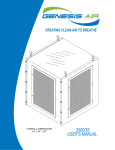
OVERALL DIMENSIONS
21 3/8” x 13 1/4” x 27 1/4”
Welcome!
Your purchase of a state of the art Genesis Air system is the first step in breathing new air! Our
powerful G.A.P. air purification method does much more than standard air filtration systems.
The G.A.P. technology in each Genesis Air system takes contaminated air and literally transforms
it into high quality clean air through a multi-step technology process.
We thank you for your purchase and are sure you will find your new Genesis Air system to be an
invaluable addition. We stand behind our products and are available to answer any of your
questions. We urge you to fill out your registration card and send it to us today! If you ever have
any questions about your new system or about our line of Genesis Air products, please contact us
at your earliest convenience.
Breathe Well.
Genesis Air, Inc.
TABLE OF CONTENTS
THE AIR WE BREATHE
Something In The Air
Where Conventional Filters Stop
What About HEPA Filters?
1
2
THE UVGI DIFFERENCE
What is UVGI?
3
GENESIS AIR GAP ™
Genesis Air GAP ™ Technology
4
INSTALLATION
Unpacking The System
Component Checklist
2000WO Unit Setup
Proper Wiring Instructions
5
6
7
8
PROPER USE
Operating the 2000WO Unit
9
MAINTENANCE
Changing the
Catalyst
Changing The Prefilter / Grille
Replacing Bulbs
10
12
13
REPLACEMENT PARTS
CONTACT INFORMATION
MAINTENANCE LOG
NOTES
16
17
18
19
TM
Table of Contents
THE AIR WE
BREATHE
Most people are spending a growing
portion of their time indoors. As much as
80% - 90% of the average American day
is spent indoors. Whether we are at home,
at work or in social settings, the majority
of our time is spent in enclosed areas with
limited air circulation. Many Americans
are unaware that their daily habits are
exposing them to increased levels of
indoor air pollution. In fact, many experts
believe that more Americans suffer from
the effects of indoor air pollution than outdoor air pollution. For many Americans that suffer
from allergies, asthma or other breathing troubles, indoor air pollution is not a nuisance, but a
threat to their health and well-being.
Where Does Indoor Pollution Come From?
Indoor air pollution can come from a variety of sources. Some air contaminants are obvious,
while others are less-known but equally dangerous threats to your health. Examples of shortterm effects include irritation to the eyes, nose and throat, and upper respiratory infections such
as bronchitis and pneumonia. Other symptoms can include headaches, nausea, and allergic
reactions. Short-term air pollution can aggravate the medical conditions of individuals with
asthma and emphysema. In the great "Smog Disaster" in London in 1952, four thousand people
died in a few days due to the high concentrations of pollution.
Long-term health effects can include chronic respiratory disease, lung cancer, heart disease, and
even damage to the brain, nerves, liver, or kidneys. Continual exposure to air pollution affects
the lungs of growing children and may aggravate or complicate medical conditions in the elderly.
The sources of indoor air pollution are varied, with some being more obvious than others.
Tobacco smoke, cooking and heating appliances, and vapors from building materials, paints,
furniture, etc. cause pollution inside buildings.
As these contaminants enter our daily environments, the lack of air circulation leaves them to
settle and accumulate. In time, these contaminants could accumulate in more than just
ventilation systems, these contaminants left to settle could accumulate within a person’s body.
Page 1
Where Conventional
Filters Stop
Where Conventional Filters Stop
A conventional air filter works by simply trapping
air debris and particulate matter in an airstream that
are too large to pass through the filter.
While larger particulate matter may be trapped by
one of these conventional filters, the smaller and
often more harmful matter can easily slip through
the gaps that exist in these filters. Airborne
bacteria, molds, pollen, chemical residue and dust
mites are just a few examples of the pollutants that
are not detained.
While breathing filtered air is a much better
alternative to non-filtered air, these conventional
filters are extremely limited in their effectiveness.
What About HEPA Filters?
High Efficiency Particulate Arrestance (HEPA) filters fill the gap in collection performance that
other conventional filters leave behind. These filters often provide a filtering efficiency of
99.9% since they can remove particles as small as 0.3 microns in diameter. HEPA filters have
proven to be very effective in containing contaminants such as lead, asbestos and mold spores.
Although these air filters are a much better alternative to conventional air filters, they alone can
not be counted on for truly clean air. Though HEPA technology may seem new to some, HEPA
filtration technology has been in existence since World War Two! Moreover, although HEPA
filters remove many airborne contaminants, their effectiveness can vary dramatically depending
on the filter’s construction, placement and amount of air passing through the filter. Moreover,
HEPA filters are not air purifiers. They, at best, trap a portion of the particulate matter and hold
it. Some filters may also contain odor-eliminating media such as charcoal - but even these
methods trap odors and fumes instead of eliminating them.
Genesis Air Systems will actually destroy organic vapors,
odors and numerous other contaminants permanently.
Page 2
THE UVGI
DIFFERENCE
Ultraviolet Germicidal Irradiation (UVGI) is a
process that exposes microorganisms to ultraviolet
radiation, typically in the range of 2250-3020
Angstroms.
The use of UVGI for the sterilization of
microorganisms has been studied since the 1930's.
Microbes are uniquely vulnerable to the effects of
light at wavelengths at or near 253.7 nanometers
(UV-C germicidal) due to the way this wavelength
resonates with a microbe’s molecular structure.
Putting it simply, the quantity of energy UVGI
possesses is just the right amount of energy to
break organic molecular bonds. When a microbe’s
bonds begin to break apart, it causes irreparable
cellular damage to bacteria, molds, fungi or
viruses.
With 11 watts of output per lamp, the UVGI intensity is 125 microwatts per cubic centimeter
within 12 inches of each lamp. Most central AC systems up to 5 tons require two lamps, which
give an effective UVGI intensity inside the air handler of approximately 250 microwatts. Larger
systems require additional lamps to maintain the required UVGI intensity levels.
In simple terms - the UVGI process will effectively destry many organic airborne contaminants
including bacteria and viruses which don’t stand a chance against concentrated UVGI. It’s a
method that’s as old and natural as the sun itself.
There is just one catch - UVGI alone is not a perfect method. Although many organic
contaminants can be destroyed easily and effectively, pollutants such as particulate matter,
smoke and inorganic gases won’t be stopped with UVGI.
Once again, something’s got to fill the GAP.
Page 3
TM
Genesis Air incorporates a revolutionary technology to clean, deodorize and disinfect the air.
This is a three-step synergistic approach to achieve air quality like never before! Our G.A.P.™
technology offers:
· Proven Leading - Edge Technology ·
· Rationalized Design For Application-Specific Products ·
G.A.P. Does Not Produce Harmful By-Products - There is No Accumulation of Contaminants
Oxidizes Organic Substances Into Benign Components
· Value-Priced, Low Maintenance Costs, Long-Lifetime Components ·
1
ADVANCED
FILTRATION
2
UVGI
TECHNOLOGY
Removes even particles you 10,000 times the power of the
Sun, eradicate most airborne
can't see. New, highbacteria, viruses, mold,
efficiency, high-capacity, low
spores, and fungi.
resistance particle filter
Ultraviolet light has been
removes most pollen, mold,
used for years in hospitals
mildew, ragweed, dust mites,
house dust, bacteria, pet
and critical situations to kill
dander and many other
bacteria, virus and other
contaminants. Its benefits are
submicroscopic poisons,
proven and well-known. Now
allergens and irritants
Genesis Air Photocatalysis
(GAP™) uses ultraviolet
germicidal light in a dual role
to destroy and neutralize
microorganisms and to
activate the photocatalyst,
which destroys organic
compounds and odors
Page 4
GENESIS AIR
3 PHOTOCATALYSIS
(GAP™) - Converts and
breaks down harmful
chemical vapors and odors.
Titanium Dioxide in the
presence of UV light has a
natural purifying effect on
organic compounds, odors,
and toxic gases of all kinds.
Its oxidizing effect converts
chemical and biological
contaminants into benign
elements - carbon dioxide
and water vapor.
Installation: Unpacking Your Genesis Air System
Your new Genesis Air 2000WO unit is ready to use or install right out of the box! Simply take
the unit out of the box, remove all protective wrapping and pull away any protective cardboard
before proceeding to the next step!
DO - Remove all protective plastic wrap, packing bubbles, foam, tape and cardboard before
continuing with the installation. Failure to remove these items could reduce the effectiveness of
your 2000WO unit, cause a hazard or fire and may void warranties.
DO NOT - Do not remove any protective or aluminum tape from the ballast, around the wiring
or from the inside of the 2000WO unit. These items - UL tape, electrical ties, etc.. are provided
for your safety and for the best performance from your 2000WO unit.
Page 5
Installation: Component Checklist
GA-WO-10
LID
GA-WO-12
PREFILTER / GRILLE
GA-WO-11
CATALYST
GA-WO-13
UVGI BULBS
(Boxed and located
within the Main Housing)
GA-WO-01
HOUSING
Use this checklist to make sure your new Genesis Air 2000WO unit arrived intact. Please note
that the UVGI bulb will not arrive installed. Open the 2000WO unit by removing the screws on
the lid and removing the catalyst. Once the catalyst has been removed, the bulbs can be removed
and installed. Make sure to remove all packaging before continuing.
NOTE - Your 2000WO may vary slightly from the unit shown above, however, all components
will be essentially the same.
Page 6
Installation: 2000WO Unit Setup
B
D
C
A
DO NOT PLUG IN THE 2000WO UNIT UNTIL IT HAS BEEN SET UP
COMPLETELY AND IS IN PLACE UNDER THE FURNACE.
The Genesis Air 2000WO unit is designed to be used as a standalone under-furnace unit. The
2000WO system must be plugged into a standard wall outlet to function.
NOTE: The UVGI bulbs are located within the main housing. Remove the lid (A) by undoing
the screws located at the top of the unit. Second, remove the catalyst (B) by gently pulling it out
evenly from both ends. Removing the catalyst allows access to the inside of the main housing
area (C) and the bulbs. Remove the bulbs (D) from the packaging and install the UVGI bulbs.
For instructions on bulb installation and replacement, see the ‘Replcing Bulbs’ section of this
manual. The UVGI bulbs MUST be installed for proper operation and effectiveness. After
installing the bulbs, gently re-insert the catalyst and secure the lid once more. DO NOT OVERTIGHTEN SCREWS.
Place the 2000WO unit beneath the furnace before connecting the power cord. The power cord
must be firmly plugged in, using a standard (120V) wall outlet before operating the 2000WO
unit. Plugging in the 2000WO unit at this point will activate the unit and begin the cleaning
process.
**CAUTION**
When using your Genesis Air 2000WO system, it must be plugged into a standard 120V
grounded outlet. DO NOT attempt to modify any electrical components or the plug itself.
Modifying any of the electrical components could result in user injury and/or damage to the
2000WO unit.
NOTE - Your 2000WO unit may vary slightly from the unit shown above. If this is the
case, some of the procedures may have to be modified. The process and function of the
components, however, will not change.
Page 7
Installation:Proper Wiring Instructions
WIRING
Your 2000WO unit is designed to be plugged in to a standard 120V wall outlet. It may, however,
become necessary to change the ballast or perform maintenance work in which the schematic and
information below would be beneficial.
GENERAL
1. Before starting the installation, disconnect power to the unit by unplugging the unit from the
outlet.
2. To ensure proper installation, read and review these instructions and illustrations thoroughly
before beginning.
3. All electrical connections must be in accordance with local codes, ordinances or the national
electrical code.
WIRING DIAGRAM
THE FOLLOWING DIAGRAM IS FURNISHED FOR REFERENCE.
BLACK
WHITE
BLUE
YELLOW
GREEN
RED
GREEN TERMINAL
MUST BE GROUNDED
THESE INSTRUCTIONS DO NOT COVER ALL DETAILS OR VARIATIONS IN
EQUIPMENT, NOR DO THEY PROVIDE FOR EVERY POSSIBLE CONTINGENCY TO BE
MET IN CONNECTION WITH INSTALLATION, OPERATION OR MAINTENANCE.
GENESIS AIR STRONGLY ADVISES ALL INSTALLATIONS BE PERFORMED BY A
LICENSED ELECTRICIAN TO SATISFY LOCAL CODES..
Page 8
Proper Use: Operating the 2000WO Unit
UNDER-FURNACE SYSTEM
Once the Genesis Air 2000WO unit has been properly installed, it is ready to be used. The
2000WO unit is a standalone unit that will work without any outside assistance, simply plug it in
and the 2000WO does the rest!.
FURNACE
3
2
1
The 2000WO unit is designed to filter and clean air before it enters the furnace. I does exactly
that by using an innovative
system.
TM
1 - As the air is passed through the prefilter / grille, larger airborne
contaminants are removed from the airstream, allowing the air to pass
on.
2- As the filtered air is passed through the irradiation chamber, the
UVGI light will destroy any organic matter in the airstream including mold, pollen and bacteria.
3 - As the air is passed through the catalyst, the UVGI light will react
with it and cause the photo-catalysis of all organic material that may
still be contained in the airstream.
Page 9
Maintenance: Changing the
TM
Catalyst
It will become necessary, from time to time to remove and change or replace the
This is an easy process and can be accomplished quickly and efficiently.
TM
catalyst.
Remove the lid by loosening the screws and slowly pulling the lid away from the unit. You may
hear a small “click” as the safety switch is released. Be sure that the power cord is not caught in
the lid.
Once the lid has been removed, the
catalyst may be removed from the housing. Put the lid
aside and carefully remove the catalyst. Remove the catalyst by pulling gently from both ends in
a straight line. If there are any snags, work them out slowly with your fingertips.
TM
After the used catalyst has been removed, it
can be replaced. Place a replacement
catalyst into the main housing by placing it
snugly against the foam padding and
pressing gently, with even pressure on both
sides of the catalyst.
Make sure that the replacement catalyst is
placed properly by noting the direction of the
airflow on the catalyst housing. There will
be an arrow or similar indicator designating
the airflow. Proper airflow will travel from
the prefilter / grille section of the unit
through the UVGI bulb section and out
through the catalyst.
Replace the lid and properly secure it in
place once more, being careful not to snag
the power cord.
NOTE - Your 2000WO unit may vary slightly from the unit shown above. If this is the
case, some of the procedures may have to be modified. The process and function of the
components, however, will not change.
CAUTION!
Make sure the power is shut off before servicing this unit. Servicing this UVGI fixture
without shutting off the power risks potential skin and/or eye exposure. Disconnect the
power by unplugging the unit from the wall outlet!
Page 10
Proper Use: Changing the
Catalyst
TM
Changing the Catalyst - cont..
The Genesis Air
catalyst will need to
be changed in time, due to the photocatalyzing properties of the material.
As the catalyst assists in the destruction of
harmful and potentially hazardous air
contaminants, they are chemically changed
to benign substances - carbon and water vapor.
In time, this carbon buildup will accumulate on the catalyst
medium and could hamper the effectiveness of your 2000WO
unit. Proper maintenance, cleaning and changing of the
catalyst is one of the crucial steps in keeping your 2000WO unit
running effectively and efficiently.
TM
TM
Keep It Clean!
Proper care and maintenance of your Genesis
Air 2000WO system will keep it running
smoothly and efficiently.
If your 2000WO unit is placed in an area
where it is likely to deal with heavy smoking,
dust or any high concentration of air
contaminants, the unit must be inspected
more frequently than average. While it is
important to check the bulbs and catalyst,
remember that the 2000WO’s first line of
defense is the grille!
Keeping your 2000WO in good condition
will help maximize it’s life and efficiency.
CAUTION!
Make sure the power is shut off before servicing this unit. Servicing this UVGI fixture
without shutting off the power risks potential skin and/or eye exposure. Disconnect the
power by unplugging the unit from the wall outlet!
Page 11
Maintenance: Changing the Prefilter / Grille
Proper maintenance of your Genesis Air 2000WO unit is simple and efficient. There are two
basic functions that must be carried out on a regular basis - The inspection and replacement of
filter and catalyst media and the inspection and replacement of the UVGI bulb. The frequency
of these maintenance procedures depends largely on the amount of pollution encountered in the
ambient environment.
Changing the prefilter / grille is a simple process. To begin, simply follow the instructions
outlined in the previous section.
After the used prefilter / grille has been
removed, it can be replaced. Place a
replacement prefilter / grille into the main
housing by placing it snugly against the
foam padding. Press gently but firmly,
keeping an even pressure on both sides of
the prefilter / grille.
Make sure that the replacement prefilter /
grille is placed properly by noting the
direction of the airflow on the grille
housing. There will be an arrow or similar
indicator designating the airflow. Proper
airflow will travel from the prefilter /
grille section of the unit through the UVGI
bulb section and out through the catalyst.
Proper airflow will travel from the
prefilter / grille section of the unit through
the UVGI bulb section and out through the
catalyst.
NOTE - Your 2000WO unit may vary slightly from the unit shown above. If this is the
case, some of the procedures may have to be modified. The process and function of the
components, however, will not change.
CAUTION!
Make sure the power is shut off before servicing this unit. Servicing this UVGI fixture
without shutting off the power risks potential skin and/or eye exposure. Disconnect the
power by unplugging the unit from the wall outlet!
Page 12
Maintenance: Replacing Bulbs
Although the UVGI bulbs shipped with your 2000WO unit are designed for a long life, it may
become necessary from time to time to perform maintenance on and sometimes replace these
bulbs. This is an easy process and can be accomplished quickly and efficiently.
Remove the lid by loosening the screws and slowly pulling the lid away from the unit. You may
hear a small “click” as the safety switch is released.
Once the face panel has been removed, the
catalyst must be removed from the housing.
Put the lid aside and carefully remove the catalyst by pulling firmly but gently in a straight line
with while holding both sides of the catalyst. Set the catalyst aside.
TM
NOTE - Your 2000WO unit may vary slightly from the unit shown above. If this is the case it
may be necessary to remove the outlet cover through a slightly different method.
Your Genesis Air 2000WO unit is equipped and designed to be used with two 36 Watt UVGI
bulbs. These bulbs are critical to the proper use and effectiveness of your system. When it
becomes necessary to change the bulbs, follow the procedures and guidelines outlined in this
section. UVGI (Ultraviolet Germicidal Irradiation) bulbs are specifically designed for
sterilization and can cause serious damage to exposed skin or eyes. If handled properly and
safely, these bulbs can be easily replaced and disposed of.
UGVI?
CAUTION!
UVGI bulbs will be extremely
hot to the touch. Allow the
bulbs to cool before attempting
to clean or replace the bulbs.
Ultraviolet energy in the "C Band" is an
electromagnetic wave form that destroys
microorganisms. It is produced when mercury vapors
are exposed to high voltage energy called plasma.
This plasma is what produces the blue light glowing
in our tubes.
CAUTION!
Make sure the power is shut off before servicing this unit. Servicing this UVGI fixture
without shutting off the power risks potential skin and/or eye exposure. Disconnect the
power by unplugging the unit from the wall outlet!
Page 13
Maintenance: Replacing Bulbs - cont.
CAUTION!
UVGI bulbs will be extremely
hot to the touch. Allow the
bulbs to cool before attempting
to clean or replace the bulbs.
To ensure effective and safe operation, UVGI fixtures must be inspected on a quarterly basis or
more often if indicated by lamp cleanliness and lamp failure due to the operating environment or
conditions.
UV working lamps should never be handled with bare fingers, always wear soft cotton gloves
when handling working lamps to prevent oily deposits that decrease lamp efficiency and lamp
All UVGI systems must be inactivated prior to maintenance, renovation or repair work, or when
accessing ventilation ducts where UVGI systems have been installed.
If it is not possible or feasible to turn the UVGI systems OFF to perform necessary
tasks appropriate personal protective equipment (PPE) must be worn.
The following procedure must be followed at all times:
Turn OFF power to the 2000-P unit. Depending on the installation, a circuit switch may be
used or the appropriate fuse may be removed.
Verify that the lamps are OFF by observing the fixture from a distance. There should not be a
blue glow if the units are OFF.
Open the unit according to the instructions in this manual.
Remove the lamps from the unit for cleaning.
Wearing soft cotton gloves and using a cloth dampened with alcohol, clean each lamp and
reflector. All dust and other deposits should be removed since they reduce the
effectiveness of the UV lamps.
While still wearing cotton gloves to prevent oily deposits, replace the lamp tubes in the unit.
Page 14
Maintenance: Replacing Bulbs - cont.
Replace "old" lamps with new lamps if any of the following conditions exists.
- Prior to the manufacturer's expected life rating of 9000 burning hours of usage.
- When tubes stop glowing.
- When they flicker to an objectionable extent;
- or if there is a drastic reduction in output measurement from the previous quarterly
inspection.
Replace and secure the outlet cover in place once more.
Turn power ON the unit and verify lamp operation.
Document the inspection, cleaning and lamp replacement in the a Preventive Maintenance
Record.
TAB
To replace the bulb, depress the TABS on
either side of the base. Slide the bulb out
carefully and replace in a similar fashion.
Bulb Disposal
In most states, UVGI light bulbs can be disposed of in the same way as regular or fluorescent
light bulbs. While all fluorescent and UVGI bulbs contain a trace amount of mercury, the
quantity is so minute that disposal is not regulated by federal standards (established by the EPA,
the Environmental Protection Agency). Individual states and provinces, however, have also
established disposal standards. Please adhere to your local regulations.
CAUTION!
Make sure the power is shut off before servicing this unit. Servicing this UVGI fixture
without shutting off the power risks potential skin and/or eye exposure. Disconnect the
power by unplugging the unit from the wall outlet!
Page 15
REPLACEMENT PARTS
Although we do not expect you to have any recurring problems with your 2000WO unit, we
understand that at some point in time, a replacement part may be necessary. These replacement
parts are readily available from our warehouse and can be shipped to you promptly. Just contact
us with the following information:
· Replacement Part Number
Pre-Order!
· Quantity Required
· 2000WO Serial Number
· Cause For Replacement (Optional)
To minimize down-time of your 2000WO
unit, pre-order replacement bulbs before the
current bulbs go out!
PART NUMBERS
GA-WO-01
-10
-11
-12
-13
GA-DT-05
GA-DT-12
HOUSING
LID
CATALYST
PREFILTER / GRILLE
UVGI BULB
BALLAST
BULB SOCKET
Page 16
CONTACT INFORMATION
We aim to serve our customers with all their needs. If you ever need to contact us, don’t hesitate.
Our offices are open Monday through Friday 8am - 5pm (Central Time).
Corporate Offices
GENESIS AIR, INC.
2714 - B 82nd Street
Lubbock, TX 79423
Phone (806) 745-7000
Fax (806) 745-7079
Company Website
www.genesisair.com
For Product Literature
[email protected]
For General Assistance
Visit Our Website
Page 17
Maintenance Log
Maintaining a well-documented log can help keep track of how your 2000WO unit is
performing. Use to spaces below to document the maintenance needed.
DATE
PART(S) SERVICED
DESCRIPTION
Page 18
NOTES
Serial Number
Write your 2000WO serial number in the
space above. It may be necessary to have this
number available when contacting Genesis Air.
Page 19
NOTES
Page 20