1
Input Setup
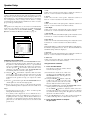
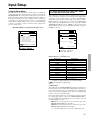
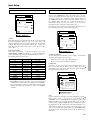
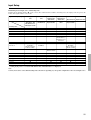
Input source signals
Listening Modes
a. Analog/PCM
Analog sources consist of LP records, FM and AM broadcasts,
cassette tapes, and the such. PCM (Pulse Code Modulation) is one
form of digital audio signals and is recorded directly onto compact
discs and DVDs without compression.
Mono
This mode is for playing old movies where the sound is recorded in
monaural or for playing the left and right channels of movies
separately that contain different language signals. This mode also
allows you to listen to the multiplexed soundtracks on DVDs, and
other media that have them.
b. PCM fs=96k
Digital PCM sources recorded with a sampling rate of 96 kHz.
c. Dolby D (Dolby Digital)
Digital data with AC-3 compression and a maximum of 5.1-channel
surround sound. This source signal comes from DVDs and LDs that
have the
mark and therefore recorded for 5.1-channel output.
Dialog norm
Dialogue Normalization (Dialog Norm) is feature of Dolby
Digital. When playing back software that has been encoded in
Dolby Digital, sometimes you may see a brief message in the
front panel display that reads Dialog Norm xdB (“x” being a
numeric value). Dialogue Normalization serves to let you know
if the source material has been recorded at a higher or lower level
than usual. For example, if you see the message “Dialog Norm:
+4” in the front panel display, to keep the overall output level
constant just turn down the volume control by 4dB. In other
words, the source material that you are listening to has been
recorded 4dB louder than usual. If you do not see a message,
then no adjustment of the volume control is necessary.
d. DTS
DTS (Digital Theater System) is compressed digital data with a
maximum 5.1-channel surround output (6.1-channel with DTS-ES
Discrete sources) that allows for an extremely high-quality sound.
This source signal requires a DVD player that supports DTS output
and comes from DVDs, compact discs, and LDs that have the
mark.
e. D.F. 2 ch (Digital Format 2 channel)
2-channel digital signals (not including PCM) such as Dolby Digital.
DVDs or LDs recorded with 2-channel sound may be this type of
input signal.
f. D.F. Mono (Digital Format Monaural)
Monaural digital signals (not including PCM) such as Dolby Digital.
DVDs or LDs recorded with monaural sound may be this type of
input signal.
56
Pure Audio
Same as the direct mode except that the pure audio mode also turns
off the display window, turns off the power supply to the video
circuitry, and minimizes the sources of noise. The result is highfidelity music playback true to the original source.
Note:
In the Pure Audio mode, if any component video signal is presented
on the COMPONENT VIDEO INPUT2 jack, it will be output to the
COMPONENT OUTPUT jack.
Direct
This mode delivers pure sound with minimum sound quality
adjustment and filtration. The sound recorded for the right and left
front channels is output to the right and left front speakers only and
not output to the subwoofer.
Stereo
This mode has all input sound is output from the left and right front
speakers.
The subwoofer is also used for playback.
T-D (Theater-Dimensional)
For the best enjoyment of your home theater, it is recommended that
you have front left and right speakers, a center speaker, and surround
left and right speakers. However, if you only have front left and right
speakers, you can enjoy multichannel audio by using this mode.
This mode controls the characteristics of the sound that reaches each
ear to reproduce a multi-speaker setup. To receive the full effect,
there is an optimum listening position (sweet spot). Refer to the
explanation of the listening angle. In addition, if the reflective sound
components are large, it may be difficult to achieve the desired
result, so be sure to set up your system and listening position to
minimize reflective sound.
Dolby Pro Logic II
Opposed to Dolby Pro Logic, which had four channels (front left/
right, center, and surround) recorded into two channels with matrix
processing and then played back in four channels, Dolby Pro Logic
II uses a feedback logic circuit to have 5.1-channel surround audio
(Dolby Surround, etc.) matrix-encoded into two channels and then
played back in its original 5.1-channel form.
Dolby Pro Logic II provides a Movie mode designed for playing
movies and a Music mode designed for listening to music. In the
Movie mode, the surround channels, which used to provide
monaural output over only a narrow frequency range, now provide
complete stereo output over the full frequency range. The result is
movie viewing with a realistic feel of movement. This mode can be
used with VHS and DVD videos with the
mark and
certain television programs. The Music mode uses the surround
channels to provide a natural soundfield that cannot be provided
with normal stereo output.
This mode can be used with music compact discs and other stereo
sources.