1
PURCHASE SELECTION
It is important that the selection of a device is
made after the purchaser and supplier have both
fully understood the application of the equipment.
3833 SALA Way, Red Wing, MN 55066-5005
800-328-6146 www.protecta.com
260 Export Blvd. Mississauga, Ontario L5S1Y9
800-387-7484 www.protecta.com
Instructions for Use
AD Series
Self Retracting Lifelines
YOU MUST READ AND UNDERSTAND, OR HAVE THE
FOLLOWING INSTRUCTIONS EXPLAINED TO YOU
BEFORE USING THIS EQUIPMENT. FAILURE TO DO SO
COULD RESULT IN INJURY OR DEATH.
This manual is intended to meet the Manufacturer’s
Instructions as required by ANSI Z359.1 and
should be used as part of an employee training
program as required by OSHA.
PART NUMBER
LINE LENGTH
SERIAL NUMBER
DATE OF MANUFACTURE
WARNING All of the equipment which is
recommended by Protecta should be used as part
of a complete Protecta Fall Prevention System.
The buyer or the user choosing to disregard this
warning is solely responsible for the safety of the
entire system. OSHA regulations require that the
employer and the employee recognize that all
components of the Personal Fall Arrest System
(PFAS) be compatible with one another before
use.
No fall prevention system can guarantee that
absolutely no injuries will be sustained should a
sudden fall occur. Improper use of this equipment
will increase the risk of serious injury. To obtain
the optimum level of safety which Protecta’s fall
prevention systems can provide, you must read or
receive, understand and adhere carefully to all
instructions given by Protecta.
Applications: These mechanical devices are
known as Fall Arrest Devices or Self Retracting
Lifelines (SRL).
A fall arrest device has two main functions:
• To safely extend the working area where a
harness with a 6 ft. (1.8 m) lanyard is
inadequate.
• To reduce the shock loading on the body by
limiting the distance of the fall.
The fall arrest devices can be mobile with a device
travelling on a steel cable, fixed rail, or rope; or
stationary with an extendable anchorage line
which extends as the user moves away from the
anchorage point and retracts as he moves
towards the anchorage point.
All Protecta SRLs are automatic and allow hand
and body freedom of movement.
IMPORTANT: If you have any questions on the
use, care, or suitability of this equipment for your
application, contact Protecta before proceeding.
CENTRIFUGAL FORCE
By using centrifugal force Protecta devices ensure
that should a fall occur the brake is instantly
engaged. Normal movement will not activate the
braking mechanism and normal movement is not
hindered as the cable extends and retracts freely.
Should the cable receive a sudden pull caused by
the event of a fall, the cable locks automatically.
Protecta devices avoid violent arrests associated
with full body safety harnesses. The mechanism
will stop the user before excessive momentum is
attained in a normal fall.
If the end use will be in abnormal atmospheres, or
involves contact with acids, alkalis, sewer gas or
anhydrous ammonia, additional information will be
required before a choice of proper equipment can
be made and purchased.
USER TRAINING
Instructions on handling are supplied with all
safety equipment. It is the purchaser’s
responsibility to ensure that his workers
understand these instructions, have been trained
in the correct use of all equipment and have been
made aware of the importance of connecting to
suitable structural anchorages.
PROTECTA FALL PROTECTION DEVICES
For almost fifty years Protecta Fall Protection
Devices have been used in virtually every
conceivable situation for fall prevention.
A collective fall prevention system should be used
whenever possible. The Fall Arrestor may be
preferred for work of short duration or due to the
technical impossibilities of installing it in a
collective fall prevention system.
Reasons for using Protecta Fall Protection Devices
are:
1. Freedom of movement is allowable within a
much greater area.
2. The locking action of the Fall Arrest Device
is almost instantaneous in the event of a fall.
3. The arrest load imposed on the body is below
1350 lbs. (6 KN).
4. The maximum free-fall distance does not
exceed 2 ft. (0.6 M).
5. The retractable cable greatly reduces the
possibility of entanglement on surrounding
structures or physical hinderance by its
constant yet light tension.
SPECIAL FEATURES (depending on model)
• Metal casing or exclusive shockproof material
compound casing.
• Full corrosion-resistant components.
• Fully automatic; requires NO adjustment by user.
• Self-retracting cable.
• Less than 2 ft. maximum free fall distance.
• 3/16 in. galvanized/stainless steel, 1 in. nylon
web, Pro-Teq™ rope available on request.
• 310 lbs. (141kg) maximum safe working load.
APPLICABLE STANDARDS
Meets rigorous standards such as : OSHA 1926,
ANSI Z359.1 • B.S.I.5062 • D.I.N.23326 •
A.F.N.O.R S 71-020 • C.S.A. Z 259-2.2 and 2.3
CAUTIONS
•To be used only with an approved Full Body
Harness.
•Hold on to cable during rewinding.
•Do not leave cable extended for long periods of time.
WARNING: Never use a waist or chest belt of any
type for fall arrest hazards.
OPERATION AND USE
WARNING: Read and understand all instructions
and warnings on the labels attached to the device
before using. These instructions and warnings are
placed on the device for your protection. Be sure
that you understand and follow these directions
carefully. Before using this equipment make a visual
inspection to ensure the serviceable condition of
the device. Use the Inspection Checklist for guidance
(located towards the rear of this manual). Under no
circumstances should the SRL be used if the
lifeline has any defect, i.e. broken or flattened wire
strands, cut fibers, or is not retracting correctly.
A. Check by pulling entire length of lifeline out
and allowing its slow retraction thorough your
protected hand (when making this check, always
wear gloves to avoid the possibility of laceration
by broken wire strands).
B. Test the locking mechanism several times by
jerking down on the cable. Any device with
suspected faults should be immediately withdrawn
from service and returned to Protecta for further
examination and replacement if necessary.
After connecting the Fall Arrest Device to a safe
anchorage point attach the snap hook at the end
of the cable to the dorsal D-ring of the harness,
ensuring that the snap hook closes fully. Medical
evidence indicates that it is preferable to be
suspended from the dorsal D-ring.
In situations where it is necessary to use a front
D-ring as a point of attachment such as working
on a fixed ladder a harness with chest D-rings
such as the Protecta AB102A harness must be
used. Refer to OSHA requirements Protecta highly
recommends the exclusive use of Protecta full
body harnesses with all its individual fall
prevention systems.
Make every effort to keep the cable clean and free
from dry mud, cement, etc. Failure to do so can
result in premature locking and rewind failure of
the device.
Never allow the cable to contact sharp abrasive
edges, i.e. girders, roofing panels, etc. which could
damage and ultimately weaken the cable.
ANCHORAGE STRUCTURE
The anchorage to which the SRL is attached must
be capable of sustaining static loads in the
directions applied by the personal fall arrest system
of at least 3,600 lbs. with certification of a qualified
person, or 5,000 lbs. without certification. See
ANSI Z359.1 for certification requirements. When
more than one personal fall arrest system is
attached to the same structure, the strength
requirements stated above must be multiplied by
the number of personal fall arrest systems
attached to the structure.
•From OSHA 1910.66 and 1926.500: Anchorages used for attachment of a PFAS shall be
independent of any anchorage being used to
support or suspend platforms, and must
support at least 5,000 lbs. (22.2kN) per user
attached, or be designed, installed, and used
as part of a complete PFAS which maintains a
safety factor of at least two, and is supervised
by a qualified person.
DO NOT WORK ABOVE THE ANCHORAGE
POINT.
While using, always ensure that there is constant
tension on the cable. Slack in the cable could result
in an increase in fall distance. Move normally,
sudden jerky movements will activate the locking
mechanism. In the event of a fall, the fall arrest
device must not be used until it has been visually
checked by a competent person.
Checks include :
1. Pull out total length of cable to ensure it is
not damaged.
2. Pull cable out fast enough to lock the
system; repeat operation 3-5 times to ensure
satisfactory operation.
3. If the device’s operation remains
questionable in operation or performance, it
must be removed from service and returned
to Protecta for further review.
INSPECTION
WARNING: Before using, read and understand all
instructions contained in the user manual as well
as warnings and instructions on all labels attached
to the device.
PRIOR TO EACH SINGLE USE, CHECK :
1. The connector at top of device and ensure
freedom of movement. Check for signs of
distortion, cracks, burns, or worn parts and
ensure that keeper is closed.
2. The nut and bolt retaining connecting hook
for signs of distortion, cracks, burns, and wear.
3. The main housing for signs of distortion or
cracks.
4. That main body housings fit evenly and that
there are no gaps between sections.
5. That all screws and rivets are present and
tightened.
6. The device for spring action; the entire
length of the cable should retract fully after
extension.
7. The locking action of the device-jerk on the
end of the cable; cable should retract easily
into the device.
8. Snap hooks for signs of distortion, cracks,
burns, and wear.
9. That all labels are present and fully legible.
10. The entire device for corrosion.
11. The condition of cable.
12. The impact load indicator, if so equipped
(webbing or mechanical).
CAUTION: Device should be stored with cable
retracted during periods of non-use. If after
inspection there is any doubt as to the safety or
appearance of the device, it should be removed
from service and returned to PROTECTA for
further inspection.
DEVICE CHECKUP
Before beginning this procedure ensure that you
are wearing gloves as broken wires along the
cable can cause severe cuts and lacerations.
1. Begin the inspection procedure at the
ferrule, check that it is correctly fitted and
there are no signs of distortion, cracks, or
corrosion.
2. Check mechanical swages for signs of
cracks, distortion, or corrosion-ensure that
they are fitted correctly and are not cutting
into the cable.
3. During the inspection of the cable the
following procedure should be used:
• Pass the cable slowly through your hands
• Flex the cable every few inches to allow for
complete inspection of broken wires.
4. Check the entire length of cable for signs of
deterioration or damage. Should there be
signs of deterioration or damage in the cable
or signs that the cable is not in safe working
condition the Fall Arrest Device must be
returned to Protecta for cable replacement.
INSPECTION OF STEEL CABLES
The following explains the principal causes of
deterioration of galvanized steel cables and
indicates the signs by which the deterioration can
be recognized.
Mechanical damage/crushing: Crushing the
cable often results in a flattened or bent section
of the cable.
Mechanical damage/cutting: Movement over
sharp edges or projections while the cable is
under tension can result in damaged strands and
broken wires.
Abrasion: Abrasion to the cable results in
localized wear. The outer wire strands appear
flattened and are brighter in appearance.
Strand Core Protrusion: Core protrusion usually
results from the cable having been subject to a
shock load.
Kinking: Kinking occurs by the deformation of the
cable during handling when a loop is formed and
then tightened without allowing for rotation about
its axis. Typical examples of localized wear and
deformation are created at a previously kinked
portion of the cable.
Corrosion: The presence of corrosion on the
exterior surface of the cable is recognizable by its
roughness and pitting. Wire breaks will generate
from these cracks or pitting.
Electric Arcing/Heat damage: Heat damage is
noticeable by a blue coloring on the wire surface
or by fusion of the wire surface and the presence
of welding signs.
SERVICING
Protecta Fall Arrest Devices, like all mechanical
mechanisms, require periodic servicing to ensure
safe and proper working condition.
ANSI Z359.1 requires formal inspection of the
SRL annually by a competent person other than
the user. Formal inspection should determine the
need for and frequency of servicing. In the event
of a Fall Arrest Device being subject to shock
loading, as the result of a fall or any other sudden
shock, it must be removed from service,
examined, repaired, and reset by Protecta before
it is placed back into service. Under no
circumstances shall the user carry out repairs or
modifications. All repairs must be carried out by
Protecta or an authorized service center. Do not
disassemble the SRL.
INSPECTION OF METAL COMPONENTS
D-Rings (on Full Body Harnesses )-check for
distortion, sharp edges, burrs, cracks, or worn
parts. For plated components, check for
deterioration in the protection and for signs of
corrosion.
Snap Hooks Check snap action, ensure that the
return spring is functioning properly and that there
is not sideways play on the latch in the closed
position. Check the hooks for distortion, sharp
edges, burrs, cracks, and worn parts. For plated
components check for deterioration in the
protection and for signs of corrosion.
Automatic Locking Hooks (Carabiners)
Check that the trigger opens fully and that it
returns automatically revolving the ferrule into the
locked position. Check for distortion, sharp
edges, burrs, cracks, or worn parts. For plated
components check for deterioration in the
protection and for signs of corrosion.
Screwgate Hooks Check snap action and ensure
that ferrule functions satisfactorily. Check for
distortion, sharp edges, burrs, cracks, and worn
parts. For plated components check for
deterioration in the protection and for signs of
corrosion.
ANY FALL ARREST COMPONENT WITH
SUSPECTED FAULTS MUST BE IMMEDIATELY
WITHDRAWN FROM SERVICE AND
RETURNED TO PROTECTA FOR INSPECTION.
WARNINGS
1. NEVER WORK ABOVE THE FALL
ARREST DEVICE. Always install the Fall
Arrest Device above head height. Avoid
working at more than 30 ° from the vertical. A
fall from more than 30 in. from vertical will
produce a swing effect which could cause
injury or death as a result of striking an
obstruction.
2. The Fall Arrest Device permits complete
freedom of movement, however, ensure that
you move normally as sudden or quick
movements will activate the locking
mechanism.
3. IT IS NOT PERMISSIBLE to make
additions or alterations to this equipment.
4. Anchorage point should allow end user to
move without interfering with other workers.
Never allow your cable to cross the cable of
another worker.
5. NEVER ALLOW more than one person at
a time to be connected to the fall arrest
device.
6. Follow manufacturer’s instructions for the
correct use of the fall arrest device and
associated accessories.
7. Before choosing an anchorage point survey
the surrounding area for hazards that could
interfere with your safety:
DO NOT INSTALL FALL ARREST DEVICES:
A. Where the possibility exists of the cable
contacting power lines, live cables ,etc.
B. Where obstructions may cause the cable to
become entangled. In the event of a fall, the
brake may not engage, or the cable runs the
risk of passing over a sharp edge; i.e.,
girders, etc., which could shear the cable
causing injury or death.
8. Do not use personal fall arrest devices
where, during an unexpected fall, the body
could strike obstructions that will cause
injuries or be fatal to the user.
9. Do not use personal fall arrest devices
where obstructions may slow down the user
and prevent the mechanism of the device
from locking.
10. Protecta SRLs are not adequate for use in
protecting workers in grain silos, coal
bunkers, slack hoppers, or other areas where
there is a danger of suffocation by immersion
in the material over which the worker is
standing should a collapse happen slowly and
not cause the locking mechanism to activate.
ALWAYS ensure that there is approximately 6
feet (1.8 M) of free fall space beneath the
working position.
11. Do not leave Protecta SRLs installed for
long periods of time in an environment where
corrosion of the main components could
occur as a result of vapors rising from organic
materials. Sewage and fertilizer plants, for
example, should be avoided due to the high
concentrations of ammonia present.
12. Do not use Protecta SRLs where there is
a potential risk of incendiary sparking due to
contact friction between the SRL, its cable, or
the device’s metal parts and rusted steel or
iron in the work area.
13. NEVER attach clips, etc., as a positioning
device to the cable which will prevent the
cable from retracting automatically. This
practice is dangerous as it leaves excessive
slack in the cable which, in the event of a fall,
will increase the fall distance and the shock
load on the body to unacceptable levels.
14. Avoid allowing the cable to pass between
your arms or legs while moving about or
working.
15. Avoid allowing the cable to contact paints,
concrete, bitumen, oils, etc. which will
adversely affect the SRL if it enters the
mechanism.
16. Always keep the steel cable clean and
free of dry mud, cement, etc. Failure to do so
could result in premature locking and
rewinding failure.
17. When detaching from the SRL do not
quick-release the cable allowing uncontrolled
rewind back into the device. This can be
dangerous and there is a probability that the
cable will rewind unevenly. Uneven rewind of
cable can prevent full retraction.
18. Do not leave cable extended for long
periods of time.
19. Always wear gloves while inspecting the
cable to avoid the possibility of laceration by
broken wire strands.
20. DO NOT repair equipment in the field.
Only Protecta is equipped to make repairs of
Protecta devices.
21. DO NOT combine self-rewinding personal
fall arrest devices with other fall arrest
systems (attach only to a 3,600 lb. anchor
point and connect directly to the dorsal D-ring
of a Protecta Full-Body Harness).
22. DO NOT OPEN the fall arrest device as
the spring is under tension.
CLEANING AND STORAGE
Wipe off all surface dirt, mud, dust, etc. with a
damp sponge. To clean off grease or oil use a mild
solution of water and household detergent.
Complete by sponging with clear water and
completely dry with a clean cloth.
After cleaning the fall arrest device, it should be
allowed to dry thoroughly in a hanging position
free from excessive heat or steam exposure.
Protecta fall arrest devices must be stored in a
clean, cool, and dry area away from chemical
fumes or corrosive elements. Never store in areas
exposed to direct sunlight. It is preferred that fall
arrest devices be kept, when not required for use,
in properly designed storage units which allow for
adequate ventilation.
Do not subject a fall arrest device to unnecessary
strain or pressure during storage. Do not expose
the fall arrest device to excessive heat, cold, or
humidity during storage. Do not allow the
equipment to contact sharp edges, corrosives, or
other likely causes of damage while the device is
in storage.
MEDICAL WARNING
For user safety, workers with physical disabilities
or muscular problems should receive medical advice prior to using fall arrest equipment. UNDER
NO CIRCUMSTANCES should pregnant women
or minors use Protecta fall arrest systems.
A worker’s ability to accommodate arrest forces
inflicted on the body in the event of a fall are
seriously affected by age and fitness of the user.
Only those in good health should work at heights.
Please contact your physician should there be
reason to doubt your ability to absorb the shock
load on your body in the event of a fall.
WARRANTY Seller warrants that its goods are
free from defects in material and workmanship for
a period of two year from the date of purchase.
Seller further warrants the fitness of their product
in meeting the applicable OSHA standard related
to the specific product. The purchaser is
responsible for advising the seller of need for
compliance with local, municipal, or state codes
other than OSHA. Accordingly, seller’s liability is
limited to replacing without charge or refunding
the purchase price, or making fair allowance for
any noncompliance with any specifications or
any defects in materials or workmanship in its
products existing at time of delivery. SELLER
MAKES NO OTHER WARRANTY OF ANY KIND
WHATEVER, EXPRESSED OR IMPLIED, AND
ALL IMPLIED WARRANTIES OF MERCHANTABILITY OR FITNESS FOR A PARTICULAR
PURPOSE, WHICH EXCEED THE ABOVE
OBLIGATION ARE HEREBY DISCLAIMED BY
SELLER AND EXCLUDED.
CONTINUED ON REVERSE
Seller will not be liable for any consequential
damages, loss, or expense arising in connection
with the use or inability whatever, regardless of
whether damage, loss, or expense results from
any act of failure to act by the Seller, whether
negligent willful, or from any other reason. Seller
requires written notice and the return of the
product to establish any claim. The seller reserves
the right to make design or other changes without
notifying the purchaser.
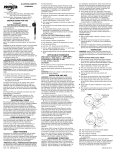
ONE OR MORE OF THESE LABELS WILL APPEAR ON YOUR PRODUCT
Inspection Log
Item
Inspect
Date Inspected
Action
Taken
AD611A and AD620A
Rebel Series: AD111, AD120, AD211
FRONT
& BACK
AD515A
FRONT
& BACK
Maintenance
Performed
FRONT
& BACK
APPROVAL:
APPROVAL:
APPROVAL:
APPROVAL:
APPROVAL:
APPROVAL:
APPROVAL:
APPROVAL:
APPROVAL:
APPROVAL:
APPROVAL:
APPROVAL:
APPROVAL:
APPROVAL:
APPROVAL:
Front Labels
AD212AG (CS),
AD222AG, AD215AG, AD230AG
Side Labels
Back Labels
APPROVAL:
APPROVAL:
AD210A (C), AD215A (C), AD220A (C), AD225A (C),
AD334A (C) AD343A (C), AD352A (C), AD360A (C)
APPROVAL:
APPROVAL:
FRONT
& BACK
APPROVAL:
APPROVAL:
APPROVAL:
APPROVAL:
APPROVAL:
APPROVAL:
APPROVAL:
APPROVAL:
APPROVAL:
APPROVAL:
APPROVAL:
©Protecta 2005
Form No.5902290 Rev.:F