1
BEFORE USING FOR THE FIRST TIME
1.
Carefully unpack the appliance and remove any packaging.
2.
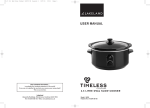
Wash the crock and lid in hot, soapy water or place in your dishwasher. Rinse and dry. The slow cooker
base may be wiped with a damp cloth, then dried. It must not be immersed in water.
USING YOUR SLOW COOKER
The beauty of slow cooking is that you can add the ingredients, turn on the slow cooker and enjoy a tender, moist
and flavourful meal hours later, with next to no effort. Cooks can make the most of cheaper cuts of meat and root
vegetables, with little or no pre-cooking required. Slow cooking is also extremely thrifty on electricity, costing not
much more than a light bulb to run. With a little adjustment here and there, you’ll find that many of your favourite
stovetop or oven-cooked recipes can be adapted to slow cooking.
1.
Prepare your ingredients and place them inside the crock. You may like to brown the meat and soften the
vegetables in a pan first.
HELPFUL HINTS
•
If you don’t have time to get your ingredients ready in the morning, they can be prepared the night before
and stored in the fridge. In the morning, transfer the food to the crock. Add enough boiling liquid e.g. stock,
to cover the ingredients, before switching on the slow cooker.
•
Frozen meat and poultry should always be thawed before slow cooking.
•
Root vegetables can take longer to cook than meat. They are best cut into small, even pieces.
•
As a general guide, most meat-and-vegetable recipes require 5-7 hours on AUTO WARM, 7-9 hours on
LOW and 4-5 hours on HIGH.
•
Slow cooking requires very little in the way of stirring, but you may like to give your food an occasional stir
if cooking on HIGH.
•
When lifting the lid, tilt so it opens away from you, to avoid being burned by steam.
PLEASE NOTE: the crock is microwave-safe and ovenproof, but must never be placed on a stovetop or
heated when empty. Please do not place the lid in your oven or microwave.
2.
Put on the lid. Being transparent, you can view the food as it cooks without needing to lift the lid, so
preventing heat and moisture from escaping.
•
3.
Plug the slow cooker into the mains socket. Select the desired temperature. See COOKING GUIDE
below. The power light will show the slow cooker is turned on and heating.
CARE AND CLEANING
1.
Turn off and unplug the slow cooker. Lift out the crock and let everything cool before cleaning.
4.
When your meal is ready, turn the dial to OFF and unplug the slow cooker. The crock can be lifted out and
taken to the table, but please wear oven gloves as it will be extremely hot.
2.
Wash the crock and lid in hot, soapy water, or place in your dishwasher. Rinse and dry. Please handle the
crock and lid with care, and do not use if they are chipped or cracked. CAUTION: avoid extreme
temperature changes. Never put a hot crock or lid into cold water or onto a wet surface.
3.
Wipe the base with a damp cloth, then dry. Please do not use abrasive cleaners or metal scourers. To avoid
electric shock, the base must not be immersed in water.
COOKING GUIDE
The slow cooker has three temperature settings so that cooking times can easily be adapted. Meals can be
slowly simmered all day long, or can be ready in just a few hours. Over time you will develop a feel for how long
your favourite recipes take, and this cooking guide offers a helpful starting point.
AUTO WARM: the standard setting, with an average cooking time of 6-8 hours. Food is cooked on HIGH until
the correct temperature is reached, then kept warm until you are ready to serve.
LOW: if you wish to extend the cooking time.
HIGH: if you wish to shorten the cooking time.
Cook on auto warm
Cook on low
Cook on high
4-6 hours
6-8 hours
3-4 hours
6-8 hours
8-10 hours
5-6 hours
8-10 hours
10-12 hours
7-8 hours
PLEASE NOTE: all cooking times are approximate, and will vary according to your recipe and choice of
ingredients.
RECYCLING YOUR ELECTRICALS
Along with many other high street retailers, Lakeland has joined a scheme whereby customers can take their
unwanted electricals to recycling points set up around the country. Visit www.recycle-more.co.uk to find your
nearest recycling point.