1
RHD2000 USB/FPGA Interface: Rhythm
Rhythm FPGA I/O Signals
General Description
The Rhythm interface code is designed for the Opal Kelly XEM6010-LX45 USB/FPGA module which is a small commerciallyavailable circuit board containing a Xilinx Spartan-6 FPGA (XC6SLX45-2), a 128-MByte SDRAM chip, a 100-MHz clock source,
I/O connectors, and a USB 2.0 interface chip capable of streaming data to a host computer at rates exceeding 20 MByte/s. (A
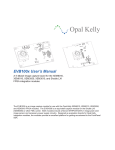
photo of the board is shown on page 1 of this datasheet. See http://www.opalkelly.com for detailed information on this module.)
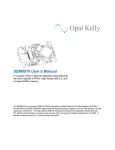
A similar Opal Kelly module, the XEM6110v2-LX45, offers the same hardware with a PCI Express interface for significantly
higher data rates and lower latencies (at the expense of a more complicated bus architecture). The Opal Kelly XEM6310 board
offers similar hardware with a USB 3.0 interface capable of significantly higher data rates with latencies similar to USB 2.0.
The Spartan-6 FPGA is a digital chip containing hundreds of thousands of configurable logic gates, flip-flops, and memory cells
with programmable connections between them. The FPGA is configured by means of a bitfile, which is compiled from Verilog
HDL (Hardware Description Language) code using the free Xilinx ISE WebPack software (available from http://www.xilinx.com).
The bitfile must be uploaded to the FPGA through the host computer interface (USB or PCI Express) every time the board is
powered up; it is not stored in non-volatile RAM on the FPGA or the Opal Kelly module. Since this “booting” process takes only a
fraction of a second, the flexibility it imparts becomes a useful feature: any changes made to the bitfile can be incorporated into a
software release. The FPGA never needs to be programmed using a special EEPROM programmer or JTAG interface.
The Rhythm Verilog code from Intan Technologies uses less than half of the logic resources on the XC6SLC45-2 FPGA, leaving
significant amounts of logic gates and on-FPGA memory for developers to add functionality (e.g., real-time signal processing and
feedback for closed-loop control). Opal Kelly also offers the XEM6010-LX150 USB/FPGA module which is identical to the
XEM6010-LX45 except for the use of an XC6SLX150-2 FPGA which contains approximately three times as many logic gates as
the XC6SLX45-2. Developers who wish to add significant amounts of processing at the FPGA level may wish to use this
module. However, to compile Verilog HDL into bitfiles for this larger FPGA, developers must use Xilinx’s ISE Logic Edition
software instead of the free WebPack. Also, the XEM6110 PCI Express interface board is only available with the smaller LX45
FPGA.
The diagram below shows the main elements on the Opal Kelly XEM6010 board and the I/O signals defined by Rhythm.
intan
TECHNOLOGIES, LLC
www.intantech.com ● [email protected]
2