1
UM1477
User manual
STEVAL-IFN004V1: BLDC six-step motor drive
based on the L6230 and STM8
Introduction
The STEVAL-IFN004V1 is a demonstration board based on STMicroelectronic's
STM8S105K4 microcontrollers and the DMOS fully integrated 3-phase motor driver L6230
implementing a trapezoidal control (6-step) for a brushless direct current motor (BLDC) in
both sensor and sensorless configurations.
It is designed as an evaluation environment for motor control applications in the range of
8 V - 48 V of DC bus voltage (which is extendable up to 52 V) and nominal power up to
35 W using the STM8S105K4 microcontroller with internal 16 kB Flash and the L6230
DMOS driver with 2.8 A output peak current, non-dissipative overcurrent
detection/protection, cross conduction protection, uncommitted comparator, thermal
shutdown, and undervoltage lockout.
With dedicated hardware evaluation features, the STEVAL-IFN004V1 board is designed to
help developers evaluate the device and develop their own applications.
The STEVAL-IFN004V1 can be used together with the STM8 BLDC firmware library v1.0
and constitutes a complete motor control evaluation and development platform.
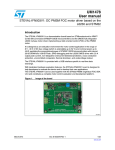
Figure 1.
December 2011
Image of the board
Doc ID 022373 Rev 1
1/22
www.st.com
Contents
UM1477
Contents
1
Main features . . . . . . . . . . . . . . . . . . . . . . . . . . . . . . . . . . . . . . . . . . . . . . . 4
1.1
Target applications . . . . . . . . . . . . . . . . . . . . . . . . . . . . . . . . . . . . . . . . . . . 4
2
Electrical characteristics of the board . . . . . . . . . . . . . . . . . . . . . . . . . . 5
3
Schematic, layout, and bill of material . . . . . . . . . . . . . . . . . . . . . . . . . . 6
4
General description . . . . . . . . . . . . . . . . . . . . . . . . . . . . . . . . . . . . . . . . . 11
4.1
Power supply . . . . . . . . . . . . . . . . . . . . . . . . . . . . . . . . . . . . . . . . . . . . . . 11
4.2
L6230 power stage . . . . . . . . . . . . . . . . . . . . . . . . . . . . . . . . . . . . . . . . . . 11
4.3
Current sensing circuitry . . . . . . . . . . . . . . . . . . . . . . . . . . . . . . . . . . . . . 13
4.4
Motor position feedback . . . . . . . . . . . . . . . . . . . . . . . . . . . . . . . . . . . . . . 14
4.5
STM8S105K4 microcontroller . . . . . . . . . . . . . . . . . . . . . . . . . . . . . . . . . 14
4.6
Using the STEVAL-IFN004V1 with the STM8 BLDC firmware library . . . 15
4.7
Hardware requirements . . . . . . . . . . . . . . . . . . . . . . . . . . . . . . . . . . . . . . 16
4.8
Software requirement . . . . . . . . . . . . . . . . . . . . . . . . . . . . . . . . . . . . . . . . 16
4.9
STM8 BLDC firmware library v1.0 customization . . . . . . . . . . . . . . . . . . . 17
5
References . . . . . . . . . . . . . . . . . . . . . . . . . . . . . . . . . . . . . . . . . . . . . . . . 20
6
Revision history . . . . . . . . . . . . . . . . . . . . . . . . . . . . . . . . . . . . . . . . . . . 21
2/22
Doc ID 022373 Rev 1
UM1477
List of figures
List of figures
Figure 1.
Figure 2.
Figure 3.
Figure 4.
Figure 5.
Figure 6.
Figure 7.
Figure 8.
Figure 9.
Image of the board . . . . . . . . . . . . . . . . . . . . . . . . . . . . . . . . . . . . . . . . . . . . . . . . . . . . . . . . 1
STEVAL-IFN004V1 schematic - MCU, power stage, and current sensing circuitry . . . . . . . 6
STEVAL-IFN004V1 schematic - power supply . . . . . . . . . . . . . . . . . . . . . . . . . . . . . . . . . . 7
STEVAL-IFN004V1 board layout - top and inner 1 layer . . . . . . . . . . . . . . . . . . . . . . . . . . . 8
STEVAL-IFN004V1 board layout - bottom and inner 2 layers . . . . . . . . . . . . . . . . . . . . . . . 8
Power supply section . . . . . . . . . . . . . . . . . . . . . . . . . . . . . . . . . . . . . . . . . . . . . . . . . . . . . 11
L6230 block diagram . . . . . . . . . . . . . . . . . . . . . . . . . . . . . . . . . . . . . . . . . . . . . . . . . . . . . 12
Current sensing circuitry . . . . . . . . . . . . . . . . . . . . . . . . . . . . . . . . . . . . . . . . . . . . . . . . . . . 13
STM8S105xx access line block diagram . . . . . . . . . . . . . . . . . . . . . . . . . . . . . . . . . . . . . . 15
Doc ID 022373 Rev 1
3/22
Main features
1
UM1477
Main features
The characteristics of the STEVAL-IFN004V1 BLDC 6-step driver board are the following:
1.1
●
DC voltage range from 8 V to 48 V (extendable up to 52 V)
●
Maximum load current of 1.4 Ar.m.s. (2.8 A peak) for each output
●
Integrated DC-DC regulator (5 V)
●
Monolithic power stage in QFN package featuring overcurrent and thermal protections
●
Single shunt current sensing
●
Control interface through trimmer and buttons
●
Debug outputs
●
Hall sensor/encoder inputs
●
Optimized layout on 4-layer board for high thermal performance.
Target applications
The demonstration kit is designed to fit all typical low-power BLDC motor applications, for
example:
4/22
●
Cooling fans
●
Pumps
Doc ID 022373 Rev 1
UM1477
2
Electrical characteristics of the board
Electrical characteristics of the board
Table 1.
STEVAL-IFN004V1 electrical characteristics
Parameter
Description
Value
Unit
VS, Max
Maximum motor supply voltage
48 (1)
V
VS, Min
Minimum motor supply voltage
8
V
Iout
Maximum output current
1.4
Ar.m.s.
Iout, peak
Maximum output peak current
2.8
A
Tj, op
Operating temperature
-25 to +125 °C
°C
1. Extendable to 52 V, refer to Section 4.1.
Doc ID 022373 Rev 1
5/22
6/22
Doc ID 022373 Rev 1
2
K
#
N&6
/54
"53?6/,4!'%?&
*0
*0
+
2
#
U6
6
2
K
#
N6
.234
0!/3#).
0!/3#/54
633
6#!0
6$$
6$$?)?/
0&!).
6
(!,,
(!,,
(!,,
.)!"0
.)!"0
.)!"0
.)!"0
.)!"0
"0
!?SS6
!?DD6
63
#
N6
6
K
2
+2"?-)4;$0=
-)73$0
$0
(#?-)4$0
$0
$0
$0
$0
30%%$$549
# N
%32 /HM
%3, N(
.234
34!2434/0
#
N6
)2%&
!PPL I CAT I ON R EF ER ENCE
2
+
"%-&
$
"!40&),-
-%4(/$?3%,
$%"5'
34-3+5
0#30)?-)3/
0#30)?-/3)
0#30)?3#+
0#
0#4)-?#(
0#4)-?#(
0#4)-?#(
0%
5
/54
#
N6
+
2
$%,!9!$6
"%-&
"%-&
"%-&
"53?6/,4!'%?&
40
-%4(/$?3%,
$%"5'
$%"5'
$%"5'
2
K
2
K
37 )-
2
K
40
40
40
'.$
40
6
#
P6
).
).
).
$)!'%.
%.
%.
%.
2
K
2
+
"%-&
$
"!40&),-
-%4(/$?3%,
6
$)!'%.
#0
)2%&
/54
).
%.
$)!'%.
,1
.#
.#
.#
.#
.#
.#
.#
#0
#0
#0/54
).
%.
).
%.
).
%.
+
2
).
%.
).
%.
5
6
%0
%0
"%-&
2
+
$
"!40&),-
-%4(/$?3%,
.#
.#
.#
'.$
'.$
3%.3%
3%.3%
3%.3%
/54
/54
/54
63!
63"
6#0
6"//4
2
27
/54
/54
/54
P6
+
2
#
"!6
2
+
#
$
5
#
N6
N6
N6
U6
#
N6
2
436
#
#
# P6
+
6
63
+
2
6
#
U6
#0
$
"!4,&),-
#/.
#.
/54
/54
/54
Figure 2.
%0
3
40
Schematic, layout, and bill of material
UM1477
Schematic, layout, and bill of material
STEVAL-IFN004V1 schematic - MCU, power stage, and current sensing
circuitry
!-V
Doc ID 022373 Rev 1
#/.
#.
63
2 2
34!2434/0 6
#
N6
37)-
"
8--04(
6 6
2%3%4
"
8--04(
2
K
6
*
.-
37)-
#
U&6
(!,,
(!,,
(!,,
5-+"*-- 4
4AI YO 9UDEN
#
N&6
34!2434/0
.234
342)0
*
#
N6
2
K
2
K
2
K
%.
%.
6).
"//4
5
%0
'.$ %0
&"
0'//$
$
3403:
)#343(3/0
37
#
N6
#
#
#
P6 P6 P6
2
K
6
*
(
(
(
6
'.$
$%"5'
$%"5'
$%"5'
$%"5'
2
K
2
2
U(
,
K
K
#
P&6
%0, -," #OI L CR AF T
U( !
342)0X
6
3PEED$UTY
6
06
404(!.%,,/--
'.$
404(!.%,,/--
.-
*
2
2
2
2
30%%$$549
360/3#/. 3!.9/
#
U&6 %32 MOHM
+
2
$
$
'2%%.
2
K
$
K
$
$
K
K
K
$%"5'
$ELAY!DVANCE
6
-)3/
-/3)
#,+
2
+
9%,,/7
9%,,/7
9%,,/7
9%,,/7
.-
-)3/
-/3)
#,+
'.$
*
$%,!9!$6
30)
Figure 3.
6
UM1477
Schematic, layout, and bill of material
STEVAL-IFN004V1 schematic - power supply
!-V
7/22
Schematic, layout, and bill of material
8/22
UM1477
Figure 4.
STEVAL-IFN004V1 board layout - top and inner 1 layer
Figure 5.
STEVAL-IFN004V1 board layout - bottom and inner 2 layers
Table 2.
STEVAL-IFN004V1
Reference
Part/value
B1, B2
Button 63 x 45 mm
CN1
3-wire power connector
CN2
2-wire power connector
C1, C9, C10, C13, C17,
C21
100 nF/6.3 V
C2
220 nF/16 V
C3
100 nF/100 V
C4
47 µF/63 V
Doc ID 022373 Rev 1
Manufacturer
Manufacturer code
UM1477
Schematic, layout, and bill of material
Table 2.
STEVAL-IFN004V1 (continued)
Reference
Part/value
Manufacturer
Manufacturer code
C5
10 nF/100 V
C6
470 nF
C7
4.7 µF/6.3 V
C8, C18, C19, C20
10 pF/6.3 V
C11
10 nF/6.3 V
C12
10 µF/6.3 V
C14
33 pF/6.3 V
C15
100 pF/6.3 V
C16
4.7 nF/10 V
C22, C23
100 nF/100 V
C24
47 µF/6.3 V
C25
820 pF/6.3 V
C26
10 µF/50 V
D1
BAV99
D2
BAT30
STMicroelectronics
BAT30LFILM
D3, D4, D5
BAT30 (dual parallel)
STMicroelectronics
BAT30-07P6FILM
D6, D7, D8, D9
Yellow LED diode
D10
STPS0560Z
STMicroelectronics
STPS0560Z
D11
Green LED diode
J1
Strip line 1 x 4
J2
Strip line 1 x 5
J3, J4
Strip line 1 x 4 (N.M.)
J5
Strip line 1 x 2 (N.M.)
JP1
Jumper SMD 3 x 1
JP2
Jumper SMD 2 x 1
L1
8.2 µH – 0.5 A
Coilcraft
EPL2010
R1, R5
33 kΩ
R2, R3, R4
39 kΩ
R6, R7, R10, R26, R27,
R28, R29, R30
1 kΩ
R8
0.33 Ω – 1 W
R9
3.3 kΩ
R11
68 kΩ
R12
10 kΩ
R13, R14, R15
2.2 kΩ
Doc ID 022373 Rev 1
9/22
Schematic, layout, and bill of material
Table 2.
10/22
UM1477
STEVAL-IFN004V1 (continued)
Reference
Part/value
Manufacturer
Manufacturer code
R16, R17, R18, R21,
R22, R23, R24, R25
10 kΩ
R19, R20
100 kΩ potentiometer
R31
0Ω
R32
47 kΩ
R33
4.7 kΩ
R34
1.5 kΩ
TP1, TP2
Ring test point
U1
STM8S105K4
STMicroelectronics
STM8S105K4U6
U2
L6230
STMicroelectronics
L6230Q
U3
TSV991
STMicroelectronics
TSV991AILT
U4
ST1S14
STMicroelectronics
ST1S14PHR
Doc ID 022373 Rev 1
UM1477
General description
4
General description
4.1
Power supply
The STEVAL-IFN004V1 board is designed to be powered via CN2 connector 'VS'.
The VS supply voltage is used to directly supply the L6230 power stage and is applied at the
input of the ST1S14 step-down power switching regulator to generate the 5 V able to supply
the microcontroller, the comparator and the board pull-ups (refer to Figure 6).
Figure 6.
Power supply section
#
N6
6$$?-#5
*
#.
63
5
343
22
#
N&6
63
66
"//4
37
6).
0'//$
%.
&"
,
6
U(!
2
2
K
K
2
K
%.
#
U&6
'.$ %0
%0
$
3403:
2
K
#
P&6
$
'2%%.
#
U&6
'.$
!-V
If the system requirements need a power stage supply voltage higher than 48 V (up to 52 V),
it is possible to disconnect the switching regulator from the VS connector by removing the
R31 resistor and supplying it through the connector J5 to keep generating the 5 V on the
board.
4.2
L6230 power stage
The L6230 is a DMOS fully integrated 3-phase motor driver with overcurrent protection.
Realized in BCDmultipower technology, the device combines isolated DMOS power
transistors with CMOS and bipolar circuits on the same chip.
An uncommitted comparator with open drain output is available (refer to demonstration
board schematic in Figure 2).
●
Features:
–
Operating supply voltage from 8 to 52 V
–
2.8 A output peak current (1.4 A RMS)
–
RDS(on) 0.73 Ω typ. value @ TJ = 25 °C
–
Integrated fast freewheeling diodes
–
Operating frequency up to 100 kHz
–
Non-dissipative overcurrent detection and protection
–
Cross conduction protection
–
Diagnostic output
Doc ID 022373 Rev 1
11/22
General description
UM1477
–
Uncommitted comparator
–
Thermal shutdown
–
Undervoltage lockout
Figure 7.
L6230 block diagram
6"//4
6#0
6"//4
6"//4
63!
4(%2-!,
02/4%#4)/.
#(!2'%
05-0
/#$
/54
6
/#$
/#$
/#$
/#$
3%.3% 6"//4
$)!'%.
/#$
'!4%
,/')#
).
%.
/54
6
).
%.
3%.3% 6"//4
).
63"
%.
6
6
/#$
/54
6
6/,4!'%
2%'5,!4/2
3%.3%
#0/54
#0
#0
#/-0!2!4/2
!-V
Table 3.
L6230 absolute maximum ratings
Symbol
Parameter
Conditions
Value
Unit
VS
Supply voltage
VSA = VSB = VS
60
V
60
V
VS +10
V
VOD
Differential voltage between: VSA, OUT1, OUT2, VSA = VSB = VS = 60 V;
SENSEA and VSB, OUT3, SENSEB
VSENSEx = GND
VBOOT
Bootstrap peak voltage
VIN, VEN
Logic inputs voltage range
-0.3 to +7
V
VCP-, VCP+
Voltage range at CP- and CP+ pins
-0.3 to +7
V
VSENSE
Voltage range at SENSEx pins
-1 to +4
V
IS(peak)
Pulsed supply current (for each VS pin)
VSA = VSB = VS;
TPULSE < 1 ms
3.55
A
IS
RMS supply current (for each VS pin)
VSA = VSB = VS
1.4
A
Tstg, TOP
Storage and operating temperature range
-40 to 150
°C
Note:
12/22
VSA = VSB = VS
Stresses above the limits shown in Table 1 may cause permanent damage to the device.
Doc ID 022373 Rev 1
UM1477
General description
The L6230 integrates a non-dissipative overcurrent detection circuit (OCD) for full
protection.
To implement the overcurrent detection, a sensing element that delivers a small but precise
fraction of the output current is implemented with each high side power MOSFET. This
current is compared with an internal reference current IREF.
When the output current reaches the detection threshold (typ ISOVER = 2.8 A), the OCD
comparator signals a fault condition. When a fault condition is detected, an internal open
drain MOSFET connected to pin DIAG-EN is turned on. Pin DIAG-EN is to be used to signal
the fault condition to a MCU.
The internal comparator is used for the current control, for more details refer to Section 4.3
which follows.
4.3
Current sensing circuitry
In the 6-step driving method only one sense resistor is needed, the three SENSE pins are
connected together to Rsense (refer to Figure 8).
Figure 8.
Current sensing circuitry
6
FROM,
3%.3%XPINS
2
K
#0/54
TO-#5
#
P
2 K
5
7
2SENSE
436
#
P
2 K
2 K
,
INTERNALCOMPARATOR
#0
)2%&
#0
2 K
#
P
!-V
The voltage across the shunt resistor is conditioned by operational amplifiers (TSV991)
which provide the proper feedback signals to the non-inverting input of the L6230 internal
comparator (CP+ pin). The op amp output voltage range is optimized for a given phase
current range and the comparator input dynamics. The op amp output voltage is
proportional to the sense voltage; when the CP+ voltage becomes greater than the
reference voltage applied at inverting input CP-, the comparator open drain output is
switched on pulling down the CPOUT pin.
This signal may be managed by the MCU to generate the proper input sequence for a 6-step
driving method with current control and to select what current decay method to implement.
When the CP+ voltage decreases below the CP- voltage, the open drain is switched off and
the voltage at the CPOUT pin starts to increase charging the capacitor connected to the pin
(C8 in Figure 2 board schematic).
The reference voltage at pin CP- is set according to the sense resistor value and the desired
regulated current.
Doc ID 022373 Rev 1
13/22
General description
4.4
UM1477
Motor position feedback
The MCU must provide the signals to direct the motor rotation and it then requires a means
of determining the rotor's orientation/position (relative to the stator coils).
Some designs use Hall effect sensors or a rotary encoder to directly measure the rotor's
position. Others measure the back EMF in the undriven phase to gather the rotor position,
eliminating the need for separate Hall effect sensors; this method is called sensorless
control.
This board is able to manage both Hall effect sensor feedback and back EMF zero-crossing
feedback.
Sensored drive
The first method uses position sensors, usually Hall sensors, to measure the rotor position.
Sensorless drive
The other method is based on the BEMF. It analyzes the zero crossing of the floating phase
BEMF signal to establish the commutation point. The match between the BEMF signal of
the floating phase, with respect to the motor neutral point (or star point), is used to generate
the commutation between two consecutive steps in order to achieve rotor synchronization.
More information about the rotor position detection techniques implemented in the STM8
motor control firmware can be found in the UM0708 user manual.
4.5
STM8S105K4 microcontroller
The STM8S105xx access line 8-bit microcontrollers offer from 16 to 32 Kbytes Flash
program memory, plus integrated true data EEPROM. They are referred to as mediumdensity devices in the STM8S microcontroller family reference manual (RM0016).
All devices of the STM8S105xx access line provide the following benefits:
●
●
●
●
Reduced system cost
–
Integrated true data EEPROM for up to 300 k write/erase cycles
–
High system integration level with internal clock oscillators, watchdog and
brownout reset.
Performance and robustness
–
16 MHz CPU clock frequency
–
Robust I/O, independent watchdogs with separate clock source
–
Clock security system.
Short development cycles
–
Application scalability across a common family product architecture with
compatible pinout, memory map and modular peripherals
–
Full documentation and a wide choice of development tools.
Product longevity
–
Advanced core and peripherals made in a state-of-the-art technology
–
A family of products for applications with a 2.95 to 5.5 V operating supply.
Please refer to the STM8S105xx datasheet for an overview of the complete range of
peripherals proposed in this family.
14/22
Doc ID 022373 Rev 1
UM1477
General description
Figure 9 shows the general block diagram of the device family.
It is possible to get more information regarding the feature of the microcontroller and its
operating mode in the STM8S-A reference manual.
Figure 9.
STM8S105xx access line block diagram
2ESET BLOCK
84!, -(Z
#LOCK CONTROLLER
2ESET
2ESET
2# INT -(Z
$ETECTOR
0/2
"/2
2# INT K(Z
#LOCK TO PERIPHERALS AND CORE
7INDOW 7$'
34- CORE
)NDEPENDENT 7$'
$EBUG37)-
5P TO +BYTES
PROGRAM &LASH
-ASTERSLAVE
AUTOSYNCHRO
,). MASTER
30) EMUL
5!24
+BYTES
DATA %%02/-
+BITS
-BITS
5P TO CHANNELS
K(Z
BEEP
) #
30)
!DDRESS AND DATA BUS
3INGLE WIRE
DEBUG INTERF
!$#
5P TO +BYTES
2!-
"OOT 2/-
BIT ADVANCED CONTROL
TIMER 4)-
5P TO
#!0#/CHANNELS COMPLEMENTARY
OUTPUTS
BIT GENERAL PURPOSE
TIMERS 4)- 4)-
5P TO
#!0#/CHANNELS
BIT BASIC TIMER
4)-
"EEPER
!75 TIMER
!-V
4.6
Using the STEVAL-IFN004V1 with the STM8 BLDC firmware
library
The “STM8 BLDC firmware library v1.0” provided together with the STM8-MCKIT performs
the trapezoidal control (6-step) of a brushless direct current motor (BLDC) in both sensor
and sensorless configurations. It is possible to configure the firmware to work with the
STEVAL-IFN004V1 board.
This section describes the customization to be applied to the STM8 BLDC firmware library
v1.0 in order for the firmware to be compatible with the STEVAL-IFN004V1.
Doc ID 022373 Rev 1
15/22
General description
4.7
UM1477
Hardware requirements
The following items are required to run the STEVAL-IFN004V1 together with the STM8
BLDC firmware library:
4.8
●
The STEVAL-IFN004V1 board
●
A DC power supply (up to 48 V)
●
A programmer/debugger dongle for the control board (not included in the package). To
program/debug the STEVAL-IFN004V1, a dongle with single wire debugging
capabilities (SWIM) is required. The use of an insulated dongle is always
recommended
●
A 3-phase brushless motor with permanent magnet rotor (not included in the package)
●
An insulated oscilloscope (as necessary)
●
An insulated multimeter (as necessary).
Software requirement
To customize, compile, and download the STM8 BLDC firmware library v1.0, a tool chain
must be installed. Please refer to the UM0708 user manual for major details on how to set
up the proper tool chain.
Please note that, as is, the STM8 BLDC firmware library v1.0 isn't fully compatible with the
STEVAL-IFN004V1.
In order for the STM8 BLDC firmware library v1.0 to be fully compatible with the STEVALIFN004V1 it is necessary to install the firmware patch “STEVAL-IFN004V1_Patch.exe”
available for download from the ST.com website.
Installing the “STEVAL-IFN004V1_Patch.exe” firmware patch enables the functionality of the
“START/STOP” button, of the “SPEED/DUTY” potentiometer and of the “DELAY/ADV”.
Please note that it is not advisable to install the firmware patch in the installation folder of the
STM8 BLDC firmware library because the process is not reversible. It is advised to apply the
patch in a folder containing a copy of that directory and remember to create a backup copy
of that folder before installing the patch.
To summarize, it is possible to follow this guideline:
16/22
●
Copy the STM8 BLDC firmware installation folder (the default path is “C:\Program
Files\STMicroelectronics\STM8MC-KIT v1.0” or similar) including the sub folder in a
working folder (example “C:\Working\IFN004V1\”).
●
Apply the “STEVAL-IFN004V1_Patch.exe” firmware patch in the working folder
(example “C:\Working\IFN004V1\STM8-MC_KIT\”).
Doc ID 022373 Rev 1
UM1477
4.9
General description
STM8 BLDC firmware library v1.0 customization
To customize the STM8 BLDC firmware library v1.0 for the STEVAL-IFN004V1, use the
“STM8S MC FW Library Builder” available for download at the ST.com web site.
The required parameters for the control stage section related to the STEVAL-IFN004V1 are
reported in Table 4.
Table 4.
STEVAL-IFN004V1 STM8S MC FW library builder parameters for the
“control stage” section
Block
Parameter
STEVAL-IFN004V1 default
value
Enable option byte programming
Enabled
Frequency
16
Temperature AIN
-
Current feedback AIN
AIN10(1)
Bus voltage feedback
AIN3
Speed potentiometer AIN
AIN12
B-emf phase A AIN
AIN0
B-emf phase B AIN
AIN1
B-emf phase C AIN
AIN2
Neutral point
AIN15(1)
Debug 0
Port: C pin: 5
Debug 1
Port: C pin: 6
Debug 2
Port: C pin: 7
Debug 3
Port: B pin: 5
Dissipative brake signal
-
TIM1CHxN re-mapping
-
Low side driving signal - phase A
Port: D pin: 5
Low side driving signal - phase B
Port: D pin: 6
Low side driving signal - phase C
Port: D pin: 7
Timer selection
Timer2 Ch2
TIM2_CH3 and TIM3_CH1
remapping
Enabled
Port
E
Phase A, pin
5
Phase B, pin
6(2)
Phase C, pin
7(2)
User button port
A
User button pin
1
Unit
Clock
MHz
Analog input
Digital I/O
Hall sensors
B-emf dynamic sampling
method selection
Doc ID 022373 Rev 1
17/22
General description
UM1477
Table 4.
STEVAL-IFN004V1 STM8S MC FW library builder parameters for the
“control stage” section (continued)
Parameter
STEVAL-IFN004V1 default
value
LCD
Disabled
Joystick
Disabled
Target speed by potentiometer
Enabled
Motor auto-start
Disabled
Block
Unit
User interface
1. Dummy value.
2. Dummy value.
The required parameters for the power stage section related to the STEVAL-IFN004V1 are
reported in Table 5.
Table 5.
STEVAL-IFN004V1 STM8S MC FW library builder parameters for the “power stage”
section
Block
Parameter
STEVAL-IFN004V1 default value
Unit
Minimum
8
V
Maximum
48
V
Nominal voltage
Equal to the BUS voltage provided
V
Power stage
Dissipative brake
Disabled
Power stage
Bus voltage sensing
Enabled
Bus voltage divider
8
Temperature sensing
Disabled
V0
-
mV
T0
-
°C
ΔV/ΔT
-
mV/°C
Overtemperature threshold
-
°C
Overtemperature hysteresis
-
°C
HW overcurrent protection
Enabled
Comparator threshold
1
V
Overcurrent network gain
0.35
V/A
Emergency stop signal polarity
Active low
Expected overcurrent threshold
2.8
Current sensing
Enabled
Current reading topology
One shunt
Shunt resistor(s) value
0.33
Amplification network gain
4
Rated bus voltage info
Bus voltage sensing
Temperature sensing
Power stage
HW overcurrent protection
Power stage
Current sensing
Current sensing
18/22
Doc ID 022373 Rev 1
A
Ω
UM1477
Table 5.
General description
STEVAL-IFN004V1 STM8S MC FW library builder parameters for the “power stage”
section (continued)
Block
Parameter
STEVAL-IFN004V1 default value
Unit
Min. dead-time
700
ns
Max. switching frequency
50
kHz
U,V,W driver high side driving signal
Active high
U,V,W driver low side driving signal
-
Power switches
U,V,W drivers
Doc ID 022373 Rev 1
19/22
References
5
UM1477
References
This user manual provides information on the hardware features and use of the
STEVAL-IFN004V1 demonstration board. For additional information on supporting software
and tools, refer to the following:
20/22
1.
STM8S105xx datasheet
2.
STM8S-A reference manual (RM0016)
3.
UM0708 user manual
4.
L6230 datasheet
5.
ST1S14 datasheet
6.
TSV991A datasheet
7.
http://www.st.com/mcu/ web site, which is dedicated to the complete
STMicroelectronics microcontroller portfolio.
Doc ID 022373 Rev 1
UM1477
6
Revision history
Revision history
Table 6.
Document revision history
Date
Revision
21-Dec-2011
1
Changes
Initial release.
Doc ID 022373 Rev 1
21/22
UM1477
Please Read Carefully:
Information in this document is provided solely in connection with ST products. STMicroelectronics NV and its subsidiaries (“ST”) reserve the
right to make changes, corrections, modifications or improvements, to this document, and the products and services described herein at any
time, without notice.
All ST products are sold pursuant to ST’s terms and conditions of sale.
Purchasers are solely responsible for the choice, selection and use of the ST products and services described herein, and ST assumes no
liability whatsoever relating to the choice, selection or use of the ST products and services described herein.
No license, express or implied, by estoppel or otherwise, to any intellectual property rights is granted under this document. If any part of this
document refers to any third party products or services it shall not be deemed a license grant by ST for the use of such third party products
or services, or any intellectual property contained therein or considered as a warranty covering the use in any manner whatsoever of such
third party products or services or any intellectual property contained therein.
UNLESS OTHERWISE SET FORTH IN ST’S TERMS AND CONDITIONS OF SALE ST DISCLAIMS ANY EXPRESS OR IMPLIED
WARRANTY WITH RESPECT TO THE USE AND/OR SALE OF ST PRODUCTS INCLUDING WITHOUT LIMITATION IMPLIED
WARRANTIES OF MERCHANTABILITY, FITNESS FOR A PARTICULAR PURPOSE (AND THEIR EQUIVALENTS UNDER THE LAWS
OF ANY JURISDICTION), OR INFRINGEMENT OF ANY PATENT, COPYRIGHT OR OTHER INTELLECTUAL PROPERTY RIGHT.
UNLESS EXPRESSLY APPROVED IN WRITING BY TWO AUTHORIZED ST REPRESENTATIVES, ST PRODUCTS ARE NOT
RECOMMENDED, AUTHORIZED OR WARRANTED FOR USE IN MILITARY, AIR CRAFT, SPACE, LIFE SAVING, OR LIFE SUSTAINING
APPLICATIONS, NOR IN PRODUCTS OR SYSTEMS WHERE FAILURE OR MALFUNCTION MAY RESULT IN PERSONAL INJURY,
DEATH, OR SEVERE PROPERTY OR ENVIRONMENTAL DAMAGE. ST PRODUCTS WHICH ARE NOT SPECIFIED AS "AUTOMOTIVE
GRADE" MAY ONLY BE USED IN AUTOMOTIVE APPLICATIONS AT USER’S OWN RISK.
Resale of ST products with provisions different from the statements and/or technical features set forth in this document shall immediately void
any warranty granted by ST for the ST product or service described herein and shall not create or extend in any manner whatsoever, any
liability of ST.
ST and the ST logo are trademarks or registered trademarks of ST in various countries.
Information in this document supersedes and replaces all information previously supplied.
The ST logo is a registered trademark of STMicroelectronics. All other names are the property of their respective owners.
© 2011 STMicroelectronics - All rights reserved
STMicroelectronics group of companies
Australia - Belgium - Brazil - Canada - China - Czech Republic - Finland - France - Germany - Hong Kong - India - Israel - Italy - Japan Malaysia - Malta - Morocco - Philippines - Singapore - Spain - Sweden - Switzerland - United Kingdom - United States of America
www.st.com
22/22
Doc ID 022373 Rev 1