1
Component Product Manual
11/6/2003
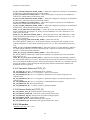
6.25.3 Ratio_test()
This function compares the ratio of the two supplied arguments and compares it with the supplied threshold
argument. The return value is the result of the comparison and is positive if the ratio is less than the absolute
value of the threshold.
6.25.4 Magnitude()
This function returns an approximation of the magnitude, or the square root of the two arguments squared.
6.25.5 Goertzel_bank()
This function executes a bank of Goertzel DFT filters. It is called on a sample-by-sample basis and it
calculates the denominator recursion only. When the full DFT block of samples is processed, then the
function computes the amplitude square of the complete DFT bins. It returns the value of the Goertzel Filter
down counter which decrements to zero upon completion of a block.
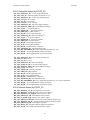
6.25.6 FSK_modulator()
This function implements a continuous phase Frequency Shift Keyed modulator using an oscillator. The
interpolator and decimator ratio relates the sample rate and the symbol rate, and can be programmed to
implement a variety of frequency plans. It includes a sub-sampler that reads 1-bit data from Tx_data[]
using Tx->data_tail, and converts the data bits for use by the modulator.
6.25.7 FSK_demodulator()
This function implements a Frequency Shift Keyed demodulator using a pair of Hilbert band-pass subsampling filters and ratio detection. The interpolator and decimator ratio relates the sample rate and the
symbol rate, and can be programmed to implement a variety of frequency plans. It sinks the received bits to
the Rx_data[] buffer using Rx->data_head. It includes a loss of signal (LOS) detector that calculates the
difference between the current signal level and the initial signal level. It reports Rx>status=LOSS_OF_LOCK if the signal level drops by 6 dB.
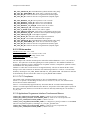
6.25.8 APSK_modulator()
This function implements an Amplitude-Phase Shift Keyed modulator and interpolator/decimator operation
to produce 8 kHz samples. It modulates complex symbols in Tx_fir[] using the Tx->fir_tail pointer. By
default the symbol clock is derived from the transmit sample clock, but the user can adjust the transmit
symbol rate using the Tx->sym_clk_offset variable.
6.25.9 APSK_demodulator()
This function implements an Amplitude-Phase Shift Keyed demodulator and interpolator/decimator
operation operating on 8 kHz samples. The algorithm includes: matched filtering, AGC gain level
normalization, a complex linear T/2 fractional-spaced adaptive equalizer, Costas PLL for carrier recovery,
variable-constellation slicer interface, symbol clock recovery and tracking, mean-square error estimator,
and loss-of-lock detector. The received symbol hard-decision slicer, symbol clock timing error estimator,
and data decoder operations are all programmable function calls such that APSK_demodulator() can be
programmed to demodulate virtually any form of phase-shift and amplitude-shift keyed signals.
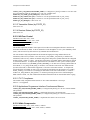
6.25.10
AGC_gain_estimator()
This function calculates the appropriate AGC_gain level from Rx->power recursively, and is used to seed
the AGC for more rapid convergence.
6.25.11
Rx_fir_autocorrelator()
This function calculates the complex autocorrelation of the received sub-sampled signal and can be used to
detect the presence of a phase reversal. It returns the scaled autocorrelation power.
62