1
This section is specifically about safety matters
Do not attempt to install, operate, maintain or inspect the inverter until you have read through this Installation Guideline and appended
documents carefully and can use the equipment correctly. Do not use the inverter until you have a full knowledge of the equipment,
safety information and instructions. In this Installation Guideline, the safety instruction levels are classified into "WARNING" and
"CAUTION".
WARNING
CAUTION
Assumes that incorrect handling may cause hazardous conditions, resulting in death or severe injury.
Assumes that incorrect handling may cause hazardous conditions, resulting in medium or slight injury, or may
cause physical damage only.
CAUTION level may lead to a serious consequence according to conditions. Please follow strictly the instructions
Note that even the
of both levels because they are important to personnel safety.
Electric Shock Prevention
WARNING
앫 While power is on or when the inverter is running, do not open the front cover or wiring cover. Otherwise you may get an electric
shock.
앫 Do not run the inverter with the front cover removed. Otherwise, you may access the exposed high-voltage terminals or the charging
part of the circuitry and get an electric shock.
앫 Even if power is off, do not remove the front cover except for wiring or periodic inspection.You may access the charged inverter circuits and
get an electric shock.
앫 Before starting wiring or inspection, check to make sure that the operation panel indicator is off, wait for at least 10 minutes after the
power supply has been switched off, and check that there are no residual voltage using a tester or the like. The capacitor is charged
with high voltage for some time after power off and it is dangerous.
앫 This inverter must be earthed (grounded). Earthing (Grounding) must conform to the requirements of national and local safety regulations
and electrical codes. (NEC section 250, IEC 536 class 1 and other applicable standards)
앫 Any person who is involved in the wiring or inspection of this equipment should be fully competent to do the work.
앫 Always install the inverter before wiring. Otherwise, you may get an electric shock or be injured.
앫 Perform setting dial and key operations with dry hands to prevent an electric shock. Otherwise you may get an electric shock.
앫 Do not subject the cables to scratches, excessive stress, heavy loads or pinching. Otherwise you may get an electric shock.
앫 Do not replace the cooling fan while power is on. It is dangerous to replace the cooling fan while power is on.
앫 Do not touch the printed circuit board with wet hands. You may get an electric shock.
앫 When measuring the main circuit capacitor capacity, the DC voltage is applied to the motor for 1 s at powering off. Never touch the
motor terminal, etc. right after powering off to prevent an electric shock.
Fire Prevention
CAUTION
앫 Mount the inverter to incombustible material. Install the inverter on a nonflammable wall without holes (so that nobody can touch the
inverter heatsink on the rear side, etc.). Mounting it to or near combustible material can cause a fire.
앫 If the inverter has become faulty, switch off the inverter power. A continuous flow of large current could cause a fire.
앫 When using a brake resistor, make up a sequence that will turn off power when an alarm signal is output. Otherwise, the brake resistor
may excessively overheat due to damage of the brake transistor and such, causing a fire.
앫 Do not connect a resistor directly to the DC terminals +, -. This could cause a fire and destroy the inverter. The surface temperature of
braking resistors can far exceed 100 °C for brief periods. Make sure that there is adequate protection against accidental contact and a safe
distance is maintained to other units and system parts.
Injury Prevention
CAUTION
앫 Apply only the voltage specified in the instruction manual to each terminal. Otherwise, burst, damage, etc. may occur.
앫 Ensure that the cables are connected to the correct terminals. Otherwise, burst, damage, etc. may occur.
앫 Always make sure that polarity is correct to prevent damage, etc. Otherwise, burst, damage, etc. may occur.
앫 While power is on or for some time after power-off, do not touch the inverter as it is hot and you may get burnt.
Additional Instructions
Also note the following points to prevent an accidental failure, injury, electric shock, etc.
Transportation and installation
CAUTION
Operating condition
앫 Transport the product using the correct method that corresponds to the weight. Failure to observe this could lead to injuries.
앫 Do not stack the inverter boxes higher than the number recommended.
앫 Ensure that installation position and material can withstand the weight of the inverter. Install according to the information in the instruction
manual.
앫 Do not install or operate the inverter if it is damaged or has parts missing. This can result in breakdowns.
앫 When carrying the inverter, do not hold it by the front cover or setting dial; it may fall off or fail.
앫 Do not stand or rest heavy objects on the product.
앫 Check the inverter mounting orientation is correct.
앫 Prevent other conductive bodies such as screws and metal fragments or other flammable substance such as oil from entering the
inverter.
앫 As the inverter is a precision instrument, do not drop or subject it to impact.
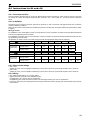
앫 Use the inverter under the following environmental conditions. Otherwise, the inverter may be damaged.
Ambient temperature −10 °C to +50 °C (non-freezing)
Ambient humidity
90 % RH or less (non-condensing)
햲
Storage temperature
Atmosphere
Altitude
Vibration
−20 °C to +65 °C 햲
Indoors (free from corrosive gas, flammable gas, oil mist, dust and dirt)
Maximum 1000 m above sea level for standard operation. After that derate by 3 % for every extra 500 m
up to 2500 m (91 %).
5.9 m/s² or less
Temperature applicable for a short time, e.g. in transit.