1
THORSTEN WIEGAND
21
Grid-based estimators of second-order statistics
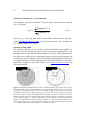
The study area is divided into a grid of cells. The size of the cells should be defined as the minimal resolution necessary to respond to the scientific question to
be answered and is limited by the measurement uncertainty of point coordinates
(Wiegand & Moloney 2004). The calculation of point-to-point distances necessary for estimation of second-order statistics is then based on distances between
cells, and counting cells and points in cells.
Grid-based estimator of K- and L-function
Wiegand & Moloney (2004) proposed a simple grid-based estimator of the
bivariate K-function for arbitrarily shaped study regions, which is based on the
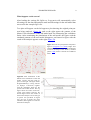
mean number of type 2 points found in (complete or incomplete) circles of radius r around all type 1 points k [= P12(r)], divided by the area of these circles
[= A(r)]:
1 n1
∑ Points 2[C1,k (r )]
2 P12 ( r )
2 n1 k =1
ˆ
λ2 K12 (r ) = πr
= πr
1 n1
A(r )
∑ Area[C1,k (r )]
n1 k =1
(A9)
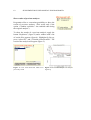
where λ2 = n2/A is the intensity of pattern 2, ni is the number of type i points (i =
1, 2) in the study region, C1,k(r) is the circle with radius r centred on the kth type
1 point, the operator. Points2[X] counts the points of the pattern 2 in a region X
of area A, and the operator Area[X] determines the total number of cells of the
region X.
The circles are incomplete if the focal point has a distance smaller than r to the
border of the study region. Note that this estimator does not scale the number of
points in incomplete circles to the expected number within complete circles as is
commonly done in point pattern analysis (for reviews on edge correction see
e.g., Haase 1995, or Goreaud & Pélissier 1999). The grid-based estimator is
therefore not affected by the problem that the weights may become unbounded
if r becomes larger.
The grid-based estimator of the L-function using equations A2 and A9 yields:
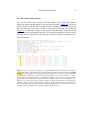
A P12 (r )
λ Kˆ
Lˆ12 (r ) = r ( 2 212 − 1) = r (
− 1) .
n2 A1 (r )
πr
(A10)