1
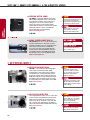
 PHOTON VACUUM PROJECTOR
Finland’s Upstream Engineering hasn’t quite determined the first application
for its postage stamp-sized video projector, but there are certainly plenty of
possibilities. The Photon Vacuum Projector would be perfect for everyday
devices like phonecams, allowing users to beam their snapshots onto
20-inch screens. Or you could put one on a PDA equipped with PowerPoint
to eliminate the need for bulky tabletop projectors. Upstream’s prototype
relies on proprietary technology that pulls light particles out of an LED and
makes the projector far more efficient than its larger predecessors. The
company hopes within a few years to manufacture a projector that draws
just 4 watts of power while still providing a crisp video image.
ULTRA HIGH DEFINITION VIDEO
HDTV is just starting to shine, and already video researchers are moving
on to the Next Big Thing. Engineers at the Japan Broadcasting Corporation
(NHK) have developed a camera-and-projection system, Ultra High Definition
Video, that produces images with 16 times more pixels than anything now on
the market. The heart of the system is a projector that uses four liquid-crystalon-silicon imaging chips. But UHDV is incredibly memory-hungry: NHK’s
researchers burned through 3.5 terabytes to capture just 18 minutes of
footage. Evidently, that’s more than enough to wow viewers – those who’ve
checked it out report that the images are indistinguishable from reality.
At one demo, featuring a driver’s-eye view from a car, several attendees
got nauseated from the realism.
VARIATIONAL SHAPE APPROXIMATION
Even the best cell phone games look no better than an Atari 2600 title, circa
1982. The conventional wisdom is that mobile gadgets simply don’t have the
power to render the kind of gorgeous 3-D images that gamers experience
on a PC. But a pair of Caltech professors are disproving that notion with an
ingenious compression algorithm, dubbed variational shape approximation.
Mathieu Desbrun and Peter Schröder have figured out a way to replicate
an intricate 3-D file that takes up only a fraction of the memory of the original.
The first application, says Desbrun, will likely be medical, allowing doctors
to view MRIs on pocket PCs as they make their rounds. But the masses will
no doubt be more interested in playing a reasonable facsimile of Doom 3
on their Sidekicks.
STEPHEN ROUNTREE
FIELD EMISSION DISPLAY
Flat-panel TVs have their obvious advantages, but image quality isn’t one of
them. Old-fashioned CRTs, despite their bulk, still produce far superior pictures.
But that’s set to change as researchers at Samsung and elsewhere fine-tune
their work on field emission displays composed of carbon nanotubes. Unlike
CRTs, which rely on a single electron gun to sweep across the inside of a
picture tube, FEDs contain millions of miniaturized guns, one behind each
phosphor pixel. FED technology has been kicking around for decades, but
it’s not until recently that Samsung engineers were able to push the approach
beyond the theoretical. The company is reportedly close to producing a
30-inch FED prototype that’ll likely rival the best plasma and LCD screens
for thinness – and still produce as rich a picture as the best tube TVs can.