1
4.3 Computational Subsystem
4.3.1 Microcontroller Selection
For this design, we needed to select an appropriate microcontroller that would be
connected and programmed for the navigation subsystem, the obstacle avoidance
subsystem, and the drive subsystem. The navigation subsystem consists of a digital
compass and a WiFly module to communicate with the laptop. As a result, it may be
necessary to explore a microcontroller with RF capabilities. Also, floating point values
are necessary as a part of the microcontroller’s features in order to ensure an accurate
value of the detected location. The drive subsystem consists of the motor controller which
connects to DC motors. The microcontroller being selected would be low power, but no
lower than 5V to be reasonable for the power needed. Also, we wanted to select a
microcontroller that could be programmed in an understandable language such as C so
debugging would be easier. Implementing functions is also simple with C programming
which would be necessary for this design.
The VEX Cortex microcontroller is designed for robotic applications, which is related to
this design. It has wireless capabilities which would facilitate the navigation subsystem
and enable wireless debugging, wireless downloading and wireless driving. Motor parts
could be connected to the available ports for the drive subsystem. And the smart sensor
port can be used for the obstacle avoidance subsystem for the various sensors needed. It
is also easily programmable with C. Although the VEX Cortex Microcontroller is user
friendly and capable for the design, the cost is $250.00, which is above our original
budget. So we could explore another option.
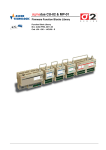
The MINI-MAX/51-C2 is a popular microcontroller subsystem. This microcontroller is
very scalable for programming, and able to be programmed in C. It also includes software
options such as the Micro C compiler. The DC regulators can also be used to power the
sensors in the obstacle avoidance subsystem. Although RF is not built in, it can be
connected and programmed with the available ports. This microcontroller also contains
numerous serial features. However, only few are needed in this design.
The CSM-12C32 is a microcontroller that contains SCI and SPI communication ports and
31 I/0 lines. It also contains Analog Comparator and includes other features such as
jumpers and button switches. One drawback that may affect the design is the time delay
for input values. For example, processing data from a compass would take 30-40ms,
which could cause inaccuracies in current locations. Also, since the microcontroller
includes many additional features which are not necessary, there is more of likelihood
that there would be malfunction.
The ATMega-328 is the best microcontroller choice for this design because it contains an
appropriate balance of features that is necessary for the design. This microcontroller has a
reasonable amount of I/O lines and serial ports that were needed. Most of the inputs are
digital, but it also contains A/D converter pins that may be necessary. Below is a table
27