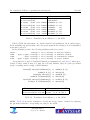
1
Automated VAlidatioN of Trust and Security
of Service-oriented ARchitectures
FP7-ICT-2007-1, Project No. 216471
www.avantssar.eu
Deliverable D2.3 (update)
ASLan++ specification and tutorial
Abstract
This updated deliverable introduces ASLan++, the AVANTSSAR specification language. ASLan++ has been designed for formally specifying dynamically composed security-sensitive web services and service-oriented architectures, their associated security policies, as well as their trust and security
properties, at both communication and application level.
We introduce ASLan++ by means of a tutorial and a formal definition. The
semantics of ASLan++ is defined by translation to ASLan, the low-level input
language for the back-ends of the AVANTSSAR Platform.
Deliverable details
Deliverable version: v2.0
Classification: public
Date of delivery: March 2011
Due on: Editors: SIEMENS, ETH Zurich, UNIVR, IBM, and all Total pages: 190
Project details
Start date: January 01, 2008
Duration: 36 months
Project Coordinator: Luca Viganò
Partners: UNIVR, ETH Zurich, INRIA, UPS-IRIT, UGDIST, IBM,
OpenTrust, IEAT, SAP, SIEMENS
D2.3 (update): ASLan++ specification and tutorial
2/190
Contents
1 Introduction
7
2 ASLan++ tutorial
2.1 Hello, World! . . . . . . . . . . . . . . . . . . . . . . . .
2.1.1 The Problem . . . . . . . . . . . . . . . . . . . .
2.1.2 Automated Security Analysis . . . . . . . . . . .
2.1.3 Formalizing Behavior . . . . . . . . . . . . . . . .
2.1.4 Specifying Security Goals . . . . . . . . . . . . .
2.1.5 Modeling the Overall Problem . . . . . . . . . . .
2.1.6 Validating the Model . . . . . . . . . . . . . . . .
2.1.7 Clauses, Deductions and Recursion . . . . . . . .
2.2 Modeling hints . . . . . . . . . . . . . . . . . . . . . . .
2.2.1 Debugging wrt. executability problems . . . . . .
2.2.2 Detecting uninitialized variables . . . . . . . . . .
2.2.3 Improving efficiency . . . . . . . . . . . . . . . .
2.3 Set operations . . . . . . . . . . . . . . . . . . . . . . . .
2.3.1 Basic Commands . . . . . . . . . . . . . . . . . .
2.3.2 ForAll and Copy . . . . . . . . . . . . . . . . . .
2.3.3 Union and Intersection . . . . . . . . . . . . . . .
2.3.4 IsSubset and IsEqual . . . . . . . . . . . . . . . .
2.3.5 Exercises . . . . . . . . . . . . . . . . . . . . . . .
2.4 Shared Data . . . . . . . . . . . . . . . . . . . . . . . . .
2.4.1 Global variables . . . . . . . . . . . . . . . . . . .
2.4.2 Implementation via facts . . . . . . . . . . . . . .
2.4.3 Shared databases . . . . . . . . . . . . . . . . . .
2.5 Set communication . . . . . . . . . . . . . . . . . . . . .
2.5.1 Shared set variables and synchronization . . . . .
2.5.2 References . . . . . . . . . . . . . . . . . . . . . .
2.5.3 Concatenated elements . . . . . . . . . . . . . . .
2.6 Time-out . . . . . . . . . . . . . . . . . . . . . . . . . . .
2.7 Policies . . . . . . . . . . . . . . . . . . . . . . . . . . . .
2.8 Communication in different channel models . . . . . . . .
2.8.1 CCM/ICM . . . . . . . . . . . . . . . . . . . . .
2.8.2 ACM . . . . . . . . . . . . . . . . . . . . . . . . .
2.9 Modeling TLS . . . . . . . . . . . . . . . . . . . . . . . .
2.9.1 Security Properties of TLS . . . . . . . . . . . . .
2.9.2 HTTP Request and Response Pairing . . . . . . .
2.9.3 Server-Authenticated HTTPS . . . . . . . . . . .
2.9.4 Weak Client Authentication . . . . . . . . . . . .
2.9.5 Strong Client Authentication . . . . . . . . . . .
2.9.6 Dynamic sessions and message order preservation
FP7-ICT-2007-1
Project No. 216471
.
.
.
.
.
.
.
.
.
.
.
.
.
.
.
.
.
.
.
.
.
.
.
.
.
.
.
.
.
.
.
.
.
.
.
.
.
.
.
.
.
.
.
.
.
.
.
.
.
.
.
.
.
.
.
.
.
.
.
.
.
.
.
.
.
.
.
.
.
.
.
.
.
.
.
.
.
.
.
.
.
.
.
.
.
.
.
.
.
.
.
.
.
.
.
.
.
.
.
.
.
.
.
.
.
.
.
.
.
.
.
.
.
.
.
.
.
.
.
.
.
.
.
.
.
.
.
.
.
.
.
.
.
.
.
.
.
.
.
.
.
.
.
.
.
.
.
.
.
.
.
.
.
.
.
.
.
.
.
.
.
.
.
.
.
.
.
.
.
.
.
.
.
.
.
.
.
.
.
.
.
.
.
.
.
.
.
.
.
.
.
.
.
.
.
.
.
.
.
.
.
.
.
.
.
.
.
.
.
.
.
.
.
.
.
.
.
.
.
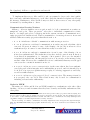
.
.
.
.
.
.
.
.
.
.
.
.
.
.
.
.
.
.
.
.
.
.
.
.
.
.
.
.
.
.
.
.
.
.
.
.
.
.
.
.
.
.
.
.
.
.
.
.
.
.
.
.
.
.
.
.
.
.
.
.
.
.
.
.
.
.
.
.
.
.
.
.
.
.
.
.
.
.
.
.
.
.
.
.
.
.
.
.
.
.
.
.
.
.
.
.
.
.
.
.
.
.
.
.
.
.
.
.
.
.
.
.
.
.
.
.
.
.
.
.
.
.
.
.
.
.
.
.
.
.
.
.
.
.
.
.
.
.
.
.
.
.
.
.
.
.
.
.
.
.
.
.
.
.
.
.
.
.
.
.
.
.
.
.
.
.
.
.
.
.
.
.
.
.
.
.
.
.
.
.
.
.
.
.
.
.
.
.
.
.
.
.
.
.
.
.
.
.
.
9
9
9
10
11
13
16
22
31
36
36
38
40
41
42
42
44
45
47
47
48
49
51
55
55
58
60
62
64
66
67
68
70
70
70
71
72
75
80
D2.3 (update): ASLan++ specification and tutorial
3 ASLan++ concepts and syntax
3.1 Introductory example . . . . . . .
3.2 Specifications . . . . . . . . . . .
3.3 Entities and agents . . . . . . . .
3.4 Dishonest agents and the intruder
3.5 Facts and Clauses . . . . . . . . .
3.6 Declarations . . . . . . . . . . . .
3.7 Terms . . . . . . . . . . . . . . .
3.8 Channels . . . . . . . . . . . . . .
3.8.1 Channel models . . . . . .
3.8.2 Channel security notions .
3.8.3 Channel syntax . . . . . .
3.9 Goals . . . . . . . . . . . . . . . .
3.9.1 Invariants . . . . . . . . .
3.9.2 Assertions . . . . . . . . .
3.9.3 Channel goals . . . . . . .
3.9.4 Secrecy goals . . . . . . .
3.10 Statements . . . . . . . . . . . . .
3.11 Guards . . . . . . . . . . . . . . .
3.12 Grammar in EBNF . . . . . . . .
3.13 ASLan++ prelude . . . . . . . .
.
.
.
.
.
.
.
.
.
.
.
.
.
.
.
.
.
.
.
.
.
.
.
.
.
.
.
.
.
.
.
.
.
.
.
.
.
.
.
.
.
.
.
.
.
.
.
.
.
.
.
.
.
.
.
.
.
.
.
.
.
.
.
.
.
.
.
.
.
.
.
.
.
.
.
.
.
.
.
.
4 ASLan++ semantics
4.1 Preprocessing . . . . . . . . . . . . . . .
4.2 Translation of Entities . . . . . . . . . .
4.3 Translation of Types and Symbols . . . .
4.4 Translation of Clauses . . . . . . . . . .
4.5 Translation of Equations . . . . . . . . .
4.6 Representing the Control Flow . . . . . .
4.7 Translation of Statements . . . . . . . .
4.7.1 Grouping . . . . . . . . . . . . .
4.7.2 Variable assignment . . . . . . . .
4.7.3 Generation of fresh values . . . .
4.7.4 Entity instantiation . . . . . . . .
4.7.5 Symbolic entity instantiation . . .
4.7.6 Send, receive, and channel models
4.7.7 Fact introduction . . . . . . . . .
4.7.8 Fact retraction . . . . . . . . . .
4.7.9 Branch . . . . . . . . . . . . . . .
4.7.10 Loop . . . . . . . . . . . . . . . .
4.7.11 Select . . . . . . . . . . . . . . .
4.7.12 Assert . . . . . . . . . . . . . . .
4.8 Translation of Guards . . . . . . . . . .
FP7-ICT-2007-1
Project No. 216471
.
.
.
.
.
.
.
.
.
.
.
.
.
.
.
.
.
.
.
.
.
.
.
.
.
.
.
.
.
.
.
.
.
.
.
.
.
.
.
.
3/190
.
.
.
.
.
.
.
.
.
.
.
.
.
.
.
.
.
.
.
.
.
.
.
.
.
.
.
.
.
.
.
.
.
.
.
.
.
.
.
.
.
.
.
.
.
.
.
.
.
.
.
.
.
.
.
.
.
.
.
.
.
.
.
.
.
.
.
.
.
.
.
.
.
.
.
.
.
.
.
.
.
.
.
.
.
.
.
.
.
.
.
.
.
.
.
.
.
.
.
.
.
.
.
.
.
.
.
.
.
.
.
.
.
.
.
.
.
.
.
.
.
.
.
.
.
.
.
.
.
.
.
.
.
.
.
.
.
.
.
.
.
.
.
.
.
.
.
.
.
.
.
.
.
.
.
.
.
.
.
.
.
.
.
.
.
.
.
.
.
.
.
.
.
.
.
.
.
.
.
.
.
.
.
.
.
.
.
.
.
.
.
.
.
.
.
.
.
.
.
.
.
.
.
.
.
.
.
.
.
.
.
.
.
.
.
.
.
.
.
.
.
.
.
.
.
.
.
.
.
.
.
.
.
.
.
.
.
.
.
.
.
.
.
.
.
.
.
.
.
.
.
.
.
.
.
.
.
.
.
.
.
.
.
.
.
.
.
.
.
.
.
.
.
.
.
.
.
.
.
.
.
.
.
.
.
.
.
.
.
.
.
.
.
.
.
.
.
.
.
.
.
.
.
.
.
.
.
.
.
.
.
.
.
.
.
.
.
.
.
.
.
.
.
.
.
.
.
.
.
.
.
.
.
.
.
.
.
.
.
.
.
.
.
.
.
.
.
.
.
.
.
.
.
.
.
.
.
.
.
.
.
.
.
.
.
.
.
.
.
.
.
.
.
.
.
.
.
.
.
.
.
.
.
.
.
.
.
.
.
.
.
.
.
.
.
.
.
.
.
.
.
.
.
.
.
.
.
.
.
.
.
.
.
.
.
.
.
.
.
.
.
.
.
.
.
.
.
.
.
.
.
.
.
.
.
.
.
.
.
.
.
.
.
.
.
.
.
.
.
.
.
.
.
.
.
.
.
.
.
.
.
.
.
.
.
.
.
.
.
.
.
.
.
.
.
.
.
.
.
.
.
.
.
.
.
.
.
.
.
.
.
.
.
.
.
.
.
.
.
.
.
.
.
.
.
.
.
.
.
.
.
.
.
.
.
.
.
.
.
.
.
.
.
.
.
.
.
.
.
.
.
.
.
.
.
.
.
.
.
.
.
.
.
.
.
.
.
.
.
.
.
.
.
.
.
.
.
.
.
.
.
.
.
.
.
.
.
.
.
.
.
.
.
.
.
.
.
.
.
.
.
.
.
.
.
.
.
.
.
.
.
.
.
.
.
.
.
.
.
.
.
.
.
.
.
.
.
.
.
.
.
.
.
.
.
.
.
.
.
.
.
.
.
.
.
.
.
.
.
.
.
.
.
.
.
.
.
.
.
.
.
.
.
.
.
.
.
.
.
.
.
.
.
.
.
.
.
.
.
.
.
.
.
.
.
.
.
.
.
.
.
.
.
.
.
.
.
.
.
.
.
.
.
.
.
.
.
.
.
.
.
.
.
.
.
.
.
.
.
.
.
.
.
.
.
.
.
.
.
.
.
.
.
.
.
.
.
.
.
.
.
.
.
.
.
.
.
.
.
.
.
.
.
.
.
.
.
.
.
.
88
88
90
90
91
92
94
95
96
96
97
99
105
106
106
106
109
111
112
113
117
.
.
.
.
.
.
.
.
.
.
.
.
.
.
.
.
.
.
.
.
121
121
122
124
125
127
127
127
128
129
130
131
132
134
141
142
143
146
148
149
150
D2.3 (update): ASLan++ specification and tutorial
4/190
4.9
4.10
4.11
4.12
Translation of Terms . . . . . . . . . . . . . . . . . . . . . . .
Translation of the Body Section . . . . . . . . . . . . . . . . .
Translation of the Constraints Section . . . . . . . . . . . . .
Translation of the Goals Section . . . . . . . . . . . . . . . . .
4.12.1 Invariants . . . . . . . . . . . . . . . . . . . . . . . . .
4.12.2 Channel Goals . . . . . . . . . . . . . . . . . . . . . . .
4.12.3 Secrecy Goals . . . . . . . . . . . . . . . . . . . . . . .
4.13 Assignment of numbers to step label terms . . . . . . . . . . .
4.14 Step Compression . . . . . . . . . . . . . . . . . . . . . . . . .
4.14.1 Motivation and example . . . . . . . . . . . . . . . . .
4.14.2 Step granularity and breakpoints . . . . . . . . . . . .
4.14.3 Translation of compressed steps . . . . . . . . . . . . .
4.15 Optimizations . . . . . . . . . . . . . . . . . . . . . . . . . . .
4.15.1 Elimination of empty transitions and redundant guards
4.15.2 Merging of transitions . . . . . . . . . . . . . . . . . .
.
.
.
.
.
.
.
.
.
.
.
.
.
.
.
.
.
.
.
.
.
.
.
.
.
.
.
.
.
.
.
.
.
.
.
.
.
.
.
.
.
.
.
.
.
.
.
.
.
.
.
.
.
.
.
.
.
.
.
.
.
.
.
.
.
.
.
.
.
.
.
.
.
.
.
.
.
.
.
.
.
.
.
.
.
.
.
.
.
.
.
.
.
.
.
.
.
.
.
.
.
.
.
.
.
.
.
.
.
.
.
.
.
.
.
.
.
.
.
.
151
152
153
153
153
153
157
158
159
159
160
160
162
162
164
5 Conclusion
166
A ASLan
A.1 Motivation . . . . . . . . . . . . . .
A.2 ASLan Syntax . . . . . . . . . . . .
A.2.1 Grammar in BNF . . . . . .
A.2.2 Structure of an ASLan File
A.2.3 Constraints on identifiers . .
A.2.4 Constraints on variables . .
A.2.5 Constraints on fact symbols
A.3 ASLan Semantics . . . . . . . . . .
A.3.1 Equalities . . . . . . . . . .
A.3.2 Execution model . . . . . .
A.3.3 Security goals . . . . . . . .
A.3.4 Typing . . . . . . . . . . . .
A.3.5 Micro and Macro Steps . . .
.
.
.
.
.
.
.
.
.
.
.
.
.
167
167
168
168
171
172
172
173
173
173
173
175
176
177
.
.
.
.
179
179
181
182
184
.
.
.
.
.
.
.
.
.
.
.
.
.
.
.
.
.
.
.
.
.
.
.
.
.
.
B Connector and Model Checker Options
B.1 ASLan++ Connector . . . . . . . . . .
B.2 SATMC . . . . . . . . . . . . . . . . .
B.3 OFMC . . . . . . . . . . . . . . . . . .
B.4 Cl-AtSe . . . . . . . . . . . . . . . . .
References
.
.
.
.
.
.
.
.
.
.
.
.
.
.
.
.
.
.
.
.
.
.
.
.
.
.
.
.
.
.
.
.
.
.
.
.
.
.
.
.
.
.
.
.
.
.
.
.
.
.
.
.
.
.
.
.
.
.
.
.
.
.
.
.
.
.
.
.
.
.
.
.
.
.
.
.
.
.
.
.
.
.
.
.
.
.
.
.
.
.
.
.
.
.
.
.
.
.
.
.
.
.
.
.
.
.
.
.
.
.
.
.
.
.
.
.
.
.
.
.
.
.
.
.
.
.
.
.
.
.
.
.
.
.
.
.
.
.
.
.
.
.
.
.
.
.
.
.
.
.
.
.
.
.
.
.
.
.
.
.
.
.
.
.
.
.
.
.
.
.
.
.
.
.
.
.
.
.
.
.
.
.
.
.
.
.
.
.
.
.
.
.
.
.
.
.
.
.
.
.
.
.
.
.
.
.
.
.
.
.
.
.
.
.
.
.
.
.
.
.
.
.
.
.
.
.
.
.
.
.
.
.
.
.
.
.
.
.
.
.
.
.
.
.
.
.
.
.
.
.
.
.
.
.
.
.
.
.
.
.
.
.
.
.
.
.
.
.
.
.
.
.
.
.
.
.
.
.
.
.
.
.
.
.
.
.
.
.
.
.
.
.
.
.
.
.
.
.
.
.
.
.
.
.
.
.
.
.
.
.
.
.
.
.
.
.
.
.
.
.
.
.
.
.
.
.
.
.
.
.
.
.
.
.
.
.
.
.
.
.
189
FP7-ICT-2007-1
Project No. 216471
D2.3 (update): ASLan++ specification and tutorial
5/190
List of Figures
1
2
3
4
5
6
7
8
9
10
How the Model Checker simulates the Attacker. . . . . . . . . . . . . . . . .
The Sequence Chart for the NSPK Protocol. . . . . . . . . . . . . . . . . . .
The annotated Sequence Chart for the NSPK Protocol. . . . . . . . . . . . .
The Security Goals for the NSPK Protocol. . . . . . . . . . . . . . . . . . .
Nested Entities: Environment, its Sessions and their Actors. . . . . . . . . .
Two parallel sessions – Multiple Interference Facilities. . . . . . . . . . . . .
An AVANTSSAR Model Checker found a Vulnerability in the NSPK Protocol.
The Lowe Attack on the NSPK Protocol. . . . . . . . . . . . . . . . . . . . .
Lowe’s Fix for the Vulnerability in the NSPK Protocol. . . . . . . . . . . . .
The CA Hierarchy Setup. . . . . . . . . . . . . . . . . . . . . . . . . . . . .
FP7-ICT-2007-1
Project No. 216471
11
11
12
15
17
18
28
29
30
31
D2.3 (update): ASLan++ specification and tutorial
6/190
List of Tables
1
2
3
4
5
6
7
8
9
10
11
12
13
Channel notations in ASLan++ for CCM and ICM . . . . . . . . . . . . . .
Channel notations in ASLan++ for ACM . . . . . . . . . . . . . . . . . . . .
Properties, channel facts, and their informal meaning . . . . . . . . . . . . .
Linked channel, fact, and its informal meaning . . . . . . . . . . . . . . . . .
Properties, channel facts, and their informal meaning . . . . . . . . . . . . .
LTL operators for specifying goals . . . . . . . . . . . . . . . . . . . . . . . .
Channel goal symbols in ASLan++ . . . . . . . . . . . . . . . . . . . . . . .
Translation from ASLan++ to the CCM . . . . . . . . . . . . . . . . . . . .
Translation from ASLan++ to the ICM . . . . . . . . . . . . . . . . . . . .
Translation from ASLan++ to the ACM . . . . . . . . . . . . . . . . . . . .
Substitutions done by the adaptGuard function . . . . . . . . . . . . . . . .
Translation of goals . . . . . . . . . . . . . . . . . . . . . . . . . . . . . . . .
Events used in the translation of channel goals and rules used for deriving the
protocol ID from the name of channel goals . . . . . . . . . . . . . . . . . .
FP7-ICT-2007-1
Project No. 216471
101
101
102
104
104
106
107
137
138
138
151
153
155
D2.3 (update): ASLan++ specification and tutorial
1
7/190
Introduction
This document introduces and describes ASLan++, the AVANTSSAR specification language. ASLan++ is a formal language for specifying security-sensitive service-oriented architectures, their associated security policies, and their trust and security properties. The
semantics of ASLan++ is formally defined by translation to ASLan, the low-level specification language that is the input language for the back-ends of the AVANTSSAR Platform.
This is an update of Deliverable D2.3 [5]. It not only further consolidates ASLan++
and ASLan, but also comes with a tutorial for the benefit of modelers learning how to use
ASLan++.
Background on ASLan++. The first version of ASLan++ (initially called ASLan v.2)
was introduced in deliverable D2.2 [4]. In deliverable D2.3 [5], we built upon that previous
version in particular by adding extensive support for using channels abstractions, and also
automating a number of optimization techniques. The present document covers further
minor extentions and clarifications.
We have developed ASLan++ to achieve the following design goals:
• The language should be expressive enough to model a wide range of service-oriented
architectures while allowing for succinct specifications.
• The language should facilitate the specification of services at a high abstraction level
in order to reduce model complexity as much as possible.
• The language should be close to specification languages for security protocols and web
services, but also to procedural and object-oriented programming languages, so that it
can be employed by users who are not experts of formal protocol/service specification
languages.
In order to support formal specification of static and dynamic services and policy composition, ASLan++ introduces a number of features.
• Control flow constructs (e.g. if and while) enhance the readability and conciseness of
the specifications, and make the specification job easier for modelers who are already
familiar with programming languages.
• Modularity is supported by the use of entities. Each entity is specified separately and
can then be instantiated multiple times and composed with others. This allows the
specifier, in particular, to localize policies in each entity by clarifying, for instance, who
is responsible to grant or deny authorization as well as the various trust relationships
between entities.
• There is an intuitive notation for channels, which may be used both as assumptions
and as service goals and provides a simple but powerful way to specify communication
and service compositionality.
FP7-ICT-2007-1
Project No. 216471
D2.3 (update): ASLan++ specification and tutorial
8/190
The AVANTSSAR Platform [6] supports ASLan++ via a connector that works in two
directions: it translates ASLan++ specifications to ASLan and translates attack traces from
ASLan level to ASLan++ level.
Structure of the document.
This document is self-contained in terms of ASLan++ and ASLan.
In order to facilitate its use for ASLan++ modelers, we start by an ASLan++ tutorial in
§ 2 illustrating to newcomers the common usage of ASLan++ and the related AVANTSSAR
tools via examples that contain typical specification patterns. Next comes a detailed introduction to the ASLan++ concepts and syntax in § 3. The formal semantics of ASLan++
is defined in § 4 via a procedure for translating ASLan++ specifications into ASLan specifications. This procedure serves as a basis for the implementation of the ASLan++ connector/translator tool integrated into the AVANTSSAR Platform. We conclude the main
document in § 5.
In Appendix A, we give a complete description of ASLan.
Appendix B gives a brief overview on the options of the ASLan++ connector and the
various model checking back-ends.
FP7-ICT-2007-1
Project No. 216471
D2.3 (update): ASLan++ specification and tutorial
2
9/190
ASLan++ tutorial
In this section, we aim to give a gentle introduction to ASLan++ to beginners. We demonstrate at small examples, starting with the well-known Needham-Schroeder Public Key
(NSPK) Protocol, how to write specifications that can be successfully translated and checked
using the back-ends.
We give a number of practically important general hints and tricks and then provide
and explain a number of useful typical specification patterns, used e.g. in the AVANTSSAR
Library [7] of industrial use cases.
The examples include set operations like union and intersection, as well as checking
properties like set inclusion and emptiness. We introduce various approaches to handle
shared data and to communicate sets in ASLan++. Moreover, we demonstrate how to
model a simple timeout mechanism, a basic hierarchical Role-Based Access Control (RBAC)
system, and various aspects of TLS-style communication channels.
For each of these examples, we give a complete ASLan++ model that can be tried out.
All models, plus a number of benchmark tests for exploring various features of ASLan++
and the AVANTSSAR Tools, are available for download on the AVANTSSAR home page
at http://www.avantssar.eu/, via the menu items Test Library| and Avantssar Platform.
There you will also find directions to online versions of the AVANTSSAR Tools.
2.1
Hello, World!
This subsection describes the first steps with modeling in ASLan++, as well as using the
translator and the AVANTSSAR Platform and its back-end model checkers. It is mainly
targeted to those who are used to designing communication protocols and to applicationlevel programming in a contemporary language like Java. Familiarity with formal modeling
is not a prerequisite.
2.1.1
The Problem
As a running example, we use variants of the simple well-known Needham-Schroeder Public
Key (NSPK) Protocol [21]. This protocol is intended to provide mutual authentication
between two parties communicating over a network, but in its proposed form is insecure.
There is an attack [13] that the tools can detect and the reader can correct (the protocol
suffers also from other weaknesses that are described in the literature but that are not of
interest here).
We give a walk through the whole range of steps required from understanding the original
protocol to correcting it based on the feedback provided by the model checkers.
The protocol runs between two parties, A (Alice) and B (Bob). In the simple Alice-andBob notation [2], it reads as:
1 A -> B : { Na . A } _Kb
2 A <- B : { Na . Nb } _Ka
3 A -> B : { Nb } _Kb
FP7-ICT-2007-1
Project No. 216471
D2.3 (update): ASLan++ specification and tutorial
10/190
Here, Na and Nb stand for nonces (i.e. non-guessable random values) produced freshly by
Alice and Bob, respectively. Line 1 says that Alice sends her nonce and her name to Bob,
readable for B only. A invents Na and together with her name sends it via -> to B, encrypted
with his public key Kb. The “.” in Na.A means concatenation of two message parts.
Lines 2 and 3 specify analogous message transmissions. B invents Nb, and sends it to A
along with Na to prove to her his ability to decrypt with his private key inv(Kb). A confirms
Nb to B, to prove to him her ability to decrypt with inv(Ka). Line 2 implies that A checks
the value Na she receives; similarly line 3 implicitly requires that B checks the value Nb he
receives.
At the end of the protocol, A and B are supposed to know each other’s identities, and
know both Na and Nb. These nonces may not get known to attackers. They must be kept
secret between A and B.
2.1.2
Automated Security Analysis
Is the protocol described above secure? Can it be attacked? Experience shows that manual analysis is cumbersome and may overlook more complex to exploit vulnerabilities (this
protocol is famous precisely for this reason and has become the standard example for the
importance of the use of formal methods for protocol analysis). Our approach is to let an automated model checker do the hard work. How do we proceed from above informal protocol
sketch? We now outline the procedure followed in the rest of this section.
Approach.
First, we formalize the protocol in cooperation with the protocol expert who is familiar
with the protocol and its typical deployment scenarios. A useful modeling and discussion
base are annotated sequence diagrams.
An automated model checker must be told explicitly what are the security goals of the
protocol. Therefore, together with the protocol expert, we specify the security goals of the
problem. Valuable discussion partners also are those parties that are to deploy the protocol.
Their security goals should be covered by the protocol.
Next, we model the problem and the goals in ASLan++. Then we translate (compile)
the problem into ASLan, which is the language understood by the model checkers. The
compiled model we feed to the automated model checkers and interpret their feedback. If a
model checker detects an attack trace, we correct the model and re-check it. Once no more
vulnerabilities are found, we fix the original protocol.
This approach is followed within this introductory example.
The Attacker Model.
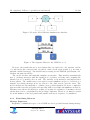
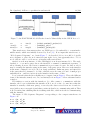
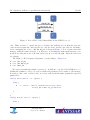
In the common ASLan++ attacker model, the attacker is The Network, as sketched in
Figure 1. The attacker is handed every message sent by the sender and forwards it to the
recipient (or not). The attacker may manipulate, generate, suppress, delay, reorder, replay,
and divert arbitrary messages.
FP7-ICT-2007-1
Project No. 216471
D2.3 (update): ASLan++ specification and tutorial
11/190
Figure 1: How the Model Checker simulates the Attacker.
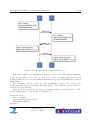
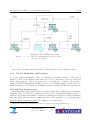
Figure 2: The Sequence Chart for the NSPK Protocol.
However, the attacker knows no keys (unless they are disclosed to the attacker, and he
of course knows his own keys) and, in general, cannot break cryptography (e.g. he cannot
un-hash a hashed message). An attacker may act using several different pseudonyms, who
all share the same knowledge.
The model checkers automatically simulate an attacker. This attacker systematically
tries to exchange messages with the lawful protocol parties, following and corrupting the
intended protocol message flow at will. The attacker reads messages and impersonates
honest parties. The attacker may even exploit several simultaneous protocol sessions, for
instance by relaying messages from one session to the other session, and vice versa. The
model checkers try automatically to evaluate every possible situation. However, complexity
increases with every involved party and especially with every additional simultaneous session.
This may cause the model checkers to require a long time for evaluation. Sometimes a model
checker may even be overwhelmed by the problem complexity. Therefore, we must be careful
about the number of involved parties and parallel sessions we request to be simulated.
2.1.3
Formalizing Behavior
Message Sequences.
Frequently, communication protocols as NSPK are developed and discussed using message
FP7-ICT-2007-1
Project No. 216471
D2.3 (update): ASLan++ specification and tutorial
12/190
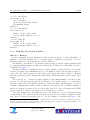
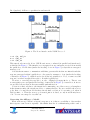
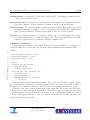
Figure 3: The annotated Sequence Chart for the NSPK Protocol.
sequence charts, as for instance depicted in Figure 2. For better efficiency it is advisable to
use a text-based sequence-chart editor, like the “Quick Sequence Diagram Editor”1 or “Web
Sequence Diagrams”2 . For instance, “Web Sequence Diagrams” takes as input
A -> B: {Na.A}_Kb
B -> A: {Na.Nb}_Ka
A -> B: {Nb}_Kb
and automatically produces as output the chart shown in Figure 2.
Role Behavior.
Usually, a communication protocol specification contains details not expressible in Aliceand-Bob notation or simple message sequence charts. In our NSPK example, such actions are
for instance how and when values like nonces and agent names are computed and checked.
That is, Na := fresh() and Nb := fresh() are newly created random values, public keys
Ka and Kb are assumed as known, and Na and Nb are checked for equality by their respective
issuers.
1
2
http://sdedit.sourceforge.net
http://www.websequencediagrams.com
FP7-ICT-2007-1
Project No. 216471
D2.3 (update): ASLan++ specification and tutorial
13/190
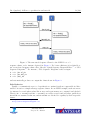
One method to sketch such behavior in message sequence charts are annotations, as
depicted in Figure 3.
The input of “Web Sequence Diagrams” corresponding to Figure 3 is:
note left of A
Na := fresh();
Kb assumed known;
end note
A -> B: {Na.A}_Kb
note right of B
Nb := fresh();
Ka assumed known;
end note
B -> A: {Na.Nb}_Ka
note left of A
Check, if Na is the same;
end note
A -> B: {Nb}_Kb
note right of B
Check, if Nb is the same;
end note
2.1.4
Specifying Security Goals
We want to model our protocol in such a manner that an automated model checker can look
for attacks. However the model checker needs to be told what are the desired protection
requirements, in order to be able to search systematically for ways an attacker may violate
these requirements. To this end, we must explicitly specify security goals. And we name our
goals, so the model checkers can refer to them when printing which goals they have found
violated.
In our NSPK example, primary security goals are that Alice authenticates Bob and vice
versa, agreeing on two secret nonces. There are secondary security goals expressing that
the values of both nonces are secrets shared between Alice and Bob only. Thus, we face
two main types of security goals, secrecy goals and authentication goals as representatives
of a message communication security goal. Typical communication security properties are
authenticity, integrity and confidentiality, as well as replay protection (freshness).
Secrecy Goals.
Secrecy goals specify who may gain knowledge of a certain piece of information. In our
NSPK example, only Alice and Bob, A and B, may know Na and Nb. These nonces may not get
known by the attacker(s). Thus, we have two secrecy goals, namely secret_Na:(Na) {A,B}
and secret_Nb:(Nb) {A,B}. These secrecy goals are noted down in the annotated message
sequence chart in Figure 4. The model checkers can refer to the goal names secret_Na and
secret_Nb if they find a way to violate any of them.
FP7-ICT-2007-1
Project No. 216471
D2.3 (update): ASLan++ specification and tutorial
14/190
To implement this secrecy, Alice and Bob, who are assumed to know each other’s public
keys, can send confidential messages to each other. Only the intended recipient can decrypt
the message. Furthermore, Alice and Bob may not disclose these nonces to any other party,
for instance by sending them to others.
Communication Security Notions.
ASLan++ offers an intuitive arrow notation used for both communication security assumptions3 and goals. These properties4 only refer to individual communication events,
that is, of a single payload at a certain point in the system execution. Communication security properties are unidirectional. That is, transmission of a message from A to B can and
will have different security properties than that from B to A.
• A -> B: M indicates “default” communication without any protection.
• A ->* B: M denotes confidential communication. A sends some payload M that only B
can read. However, B cannot be sure of the identity of A (as long as A has not been
authenticated) so B cannot be sure this M has really been sent by A.
• A *-> B: M denotes authentic communication. B can be sure of the identity of A, as
A has been authenticated. The M that B receives here indeed comes from A. It has not
been altered in transmission, i.e. integrity of M is granted. Moreover, the intended
recipient B is included into the integrity protection, so B can rely on the message being
meant for him. However, the communication is not confidential; thus any eavesdropper
can access the contents in transit from A to B.
• A *->* B: M denotes secure communication, in the sense that A has been authenticated, the payload M is integrity and confidentiality protected, and it is intended by A
for B. It does not protect against message replay, re-ordering, suppression, and delay,
as well as traffic analysis.
• A *->> B: M denotes replay-protected (fresh) communication. The message M sent by
A is accepted only once by B. This notation may only be used for communication
including at least sender authenticity.
Goals for NSPK.
The main goal of Alice and Bob in our NSPK example is to authenticate each other. After
checking of nonces, A and B assume that they have securely and freshly authenticated the
other party.
3
With an assumption we declare a communication has special security properties without saying how
they are achieved. They just are assumed present by us and the model checker. We use assumptions, if we
do not want to bother with implementation details. We will not use communication security assumptions in
our NSPK example, but rather implement the security ourselves.
4
In the following, we assume communication security implemented via encrypted and signed messages,
using the AVANTSSAR CCM (cryptographic channel model). For more detail and other channel models,
see § 3.8.
FP7-ICT-2007-1
Project No. 216471
D2.3 (update): ASLan++ specification and tutorial
15/190
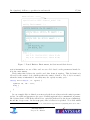
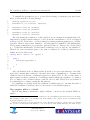
Figure 4: The Security Goals for the NSPK Protocol.
Thus, they require as communication goals two secure and fresh message transmissions, one from Alice to Bob and one from Bob to Alice. A_auth_B:(Na) B*->>A and
B_auth_A:(Nb) A *->> B are the primary authentication goals. Their names are A_auth_B
and B_auth_A.
The secondary secrecy goals for the transmitted nonces (see above) are
secret_Na:(Na) {A,B} and secret_Nb:(Nb) {A,B}. The respective nonces may not
be disclosed to the attacker.
These goals are sketched in the annotated message sequence chart in Figure 4. The
corresponding input to “Web Sequence Diagrams” is:
note left of A
Na := fresh();
goal secret_Na:(Na) {A,B};
Kb assumed known;
end note
FP7-ICT-2007-1
Project No. 216471
D2.3 (update): ASLan++ specification and tutorial
16/190
A -> B: {Na.A}_Kb
note right of B
Nb := fresh();
goal secret_Nb:(Nb) {A,B};
Ka assumed known;
end note
B -> A: {Na.Nb}_Ka
note left of A
Check, if Na is the same;
goal A_auth_B:(Na) B *->> A;
end note
A -> B: {Nb}_Kb
note right of B
Check, if Nb is the same;
goal B_auth_A:(Nb) A *->> B;
end note
2.1.5
Modeling the Overall Problem
ASLan++ Entities.
So far, everything we have discussed in this example is (more or less) independent of
ASLan++. We have clarified and, to a certain degree, formalized our problem. Now, we
make the transition to modeling the problem in ASLan++.
An ASLan++ specification of a system and its security goals has a name (which should
be consistent with the name of its file) and contains the declaration of a hierarchy of entities,
as sketched in Figure 5.5
The major ASLan++ building blocks are entities, similar to classes in Java or roles in the
context of security and communication protocols. Entities declare various symbols, macros,
goals, and other items required by the entity and describe the entity behavior. Entities
may have parameters and contain nested sub-entities, which inherit the items of their outer
entities.
The top-level (i.e. outermost) entity usually is called Environment. It serves as the
global root of the system being specified, similarly to the “main” routine of a conventional
program. Inside the environment normally we define an entity called Session. A session
contains communicating entities. Such an entity is called Actor. In our NSPK example, a
session is conducted between 2 actors, called Alice and Bob. Alice will initiate the NSPK
protocol with Bob, therefore she must be told, which Bob to contact.
The environment can be instantiated as a process. Inside it, one or several sessions may
be instantiated. The sessions instantiate their associated actors, which communicate with
each other following the specified protocol. In our example, as sketched in Figure 5, the
5
A channel model characterizes the basic communication model of the specification. CCM (cryptographic
channel model) stands for communication security implemented via encrypted and signed messages. For
more detail and other channel models, see § 3.8.
FP7-ICT-2007-1
Project No. 216471
D2.3 (update): ASLan++ specification and tutorial
17/190
Figure 5: Nested Entities: Environment, its Sessions and their Actors.
session instantiates one actor Alice and one actor Bob based on the parameters handed to
it by the environment.
Each entity first declares its symbols and other items it requires. This declaration is
followed by the entity’s body, which specifies the entity’s behavior. The body is executed,
when the entity is instantiated. An entity may also specify security goals.
entity Alice ( Actor , B : agent ) {
symbols Na , Nb : text ;
body {
...
}
}
In our example Alice is defined as an Actor by the keyword Actor in the entity’s parameter list. As additional parameter, she gets told which agent B is her communication partner.
She declares that for NSPK she will need two variables (indicated by the keyword symbols),
Na and Nb of type text6 . In the body part, Alice’s behavior is specified. Note that within
6
The ASLan++ standard prelude defines some fundamental types like fact (anything that can be intro-
FP7-ICT-2007-1
Project No. 216471
D2.3 (update): ASLan++ specification and tutorial
(A, B)
(A, i)
(i, B)
(A, B)
(A, i)
×
(i, B)
18/190
(1)
Figure 6: Two parallel sessions – Multiple Interference Facilities.
that body, whenever Alice herself is referenced, this is done by using the keyword Actor.
ASLan++ Session Instantiation.
In the body of the environment, sessions are instantiated. To find an attack on NSPK, we
need Alice to conduct at least two sessions in parallel.
body { % need two sessions for Lowe ’ s attack
any A B . Session (A , B ) where ! A = B ;
any A B . Session (A , B ) where ! A = B ;
}
Therefore, we instantiate two so-called “symbolic sessions” between A and B, where A
may be an honest Alice instance or a dishonest attacker, also known as the intruder i), and
B may be an honest Bob instance or an attacker. For details on symbolic sessions, cf. § 3.10.
In this specification, two sessions of the protocol are launched, each involving one instance
of A and B. However, we disallow entities talking to themselves. So, for instance, a session
of Alice talking to herself is not taken into account.
The model checker will evaluate the combinations sketched in Figure 6. For two parallel
sessions, the model checker, taking into account symmetries, will evaluate 6 different pairs
of parallel sessions. The model checker will try to interlace each of these session pairs in all
different protocol-compliant variants possible. It makes sense to be careful about the numbers
of sessions one instantiates in parallel as the workload for the model checker explodes with
the number of parallel sessions. This may preclude receiving an answer in reasonable time.
ASLan++ Implicit Operations.
In ASLan++, many operations are performed implicitly. Among these are the learning
of new values received by message passing, the checking for equality of received values to
already known values and the decryption of encrypted values.
We have seen that Alice and Bob, by message passing, need to learn the values of nonces
and names and need to check them for equality. In ASLan++, this is done implicitly by
pattern matching. For instance, let’s look at the specification of entity Bob.
1
2
3
entity Bob (A , Actor : agent ) {
symbols
duced and retracted as global meta-information) and message (anything that can be sent over a network). It
also specifies that text and agent are subtypes of message and introduces a number of pre-defined constants.
For more details on the standard prelude, see § 3.13.
FP7-ICT-2007-1
Project No. 216471
D2.3 (update): ASLan++ specification and tutorial
4
5
6
7
8
9
10
11
12
13 }
19/190
Na , Nb : text ;
body {
? -> Actor : {? Na .? A } _pk ( Actor );
secret_Nb :( Nb ) := fresh ();
Actor -> A : { A l i c e _ a u t h e n t i c a t e s _ B o b :( Na ). Nb } _pk ( A );
A -> Actor : { B o b _ a u t h e n t i c a t e s _ A l i c e :( Nb )} _pk ( Actor );
secret_Na :( Na ) := Na ;
}
In line 7, Bob receives a message from some party, which at this point is still unknown
to him. This is denoted by the ? on the left-hand side of the message passing definition. He
learns the name A the sender claims to have and memorizes it7 . Learning a value for A is
indicated by the ? preceding A.
By ?Na, Bob also learns the value Na, which implicitly is decrypted using his private key
corresponding to his public key pk(Actor).8
In line 9, Bob sends A’s nonce Na and his freshly generated own nonce Nb (from line 8)
to that A that he has learned in line 2, encrypted with that A’s public key.
In line 10, Bob receives back from A his nonce. This nonce must have the same value
as the one he sent to A. Checking for equality is performed implicitly and indicated by the
absence of the ?. Again decryption is performed implicitly, as Bob’s private key is available
within the Bob entity.
The security goal names secret_Nb (line 8), Alice_authenticates_Bob (line 9),
Bob_authenticates_Alice (line 10), and secret_Na (line 11) refer to security goals that
must be met and may not be violated. We look this in more detail right now.
ASLan++ Goal Specification Conventions.
For reference by the model checker, in ASLan++ every goal needs to be given a name.
Naming conventions propose to name a secrecy goal by the item that is to be kept secret, and
a channel goal (a communication goal, e.g. authentication, integrity, confidentiality, replay
protection, ...) by the sender, receiver, specific security characteristic such as authentication,
and (within the respective sub-entities) the message value that is communicated.
Security goals are specified within entity definitions. If more than one entity wants to
require a given security goal to be met, the security goal must be declared in the enveloping
entity. If not all parameters required in the security goal specification are available already
within the enveloping entity, we must use security goal templates. For this we first declare a
security goal template within the outer entity and then fill in the template within the inner
7
One may wonder, why Bob is given A as parameter by Session and then plainly ignores its value. The
reason for this is as follows. The translator/compiler from ASLan++ to ASLan needs to know with which
agent variables inside the Bob entity the security goals given in the Session entity are connected. Therefore,
we need not only declare the Agent parameter of Bob but also the A parameter standing for Alice, although
the value passed during instantiation of Bob is overwritten later on receiving the first message.
8
Every agent automatically is assigned a default public and private key pair. Definitions are part of the
ASLan++ standard prelude. For details, see § 3.13.
FP7-ICT-2007-1
Project No. 216471
D2.3 (update): ASLan++ specification and tutorial
20/190
entities, after the missing parameters have been declared and the security goal is required
to be met by the inner entity.
Let us look at our NSPK example. Alice and Bob both want to require the two nonce
secrecy goals and the two authentication goals to be met. Thus, we specify the security goals
in the enveloping entity, which is Session. However, Session cannot access the nonces that
Alice and Bob will use, as they declare them locally, so we specify the security goals as
templates within Session and fill in these templates within Alice and Bob, when they refer
to the respective goals.
After the specification of Session’s body, we – still within the definition of the entity
Session – specify our security goal templates as follows.
1 entity Session (A , B : agent ) { ...
2
3
body { ... }
4
5
goals
6
secret_Na :( _ ) {A , B };
7
secret_Nb :( _ ) {A , B };
8
A li c e _ a u t h e n t i c a t e s _ B o b :( _ ) B * - > > A ;
9
B ob _ a u t h e n t i c a t e s _ A l i c e :( _ ) A * - > > B ;
10 }
In lines 6 and 7 of the above listing of the Session’s goal section, the secrecy goals by
the names of secret_Na and secret_Nb are specified as templates. They require some still
undeclared item to be kept secret between A and B. A and B must fill in the placeholder for
that item, (_), with Na and Nb respectively, when they are actually requiring the security
goal to be met.
The equivalent applies to the authentication goals by the names of
Alice_authenticates_Bob and Bob_authenticates_Alice in lines 8 and 9 of above
listing. These goals require that some hitherto undeclared item is transmitted in an
authenticated and fresh manner (*->>) from one party to the other, thus allowing the
receiving party to authenticate the sending party and offering replay-protection at the same
time.
In lines 8, 9, 10, and 11 of the listing of Bob’s body in the previous paragraph these
four security templates are referenced and filled in. In line 8 the secrecy goal secret_Nb is
concretized for Nb. Besides Bob, only A may learn of it. Neither party may disclose Nb to
any other party and it must of course be secured in transmission. The equivalent applies to
A’s nonce Na, as stated in secrecy goal secret_Na in line 119 .
The authentication goal Alice_authenticates_Bob in line 9 is concretized for the message transmission of Na from Bob to A. Bob’s goal is to let A authenticate him via the reflection
of Na. The equivalent applies to Bob’s nonce Nb that Bob expects to let him authenticate A
on, when she reflects Nb to him in line 10.
9
Specified here, as only at this point Bob finally feels confident about A’s identity. Before, Bob could also
have been talking to an attacker.
FP7-ICT-2007-1
Project No. 216471
D2.3 (update): ASLan++ specification and tutorial
21/190
The goal labels of a channel goal are written on both communication endpoints immediately in-line the corresponding communication event the goal refers to.
The goal labels of a secrecy goal are also specified at each entity that share the secret
value, and as soon after generation or reception as possible. The resulting redundancy (i.e.
duplication among the various “knowers”) is intentional in order to fully capture also the
cases where part of these parties are played by the intruder.
The complete ASLan++ Model.
In ASLan++, the complete protocol reads as follows, where comments in ASLan++, as
usual, start with a “%” symbol and extend until the end of the line.
specification NSPK
channel_model CCM
entity Environment {
entity Session (A , B : agent ) {
entity Alice ( Actor , B : agent ) {
symbols
Na , Nb : text ;
body {
secret_Na :( Na ) := fresh ();
Actor -> B : { Na . Actor } _pk ( B );
B -> Actor : { A l i c e _ a u t h e n t i c a t e s _ B o b :( Na ).
secret_Nb :(? Nb )} _pk ( Actor );
Actor -> B : { B o b _ a u t h e n t i c a t e s _ A l i c e :( Nb )} _pk ( B );
}
}
entity Bob (A , Actor : agent ) {
symbols
Na , Nb : text ;
body {
? -> Actor : {? Na .? A } _pk ( Actor ); % Bob learns A here !
secret_Nb :( Nb ) := fresh ();
Actor -> A : { A l i c e _ a u t h e n t i c a t e s _ B o b :( Na ). Nb } _pk ( A );
A -> Actor : { B o b _ a u t h e n t i c a t e s _ A l i c e :( Nb )} _pk ( Actor );
secret_Na :( Na ) := Na ;
% Goal can only be given here ,
% because A certainly is not authenticated before !
}
}
FP7-ICT-2007-1
Project No. 216471
D2.3 (update): ASLan++ specification and tutorial
22/190
body { % of Session
new Alice (A , B );
new Bob (A , B );
}
goals
% secret_Na :( _ ) {A , B };
% Okay .
% secret_Nb :( _ ) {A , B };
% Attack found !
% %% Commented out the above goals such that
% %% the attack is printed on authentiation .
A li c e _ a u t h e n t i c a t e s _ B o b :( _ ) B * - > > A ; % Okay .
B ob _ a u t h e n t i c a t e s _ A l i c e :( _ ) A * - > > B ; % Attack found !
}
body { % of Environment
% Two sessions needed for Lowe ’ s attack .
any A B . Session (A , B ) where A != B ;
any A B . Session (A , B ) where A != B ;
}
}
The Alice entity, describing her behavior and security requirements (as long as she is
played by an honest agent), has two parameters of type agent: Actor is used to refer to
herself, and B is the name of the party she is supposed to communicate with. The Bob entity
obtains the name of A via the first message it receives10 .
Please note that we have intentionally commented out the secrecy goal templates in the
Session entity. The reason for this will be explained below, when analyzing the results of
the model validation.
2.1.6
Validating the Model
Translating the ASLan++ Model to ASLan.
We have specified our NSPK model in the high-level language ASLan++. Now, we must
translate it into the lower-level language ASLan, which the model checkers accept as input.
Translation is done automatically by a compiler, also known as ASLan “connector”.
The translator and its usage are described in great detail in Deliverable 4.2 [6, §4.1]. For
a brief overview of its options you can also refer to Appendix B. The translator is available
in both an online and offline version. For directions please refer to the AVANTSSAR home
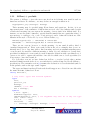
page at http://www.avantssar.eu/ - Menu Item Avantssar Platform.
Assume that above listed model is placed in a file named NSPK.aslan++. Then we can
translate (“compile”) our ASLan++ model by this command:
10
Bob is given A as parameter by Session and then plainly ignores its value. This, as remarked already,
is necessary, because the translator from ASLan++ to ASLan needs to know which agent variables inside
the Bob entity the security goals given in the Session entity are connected to.
FP7-ICT-2007-1
Project No. 216471
D2.3 (update): ASLan++ specification and tutorial
23/190
java -jar aslanpp-connector.jar -gas NSPK.aslan++ -o NSPK.aslan
The -gas option is recommended, as it makes the goals easier to handle for the automated model checkers11 .
The error messages and warnings of the compiler should be largely self-explanatory. Only,
should you encounter a quite cryptic message like “no viable alternative at ...”, then it
is best to look in close proximity of the location indicated in the message for some trivial
syntax error violating the grammar given in § 3.12.
Please note that due to the intentional commenting out of the secrecy goal templates in
the Session entity, you will – on executing above command – receive a list of warnings from
the translator that undefined secrecy goals are referred to in the Alice and Bob entities.
This of course obviously is true, but you at this point can safely ignore these warnings and
use the resulting NSPK.aslan file for analysis by the model checkers.
Checking the ASLan Model.
We can now submit the ASLan model to one or more of the back-ends of the AVANTSSAR
Platform, namely CL-AtSe, OFMC, and SATMC. All three model checkers are available in
both an online and offline version. For directions please refer to the AVANTSSAR home
page at http://www.avantssar.eu/ - Menu Item Avantssar Platform.
The back-ends are based on different technologies and thus provide complementary
strengths, for instance: CL-AtSe efficiently deals with Horn clauses and exhibits good performance in general; OFMC supports algebraic reasoning, a proved-correct pruning of the
search space, compositionality, and an experimental combination with abstract-based interpretation; and SATMC supports LTL goals, all channels models, and Horn theories.
We can upload the ASLan file to the model checker service of our choice and let the
model checker execute the model remotely. Alternatively, we can use the offline binary of a
model checker locally, e.g. we use CL-AtSe on our ASLan file by executing
cl-atse NSPK.aslan
The search behavior and the attack output of the model checkers may be tuned by certain
options. For instance, OFMC usually needs both the --classic and the --untyped option.
CL-AtSe requires the --nb n option with n being least 2 in order to deal with loops and
requires the --not_hc option to deal with negations in clauses. For detailed instructions on
how to use and tune the various AVANTSSAR model checkers, please see Appendix B and
refer to Deliverable 4.2 [6].
The options to fine-tune the model checkers can be given manually as command line
option each time the model checker is executed. Another method is to use directives at the
very beginning of the ASLan++ model definition. Here as a kind of comment each model
checker can be assigned options that are used, whenever the model is analyzed. For instance
% @clatse(--hc blr) sets options for CL-AtSe, whenever that model checker analyzes this
11
The option -gas can also be given more verbosely as --goals-as-attack-states. It transforms, as
far as possible, goal formulas as attack states, which can be handled by the model checkers more efficiently
than goals in LTL (Linear Temporal Logic) form.
FP7-ICT-2007-1
Project No. 216471
D2.3 (update): ASLan++ specification and tutorial
24/190
model. With satmc the model checker SATMC can be addressed, for OFMC we must use
ofmc. An example for such server directives can be found below in § 2.1.7.
Interpreting the Model Checkers’ output.
The model checkers produce a rather abstract and low-level output format, called
AVANTSSAR OF. Each model checkers offers various options to tweak the output. For
instance, one may launch CL-AtSe with the option "--of if", which results in a very detailed message-sequence-chart-like output of traces as ASLan level. In traces produced by
OFMC, unexpected variables like x2602 may appear when an attack is possible for any
(non-constrained) value at the given term position(s).
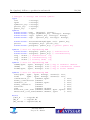
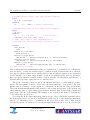
The ASLan++ connector can transform the low-level AVANTSSAR OF back to a more
or less ASLan++ level output. For example, the commands
cl-atse NSPK.aslan >NSPK.atk;
java -jar aslanpp-connector.jar NSPK.aslan -ar NSPK.atk
produce the following output:
1
2
INPUT:
NSPK_Unsafe.aslan
3
4
5
SUMMARY:
ATTACK_FOUND
6
7
8
DETAILS:
TYPED_MODEL
9
10
11
BACKEND:
CL-ATSE 2.5-7e_(December_27th_2010)
12
13
14
15
16
COMMENTS:
CLAUSES coding internal intruder’s actions are not shown
EXPLICIT section shows only facts not removed by the simplification
IMPLICIT section shows only facts needed for showing insecurity
17
18
19
20
21
22
23
STATISTICS:
TIME 592 ms
TESTED 2115 transitions
REACHED 1110 states
READING 0.02 seconds
ANALYSE 0.57 seconds
24
25
26
STATES:
Environment[Actor=root, IID=0, SL=1]
27
28
CLAUSES:
29
30
31
32
STATEMENTS:
g A(4) != Req(1) % on line 53
n Session[Actor=dummy_agent, IID=n4(IID), SL=1, A=A(4), B=Req(1)]
33
34
35
36
STATES:
Environment[Actor=root, IID=0, SL=2]
Session[Actor=dummy_agent, IID=n4(IID), SL=1, A=A(4), B=Req(1)]
37
38
CLAUSES:
39
FP7-ICT-2007-1
Project No. 216471
% on line 53
D2.3 (update): ASLan++ specification and tutorial
40
41
42
STATEMENTS:
g Wit(1) != i % on line 54
n Session[Actor=dummy_agent, IID=n5(IID), SL=1, A=Wit(1), B=i]
25/190
% on line 54
43
44
45
46
47
STATES:
Environment[Actor=root, IID=0, SL=3]
Session[Actor=dummy_agent, IID=n4(IID), SL=1, A=A(4), B=Req(1)]
Session[Actor=dummy_agent, IID=n5(IID), SL=1, A=Wit(1), B=i]
48
49
CLAUSES:
50
51
52
53
STATEMENTS:
n Alice[Actor=Wit(1), IID=n6(IID), SL=1, B=i, Na=dummy_text, Nb=dummy_text] % on line 38
n Bob[Actor=i, IID=n6(IID), SL=1, A=Wit(1), Na=dummy_text, Nb=dummy_text] % on line 39
54
55
56
57
58
59
60
STATES:
Environment[Actor=root, IID=0, SL=3]
Session[Actor=dummy_agent, IID=n4(IID), SL=1, A=A(4), B=Req(1)]
Session[Actor=dummy_agent, IID=n5(IID), SL=3, A=Wit(1), B=i]
Alice[Actor=Wit(1), IID=n6(IID), SL=1, B=i, Na=dummy_text, Nb=dummy_text]
Bob[Actor=i, IID=n6(IID), SL=1, A=Wit(1), Na=dummy_text, Nb=dummy_text]
61
62
CLAUSES:
63
64
65
66
STATEMENTS: of Alice[n6(IID)]
f Na := n7(Na) % from fresh on line 14
s Wit(1) -> i : {n7(Na).Wit(1)}_pk(i) % on line 15
67
68
69
70
71
72
73
STATES:
Environment[Actor=root, IID=0, SL=3]
Session[Actor=dummy_agent, IID=n4(IID), SL=1, A=A(4), B=Req(1)]
Session[Actor=dummy_agent, IID=n5(IID), SL=3, A=Wit(1), B=i]
Alice[Actor=Wit(1), IID=n6(IID), SL=3, B=i, Na=n7(Na), Nb=dummy_text]
Bob[Actor=i, IID=n6(IID), SL=1, A=Wit(1), Na=dummy_text, Nb=dummy_text]
74
75
CLAUSES:
76
77
78
79
STATEMENTS:
n Alice[Actor=A(4), IID=n22(IID), SL=1, B=Req(1), Na=dummy_text, Nb=dummy_text] % on line 38
n Bob[Actor=Req(1), IID=n22(IID), SL=1, A=A(4), Na=dummy_text, Nb=dummy_text] % on line 39
80
81
82
83
84
85
86
87
88
STATES:
Environment[Actor=root, IID=0, SL=3]
Session[Actor=dummy_agent, IID=n4(IID), SL=3, A=A(4), B=Req(1)]
Session[Actor=dummy_agent, IID=n5(IID), SL=3, A=Wit(1), B=i]
Alice[Actor=Wit(1), IID=n6(IID), SL=3, B=i, Na=n7(Na), Nb=dummy_text]
Bob[Actor=i, IID=n6(IID), SL=1, A=Wit(1), Na=dummy_text, Nb=dummy_text]
Alice[Actor=A(4), IID=n22(IID), SL=1, B=Req(1), Na=dummy_text, Nb=dummy_text]
Bob[Actor=Req(1), IID=n22(IID), SL=1, A=A(4), Na=dummy_text, Nb=dummy_text]
89
90
CLAUSES:
91
92
93
94
95
96
97
98
99
STATEMENTS: of Bob[n22(IID)]
r ? -> Req(1) : {n7(Na).Wit(1)}_pk(Req(1)) % on line 28
m A := Wit(1) % from matching on line 28
m Na := n7(Na) % from matching on line 28
f Nb := n20(Nb) % from fresh on line 29
s Req(1) -> Wit(1) : {n7(Na).n20(Nb)}_pk(Wit(1)) % on line 30
+ witness(Req(1),Wit(1),auth_Alice_authenticates_Bob,n7(Na)) % on line 30
+ witness(Req(1),Wit(1),fresh_Alice_authenticates_Bob,n7(Na)) % on line 30
100
101
102
103
104
STATES:
Environment[Actor=root, IID=0, SL=3]
Session[Actor=dummy_agent, IID=n4(IID), SL=3, A=A(4), B=Req(1)]
Session[Actor=dummy_agent, IID=n5(IID), SL=3, A=Wit(1), B=i]
FP7-ICT-2007-1
Project No. 216471
D2.3 (update): ASLan++ specification and tutorial
105
106
107
108
26/190
Alice[Actor=Wit(1), IID=n6(IID), SL=3, B=i, Na=n7(Na), Nb=dummy_text]
Bob[Actor=i, IID=n6(IID), SL=1, A=Wit(1), Na=dummy_text, Nb=dummy_text]
Alice[Actor=A(4), IID=n22(IID), SL=1, B=Req(1), Na=dummy_text, Nb=dummy_text]
Bob[Actor=Req(1), IID=n22(IID), SL=4, A=Wit(1), Na=n7(Na), Nb=n20(Nb)]
109
110
CLAUSES:
111
112
113
114
115
116
117
118
119
STATEMENTS: of Alice[n6(IID)]
r i -> Wit(1) : {n7(Na).n20(Nb)}_pk(Wit(1)) % on line 16
m Nb := n20(Nb) % from matching on line 16
+ request(Wit(1),i,auth_Alice_authenticates_Bob,n7(Na),n6(IID)) % on line 16
+ request(Wit(1),i,fresh_Alice_authenticates_Bob,n7(Na),n6(IID)) % on line 16
s Wit(1) -> i : {n20(Nb)}_pk(i) % on line 18
+ witness(Wit(1),i,auth_Bob_authenticates_Alice,n20(Nb)) % on line 18
+ witness(Wit(1),i,fresh_Bob_authenticates_Alice,n20(Nb)) % on line 18
120
121
122
123
124
125
126
127
128
STATES:
Environment[Actor=root, IID=0, SL=3]
Session[Actor=dummy_agent, IID=n4(IID), SL=3, A=A(4), B=Req(1)]
Session[Actor=dummy_agent, IID=n5(IID), SL=3, A=Wit(1), B=i]
Alice[Actor=Wit(1), IID=n6(IID), SL=5, B=i, Na=n7(Na), Nb=n20(Nb)]
Bob[Actor=i, IID=n6(IID), SL=1, A=Wit(1), Na=dummy_text, Nb=dummy_text]
Alice[Actor=A(4), IID=n22(IID), SL=1, B=Req(1), Na=dummy_text, Nb=dummy_text]
Bob[Actor=Req(1), IID=n22(IID), SL=4, A=Wit(1), Na=n7(Na), Nb=n20(Nb)]
129
130
CLAUSES:
131
132
133
134
135
136
STATEMENTS: of Bob[n22(IID)]
r Wit(1) -> Req(1) : {n20(Nb)}_pk(Req(1)) % on line 31
+ request(Req(1),Wit(1),auth_Bob_authenticates_Alice,n20(Nb),n22(IID)) % on line 31
+ request(Req(1),Wit(1),fresh_Bob_authenticates_Alice,n20(Nb),n22(IID)) % on line 31
a Na := n7(Na) % from assignment on line 32
137
138
139
140
141
142
143
144
145
STATES:
Environment[Actor=root, IID=0, SL=3]
Session[Actor=dummy_agent, IID=n4(IID), SL=3, A=A(4), B=Req(1)]
Session[Actor=dummy_agent, IID=n5(IID), SL=3, A=Wit(1), B=i]
Alice[Actor=Wit(1), IID=n6(IID), SL=5, B=i, Na=n7(Na), Nb=n20(Nb)]
Bob[Actor=i, IID=n6(IID), SL=1, A=Wit(1), Na=dummy_text, Nb=dummy_text]
Alice[Actor=A(4), IID=n22(IID), SL=1, B=Req(1), Na=dummy_text, Nb=dummy_text]
Bob[Actor=Req(1), IID=n22(IID), SL=6, A=Wit(1), Na=n7(Na), Nb=n20(Nb)]
146
147
CLAUSES:
148
149
150
VIOLATED:
auth_Bob_authenticates_Alice[IID=n22(IID), Msg=n20(Nb), Req=Req(1), Wit=Wit(1)]
151
152
153
154
155
156
157
158
159
160
161
162
163
164
165
166
167
168
169
EXPLICIT:
child(0,n4(IID))
child(0,n5(IID))
child(dummy_nat,0)
child(n4(IID),n22(IID))
child(n4(IID),n22(IID))
child(n5(IID),n6(IID))
child(n5(IID),n6(IID))
dishonest(i)
iknows(ak)
iknows(atag)
iknows(ck)
iknows({n7(Na).n20(Nb)}_pk(Wit(1)))
iknows({n20(Nb)}_pk(i))
iknows({n7(Na).Wit(1)}_pk(i))
iknows(ctag)
iknows(hash)
iknows(i)
FP7-ICT-2007-1
Project No. 216471
% on line 48
D2.3 (update): ASLan++ specification and tutorial
27/190
iknows(inv(ak(i)))
iknows(inv(ck(i)))
iknows(inv(pk(i)))
iknows(n20(Nb))
iknows(n7(Na))
iknows(pk)
iknows(root)
iknows(stag)
iknows(A)
iknows(B)
iknows(A)
iknows(B)
request(Req(1),Wit(1),auth_Bob_authenticates_Alice,n20(Nb),n22(IID))
request(Req(1),Wit(1),fresh_Bob_authenticates_Alice,n20(Nb),n22(IID))
request(Wit(1),i,auth_Alice_authenticates_Bob,n7(Na),n6(IID))
request(Wit(1),i,fresh_Alice_authenticates_Bob,n7(Na),n6(IID))
state_Bob(i,n6(IID),1,Wit(1),dummy_text,dummy_text)
state_Environment(root,0,1)
witness(Req(1),Wit(1),auth_Alice_authenticates_Bob,n7(Na))
witness(Wit(1),i,auth_Bob_authenticates_Alice,n20(Nb))
170
171
172
173
174
175
176
177
178
179
180
181
182
183
184
185
186
187
188
189
190
191
192
193
194
195
196
197
MESSAGES:
Wit(1)
<?>
Req(1)
<i>
Wit(1)
<Wit(1)>
->
->
->
->
->
->
<i>
Req(1)
<Wit(1)>
Wit(1)
<i>
Req(1)
:
:
:
:
:
:
{n7(Na).Wit(1)}_pk(i)
{n7(Na).Wit(1)}_pk(Req(1))
{n7(Na).n20(Nb)}_pk(Wit(1))
{n7(Na).n20(Nb)}_pk(Wit(1))
{n20(Nb)}_pk(i)
{n20(Nb)}_pk(Req(1))
As you can see, CL-AtSe was able to find an attack path to violate some security goal.
This it indicates at the very beginning under SUMMARY: ATTACK_FOUND. After some statistics
about itself and the present model check, the model checker lists a protocol of the steps it
performed while checking our model. The description of each step consists of a triple of
STATES, CLAUSES, and STATEMENTS.
The STATES section lists all then existing entity instances and their current parameter
values. The CLAUSES section would provide information about Horn Clauses, which however
in our NSPK example we did not use. So for the present, this section is empty12 . The
STATEMENTS section lists the statements that were executed in that step together with the
parameter values, and makes references to the code line numbers in the ASLan++ file.
Once the model checker detects a security goal violation, it stops model checking and
under the heading VIOLATED prints out the violated security goal. This is followed by a kind
of ”core dump”, which lists all facts that are known at the time of the goal violation. Here
we have only EXPLICIT facts, that have been introduced by declaring them fact explicitly,
for instance by instantiation of an entity or generation of a nonce. As in our NSPK example
we don’t use horn clauses, we have no IMPLICIT deduced facts.
The most interesting part of it however is the MESSAGES section with its compact messagesequence-chart-like attack representation at the very bottom of this listing:
Wit(1)
<?>
Req(1)
12
->
->
->
<i>
Req(1)
<Wit(1)>
: {n7(Na).Wit(1)}_pk(i)
: {n7(Na).Wit(1)}_pk(Req(1))
: {n7(Na).n20(Nb)}_pk(Wit(1))
For an example containing Horn Clauses please refer to § 2.1.7 below.
FP7-ICT-2007-1
Project No. 216471
D2.3 (update): ASLan++ specification and tutorial
28/190
Figure 7: An AVANTSSAR Model Checker found a Vulnerability in the NSPK Protocol.
<i>
Wit(1)
<Wit(1)>
->
->
->
Wit(1)
<i>
Req(1)
: {n7(Na).n20(Nb)}_pk(Wit(1))
: {n20(Nb)}_pk(i)
: {n20(Nb)}_pk(Req(1))
This attack trace demonstrates that our NSPK protocol is vulnerable to a man-in-themiddle-attack, which was initially detected by Lowe [13]. If we input this attack trace to
“Web Sequence Diagrams”, we obtain Figure 7. As described below, it would be logically
more adequate to place the node <Wit(1)> just right of <?>, but apparently the tool does
not do this in order to avoid arrows overapping with vertical lines.
Wit(1) is an honest instance of Alice and Req(1) is an honest instance Bob. The angle
brackets <...> around a party denote the intended or assumed communication partner, of
whose identity, however, the honest communication peer cannot be sure. In other words, it
may be actually the intruder acting in the name of the party given. Here <i> is the intruder
in the name of himself, <?> is (for Bob at least) an hitherto unknown party, and <Wit(1)>
is the party that Bob assumes to be Alice, which however he cannot be sure of until proper
authentication – and here in fact it is the intruder in the name of Alice.
Lowe’s attack is sketched in a slightly more compact form in Figure 8. There the different
forms of the intruder, namely <i>, <?>, and <Wit(1)> from Figure 7 all are subsumed under
a single i.
If A initiates a session with the intruder i (i.e. Alice wants to communicate with the
intruder, she does not think that the intruder is Bob, nor does she of course know that the
intruder is actually a dishonest party), i can relay the data received from A to B and vice
versa (with some re-encryption) and thus convince B that he is communicating with A. That
is, Bob is tricked into thinking that he is talking with Alice, while in fact he is communicating
with the intruder.
The input of “Web Sequence Diagrams” corresponding to the compact attack trace in
Figure 8 is:
A->i: {Na, A}_Ki
i->B: {Na, A}_Kb
B->i: {Na, Nb}_Ka
FP7-ICT-2007-1
Project No. 216471
D2.3 (update): ASLan++ specification and tutorial
29/190
Figure 8: The Lowe Attack on the NSPK Protocol.
i->A: {Na, Nb}_Ka
A->i: {Nb}_Ki
i->B: {Nb}_Kb
This attack only succeeds, if two NSPK sessions are conducted in parallel and interleaved,
as sketched in Figure 8. The intruder i re-encrypts A’s nonce and name received from A with
the public key of B. He then (under the heading of <?> in Figure 7) relays this re-encrypted
message to B.
B reads that A wants to communicate with him, generates his fresh nonce Nb and sends the
response encrypted with A’s public key to the party he assumes to be A (under the heading
of <Wit(1)> in Figure 7), which however (as we know) actually is i. Now, i cannot read Bs
response, as B has encrypted his reply to A with A’s public key.
However, i can relay B’s response to A, who obligingly decrypts Nb for i. Then i can
re-encrypt Bs nonce and (under the heading of <Wit(1)> in Figure 7) forward it to B. B now
erroneously believes that he has successfully authenticated A.
Please note that only due to the intentional commenting out of the secrecy goal templates
in the Session entity, the attack was able to continue that far. If you re-activate the secrecy
goals, then of course the model checkers already find a violation of a security goal, when A
discloses Nb to i. Then the secrecy goal secret_Nb is violated, as only A and B may know
of it. You are encouraged to try this out.
Correcting the ASLan++ Model.
What went wrong? When i relays B’s response to A, A has no possibility to discern that
this response came from B originally. She thinks that she is communicating with i and i
FP7-ICT-2007-1
Project No. 216471
D2.3 (update): ASLan++ specification and tutorial
30/190
Figure 9: Lowe’s Fix for the Vulnerability in the NSPK Protocol.
only. Thus, we have to extend the protocol with some indication for A that the response
comes from B. B puts into his response not only A’s nonce and his own, but also his name,
before encrypting it for A, i.e. {Na.Nb.B}_Ka, as shown in Figure 9. Now i again relays this
message, which he cannot decrypt, to A. However, on checking the name in the message, now
A will notice that the nonce is from B and not from i, as she thought. Then she can react
accordingly.
The input of “Web Sequence Diagrams” corresponding to Figure 9 is:
A -> B: {Na.A}_Kb
B -> A: {Na.Nb.B}_Ka
A -> B: {Nb}_Kb
We can now transfer the simple correction to our ASLan++ model of the NSPK protocol.
Within the definition of Bob, we add as additional parameter Bob’s name to the message
he sends to Alice, and on Alice’s side, we receive and check this name against the expected
partner Bob.
entity Alice ( Actor , B : agent ) {
...
body {
...
B -> Actor : { A l i c e _ a u t h e n t i c a t e s _ B o b :( Na ).
secret_Nb :(? Nb ). B } _pk ( Actor );
...
}
...
}
entity Bob (A , Actor : agent ) {
...
body {
...
FP7-ICT-2007-1
Project No. 216471
D2.3 (update): ASLan++ specification and tutorial
31/190
Figure 10: The CA Hierarchy Setup.
Actor
->
A : { A l i c e _ a u t h e n t i c a t e s _ B o b :( Na ).
Nb . Actor } _pk ( A );
...
}
...
}
If we now re-translate and re-check the corrected model, no more attack is found.
2.1.7
Clauses, Deductions and Recursion
A concept required frequently is that of computation including recursion. Although in
ASLan++ there are no function calls, there are clauses 13 that may be used for such (and
many other) purposes. This section introduces some basic use of clauses. We specify a
simple Public Key Infrastructure (PKI) extension of our NSPK example, and show how to
use Horn Clauses to do deductions, including recursion, of additional facts from given facts.
On Public Key Infrastructures.
We assume that A and B (and i) have been issued Public Key certificates by a Certificate
Authority (CA). A public key certificate is an electronic document that binds a name to a
public key in a trustworthy manner. Public key certificates are signed by a trusted certificate
authority (CA), after the CA has verified the data of the applicant, e.g. by checking their
passport. When validating a public key certificate, one must check:
13
These are extensions of classical Horn clauses; the syntax of the rules resembles Prolog.
FP7-ICT-2007-1
Project No. 216471
D2.3 (update): ASLan++ specification and tutorial
32/190
Validity Range: Normally the “Valid From” and “Valid To” fields in the certificate can be
compared to a reference time.
Revocation State: A certificate may be revoked before it expires, e.g. because an employee
leaves the company. A check against a blacklist or directory should help here.
Chain of Trust: The certificate must be signed by a trusted party. Especially in large PKI
structures trust may be indirect, e.g. a root CA signs a subordinate CA, which in turn
signs end user certificates. Directories may help to discover chains of trusts.
Purpose: A certificate is issued for a certain certificate use, e.g. email signing, file encryption, client authentication, certificate signing, etc. The relying party must check the
certificate’s signed purpose against the intended certificate use.
Validating Certificates.
To implement the validation of the chain of trust from a given certificate to a trusted root
certificate authority, we introduce the following clauses within the Environment entity.
1 symbols
2 ...
3
trusted_agent ( agent ): fact ;
4
trusted_pk ( agent ): fact ;
5
issued ( message ): fact ;
6 ...
7 clauses
8
trusted_p k_dire ct ( C ):
9
trusted_pk ( C ) : 10
trusted_agent ( C );
11
12
tru sted _ p k _ c e r t _ c h a i n (A , B ):
13
trusted_pk ( A ) : 14
trusted_pk ( B ) &
15
issued (B - > cert (A , pk ( A )))
16
& B != A ;
With the clause named trusted_pk_direct (line 8) we express, that we trust a public
key of an entity C, if C has been declared a trusted agent. In our model we will do this for
the trusted root certificate authority only. This clause is a recursion termination point.
With the other clause named trusted_pk_cert_chain (line 12) we introduce the recursion step. We say that we trust the public key of an entity A only, if we trust the public key
of another entity B, and if B has issued a certificate for A, accrediting A’s public key, and if
it is not a self-signed certificate. Please note, that A and B here are not Alice and Bob, but
just placeholders for any entity.
FP7-ICT-2007-1
Project No. 216471
D2.3 (update): ASLan++ specification and tutorial
33/190
To simplify the presentation, we do not model the issuing of certificates, but just declare
them, as shown in the following listing14 .
1
2
3
4
5
6
7
8
trusted_agent ( root_ca );
issued ( root_ca - > cert ( ca , pk ( ca )));
issued ( ca - > cert ( A , pk ( A )));
issued ( ca - > cert ( A , pk ( B )));
issued ( ca - > cert (i , pk ( i )));
issued ( c - > cert (i , pk ( i )));
The CA signing the certificates of Alice and Bob in our example is an intermediate CA,
authorized by a superordinate trusted root CA. A and B both trust the root CA, as depicted
in Figure 10. We declare the root CA as trusted by stating trusted_agent(root_ca) (line
1) as fact. Then we state as fact, that the root CA has issued a certificate for the intermediate
CA by saying issued(root_ca->cert(ca, pk(ca))) (line 2). Then we also declare (lines
4, 5, 7) that the intermediate CA has issued certificates for A, B, and also the intruder i.
Then we let some non-trusted party c also issue a certificate for i (line 8), which however
neither A nor B would accept.
1 entity Alice ( Actor , B : agent ) {
2 ...
3
body {
4
if ( trusted_pk ( B )) {
5
...
6
}
7
}
8 }
Alice (as sketched in above listing in line 4) and Bob accept a signed message only if the
signer has a trustworthy certificate, otherwise they refuse communication. A trustworthy
certificate has been directly or indirectly signed by a trusted CA. To discover the chain of
trust requires recursive verification of certificates until reaching the signature of a trusted
CA or coming to the conclusion, that no such CA can be found. This is done via deduction
by evaluating above clauses against the known facts.
For simplicity, we neither verify the certificate’s validity range (i.e. the time interval for
which the certificate is valid) nor its revocation state nor its intended purpose.
The complete ASLan++ Model.
The following listing contains the complete ASLan++ model for the adapted NSPK example15 .
14
->cert(A,PK) is an example of a macro defined for better readability in the macros section of an entity.
The definition of that macro you can find below in the listing of the complete model. For further details
about macros please refer to § 3.6
15
The model checkers, as we have said already, can be fine-tuned by various options, either as command
line options or as directives in the ASLan++ code of the model. Here with % @clatse(--hc blr) we give
FP7-ICT-2007-1
Project No. 216471
D2.3 (update): ASLan++ specification and tutorial
%
%
%
%
NSPK with Public Key Certificates / Horn Clause Use Case
@clatse ( - - hc blr )
@satmc ( NO )
@ofmc ( NO )
specification NSPK_Cert_Unsafe
channel_model CCM
entity Environment {
symbols
% Declare global symbols .
root_ca , ca : agent ;
% certificate authorities .
c : agent ;
% agent used as fake CA .
trusted_agent ( agent ): fact ;
trusted_pk ( agent ): fact ;
issued ( message ): fact ;
macros
% Macros improving readability .
A - > signed ( M ) = { M } _inv ( pk ( A )). M ; % Agent A signed M
% = sign ( inv ( pk ( A )) , M ). M
C - > cert (A , PK ) = C - > signed ( C . A . PK );
% Abstract certificate without details ,
% like validity period , cert . purpose , etc .
clauses
trusted_p k_dire ct ( C ):
trusted_pk ( C ) : trusted_agent ( C );
% Horn Clauses deduce new facts
% Direct trust C ’ s pk ?
% If C is a trusted
% certificate authority .
tru st e d _ p k _ c e r t _ c h a i n (A , B ):
% Indirect trust C ’ s pk ?
trusted_pk ( A ) : % If we trust B ’ s pk
trusted_pk ( B ) &
% and know a certificate ,
issued (B - > cert (A , pk ( A )))
% where B accredits A .
& B != A ;
% %% CL - AtSe : no self - signed certs allowed .
% %% SATMC and OFMC can handle certificate chain loops !
entity Session (A , B : agent ) {
entity Alice ( Actor , B : agent ) {
symbols
Na , Nb : text ;
an example of the latter method.
FP7-ICT-2007-1
Project No. 216471
34/190
D2.3 (update): ASLan++ specification and tutorial
35/190
body {
if ( trusted_pk ( B )) { % A talks to B if B ’ s pk is trusted
secret_Na :( Na ) := fresh ();
Actor -> B : { Na . Actor } _pk ( B );
B -> Actor : { A l i c e _ a u t h e n t i c a t e s _ B o b :( Na ).
secret_Nb :(? Nb )} _pk ( Actor );
Actor -> B : { B o b _ a u t h e n t i c a t e s _ A l i c e :( Nb )} _pk ( B );
}
}
}
entity Bob (A , Actor : agent ) {
symbols
Na , Nb : text ;
body {
? -> Actor : {? Na .? A } _pk ( Actor );
% Bob learns A here !
if ( trusted_pk ( A )) { % B talks to A if A ’ s pk is trusted
secret_Nb :( Nb ) := fresh ();
Actor -> A : { A l i c e _ a u t h e n t i c a t e s _ B o b :( Na ). Nb } _pk ( A );
A -> Actor : { B o b _ a u t h e n t i c a t e s _ A l i c e :( Nb )} _pk ( Actor );
secret_Na :( Na ) := Na ; % Goal can only be given here ,
% because A certainly is not authenticated before !
}
}
}
body { % of Session
issued ( ca - > cert ( A , pk ( A )));
issued ( ca - > cert ( A , pk ( B )));
new Alice (A , B );
new Bob (A , B );
}
% Alice ’ s cert . signed by CA .
%
Bob ’ s cert . signed by CA .
goals
secret_Na :( _ ) {A , B };
% Okay .
secret_Nb :( _ ) {A , B };
% Attack found !
% %% May comment out the above secrecy goals such that
% %% the attack is printed on authentiation .
A li c e _ a u t h e n t i c a t e s _ B o b :( _ ) B * - > > A ; % Okay .
B ob _ a u t h e n t i c a t e s _ A l i c e :( _ ) A * - > > B ; % Attack found !
} % end entity Session
FP7-ICT-2007-1
Project No. 216471
D2.3 (update): ASLan++ specification and tutorial
36/190
body { % of Environment
trusted_agent ( root_ca ); % We accept root_ca as trusted .
issued ( root_ca - > cert ( ca , pk ( ca ))); % Intermediate ca
issued ( ca - > cert (i , pk ( i )));
issued ( c - > cert (i , pk ( i )));
% i ’ s cert . signed by CA .
% Fake intruder certificate
% Two sessions needed for Lowe ’ s attack .
any A B . Session (A , B )
where A != B & A != root_ca & B != root_ca
& A !=
ca & B !=
ca ;
any A B . Session (A , B )
where A != B & A != root_ca & B != root_ca
& A !=
ca & B !=
ca ;
}
}
If A, B and i are granted a trusted certificate, the well-known Lowe attack [13] succeeds. If,
for instance, the intruder i does not have a trusted certificate, then A refuses to communicate
with i and no attack can take place.
Please note that, on translating above listing, you will receive a warning on horn clauses
being an experimental feature. You can safely ignore this warning and check the model with
CL-AtSe.
For a further example you may refer to § 2.7, where we provide a simple RBAC model
utilizing Horn Clauses.
2.2
Modeling hints
When specifying a protocol/system in ASLan++, you may wonder whether your model is
correct. Of course, there may be conceptual mistakes. You for instance may have misunderstood the protocol/system properties and the resulting model therefore would not adequately
represent reality. However here in this chapter we do not want to address conceptual correctness of individual models.
Rather we now discuss ’programming’ errors and inefficiencies. These can render any
conceptually flawless model useless. We point out a few basic strategies of how to avoid the
most common mistakes.
2.2.1
Debugging wrt. executability problems
The following advice should be every model checker’s intrinsic mantra. Prior to checking
your model for attacks,
FP7-ICT-2007-1
Project No. 216471
D2.3 (update): ASLan++ specification and tutorial
37/190
ALWAYS ensure executability of your model first!
If a model checker responds with NO_ATTACK_FOUND, this does not necessarily mean that
the protocol/system described is secure. Before you may put trust in such a result, you must
ensure as far as possible, that there are no problems in the model or in the tools. Until then,
indeed you must be very suspicious if no attack has been found during a model check. Why?
Very often, no attack is reported by a model checker, because in the model not all
statements can be executed. Non-executability of a model in this context means, that not
even under optimal conditions (i.e. all participants are behaving as they should and no
intruder is messing up things), the protocol can be executed until the intended end, if any,
of the system run.
The most frequent reason for non-executability of a model is that a message sent by some
party does not match with the message pattern expected by the intended receiver. Then
the intended receiver, who is waiting for a different message, blocks execution and the rest
of the protocol may never be executed.
Incompatibility may result because of missing sub-messages. Also wrongly set parentheses such as (M1.M2).M2 vs. M1.M2.M2, which is implicitly parenthesized as M1.(M2.M2), etc.
can easily cause non-executability and are easily overlooked by human readers. Even more
subtle mistakes are type mismatches, e.g. because the sender sends an agent name and the
receiver expects a public key instead.
To help detecting such problems, the ASLan output format (OF) provides an UNUSED:
section which shows any ASLan rules that were never used by the model checker during its
analysis16 So far only CL-AtSe supports this. SATMC offers the -e option for executability
checking, showing which rules can be executed and which not. OFMC will soon offer a
similar functionality, after a correction of its --exec option.
Independently of such a special support by the model checkers, a very helpful technique
to spot and debug executability problems consists of manually adding checkpoints into the
model like for instance
assert r e a c h e d _ b r e a k p o i n t 4 7 1 1 : false ; % for exec testing !
at various places, in particular at the intended end of a protocol session. Then with the
help of the model checkers and typically for a single session of your protocol/system you can
observe if the artificial ’attack’ provoked by the false formula actually is found. If so, the
breakpoint can be commented out and other reachability properties or actual security goals
can be checked.
This technique also helps you to detect for instance ”overused” statement lines caused
by CL-AtSe not being supplied with a large enough --nb <n> value. The --nb option
instructs CL-AtSe, how often it should execute code multiple times, for instance in while
16
Please note that individual unreachable statements not necessarily are a reason to worry about. For
instance, with parameterized models, if you instantiate your session with one parameter value, sections of
your model only applicable to other parameter values of course may not be executed. Further, if you use
an if-branch without any else-branch in ASLan++, in ASLan there will implicitly be added an empty
else-branch, which may show up as a single non-executable statement pointing to the if-branch of your
ASLan++ file.
FP7-ICT-2007-1
Project No. 216471
D2.3 (update): ASLan++ specification and tutorial
38/190
loops. If you require a loop to be executed a lot of times, you might need to experiment a
bit, before finding the optimal --nb value. If you choose an insufficient one, when exceeding
the maximum number of iterations, CL-AtSe just quietly exits at that point and reports,
that no attack was found until then. This however you will notice by an appropriately
placed ”assert finished: false;”. The equivalent applies to situations, in which you try
to remove an element from a set that this element is not contained in. Or if you attempt to
retract a fact that has not been introduced before.
So, again, before actually starting to check your model for real attacks, we strongly advise
you first to make sure and double-check that all parts of the modeled protocol/system can
in fact be reached and executed.
2.2.2
Detecting uninitialized variables
A problem easily overlooked is that variables might be used without being initialized first.
This typically leads to attacks not found or spurious (wrong) attacks being reported.
For example, the following entity declaration contains four such mistakes.
entity Test { % implicit Actor parameter not initialized !
symbols
U : message ;
S : message set ;
body {
send (i , U );
% sends an uninitialized msg variable !
S - > add ( i );
% uses an uninitialized set variable !
S := {};
% initializes the set variable
S - > add ( U );
% adds an uninitialized msg variable !
}
}
Uninitialized variables after translation in the resulting ASLan model have pseudo values
such as dummy_message and dummy_nat, depending on the type of the variable. When an
attack trace is printed by the model checkers, one may have a close look at it to spot such
values in term positions where variables are used (e.g. in a term that is sent or assigned to
some other variable).
In the given example, an attack trace would include
STATEMENTS: of Test[n3(IID)]
s dummy_agent -> i : dummy_message
+ dummy_set_message->contains(i)
a S := set_1(n3(IID))
+ set_1(n3(IID))->contains(dummy_message)
clearly showing the four dummy_. . . values resulting from using Actor, U (two times), and S
while not yet being initialized.
So far there is no direct tool support for finding such mistakes. Yet one may extend an
ASLan++ specification with a couple of auxiliary declarations and goals at the level of the
outermost entity, as in the listing given next.
FP7-ICT-2007-1
Project No. 216471
D2.3 (update): ASLan++ specification and tutorial
specification U n i n i t i a l i z e d _ U n s a f e
channel_model CCM
entity Environment
{
symbols
uninitial ized_m sg ( message
): fact ;
uninitial ized_s et ( message set ): fact ;
symbols
UA : agent ;
UM : message ;
UK : symmetric_key ;
UN : nat ;
UP : public_key ;
US : private_key ;
UT : text ;
SA :
SM :
SK :
SN :
SP :
SS :
ST :
agent set ;
message set ;
symmetric_key set ;
nat set ;
public_key set ;
private_key set ;
text set ;
entity Test { % implicit Actor parameter not initialized !
symbols
U : message ;
S : message set ;
body {
send (i , U );
% sends an uninitialized msg variable !
S - > add ( i );
% uses an uninitialized set variable !
S := {};
% initializes the set variable
S - > add ( U );
% adds an uninitialized msg variable !
}
}
body
{
uninitial ized_m sg ( UA );
uninitial ized_m sg ( UM );
uninitial ized_m sg ( UK );
uninitial ized_m sg ( UN );
uninitial ized_m sg ( UP );
uninitial ized_m sg ( US );
uni nitia lized_ set ( SA );
uni nitia lized_ set ( SM );
uni nitia lized_ set ( SK );
uni nitia lized_ set ( SN );
uni nitia lized_ set ( SP );
uni nitia lized_ set ( SS );
FP7-ICT-2007-1
Project No. 216471
39/190
D2.3 (update): ASLan++ specification and tutorial
40/190
uninitial ized_m sg ( UT ); uni nitia lized_ set ( ST );
new Test ;
}
goals
no_uni n i t i a l i z e d _ m s g : []( forall U .
!(
iknows ( U ) & un initia lized _msg ( U )));
no_uni n i t i a l i z e d _ s e t : []( forall U S .
!( S - > contains ( U ) & un initia lized _set ( S )));
no_uni n i t i a l i z e d _ m e m : []( forall U S .
!( S - > contains ( U ) & un initia lized _msg ( U )));
}
The goals no_uninitialized_msg, no_uninitialized_mem and no_uninitialized_set
will raise an attack when an uninitialized message is sent, when an uninitialized set reference
is used, or when there is an uninitialized element in a set.
Indeed, when running the example, the above mistakes are found. For instance, SATMC,
which can report multiple goal violations at once, prints
DETAILS
ATTACK_FOUND
..
.
GOAL
no_uninitialized_msg(dummy_message)
no_uninitialized_mem(set_1(fnat(iid_1,0,0)),dummy_message)
no_uninitialized_set(dummy_set_message,i)
This technique could be extended further to check e.g. for uninitialized sender and
receiver variables in transmission statements.
2.2.3
Improving efficiency
Models may take quite a long time to get checked by a model checker. Sometimes the size
and complexity of a model may even prevent receiving an answer within reasonable time.
If the protocol and system to be modeled is so very complex and cannot be simplified,
sometimes this is unavoidable. Maybe it can in some cases be solved by using a better
computer. Or it would require improving the translator and/or the model checkers. Or
according to current facilities it cannot be fixed at all.
However modelers may follow some guidelines to improve the efficiency of their models,
making it easier for the translator to generate more efficient17 ASLan code and for the model
checkers to perform faster checks.
17
This will allow for more for better ’lumping’ of ASLan transitions, that is, more efficient ASLan code
generation resulting in reduced search space.
FP7-ICT-2007-1
Project No. 216471
D2.3 (update): ASLan++ specification and tutorial
41/190
• Try to make the ’code’ in the bodies of entities as ’linear’ as possible. In particular,
try to avoid if and while constructs as far as possible. If in a conditional statement
you only need a positive branch like
if ( condition ) {
statements
}
then this can be coded more efficiently as
select {
on ( condition ): {
statements
}
}
• Use types as narrow as possible. For example, prefer type text over message whenever
there is no need for the modeling to decompose into sub-messages, and use compound
types indicating the internal structure of messages as far as possible. This will reduce
search time in particular for SATMC.
• Avoid complex/recursive Horn clauses, complex LTL goals, etc. For instance, in many
cases the <-> (“once”) LTL operator can be avoided by using stable predicates, i.e.
facts that are never retracted.
2.3
Set operations
In ASLan++ we can use sets of elements of a certain type. These types may be basic, like
text or nat. They also may be composite, like we will see in § 2.9 on TLS, where we use
sets to model a session database. Elements of sets must be of a uniform type and may not
be of type fact. Please note that sets are not multi-sets, thus elements may not be present
in duplicates within a set. The following examples define sets.
NatResultSet
: nat set;
TextSet
: text set;
ServerSessions : agent*text*nat set;
Set variables like NatResultSet, TextSet, and ServerSessions are all references, like
pointers in C. You can imagine, they point to a location where the elements in the set
are stored. For instance, if you copy with ”TextSetCopy := TextSet;”, then both pointers
point to the same location and thus they are aliases of the same set of elements. You do NOT
get a cloned set of elements that way. Naturally you also cannot concatenate sets simply
with a ”.”, like ”Set3 := Set1.Set2;”. Just imagine, what it would mean to concatenate
two pointers in C.
FP7-ICT-2007-1
Project No. 216471
D2.3 (update): ASLan++ specification and tutorial
2.3.1
42/190
Basic Commands
For querying and manipulating sets in ASLan++, we can use the following basic facts and
statements (commands). For all these operations, the type of variable E must be the type of
the elements of MySet.
Contains: contains(MySet,E), or equivalently MySet->contains(E).
This fact states that the element E belongs to MySet. If you use a ”?” like
a wildcard with the element name, then MySet->contains(?E) returns the value
of a single random element, if there is at least one element in the set. If you
use composite elements, then you also may partially qualify the query, like in
ServerSessions->contains((C,SessID,?N)), where client C and SessID are known
and ?N may have any value. If multiple elements would qualify, this query also returns
only a single random element.
IsEmpty: if(!MySet->contains(?)) {% it is empty ...}.
There is no dedicated isEmpty()-operator. Yet, the mentioned fact allows us to
check whether the set is empty. We have learned already that the statement
MySet->contains(?E) returns a single random value, as long as there is at least one
element in the set. Here we use just a ”?”, since we are not interested in any specific
element value.
Add: add(MySet,E), or equivalently MySet->add(E).
This statement adds the element E to MySet. If the element is in the set already then
the addition has no effect.
Remove: remove(MySet,E), or equivalently MySet->remove(E).
This statement removes the element E from MySet. Here also you can use a ”?” like
a wildcard with the element name. If multiple elements would qualify, this statement
still removes just one single random element. Please be aware, if you try to remove a
specific element from a set, ensure first that this element really is contained in the set.
Otherwise execution simply block at this point. The same applies for trying to remove
a wildcard element from an empty set.
These basic commands allow us to query and manipulate sets.
2.3.2
ForAll and Copy
If we want to copy sets and/or perform some actions on all elements of a set, things get
more complex. As we have seen, a set is merely a pointer to a location where the elements
in the set are stored, rather than the set itself. Moreover, we cannot access the elements in
the set sequentially, since set elements are not ordered, so there is no next()-operator for
sets. Consequently, we must proceed somewhat more circumstantial to provide a set copy
functionality and a ForAll operator.
FP7-ICT-2007-1
Project No. 216471
D2.3 (update): ASLan++ specification and tutorial
43/190
ForAll. If we want to perform some action for all elements in a set and do not need to
retain the set as such, we can proceed as follows.
while ( MySet - > contains (? E )) {
% perform the action for E
MySet - > remove ( E );
}
Here we iterate though all elements. Each element processed is simply removed from the
set, until the set is empty and all elements have been processed.
Copy. If, however, we need to retain the original set, we must copy the set, either before
or while iterating through it and performing the desired actions on the elements. To copy all
elements of a set into another set and still retain the original set of elements requires some
organization, as shown next.
MySetCopy
:= {}; % point to a fresh location
MySetBackup := {}; % -" % transfer elements to both MySetCopy and MySetBackup
while ( MySet - > contains (? E )) {
MySetBackup - > add ( E );
MySetCopy - > add ( E );
MySet - > remove ( E );
}
% move back the elements from MySetBackup to MySet
while ( MySetBackup - > contains (? E )) {
MySet - > add ( E );
MySetBackup - > remove ( E );
}
We first prepare two new locations for the elements, one for the required copy, and one for
a backup of the elements of the original set. Then we iterate through the original set, copying
all elements in both the copy and the backup location. Finally we restore the elements from
the backup location to the original location.
For improved efficiency, we of course can combine performing actions on the elements
and making the necessary backup for set preservation. This is left to the reader as simple
exercise.
To make this work with SATMC, you need to set no special options. For OFMC, as
usual, please use the options --classic --untyped. When using CL-AtSe, you must state
the option --nb <n>. Select <n> large enough to cover the maximal number of iterations
of while loops in the model. For instance, <n> resolves to at least 5 if you plan to use an
example set with 5 elements. This allows CL-AtSe to execute the verb|while| loop 5 times.
FP7-ICT-2007-1
Project No. 216471
D2.3 (update): ASLan++ specification and tutorial
2.3.3
44/190
Union and Intersection
Union. If we want to compute the union of two sets, not preserving the original sets and
ending up with the union of both sets, we may simply move the contents to one set into the
other set.
MySetUnionResult := MySet1 ;
% Result points to MySet1
% MySetUnionResult := MySet1 + MySet2 ;
while ( MySet2 - > contains (? E )) {
MySetUnionResult - > add ( E );
MySet2 - > remove ( E );
}
After this, MySetUnionResult points to the same location as MySet1 where also the
elements of MySet2 have been added. MySet2 is now empty.
If we need to preserve the original sets, we must use the copy strategy introduced in the
previous paragraph. This is left to the reader as simple exercise.
Intersection. Analogously, if we want to compute the intersection of two sets, and do not
need to preserve the original sets, we can proceed as follows.
M yS et I nt e r s e c t i o n R e s u l t := {};
% Provide a fresh location
% M yS e tI n t e r s e c t i o n R e s u l t := MySet1 ^ MySet2 ;
while ( MySet1 - > contains (? E )) {
if ( MySet2 - > contains ( E )) {
MySetIntersectionResult - > add ( E );
}
MySet1 - > remove ( E );
}
After this, MySetIntersectionResult contains the intersection of MySet1 and MySet2.
The latter set has been left unchanged, whereas MySet1 is now empty.
Again, if we need to preserve the original MySet1, we must use the copy strategy.
Minus. If we want to subtract all elements of one set from another set, not needing to
preserve the original set, we might do this as follows.
MySetMinusResult := {};
% Provide a fresh location
% MySetMinusResult := MySet1 - MySet2 ;
while ( MySet1 - > contains (? E )) {
if (! MySet2 - > contains ( E )) {
MySetMinusResult - > add ( E );
}
MySet1 - > remove ( E );
}
FP7-ICT-2007-1
Project No. 216471
D2.3 (update): ASLan++ specification and tutorial
45/190
After this, MySetMinusResult contains those elements of MySet1 not part of MySet2.
The former set is now empty, whereas the latter set is still in its original state.
If we need to preserve the original MySet1, we must take measures to copy it, either
before or on the fly, as mentioned in § 2.3.2.
2.3.4
IsSubset and IsEqual
IsSubset. If we want to check whether one set is a subset of another set, we can subtract
the other set from that set and check whether the result is the empty set. How to subtract
one set from another we have just described in § 2.3.3. How to test a set for emptiness is
detailed above in § 2.3.1.
However, we should take care to preserve the original sets carefully, as nobody will expect
a query operation like this to modify the sets in question. Including optimizations like making
a backup while checking for the subset-property, this might look as follows.
...
nonpublic isSubset : fact ; % locally declared auxiliary fact
...
MySetBackup := {}; % provide a fresh location
isSubset ;
% initially assume the subset property
% MySet1 - > isSubsetOf ( MySet2 );
while ( MySet1 - > contains (? E ) & isSubset ) {
if (! MySet2 - > contains ( E )) {
retract isSubset ;
}
if ( isSubset ) {
MySetBackup - > add ( E );
MySet1 - > remove ( E );
}
}
% move back the elements from NatSet1Backup to NatSet1
while ( MySetBackup - > contains (? E )) {
MySet1 - > add ( E );
MySetBackup - > remove ( E );
}
After this, if the fact isSubset still holds, we have checked that MySet1 is a subset of
MySet2. By restoring all elements from MySetBackup to the original location in MySet1, we
have preserved the original set and thus the validity of the tested set property.
As said already, this works. However it is pretty inefficient and does in no way utilize
the full capabilities of the model checkers.
How could we proceed more efficiently? By properly challenging the model checkers and
letting them do the hard work they have been desigend to do. We can query for the sub-set
property more efficiently utilizing the fact that the model checkers will evaluate any possible
combination on their own anyway, when properly challenged. For this we state the following.
FP7-ICT-2007-1
Project No. 216471
D2.3 (update): ASLan++ specification and tutorial
46/190
...
nonpublic nonSubset : fact ;
% initially this fact is not set
...
% MySet1 - > isSubsetOf ( MySet2 );
if ( MySet1 - > contains (? E ) & ! MySet2 - > contains (? E )) {
nonSubset ;
}
assert subset_test : ! nonSubset ;
This also works. And it is much less work for us, and less work for the model checker as
well. You will notice, that this evaluates much faster. Black magic? No. How does it work?
If you challenge a model checker by stating a security goal, the model checker will look
for ways to violate that goal. This is similar to what it does here. We say, activate the
nonSubset fact if (and only if) there is some E that indicates that the subset property does
not hold. The model checker will now try to find a way to violate the subset property by
trying all possible values of elements from the two sets. It will take each element from MySet1
and look at all elements from MySet2 to find whether that element from MySet1 is in MySet2
as well. Just as we wanted to. Smart? Yes.
IsEqual. Two sets S1 and S2 are equal if and only if S1 is a subset of S2 and S2 is a subset
of S1. Checking equality can therefore be reduced to computing — in both directions — the
subset relation, which can be done as described in the previous paragraph. We first do it
the efficient way.
...
nonpublic nonMutualSubset : fact ;
% initially fact is not set
...
% MySet1 - > isEqualTo ( MySet2 );
if (( MySet1 - > contains (? E ) & ! MySet2 - > contains (? E )) |
(( MySet2 - > contains (? E ) & ! MySet1 - > contains (? E )))) {
nonMutualSubset ;
}
assert equal_test : ! nonMutualSubset ;
Again, the model checker, being challenged to violate the property of the mutual subset
property, will search for ways to find elements in MySet1 or MySet2 to violate this property.
That was easy. And sufficient.
If we want to do it the hard way, querying for equality manually, but nevertheless including some optimzations, we can do as follows.
...
isSubset , isEqual : fact ;
...
MySetIntersecti on := {};
isSubset ;
% isEqual ; retract isEqual ;
% Provide a fresh location
% initially assume the subset property
% initially assume sets are not equal
FP7-ICT-2007-1
Project No. 216471
D2.3 (update): ASLan++ specification and tutorial
47/190
% MySet1 - > isSubsetOf ( MySet2 );
while ( MySet1 - > contains (? E ) & isSubset ) {
if (! MySet2 - > contains ( E )) {
retract isSubset ;
}
if ( isSubset ) {
MySetIntersection - > add ( E );
MySet1 - > remove ( E );
MySet2 - > remove ( E );
}
}
if ( isSubset & ! MySet2 - > contains (?)) { % MySet2 is Empty
isEqual ;
}
% move back the elements from MySe tInter sectio n to MySet1
% and MySet2
while ( MySetIntersection - > contains (? E )) {
MySet1 - > add ( E );
MySet2 - > add ( E );
MySetIntersection - > remove ( E );
}
At the end of executing this, if the fact isEqual holds, we have checked that MySet1
and MySet2 are equal. MySet1 has been shown a subset of MySet2 and, after removing every
element contained in MySet1 from MySet2, MySet2 is empty. This confirms that also MySet2
is a subset of MySet1. Which is what we needed to show.
By restoring all elements from MySetIntersection to the original locations in MySet1
and MySet2, we have preserved the original sets.
2.3.5
Exercises
For the advanced reader we propose the following exercises.
• Count how many elements there are in a set (using the succ()-operator).
• Implement indexed sets (using composite elements and the succ()-operator).
Have fun!
2.4
Shared Data
Sometimes it is useful to model that more than one entity has access to the same data.
As long as the data is constant, this can be easily achieved by simply declaring the values
as constants (characterized by lower-case symbols) in an entity surrounding the others, for
instance in the root entity, which, as we know, is usually called Environment. Then the
constant data can be used without further ado in this and all enclosed (sub-)entities.
FP7-ICT-2007-1
Project No. 216471
D2.3 (update): ASLan++ specification and tutorial
48/190
Things become a bit more involved when data may change over time and thus needs to
be stored in a variable. Here we show three methods of dealing with this: global variables,
facts, and shared sets used e.g. as global databases.
2.4.1
Global variables
A standard method is similar to the style using global constants mentioned before in the
introduction to this section. The shared variable is declared in an outer entity and may be
used in any inner one. See the following example.
% @verbatim ( Modifiable shared variable by inheritance )
% @clatse ( - - nb 2)
% @ofmc ( NO )
specification S h a r e d V a r i a b l e 1 _ U n s a f e
channel_model CCM
entity Environment {
symbols
succ ( nat ): nat ;
entity Session (A , B : agent ) {
symbols
SharedVar : nat ;
entity Alice ( Actor , B : agent ) {
body {
SharedVar := succ ( SharedVar );
% this refers two times to the inherited
% shared variable - does not work for OFMC !
Actor * - > B : i ; % just an authentic signal to B
}
}
entity Bob (A , Actor : agent ) {
body {
A * - > Actor : i ;
assert t e s t _ S h a r e d V a r _ s t i l l _ 1 : SharedVar = 1;
% should report violation because now
% " shared ( SharedVarId , succ (1))" holds
}
}
FP7-ICT-2007-1
Project No. 216471
D2.3 (update): ASLan++ specification and tutorial
49/190
body {
SharedVar := 1;
new Alice (A , B );
new Bob (A , B );
}
}
body
any A B . Session (A , B );
}
Here both Alice and Bob have access to the variable named SharedVar. When Alice changes
it, Bob can observe this, such that the given assertion
assert t e s t _ S h a r e d V a r _ s t i l l _ 1 : SharedVar = 1;
does not hold anymore.
When translating this example, with
java -jar aslanpp-connector.jar -hc all -gas
SharedVariable1_Unsafe.aslan++
-o SharedVariable1_Unsafe.aslan
the ASLan++ connector warns:
WARNING at line 20, column 26: Variable "SharedVar" defined in the scope of "Session"
is used in the scope of "Alice". This may cause problems to some of the backends.
WARNING at line 20, column 18: Variable "SharedVar" defined in the scope of "Session"
is used in the scope of "Alice". This may cause problems to some of the backends.
WARNING: Variable "SharedVar" defined in the scope of "Session"
is used in the scope of "Bob". This may cause problems to some of the backends.
WARNING at line 31, column 39: Variable "SharedVar" defined in the scope of "Session"
is used in the scope of "Bob". This may cause problems to some of the backends.
And indeed, OFMC terminates abruptly stating
ofmc-core: multiple waiting terms in lhs of a rule:
[descendant(x201.x202,i),state_Alice(x203,1,x204,x202),
state_Session(x205,x206,x207,x208,x209,x201)]
SATMC (without the need for special options) confirms the expected violation of the
assertion. CL-AtSe also does this, but needs to be called with the --nb 2 option to cope
with variable inheritance without executability problems.
Consequently, this method of global shared variables may only be used if its side effects
regarding the selection of a model checker are acceptable.
2.4.2
Implementation via facts
An alternative method to inherited variables takes advantage of facts being global. Therefore
facts may be (ab-)used for indirect communication. To this end, we can globally declare a
symbol
FP7-ICT-2007-1
Project No. 216471
D2.3 (update): ASLan++ specification and tutorial
50/190
shared ( protocol_id , message ): fact ;
that may be used to hold the value of a shared variable (of type message in this case). Here
we refer to the variable by some value of type protocol_id representing the identity of the
variable, for instance
SharedVarId : protocol_id ;
Initializing this variable to some value x amounts to introducing the fact
shared ( SharedVarId , x )
The variable may be read by referring to the fact as in
shared ( SharedVarId , < pattern >)
which has the same effect as testing the variable for equality (where the <pattern> may
be e.g. ?X such that the local variable verb|X| is bound to the current value of the shared
variable.
The effect of assigning to the variable is achieved by retracting the previous fact for this
variable and then introducing a new one, e.g.
retract shared ( SharedVarId , ?);
shared ( SharedVarId , < new value >);
See the following example:
% @verbatim ( Modifiable shared variable implemented via facts )
specification Shar edFac t_Unsa fe
channel_model CCM
entity Environment {
symbols
succ ( nat ): nat ;
entity Session (A , B : agent ) {
symbols
shared ( protocol_id , nat ): fact ;
SharedVarId : protocol_id ;
entity Alice ( Actor , B : agent , SharedVarId : protocol_id ) {
% Alice and Bob does not inherit SharedVarId , but
% get a copy of the reference to SharedVar as parameter
symbols
ValueOfSharedVar : nat ;
body {
% read and remove the old value and set a new value :
select {
FP7-ICT-2007-1
Project No. 216471
D2.3 (update): ASLan++ specification and tutorial
51/190
on ( shared ( SharedVarId , ? ValueOfSharedVar )): {
retract ( shared ( SharedVarId , ValueOfSharedVar ));
shared ( SharedVarId , succ ( ValueOfSharedVar ));
}
}
Actor * - >
B: i;
% handover to B
}
}
entity Bob (A , Actor : agent , SharedVarId : protocol_id ) {
body {
A * - > Actor : i ;
% handover from A
assert t e s t _ S h a r e d V a r _ s t i l l _ 1 : shared ( SharedVarId , 1);
% reads the current value
% should report violation because now
% " shared ( SharedVarId , succ (1))" holds
}
}
body {
SharedVarId := fresh ();
shared ( SharedVarId , 1); % sets the initial value
new Alice (A ,B , SharedVarId );
new Bob (A ,B , SharedVarId );
}
}
body
any A B . Session (A , B ) where A != B & ! dishonest ( A );
}
This model uses all the mechanisms just described to achieve essentially the same effect as
the previous example.18
This variant is more involved than the previous one, but has the advantage that all three
model checkers, SATMC, OFMC and CL-AtSe can deal with it without problems.
2.4.3
Shared databases
A very typical way to implement shared databases is via sets, which by the semantics of
ASLan++ are implemented using references to (global) facts. This technique will be used,
18
Regarding semantics, there is one caveat: when changing the value of the shared variable, there might
be race conditions if between the retraction of the old value and the introduction of the new value there is
interleaving with any other entity instances that use the same shared variable. Yet due to default optimization
options of the translator, the retraction and the introduction are typically executed in a single atomic
transition.
FP7-ICT-2007-1
Project No. 216471
D2.3 (update): ASLan++ specification and tutorial
52/190
among others, in § 2.5.1 and § 2.9.
To implement a database, we first have to declare it.
With the definition
SharedDB: agent*text*nat set we specify that each entry in our shared database will
hold an agent, a nonce and a counter.
To work with our database, we need some basic commands.
With
SharedDB->add ((Actor,Nonce,0)) we can add an entry to the database.
With SharedDB->remove((B,?,1)) we can remove an entry.
With
SharedDB->contains((B,?,1)) we can query the database if an entry of a certain
form is present (or not: !SharedDB->contains((B,?,1))). For more details on sets and
how to use them, see the ASLan++ syntax definition in § 3 and the set examples in § 2.3.
To make our database shared between the entities Alice and Bob, we declare it in the
entity immediately enclosing these two entities, which is the Session entity. Session passes
the reference to the shared database to Alice and Bob as parameter. For the complete
example see the following listing.
% @verbatim ( Modifiable contents of shared database )
% @ofmc ( NO )
specification SharedDB_Unsafe
channel_model CCM
entity Environment {
entity Session (A , B : agent ) {
symbols
SharedDB : agent * text * nat set ;
% Contents global for
% Alice and Bob
entity Alice ( Actor , B : agent ,
SharedDB : agent * text * nat set ) {
symbols
Nonce : text ;
body {
Nonce := fresh ();
SharedDB - > add (( Actor , Nonce ,0));
% add entry to DB
Actor * - > B : Nonce ;
% handover to B
B * - > Actor : ?;
% handover from B
if ( SharedDB - > contains (( B ,? ,1))) {
SharedDB - > remove (( B ,? ,1));
% remove B from DB
}
Nonce := fresh ();
SharedDB - > add (( Actor , Nonce ,2));
% add entry to DB
Actor * - > B : Nonce ;
% handover to B
FP7-ICT-2007-1
Project No. 216471
D2.3 (update): ASLan++ specification and tutorial
53/190
}
}
entity Bob (A , Actor : agent ,
SharedDB : agent * text * nat set ) {
symbols
Nonce : text ;
body {
A * - > Actor : ?;
Nonce := fresh ();
SharedDB - > add (( Actor , Nonce ,1));
Actor * - > A : Nonce ;
A * - > Actor : ?;
% handover from A
% add entry to DB
% handover to A
% handover from A
assert test_sharedDB_B :
SharedDB - > contains (( Actor , Nonce ,1));
% should report violation because now
% A has removed B ’ s entry from the shared DB
}
}
body {
SharedDB := {};
new Alice (A ,B , SharedDB );
new Bob (A ,B , SharedDB );
}
}
body
any A B . Session (A , B ) where A != B &
! dishonest ( A ) & ! dishonest ( B );
}
In this example, the Session provides an empty shared database to Alice and Bob,
a reference to which they obtain as parameter. The contents of the shared database are
common to both Alice and Bob (call-by-reference semantics). Alice puts an entry with her
name into the database and hands over to Bob. Bob puts an entry with his name into the
database and hands back to Alice. Alice checks,whether Bob has entered an entry with his
name into the database, and, in case he did, removes that entry. Then she hands over to
Bob. Bob checks whether his entry is still in the database and complains if this is not the
case any longer.
In fact, once you translate and check19 this model with
java -jar aslanpp-connector.jar -hc all -gas
19
For more information on connector and model checker options please see Appendix B.
FP7-ICT-2007-1
Project No. 216471
D2.3 (update): ASLan++ specification and tutorial
54/190
SharedDB_Unsafe.aslan++ -o SharedDB_Unsafe.aslan
cl-atse SharedDB_Unsafe.aslan >SharedDB_Unsafe.atk
java -jar aslanpp-connector.jar SharedDB_Unsafe.aslan -ar
SharedDB_Unsafe.atk
the model checker reports the expected ”attack”. Please note, that here the model checker
uses A(1) to refer to the instance A of Alice, and Actor(0) to refer to the instance B of Bob.
INPUT
: SharedDB_Unsafe.aslan
SUMMARY : ATTACK_FOUND
...
STATES:
...
Alice[Actor=A(1), IID=n2(IID), SL=5, B=Actor(0),
Nonce=n3(Nonce),
SharedDB={Actor(0).n7(Nonce).1, A(1).n3(Nonce).0}]
Bob[Actor=Actor(0), IID=n2(IID), SL=7, A=A(1),
Nonce=n7(Nonce),
SharedDB={Actor(0).n7(Nonce).1, A(1).n3(Nonce).0}]
CLAUSES:
STATEMENTS:
g set_1(n1(IID))->contains(Actor(0).n7(Nonce).1) % line 26
- set_1(n1(IID))->contains(Actor(0).n7(Nonce).1) % line 27
f Alice[n2(IID)].Nonce := n5(Nonce)
% fresh on line 29
+ set_1(n1(IID))->contains(A(1).n5(Nonce).2) % on line 30
s A(1) *-> Actor(0) : n5(Nonce)
% on line 31
STATES:
...
Alice[Actor=A(1), IID=n2(IID), SL=10, B=Actor(0),
Nonce=n5(Nonce),
SharedDB={A(1).n3(Nonce).0, A(1).n5(Nonce).2}]
Bob[Actor=Actor(0), IID=n2(IID), SL=7, A=A(1),
Nonce=n7(Nonce),
SharedDB={A(1).n3(Nonce).0, A(1).n5(Nonce).2}]
CLAUSES:
VIOLATED:
test_sharedDB_B[Actor=Actor(0), IID=n2(IID),
Nonce=n7(Nonce), SL=7, SharedDB=
{A(1).n3(Nonce).0, A(1).n5(Nonce).2}] % on line 47
...
MESSAGES:
A(1)
*->
<Actor(0)> : n3(Nonce)
FP7-ICT-2007-1
Project No. 216471
D2.3 (update): ASLan++ specification and tutorial
Actor(0)
A(1)
*->
*->
55/190
<A(1)>
: n7(Nonce)
<Actor(0)> : n5(Nonce)
You can see nicely that both Alice and Bob see the same contents of SharedDB, and that
manipulations of either of them are immediately visible to the other party.
Synchronization of database access is the responsibility of the modeler.
2.5
Set communication
Since in ASLan++ one cannot send or receive sets directly, we focus in this section on the
different approaches to communicate sets between entities.
2.5.1
Shared set variables and synchronization
A simple way of communicating sets among entities in ASLan++ is to declare the sets
as shared/global variables. This resembles the shared memory communication model in
distributed computing. The burden of synchronizing access to the shared sets is however left
to the modeler. We explain this method using a small example. A more detailed example
can be found in the ASLan++ specification of the Public Bidding scene [7, §4.1].
Suppose Alice and Bob wish to communicate a set. The set is created by Bob, and then
Bob asks Alice to modify the set. Alice then notifies Bob that she is done with her changes,
before Bob accesses the global set again.
specification SetsGlobal
channel_model CCM
entity Environment
{
symbols
sync1 , sync2 : message ;
a , b , e1 , e2 : agent ;
SetGlobal : agent set ;
entity Alice ( Actor , B : agent ) {
body {
B * - > Actor : sync1 ;
if ( SetGlobal - > contains ( e1 ))
SetGlobal - > remove ( e1 );
Actor * - > B : sync2 ;
}
}
entity Bob (A , Actor : agent ) {
body {
FP7-ICT-2007-1
Project No. 216471
D2.3 (update): ASLan++ specification and tutorial
56/190
SetGlobal := { e1 , e2 };
% Possible assignment method
% SetGlobal - > add ( e1 ); % Alternative assignment method
% SetGlobal - > add ( e2 ); % Alternative assignment method
Actor * - > A : sync1 ;
A * - > Actor : sync2 ;
assert no_alarm : !( SetGlobal - > contains ( e1 ));
}
}
body {
SetGlobal := {};
new Alice (a , b );
new Bob (a , b );
}
% Initialize global set
}
Initially, e1 belongs to SetGlobal. Bob asks Alice, by sending the synchronization
message sync1, to apply her changes to the set. Alice assigns the empty set to SetGlobal.
Then, Alice notifies Bob, by sending message sync2, that he can now access the shared
set. Indeed, at this moment, SetGlobal does not contain e1 anymore. Hence, the assertion
no_alarm is never violated and therefore no attack has to be reported.
You do not need any special options for the model checkers. Please note that when
translating this model, there will be warnings regarding the use of global variables. You may
ignore them at this point. Currently only CL-AtSe and SATMC support global sets; OFMC
cannot be used for verifying specifications which use global sets.
The synchronization mechanism, as it is always the case with accessing shared objects, is
crucial for the correct working of the entities. The AVANTSSAR Platform can indeed help
the modelers and designers to debug their synchronization mechanism. In the example given
above, for instance, using authenticated channels (*->) to communicate synchronization
messages is essential for the correctness of the specification. In particular, if any of sync1 or
sync2 is sent over insecure channels, the attacker can fake them, hence subverting the goal
no_alarm.
• If sync1 is sent over an insecure channel, then the attacker can fake this message, hence
enabling Alice to use SetGlobal while it still holds the empty set, that is to before
Bob inserts {e1} in this set. Recall that actions of Alice and Bob are interleaved in the
semantics of ASLan++; see § A.3. Then, Bob and Alice would synchronize on sync2,
while SetGlobal meanwhile contains e1. Consequently, the no_alarm assertion would
be violated in the state of Bob. You are encouraged to try this out. The attack has
been reproduced using CL-AtSe.
• If sync2 is sent over an insecure channel, then the attacker can fake this message,
hence causing Bob to check the content of SetGlobal before Alice assigns the empty
FP7-ICT-2007-1
Project No. 216471
D2.3 (update): ASLan++ specification and tutorial
57/190
set to this set. The fact that Bob and Alice would synchronize on sync1 obviously
enables the no_alarm assertion to be violated in Bob’s state. You may want to try
this. The attack has been reproduced using CL-AtSe.
If you dislike translator warnings and want to avoid problems with the model checkers,
you can also use the following version of our example.
specification SetsGlobal2
channel_model CCM
entity Environment
{
symbols
sync1 , sync2 : message ;
a , b , e1 , e2 : agent ;
SetGlobal : agent set ;
entity Alice ( Actor , B : agent , SetGlobalA : agent set ) {
body {
B * - > Actor : sync1 ;
if ( SetGlobalA - > contains ( e1 ))
SetGlobalA - > remove ( e1 );
Actor * - > B : sync2 ;
}
}
entity Bob (A , Actor : agent , SetGlobalB : agent set ) {
body {
% SetGlobalB := { e1 , e2 };
% May NOT be used here !
SetGlobalB - > add ( e1 ); % Only possible assignment method
SetGlobalB - > add ( e2 ); % Only possible assignment method
Actor * - > A : sync1 ;
A * - > Actor : sync2 ;
assert no_alarm : !( SetGlobalB - > contains ( e1 ));
}
}
body {
SetGlobal := {};
new Alice (a ,b , SetGlobal );
new Bob (a ,b , SetGlobal );
}
}
FP7-ICT-2007-1
Project No. 216471
% Initialize global set
D2.3 (update): ASLan++ specification and tutorial
58/190
Here we use the same method as we already have used for the shared database in § 2.4.3.
In fact, it is an equivalent example. What are the differences here compared to the previous
example?
In the ”shared DB”-style example, we pass the reference to the global set as parameter
to both Alice and Bob. They may both use this reference to query, add and remove elements
to and from the global set.
Please be aware of what here of course you may not do. You may not re-assign a
different location to the local parameter. This for instance Bob would do by stating
SetGlobalB := {e1, e2}. Just imagine, what would happen, if in a C function you get
passed a parameter containing a pointer, and then plainly ignore the pointer by assigning a
new pointer to the variable. In the previous example, however, assigning a new set location
to a global variable does not cause a problem, as the changes are visible to all partners.
2.5.2
References
We can communicate sets among agents in ASLan++ by passing references to the sets. This
method should however be used with caution because of aliasing. For instance, if a reference
to a set S which is stored locally at A is passed to B, then B can directly read and manipulate
S from the moment he receives the reference. In particular, if A adds elements to S after
sending the reference to S to B, the added elements will be visible to B. Similarly, B can
directly add (or remove) elements to S, even though S is locally stored at A. The modeler can
think of the set passed by reference as if it resides at a global level, hence being accessible to
both A and B. Obviously, if the receiver B is dishonest, the content of the shared set S will
be readily available to the attacker. We remark that A can always make a local copy of S,
and pass the reference to the copy to B, so that B would not be able to directly manipulate
or read the content of S.
A simple example of how the reference method of set communication works, may look as
follows.
specification S e t s _ S e n t _ A s _ R e f e r e n c e
channel_model CCM
entity Environment
{
symbols
a , b : agent ;
e1 , e2 , signal : message ;
setref ( message set ): message ;
entity Alice ( Actor , B : agent ) {
symbols
Set1 : message set ;
body {
Set1 := { e1 , e2 };
Actor * - >* B : setref ( Set1 );
FP7-ICT-2007-1
Project No. 216471
D2.3 (update): ASLan++ specification and tutorial
59/190
B * - > Actor : signal ;
assert no_alarm : !( Set1 - > contains ( e2 ));
}
}
entity Bob (A , Actor : agent ) {
symbols
Set2 : message set ;
body {
A * - >* Actor : setref (? Set2 );
if ( Set2 - > contains ( e2 ))
Set2 - > remove ( e2 );
Actor * - > A : signal ;
}
}
body {
new Alice (a , b );
new Bob (a , b );
}
}
Note that in this specification, Alice sends the set Set1 to Bob by passing the reference
to the set, namely setref(Set1). After receiving the reference, Bob removes the element
e2 from the set. This operation is visible to Alice. That is, the assertion no_alarm within
Alice is not violated: e2 does not belong to Set1 anymore when Alice checks it.
It is worth mentioning that in order to prevent the attacker from manipulating
the set, Alice sends the reference to the set to Bob both confidentially and authentic:
Actor *->* B: setref(Set1). It must be confidential because, if the attacker can read
the reference, the attacker may read and manipulate the set. However it also must be authentically from Alice, as otherwise an attacker can substitute Alice’s reference by his own
and trick Bob into using the attacker’s set instead. This attack you may provoke, if you send
the reference without ensuring authenticity (removing the * left to the -> in both Alice and
Bob). Please try it!
As usual with global variables, the modeler needs to explicitly deal with synchronizing
the access to sets shared using references. If the modeler intends that Alice creates a set
and that Bob should access after the (reference to the) set has been passed to Bob, then the
modeler should devise a proper synchronization mechanism. Here, before manipulating the
set any further, Alice should wait for an acknowledgement from Bob, stating that he has
finished accessing the set. To this end, in the above example we use of the constant message
signal. Note that the goal no_alarm could be violated if the signal was not sent over an
authentic channel.
FP7-ICT-2007-1
Project No. 216471
D2.3 (update): ASLan++ specification and tutorial
2.5.3
60/190
Concatenated elements
An further approach for communicating a set between agents is to send a copy of the set by
concatenating all its elements. This is comparable to marshalling and un-marshalling parameters for remote procedure calls. This approach is less efficient than the ones introduced
above, but allows for loose coupling of the agents without sharing memory of any kind, thus
not incurring any synchronization problems.
The sender first transforms the set to be sent into a complex message containing a
concatenation of the elements of the set. That is, in order to send a set S = {A1,..,An},
we send the message SMsg = A1.A2...An, where "." denotes the concatenation operator.
In the following example, Alice communicates the set NatSet := {1,2,3,4} to Bob.
specification Se ts _C on ca te na ti on
channel_model CCM
entity Environment {
symbols
a , b : agent ;
nil : message ;
box ( message ): message ;
entity Alice ( Actor , B : agent ) {
symbols
NatSet , NatSetBackup : nat set ;
E : nat ;
NatSetMessage : message ;
body {
NatSet
:= {1 ,2 ,3 ,4};
NatSetBackup := {};
NatSetMessage := nil ;
% point to a fresh location
% empty
% preserve elements in NatSetBackup
while ( NatSet - > contains (? E )) {
NatSetMessage := E . box ( NatSetMessage );
NatSetBackup - > add ( E );
NatSet - > remove ( E );
}
% move back the elements from NatSetBackup to NatSet
while ( NatSetBackup - > contains (? E )) {
NatSet - > add ( E );
NatSetBackup - > remove ( E );
}
Actor * - >* B : NatSetMessage ;
FP7-ICT-2007-1
Project No. 216471
D2.3 (update): ASLan++ specification and tutorial
61/190
}
}
entity Bob ( Actor , A : agent ) {
symbols
BNatSet : nat set ;
BE : nat ;
BMessage , Rest : message ;
body {
A * - >* Actor : ? BMessage ;
BNatSet := {}; % point to a fresh location
while (( BMessage != nil )) {
select {
on ( BMessage = ? BE . box (? Rest )): {
BNatSet - > add ( BE );
BMessage := Rest ;
}
}
}
assert finished : false ;
}
}
body { % of Environment
new Alice (a , b );
new Bob (b , a );
}
}
Alice forms a concatenation of all elements of NatSet into NatSetMessage. We use a
box()-bracket to aid Bob in precise un-marshalling. We preserve a backup of NatSet in
NatSetBackup. In the end, NatSetMessage consists of a concatenation of all the elements
in NatSet, which might look like 3.box(2.box(4.box(1.box(nil)))) (which reminds us
that contains() non-deterministically returns any element). We restore the original NatSet
from NatSetBackup. Now Alice ships NatSetMessage to Bob.
Bob has to revert the procedure to retrieve the set from the message containing the
concatenation of the set’s elements. In Bob’s specification, BMessage denotes the message
received by Bob. It contains a box()ed concatenation of elements of type nat. This message
Bob processes iteratively: we retrieve its elements BE one by one, and add them to BNatSet.
Every added element BE is split off BMessage.
The box()-bracket aids Bob in precise un-marshalling. Why is this needed? Let’s
suppose we would not used the box() operator and instead transmit the message
FP7-ICT-2007-1
Project No. 216471
D2.3 (update): ASLan++ specification and tutorial
62/190
SetMessage=M1.M2....Mn directly, where each Mi is an element of type message from MySet,
which is a set of type message. Then, on the receiving side, a variable M of type message
can match Mi, but also (Mi....Mj). The receiver cannot determine where to split.
We can translate and check the above example with the given four-element set, for
instance using Cl-AtSe, supplying the (--nb 4) option:
java -jar aslanpp-connector.jar sets_concatenation.aslan++
-o sets_concatenation.aslan -gas
cl-atse --nb 4 -f sets_concatenation.aslan
>sets_concatenation.atk
java -jar aslanpp-connector.jar sets_concatenation.aslan -ar
sets_concatenation.atk
2.6
Time-out
In this section, we give an example of specifying a simple timeout mechanism in ASLan++.
A common use of timeout is to enable an alternative action for an entity. For instance,
Alice sends a message to Bob, and expects to receive an acknowledgement from Bob saying
that he has received the message. If the acknowledgement message does not arrive “in time”,
Alice may timeout and do something else, for instance raise an alarm. We abstract away
the actual amount of time the entity Alice would wait for the acknowledgement in this case,
and model the timeout simply as a non-deterministic event.
After sending her message to Bob, Alice starts an imaginary “timer” (which we do not
model explicitly). The timer may go off at any moment after it has been initiated, on
which Alice introduces the fact timeout. Meanwhile Alice may receive the acknowledgement
message from Bob, or she may timeout if the timer goes off before such an acknowledgement
arrives.
How do we model non-deterministic events in ASLan++? The language reference defines
in § 3.10:
”The select statement ... checks the guards given, blocking as long as no guard
is fulfilled, then nondeterministically chooses any one of the fulfilled guards and
executes the corresponding statement block.”
Thus using select-statements allows us to model non-deterministic events. This is reflected
in the following ASLan++ specification.
specification TimeOut
channel_model CCM
entity Environment {
symbols
alice , bob : agent ;
ack ( message ): message ;
FP7-ICT-2007-1
Project No. 216471
D2.3 (update): ASLan++ specification and tutorial
63/190
ackrcvd : fact ;
alarm : fact ;
entity Alice ( Actor , B : agent ) {
symbols
M : message ;
timeout : fact ;
body {
M := fresh ();
Actor * - >* B : M ;
timeout ;
select {
on ( B * - >* Actor : ack ( M )): ackrcvd ;
on ( timeout ): alarm ;
}
}
}
entity Bob ( Actor , A : agent ) {
symbols
Datum : message ;
body {
A * - >* Actor : ? Datum ;
Actor * - >* A : ack ( Datum );
}
}
body {
new Alice ( alice , bob );
new Bob
( bob , alice );
}
goals
% no_ackrcvd : [](! ackrcvd );
no_alarm : [](! alarm );
}
In this model, timeout is set, and therefore we expect that the fact alarm is (at least
in some of the executions of the model by a model checker) introduced to the state. For
translation and model checking with Cl-AtSe we simply use the following commands and
options.
java -jar aslanpp-connector.jar -gas timeout.aslan++
FP7-ICT-2007-1
Project No. 216471
D2.3 (update): ASLan++ specification and tutorial
64/190
-o timeout.aslan
cl-atse -f timeout.aslan > timeout.atk
java -jar aslanpp-connector.jar timeout.aslan -ar timeout.atk
The goal no_alarm does not hold for this model, as confirmed by CL-AtSe.
You may want to try the following two experiments. First we are curious, if really the
acknowledgement from Bob can arrive before the timeout occurs. For this we can check the
model against the following goal no_ackrcvd.
no_ackrcvd : [](! ackrcvd );
To try this, in above listing you comment out the goal no_alarm (in line 47) and comment
in the goal no_ackrcvd (in line 46). Then you re-check the model as described. Indeed, the
acknowledgement message in this specification may be received by Alice before the timeout.
Therefore, the goal no_ackrcvd too is unsatisfied. CL-AtSe confirms that no_ackrcvd can
be violated, and provides the corresponding attack trace.
Now we at last want to check, what happens, if Bob never sends any acknowledgement
at all. For this, in above listing, we prevent Bob from returning a receipt by commenting
out his reply (in line 36). Then the goal no_ackrcvd holds safe in the model. If you re-check
this modified model, now Cl-AtSe confirms to you that it found no attack anymore.
2.7
Policies
In § 2.1.7 we have already seen how we can utilize Horn Clauses to model recursion. In
this section, we give an example of specifying a simple Role-Based Access Control (RBAC)
system, with role hierarchy, by using Horn Clauses. Consider a file server which allows any
user to read any file, and any admin inherits the rights of a user, and additionally may
write files. That is, the RBAC system consists of two roles, namely user and admin, with
admin≥user. This scenario can be modeled using Horn clauses in ASLan++:
forall Y . can_write (X , Y ): - is_admin ( X );
forall Y . can_read (X , Y ): - is_user ( X );
can_write ( X ):
can_read ( X ):
role_hierarchy ( X ): is_user ( X ) : - is_admin ( X );
We specify a file server with the RBAC system described above. Note the use of “explicit”
facts (add_user and add_admin) serve to introduce these rights, as opposed to “implicit”
facts (is_user and is_admin, see also § 3.5).
specification RBAC
channel_model CCM
entity Server {
symbols
Datum : message ;
FP7-ICT-2007-1
Project No. 216471
D2.3 (update): ASLan++ specification and tutorial
alice , bob , eve : agent ;
is_user ( agent ) : fact ;
is_admin ( agent ) : fact ;
add_user ( agent ) : fact ;
add_admin ( agent ) : fact ;
can_read ( agent , message ) : fact ;
can_write ( agent , message ) : fact ;
discloses_to ( agent , message ) : fact ;
clauses
write_right ( X ):
forall Y . can_write (X , Y ): - is_admin ( X );
read_right ( X ):
forall Y . can_read (X , Y ): - is_user ( X );
role_hierarchy ( X ):
is_user ( X ) : - is_admin ( X );
introduct ion_us er ( X ):
is_user ( X ) : - add_user ( X );
intr od uc ti on _a dm in ( X ):
is_admin ( X ) : - add_admin ( X );
body {
Datum := fresh ();
add_admin ( alice );
if ( can_read ( alice , Datum ) & can_write ( alice , Datum )) {
Datum := fresh ();
if ( is_admin ( alice )) {
% add_user ( alice );
add_user ( bob );
}
}
if ( can_read ( bob , Datum )) {
retract add_admin ( alice );
if ( can_write ( alice , Datum )) {
Datum := fresh ();
}
if ( can_read ( alice , Datum )) {
discloses_to ( eve , Datum );
FP7-ICT-2007-1
Project No. 216471
65/190
D2.3 (update): ASLan++ specification and tutorial
66/190
}
}
}
goals
readers_goal_eve :
[](! discloses_to ( eve , Datum ));
}
As goal we check readers_goal_eve, which states that Eve may never be told Datum.
First, Datum is initialized and Alice is granted admin status. If she can both read and write
Datum, she initializes Datum. If she has admin status, she grants Bob user status.
Potentially, Alice could disclose Datum to Eve, because administrators also are users.
Therefore Alice also has reading rights. And Alice has declared Bob user. So Bob has
reading rights, too, and could tell Eve about Datum.
Now we verify that Bob indeed has reading rights on Datum. Then we retract Alice’s
admin role. After this she can neither write nor read Datum anymore. Thus she can no
longer disclose it to Eve. Cl-AtSe confirms this.
Assume however that Alice, while still being an admin, also creates herself a plain user
account (remove the comment in line 43). Then, on retracting the admin role from Alice,
she still retains that user account and therefore can still read and disclose Datum to Eve.
This is also confirmed by Cl-AtSe.
2.8
Communication in different channel models
We currently support three different channel models.
Cryptographic Channel Model (CCM): communication is realized by passing individual messages via the intruder; security is achieved via applying cryptography to the
messages.
Ideal Channel Model (ICM): This is similar to CCM, with the difference being that
message protection is achieved by more abstract means.
Abstract Channel Model (ACM): named channels are realized using explicit send and
receive events that may be constrained by LTL formulas over the traces.
Thanks to the encoding of channels by cryptographic means that all current backends
support, CCM can be used with all existing backends. ICM is currently more of theoretical
interest.
While in CCM and ICM the focus is on individual message transfers, in ACM there is a
built-in notion of channel identities. ACM is currently supported only by SATMC. It has a
slightly different syntax and semantics of channels, which allows for transmitting messages
with respect to a channel name, and for specifying channel properties more flexibly via LTL
formulas.
For more details about the syntax and semantics of channels, please refer to § 3.8 and
§ 4.7.6.
FP7-ICT-2007-1
Project No. 216471
D2.3 (update): ASLan++ specification and tutorial
67/190
To highlight the differences between the CCM/ICM notation and the ACM style, we give
a couple of ASLan++ specification examples in both variants.
We first consider a client C who sends a request confidentially to a server S, and S
sends a response authentically. This is a typical situation where the server possesses a key
certificate (so the client can check that the response really comes from S), but the client
does not have a certificate.
In fact, one can achieve stronger channels in such a case, for instance additionally guaranteeing that the response of the S is only visible to the principal who sent the request.
Because this principle is not authenticated, this is called a pseudonymous secure channel
in CCM/ICM, or a unilaterally authenticated channel in ACM. However, we postpone this
to the section on modelling TLS, see § 2.9. For the first example we consider a response
channel where the message contents are not confidential, but only authentic.
2.8.1
CCM/ICM
For CCM/ICM, authentication of the sender is specified in ASLan++ by using ”*->” in the
send and receive instructions. Similarly, message transmission confidentiality is expressed
by ”->*”. Thus, if an unauthenticated client submits a confidential request to a server and
requires an authenticated reply from that server, this looks as follows.
specification CCM_example
channel_model CCM
entity Environment {
symbols
client , server : agent ;
entity Session (C , S : agent ) {
entity Client ( Actor , S : agent ) {
symbols
Nc , Ns : text ;
body {
Nc := fresh ();
Actor - >* S : Actor . Nc ;
S * - > Actor : ? Ns ;
assert finished : false ;
}
}
entity Server ( Actor : agent ) {
symbols
C : agent ;
FP7-ICT-2007-1
Project No. 216471
D2.3 (update): ASLan++ specification and tutorial
68/190
Nc , Ns : text ;
body {
? - >* Actor : ? C .? Nc ; % Server learns C here !
Ns := fresh ();
Actor * - > C : Ns ;
}
}
body { % of Session
new Client (C , S );
new Server (
S );
}
}
body { % of Environment
new Session ( client , server );
}
}
Note that the server learns the name of the client on reception of the first message. This
is why in the receive statement ? ->* Actor: ?C.?Nc; the sender side is marked with the
dummy pattern ‘?’ and the agent name of the client C is prepended by ‘?’ to indicate that
this value is received as part of the message sent by the client.
2.8.2
ACM
For the ACM, we have recently introduced named channels at ASLan++ level. The
ASLan++ translator does not support this feature yet, but we aim to add support for
it soon. At this point we present an illustrative example on how these named channels
would be used when defining ASLan++ models.
In the ACM, the example from the previous section would look as follows.
specification ACM_example
channel_model ACM
entity Environment {
symbols
client , server : agent ;
ch_c2s , ch_s2c : channel ;
entity Session (C , S : agent ,
Ch_C2S , Ch_S2C : channel ) {
entity Client ( Actor , S : agent ,
Ch_C2S , Ch_S2C : channel ) {
symbols
FP7-ICT-2007-1
Project No. 216471
D2.3 (update): ASLan++ specification and tutorial
69/190
Nc , Ns : text ;
body {
Nc := fresh ();
Actor - C_C2S - > S : Actor . Nc ;
S - C_S2C - > Actor : ? Ns ;
assert finished : false ;
}
}
entity Server ( Actor : agent ,
Ch_C2S , Ch_S2C : channel ) {
symbols
C : agent ;
Nc , Ns : text ;
body {
? - Ch_C2S - > Actor : ? C .? Nc ; % Server learns C here !
Ns := fresh ();
Actor - Ch_S2C - > C : Ns ;
}
}
body { % of Session
new Client (C , S , Ch_C2S , Ch_S2C );
new Server (
S , Ch_C2S , Ch_S2C );
}
}
body { % of Environment
ch_c2s - > confidential_to ( server );
ch_s2c - >
authentic_on ( server );
new Session ( client , server , ch_c2s , ch_s2c );
}
}
Two channels are defined, ch_c2s and ch_s2c. In the body of the entity Environment,
the channel ch_c2s is declared confidential to the server, while the channel ch_s2c is
specified as authentic on the server side. Note that the channel identifiers like ch_c2s are
now passed as parameters like Ch_C2S to the two sub-entities and used there within the send
and receive statements.
FP7-ICT-2007-1
Project No. 216471
D2.3 (update): ASLan++ specification and tutorial
2.9
70/190
Modeling TLS
Like in the examples given so far, unless further action is taken, the security guarantees
offered by assumed standard channel properties like confidentiality and authenticity only
pertains to individual message transfer. Most of today’s online applications, however, do not
communicate via unrelated messages. Web applications and web services base themselves on
at least HTTP or HTTPS request and response pairs, frequently combined via some notion
of a session, forming multiple correlated message exchanges. The channel identifiers of ACM
are already a step forward towards relating multiple transmissions.
2.9.1
Security Properties of TLS
Transport Layer Security (TLS) [22] provides stronger guarantees than the channels we have
modeled in the previous section. Even if the client is not authenticated, TLS guarantees that
the server can ensure that its answer goes only to the party that initiated the connection.
This is the typical case where only the server has a public-key certificate. If the client also
has a certificate, then we have a full secure channel (both sides authenticated, all messages
confidential). Additional properties are that different parallel sessions between the same
parties are distinguished, and that the order is preserved in which messages are sent and
that message replay is prevented.
One way to model TLS channels would be to directly include the TLS handshake into
the specification, but this would not only mean a lack of abstraction and clutter up the
specification of a high-level protocol, but for many applications result in a system so complex
that it would be infeasible for automated verification. The better way is using our channel
notations for CCM/ICM and ACM, but special care must be taken to capture all relevant
properties of TLS.
2.9.2
HTTP Request and Response Pairing
Let us first consider one of the most frequent application protocols that are run on TLS,
namely HTTP. We model first how to ensure the correct pairing between requests and
responses: the client generates a nonce and sends it to the server along with the payload and
with its own name such that the server knows whom to respond to. The client then waits
for a reply from that server containing the same nonce. This is sketched in the following
model fragment. It shows how to model a very basic client-server request-response message
exchange.
entity Client ( Actor , S : agent ) {
...
PayloadC := <... >;
Nc := fresh ();
% generates nonce
Actor -> S : Actor . Nc . PayloadC ;
...
S -> Actor : Nc .? PayloadS ; % checks nonce
...
FP7-ICT-2007-1
Project No. 216471
D2.3 (update): ASLan++ specification and tutorial
71/190
}
entity Server ( Actor : agent ) {
...
while ( true ) {
select {
on (? -> Actor : ? C .? Nc .? PayloadC ) { % learns C here
PayloadS := <... >;
Actor -> C : Nc . PayloadS ; % reflects nonce
...
}
...
}
}
}
Since we use insecure channels, with an intruder between client and server, this is completely open to attacks.
2.9.3
Server-Authenticated HTTPS
Next we model a simple stateless server-authenticated HTTPS (HTTP over TLS) message
exchange in ASLan++, based on the above HTTP request-response pairing. That is, we
want to ensure that each request sent by the client is confidential to the server and that
the result received by the client is protected for authenticity, integrity, and freshness and
is associated with the right request. For now, we do not address client authentication nor
maintain session state or preserve message order.
In CCM, we express message transmission confidentiality using ->*, Similarly, authentication of the sender can be specified by using *->. The only thing we need to implement
ourselves is the session disambiguation and the (one-sided) replay protection. Due to the
confidentiality and integrity assumptions that we now make, it is sufficient to include a nonce
like in the example given before: The client now sends the nonce confidentially with its request, and it is now reflected authentically by the server in its answer and checked by the
client. This approach securely associates every response to the correct request, and ensures
that the response was not a replay of the response to an older request.
entity Client ( Actor , S : agent ) {
...
PayloadC := <... >;
Nc := fresh ();
% C generates nonce
Actor - >* S :
% S can NOT verify C ’ s identity
Actor . C l i en t _ HT T P S_ S e rv e r :( Nc . PayloadC );
...
S * - > Actor : S e r ve r _ HT T P S_ C l ie n t :( Nc .? PayloadS );
% checks nonce
...
FP7-ICT-2007-1
Project No. 216471
D2.3 (update): ASLan++ specification and tutorial
72/190
}
entity Server (C , Actor : agent ) {
...
while ( true ) {
select {
on (? - >* Actor :
% S learns C here
? C . C l i en t _ HT T P S_ S e rv e r :(? Nc .? PayloadC )):
{
PayloadS := <... >;
Actor * - > C : % reflects nonce
S er v e r_ H T T PS _ C li e n t :( Nc . PayloadS );
...
}
...
}
}
}
...
goals
Client_H T T PS _ S er v e r :( _ ) C - >* S ;
Server_H T T PS _ C li e n t :( _ ) S * - > > C ;
...
The goals specified here reflect many aspects of what this model of the TLS channel provides.
The client request is confidential to the server, the response is authentic and replay-protected.
However, the fact that different parallel session are distinguished thanks to the nonce is not
captured by the goals.
Note that the server accepts any (unauthenticated) client, learning the (alleged) client
name C in the request message. Therefore, in the backwards direction confidentiality would
not make sense.
2.9.4
Weak Client Authentication
The next aspect we model is a form of weak authentication: that the response can only be
received by the client who sent the request. It is common that the client does not possess
a certificate and thus cannot authenticate itself directly to the server. However, even not
authenticated, TLS ensures that nobody else can read the response.
In CCM/ICM this is modeled using the concept of pseudonymous secure channels, the
client not authenticated by its real identity (as it would appear in a certificate) but with
respect to self-chosen, unauthenticated identifier, called pseudonym. This is indicated by
square bracket the notation as in [Actor] *->... using the sender’s default pseudonym
and a sender-side signature. 20 One may also explicitly specify a pseudonym as in
20
The digital signature implicitly deployed in CCM to implement “*->” serves as a proof of possession of
FP7-ICT-2007-1
Project No. 216471
D2.3 (update): ASLan++ specification and tutorial
73/190
[Actor]_[MyNym] *->.... When receiving a message on a pseudonymous secure channels
with receiver-side encryption, we write ...->* [Actor]. The server uses the term [CP] to
represent the client’s pseudonym.
Here is the ICM/CCM specification of this request-response pair:
entity Session (C , S : agent ) {
symbols % used for client_link LTL goal
client_sent ( agent , nat , message ): fact ;
client_rcvd ( agent , nat , message ): fact ;
entity Client ( Actor , S : agent ) {
...
PayloadC := <... >;
Nc := fresh ();
% C generates nonce
[ Actor ] * - >* S :
% S can NOT verify C ’ s identity
Actor .( Nc . PayloadC );
client_sent ( Actor , IID , Nc ); % used for client_link goal
...
S * - >* [ Actor ]: Nc .? PayloadS ;
% checks nonce
client_rcvd ( Actor , IID , Nc ); % used for client_link goal
...
}
entity Server (C , Actor : agent ) {
...
while ( true ) {
select {
on ([? CP ] * - >* Actor :
% S learns C here
? C .(? Nc .? PayloadC )):
{
PayloadS := <... >;
Actor * - >* [ CP ]: % reflects nonce to same C only
Nc . PayloadS ;
...
}
...
}
}
}
...
goals
...
client_link : forall C C ’ IID IID ’ M .
[](( client_sent ( C , IID ,M ) &
the private key associated with the client’s (alleged) name. Thus the server can check that in subsequent
transmissions the client side (whoever this really is) uses the same private key matching the client’s name.
FP7-ICT-2007-1
Project No. 216471
D2.3 (update): ASLan++ specification and tutorial
74/190
client_rcvd (C ’ , IID ’ , M )) = >
( C =C ’ & IID = IID ’));
Here the client_link goal, given as an LTL formula, expresses that the client receiving the
response is the same client who sent the request. The property actually achieved is even a
bit stronger: the response can not be received by any party except the client who crafted the
request, i.e. the pseudonymous-security. It is possible to use a similar pseudonymous-secure
channel on the goal side [18], but currently such goals are not supported by ASLan++.
In this example, we have just one request-response pair. If we model applications with
several transmissions, this kind of channel achieves another interesting property: even though
the client is not authenticated, the server can be sure that all messages come from the
same sender. This also called sender invariance. This is also captured by our model of
pseudonymous secure channels, because they behave exactly like normal secure channels
except that authentication is with respect to a pseudonym.
An almost equivalent model can be written in ACM, where we can take good advantage
of unilaterally authenticated channels.
entity Session (C , S : agent ) {
symbols
Ch_C2S , Ch_S2C : channel ;
entity Client ( Actor , S : agent ,
Ch_C2S , Ch_S2C : channel ) {
...
PayloadC := <... >;
Actor - Ch_C2S - > S :
% S can NOT verify C ’ s identity
Actor . PayloadC ;
...
S - Ch_S2C - > Actor : ? PayloadS ;
% checks nonce
...
}
entity Server (C , Actor : agent ,
Ch_C2S , Ch_S2C : channel ) {
...
while ( true ) {
select {
on (? - Ch_C2S - > Actor :
% S learns C here
? C .? PayloadC ):
{
PayloadS := <... >;
Actor - Ch_S2C - > C : % sends response to same C only
PayloadS ;
...
}
...
FP7-ICT-2007-1
Project No. 216471
D2.3 (update): ASLan++ specification and tutorial
75/190
}
}
}
body { % of Session
Ch_C2S := fresh ();
Ch_S2C := fresh ();
% we assume unilaterally authenticated TLS from C to S
unila t e r a l _ c o n f _ a u t h ( Ch_C2S , Ch_S2C ,C , S ); ...
new Client (C , S , Ch_C2S , Ch_S2C );
new Server (C , S , Ch_C2S , Ch_S2C );
}
goals
...
Note that for each session of a client and a server, we create a fresh pair channels between
the two, which is essential in case more then one session is created.
This ACM variant follows the general pattern of the CCM variant, but
with interesting differences.
For modeling the assumed weak client authentication, instead of using a pseudonym we use the more abstract channel relation unilateral_conf_auth(Ch_C2S,Ch_S2C,C,S). This in particular implies via
link(Ch_C2S,Ch_S2C) that the client instance sending on the former channel is the same
as the one receiving on the latter channel. Therefore, hhe client_link goal given for the
CCM variant is automatically fulfilled. Also the replay protection is automatically fulfilled
via the implied weakly_confidential(Ch_S2C) property. Thus, for the ACM variant we do
not need to construct these properties with the nonce Nc. For more details on such channel
types, see Table 5).
Finally, observe so far our model does not include a mechanism to ensure ordering in
which messages are sent (and this is of course not necessary when every session contains
only one message in each direction). Modeling such an order preservation is more involved
and we come back to this later, in § 2.9.6.
2.9.5
Strong Client Authentication
A very common application of the unilateral TLS channels with weak client authentication
that we have just modeled is the use for a secure login, i.e., the so far unauthenticated client
sends his or her username and password to the server and thereby authenticates. The idea is
that now to use the aforementioned properties: responses go to exactly the client who sent
the requests (whoever this is) and sender invariance: over several transmissions of a session,
it is ensured that it must be the same client. Together with the authentication that the login
provides, it follows that all messages are securely transmitted between client and server. In
other words, the TLS channel is effectively upgraded to bilateral authentication.
Note that here and above we do not exclude the case of dishonest clients or servers, e.g.
we will include also the case that an attacker is a registered client at some server, with his
own username and password. Note also that more complex matters may be attached to a
login, such as an access control policy based on user names.
FP7-ICT-2007-1
Project No. 216471
D2.3 (update): ASLan++ specification and tutorial
76/190
In order to model client authentication and authorization, upon receiving a request from
a prospective client for using a certain service, the server should check (an abstraction of)
the identity of the client and authorize the service use. To this end, the server needs to have
a policy indicating which clients it is willing to serve and which credentials these clients have
to supply.
We might model the authentication of the client with a challenge-response protocol: when
the client requests a service, the server sends a challenge that the client must correctly react
to. We could also use certificates at least for the server party, where (like above in the NSPK
variant with certificates, see § 2.1.7) the peer checks if the party’s certificate has been signed
by some trusted authority.
Here, extending the example given in § 2.8.1, for simplicity we model a very basic and
classic form of client authentication and authorization: the client sends along with his login
message a password which is checked by the server. Every client that sends a correct password
is assumed to be authorized.
We model the passwords as shared secrets between a user and a server; the most convenient way to achieve this is to globally declare a function that maps every pair of agents to
their shared secret:
nonpublic noninvertible password(agent,agent): text;
This function is not public, of course, because the passwords are secret. Every participant
simply initially knows all passwords that it is involved in. This allows us to model dishonest
users and servers. To model dishonest users, we add the intruder knowledge facts
iknows(password(i,S)) % intruder knows its own password
for every server S. We model the knowledge of dishonest servers as well:
iknows(password(C,i)) % dishonest server knows client passwords
for every client C. We do not discuss issues like weak passwords or password-change protocols
since we do not want to complicate things in this example.
If we want to model the credential handling more explicitly, we might let the server make
use of a credentials database, in form of the server’s session database. which may contain
also information on the authorization of clients. how to model a database we have already
seen in previous examples.
specification T L S_ c l ie n t _a u t h_ C C M
channel_model CCM
entity Environment {
symbols
login , ok : text ;
nonpublic noninvertible password ( agent , agent ): text ;
entity Session (C , S : agent ) {
FP7-ICT-2007-1
Project No. 216471
D2.3 (update): ASLan++ specification and tutorial
77/190
entity Client ( Actor , S : agent ) {
symbols
Payload : text ;
body {
[ Actor ]* - >* S
: login . Actor .
shared_secret :( password ( Actor , S ));
S
* - >*[ Actor ]: ok ;
Payload := fresh ();
[ Actor ]* - >* S
: s e cu r e _ tr a n sm i s si o n :( Payload );
}
}
entity Server (C , Actor : agent ) {
symbols
Payload : text ;
CP : public_key ; % pseudonym of C
body {
[? CP ]
* - >* Actor : login .? C . % Server learns C here !
shared_secret :( password (? C , Actor ));
% checks password , proceeds only if fine !
Actor * - >*[ CP ] : ok ;
[ CP ]
* - >* Actor : s e c ur e _ tr a n sm i s si o n :(? Payload );
}
}
body { % of Session
iknows ( password (i , S )); % intruder knows its own password
iknows ( password (C , i )); % dishonest server knows client password
% we assume unilaterally authenticated TLS from C to S
new Client (C , S );
new Server (C , S );
}
goals
shared_secret
:( _ ) {C , S };
secu r e _t r a ns m i ss i o n :( _ ) C * - >* S ;
}
body { % of Environment
any C S . Session (C , S ) where C != S ;
}
}
After the client’s identity been verified by the server (assuming that the client
did not share its password with anyone else), the unilateral authentication has
FP7-ICT-2007-1
Project No. 216471
D2.3 (update): ASLan++ specification and tutorial
78/190
been effectively transformed into a bilateral one, which is checked by the goal
secure_transmission:(_) C *->* S for the payload. For the sake of completeness, we also
check that the client’s password is only shared with the server: shared_secret:(_) {C, S}
The idea of the construction using a login over a secure pseudonymous channel (where the
client is not a priori authenticated) is that the result is a secure channel: i.e. we can run an
application protocol (such as a webmail application) over this channel as if it was a standard
(bilaterally authenticated) secure channel. Such a compositionality result is shown in [18],
provided that certain conditions between channel and application protocol are fulfilled (so
that they do not interfere with each other). 21
If the focus is the verification of an application protocol (and not of a login mechanism),
it is recommended to directly model secure channels (without pseudonyms and passwords
transmission), as done below in § 2.9.6.
Note that here we employ one symbolic session between any client C and any server S,
either of which may be the intruder. We just forbid that the client and the server are the
same agent (in which case the client would talk to itself, which would not make much sense).
The ACM variant given next follows the design of the CCM variant, with
the main difference being that for modeling the assumed weak client authentication, instead of using a pseudonym we use the more abstract channel relation
unilateral_conf_auth(Ch_C2S,Ch_S2,C,S) already used in the previous example.
specification T L S_ c l ie n t _a u t h_ A C M
channel_model ACM
entity Environment {
symbols
login , ok : text ;
nonpublic noninvertible password ( agent , agent ): text ;
entity Session (C , S : agent ) {
symbols
Ch_C2S , Ch_S2C : channel ;
entity Client ( Actor , S : agent ,
Ch_C2S , Ch_S2C : channel ) {
symbols
Payload : text ;
body {
Actor - Ch_C2S - > S
: login . Actor .
21
Note that after successful client authentication we could have directly used secure channels instead
of pseudonymous channels, replacing e.g. [Actor]*->* S by Actor *->* S and [CP] *->* Actor by
[C] *->* Actor, making use of the compositionality theorem for CCM/ICM.Yet we did not perform this
transformation in order to avoid confusion between the assumed properties of the channels (namely, unilateral
TLS) and the additional property (namely, client-side authentication) obtained by explicit authentication
via the client’s password.
FP7-ICT-2007-1
Project No. 216471
D2.3 (update): ASLan++ specification and tutorial
79/190
shared_secret :( password ( Actor , S ));
S
- Ch_S2C - > Actor : ok ;
Payload := fresh ();
Actor - Ch_C2S - > S
: s ec u r e_ t r an s m i ss i o n :( Payload );
}
}
entity Server (C , Actor : agent ,
Ch_C2S , Ch_S2C : channel ) {
symbols
Payload : text ;
body {
- Ch_C2S - > Actor : login .? C . % Server learns C here !
shared_secret :( password (? C , Actor ));
% checks password , proceeds only if fine !
Actor - Ch_S2C - > C
: ok ;
C
- Ch_C2S - > Actor : s e cu r e _ tr a n sm i s si o n :(? Payload );
?
}
}
body { % of Session
iknows ( password (i , S )); % intruder knows its own password
iknows ( password (C , i )); % dishonest server knows client password
Ch_C2S := fresh ();
Ch_S2C := fresh ();
% we assume unilaterally authenticated TLS from C to S
uni l a t e r a l _ c o n f _ a u t h ( Ch_C2S , Ch_S2C ,C , S );
new Client (C , S , Ch_C2S , Ch_S2C );
new Server (C , S , Ch_C2S , Ch_S2C );
}
goals
shared_secret
:( _ ) {C , S };
sec u r e _t r a ns m i ss i o n :( _ ) C * - >* S ;
}
body { % of Environment
any C S . Session (C , S ) where C != S ;
}
}
After the client’s identity has been verified, like in the CCM variant we again state and
check the goal client_authentication.
If we did not want to implement the client authentication, we could have started with
the stronger channel assumption bilateral_conf_auth(Ch_C2S,Ch_S2C,C,S) for ACM, or
non-pseudonymous secure channels for CCM.
FP7-ICT-2007-1
Project No. 216471
D2.3 (update): ASLan++ specification and tutorial
2.9.6
80/190
Dynamic sessions and message order preservation
If a dynamic session concept is required and if we need to ensure message order preservation
as provided by TLS, we may proceed as outlined here.
We model the TLS concept of a session by dynamically creating session identifiers and
including these in all messages belonging to the session. To additionally ensure message
order preservation, the client uses a sequence number for each message, which the server
checks against its session database. We model the sequence numbers in ASLan++ as terms
of the form succ(succ(...succ(0)...)) of type nat. An introduction on how to model a
shared database has been given in § 2.4.3.
This example contains a single but multi-threaded instance of the server. A client requests
a new session, using a fresh session identifier, by starting with message sequence number 0.
recognizes a new session by the session identifier being unknown and the message sequence
number being 0. The server then enters the new session into its session database and spawns
a new thread handling that session. The thread only accepts messages from the same client C
that initially contacted the server using the same session identifier and a suitable consecutive
message sequence number. Thus a client may have several simultaneous sessions with the
server, each being handled by a different thread.
In this model, unlike in the ones before, we make use of the full power of channel assumptions regarding bilaterally authenticated channels and thus can simply assume that the client
is authenticated to the server. The server accepts requests for a new session by any client.
During a session the server will need to recognize the same client and the corresponding
session, such that the reply and all further communication in this session will be with the
original client.
To implement this in CCM, we make use of the authenticity assumption specified for all
message transmissions by the ‘*’ on left-hand side of the arrow in any statement of the form
‘A *->* B’ where A is the real sender name known to the receiver.
% @clatse ( - - nb 2)
specification T L S _ S e s s i o n s O r d e r _ C C M
channel_model CCM
entity Environment {
symbols
succ ( nat ): nat ; % %% workaround ; declaration should not be needed
server : agent ;
symbols
ServerSessions : agent * text * nat set ; % global for Server
entity Session (C , S : agent ) {
entity Client ( Actor , S : agent ) {
FP7-ICT-2007-1
Project No. 216471
D2.3 (update): ASLan++ specification and tutorial
symbols
SessID : text ;
Counter : nat ;
PayloadC ,
PayloadS : text ;
body {
SessID := fresh ();
secrecy_goal secret_SessID : Actor , S : SessID ;
Counter := 0; % start session
Actor * - >* S : Actor . SessID . Counter ;
Counter := succ ( Counter ); % 1
PayloadC := fresh ();
Actor * - >* S : ( SessID . Counter ). PayloadC ;
channel_goal Cl ient_ TLS_Se rver :
Actor * - > >* S : ( SessID . Counter ). PayloadC ;
S * - >* Actor : ( SessID . Counter ).? PayloadS ;
channel_goal Se rver_ TLS_Cl ient :
S * - > >* Actor : ( SessID . Counter ). PayloadS ;
Counter := succ ( Counter ); % 2
PayloadC := fresh ();
Actor * - >* S : ( SessID . Counter ). PayloadC ;
channel_goal Cl ient_ TLS_Se rver :
Actor * - > >* S : ( SessID . Counter ). PayloadC ;
S * - >* Actor : ( SessID . Counter ).? PayloadS ;
channel_goal Se rver_ TLS_Cl ient :
S * - > >* Actor : ( SessID . Counter ). PayloadS ;
assert finished : false ; % %% for excutability testing ;
% If the model checker does not find an attack at least
% here , the model has an executability problem .
% Once this pseudo - attack has been shown , the assertion
% can be commented out to check for the other goals .
}
}
body { % of Session
new Client (C , S );
}
}
entity Server ( Actor : agent , Sessions : agent * text * nat set ) {
FP7-ICT-2007-1
Project No. 216471
81/190
D2.3 (update): ASLan++ specification and tutorial
symbols
C
: agent ;
SessID : text ;
entity Thread ( Actor , C : agent , SessID : text ,
Sessions : agent * text * nat set ) {
symbols
N : nat ;
PayloadC ,
PayloadS : text ;
body {
while ( true ) {
select {
on ( C * - >* Actor : ( SessID .? N ).? PayloadC &
Sessions - > contains (( C , SessID ,? N ))
):
channel_goal Cl ient_ TLS_Se rver :
C * - > >* Actor : ( SessID . N ). PayloadC ;
{
PayloadS := fresh ();
Actor * - >* C : ( SessID . N ). PayloadS ;
channel_goal Se rver_ TLS_Cl ient :
Actor * - > >* C : ( SessID . N ). PayloadS ;
Sessions - > remove (( C , SessID ,
N ));
Sessions - > add
(( C , SessID , succ ( N )));
}
}
}
}
}
body { % of the Server
while ( true ) {
select {
on (? C * - >* Actor : ? C .? SessID .0 &
% Server learns C here !
! Sessions - > contains ((? C ,? SessID ,?))
): {
secrecy_goal secret_SessID : Actor , C : SessID ;
Sessions - > add (( C , SessID , succ (0)));
new Thread ( Actor ,C , SessID , Sessions );
% The Thread ’ s Actor is the same as for the Server !
}
FP7-ICT-2007-1
Project No. 216471
82/190
D2.3 (update): ASLan++ specification and tutorial
83/190
}
}
}
}
body { % all sessions are with the same server !
iknows (0); % %% workaround ; should not be needed
ServerSessions := {};
new Server ( server , ServerSessions );
any C . Session (C , server ) where C != server ;
any C . Session (C , server ) where C != server ;
}
}
To demonstrate the guarantees we obtain by the construction just explained, this model
uses the goal Server_TLS_Client for the channel between the server and the client and
Client_TLS_Server for the opposite direction. Moreover, there is a new secrecy goal
secret_SessID indicating that the session ID is a secret shared between the client and
the server.
Due to limitations of the translation of the current ASLan++ channel and secrecy goal
syntax, we had to resort to an earlier form of stating such goals that is more cumbersome,
but on the other hand more flexible to cope with the nested Thread entity and the global
server instance.
The channel goals for each direction involve integrity/authenticity, replay protection, and
confidentiality of the session ID, sequence number, and payload. Note that in comparison
to the model mentioned in § 2.9.3, there is now additionally authentication of the client
to the server and freshness of messages in the same directions, as well as confidentiality in
the opposite direction. Since both the clients and the server threads increase the sequence
number upon each reception and the sequence number is part of the channel goals, this also
checks for the preservation of the message order in both directions. Of course, apart from
the replay protection aspect22 , the channel goals are obviously fulfilled by construction of
the channels themselves23 .
To implement the session database, we use sets.
With the definition
Sessions: agent*text*nat set we specify that our session database will
hold client, session identifier and current sequence counter for each session.
With Sessions->add ((C,SessID,N)) we can add an entry to the database,
with Sessions->remove((C,SessID,N)) we can remove an entry, and with
22
The way to achieve replay protection in CCM is not that straightforward, in particular from the clients
to the server threads. Indeed, an earlier version of this model had a bug which lead to a violation of the
freshness property, found by CL-AtSe. The problem occurred because multiple instances of our single server
each had their own session database. To fix this problem, all server instances now share the same session
database.
23
The distinction between the channels as assumptions and the corresponding communication goals would
be more clear if in the model there was a distinction between the implementation of the TLS channels and
their use at application level.
FP7-ICT-2007-1
Project No. 216471
D2.3 (update): ASLan++ specification and tutorial
84/190
Sessions->contains((C,SessID,N)) we can query the database for an entry being
present (or not: !Sessions->contains((C,SessID,N))). For more details on sets and how
to use them see the ASLan++ syntax definition in § 3 and the set examples in § 2.3.
Note that the last statement in the client’s body is used to test the specified protocol
is fully executable. The model checker should find an artificial attack on reaching this line.
If the model checker does not find this “attack”, then the protocol can not be executed as
intended. In this case, we need to eliminate the blocking point(s), making sure for instance
that all messages sent match the expectations at the receiver’s side, etc. For more details
on executability, please see § 2.2.1 within this document.
If you want the check this model yourself, you may copy the model into a file named
TLS.aslan++ and use the following command for translation24 .
java -jar aslanpp-connector.jar -hc all -gas
TLS.aslan++ -o TLS.aslan
To check the model, with SATMC you need to set no special options. For OFMC, please
use the options --classic --untyped. When you want to use CL-AtSe, you must state
the option --nb 2. For instance, to check the model off-line with CL-AtSe, you can use the
following commands.
cl-atse TLS.aslan --nb 2 >TLS.atk
java -jar aslanpp-connector.jar TLS.aslan -ar TLS.atk
Online you select your model checker of your choice, upload TLS.aslan, set the required
options, and execute the model.
Using ACM, we can specify explicitly and very naturally that all payload messages among
the client and the server are transmitted over the same pair of channels by the following
variant of the above model.
The channel pairs are reflected by the functions
noninvertible ch_c2s ( text ): channel ; % client to server
noninvertible ch_s2c ( text ): channel ; % server to client
that, for any session ID, yield a channel from the client to the server or vice versa, respectively.
Using these functions, we can dynamically create for each new session, referred to by a fresh
value stored in the variable SessID, a new pair of channel names and the corresponding
channels. These channels are assumed to be confidential and authentic in both directions,
which we indicate by introducing the following facts:
bilatera l _ co n f _a u t h ( ch_c2s ( SessID ) , ch_s2c ( SessID ) , Actor , S );
For initiating a new session, we use a unique public channel provided by the server
ch_server : channel ; % public initiation ch of server
where transmissions are confidential to the server and authentic at the server side:
24
For more information on connector and model checker options please see Appendix B.
FP7-ICT-2007-1
Project No. 216471
D2.3 (update): ASLan++ specification and tutorial
85/190
ch_server - > confidential_to ( server );
ch_server - >
authentic_on ( server );
Apart from these declarations, the resulting ASLan++ model is basically the same as
before:
% @clatse ( - - nb 2)
specification T L S _ S e s s i o n s O r d e r _ A C M
channel_model ACM
entity Environment {
symbols
succ ( nat ): nat ; % %% workaround ; declaration should
server : agent ;
ch_server : channel ;
% public initiation channel
noninvertible ch_c2s ( text ): channel ; % from client
noninvertible ch_s2c ( text ): channel ; % from server
not be needed
of server
to server
to client
symbols
ServerSessions : agent * text * nat set ; % global for Server
entity Session (C , S : agent , ChS : channel ) {
entity Client ( Actor , S : agent , ChS : channel ) {
symbols
SessID : text ;
Counter : nat ;
PayloadC ,
PayloadS : text ;
body {
SessID := fresh ();
secrecy_goal secret_SessID : Actor , S : SessID ;
b i la t e ra l _ co n f _a u t h ( ch_c2s ( SessID ) , ch_s2c ( SessID ) , Actor , S );
Counter := 0; % start session
Actor -ChS - > S : Actor . SessID . Counter ;
Counter := succ ( Counter ); % 1
PayloadC := fresh ();
Actor - ch_c2s ( SessID ) - > S : Counter . PayloadC ;
channel_goal C lient_ TLS_Se rver :
Actor * - > >*
S : Counter . PayloadC ;
S - ch_s2c ( SessID ) - > Actor : Counter .? PayloadS ;
channel_goal S erver_ TLS_Cl ient :
FP7-ICT-2007-1
Project No. 216471
D2.3 (update): ASLan++ specification and tutorial
Actor : Counter . PayloadS ;
S * - > >*
Counter := succ ( Counter ); % 2
PayloadC := fresh ();
Actor - ch_c2s ( SessID ) - > S : Counter . PayloadC ;
channel_goal Cl ient_ TLS_Se rver :
Actor * - > >*
S : Counter . PayloadC ;
S - ch_s2c ( SessID ) - > Actor : Counter .? PayloadS ;
channel_goal Se rver_ TLS_Cl ient :
S * - > >*
Actor : Counter . PayloadS ;
assert finished : false ; % %% for excutability testing ;
% If the model checker does not find an attack at least
% here , the model has an executability problem .
% Once this pseudo - attack has been shown , the assertion
% can be commented out to check for the other goals .
}
}
body { % of Session
new Client (C ,S , ChS );
}
}
entity Server ( Actor : agent , ChS : channel ,
Sessions : agent * text * nat set ) {
symbols
C
: agent ;
SessID : text ;
entity Thread ( Actor , C : agent , SessID : text ,
Sessions : agent * text * nat set ) {
symbols
N : nat ;
PayloadC ,
PayloadS : text ;
body {
while ( true ) {
select {
on ( C - ch_c2s ( SessID ) - > Actor : ? N .? PayloadC &
Sessions - > contains (( C , SessID ,? N ))
):
channel_goal Cl ient_ TLS_Se rver :
FP7-ICT-2007-1
Project No. 216471
86/190
D2.3 (update): ASLan++ specification and tutorial
C * - > >* Actor :
87/190
N . PayloadC ;
{
PayloadS := fresh ();
Actor - ch_s2c ( SessID ) - > C :
N . PayloadS ;
channel_goal Se rver_ TLS_Cl ient :
Actor * - > >*
C:
N . PayloadS ;
Sessions - > remove (( C , SessID ,
N ));
Sessions - > add
(( C , SessID , succ ( N )));
}
}
}
}
}
body { % of the Server
while ( true ) {
select {
on (? -ChS - > Actor : ? C .? SessID .0 &
% Server learns C here !
! Sessions - > contains ((? C ,? SessID ,?))
): {
secrecy_goal secret_SessID : Actor , C : SessID ;
Sessions - > add (( C , SessID , succ (0)));
new Thread ( Actor ,C , SessID , Sessions );
% The Thread ’ s Actor is the same as for the Server !
}
}
}
}
}
body { % all sessions are with the same server !
ch_server - > confidential_to ( server );
ch_server - >
authentic_on ( server );
iknows (0); % %% workaround ; should not be needed
ServerSessions := {};
new Server ( server , ServerSessions );
any C . Session (C , server , ch_server ) where C != server ;
any C . Session (C , server , ch_server ) where C != server ;
}
}
In analogy to the client authentication introduced above in 2.9.5, one could also model a
variant for ACM as follows: some unilaterally authenticated channel between the client and
the server gets promoted to a fully secure channel, by means of an explicit client authentication using some credentials.
FP7-ICT-2007-1
Project No. 216471
D2.3 (update): ASLan++ specification and tutorial
3
88/190
ASLan++ concepts and syntax
We have developed ASLan++ to achieve the following design goals:
• The language should be expressive enough to model a wide range of service-oriented
architectures while allowing for succinct specifications.
• The language should facilitate the specification of services at a high level of abstraction
in order to reduce model complexity as much as possible.
• The language should be close to specification languages for security protocols and web
services, but also to procedural and object-oriented programming languages, so that it
can be employed by users who are not experts of formal protocol/service specification
languages.
3.1
Introductory example
For those readers who have skipped the ASLan++ tutorial (§ 2), here is a simple example of
how an ASLan++ specification looks like: the well-known Needham-Schroeder Public Key
protocol [21] aiming at mutual authentication of two parties, A and B, which in Alice-Bob
notation reads as:
1
2
3
1. A -> B : { Na . A } _Kb
2. A <- B : { Na . Nb } _Ka
3. A -> B : { Nb } _Kb
Here Na and Nb stand for nonces (i.e. non-guessable random values) produced by Alice and
Bob, respectively. The first line says that Alice sends her nonce and her name to Bob,
encrypted with his public key Kb, while the second and third line specify similar message
transmissions. The second line implicitly requires that Alice checks the value Na she receives;
similarly the third line implicitly requires that Bob checks the value Nb he receives.
In ASLan++, this protocol reads as follows, where the various language components will
be introduced below.
specification NSPK
channel_model CCM
entity Environment {
entity Session (A , B : agent ) {
entity Alice ( Actor , B : agent ) {
symbols
Na , Nb : text ;
body {
FP7-ICT-2007-1
Project No. 216471
D2.3 (update): ASLan++ specification and tutorial
89/190
secret_Na :( Na ) := fresh ();
Actor -> B : { Na . Actor } _pk ( B );
B -> Actor : { A l i c e _ a u t h e n t i c a t e s _ B o b :( Na ).
secret_Nb :(? Nb )} _pk ( Actor );
Actor -> B : { B o b _ a u t h e n t i c a t e s _ A l i c e :( Nb )} _pk ( B );
}
}
entity Bob (A , Actor : agent ) {
symbols
Na , Nb : text ;
body {
? -> Actor : {? Na .? A } _pk ( Actor ); % Bob learns A here !
secret_Nb :( Nb ) := fresh ();
Actor -> A : { A l i c e _ a u t h e n t i c a t e s _ B o b :( Na ). Nb } _pk ( A );
A -> Actor : { B o b _ a u t h e n t i c a t e s _ A l i c e :( Nb )} _pk ( Actor );
secret_Na :( Na ) := Na ;
% Goal can only be given here ,
% because A certainly is not authenticated before !
}
}
body { % of Session
new Alice (A , B );
new Bob (A , B );
}
goals
% secret_Na :( _ ) {A , B };
% Okay .
% secret_Nb :( _ ) {A , B };
% Attack found !
% %% Commented out the above goals such that
% %% the attack is printed on authentiation .
A li c e _ a u t h e n t i c a t e s _ B o b :( _ ) B * - > > A ; % Okay .
B ob _ a u t h e n t i c a t e s _ A l i c e :( _ ) A * - > > B ; % Attack found !
}
body { % of Environment
% Two sessions needed for Lowe ’ s attack .
any A B . Session (A , B ) where A != B ;
any A B . Session (A , B ) where A != B ;
}
}
In this specification, two sessions of the protocol are launched, each involving one instance
of Alice and Bob. The Alice entity, used to describe her behavior and security requirement
FP7-ICT-2007-1
Project No. 216471
D2.3 (update): ASLan++ specification and tutorial
90/190
(as long as she is played by an honest agent), has two parameters (of type agent): Actor
is used to refer to herself, while B is the name of the party she is supposed to connect to.
The Bob entity obtains the name of Alice via the first message received. The variables Na
and Nb (of the general type message) are used to store the nonces produced by Alice and
Bob, respectively. There are secondary secrecy goals expressing that the values of both
variables are secrets shared between the two parties. The primary security goals are that
Alice strongly authenticates Bob and vice versa, agreeing on the nonces.
A statement like B -> Actor: {Na.?Nb}_pk(Actor) reads as follows: the current agent
Actor, which is Alice, receives a message from B, encrypted with the public key of Actor,
containing three values. Alice learns the value of Nb at this point, while she already knows
Na and thus can check if she received the correct value, which is used to identify her session
with Bob.
Note that this specification contains details not expressible in the Alice-Bob notation:
how and when values like nonces and agent names are computed and checked, and which
sessions are created. Moreover, it contains several secrecy and authenticity goals.
3.2
Specifications
An ASLan++ specification of a system and its security goals has a name (which should agree
with the file name it is contained in) and contains the declaration of a hierarchy of entities,
described in detail below.
An entity may import other entities contained in separate files (known as modules, with
their filename being the entity name with the extension .aslan++ appended to it), which in
turn contain a hierarchy of entity declarations. There is a “virtual” module available called
Prelude, defined in § 3.13, that is implicitly part of all specifications.
The top-level (i.e. outermost) entity, usually called Environment, is not imported by
any other entity, but serves as the global root of the system being specified, similarly to the
“main” routine of a program.
Entities and variables have names starting with an upper-case letter, while types, constants and function names start with lower-case letters. The remaining characters in a name
may be alphanumeric characters or underscores “_” or primes “’”.
Comments in ASLan++, as well as in the EBNF grammar in § 3.12, start with a “%”
symbol and extend until the end of the line.
3.3
Entities and agents
The major ASLan++ building blocks are entities, which are similar to classes in Java or
roles in HLPSL [8]. Entities are a collection of declarations and behavior descriptions, which
are usually known as roles in the context of security and communication protocols.
Entities may have parameters and contain — via import or textual inclusion — subentities with nested scoping. Variables and other items declared in outer entities are inherited25 to the current one, where inner declarations hide any outer declarations of elements
25
Since the OFMC backend does not support inherited variables and CL-AtSe requires at least the option
FP7-ICT-2007-1
Project No. 216471
D2.3 (update): ASLan++ specification and tutorial
91/190
with the same name. However, redeclaring elements of the same kind (e.g. two function
declarations or two sub-entity declarations with the same name) at the same level in the
same entity is not allowed.
Entities may be instantiated to processes (or threads) executing the body of the entity,
which contains statements like in procedural programming languages (see § 3.10 for details.)
Entity execution is usually “compressed”, which means that the statements in its body are
executed atomically, except for certain “breakpoints”. Immediately before these breakpoints,
compressed execution is broken up, such that other entities and the intruder may interleave.
By default, there is just one breakpoint action, namely the reception of messages. Optionally,
the modeler may specify for each entity a set of additional breakpoint actions before the
entity’s body. This set is inherited to sub-entities unless these declare their own set of
additional breakpoint actions.
One can specify LTL constraints 26 as assumptions in the root entity; therefore it is
possible to specify constraints on all goals of the model, which from the security standpoint
is equivalent to constraints on the execution of the overall system.
Each entity has an explicit or implicit formal parameter Actor, which is similar to this
or self in object-oriented programming languages. The value of Actor is the name of the
agent playing the role defined by the entity. This is important for defining the security
properties of the entity. Actor must be of type agent or a subtype of it. If an entity does
not have a formal parameter Actor, this parameter is defined implicitly. The root entity
must not have explicit parameters. Its implicit Actor parameter has the value root.
3.4
Dishonest agents and the intruder
The attacker is known as the intruder and can be referred to by the constant i (of type
agent). Yet we allow the intruder to have more than one “real name”.27 To this end, we use
the predicate dishonest that holds true of i and of every pseudonym (i.e. alias name) A of
i. Once an agent has become dishonest, for instance because it has been corrupted, it can
never become honest again. Therefore, a dishonest fact may not be retracted.
We will use dishonest also for pseudonyms freshly created by the intruder for pseudonymous channels, which are discussed in more detail in § 3.8.3 below; see also [18, 19].28
--nb 2 to handle them correctly, the translator gives a warning in this case.
26
This is so far supported only by SATMC and not yet implemented in the translator.
27
The intruder may have several names that he controls, in the sense that he has, for instance, the necessary
long-term keys to actually work under a particular name. This reflects a large number of situations, like an
honest agent who has been compromised and whose long-term keys have been learned by the intruder, or
when there are several dishonest agents who collaborate. This worst case of a collaboration of all dishonest
agents may be simply modeled by one intruder who acts under different identities.
28
For instance, to ensure that the intruder can generate for himself new pseudonyms ψ at any time and
can send and receive messages with these new pseudonyms, we use the predicate dishonest(·) in the rule:
=[ψ]⇒ iknows(ψ).iknows(inv(ψ)).dishonest(ψ) .
This includes inv(ψ), which we need for the CCM, where pseudonyms are simply public keys (as, e.g., in
PBK). Creating a new pseudonym thus means generating a key pair (ψ, inv(ψ)).
FP7-ICT-2007-1
Project No. 216471
D2.3 (update): ASLan++ specification and tutorial
92/190
As long as the actual value of the Actor parameter of an entity is an honest agent,
the agent faithfully plays the role defined by the entity. If the Actor parameter value is
dishonest already on instantiation of the entity, which is typically the case for some of the
possibilities included in symbolic sessions, the body of the entity is ignored because the
intruder behavior subsumes all honest and dishonest behavior. We also allow that an entity
instance gets compromised later, that is, the hitherto honest agent denoted by the Actor of
the entity becomes dishonest.
From the above follows that one may declare any number of dishonest agents at any time
(to model, for instance, that an intruder has been able to compromise some machine at some
point). The modeler must take care to correctly represent this situation by introducing the
fact dishonest(a) and by giving the intruder access to all knowledge of agent a needed to
behave like a. This may be achieved by introducing iknows facts for
• the private keys of a, in particular iknows(inv(pk(Actor))),
• the shared keys known to a,
• values of other parameters and local variables that are not already known to the intruder, which may include values produced by a using the fresh() operator and set
literals,
• nonpublic symbols used by a.
All other data known to a can then automatically be inferred.
In this way, it is ensured that for an entity that is “played” by a dishonest party, with
the sufficient knowledge of long-term secrets (e.g., private keys), the intruder has enough
information to perform every legal step of the entity, so that the behavior of that entity can
be subsumed by what the intruder can do. 29
One must then however be careful in the handling of the information that the intruder
obtains and how that may affect the goals. For instance, consider a secret between a set of
agents. If any of these agents is compromised, the secrecy goal may lead to spurious attacks,
which can be avoided by stating just before the agent is declared dishonest:
select { on ( child (? IID ’ , IID )): s e c re c y Go a l Na m e _ se t ( IID ’) - > add ( i ); }
where the IID’ variable30 must be declared of type nat.
3.5
Facts and Clauses
Instead of the usual type bool for truth values, ASLan++ uses the type fact. Atomic
propositions are represented by predicates of type fact, and the question whether an atomic
proposition holds or not is expressed by the (non-)existence the respective predicate term in
a global “fact space”.
29
Of course, the intruder does not necessarily stick to the prescribed steps of this entity as an honest agent
would.
30
The select statement binds it to the instance ID of the parent of the current entity.
FP7-ICT-2007-1
Project No. 216471
D2.3 (update): ASLan++ specification and tutorial
93/190
For truth values represented by facts, only the type fact is allowed. We do not allow
variables of type fact.
Facts may be combined with the usual logical operators in LTL formulas to express goals,
and they are also used in conditions (e.g. in if statements) known as guards (cf. § 3.11).
By default a fact does not hold, but it may be explicitly introduced (simply by writing it
as an ASLan++ statement) and retracted. The constant true is introduced automatically,
while the constant false is never introduced.
Facts may also be produced and used by so-called clauses 31 . These are rules for “spontaneously” producing facts whenever the conditions on their right-hand side are fulfilled.
These conditions are typically positive occurrences of facts, but we have some support (by
the experimental CL-AtSe option –not_hc) also for equalities as well as negative facts and
inequalities.
Both the head (on the LHS) and the body (on the RHS) may refer to local or inherited
variables of the entity where the clause is defined, making it applicable only when the
entity instances “owning” these variables are present. All other variables in the clause
(i.e. free in the scope of the owner entity) are treated as universally quantified. Free variables
not appearing on the RHS, and only these, must be explicitly universally quantified using
the keyword forall. Any other free variables, and only these, must be listed as formal
parameters right after the name of the clause, which is useful for documenting derivations
that involve the clause. For instance, assume Z is a variable defined in an entity. Then the
following Horn clause may be declared in the entity:
hc_name ( X ): forall Y . fact2 (X , Y ) : - fact1a ( X ) & fact1b ( Z );
When it comes to retracting facts from a state, there is a difference between facts implicitly produced by the clauses, and those explicitly introduced in the state. For instance, in the
example above, if fact1a(1) and fact1b(2) hold, retracting fact2(1,3) would not be effective, because fact2(1,3) is “spontaneously” introduced according to the clause hc_name.
In order to help the modeler to make this distinction, we partition the facts into two sets,
called explicit and implicit facts. Implicit facts are those which appear in the head of a
clause; the rest of the facts are explicit. It is required that the facts appearing in the head of
the clauses cannot be explicitly introduced nor retracted in the specifications.32 Conversely,
facts explicitly introduced or retracted must not appear as the head of any clause. We consider the facts of the form iknows(M), used to model the intruder knowledge, as the only
exception to this restriction. These facts may appear both in the head of clauses, and may
be freely introduced in specifications. Therefore, iknows facts are the only facts that are
both explicit and implicit. However, iknows facts cannot be retracted, since intruders never
lose their knowledge.
Note that while the aforementioned requirement prevents the modeler from explicitly
introducing, e.g., fact2(1,3) to the state, the modeler can instead introduce a new fact,
say fact2e(1,3), to the state, and add the clause
hc_extra (X , Y ): fact2 (X , Y ) : - fact2e (X , Y );
31
32
We use this name as a shorthand for definite Horn clauses with side-conditions.
The requirement follows the distinction between policy and state predicates in § A.2.
FP7-ICT-2007-1
Project No. 216471
D2.3 (update): ASLan++ specification and tutorial
94/190
to the specification to achieve essentially the same result as introducing fact2(1,3).
Clauses may include in their bodies side-conditions like (in-)equalities and may be recursive, though this might lead to non-termination of some model checking tools.
3.6
Declarations
Within an entity, declarations of elements like types, variables, constants, functions, macros,
clauses, and equations may be freely mixed.
Types and equations always have global scope (i.e. visibility and effect). Types may be
declared in any entity, but must not be re-defined in sub-entities. All other declarations have
lexical scope, i.e. the declared elements are visible and effective only in the declaring entity
and in sub-entities (unless the element is hidden there by a new declaration of a homonymous
element of the same kind).
Types may have subtypes, e.g. the (built-in subtype) relation agent < message means
that any value of type agent may be used in a context where a value of type message is
expected. The type message includes all those values that may be sent over the network, in
particular concatenation and tuples of sub-messages. For atomic values in messages, it may
be more efficient for model-checking with SATMC to use the subtype text. Sets are not a
subtype of message, such that they cannot be directly sent as messages, but see § 2.5 for
possibilities how to deal with this.
The only types that have (implicit) type parameters are tuples (e.g. agent * message)
and sets (e.g. nat set).
There are also are compound types, which are a shorthand for specifying structural constraints on terms. These are mainly used for emphasizing the structure of messages sent or
received. (This is also very helpful for the performance of SATMC.) For example, a variable
declaration
X: crypt(public_key, agent.message)
is expanded to a set of declarations
X1: public_key; X2: agent; X3: message;
and every occurrence of the variable X in a term is replaced by
crypt(X1, X2.X3).
A compound type f(T1,T2,...) where f has result type T is regarded as a subtype of T. A
compound type using the tuple constructor like (T1, T2) is equivalent to T1 * T2. Both
forms of denoting a tuple type have higher syntactic precedence than general compounds
and concatenation compounds.
The symbols section is used to declare constants and functions. The names of symbols
must be unique, i.e. overloading is not permitted.
Macros are used to shorten and simplify recurring terms. The function (or constant)
name on the left-hand side must not be declared in the symbols section or inherited from
any enclosed entity.
FP7-ICT-2007-1
Project No. 216471
D2.3 (update): ASLan++ specification and tutorial
95/190
User-defined symbols (as long as their (result) type and all of their argument types are
subtypes of message or of some set type) are by default public, which means they are known
and usable by the intruder. To avoid this default behavior, the keyword nonpublic must
be given before the symbol name when declaring the function or constant. Similarly, userdefined functions are by default invertible in each argument (as long as their result type and
the respective argument type are subtypes of message or of some set type), which means that
the intruder can derive the arguments of a function call when he knows its result. To avoid
this default behavior, the keyword noninvertible must be given before the function name
when declaring the function. The special function symbol iknows, which is used to describe
the knowledge of the intruder, may also be used to describe special cases of invertibility. For
instance, to specify that the intruder can invert the function f in its first argument, one can
write the following Horn clause involving iknows facts:
iknows_f1 (X , Y ): iknows ( X ) : - iknows ( f (X , Y ));
Equations are used to define algebraic properties, e.g. the property of exponentiation that
exp(exp(g,X),Y) = exp(exp(g,Y),X) is necessary for Diffie-Hellman based key-exchange.
They are only allowed at the root level, i.e. in the outermost entity, and thus are global. All
variables occurring in them are implicitly universally quantified.
3.7
Terms
Terms may consist of variables (e.g. A), constants (e.g. b2), function applications (or to
be more precise, function symbols applied to first-order terms, e.g. hash(Msg) and message
concatenation), tuples (e.g. (A,b2,0), which are right-associative), and set literals (e.g.
{A,B,C}).
Terms, as well as variables on the left-hand side of assignments, may be “labeled” with
a goal name (e.g. my_name:(My_term)), which is used as goal labels for channel goals and
secrecy goals, as described in § 3.9.3 and § 3.9.4.
We denote the concatenation of messages M1 and M2 as M1.M2. Therefore, it also associates
to the right, so M1.M2.M3 = M1.(M2.M3).
Except when explicit equations are given for them, “Function calls” and constructors like
concatenation of messages are not really evaluated but are kept as kind of “tags” around
their argument list. 33
To enhance readability for instance for functions that one would like to write as infix
operators (like e.g. the binary predicate weaker_than), any function application of the form
f(X,Y,Z,...) may alternatively be written “in object-oriented style” as X->f(Y,Z,...).
Variables of set type hold globally scoped references to the set they represent. These set
references may be copied and even passed as arguments of send and receive instructions.
If a reference gets known to the intruder, he may modify34 the set by adding or removing
the respective contains facts.
33
Formally, terms are interpreted in the quotient algebra T/E , where E are the specified algebraic equations.
By default, when no algebraic equations are specified, all functions are uninterpreted (i.e. in the free algebra).
34
At the moment, this is only implemented by CL-AtSe.
FP7-ICT-2007-1
Project No. 216471
D2.3 (update): ASLan++ specification and tutorial
96/190
The basic operator on sets is the contains function, where the presence of the fact
contains(Set,X) means that X is a member of Set. There is syntactic sugar for the introduction and retraction of Set->contains(X), namely Set->add(X) and Set->remove(X).
The precedence of operators in guards and other formulas is, in descending order: ’(’ ...
’)’, ’->’, ’!’, ’!=’, ’=’, ’&’, ’|’, ’=>’.
Encryption of a message M with a symmetric key K can be written as scrypt(K,M) or
equivalently as {|M|}_K. Asymmetric encryption with a public key PK can be written as
crypt(PK,M) or as {M}_PK. The very same syntax is used also in receive operations where it
means decryption. A digital signature with the private key PK’ corresponding to the public
key PK, i.e. PK’ = inv(PK), can be written as sign(PK’,M) or as {M}_inv(PK). The very
same syntax is used also in receive operations where it means signature checking.
3.8
Channels
ASLan++ offers a concept of channels that allows specifications to abstract from the technical details of the realization of communication and their protection, such as cryptographic
mechanisms. First, we describe the meaning of channels as assumptions, i.e. when for the
transmission of some of its messages a protocol or service relies on channels with particular
properties. Second, we also introduce the meaning of channels as goals, i.e. when a protocol
or service aims at establishing a particular kind of secured channel. Moreover, there is a
compositionality aspect behind channels, mentioned below.
3.8.1
Channel models
For channels as assumptions, we currently support three different channel models (ACM,
CCM, ICM; see [2]), as described in the subsequent sections. All our channel models are
based on certain events in the system execution trace implementing unidirectional messagebased communication from a single sender to a single (intended) receiver.
Abstract Channel Model (ACM). In ACM, a channel is referred to by a name and
provides a communication link relating all messages sent and received using this name.
The assumed properties of a channel are declared as LTL constraints over explicit send
and receive events usually with the help of a set of predefined fact symbols.
Cryptographic Channel Model (CCM). In CCM, channels are realized by individual
transmission of messages via the (Dolev-Yao style) intruder. Multiple transmissions
may be related using pseudonyms and user-defined identifiers. Assumed security properties are defined via concrete implementations, like certain ways of encrypting or
signing messages.
Ideal Channel Model (ICM). Like CCM, the ICM focuses on individual message transfers. In contrast, assumed security properties of channels are described by abstract
fact symbols and special transition rules that model the intruder’s limited ability to
send and receive on those channels.
FP7-ICT-2007-1
Project No. 216471
D2.3 (update): ASLan++ specification and tutorial
97/190
We have shown in [2, 18] that CCM and ICM are equivalent under certain realistic assumptions, while the ACM operates at a different abstraction level than CCM and ICM.
We are working at establishing a formal comparison between the ACM and the CCM/ICM;
establishing such equivalence results is fundamental as they allow us to use each model interchangeably, according to what fits best with certain analysis methods. A detailed comparison
of the strengths of the different models is given in [2, 4], while here we just summarize the
main differences.
There are slight differences in the way ACM and CCM/ICM are used to formulate the
interesting channel properties and in terms of expressiveness and scope of the models.
In ACM the modeler can conveniently refer to channels via their names. This allows, for
instance, to disambiguate several channels between the same participants, and to specify in
a very convenient way that for several message transmissions the very same channel is used.
In CCM/ICM, if needed this can be simulated by the modeler, by attaching channel names
to the transmitted messages.
ACM has more freedom to specify assumed security properties via LTL constraints, allows
in particular for the definition of resilient channels, which cannot be expressed in CCM/ICM.
35
An important feature of CCM/ICM are the availability of compositionality results between channels as assumptions and channels as goals [18, 2], where the ICM serves as the
abstract reference model. Since ICM and CCM are equivalent, at the ASLan++ level CCM
channels and ICM channels are expressed in the same way; the differences of these two
channel models manifest in their translation to ASLan.
3.8.2
Channel security notions
Since the term channel has been used in many different ways both in academia and in the
ICT industry, in order to avoid any confusion, let us first clarify our notions for channels
and their properties, depending on the particular channel model used.
For all channel models, the “default” communication medium is a channel without any
protection (an insecure channel). Here, the communication medium is fully controlled by an
intruder who, according to the Dolev-Yao model [11], can read and intercept all messages, as
well as send arbitrary messages he can craft to any agent (as long as he has the appropriate
keys, i.e. he does not break cryptography). One may imagine this situation as the intruder
being the network.36
Inspired by the “bullet-notation” of [16], for CCM and ICM we introduce several kinds
of channels that offer various forms of protection:
• A → B, like it is commonly written in the analysis of simple security protocols, denotes
the default insecure channel from A to B,
35
On the other hand, potentially there may be properties that can be described more adequately in CCM
by means of cryptographic primitives.
36
The situation is more complex, however, if there are several non-collaborating intruders.
FP7-ICT-2007-1
Project No. 216471
D2.3 (update): ASLan++ specification and tutorial
98/190
• A •→ B denotes an authentic channel from A to B. This means that B can rely that
any message M he receives via this channel indeed comes from A. One may thus say
the channel protects the identity of the sender and use the bullet to indicate this.
Note that authentication is tied to the integrity of the transmitted message: B can be
sure that A has sent exactly that message M . Furthermore, in all channel models, for
channels that are at least authentic, B can be sure that the message was meant for
him. This additional property, known as directedness, has been motivated in [2, §4.1.4].
The authentic channel does not however protect message transmission against eavesdropping (the intruder can still see the message), disruption (the message does not
arrive at the intended receiver), replay (the message may arrive several times, even
much later), or re-ordering (messages may not arrive at the recipient in the order they
were sent.
The behavior of an authentic channel is thus like a digital signature on the message
by the sender, including the intended recipient as part of the signed text.
• A→• B denotes a confidential channel from A to B. This means that A can be sure
that any message M sent over this channel can only be read by B, hence the bullet on
the receiver side. Any intruder cannot learn the contents of M sent on this channel.
Confidential channels do not however protect the message transmission against intercepting messages and replacing them with different ones, spoofing (the intruder may
introduce messages on the channel in the name of other parties), disruption, replay
(with CCM/ICM), or re-ordering.
The behavior of a confidential channel can thus be thought of as an encryption with
the receiver’s public key.
• A •→• B denotes a secure channel from A to B, in the sense that both end-points are
protected, such that messages are transmitted authentically and confidentially.
All these kinds of channels can be considered also when one (or both) of the parties
involved is identified by a pseudonym (e.g. for sender and/or receiver invariance, as described
in [2, §4.1.4]).
For ACM there is the following abstract notation: A ch B. This notation denotes
a communication between A and B over the channel ch. The assumed properties of the
channel ch can be specified using facts. For doing so, there is a set of predefined facts, which
are described along with their informal definitions in § 3.8.3.
Besides types of channels mentioned above, we can consider further properties. These
are of interest for protocols such as TLS, which additionally offers order preservation, replay
protection, some limited protection against traffic analysis (e.g. the number of messages sent
and so on), etc.
The following properties are partially supported in ASLan++, depending on the channel
model, as described in the subsequent sections.
FP7-ICT-2007-1
Project No. 216471
D2.3 (update): ASLan++ specification and tutorial
99/190
• Resilient channels: the intruder cannot disrupt the communication indefinitely and
messages will thus eventually arrive at the intended recipient. With reference to the
formalism presented in D3.3 [2, §4.2], this amounts to requiring that every message sent
over the channel may be delayed by the intruder for an arbitrary, but finite amount of
time, but will be eventually delivered to the intended recipient.
• Pseudonymous channels: one endpoint is not authenticated, but uses a unique
pseudonym relative to which the channel is secured.
• Channels that are protected against replay. This is also known as freshness of a channel:
each sent message can be received only once. In ASLan++, we directly support this
notion as a communication goal. In ACM this is implied by the confidentiality and
weak confidentiality channel assumptions, while in CCM/ICM it can be implemented
by using sequence numbers or challenge-response.
• Channels that are order-protecting. We do not have this as an ASLan++ primitive so
far, but it can be achieved by including sequence numbers into the messages.
• Linked channels, where we distinguish different channels between two end points. This
is directly supported by ACM, while for CCM/ICM it can be achieved by including a
unique identifier into the messages.
In addition to their use as assumptions, slightly abusing the notion (and notation) of
channels, we also allow for channels as goals. This is inspired by a compositionality result [18]. The idea is that complementing security assumptions on which a system can rely
when using channels, one can also ask what properties a system ensures when aiming to
realize a certain kind of secured channel. In fact, as shown in that paper, when considering a
fixed set of “application” messages being exchanged in the system modeled, we can identify
the goals for authentic and confidential channels as the classical authentication and secrecy
goals. 37
3.8.3
Channel syntax
To express security properties of (potentially pseudonymous) channels, we use and partially
extend the notation we introduced in Deliverables D2.2 [4] and D3.3 [2] and recalled above.
While [16] uses the bullet notation to reason about the existence of channels, we use it
to specify message transmission in services in two ways.
• First, as described in this subsection, the modeler may use channel properties as assumptions, i.e. when a service relies on channels with particular properties for the
transmission of some of its messages.
• Second, the service may have the goal of establishing a particular kind of channel.
Details on how to specify channel goals are given in § 3.9.3.
37
In fact, this identification has shown a problem in many classical authentication definitions that had not
been observed before; the details are found in [18].
FP7-ICT-2007-1
Project No. 216471
D2.3 (update): ASLan++ specification and tutorial
100/190
Note that the properties for channels as goals refer to individual transfer of messages only,
which also holds for CCM and ICM channel assumptions, whereas ACM channel assumptions
may stretch over multiple message transmissions.
In an ASLan++ specification, the channel model is globally specified, right at the beginning after the specification name, using the keyword channel_model.
For ICM and CCM, but also for channels goals in all channel models including ACM,
we adopt the intuitive notation from [16] briefly introduced above, where a secure endpoint of a channel is marked with a bullet. Just note that while so far we have used abstract
bullet symbols, we now switch to the concrete ASLan++ syntax and write, e.g., A *-> B: M
instead of A •→ B : M .
• A *->
• A
B: M represents an authentic transmission of M .
->* B: M represents a confidential transmission of M .
• A *->* B: M represents a secure transmission of M .
There is also a further variant of the channel notation using a double-headed arrow like
“->>” representing a fresh channel. This notation may be used for channel goals that include
at least authenticity, e.g. A *->>* B: M represents the goal that a channel is both secure
and fresh.
Similarly, to represent the abstract syntax A ch
B : M for ACM channel assumptions in ASLan++, we use the concrete syntax A -ch-> B: M. 38
Table 1 and Table 2 show the syntax notations that ASLan++ supports for CCM/ICM
and ACM, respectively.
Channels may be specified in “OO-style” notation as well as in the annotated channel
notation. For sends and receives, if the first argument is Actor, like in send(Actor,B,M)
or Actor->receive(B,M), it may be omitted such that only send(B,M) or receive(B,M),
respectively, is written.
The sender and receiver terms in the channel notation must be of type agent or a subtype
of it.
CCM and ICM. In CCM and ICM, we allow agents to be identified by pseudonyms
rather than by their real names. We denote this as [A]_[P] where A denotes the real name
and P is the pseudonym. Authentication and confidentiality of a pseudonymous endpoint is
only with respect to the pseudonym (and not with respect to the real name). When the real
name is not used at all, one may also write [?]_[P].
In order to make pseudonyms directly applicable for asymmetric encryption, they have
type public_key. We regard public_key as a subtype of agent, such that pseudonyms can
be used in place of an agent real name. By default, every agent will create a fresh pseudonym
upon instantiation; we can write simply [Actor] to denote the current agent acting under
this default pseudonym.
For instance, to model transmissions over a TLS channel without client authentication,
one can simply use [Client] *->* Server: M for a message M from the pseudonymous
38
This new ACM channel syntax is going to be supported by the translator soon.
FP7-ICT-2007-1
Project No. 216471
D2.3 (update): ASLan++ specification and tutorial
“OO-style” notation
ActorP->send(B,M)
ActorP->receive(B,M)
ActorP->send(B,M)
ActorP->receive(B,M)
ActorP->send(B,M)
ActorP->receive(B,M)
ActorP->send(B,M)
ActorP->receive(B,M)
ActorP->send(B,M)
ActorP->receive(B,M)
ActorP->send(B,M)
ActorP->receive(B,M)
over
over
over
over
over
over
over
over
over
over
authCh
authCh
confCh
confCh
secCh
secCh
fresh_authCh
fresh_authCh
fresh_secCh
fresh_secCh
101/190
Annotated channels notation
ActorP -> B: M
B -> ActorP: M
ActorP *-> B: M
B *-> ActorP: M
ActorP ->* B: M
B ->* ActorP: M
ActorP *->* B: M
B *->* ActorP: M
ActorP *->> B: M
B *->> ActorP: M
ActorP *->>* B: M
B *->>* ActorP: M
Table 1: Channel notations in ASLan++ for CCM and ICM
“OO-style” notation
Actor->send(B,M)
over ch
Actor->receive(B,M) over ch
Annotated channels notation
Actor -ch-> B: M
B -ch-> Actor: M
Table 2: Channel notations in ASLan++ for ACM
Client to the Server, where either one of the end-points is replaced by Actor. This does
not give all protections of TLS, but is usually sufficient. If the additional properties of
replay protection, order preservation, and session distinction are needed, then they can be
constructed as described in § 2.9.6.
In Table 1, ActorP stands for Actor or any pseudonym of P it, which is either the default
pseudonym [Actor] or [Actor]_[P]. Similarly, B stands for the (intended) communication
partner of Actor or any pseudonym P of this partner, which is denoted by [B’]_[P] where
B’ is a term different from Actor with irrelevant value.
ACM. In ACM, channels are referred to by terms of type channel. Their properties are
usually declared by introducing certain pre-defined facts, introduced below, which trigger
pre-defined LTL constraints. One must of course be careful not to require non-fulfillable
(e.g., contradictory) channel properties, which would lead to a non-executable model.
As mentioned before, Table 2 shows the general syntax that ASLan++ supports for
ACM. Differently from the CCM and ICM, in ACM the arrow is labeled with the name of
the channel. The name may be used for identifying the channel to relate several send/receive
statements, as well as for stating the assumed properties of the channel.
The named channel syntax can be used only for ACM channels as assumptions, while –
even when ACM is chosen – channel goals are always expressed and interpreted in the same
way as in CCM/ICM.
Like in CCM and ICM, by default a channel does not guarantee any protection (insecure
channel), and is controlled by a Dolev-Yao intruder. The other properties of the channels
FP7-ICT-2007-1
Project No. 216471
D2.3 (update): ASLan++ specification and tutorial
Property
Confidential
Weakly
confidential
Fact
confidential_to(ch,B)
weakly_confidential(ch)
Authentic
authentic_on(ch,A)
Weakly
authentic
weakly_authentic(ch)
Resilient
resilient(ch)
102/190
Meaning
A channel ch provides confidentiality if its output is exclusively accessible to the specified receiver B.
This is the relaxed notion of confidential channel. A channel ch provides weak confidentiality if its output is exclusively accessible to a
single, yet unknown, receiver.
A channel ch provides authenticity
if its input is exclusively accessible
to the specified sender A.
This is the relaxed notion of authentic channel. A channel ch provides weak authenticity if its input
is exclusively accessible to a single,
yet unknown, sender.
The channel ch is normally operational but an attacker can succeed
in delaying messages by an arbitrary, but finite amount of time.
In other words, a message inserted
into a resilient channel will eventually be delivered.
Table 3: Properties, channel facts, and their informal meaning
that are currently supported are given in this section. In Table 3, for each channel property
the corresponding fact and an informal description are reported. The formal semantics is
provided at the ASLan level, as defined in § 4.7.6, using LTL constraints.
The facts indicating the assumed security properties of a channel must be introduced
before the channel is used and should not be retracted. They are typically stated in the
body of the entity Environment or a session entity.
Note that the confidentiality and authenticity properties defined in the table refer to a
pair of agents. In principle, multiple senders and/or recipients can be defined for a channel,
but currently they are not supported. Further note that the weak form of confidentiality
and authenticity are obtained in CCM by using pseudonyms.
For any given channel, the properties of (weak) confidentiality, (weak) authenticity, and
resilience, etc. may be combined freely.
To give an example of ACM channels, let us consider the following specification. Two
entities and the respective agents (client and server) are involved, and two channels are
defined (lines 7) ch_c2s and ch_s2c. The channel ch_c2s is confidential to the server
(line 43), while the channel ch_s2c is authentic for the server (line 44).
FP7-ICT-2007-1
Project No. 216471
D2.3 (update): ASLan++ specification and tutorial
1
2
3
4
5
6
7
8
9
10
11
12
13
14
15
16
17
18
19
20
21
22
23
24
25
26
27
28
29
30
31
32
33
34
35
36
37
38
39
40
41
42
43
44
45
46
specification ACM_example
channel_model ACM
entity Environment {
symbols
client , server : agent ;
ch_c2s , ch_s2c : channel ;
entity Session (C , S : agent ,
Ch_C2S , Ch_S2C : channel ) {
entity Client ( Actor , S : agent ,
Ch_C2S , Ch_S2C : channel ) {
symbols
Nc , Ns : text ;
body {
...
Actor - C_C2S - > S : Nc ;
S - C_S2C - > Actor : ? Ns ;
}
}
entity Server ( Actor : agent ,
Ch_C2S , Ch_S2C : channel ) {
symbols
C : agent ;
Nc , Ns : text ;
body {
? C - Ch_C2S - > Actor : ? Nc ;
...
Actor - Ch_S2C - > C : Ns ;
}
}
body {
new Client (C , S , Ch_C2S , Ch_S2C );
new Server (
S , Ch_C2S , Ch_S2C );
}
}
body {
...
ch_c2s - > confidential_to ( server );
ch_s2c - >
authentic_on ( server );
new Session ( client , server , ch_c2s , ch_s2c );
}
FP7-ICT-2007-1
Project No. 216471
103/190
D2.3 (update): ASLan++ specification and tutorial
Property
Linked
Fact
link(ch_a2b,ch_b2a)
104/190
Meaning
This relation requires that the entity sending messages over the channel ch_a2b is
the same entity that receives messages
from ch_b2a.
Table 4: Linked channel, fact, and its informal meaning
Property
Bilateral
confidential
and
authentic
Unilateral
confidential
and
authentic
Fact
bilateral_conf_auth
(ch_a2b,ch_b2a,a,b)
Meaning
The relation of the pair of channels ch_a2b and
ch_b2a, for instance modeling a run of SSL/TLS
in which entity a and b have a valid certificate
with each other.
unilateral_conf_auth A pair of channels ch_a2b and ch_b2a, where
(ch_a2b,ch_b2a,b)
ch_a2b is confidential to b and weakly authentic
and ch_b2a is weakly confidential and authentic
for b with the additional requirement — referred
to as the link requirement — that the principal
sending messages on ch_a2b is the same principal
that receives messages from ch_b2a. This can
be used to model a run of SSL/TLS in which
principal b has a valid certificate, but principal a
does not.
Table 5: Properties, channel facts, and their informal meaning
47 ...
48 }
If we want to define the channel ch_c2s as resilient, we may simply add the following
line to the body of the entity session (line 41): resilient(ch_c2s);
It could also be important to constrain the behaviour of different channels, as done in
the relation between channels defined in Table 4.
By leveraging the elementary properties defined above, it is possible to define more
complex properties and channel relations, approximating real-world transport level communications such as SSL/TLS better than possible using CCM (see 2.9.5 and 2.9.6), like the
ones given in Table 5.
With reference to the previous example, if we want to model a TLS transmission without client authentication, we may simply replace lines 43 and 44 with the following one:
unilateral_conf_auth(ch_c2s,ch_s2c,server).
Another feature of the ACM is the possibility to use either the same or different channel
identifiers for different sessions. For instance, with reference to the previous example, a
modeler can consider a further session, adding the following statement in the body of the
entity session (line 41):
FP7-ICT-2007-1
Project No. 216471
D2.3 (update): ASLan++ specification and tutorial
105/190
new Session ( client , server , ch_c2s , ch_s2c );
In this way, the same pair of channels is shared between different sessions. Alternatively, the
modeler can consider the following session:
new Session ( client , server , ch_c2s_new , ch_s2c_new );
For instance, in case of the unilateral_conf_auth channel relation, the use of different
channels allows to model different TLS sessions.
Channels may be created even dynamically, by producing fresh channel names and using
these new values when stating their security properties and when sending and receiving on
these channels. See 2.9.6 for an example.
Extensions. It is important to note that we have designed ASLan++ so to allow the
modeler to choose the particular channel model he wishes to consider. We have therefore
introduced the schematic notation considered above, which can then be translated to different
models and is open to the extension with other features, such as further channel types
(e.g. like the ones considered in [10]), a more fine-grained definition of the nature of a
pseudonym, and so on, which may be realized in a different way depending on the particular
underlying channel model. In other words, as we will see in more detail below, we deliberately
did not fix the semantics of ASLan(++) on the channel model question but instead allow
the modeler to “plug-in” different kinds of channels and models for them, which allows us
to later define more and/or different models. Such extensions are currently in progress and
can be integrated into the AVANTSSAR Platform in future.
3.9
Goals
Validation goals have a name and (in one way or the other) give rise to an LTL formula
(or equivalently, an attack state) that is checked by the validation back-ends at appropriate
times. An LTL formula may contain predicates (of type fact), which may refer to the values
of variables in the scope of the current entity (typically at the current state of execution),
the usual first-order logic operators (namely, propositional connectives and quantifiers), and
(future and past) temporal operators. The LTL operators for ASLan++ are listed in Table 6.
See § A.3 and § 4.12 for formal definitions of the operators.
Note that most LTL formulas that state a liveness property (e.g. <>(P)) would not hold
for any ASLan++ (or ASLan) model, because the semantics of specifications are Kripke
structures in which the transitions relations are reflexive (see § A.3). In order to verify
liveness properties, therefore, fairness assumptions must be added to the Kripke structure,
which can be done via LTL constraints.
In ASLan++ there are different kinds of goals, which we describe below.
39
Due to stuttering at the ASLan level and merging of transitions during translation, these operators make
little sense at the ASLan++ level.
40
Due to ASLan’s stuttering semantics, this only makes sense with fairness constraints.
FP7-ICT-2007-1
Project No. 216471
D2.3 (update): ASLan++ specification and tutorial
Operator
¬
=
6=
∧
∨
⇒
∀
∃
neXt
Yesterday
Finally
Once
Globally
Historically
Until
ASLan++ connective
!f
f_1 = f_2
f_1 != f_2
f_1 & f_2
f_1 | f_2
f_1 => f_2
forall V_1 ... V_n.f
exists V_1 ... V_n.f
X(f)
Y(f)
<>(f)
<->(f)
[](f)
[-](f)
U(f_1,f_2)
Release
R(f_1,f_2)
Since
S(f_1,f_2)
106/190
Explanation
negation
equality
inequality
conjunction
disjunction
implication
universal quantification
existential quantification
in the next state39
in the previous state39
at some time in the future40
at some time in the past
always
at all times in the past
f1 holds until f2 holds
and f2 will eventually hold
f2 holds until and including
the point where f1 first becomes
true; if f1 never becomes true
f2 must remain true forever.
f2 was true at least once in the
past and since then f1 holds
Table 6: LTL operators for specifying goals
3.9.1
Invariants
Goals that should hold during the whole life of an entity instance should be stated in the
goals section of the entity declaration. In particular, goals expected to hold globally during
the overall system execution should be given in the outermost entity. For this type of goals,
any LTL formula can be given. Free variables, i.e. those not declared in the given entity nor
inherited from any outer entity, are implicitly universally quantified.
3.9.2
Assertions
Assertions are given as a statement in the body of an entity. They are like invariants, except
that they are expected to hold only at the given point of execution of the current entity
instance.
3.9.3
Channel goals
A channel goal has the form
name:(_) Sender Channel Receiver
FP7-ICT-2007-1
Project No. 216471
D2.3 (update): ASLan++ specification and tutorial
Symbol
->*
*->
*->>
*->*
*->>*
107/190
Explanation
confidentiality
authenticity and directedness
authenticity and directedness plus freshness
authenticity, directedness, and confidentiality
the above plus freshness
Table 7: Channel goal symbols in ASLan++
where the goal name is augmented with a parameter placeholder (_) to indicate that in
sub-entities the goal name will appear again, in the form of a goal label, with a message
term as its argument.
Similar to the syntax of message transmission, Sender and Receiver can be real names
or the pseudonym notation, and Channel is a symbol for the kind of channel used. For
instance, the goal of implementing TLS without client authentication to send a suitable
payload message is [Client] *->* Server.
A channel goal is usually stated at the level of a session entity and pertains to those
message transmissions in sub-entities that contain goal labels using the same goal name. See
also the example below.
When goals are specified using the channel notation, they refer to individual message
transfer even when the ACM is chosen for channel assumptions. In other words, the arrow
symbols are interpreted as for channels as assumptions in the ICM/CCM, independently
of the channel model chosen (which only affects channel assumptions). This implies the
intuitive meaning for each type of arrow as given in Table 7. More details can be found
in [2, §4.1.4] and [18, 19].
As an example consider the following specification excerpt:
entity Session (A , B : agent ) {
entity Alice ( Actor , B ’: agent ) {
symbols
Payload : message ;
...
body {
...
Actor -> B ’: ... s e c u r e _ A l i c e _ P a y l o a d _ B o b :( Payload )...
% send Payload to B , somehow fully secured
...
}
}
entity Bob (A ’ , Actor : agent ) {
symbols
Payload : message ;
...
FP7-ICT-2007-1
Project No. 216471
D2.3 (update): ASLan++ specification and tutorial
108/190
body {
...
A ’ -> Actor : ... s e c u r e _ A l i c e _ P a y l o a d _ B o b :(? Payload )...
% receive Payload from A , somehow fully secured
...
}
}
body {
new Alice (A , B );
new Bob (A , B );
}
goals
s e cu r e _ A l i c e _ P a y l o a d _ B o b :( _ ) A * - >* B ;
}
A channel goal is given as follows:
• The goal is stated — using an arbitrary goal name — in an entity enclosing both the
sending and receiving entity. 41
In the above example, the sender is Alice, the
receiver is Bob, and the enclosing role is Session.
• The channel symbol (“arrow”) describes the property that the channel between the
sender and the receiver is supposed to have; for details please refer to Table 7 and
§ 3.8.
• The agent term A occurring in the channel goal declaration must re-appear as the
actual argument given for the Actor parameter of the sending entity (which in the
above example is Alice), and the agent term B must re-appear as the actual argument
given for one other parameter (named B’ in the above example) of the sending entity.
In this entity, there must be a send statement that contains the given goal label. The
values of the two parameters Actor and B’ are evaluated when executing this send
statement.
• Analogously, the agent term B occurring in the channel goal declaration must re-appear
as the actual argument given for the Actor parameter of the receiving entity (Bob), and
the agent term A must re-appear as the actual argument given for one other parameter
(named A’ in the above example) of the receiving entity. In this entity, there must be a
receive statement that contains the given goal label. The values of the two parameters
Actor and A’ are evaluated when the executing this receive statement.
• The payload terms labeled with the goal name on both the sender and receiver sides
indicate the value to the protected during transmission. These terms may look different
41
Currently, the translator only supports channel goals where both the sending and the receiving entity
are direct sub-entities of the entity in which the goal is declared.
FP7-ICT-2007-1
Project No. 216471
D2.3 (update): ASLan++ specification and tutorial
109/190
(e.g. due to different variable names), but their actual values, evaluated when the send
or receive statement is executed, should of course be equal.
Note that it is allowed to declare channel goals that state e.g. authentic indirect transmission, for instance from Alice via Bob to Charlie:
entity Session (A , B , C : agent ) {
entity Alice ( Actor , B , C : agent ) {
...
Actor -> B : ... a u t h e n t i c _ A l i c e _ C h a r l i e :( Payload )...
...
}
entity Bob (A , Actor , C : agent ) {
...
}
entity Charlie (A , B , Actor : agent ) {
...
B -> Actor : ... a u t h e n t i c _ A l i c e _ C h a r l i e :(? Payload )...
...
}
...
goals
a ut he n t i c _ A l i c e _ C h a r l i e :( _ ) A * - > C ;
}
So far, the translator accepts as agent terms in channel goals only constants or variables.
In case a more complex term is needed, one may write e.g.
body {
B := peer ( A );
new Alice (A , B );
new Bob (A , B );
}
goals
s e cu r e _ A l i c e _ P a y l o a d _ B o b :( _ ) A * - >* B ;
% currently cannot write " peer ( A )" instead of B here
In case a more complex channel goal cannot be expressed given the above syntactic
restrictions, advanced users may directly use the formulation using witness and request
facts, as described in § 4.12.2.
3.9.4
Secrecy goals
A secrecy goal has the form
FP7-ICT-2007-1
Project No. 216471
D2.3 (update): ASLan++ specification and tutorial
110/190
name:(_) {A1, A2, ...}
where the goal name is augmented with a parameter placeholder (_) to indicate that in
sub-entities the goal name will appear again, in the form of a goal label, with a term as its
argument.
Its interpretation is that the values annotated with the goal labels must be known only
to the agents referred to in the set literal {A1, A2, ...}.
All terms A1, A2, etc. must re-appear as actual arguments in the instantiations of all
sub-entities sharing the secret. In each sub-entity42 , whenever a term labeled with the goal
name is evaluated, the set of the “knowing” agents is computed from the current values of
those parameters that have been matched as just described.
The goal labels should be given in all sub-entities that may know the secret value, as
early as possible, for instance when the value is produced or learned by the respective entity
instance, for example:
entity Session (A , B : agent ) {
entity Alice ( Actor , B : agent ) {
symbols
Nonce : message ;
...
body {
...
secret_Nonce :( Nonce ) := fresh ();
Actor -> B : ... Nonce ...;
% send Nonce to B , somehow confidentiality protected
...
}
}
entity Bob (A , Actor : agent ) {
symbols
N_A : message ;
...
body {
...
A -> Actor : ... secret_Nonce :(? N_A )...;
% receive Nonce from A , somehow confidentiality protected
...
}
}
body {
new Alice (A , B );
42
According to current translator restrictions, only direct sub-entities are supported for secrecy goals.
FP7-ICT-2007-1
Project No. 216471
D2.3 (update): ASLan++ specification and tutorial
new Bob
111/190
(A , B );
}
goals
secret_Nonce :( _ ) {A , B };
}
The terms given for the same secrecy goal in the entities involved may look different (e.g.
due to different variable names, like in the above example: Nonce vs. N_A), but their actual
values should of course be equal.
Note that confidential transmission of a value between two parties can also be stated as
a channel goal, but the secrecy goal is more general: it may be used to state the value is
shared between more than two parties.
In case a more complex secrecy goal cannot be expressed given the above syntactic
restrictions, advanced users may directly use the formulation using secret facts, as described
in § 4.12.3.
So far, the translator accepts as agent terms in secrecy goals only constants or variables.
In case a more complex term is needed, one may write e.g.
body {
B := peer ( A );
new Alice (A , B );
new Bob (A , B );
}
goals
secret_Nonce :( _ ) A - >* B ;
% currently cannot write " peer ( A )" instead of B here
It is even possible to dynamically change the set of agents that may know the value. For
example, consider the secrecy goal
secret1 :( _ ) {A , B };
and suppose we want to manipulate the set of agents within a child entity of the entity
declaring the secrecy goal. After binding an auxiliary local variable like IID’: nat to the
instance ID of the parent entity, which can be achieved by
select { on ( child (? IID ’ , IID )): {} }
we can dynamically add c to the set by introducing the fact
secret1_set ( IID ’) - > add ( c );
or remove B from the set by stating
secret1_set ( IID ’) - > remove ( B );
where the secret1 part is the name of the secrecy goal.
3.10
Statements
Statements may be the usual assignments, branches and loops, but also nondeterministic
selections, assertions, the generation of fresh values and of new entity instances, the transFP7-ICT-2007-1
Project No. 216471
D2.3 (update): ASLan++ specification and tutorial
112/190
mission of messages (i.e. send and receive operations), and the generation or retraction of
facts.
The select statement is typically used within the main loop of a server, which handles a
variety of potential incoming requests or other events such as timeouts. It checks the guards
given, blocking as long as no guard is fulfilled, then nondeterministically chooses any one of
the fulfilled guards and executes the corresponding statement block. The evaluation of the
guard chosen may assign variables as described in § 3.11.
Assertions induce goals to be checked at the current position in the control flow.
Entity generation, introduced by the keyword new or any, instantiates sub-entities. This
is only allowed for direct sub-entities, such that static and dynamic scoping coincide.
Symbolic entity generations, introduced by any, are a convenient shorthand for loosely
instantiating an entity, in the following sense: the bound parameters of the entity, as indicated by the given list of variables, allows to explore all possible values, from the domain of
their type (which may be any subtype of message). An optional guard, which may refer to
the variables listed, constrains the selection. This mechanism is typically used to produce
so-called symbolic sessions, where the bound variables range over type agent, such that
(unless further constraints exist) their values include i, the name of the intruder.
3.11
Guards
Formulas used as conditions in if, while, select, and symbolic entity generation statements
are called guards. They may refer to the current state of the system via variables and
facts, for example peer(?A)=B & dishonest(?A). The “?” symbol indicates implicit logical
quantification and may yield to implicit variable assignment.
Within guards, variable names may be preceded by “?” to specify that during pattern
matching each “?”-variable obtains a suitable value such that the overall condition is satisfied.
For each variable name occurring in a guard, either all occurrences must be preceded by “?”
or appear without a “?”.
At pattern positions where the value to be matched is irrelevant, one may write a singleton “?”, without giving a variable name, which is treated as a ’wildcard’.
When a guard is evaluated, variables are handled as follows.
• A variable name without “?” is evaluated according to the current value of the variable.
• A “?” not followed by a variable name matches any value.
• For a variable name with “?”, it is checked if there is a value that can be consistently replaced for all occurrences of this variable name such that the condition
holds. To this end, “?”-variables that occur at least once positively are treated as
existentially quantified, while “?”-variables that occur only negatively are treated
as universally quantified. Thus the above example guard is logically treated as
exists A. (peer(A)=B & dishonest(A)), whereas for example N!=?M is treated as
forall M. N!=M.
FP7-ICT-2007-1
Project No. 216471
D2.3 (update): ASLan++ specification and tutorial
113/190
If the guard cannot be satisfied according to these rules, no variable assignment occurs.
Otherwise, each implicitly existentially quantified “?”-variable is assigned to a value such
that the condition holds. If there is more than one solution then each of them is a possible
successor state. Note that an ASLan++ specification may give rise to many different possible
behaviors of the described system and the verification covers all of these behaviors.
To avoid interference with negation and implicit quantification, there are further syntactic
restrictions on “?”-variables (but not on singleton “?”s). They apply after constructing the
disjunctive normal form (DNF) of the guard (which among others expands implications of
the form “P => Q” as “!P | Q”).
• “?”-variables must not occur as arguments of negated facts.
• In the condition of an if or while statement, the sets of “?”-variables occurring as
arguments of facts must be pairwise disjoint, i.e. no “?”-variable may appear in more
than one conjunct of the DNF. This rules out the occurrence of variables like ?X in
multiple facts, e.g. if (fact1(?X) & fact2(?X,Y)) because their negation in the
“else” branch would require a quantifier, namely
!( exists X . fact1 ( X ) & fact2 (X , Y ))
If needed, the condition can be re-phrased using an auxiliary Horn clause, e.g.
aux_fact12 (X , Y ):
3.12
fact12 (X , Y ) : - fact1 ( X ) & fact2 (X , Y );
Grammar in EBNF
The (more or less) context-free aspects of the ASLan++ grammar are defined using an
Extended Backus-Naur Form (EBNF), where (X #Y)+ stands for one or more occurrences
of X, separated by Y, e.g. (Term #",")+ can be expanded to Term, Term, Term. Contextdependent restrictions are stated to the right of the respective BNF rule, as informal text
that is preceded by the “%%” symbols.
MainSpec
Module
EntityDecl
::= "specification" Name
"channel_model" ("CCM" | "ICM" | "ACM")
EntityDecl
::= EntityDecl
::= "entity" UpperName Params? "{" Imports?
Decls* EntityDecl* Body? ConstrDecls? GoalDecls? "}"
UpperLetter ::=
LowerLetter ::=
NonZeroDigit::=
Digit
::=
Numeral
::=
Alphanum
::=
UpperName
::=
LowerName
::=
Name
::=
["A" .. "Z"]
["a" .. "z"]
["1" .. "9"]
"0" | NonZeroDigit
"0" | NonZeroDigit Digit*
UpperLetter | LowerLetter | Digit | "_" | "’"
UpperLetter Alphanum*
LowerLetter Alphanum*
LowerName | UpperName
FP7-ICT-2007-1
Project No. 216471
D2.3 (update): ASLan++ specification and tutorial
114/190
Var
Vars
Params
::= UpperName
::= (Var #",")+
::= "(" ((Vars ":" Type) #",")+ ")"
Imports
::= "import" (UpperName #",")+
Decls
::= TypeDecls | SymbolDecls | MacroDecls | ClauseDecls
| EquationDecls
TypeDecls
TypeDecl
Type
::=
::=
::=
|
|
|
|
|
|
::=
Types
"types" (TypeDecl ";")+
LowerName ("<" LowerName )? % note the optional supertype
LowerName
% simple type name
Type "set"
% note the actual type parameter
Type ("*" Type)+ % tuple
"(" Type ("," Type)+ ")"
% tuple compound
(Type "->")? LowerName ("(" Types ")")? % general compound
Type ("." Type)+
% concatenation compound
"(" Type ")"
(Type #",")+
SymbolDecls ::= "symbols" (SymbolDecl ";")+
SymbolDecl ::= Vars ":" Type
| "nonpublic"? (LowerName #",")+ ":" Type
% constants
| "nonpublic"? "noninvertible"?
LowerName "(" Types ")" ":" Type % function symbol
MacroDecls
MacroDecl
::= "macros" (MacroDecl ";")+
::= (Var "->")? LowerName ("(" Vars ")")? "=" Term
ClauseDecls ::= "clauses" (ClauseDecl ";")+
ClauseDecl ::= LowerName ("(" Vars ")")? ":" % name and parameters
("forall" Var+ ".")? Term (":-" (Condition #"&")+)?
Condition ::= Term | Term "=" Term | Term "!=" Term | "!" Condition
EquationDecls ::= "equations" (EquationDecl ";")+
EquationDecl ::= Term "=" Term
Term
::=
|
|
|
|
|
|
|
|
|
|
|
|
|
%% only allowed in the root entity
LowerName
Numeral
Var
"?"Var %% only allowed within guards
"?"
%% only allowed within guards
"[" Term ("]" | ("]_[" Term "]")) % pseudonym
FuncApp
Term ("." Term)+
% message concatenation
"(" Term "," Terms ")"
% tuple
"{" Terms? "}" % set literal %% only allowed in variable assignment
"{|" Term "|}_" Term
% symmetric encryption
"{" Term "}_" Term
% asymmetric encryption
"{" Term "}_inv" Term
% digital signature
"(" Term ")"
FP7-ICT-2007-1
Project No. 216471
D2.3 (update): ASLan++ specification and tutorial
Terms
FuncApp
Body
BreakDecl
Guard
GuardNoRcv
Stmt
115/190
|
::=
::=
::=
::=
Name ":(" Term ")"
% goal label
(Term #",")+
(Term "->")? LowerName ("(" Terms ")")? %% transmission not allowed here
BreakDecl? "body" Stmt
"breakpoints" "{" ( LowerName #"," )+ "}"
::=
|
|
|
|
|
|
::=
FuncApp
Transmission %% sending transmission not allowed here
"!" Guard
Term "!=" Term
Term "=" Term
Guard ("&" | "|" | "=>") Guard
"(" Guard ")"
Guard %% any Guard but no transmissions allowed here
::=
|
|
|
|
|
|
|
|
|
|
|
Assign
FreshGen
EntityGen
SymbEntityGen
% symbolic session
Transmission ";"
IntroduceFact
RetractFact
Branch
Loop
Select
Assert
"{" Stmt* "}"
Assign
::= (Var | Name ":(" Var ")" ) ":=" Term ";"
FreshGen
::= (Var | Name ":(" Var ")" ) ":=" "fresh()" ";"
EntityGen
::= "new" Entity ";"
SymbEntityGen ::= "any" (Var+ ".")? Entity ("where" Guard)? ";"
Transmission ::= (Term "->")? ("send" | "receive") "(" Terms ")" ("over" Term)?
% where "Actor ->" is optional
| Term ChannelProps Term ":" Term ";" % annotated channels for CCM and ICM
| Term "-" Term "->" Term ":" Term ";" % annotated channels for ACM
%% set literals are not allowed in transmissions
ChannelProps ::= "*"? ("->" | "->>") "*"?
Entity
::= UpperName ("(" Terms ")")?
IntroduceFact ::=
FuncApp ";" % only for "iknows" and facts not in any clause head
RetractFact ::= "retract" FuncApp ";" % only for "iknows" and facts not in any clause head
Branch
::= "if" "(" GuardNoRcv ")" Stmt ("else" Stmt)? ";"
Loop
::= "while" "(" GuardNoRcv ")" Stmt
Select
::= "select" "{" ("on" "(" Guard ")" ":" Stmt)+ "}"
% Guard may include receive
Assert
::= "assert" GoalDecl ";"
ConstrDecls ::= "constraints" (ConstrDecl ";")+
ConstrDecl ::= Name ":" Formula
FP7-ICT-2007-1
Project No. 216471
%% only allowed in the root entity
D2.3 (update): ASLan++ specification and tutorial
GoalDecls
GoalDecl
ChanGoal
SecrGoal
Formula
::= "goals" (GoalDecl ";")+
::= Name ":" Formula | ChanGoal | SecrGoal
::= Name ":(_)" Term ChannelProps Term
::= Name ":(_)" "{" (Term #",")+ "}"
::= FuncApp
| "!" Formula
| LTLOp1 "(" Formula ")"
| LTLOp2 "(" Formula "," Formula ")"
| Term "!=" Term
| Term "=" Term
| Formula ("&" | "|" | "=>") Formula
| ("forall" | "exists") Var+ "." Formula
| "(" Formula ")"
% neXt | Yesterday | Finally | Once | Globally | Historically
LTLOp1
::= "X" | "Y" | "<>" | "<->" | "[]" | "[-]"
% Until | Release | Since
LTLOp2
::= "U" | "R" | "S"
FP7-ICT-2007-1
Project No. 216471
116/190
D2.3 (update): ASLan++ specification and tutorial
3.13
117/190
ASLan++ prelude
The syntax of ASLan++ gives the user some freedom in declaring new symbols such as
functions and facts. For instance, one may declare an encryption function as
crypt ( public_key , message ): message
Their meaning may be specified using Horn clauses and equations. In fact, it is an
important feature of the semantics of ASLan that we need only a few built-in symbols with
a hard-wired meaning but can express the meaning of most symbols in ASLan itself. For
instance, we use the symbol iknows to specify that the intruder knows a particular value (of
type message or a subtype of it, or also of any set type), and to define the deductions of the
intruder in the style of Dolev-Yao by a set of Horn clauses, e.g.
iknows ( crypt (K , M )) : - iknows ( K ) & iknows ( M )
iknows ( M ) : - iknows ( crypt (K , M )) & iknows ( inv ( K ))
There are two reasons, however, to fix the meaning of some symbols with a kind of
“standard interpretation”. First, some symbols like in the above examples have been consistently used over a long time with a fixed meaning and serious misunderstandings may
occur if somebody attaches a different meaning to them. Second, validation tools may have
specialized techniques for some symbols, such as intruder deduction with a predefined set of
operators; in order to capture the subclass of models for which some tools are specialized, it
is necessary to have fixed symbols.
For both these reasons, we have defined an ASLan++ standard prelude that contains
standard definitions such as the above ones and that is considered imported by all ASLan++
specifications. The semantics section § 4 assumes the declaration of several standard symbols
in the prelude, such as the type symbol agent.
The types and functions that all back-ends should support are collected in a module with
the name Prelude, defined as follows.
entity Prelude {
% very basic types and related symbols
types
fact ;
protocol_id ;
message ;
channel ; % for ACM
nat < message ;
symbols
i , root : agent ;
dishonest ( agent ): fact ;
iknows ( message ): fact ; % its argument may also be of any set type
true , false : fact ;
0 ,1 ,2 ,3 , ...: nat ;
succ ( nat )
: nat ;
"." ( message , message ): message ; % non - associative concatenation
FP7-ICT-2007-1
Project No. 216471
D2.3 (update): ASLan++ specification and tutorial
118/190
% subtypes of message and related symbols
types
text
< message ;
agent
< message ;
symmetric_key < message ;
private_key
< message ;
public_key
< agent ;
symbols
noninvertible hash
( message ): message ;
noninvertible scrypt ( symmetric_key , message ): message ;
noninvertible crypt ( public_key , message ): message ;
noninvertible sign
( private_key , message ): message ;
noninvertible defaultPseudonym ( agent , nat ): public_key ;
private
inv ( public_key ): private_key ;
noninvertible pk ( agent ): public_key ; % generic public key
symbols % used for implementing CCM
noninvertible ak ( agent ): public_key ; % authentication
noninvertible ck ( agent ): public_key ; % confidentiality
atag : slabel ; % authentication tag
ctag : slabel ; % confidentiality tag
stag : slabel ; % security ( A + C ) tag
symbols % used
athCh ( agent ,
cnfCh (
secCh ( agent ,
for implementing
agent , message ):
agent , message ):
agent , message ):
ICM
fact % msg on authentic channel
fact % msg on confidential channel
fact % msg on secure channel
symbols % used for implementing ACM
sent ( agent , agent , agent , message , channel ): fact ;
rcvd (
agent , agent , message , channel ): fact ;
confidential_to
( channel , agent
):
weakly _c o n fi d e nt i a l ( channel
):
authentic_on
( channel , agent
):
weakly_authentic
( channel
):
resilient
( channel
):
link
( channel , channel
):
bilate ra l _ co n f _a u t h ( channel , channel , agent , agent ):
unila t e r a l _ c o n f _ a u t h ( channel , channel , agent
):
macros
{| M |} _K
= scrypt (K , M )
{ M } _K
= crypt (K , M )
{ M } _inv ( K ) = sign ( inv ( K ) , M )
FP7-ICT-2007-1
Project No. 216471
fact ;
fact ;
fact ;
fact ;
fact ;
fact ;
fact ;
fact ;
D2.3 (update): ASLan++ specification and tutorial
119/190
% parameterized tuple type and related symbols
types
" A * B " < message ;
symbols
"( ,... )": " A * B "; % tuple constructor
% paramerized type of sets and related symbols
types
" A set ";
symbols
"{ ,... }": " A set ";
% set literal
contains (" A set " ," A "): fact ;
% " add " and " remove " are implemented by
% introducing and retracting " contains " facts
clauses
true_holds :
true ;
dishon es t_ in tr ud er :
dishonest ( i );
analysis_crypt (K , M ):
iknows ( M ) : - iknows ( crypt (K , M )) & iknows ( inv ( K ));
analysis_scrypt (K , M ):
iknows ( M ) : - iknows ( scrypt (K , M )) & iknows ( K );
analysis_sign (K , M ):
iknows ( M ) : - iknows ( sign ( inv ( K ) , M )) & iknows ( K );
} % end entity Prelude
The modifiers private and noninvertible are explained more formally in § 4.3; intuitively,
they are used to override the default behavior of function symbols that terms can be arbitrarily composed (that is, functions are public) and decomposed (that is, functions are invertible)
by the intruder. Note that cryptographic operators are usually public and non-invertible:
there are special intruder deduction rules for their analysis. An alternative specification of
analysis using algebraic equations is not considered here.
The agent constants i and root denote the intruder and the root entity instance, respectively. The term pk(A) is used to denote the canonical public key of an agent A. The type
public_key is a subtype of type agent for convenience in models involving pseudonyms.
The term defaultPseudonym(A,IID) stands for the default pseudonym of the agent A and
entity instance IID, i.e. when using pseudonymous channels without specifying a particular
pseudonym. The use of the instance ID is simply to use a fresh pseudonym for each instance
of an entity that one plays in.
Note that the Horn clause analysis_sign is precise only for RSA-like signatures where
the signed part can be recovered by applying the public key. For other signature implementations, e.g. ElGamal, it is too pessimistic in the sense that it may lead to false attacks
because in general one can not recover M from sign(inv(K),M). Moreover, in case M is the
FP7-ICT-2007-1
Project No. 216471
D2.3 (update): ASLan++ specification and tutorial
120/190
hash of the actual payload with suitable padding (e.g. following state-of-the-art standards
like PKCS), the Horn clause is not helpful in the sense that knowing the value of M has no
use apart from verifying the signature.
FP7-ICT-2007-1
Project No. 216471
D2.3 (update): ASLan++ specification and tutorial
4
121/190
ASLan++ semantics
In this section, we give a procedure for translating ASLan++ specifications into ASLan
specifications. This procedure therefore defines the semantics of ASLan++ in terms of
ASLan, and serves as a basis for the implementation of the translator which we call the
ASLan++ connector, described in [6, §4.1].
We provide a high-level overview of the translation procedure, which consists of a number
of steps, each focusing on different aspects of the mapping from the feature-rich, processbased ASLan++ into the rewrite-based ASLan.
The first step of the translation takes care of file imports and macro unfolding and the
like. This phase is known as the preprocessing phase and is described in § 4.1.
Next, we have the static part of the specification, that is, everything that is not code, is
translated. This translation step covers entities (§ 4.2), types and symbols (§ 4.3), clauses
(§ 4.4), equations (§ 4.5) and security goals (§ 4.12).
Some preliminaries for the translation of code sections are described in § 4.6 (for control
flow) and in § 4.14 (for compression).
Then, the code sections are translated in three sequential phases:
• translation of statements and guards (described respectively in § 4.7 and § 4.8), where
the rewrite rules for the ASLan specification are generated (although in a temporary
form allowing for ASLan++ terms),
• translation of terms (§ 4.9), applied to the rules generated in the first phase, converting
ASLan++ terms into ASLan ones, and
• replacement of step label terms with numbers (as described in § 4.13).
Finally, § 4.10 describes the translation of the encapsulating body section.
In order to decrease the number of transition rules that are generated by the translation
procedure, the set of transition rules can be, optionally, optimized. § 4.15 describes the two
levels of optimization that can be employed.
4.1
Preprocessing
As a first step, we consider a group of preliminary operations on the input specification,
which do not generate ASLan specifications but rather modify the input specification to
ease the translation procedure. These operations are:
Import of external modules. In the import section a modeler can specify any number
of external entities (called modules) to be included into the current entity specification. Importing a module corresponds to merging the sections of the module with the
analogous sections of the current entity specification. This step results in a single entity, without any remaining import section. Note that imported modules may contain
imports themselves, treated recursively.
FP7-ICT-2007-1
Project No. 216471
D2.3 (update): ASLan++ specification and tutorial
122/190
Global disambiguation of elements. Since entities may have nested sub-entities, local
declarations of elements (e.g. symbols, sub-entities, types, goals, . . . ) hide any homonymous elements of the same kind that are defined in outer entities. Moreover, subentities of a given entity may declare independent elements that happen to have the
same name, but which should not conflict (or in other ways interfere) with each other.
Because ASLan only supports a flat name space, each hidden or potentially conflicting
element must be renamed (for instance, by prepending the name of the entity in which
it is defined) in order to make them unique within the global scope of ASLan. Hence
the element is known under the new disambiguated name for all further translation
steps and at the ASLan level.
Expansion of macros. The specification is parsed and any term matching the LHS of a
macro defined in the macros section is replaced by the corresponding RHS. After this
step, the macros section can be removed.
Expansion of shorthands. All function applications in object-oriented style notation, namely of the form t_1 -> func(t_2,..,t_n), are converted to the form
func(t_1,t_2,..,t_n). For the special cases of send and receive operations where
just two arguments are given, i.e. the optional argument Actor has been omitted, Actor
is inserted in this step as an additional first argument. In a similar way, all bulletstyle transmission (i.e. annotated channel) facts are converted into the appropriate
predicates as specified in Table 1.
4.2
Translation of Entities
For every entity (at any level of nesting) in the specification, we declare in the translation
a fresh state predicate, in the ASLan section signature. The new predicate will be parameterized with respect to a step label, an instance ID to uniquely identify every instance,
parameters and variables of the entity, and will yield a fact. Parameters are treated exactly like local variables, except that they are initialized at entity instantiation. The state
predicate has multiple purposes:
• “record” each instance of the entity,
• express the control flow of the entity, by means of the step label,
• keep track of the local state of an instance (namely, the current value of its variables),
and will be used later in the generation of rewrite rules for the translation.
While such facts store the values of parameters and other variables local to the given
instance of an entity, these may be accessed (read and written) by children entities as well.
In these cases, we will refer to the owner of a variable as the parent/ancestor instance that
declares this variable locally and therefore has the variable stored in its state fact.
By convention, the state predicate for an entity E has the name state_E and will always
have the first three parameters of fixed types and meanings, as follows:
FP7-ICT-2007-1
Project No. 216471
D2.3 (update): ASLan++ specification and tutorial
123/190
• The first parameter will be of type agent (or a subtype of it) and will represent Actor,
i.e. the agent who is playing the role of the entity to which the state fact is associated.
For the root entity instance, its value is root.
• The second parameter will be of type nat and will represent the instance ID, with
implicit name IID. For the root entity instance, its value is 0.
• The third parameter will be of type nat and will represent the step label. Its initial
value is sl_0 (which is later replaced by 1, as defined in § 4.13).
Consequently, if the ASLan++ root entity has the name Environment, it the state predicate
given in the initial ASLan state will be
state_Environment(root, 0, 1)
Any other parameters and local variables of the entity will be listed as parameters of the
state fact after these special three parameters. If the entity has an Actor parameter, it will
be assimilated with the first of the three special parameters just listed.
Example 1. Consider the following entity declaration for the Bid Manager in the Public
Bidding model
entity BidM ( Actor , BP : agent ) {
symbols
M : message ; % a variable
}
then the following state predicate is created
state_BidM: agent * nat * nat * agent * message -> fact
in section signature in the translation.
The arguments of the predicate are an agent name (for parameter Actor), a unique
instance ID (of type nat) created at instantiation, a step label of type nat, an agent name
(for parameter BP), and finally a message (for variable M).
At instantiation of the entity,
new BidM ( bm , bp )
where terms are passed to the entity in place of its parameters, a new fact
state_BidM(bm, iid, sl_0, bp, dummy_message)
will be added to the state. From now on, this fact can be used to identify this particular
entity (via its instance ID iid), the value of its variables (M, initially set to dummy_message,
to indicate that it is uninitialized) and parameters (Actor and BP, here replaced by the terms
bm and bp), and its execution progress (step label, sl_0).
2
FP7-ICT-2007-1
Project No. 216471
D2.3 (update): ASLan++ specification and tutorial
124/190
As the above example shows, this state fact stores all necessary information regarding
the execution state of a particular instance of an entity in the system, namely its instance
ID, its step label, and the value of all its variables (including also parameters). Yet, nested
entities inherit these values from their ancestors, meaning that variables of an instance are
visible (unless overridden) to all its descendants. Thus, when an entity E refers to a variable
of its ancestor A, then it is A’s state fact, rather than E’s, that needs be used.
To this end, in the following we will speak of the owner of a variable, indicating the
instance whose state fact contains the value of that variable. While identifying which entity
a variable belongs to can be done in the translation phase, identifying the exact runtime
instance depends on the execution of the system and can be done only by binding each
instance to its ancestors.
Assuming the restriction that entities can instantiate only direct sub-entities, we implement this binding as follows:
• We use a binary predicate: descendant(A,D), stating that the entity instance D has
been instantiated directly or indirectly by A, i.e. it is a sub-entity of A in the tree of
dynamically created entity instances.
• descendant predicate is completed by taking its transitive closure, which is implemented
via the clause
descendant(A, D) :− descendant(A, E) & descendant(E, D)
That is, descendant facts are implicit facts, see § 3.5. In order to respect the distinction between implicit and explicit facts (discussed in § 3.5), the binary predicate child
is consider, with the following clause:
descendant(A, D) :− child(A, D)
• At instantiation of an entity, let iid and pid be the IDs of the new instance and its
parent, respectively. We add to the state the (persistent) fact child(pid,iid).
• When we check for the state fact of the owner of a variable, we actually write in
the LHS of the generated rule both its state fact (with ID OID) and the predicate
descendant(OID,iid) (where iid is the ID of the entity instance being executed at this
step), thus enforcing the binding. See example 3 for more details.
4.3
Translation of Types and Symbols
ASLan++ has several built-in types, constants and functions, as defined in § 3.13. These
are immediately reflected at the ASLan level.
After having (in the preprocessing phase) renamed all homonymous elements so to have
globally unique names, declarations of new types (both basic and compound) are immediately
reflected in the ASLan file in section typeSymbols (modulo minor syntactic adjustments).
FP7-ICT-2007-1
Project No. 216471
D2.3 (update): ASLan++ specification and tutorial
125/190
Symbols must be partitioned into variables, constants and functions, and then be transcribed to section types (the first two) and to section signature (the latter) in the
ASLan specification. Their types are also immediately reflected, except in the case of parametric types (i.e. tuple and set), where a more involved translation is required, fully detailed
in § 4.9.
Symbols can be declared using the modifiers nonpublic and noninvertible.
• If a symbol (which may be a constant) f (τ1 , . . . , τn ) : τ , where all τ1 , . . . , τn , τ are
subtypes of message or of some set type, is not declared as nonpublic, it is considered
public. The semantics of being public can be defined by the following clause:
hc f_public(M1,..,Mn):
iknows(f(M1,...,Mn)) :- iknows(M1), ..., iknows(Mn);
where the Mi are variables of type τi , respectively.
• Similarly, if a function f (τ1 , . . . , τn ) : τ is not declared to be non-invertible, it is
considered invertible in those arguments where both τi and τ are subtypes of message
or of some set type. The semantics of being invertible in the i-th argument (for
i ∈ {1, . . . , n}) can be defined by the following rule:
hc f_invertible_i(M1,..,Mn):
iknows(Mi) :- iknows(f(M1,...,Mn))
where again the Mi are variables of type τi , respectively.
Note that most functions are typically public, i.e. everybody can apply them to known
terms. To be on the safe side, user-defined functions are by default invertible. This
makes sense at least for message constructors, which can be seen as operators in the
free term algebra. Few other functions are invertible, for instance pair and inv in the
prelude. inv is an example of an invertible function that is not public.
4.4
Translation of Clauses
Although each clause is declared inside an entity, it should be applicable globally if it does not
refer to local variables (including parameters) of the entity or any enclosing ones. Otherwise,
the clause will be applicable locally, being inherently bound to the variables it refers to, which
might belong to the entity as well as to its ancestors. Translating the clauses is therefore
adjusted so to preserve this binding.
For each of the entities whose variables are referred to by the given clause, we add to the
conditions of the clause their state fact. This means that if in an entity E we have a clause
h : A : - A_1 & .. & A_n ;
such that if V is the intersection between the variables in the scope of E and the variables in
A,A_1,..,A_n, and {o_1,..,o_m} is the set of owners of the variables in V, we add to the
translation the clause
FP7-ICT-2007-1
Project No. 216471
D2.3 (update): ASLan++ specification and tutorial
126/190
hc h(A,A_1,..,A_n):
A :- A_1 & .. & A_n & state_{o_1}(..) & .. & state_{o_m}(..)
so that each variable in the clause that exists in the scope of E is bound to the value the
variable currently has in its owning entity instance.
Example 2. Take the entity declaration for the BidM above, extended with a clause asserting
that the bid manager trusts the bidding portal on any message, as follows
entity BidM ( Actor , BP : agent ) {
clauses bmTr ustBp OnAnyM sg ( X ):
trusts ( Actor , BP , X ) : - saidTo ( BP , Actor , X );
}
The only free variable in the clause is X, while Actor and BP are bound to the values of the
parameters.
If this clause were transcribed to an ASLan specification as is,
hc bmTrustBpOnAnyMsg(Actor, BP, X):
trusts(Actor, BP, X) :- saidTo(BP, Actor, X);
then Actor and BP would be considered as universally quantified and the clause would change
its meaning entirely (anyone would trust any entity who says something). Adding instead
the state fact to the conditions of the clause
hc bmTrustBpOnAnyMsg(Actor, BP, X):
trusts(Actor, BP, X) :- saidTo(BP, Actor, X) &
state_BidM(Actor, IID, SL, BP, M);
Actor and BP are bound by the state fact
state_BidM(Actor, IID, SL, BP, M)
to belong to an instance of the entity.
2
We remark that variables which appear under the forall quantifier in a clause are
interpreted universally. For instance, in the clause:
clauses ce rt Au th or it yT ru st ( A ):
forall B , K . trusts ( Actor , A , isPK (B , K )) : - isCA ( A );
the variables B and K are interpreted universally. That is, the rule stipulates that if A is a
certificate authority, then he is trusted on stating that K is a public key of B, for any K and B.
We create a set PolicyPredicates which stores all implicit facts, i.e. iknows and all
other predicate symbols appearing in the head of the clauses. This set serves in later phases
of the translation to ensure that no implicit fact, except for iknows, is introduced explicitly
and no implicit fact is retracted explicitly, cf. § A.2.
FP7-ICT-2007-1
Project No. 216471
D2.3 (update): ASLan++ specification and tutorial
4.5
127/190
Translation of Equations
The syntax for equations in ASLan++ closely resembles the syntax for the equalities in
ASLan, and their semantics are identical, therefore their translation will consist in minor
syntactic adjustments (applying a procedure for conversion of terms that we will present in
§ 4.9) and transcription in the section equations of the file.
4.6
Representing the Control Flow
As anticipated in § 4.2 we represent the control flow of the entity via a step label stored in
its state fact. We introduce here an abstract encoding for step labels which we will refer to
in the next phases of the translation procedure. Note that step labels are symbolic and do
not need to be numbers.
We assume a predefined step label sl_0 standing for the default initial step label and
the following functions, which are total, injective and have disjoint range:
• succ(sl), returning the successor for sl, and
• branch(sl, n), returning the nth branch for sl.
These two symbols are used only for presentation purposes. For a realistic ASLan++
model the number of applications of these predicates would be too high and would unnecessarily increase the complexity of the generated ASLan translation. Thus, based on the two
predicates, numeric step numbers are generated and used in the translation. See § 4.13 for
a description on how this is done.
4.7
Translation of Statements
We define here, in pseudo-code, a procedure ParseCode that recursively parses a list of
statements and generates equivalent rewrite rules as output. Its arguments are the list of
statements Stmts to parse, the current step label sl and a return step label (for returning
from a branch).
For ease of understanding, the procedure will call different sub-procedures according to
the kind of the statement examined, each of which is treated in a subparagraph.
ParseCode(Stmts, sl, return_sl)
if (Stmts = stmt.rest) { % Stmts not empty
% stmt: first statement,
% rest: remaining statements
case stmt {
- assign
- freshGen
- entityGen
: Assign(stmt, rest, sl, return_sl)
: FreshGen(stmt, rest, sl, return_sl)
: EntityGen(stmt, rest, sl, return_sl)
FP7-ICT-2007-1
Project No. 216471
D2.3 (update): ASLan++ specification and tutorial
128/190
- symbEntGen : SymbEntGen(stmt, rest, sl, return_sl)
- transmission: Transmission(stmt, rest, sl, return_sl)
- introduceFact : IntroduceFact(stmt, rest, sl, return_sl)
- retractFact
: RetractFact(stmt, rest, sl, return_sl)
- branch
: Branch(stmt, rest, sl, return_sl)
- loop
: Loop(stmt, rest, sl, return_sl)
- select
: Select(stmt, rest, sl, return_sl)
- assert
: Assert(stmt, rest, sl, return_sl)
- grouping
: Grouping(stmt, rest, sl, return_sl)
}
} else {
% No statement left to parse
if (return_sl != null) {
LHS = state fact for this entity, with step label sl
RHS = state fact for this entity, with step label return_sl
add
LHS "=>" RHS
to "section rules" in the translation
}
}
The procedure analyzes the first statement in the list given, calling the appropriate subprocedure according to the statement’s type. When no statements are left to parse, either
the execution of the main thread is finished or that of a branch is. In the latter case, a
return step label is provided, and a new idle rule will be added to the translation to redirect
the control flow to the former thread’s execution.
In the following sub-paragraphs, we will explain every sub-procedure individually, and
use the first instruction stmt = form to describe the syntactic form of statement stmt.
Furthermore, it is necessary that in translating the guards, facts from the state are
not removed; therefore we use a function renewPositiveFactsIn that renews the positive
explicit facts in the clause. Implicit facts are not reintroduced on the right-hand side of
the corresponding rewrite rule because implicit facts (stored in the set PolicyPredicates,
see § 4.4) must not appear on the RHS of rewrite rules. The function renewPositiveFactsIn
is used in § 4.7.5, § 4.7.9, § 4.7.10, etc.
4.7.1
Grouping
Grouping(stmt, rest, sl, return_sl) {
stmt = "{" InnerStmts "}"
ParseCode(InnerStmts.rest, sl, return_sl)
}
FP7-ICT-2007-1
Project No. 216471
D2.3 (update): ASLan++ specification and tutorial
129/190
In the case of a series of statements grouped by brackets, the internal statements are
prepended to the remaining statements, and the parsing is resumed on this new list of
instructions.
4.7.2
Variable assignment
Assign(stmt, rest, sl, return_sl) {
stmt = Var ":=" Term
LHS = state
state
RHS = state
state
fact
fact
fact
fact
for
for
for
for
this entity,
the owner of
this entity,
the owner of
with step label sl.
Var
with step label succ(sl).
Var with Var set to Term
add
LHS "=>" RHS
to "section rules" in the translation
ParseCode(rest, succ(sl), return_sl)
}
In case of assignment to a variable Var, we create a rewrite rule as given above, with one
exception. Since Var may belong to an ancestor of the entity, we need to change its state fact
rather than the current entity’s (for which we will update the step label nonetheless). Yet
in case Var belongs to the current entity, the two state facts in the LHS are collapsed into
one, and there is only one state fact on the RHS that combines the change to the step label
with the assignment to the variable. A similar strategy is always followed in order to avoid
unintended duplication of state facts on the right-hand side of a rule, e.g. when multiple
variables (and possibly step numbers) on the right-hand side of a rule need to be updated.
Example 3. Let us extend further the BidM declaration above, with a variable assignment,
as follows
M := crypt ( pk ( BP ) , m );
The variable assignment can be expressed via a rule as the following one, which replaces M
with the term assigned to it:
state_BidM(Actor,IID,sl,BP,M)
=>
state_BidM(Actor,IID,succ(sl),BP,crypt(pk(BP),m))
Note that this is the case for assignment to a variable M local to the entity BidM, whereas
if it was another variable E belonging to an ancestor of BidM, e.g. Env, the resulting rewrite
rule would be
FP7-ICT-2007-1
Project No. 216471
D2.3 (update): ASLan++ specification and tutorial
130/190
state_BidM(Actor,IID,sl,BP,M).
state_Env(..,OID,..,E,..).
descendant(OID,IID)
=>
state_BidM(Actor,IID,succ(sl),BP,M).
state_Env(..,OID,..,crypt(pk(BP),m),..)
2
Note that descendant(OID,IID) is not reintroduced in the RHS of the last rewrite rule,
because descendant facts are implicit, cf. § 3.5 and § 4.2.
4.7.3
Generation of fresh values
FreshGen(stmt, rest, sl, return_sl) {
stmt = Var ":=" "fresh()"
N is fresh variable name
declare N of same type as Var in "section types" in
the translation
LHS = state
state
RHS = state
state
fact
fact
fact
fact
for
for
for
for
this entity, with step label sl.
owner of Var
this entity, with step label succ(sl).
owner of Var with Var set to N
add
LHS =[exists N]=> RHS
to "section rules" in the translation
ParseCode(rest, succ(sl), return_sl)
}
Generation of a fresh value is straightforward: transparently to the modeler, a new
variable N is created, and a rewrite rule is added that substitutes Var in its owner’s state
fact with N, instantiated by the exists of the rewrite rule, and advances the step label.
Like for regular assignments, since Var may belong to an ancestor of the entity, we
need to change its state fact rather than the current entity’s (for which we will update the
step label nonetheless). Yet, in case Var belongs to the current entity, the two state facts
in the LHS are collapsed into one, and there is only one state fact on the RHS that combines
the changes to the step label with the assignment to the variable.
Example 4. Let’s extend the above Bid Manager specification by adding in its body the
following instruction to instantiate variable M of type message with a fresh value of agreeing
type
FP7-ICT-2007-1
Project No. 216471
D2.3 (update): ASLan++ specification and tutorial
131/190
M := fresh ();
then we create a new variable M_1 in the translation, and express the fresh generation via
the rule
state_BidM(Actor,IID,sl,BP,M)
=[exists M_1]=>
state_BidM(Actor,IID,succ(sl),BP,M_1)
As for the variable assignment case, if the generated value is assigned to a variable belonging
to an ancestor, the state fact of the latter must be changed instead.
2
4.7.4
Entity instantiation
EntityGen(stmt, rest, sl, return_sl) {
stmt = "new" entity "(" t_1 "," .. "," t_n ")"
IID = fresh variable
declare IID of type nat in "section types" in
the translation
LHS = state fact for the current entity, with step label sl.
state facts for the owners of variables appearing in
t_1,..,t_n
RHS = state fact for the current entity, with step label
succ(sl).
state facts for the owners of variables appearing in
t_1,..,t_n.
state fact for new entity instance, such that
- its step label is sl_0
- its instance ID is IID
- all parameters p_1,..,p_n set to t_1,..,t_n
- all variables v_1,..,v_m set to "dummy" of the right type
add
LHS =[exists IID]=> RHS
to "section rules" in the translation
ParseCode(rest, succ(sl), return_sl)
}
Conceptually, instantiating an entity corresponds to creating a new state fact for the
instance, running from this point on in parallel to all other entity instances in the system.
FP7-ICT-2007-1
Project No. 216471
D2.3 (update): ASLan++ specification and tutorial
132/190
To this end, we create a rule that adds to the current state the state fact for the new
instance, with a fresh instance ID to make it distinct from any other already in the system
and step label sl_0 from which execution of its body can start. Its parameters p_1,..,p_n
are assigned the terms passed, namely t_1,..,t_n, while its internal variables v_1,..,v_m
are assigned the value dummy_T standing for an uninitialized value of the respective type T.
Example 5. Imagine that during the parsing of the entity Env, at step label sle, the
following instantiation for BidM is encountered
new BidM ( bm , bp );
The rule generated will be
state_Env(...,OID,sle,..)
=[exists IID]=>
state_Env(...,OID,succ(sle),..).
state_BidM(bm,IID,sl_0,bp,dummy_message).
child(OID,IID)
that will create the fact for the BidM instance, with step label sl_0.
2
Recall that, as we remarked in § 3.3 above, we assume that the modeler is responsible
to ensure, for each entity that may also be “played” by a dishonest party, that with the
sufficient knowledge of secrets, the intruder has enough information to perform every legal
step of the entity, so that the behavior of that entity is subsumed by what the intruder can
do. Therefore, we can block, as described in § 4.10, any entity instances with a dishonest
player, i.e. where dishonest(Actor). This is safe because all transitions that the dishonest
agent can perform are covered by the intruder’s general ability (expressed by the built-in
Dolev-Yao behavior), and we therefore spare the tools the explicit transition rules associated
with executing “honest” steps of the entity description for a dishonest agent.
4.7.5
Symbolic entity instantiation
SymbEntityGen(stmt, rest, sl, return_sl) {
stmt = "any" A_1 .. A_m "."
entity "(" t_1 "," .. "," t_n ")" "where" Guard
g_1..g_k = positiveGuards(Guard)
apply adaptGuard to g_1..g_k
IID = fresh variable
declare IID of type nat
and a_1 .. a_m of suitable type
in "section types" in the translation
FP7-ICT-2007-1
Project No. 216471
D2.3 (update): ASLan++ specification and tutorial
133/190
for (i from 1 to k) {
LHS = state fact for the current entity, with step label sl.
state facts for the owners of variables appearing in
t_1,..,t_n.
state facts for the owners of variables appearing in g_i
RHS = state fact for the current entity, with step label succ(sl).
state facts for the owners of variables appearing in
t_1,..,t_n.
state facts for the owners of variables appearing in g_i
state fact for new entity instance, such that
- its step label is sl_0
- its instance ID is IID
- all parameters p_1,..,p_n set to t_1,..,t_n
- all variables v_1,..,v_m set to "dummy" of the right type
for (j from 1 to m) {
LHS = LHS.iknows(V_j)
RHS = RHS.iknows(V_j)
}
add
LHS.g_i =[exists IID]=> RHS.renewPositiveFactsIn(g_i)
to "section rules" in the translation
}
ParseCode(rest, succ(sl), return_sl)
}
A symbolic entity instantiation consists in a partially specified instantiation of an entity.
Its purpose is modelling a whole class of instances, i.e. for all possible instantiations of the
bound variables A_1,..,A_m with constants taken from the domain. Usually, these variables
and constants are of type agent, but it is only required that each of their type is a subtype
of message.
The instruction is translated to a rule that introduces the new entity instance on the
RHS. The variables A_1,..,A_m will be bound to ground constants by the predicates
iknows(A_1)..iknows(A_m) appearing in the LHS of the rule (and also renewed in the
RHS). The binding allows to explore all possible instantiation of the variables A_1,..,A_m
with concrete values. To this end, m new constants are declared, of the types determined
from from the respective parameters of the entity.
In addition to this, the rule will also enforce that the chosen values for A_1,..,A_m satisfy
Guard, whose treatment, using the auxiliary function positiveGuards, we will introduce in
FP7-ICT-2007-1
Project No. 216471
D2.3 (update): ASLan++ specification and tutorial
134/190
detail in § 4.7.9.
4.7.6
Send, receive, and channel models
Transmission(stmt, rest, sl, return_sl) {
if stmt = "receive" params
then
Select("select { on (" stmt "): {}}", rest, sl, return_sl)
else % stmt = "send" params
IntroduceFact(stmt, rest, sl, return_sl)
}
An independent receive statement R, i.e. a receive operation that has not been specified
as a guard in an on part of a select statement, is translated at first as if it appeared in
select { on(R): {}} (see § 4.7.11 for details).
A send statement is translated at first like a fact introduction (see § 4.7.7 for details).
As described in detail in Deliverable D3.3 [2], we have formalized different models of communication and definitions of channels as assumptions or goals, respectively. In particular,
for channels as assumptions
• The Cryptographic Channel Model CCM : here, channels are realized by passing messages via the intruder, where security is achieved by certain ways of encrypting and
signing the messages.
• The Ideal Channel Model ICM : here, we have abstract fact symbols and special transition rules that model the intruder’s limited ability to send and receive on those
channels. (For instance, he can see everything that is transmitted on an authentic
channel, but he can only send under any identity that he controls.)
• The Abstract Channel Model ACM : is at a similar abstraction level as ICM, but here,
the notion of a channel is per “session” between two parties. It uses named channels
and explicit send and receive events that are constrained by LTL formulas over the
traces.
We have shown in [2,18] that CCM and ICM are equivalent under certain realistic assumptions, and we are working to obtain a similar result between ICM and ACM. Establishing
such equivalence results is fundamental as they allow us to use each model interchangeably,
according to what fits best with certain analysis methods. In this regard, each of these
models has its strengths:
• The CCM allows one to model channels within tools that do not have support for
channels, because it requires only the standard cryptographic primitives and the intruder deduction machinery that is integrated in all the back-ends of the AVISPA Tool
that are providing a basis for the AVANTSSAR platform. Also, it allows for using
FP7-ICT-2007-1
Project No. 216471
D2.3 (update): ASLan++ specification and tutorial
135/190
the optimization that an insecure network and the intruder can be identified, i.e. we
have a compressed transition where the intruder sends a message that is received and
answered to by the receiver, and the intruder immediately intercepts this answer.
• The ICM is more helpful in a different class of tools where the number of transitions
is less problematic, but the complexity of terms is an issue. Also, it is the abstract
reference model for our compositionality results between channels as assumptions and
channels as goals.
• The ACM, finally, allows for arbitrary LTL constraints on the sending and receiving,
e.g. resilient channels (i.e. every message is eventually received). Thus, the assumed
security properties of the channels are expressed abstractly, and — differently from
CCM — they do not need to be defined via concrete implementations.
Translation of channel goals is discussed in § 4.12.2. Here, we focus on the translation
of channels when used as an assumption, which depends on the choice of the channel model
as we discussed in detail in D3.3 [2]. In this case, we take into account the send and
receive predicates generated after the preprocessing phase described in § 4.1. In order to
make explicit that both the translation and the interpretation of such predicates can be
different according to the channel model chosen, let us illustrate the translation(s) at hand
of a concrete example (we proceed analogously for the other cases).
Each model introduces a number of symbols, facts, and rules necessary to express the
different channels as defined in D3.3. Note that freshness is not supported for CCM/ICM
channels as assumptions, while for ACM it is implied by confidentiality and weak confidentiality.
Assume that the translation process has proceeded up to the point of producing a transition rule that includes an agent receiving a message M1 on a confidential channel from A and
sending a message M2 to B on an authentic channel. For CCM/ICM let us further assume
that the agent sends M2 under pseudonym P:
A
- >* Actor : M1 ;
[ Actor ] _ [ P ] * - > B
: M2 ;
while for ACM let us further assume that the reception is on channel ch1 and transmission
is on channel ch2:
ch1 - > confidential_to ( Actor );
ch2 - >
authentic_on ( Actor );
...
A
-ch1 - > Actor : M1 ;
Actor -ch2 - > B
: M2 ;
The final translation into ASLan in the three models is as follows.
CCM:
FP7-ICT-2007-1
Project No. 216471
D2.3 (update): ASLan++ specification and tutorial
136/190
iknows(crypt(ck(Actor),ctag.M1)).L
=[V]=>
R.iknows(sign(inv(P),atag.B.M2)))
Here, ck is the confidentiality key of the receiver, and ctag and atag are tags describing confidentiality and authenticity, respectively. The agent name B given for
authentic transmissions after the atag identifies the intended receiver, which captures
directedness only for authentic CCM channels.
ICM:
cnfCh(Actor,M1).L
=[V]=>
R.athCh(P,B,M2)
Here, cnfCh indicates a confidential channel, where its first argument is the receiver.
Here, athCh indicates an authentic channel, where its first argument is the sender and
the second argument identifies the intended receiver, which captures directedness.
ACM:
rcvd(Actor,A,M1,ch1).L
=[V]=>
R.sent(Actor,Actor,B,M2,ch2)
Here the fact ch1->confidential_to(Actor), given earlier, captures confidentiality to the
receiver, while ch2->authentic_on(Actor) captures authentiticy of the sender and the third
argument of the sent fact identifies the intended receiver, which captures directedness.
In the following paragraphs, one for each channel model, the translation of each channel
security property is listed in detail.
CCM. Table 8 shows the translation of send and receive terms, obtained by replacing the
predicates with the corresponding encoding for the CCM.
In the translation table, the following auxiliary symbols are used, where the type slabel
stands for “security label”.
atag : slabel; % authentication tag
ctag : slabel; % confidentiality tag
stag : slabel; % security (A+C) tag
iknows : message -> fact
% send/receive on CCM (or unprotected ICM) channel
ak
: agent -> public_key % noninvertible authentication key function
ck
: agent -> public_key % noninvertible confidentiality key function
FP7-ICT-2007-1
Project No. 216471
D2.3 (update): ASLan++ specification and tutorial
ASLan++ predicate
ASLan translation for CCM
A->send
(B,M)
A->receive(B,M)
A->send
(B,M)
A->receive(B,M)
A->send
(B,M)
A->receive(B,M)
A->send
(B,M)
iknows(M’)
iknows(M’)
iknows(sign (akP(A’),atag.B’.M’))
iknows(sign (akP(B’),atag.A’.M’))
iknows(crypt(ckP(B’),ctag.
M’))
iknows(crypt(ckP(A’),ctag.
M’))
iknows(crypt(ckP(B’),
sign (akP(A’),stag.B’.M’)))
iknows(crypt(ckP(A’),
sign (akP(B’),stag.A’.M’)))
over
over
over
over
over
authCh
authCh
confCh
confCh
secCh
A->receive(B,M) over
secCh
137/190
Table 8: Translation from ASLan++ to the CCM
In the ASLan++ term pattern in the left-hand column of the table, A stands for Actor or
any pseudonym of it, i.e. [Actor] or [Actor]_[P] for any P. B stands for an agent different
from Actor or any pseudonym of it, i.e. [B]_[P] for any P. In the translation pattern in the
right-hand column,
• akP(X) stands for inv(X) if X is a pseudonym and inv(ak(X)) otherwise,
• ckP(X) stands for X if X is a pseudonym and ck(X) otherwise,
• A’ stands for the translation of A,
• B’ stands for the translation of B, and
• M’ stands for the translation of M,
where the translation of the agent, pseudonym, and message subterms is as defined in § 4.9.
In cases where a pseudonym P and is in the sending role, i.e. for transmissions
of the form P->send(B,M) ... (or the equivalent P ...->... B: M), and the form
B->receive(P,M) ... (or the equivalent P ...->... B: M), the value of the pseudonym
is additionally transmitted in unprotected fashion. For instance, [Actor] *->* B : M gets
translated to
iknows(pair(defaultPseudonym(Actor, IID),
crypt(pk(B), sign(inv(defaultPseudonym(Actor, IID),
pair(stag, pair(B, M)))))))
The transmission of the pseudonym is needed so that the receiver can send an answer or
recognize different messages sent by the same pseudonymous sender.
ICM. Table 9 shows the translation of send and receive terms, obtained by replacing the
predicates with the corresponding encoding for the ICM.
FP7-ICT-2007-1
Project No. 216471
D2.3 (update): ASLan++ specification and tutorial
ASLan++ predicate
A->send
(B,M)
A->receive(B,M)
A->send
(B,M) over
A->receive(B,M) over
A->send
(B,M) over
A->receive(B,M) over
A->send
(B,M) over
A->receive(B,M) over
authCh
authCh
confCh
confCh
secCh
secCh
138/190
ASLan translation for ICM
iknows(M’)
iknows(M’)
athCh(A’,B’,M’)
athCh(B’,A’,M’)
cnfCh(B’
,M’)
cnfCh(A’
,M’)
secCh(A’,B’,M’)
secCh(B’,A’,M’)
Table 9: Translation from ASLan++ to the ICM
Like for CCM, the subterms A’, B’, and M’ stand for the translation of A, B, and M, respectively, including any pseudonyms. Also the pseudonyms in the sending role are transmitted
in an analogous way.
In the translation table, the following auxiliary symbols are used:
iknows
athCh
cnfCh
secCh
:
message
: agent * agent * message
:
agent * message
: agent * agent * message
->
->
->
->
fact
fact
fact
fact
%
%
%
%
message
message
message
message
on
on
on
on
insecure channel
authentic channel
confidential channel
secure channel
As specified in [2, §4.1.4: Standard Channels as Assumptions], and [20, 18], where more
details on these symbols may be found, the following intruder rules are given (at ASLan
level) for sending and receiving on ICM channels:
iknows(B).iknows(M ).dishonest(A)
athCh(A, B, M )
iknows(B).iknows(M )
cnfCh(B, M ).dishonest(B)
iknows(B).iknows(M ).dishonest(A)
secCh(A, B, M ).dishonest(B)
ASLan++ predicate
A->send
(B,M) over Ch
A->receive(B,M) over Ch
⇒
⇒
⇒
⇒
⇒
⇒
athCh(A, B, M )
iknows(M )
cnfCh(B, M )
iknows(M )
secCh(A, B, M )
iknows(M )
ASLan translation for ACM
sent(A’,A’,B’,M’,Ch’)
rcvd(
A’,B’,M’,Ch’)
Table 10: Translation from ASLan++ to the ACM
ACM. Table 10 shows the translation of send and receive terms, obtained by replacing
the predicates with the corresponding encoding for the ACM.
FP7-ICT-2007-1
Project No. 216471
D2.3 (update): ASLan++ specification and tutorial
139/190
Similarly to CCM, the subterms A’, B’, M’, and Ch’ stand for the translation of A, B, M,
and Ch, respectively. Note that pseudonyms are not used for ACM, such that in all cases, A
is identical to Actor.
In the translation table, the following auxiliary symbols are used, where the type channel
stands for an ACM channel.
sent: agent * agent * agent * message * channel -> fact
rcvd:
agent * agent * message * channel -> fact
Reception and sending of messages are captured as two separated actions. This allows for
a finer-grained model where resilient channels can be captured. In particular, the following
rule is added to section rules in the translation:
step deliver(RS,OS,R,M,Ch):=
sent(RS,OS,R,M,Ch)
=>
rcvd(R,OS,M,Ch)
The first argument of sent is the real name of the sender RS, whereas the second argument is
the official sender OS, which is relevant for the receiver, and might be faked/manipulated by
the intruder as given in the rules below. The third argument of sent identifies the intended
receiver R. The first argument of rcvd is the real name of the receiver R, whereas the second
argument is the official sender. The remaining two arguments are the message M transmitted
and the name of the channel Ch, respectively. Note that this rule entails directedness: the
only (honest) receiver of a message is the intended one.
The abilities of the intruder are augmented by the following rules:
step fake(OS,R,M,Ch):=
iknows(M). iknows(OS). iknows(R)
=>
iknows(M). iknows(OS). iknows(R).
sent(i,OS,R,M,Ch)
step intercept(A,R,M,Ch):=
sent(A,A,R,M,Ch)
=>
rcvd(i,A,M,Ch). iknows(M)
step overhear(A,R,M,Ch):=
sent(A,A,R,M,Ch)
=>
sent(A,A,R,M,Ch).
rcvd(i,A,M,Ch). iknows(M)
For instance, the first rule models the intruder that exploits its knowledge to impersonate
an agent OS in sending a message M to an agent R on a communication channel Ch.
FP7-ICT-2007-1
Project No. 216471
D2.3 (update): ASLan++ specification and tutorial
140/190
The facts used at the ASLan++ level (cf. Table 3, Table 4, and Table 5) to state
assumed channel properties are kept at the ASLan level such that the backends can use
them as triggers for LTL constraints, described next.
The condition that a channel Ch is confidential to a principal p can be formalized by the
following LTL formula:
confidential_to(Ch,p) :=
forall A. forall B. forall M.
G(implies(rcvd(B,A,M,Ch),equal(B,p)))
In our framework this boils down to adding the following constraint in the
ConstraintsSection of the ASLan prelude:
forall Ch. forall P. forall A. forall B. forall M.
G(implies(confidential_to(Ch,P),
G(implies(rcvd(B,A,M,Ch),equal(B,P)))))
The other definitions are treated in a similar way.
Weak confidentiality is translated as the LTL constraint
forall Ch.
forall A . forall B . forall M .
forall A’. forall B’. forall M’.
G(implies(weakly_confidential(Ch),
G(implies(and(rcvd(A,B,M,Ch), F(rcvd(A’,B’,M’,Ch))),
equal(A,A’)))))
A channel provides authenticity if its input is exclusively accessible to a specified sender.
Authenticity is translated as the LTL constraint
forall Ch. forall P. forall RS. forall A. forall B. forall M.
G(implies(authentic_on(Ch,P),
G(implies(sent(RS,A,B,M,Ch),
and(equal(A,P), equal(RS,P))))))
Weak authenticity is translated as the LTL constraint
forall Ch.
forall RS . forall A . forall B . forall M.
forall RS’. forall A’. forall B’. forall M’.
G(implies(weakly_authentic(Ch),
G(implies(and(sent(RS,A,B,M,Ch), F(sent(RS’,A’,B’,M’,Ch))),
and(equal(A,A’), equal(RS,RS’))))))
FP7-ICT-2007-1
Project No. 216471
D2.3 (update): ASLan++ specification and tutorial
141/190
In ACM, resilience amounts to requiring that every message sent over the channel will
be eventually delivered to the intended recipient. This is translated as the LTL constraint
forall Ch. forall RS. forall A. forall B. forall M.
G(implies(resilient(Ch),
G(implies(sent(RS,A,B,M,Ch),
F(rcvd(B,A,M,Ch))))))
The fact that the principal sending messages on Ch1 is the same principal that receives
messages from Ch2 is captured by the link(Ch1, Ch2) property, which is translated as the
LTL constraint
forall Ch1. forall Ch2.
forall RS. forall A. forall B . forall M.
forall R .
forall B’. forall M’.
G(implies(link(Ch1,Ch2),
G(implies(and(F(sent(RS,A,B,M,Ch1)), F(rcvd(R,B’,M’,Ch2))),
equal(RS,R)))))
The relation between two channels Ch1 and Ch2 capturing a bilateral confidential and authentic communication between A and B, is expressed by the fact
bilateral_conf_auth(Ch1,Ch2,A,B). This is implementend as shorthand that the translator expands on introduction to the facts:
confidential_to(Ch1,B)
authentic_on
(Ch1,A)
confidential_to(Ch2,A)
authentic_on
(Ch2,B)
Similarly, the relation between two channels Ch1 and Ch2 capturing a unilateral
confidential and authentic communication between A and B, expressed by the fact
unilateral_conf_auth(Ch1,Ch2,B)), is expanded to the facts:
confidential_to (Ch1,B)
weakly_authentic(Ch1)
weakly_confidential (Ch2)
authentic_on
(Ch2,B)
link
(Ch1,Ch2)
4.7.7
Fact introduction
When translating a fact introduction statement as defined next, a check is done whether the
fact symbol is contained in the set PolicyPredicates; cf. § 3.5 and § 4.4. In this case, with
the exception of iknows, an error message is produced by the translator because implicit
facts are not allowed here.
FP7-ICT-2007-1
Project No. 216471
D2.3 (update): ASLan++ specification and tutorial
142/190
IntroduceFact(stmt, rest, sl, return_sl) {
stmt = funcapp
LHS = state fact for this entity, with step label sl
RHS = state fact for this entity, with step label succ(sl).
funcapp
add
LHS "=>" RHS
to "section rules" in the translation
ParseCode(rest, succ(sl), return_sl)
}
An element addition statement of the form add(Set,X) is handled as an introduction of
contains(Set,X).
4.7.8
Fact retraction
When translating a fact retraction statement as defined next, a check is done whether the
fact symbol is contained in the set PolicyPredicates; cf. § 3.5 and § 4.4. In this case, an
error message is produced by the translator because implicit facts are not allowed here.
RetractFact(stmt, rest, sl, return_sl) {
stmt = "retract" funcapp
LHS = state fact for this entity, with step label sl.
funcapp
RHS = state fact for this entity, with step label succ(sl)
add
LHS "=>" RHS
to "section rules" in the translation
ParseCode(rest, succ(sl), return_sl)
}
If the fact to be retracted is not present, execution is blocked (as long as the fact is not
introduced).
An element removal statement of the form remove(Set,X) is handled as a retraction
contains(Set,X).
FP7-ICT-2007-1
Project No. 216471
D2.3 (update): ASLan++ specification and tutorial
4.7.9
Branch
Branch(stmt, rest, sl, return_sl) {
stmt = "if" Guard "then" LeftStmt ("else" RightStmt)?
p_1..p_n = positiveGuards(Guard)
n_1..n_m = negativeGuards(Guard)
apply adaptGuard to p_1..p_n and n_1,..,n_m
% positive branches, i.e. Guard satisfied
for (i from 1 to n) {
LHS = state fact for this entity, with step label sl.
state facts for the owners of variables appearing in
p_i
RHS = state fact for this entity, with step label
branch(sl, 0).
state facts for the owners of variables appearing in
p_i
add
LHS.p_i "=>" RHS.renewPositiveFactsIn(p_i)
to "section rules" in the translation
}
% negative branches, i.e. Guard not satisfied
for (i from 1 to m) {
LHS = state fact for this entity, with step label sl.
state facts for the owners of variables appearing in
n_i
RHS = state fact for this entity, with step label
branch(sl, 1).
state facts for the owners of variables appearing in
n_i
add
LHS.n_i "=>" RHS.renewPositiveFactsIn(n_i)
to "section rules" in the translation
}
ParseCode(LeftStmt, branch(sl, 0), succ(sl))
ParseCode(RightStmt, branch(sl, 1), succ(sl))
ParseCode(rest, succ(sl), return_sl)
}
FP7-ICT-2007-1
Project No. 216471
143/190
D2.3 (update): ASLan++ specification and tutorial
144/190
Conceptually, an if statement corresponds to two rewrite rules branching the execution
of the model in one direction if the Guard is satisfied, or another if it is not. Then, for each
of these branches, the corresponding statements are parsed, and the control in both cases
goes back to the original thread of execution.
This holds, though, only for (possibly negated) literals, while in the general case a Boolean
expression can be used. Since ASLan rewrite rules admit only conjunctions of conditions,
we use an auxiliary function positiveGuards for computing the DNF (disjunctive normal
form) and returning the list of clauses in it. Analogously, negativeGuards computes the
DNF of the negated guard, and returns its clauses. For computing the DNF, we expand
implications of the form P => Q as !P | Q.
For each of these clauses a branching rule will be created and added to the translation,
leading to the apposite branch. Furthermore, evaluation of the guards should not remove
facts from the state, so we assume a further function renewPositiveFactsIn that renews the
positive explicit facts in the clause. Implicit facts are not reintroduced on the right-hand side
of the corresponding rewrite rule because implicit facts (stored in the set PolicyPredicates,
see § 4.4) must not appear on the RHS of rewrite rules.
Example 6. Let p, q and q’ be predicates defined in BidM on agents, and the following
branch occurs at step sl:
if ( p ( Actor )) then
q ( Actor );
else
q ’( Actor );
We will then create one rule leading to the first branch if p(Actor) is satisfied
state_BidM(Actor,IID,sl,BP,M).p(Actor)
=>
state_BidM(Actor,IID,branch(sl, 0),BP,M).p(Actor)
and another leading to the second branch if instead p(Actor) is not satisfied
state_BidM(Actor,IID,sl,BP,M).not(p(Actor))
=>
state_BidM(Actor,IID,branch(sl, 1),BP,M)
Parsing the two branches separately will give rise to the following rules
state_BidM(Actor,IID,branch(sl, 0),BP,M)
=>
state_BidM(Actor,IID,succ(branch(sl, 0)),BP,M).q(Actor)
state_BidM(Actor,IID,succ(branch(sl, 0)),BP,M)
=>
state_BidM(Actor,IID,succ(sl),BP,M)
state_BidM(Actor,IID,branch(sl, 1),BP,M)
FP7-ICT-2007-1
Project No. 216471
D2.3 (update): ASLan++ specification and tutorial
145/190
=>
state_BidM(Actor,IID,succ(branch(sl, 1)),BP,M).q’(Actor)
state_BidM(Actor,IID,succ(branch(sl, 1)),BP,M)
=>
state_BidM(Actor,IID,succ(sl),BP,M)
2
Example 7. A guard can be a general Boolean expression, which will always be reduced to
a disjunctive normal form like
c1 ∨ . . . ∨ cn
where the clauses c1 . . . cn are conjunctions of (possibly negated) predicates.
For each of these clauses, we need a rewrite rule checking it on its LHS, and leading to
a common RHS (except for the positive facts of the clause that are renewed).
Consider the following branch, where p, r and s are constant facts here.
if (( p | not ( r )) & not ( s )) then
q ( Actor );
else
q ’( Actor );
Here the DNF obtained is
(p ∧ not(s)) ∨ (not(r) ∧ not(s))
Therefore the obtained rules will be
state_BidM(Actor,IID,sl,BP,M).p.not(s)
=>
state_BidM(Actor,IID,branch(sl, 0),BP,M).p
state_BidM(Actor,IID,sl,BP,M).not(r).not(s)
=>
state_BidM(Actor,IID,branch(sl, 0),BP,M)
state_BidM(Actor,IID,branch(sl, 0),BP,M)
=>
state_BidM(Actor,IID,succ(branch(sl, 0)),BP,M).q(Actor)
state_BidM(Actor,IID,succ(branch(sl, 0)),BP,M)
=>
state_BidM(Actor,IID,succ(sl),BP,M)
as to the case where the guard holds. For the opposite case, i.e. guard evaluation fails, we
will proceed similarly but considering the negated guard, whose DNF is
(not(p) ∧ r) ∨ s
generating the following rules
FP7-ICT-2007-1
Project No. 216471
D2.3 (update): ASLan++ specification and tutorial
146/190
state_BidM(Actor,IID,sl,BP,M).not(p).r
=>
state_BidM(Actor,IID,branch(sl, 1),BP,M).r
state_BidM(Actor,IID,sl,BP,M).s
=>
state_BidM(Actor,IID,branch(sl, 1),BP,M).s
state_BidM(Actor,IID,branch(sl, 1),BP,M)
=>
state_BidM(Actor,IID,succ(branch(sl, 1)),BP,M).q’(Actor)
state_BidM(Actor,IID,succ(branch(sl, 1)),BP,M)
=>
state_BidM(Actor,IID,succ(sl),BP,M)
2
Note, finally, that, before any actual translation of the statement is put in place, the
function adaptGuard, which we will present in detail in § 4.8, is applied to each clause of
the guard’s DNF to convert all logical connectives into ASLan equivalent predicates. This
approach will be applied to all statements using guards.
4.7.10
Loop
Loop(stmt, rest, sl, return_sl) {
stmt = "while" Guard Body
p_1..p_n = positiveGuards(Guard)
n_1..p_m = negativeGuards(Guard)
apply adaptGuard to p_1..p_n and n_1,..,n_m
% positive branches, i.e. Guard satisfied
for (i from 1 to n) {
LHS = state fact for this entity, with step label sl.
state facts for the owners of variables appearing in p_i
RHS = state fact for this entity, with step label branch(sl, 0).
state facts for the owners of variables appearing in p_i
add
LHS.p_i "=>" RHS.renewPositiveFactsIn(p_i)
to "section rules" in the translation
}
FP7-ICT-2007-1
Project No. 216471
D2.3 (update): ASLan++ specification and tutorial
147/190
% negative branches, i.e. Guard not satisfied
for (i from 1 to m) {
LHS = state fact for this entity, with step label sl.
state facts for the owners of variables appearing in n_i
RHS = state fact for this entity, with step label succ(sl).
state facts for the owners of variables appearing in n_i
add
LHS.n_i "=>" RHS.renewPositiveFactsIn(n_i)
to "section rules" in the translation
}
ParseCode(Body, branch(sl, 0), sl)
ParseCode(rest, succ(sl), return_sl)
}
A while construct translates in a very similar way to the if construct: two sets of rules
are created, one set of which leading to the body of the loop (if the guard is satisfied) and
the other leading outside the loop (if the guard is not satisfied). Then the body is parsed,
and given as return step label the step label for evaluation of the guard, so that it will be
reevaluated. Ultimately, the remaining statements are parsed.
Example 8. Consider the following loop
while ( p ) {
q;
}
We will create one rule leading inside the loop if p is satisfied
state_BidM(Actor,IID,sl,BP,M).p
=>
state_BidM(Actor,IID,branch(sl, 0),BP,M).p
and another leading outside of the loop if instead p is not satisfied
state_BidM(Actor,IID,sl,BP,M).not(p)
=>
state_BidM(Actor,IID,succ(sl),BP,M)
Parsing the inner statements of the loop, we will obtain the following rules
state_BidM(Actor,IID,branch(sl, 0),BP,M)
=>
state_BidM(Actor,IID,succ(branch(sl, 0)),BP,M).q
state_BidM(Actor,IID,succ(branch(sl, 0)),BP,M)
=>
state_BidM(Actor,IID,sl,BP,M)
2
FP7-ICT-2007-1
Project No. 216471
D2.3 (update): ASLan++ specification and tutorial
4.7.11
148/190
Select
Select(stmt, rest, sl, return_sl) {
stmt = "select" "{"
"on" Guard_1 ":" Stmt_1
...
"on" Guard_g ":" Stmt_g
"}"
for (i from 1 to g) {
p_1..p_n = positiveGuards(Guard_i)
apply adaptGuard to p_1..p_n
% positive branches only, i.e. Guard satisfied
for (j from 1 to n) {
LHS = state fact for this entity, with step label sl.
state facts for the owners of variables appearing in p_j
RHS = state fact for this entity, with step label branch(sl, i).
state facts for the owners of variables appearing in p_j
add
LHS.p_j "=>" RHS.renewPositiveFactsIn(p_j)
to "section rules" in the translation
}
ParseCode(LeftStmt, branch(sl, i), succ(sl))
}
ParseCode(rest, succ(sl), return_sl)
}
The select construct allows one to nondeterministically pick one code block provided
its guard is satisfied. If no guard is satisfied, it blocks until one is.
Theon(...) guards in a select statement, which typically contain receive conditions,
are translated with the adaptGuard function as described in § 4.8.
This translates in a way similar to an if construct, differing in the following two aspects:
• the number of branches varies according to the number of different code blocks contained, and
• there is no branching for failed evaluation of guards, since the construct blocks until
one is satisfied.
Example 9. The methods
FP7-ICT-2007-1
Project No. 216471
D2.3 (update): ASLan++ specification and tutorial
149/190
select {
on ( p_1 ) : q_1 ;
...
on ( p_n ) : q_n ;
}
will be translated to the following rules
state_BidM(Actor,IID,sl,BP,M).p_1
=>
state_BidM(Actor,IID,branch(sl, 1),BP,M).p_1
state_BidM(Actor,IID,branch(sl, 1),BP,M)
=>
state_BidM(Actor,IID,succ(branch(sl, 1)),BP,M).q_1
state_BidM(Actor,IID,succ(branch(sl, 1)),BP,M)
=>
state_BidM(Actor,IID,succ(sl),BP,M)
...
state_BidM(Actor,IID,sl,BP,M).p_n
=>
state_BidM(Actor,IID,branch(sl, n),BP,M).p_n
state_BidM(Actor,IID,branch(sl, n),BP,M)
=>
state_BidM(Actor,IID,succ(branch(sl, n)),BP,M).q_n
state_BidM(Actor,IID,succ(branch(sl, n)),BP,M)
=>
state_BidM(Actor,IID,succ(sl),BP,M)
2
4.7.12
Assert
Assert(stmt, rest, sl, return_sl) {
stmt = "assert" assertion-name ":" "exists" V_1,..,V_n "." Guard
W_1,..,W_m = intersection of variables of Guard (but excluding
V_1,..,V_n) and the variables in the scope of the entity
check = fresh predicate, the name of which includes
assertion-name, on m variables of types agreeing
with W_1,..,W_m, plus the entity instance ID (IID)
and the next step label (succ(sl)).
LHS = state fact for this entity, with step label sl.
FP7-ICT-2007-1
Project No. 216471
D2.3 (update): ASLan++ specification and tutorial
150/190
state facts for the owners of W_1,..,W_m
RHS = state fact for this entity, with step label succ(sl).
state facts for the owners of W_1,..,W_m.
check(W_1,..,W_m,IID,succ(sl))
add
LHS "=>" RHS
to "section rules" in the translation
LHS = state fact for this entity, with step label succ(sl).
check(W_1,..,W_m,IID,succ(sl))
RHS = state fact for this entity, with step label succ(succ(sl)).
add
LHS "=>" RHS
to "section rules" in the translation
add
[] (check(W_1,..,W_m,IID,SL) => exists V_1,..,V_n. Guard)
to the "section goals" in the translation.
ParseCode(rest, succ(succ(sl)), return_sl)
}
An assert statement is translated into two rules, one adding a fresh predicate check,
whose purpose is just to tag the state so to make references possible in the ASLan goals
section, and the other removing the predicate. In fact, the assertion itself (i.e. the Guard
whose satisfaction is required) is checked via an extra goal, checking that when this predicate
appears, the Guard holds. The exists V_1,..,V_n. Guard part in the above definition is
further translated as given in § 4.12.
4.8
Translation of Guards
In some of the previous sub-procedures, we made use of a function adaptGuard. This is a
minor and straightforward procedure that only replaces all applications of logical connectives
with ASLan predicates, as specified in Table 11. Note that the | (disjunction) and =>
(implication) operators are not included since there is no corresponding predicate in ASLan,
and coherently the function will be only applied to separate clauses of disjunctive normal
forms. The function adaptGuard recursively follows the term structure of the guard and does
the substitutions defined in Table 11. Note that the translation of sub-terms (i.e. ‘atoms’
from the logical point of view) is specified in § 4.9.
FP7-ICT-2007-1
Project No. 216471
D2.3 (update): ASLan++ specification and tutorial
ASLan++ operator
!G
G_1 & G_2
T_1 = T_2
T_1 != T_2
151/190
ASLan predicate
not(G)
G_1.G_2
equal(T_1,T_2)
not(equal(T_1,T_2))
Table 11: Substitutions done by the adaptGuard function
4.9
Translation of Terms
In § 4.7, we presented a procedure for translating ASLan++ statements into ASLan transitions, but we did not apply any translation of terms. There are two reasons behind this:
• Split the translation into a higher level (of statements) and a lower one (of terms
contained in them), allowing for cleaner exposition and ease of understanding.
• In most cases, ASLan++ terms can be easily replaced by equivalent terms in ASLan
by means of semantically equivalent predicates. However, there are a few exceptions
(e.g. set literals and assignment of variables by pattern matching) that can not be
handled by simply replacing the term with another, as they affect the entire resulting
rule for the statement that contains the term.
The approach followed is therefore to defer translation of terms, carrying over the original
ones during translations of statements (and guards included in them), and then apply a term
translation procedure to the generated rule, which we describe in the following.
Consider a rule R of the form
LHS =[exists E]=> RHS
and let us apply the procedure to R. Suppose that R is now in an intermediate state where
both ASLan and ASLan++ predicates (namely, transmission events) may appear, of which
only the latter need be translated but all need be processed recursively for contained terms.
For each predicate in R, we recursively traverse each (sub-)term T according to its syntactic
form, obtaining the following cases:
• T = c, i.e. T is a constant c. In this case we leave c as is.
• T = V, i.e. T is a variable V. The case is similar to the above one for constants, except
that the variable name must be bound to its value. Therefore we add the state fact of
the owner of V to both LHS and RHS of R.
• T = [T_1], i.e. T is a pseudonym term T_1 (which must be of type agent or of a
subtype of it). Then T will be replaced by
defaultPseudonym(T_1’,IID) if T_1 is Actor
T_1’
otherwise
where T_1’ is the recursive translation of T_1 and IID is the instance ID of the current
entity.
FP7-ICT-2007-1
Project No. 216471
D2.3 (update): ASLan++ specification and tutorial
152/190
• T = [T_1]_[T_2], i.e. T represents an explicitly given pseudonym T_2 for the agent
represented by term T_1. In this case, the result is simply the recursive translation of
T_2 — that is, T_1 is ignored.
• T = T_1.T_2..T_n, i.e. T is the concatenation of terms T_1,T_2,.., T_n. In this
case, we apply the binary predicate pair to T_1 and the recursive application of pair
to T_2..T_n, and finally apply the terms translation procedure recursively on each of
T_1,..,T_n.
• T = (T_1,T_2,..,T_n), i.e. T is a tuple containing the terms T_1,T_2, ..,T_n. This
case is translated exactly as the one for concatenation, also as right-associative pairing.
• T = { T_1,T_2,..,T_n }, i.e. T is a set literal of type ‘τ set’, containing the elements
T_1,T_2,..,T_n all of type τ . We create a fresh function symbol sf of type τ set,
parameterized by the instance ID of the entity which owns the set literal. Then we
substitute T by sf(IID), and add to the RHS of R the facts contains(sf(IID),T_1),...,
contains(sf(IID),T_n).
• T = ?, i.e. T pattern-matches anything, which is allowed only in guards, i.e. on the LHS
of R. In this case, we just create a fresh variable name V’ and replace T by V’.
• T = ?V, i.e. T represents an assignment of V by pattern-matching, which is allowed
only in guards, i.e. on the LHS of R. We add the state fact of the owner of V to both
the LHS and RHS of R where we replace the variable name V in the left state fact by a
fresh variable name V’. For example, if p(?V) then q(V) is translated to
state_X(...,V’,...). p(V) => state_X(...,V,...).p(V).q(V).
• T = f(T_1,..,T_n), i.e. T is the application of a function f to the terms T_1,..,T_n.
In the general case, f will be left as is, and we need only apply the terms translation
procedure recursively to T_1,..,T_n. As to the case where f is a send or a receive,
its translation will change according to the channel model employed, discussed in depth
in § 4.7.6.
4.10
Translation of the Body Section
Now that we have introduced the procedure ParseCode, parsing the Body section is straightforward. In particular, we just need invoke
ParseCode(Stmts, sl_0, null)
where Stmts is the body and sl_0 the initial step label (while no return step label is
provided being this the main block of instructions).
In the case of the root entity, it is also necessary to add its state fact with step label
sl_0 in section inits in the translation, in order for the execution to start. For all other
entities, all rules that have on their left side the state fact with step label sl_0 need to contain
FP7-ICT-2007-1
Project No. 216471
D2.3 (update): ASLan++ specification and tutorial
153/190
the extra precondition not(dishonest(Actor)) to avoid executing superfluous transitions,
which would be needlessly inefficient and could lead to spurious attacks.
Note that, as a final step of the translation, the step label terms, built up from the sl_0,
succ and branch symbols, are replaced with numbers. § 4.13 describes how this is done.
4.11
Translation of the Constraints Section
The translation of constraints in the constraints section is immediate, consisting in minor
syntactical adjustments.
4.12
Translation of the Goals Section
4.12.1
Invariants
In the case of invariants given as LTL goals, in a similar way as for guards, we need to
translate the LTL operators to ASLan LTL syntax (given in § A.3), according to Table 12.
After doing so, the terms contained in the goal formulae must be converted, by means of a
slight variant of the procedure introduced in § 4.9 (which we omit).
Operator
¬
=
6=
∧
∨
⇒
∀
∃
neXt
Yesterday
Finally
Once
Globally
Historically
Until
Release
Since
ASLan++ connective
!f
f_1 = f_2
f_1 != f_2
f_1 & f_2
f_1 | f_2
f_1 => f_2
forall V_1 .... V_n.f
exists V_1 .... V_n.f
X(f)
Y(f)
<>(f)
<->(f)
[](f)
[-](f)
U(f_1,f_2)
R(f_1,f_2)
S(f_1,f_2)
ASLan predicate
not(f)
equal(f_1,f_2)
not(equal(f_1,f_2))
and(f_1,f_2)
or(f_1,f_2)
implies(f_1,f_2)
forall(V_1,..forall(V_N,f)..)
exists(V_1,..exists(V_N,f)..)
X(f)
Y(f)
F(f)
O(f)
G(f)
H(f)
U(f_1,f_2)
R(f_1,f_2)
S(f_1,f_2)
Table 12: Translation of goals
4.12.2
Channel Goals
As we described above, we can use the bullet annotations to specify different kinds of transmission goals of a service. Intuitively, this means that the service should ensure the authentic,
FP7-ICT-2007-1
Project No. 216471
D2.3 (update): ASLan++ specification and tutorial
154/190
confidential, or in other ways protected transmission of the respective message. Note that
all these goals are independent of the channel model, which only affects the assumptions on
channels.These definitions are close to standard authentication and secrecy goals of security
protocols, e.g. [9, 14, 17]. As we remarked, we focus here on these kinds of channels as goals
(and to the kinds of channels as assumptions discussed above), but of course additional kinds
might be possible by extending the syntax and semantics we give here.
Auxiliary events. In order to formulate the goals in a service-independent way, we use,
in the translation, a set of auxiliary events (modeled as ASLan facts) of the service execution
as an interface between the concrete service and the general goals. The use of such auxiliary events is common to several approaches (including, most notably, AVISPA’s IF and
Casper [15]). More specifically, we consider the following kinds of fact symbols:43
witness: agent * agent * protocol_id * message
-> fact
request: agent * agent * protocol_id * message * nat -> fact
secret : message
* protocol_id * agent set
-> fact
where the protocol_id type is used to hold an identifier for the particular goal.44
These events provide an interface over which we define service properties in LTL formulae.
Each specification of a channel as a goal (as described in § 3.8) implies the creation of such
events within the execution of a particular entity; in particular the translation to ASLan
decorates appropriate transition rules with these facts as described here. Remember that
channel goal labels can be used only in the context of a transmission statement.
The auxiliary events are used depending on the kind of the channel.
• If the channel is authentic (there is a bullet at the left of the arrow) then the witness
and request events are used.
• If the channel is authentic and fresh (the arrow is double-headed) then an additional
rule involving request is used.
• If the channel is confidential (there is a bullet at the right of the arrow) then the
secret event is used.
The value for the protocol_id parameter is derived from the name of the channel goal,
depending on the kind of the channel. Table 13 summarizes the events that are used for
each kind of channel, together with the rule for deriving the value for protocol_id.
43
Other fact symbols could be considered for the specification of other channel goals, such as the facts
whisper and hear that are considered for a different notion of secrecy for the compositionality results given
in [18].
44
For the fact symbol secret, the parameter of type protocol_id is not actually needed.
FP7-ICT-2007-1
Project No. 216471
D2.3 (update): ASLan++ specification and tutorial
Channel kind
Authentic
Fresh
Confidential
Events used
witness, request
request
secret
155/190
Rule for deriving protocol_id
“auth_” + channel goal name
“fresh_” + channel goal name
“secr_” + channel goal name
Table 13: Events used in the translation of channel goals and rules used for deriving the
protocol ID from the name of channel goals
Declarations. For ease of description, consider the example similar to the one given in
§ 3.9.3, where in some entity E there is the following channel goal declaration.
s e cu r e _ A l i c e _ P a y l o a d _ B o b :( _ ) tA * - >* tB ;
According to the syntactic restrictions given in § 3.9.3, in each sub-entity in which the
goal label re-appears, there will be exactly one parameter that corresponds to the sender
term tA and one parameter that corresponds to the receiver term tB. In a sending sub-entity
E1 , the former parameter must be Actor, and let us assume that the latter parameter has
the name B. In a receiving sub-entity E2 , the former parameter must be Actor, and let us
assume that the latter parameter has the name A.
Labels in send statements. Given a transmission statement where the Actor appears
on the left of the arrow such that it is a send statement, located in a sub-entity E1, with
the same channel goal label:
Actor -> B ’: ... s e c u r e _ A l i c e _ P a y l o a d _ B o b :( Payload )...
the translator will first translate the send statement Actor -> B’: ...Payload... where
the goal label has been stripped off.
Then it generates suitable auxiliary events, for instance
witness(Actor,B,auth_secure_Alice_Payload_Bob,Payload)
and inserts them into the ASLan transition rule representing the send event.
Note that here B, the parameter of E1 corresponding to the term tB, usually still has
the value of tB, but in fact B might have changed due to an assignment to B that may
have occurred in the meantime. Moreover, typically the term B’ that occurs in the send
statement usually is identical to B. These two agreements are typically intended, but not
enforced, which gives the modeler more freedom but also more responsibility.
When using a pseudonym Phi, the sender (or receiver) name will simply be replaced by
that in the event:
witness(Phi,B,auth_secure_Alice_Payload_Bob,Payload)
The confidentiality part, if any, is basically translated as described in § 4.12.3, adding
the fact
secret(Payload,secr_secure_Alice_Payload_Bob,
secr_secure_Alice_Payload_Bob_set)
FP7-ICT-2007-1
Project No. 216471
D2.3 (update): ASLan++ specification and tutorial
156/190
in the ASLan transition rule representing the send event within E1 and the necessary
contains facts in the (ancestor) entity E.
Labels in receive statements. Given a transmission statement where the Actor appears
on the right of the arrow such that it is a receive statement in a sub-entity E2 with the same
channel goal label:
A ’ -> Actor : ... s e c u r e _ A l i c e _ P a y l o a d _ B o b :(? Payload )...
the translator will first translate the receive statement A’ -> Actor: ...?Payload...
where the goal label has been stripped off.
Then it generates suitable auxiliary events, for instance
request(Actor,A,auth_secure_Alice_Payload_Bob,Payload,IID)
and inserts them into the ASLan transition rule representing the receive event. Note that, in
analogy to the above, here A and A’ usually have the value of tA, but this is not guaranteed.
When using a pseudonym Phi, the receiver (or sender) name will simply be replaced by
that in the event:
request(Phi,A,auth_secure_Alice_Payload_Bob,Payload,IID)
If the channel goal includes confidentiality, the fact
contains(i, secr_secure_Alice_Payload_Bob_set(IID’))
is introduced in the translation of the receiving statement, where IID’ is the instance ID
of the (ancestor) entity E. In this way, the intruder is added to the set of agents allowed
to know the secret, because the confidentiality channel goal is required to hold only until
reception of the secret.
Authenticity and freshness. We can now define the semantics of authenticity and freshness as LTL formulae (to be used as LTL goals, or equivalently, used in negated form as attack
states) over the given facts without referring to the particularities of the specified entities
such as the message formats.
The built-in LTL semantics45 of the authentication goal is
forall A B M IID . []( request (B ,A ,P ,M , IID ) = >
( < - >( witness (A ,B ,P , M ))
| dishonest ( A )))
where P is the protocol ID of the goal, as defined above.
This is a standard authentication goal (non-injective agreement [14]), which includes
directedness.
45
In the translation, <->(witness(A,B,P,M)) is simplified to witness(A,B,P,M), which is equivalent
because witness facts are stable, i.e. they are never retracted.
FP7-ICT-2007-1
Project No. 216471
D2.3 (update): ASLan++ specification and tutorial
157/190
For the channel compositionality results of [18], it is necessary strengthen this with
the additional condition that, if the sender is dishonest, then the intruder must know this
message. This involves negation of iknows facts, which so far is supported by SATMC only.
Therefore we did not define it as part of the built-in authentication translation. If needed,
it may be user-defined as
forall A B P M IID . []( request (B ,A ,P ,M , IID ) = >
( witness (A ,B ,P , M )
| ( dishonest ( A ) = > iknows ( M ))));
The LTL semantics46 of the freshness goal, which may be given in addition to an authenticity goal, is
forall A B M IID IID ’. [] ( request (B ,A ,P ,M , IID ) = >
(!( < - > ( request (B ,A ,P ,M , IID ’) & !( IID = IID ’))
| dishonest ( A ))))
This says that the agent B executing an entity instance IID should not accept the same value
M in a different session (identified by IID’) from the same honest communication partner
A at the same point of B’s execution identified by A and P: that is, B has never previously
accepted the same value M at that point.
4.12.3
Secrecy Goals
Each secrecy goal will generate at the ASLan level several transition rules.
Declarations. For ease of description, consider the following secrecy goal:
secrecyGoalName :( _ ) { tA , tB , tC };
declared in some entity E.
According to the syntactic restrictions given in § 3.9.4, in each sub-entity in which the
goal label re-appears, there will be parameters that correspond to the terms tA, tB, and tC.
Let us assume that these parameters have the names A, B, and C.
Labels in sub-entities. In any direct sub-entity E 0 , each term that bears a matching goal
label, for example,
... secrecyGoalName :( Token )...
is translated recursively, and then the following procedure is applied, using the secret predicate available in ASLan. It has the following signature:
secret: message * protocol_id agent set -> fact
46
In
the
translation,
<->(request(B,A,P,M,IID’) & !(IID=IID’))
is
simplified
to
request(B,A,P,M,IID’) & !(IID=IID’), which is equivalent because request facts are stable, i.e.
they are never retracted.
FP7-ICT-2007-1
Project No. 216471
D2.3 (update): ASLan++ specification and tutorial
158/190
The protocol ID is derived from the name of the secrecy goal, while the message value is
taken from the translation of the term, which in our example is Token.
For rendering the set of agents, the procedure for translating set literals (described in
§ 4.9) is applied, as if the agents were specified using a set literal. A new function symbol
is introduced for the set. The function symbol is parameterized by the instance ID of the
parent entity E and has the type agent set. The name of the function symbol is derived
from the name of the secrecy goal by appending the suffix "_set". The signature of the
function symbol is therefore:
secrecyGoalName_set: nat -> set(agent)
The membership of each agent to the set is stated using the contains predicate. The
following transition rule is generated within entity E 0 :
child(IID’, IID).
state_...(Actor, IID, ...)
=>
child(IID’, IID).
contains(A, secrecyGoalName_set(IID’)).
contains(B, secrecyGoalName_set(IID’)).
contains(C, secrecyGoalName_set(IID’)).
secret(Token, secrecyGoalName, secrecyGoalName_set(IID’)).
state_...(Actor, IID, ...)
where A, B, and C are the entity parameters corresponding to the set of agents specified in
the secrecy goal, IID is the instance ID of E 0 and, IID’ is the instance ID of its parent entity
E. Note that here A usually has the value of tA, and similarly for B and C, but they may
have changed (in case the entity parameters have been assigned to in the meantime).
On the ASLan level the secrecy goal is stated as an LTL goal over the secret predicate:
forall M ,P , As . []
(( secret (M , P , As ) & iknows ( M )) = > contains (i , As ))
Informally the meaning is that if a certain message M is a secret shared between a set As
of agents, and the intruder knows M, then the intruder must be part of the set As of agents.
Note that this is possibly too strong if among the members of As there is a dishonest
agent that is not the intruder itself. For such cases, spurious attacks can be avoided by the
ASLan++ modeler stating just before any agent in As is declared dishonest:
select { on ( child (? IID ’ , IID )): s e c re c y Go a l Na m e _s e t ( IID ’) - > add ( i ); }
where the IID’ variable must be declared of type nat.
4.13
Assignment of numbers to step label terms
This phase of the translation generates and uses numbers for the step labels in the state
facts of entities. This is done because even for an relatively small number of statements in
FP7-ICT-2007-1
Project No. 216471
D2.3 (update): ASLan++ specification and tutorial
159/190
an entity the successive application of succ and branch creates very complex terms, which
would only place an unnecessary burden on the verifiers.
In order to simplify the generated ASLan output, in this last phase of the translation,
after all transition rules are generated, we assign numbers to the generated step label terms,
so that each step label term receives a unique number. This is done by a procedure that
starts at the initial step label sl_0, which is replaced by 1, and proceeds recursively on the
succ and branch symbols (the procedure is omitted). Then in all generated transitions the
step label terms are replaced by their assigned numbers.
4.14
Step Compression
4.14.1
Motivation and example
The translation we define in § 4.7 produces for each entity transition rules expressing progress
at statement-level granularity. For instance, the three lines
receive (? , ? A );
N := fresh ();
send (A , N );
would get translated into three individual transitions:
state_responder(Actor, IID, 1, dummy_agent, dummy_message).iknows(A)
=>
state_responder(Actor, IID, 2, A, dummy_message)
state_responder(Actor, IID, 2, A, dummy_message)
=[exists N]=>
state_responder(Actor, IID, 3, A, N)
state_responder(Actor, IID, 3, A, N)
=>
state_responder(Actor, IID, 4, A, N).iknows(N)
After each such progress step, other processes or the intruder may make progress. This gives
rise to the following issues:
• Race conditions may appear in case of shared knowledge (e.g. all instances of a service
running on the same server, accessing its database). If we do not want to explicitly
specify mutual exclusion algorithms within the model to prevent race conditions, we
thus need to be able to specify that certain sequences of transitions are atomic. This is
of course an abstraction step that the specifier may choose to use, at the risk of losing
certain behaviors of the model.
• On the practical side, even for relatively small processes, this fine-grained model produces a large set of interleavings even for a few processes. Specifications can thus easily
FP7-ICT-2007-1
Project No. 216471
D2.3 (update): ASLan++ specification and tutorial
160/190
get infeasible for the validation tools. Note that in many cases these interleavings are
irrelevant because they concern internal computations of a service and the relative
ordering with other internal computations is not really relevant. On the other hand,
it is almost impossible to determine which interleavings could give rise to new attacks
on the tool side.
For this reason we introduce here the concept of step compression, allowing modelers
to consider different (coarser) granularities for their models. The idea is that some actions
(instructions in the ASLan++ code) can be considered internal and not relevant in the
interleaving of the entities, hence they can be safely lumped together. The effect of lumping
is similar to atomic blocks, i.e. nothing else can happen before the atomic section is finished.
4.14.2
Step granularity and breakpoints
The step granularity of a model is controlled by the set of breakpoint actions. By default, the
only breakpoint is the action receive. The modeler may optionally specify for each entity
additional breakpoints with the declaration breakpoints {bp_1,...,bp_n}. This set of
breakpoints is inherited to sub-entities unless they declare their own set of breakpoints.
If needed, a modeler can specify further individual breakpoints in the model by placing
a breaking instruction (e.g., receive(?,?)) at the desired points of the code. This will
artificially force the translation to stop compressing and start a new transition.
The meaning is that all transitions within the entity are compressed up to, but not
including, any breakpoint action. This corresponds to declaring that everything from a
breakpoint action up to the next one is considered as an internal computation. This in
particular allows for compressions up to an event in a loop without unrolling this loop for
the specification of the compression. We believe that this is a useful compromise between the
goal of a declarative, intuitive, easy-to-use specification language of services and the needs
of the validation tools that have to work on these specifications.
4.14.3
Translation of compressed steps
The compression of several rules would in many cases considerably complicate the exposition
of this translation process and is in some cases impossible (e.g. when an entire loop is
compressed). Therefore, we describe the translation by using the fine-grained transitions
but with annotations specifying what should be compressed as follows. These annotations
are the special state! facts of ASLan (see § A.3.5): like standard state facts, they represent
the local state of honest agents where the exclamation mark expresses an intermediate state
of a compressed transition. Recall that the semantics is to consider macro-transitions that
compress all the intermediate micro-transitions where honest agents are in a local state
denoted by a state! fact.
In the translation from ASLan++ to ASLan, the compression can now be straightforwardly integrated into the normal translation process. Consider a transition rule that is
produced by the translation and that has the following form:
FP7-ICT-2007-1
Project No. 216471
D2.3 (update): ASLan++ specification and tutorial
161/190
state_X(MSGs,IID).facts | conditions
=>
state_X(MSGs’,IID).facts’
where IID is the identifier of the current entity instance. To add the compression, the
translator would replace the left-hand side or right-hand side state fact, or both, with a
state! fact, depending on the location of this transition with respect to the compression:
• If the transition enters a compressed section, then only the right-hand side is changed:
state_X(MSGs,IID).facts | conditions
=>
state!_X(MSGs’,IID).facts’
• If the transition is within the compressed section, i.e. neither entering nor exiting it,
both sides are changed:
state!_X(MSGs,IID).facts | conditions
=>
state!_X(MSGs’,IID).facts’
• If the transition is exiting the compression section, only the left-hand side is changed:
state!_X(MSGs,IID).facts | conditions
=>
state_X(MSGs’,IID).facts’
Compressing the three step example above gives thus the following rules:
state_responder(Actor, IID, 1, dummy_agent, dummy_message).iknows(A)
=>
state!_responder(Actor, IID, 2, A, dummy_message)
state!_responder(Actor, IID, 2, A, dummy_message)
=[exists N]=>
state!_responder(Actor, IID, 3, A, N)
state!_responder(Actor, IID, 3, A, N)
=>
state_responder(Actor, IID, 4, A, N).iknows(N)
According to the macro step semantics introduced in § A.3.5, a macro transition would
not stop at the intermediate states that contain a state! fact, but continues, with any
applicable rule, until reaching a state without a state! fact (and cannot apply any rule that
does not change the state! fact, which guarantees that progress is made only in one process
instance).
Note that in the above simple sequence of atomic actions, as well as in many similar
cases, there is an equivalent compressed rule:
FP7-ICT-2007-1
Project No. 216471
D2.3 (update): ASLan++ specification and tutorial
162/190
state_responder(Actor, IID, 1, dummy_agent, dummy_message).iknows(A)
=[exists N]=>
state_responder(Actor, IID, 4, A, N).iknows(N)
Whenever feasible, the translator actually produces such compressed rules, since it makes
verification easier for the back-end tools. As mentioned above, this is sometimes a complex
procedure, e.g. if the sequence of actions contains branches, and there are cases when this is
not possible, e.g. the compression of an entire loop. We have chosen not to complicate our
semantics exposition with a complete description of the compression procedure but to regard
it as an optimization step (that must be semantics-preserving, as in the above example) of
the translation from ASLan++ to ASLan. See also § 4.15.2.
4.15
Optimizations
The translation procedure presented so far produces a set of transition rules that quickly
increases in size, even for small ASLan++ specifications. In order to ease the work of the
verifier tools, in the following we introduce two optimization techniques for the translation.
The optimizations decrease the number of generated transition rules.
4.15.1
Elimination of empty transitions and redundant guards
Intuitive explanation. The first level of optimization aims at eliminating empty transitions and redundant guards. An empty transition does not change the state, except for the
step label. A redundant guard is a guard which is either always true or always false.
Removing empty transitions and redundant guards alters the semantics of the ASLan++
model with respect to the neXt and Yesterday LTL operators. As an example, lets consider
the following ASLan++ code:
body {
M := fresh ();
while ( true ) {
Actor -> B : M ;
}
}
Without optimizations, the generated set of transition rules is:
state_Alice(Actor, IID, 1, B, M)
=[exists M_1]=>
state_Alice(Actor, IID, 2, B, M_1)
state_Alice(Actor, IID, 2, B, M).true
=>
state_Alice(Actor, IID, 3, B, M).true
state_Alice(Actor, IID, 3, B, M)
FP7-ICT-2007-1
Project No. 216471
D2.3 (update): ASLan++ specification and tutorial
163/190
=>
state_Alice(Actor, IID, 4, B, M).iknows(M)
state_Alice(Actor, IID, 4, B, M)
=>
state_Alice(Actor, IID, 2, B, M)
state_Alice(Actor, IID, 2, B, M).not(true)
=>
state_Alice(Actor, IID, 5, B, M)
After eliminating empty transitions and redundant guards, the set of transition rules
becomes:
state_Alice(Actor, IID, 1, B, M)
=[exists M_1]=>
state_Alice(Actor, IID, 2, B, M_1)
state_Alice(Actor, IID, 2, B, M)
=>
state_Alice(Actor, IID, 2, B, M).iknows(M)
Empty transitions. Most transition rules generated by the translation procedure contain
in their LHS and RHS state facts that refer to the same entity. This means that the transition
expresses some progress in the state of an entity. We can write such transitions as
PF .NF .stateS C =[V ]⇒ R.stateS 0
where PF and NF are sets of facts and negated facts respectively, stateS represents a state of
an entity instance, C is a conjunction of possibly negated atomic conditions, R is the set of
facts introduced by the transition the entity is taking, stateS 0 is the next state of the entity,
while V is a finite set of existential variables. See § A.3.2 for ASLan transition rules.
A transition rule is considered empty if P F = ∅, N F = ∅, C = ∅, V = ∅ and R = ∅.
Informally this means that the transition does not change the state, except for moving one
entity from a step label to another. Empty transitions can be written as
stateS ⇒ stateS 0
Empty transitions are introduced by the translation procedure whenever a branch is
exited.
An empty transition stateS 0 ⇒ stateS 00 can be eliminated when it is the only transition
that takes the entity from stateS 0 to stateS 00 and one of the following holds:
• there exists one or more other transitions that take the entity into state stateS 0 , so that
we can write
PF .NF .stateS C =[V ]⇒ R.stateS 0
stateS 0
⇒
stateS 00
FP7-ICT-2007-1
Project No. 216471
D2.3 (update): ASLan++ specification and tutorial
164/190
• there exists one or more other transitions that take the entity out of state stateS 00 , so
that we can write
stateS 0
⇒
stateS 00
PF .NF .stateS 00 C =[V ]⇒ R.stateS 000
In this case the existing chains of two transitions of the above form can be replaced by
single transitions of the form
PF .NF .stateS C =[V ]⇒ R.stateS 00
or
PF .NF .stateS 0 C =[V ]⇒ R.stateS 000
Redundant guards. A transition rule is considered to be a redundant guard if P F = ∅,
N F = ∅, C ⊂ {true, false}, V = ∅ and R = ∅. Intuitively this means that the transition
does not change the state, except for moving an entity from one step label to another, and
additionally the transition is guarded by a guard which is either always true, either always
false. Such transitions can be written as
stateS .true ⇒ stateS 0 .true
or
stateS .not(true) ⇒ stateS 0
Such redundant guards can be introduced by the translation procedure when entering
branches guarded by expressions which can be reduced to the logical constants true or false.
Transitions of the form stateS .not(true) ⇒ stateS 0 can be eliminated if there exists no
other transition taking the entity out of stateS . It can happen that, after dropping such a
transition, other transition rules will become unreachable, in which case they can be also
eliminated.
Transitions of the form stateS .true ⇒ stateS 0 .true are equivalent to empty transitions
and can be eliminated under the same conditions as empty transitions.
4.15.2
Merging of transitions
Following the notion of step compression explained in § 4.14, a second level of optimization
is introduced. Instead of generating the transition rules with the state! facts and leaving
the handling of atomicity to the verifier tools47 , these transition rules are actually lumped
into one rule wherever possible.
This process of lumping transitions is guided by the breakpoints defined in the ASLan++
model. Intuitively, each macro-step should result in a single transition rule. However this is
not always possible, for example if there are loops in the ASLan++ model. Thus in certain
situations the lumping of transitions cannot replace using the state! fact.
As an example consider the following ASLan++ code:
47
The handling of the state! facts has not yet been implemented for any of the back-ends.
FP7-ICT-2007-1
Project No. 216471
D2.3 (update): ASLan++ specification and tutorial
165/190
body {
B -> Actor : ? Req ;
Actor -> B : Resp ;
some_fact ( Req , Resp );
}
Without any optimizations, the generated transition rules are:
state_Alice(E_A_Actor, E_A_IID, 1, B, Req_1, Resp).iknows(Req)
=>
state_Alice(E_A_Actor, E_A_IID, 2, B, Req, Resp)
state_Alice(E_A_Actor, E_A_IID, 2, B, Req, Resp)
=>
state_Alice(E_A_Actor, E_A_IID, 3, B, Req, Resp).iknows(Resp)
state_Alice(E_A_Actor, E_A_IID, 3, B, Req, Resp)
=>
state_Alice(E_A_Actor, E_A_IID, 4, B, Req, Resp).some_fact(Req, Resp)
Since no breakpoints are explicitly defined, the default breakpoint is the receive predicate.
After merging transition rules where possible, only one transition rule results:
state_Alice(Actor,IID,1,B,Req_1,Resp).iknows(Req)
=>
state_Alice(Actor,IID,4,B,Req ,Resp).iknows(Resp).some_fact(Req,Resp)
FP7-ICT-2007-1
Project No. 216471
D2.3 (update): ASLan++ specification and tutorial
5
166/190
Conclusion
We have presented ASLan++, the AVANTSSAR specification language. The low-level language ASLan given in Appendix A is the input to the back-ends of the AVANTSSAR Platform. ASLan++ has the look and feel of procedural and object-oriented programming
languages, and thus can be employed by users who are not experts in formal specification
languages. The semantics of ASLan++ is defined by translation to ASLan. Both ASLan
and ASLan++ are supported by the AVANTSSAR Platform.
ASLan++ allows us to formally specify services and their policies in a way that is close
to what can be achieved with specification languages for security protocols and web services.
The flexibility and expressiveness of ASLan++ and the underlying low-level language ASLan
is demonstrated via the formalized and validated problem cases, reported in Deliverable
D5.3 [7].
As discussed in the AVANTSSAR description of work (Annex I), the refined versions
of ASLan++ and ASLan, as presented in this document, cover static and dynamic service and policy composition aspects. The specification languages and the entire AVANTSSAR Platform [6] support full-fledged specification and analysis of the case studies and the
industrial-strength applications that we have considered.
FP7-ICT-2007-1
Project No. 216471
D2.3 (update): ASLan++ specification and tutorial
A
167/190
ASLan
This appendix describes the syntax and semantics of ASLan, the low-level input language for
the back-ends of the AVANTSSAR Platform. We proceed as follows. In § A.1, we motivate
why, and describe how, ASLan extends and refines the specification language Intermediate
Format (IF) of the AVISPA Tool [9]. In § A.2, we give the syntax of ASLan, and we then
describe the semantics of the language in § A.3.
Background on ASLan. The first version of ASLan (called ASLan v.1) was described
in deliverable D2.1 [1] and then it was extended (and called ASLan v.1.1) in deliverable
D2.2 [4]. In this deliverable, we refine ASLan in particular with respect to the notion of
dynamic policies. We introduce implicit closure of states under policy rules, which allows us
to specify the revocation of policy facts in ASLan in a natural way.
ASLan is defined by extending and refining the Intermediate Format IF [9], a specification
language that several of the partners of the AVANTSSAR consortium developed in the
context of the FP5 project AVISPA. IF is an expressive language for specifying security
protocols and their properties, based on set rewriting. Moreover, IF comes with mature
tool support, namely the AVISPA Tool and all of its back-ends, which provide the basis for
the back-ends of the AVANTSSAR Platform that we have been developing. As described
in detail in [1], ASLan extends IF with a number of important features so as to express
diverse security policies, security goals, communication and intruder models at a suitable
abstraction level, and thereby allow for the formal specification and analysis of complex
services and service-oriented architectures. Most notably, ASLan extends IF with:
Horn Clauses: In ASLan, invariants of the system can be defined by a set of (definite)
Horn clauses. Horn clauses allow us not only to capture the deduction abilities of
the attacker in a natural way, but also, and most importantly, they allow for the
incorporation of authorization logics in specifications of services.
LTL: In ASLan, complex security properties can be specified in Linear Temporal Logic.
As shown, for instance, in [3], this allows us to express complex security goals that
services are expected to meet as well as assumptions on the security offered by the
communication channels.
ASLan is the actual input language to the validation tools that comprise the AVANTSSAR Platform.
A.1
Motivation
We define ASLan by extending the Intermediate Format IF [9], a specification language
that several of the partners of the AVANTSSAR consortium developed in the context of the
AVISPA project: it provides the user with an expressive language for specifying security
protocols and their properties, based on set rewriting. Moreover, IF comes with mature tool
support, namely the AVISPA Tool and all of its back-ends. However, the IF language has
the following major shortcomings that make it unsuited for the analysis of complex services:
FP7-ICT-2007-1
Project No. 216471
D2.3 (update): ASLan++ specification and tutorial
168/190
• In IF, the behavior of the system can only be described by means of transitions and
this makes IF inadequate to express security policies, which are usually best described
as invariants.
• In IF, security goals can only be expressed as reachability properties and this makes IF
inadequate to express complex security goals (e.g. fair exchange) that occur in complex
services.
To overcome these shortcomings, we have defined ASLan by extending IF with the following
two important features:
Horn Clauses: In ASLan, invariants of the system can be defined by a set of Horn Clauses.
Horn clauses allow us not only to capture the deduction abilities of the attacker in
a natural way, but also, and most importantly, they allow for the incorporation of
authorization logics in specifications of services.
LTL: In ASLan, complex security properties can be specified in LTL. As shown, for instance,
in [3], this allows us to express complex security goals that services are expected to
meet as well as assumptions on the security offered by the communication channels.
Moreover, in IF, the intruder can always overhear or intercept messages and fake new
ones. This is not always possible in recent protocols and services, which often assume
for their proper functioning that communication is carried out over secure (confidential
and/or authentic) channels. This issue is discussed in detail in Deliverable D3.3 (Attacker
models) [2]. ASLan++ natively supports various channels models, as described in § 3.8.
We have opted for ASLan to be an extension of IF with Horn clauses and LTL because
in that way ASLan is expressive enough that many high-level languages can be translated
to it. Moreover, defining ASLan as an extension of IF made it possible to extend the suite
of tools provided in AVISPA, rather than building new tools from scratch, aiming thus at
an already stable and effective tool support.
A.2
A.2.1
ASLan Syntax
Grammar in BNF
We first present the entire ASLan syntax in BNF with the usual conventions.
The grammar has two start symbols, Prelude and ASLanFile. Intuitively, the prelude
file contains all declarations that are service-independent, while the ASLan file contains only
service-specific declarations. An example of a prelude file (in ASLan++) is given in § 3.13.
The symbol for comments is %, both for ASLan and in the BNF below.
Prelude ::=
TypeSymbolsSection
SignatureSection
TypesSection
EquationsSection
FP7-ICT-2007-1
Project No. 216471
D2.3 (update): ASLan++ specification and tutorial
IntruderSection
ASLanFile
::=
SignatureSection
TypesSection
InitsSection
ClausesSection
RulesSection
ConstraintsSection
GoalsSection
TypeSymbolsSection ::= "section typeSymbols:" Types
SignatureSection
::= "section signature:"
( SuperType | OpDecl )*
TypesSection
::= "section types:" TypeDecl*
EquationsSection
::= "section equations:" Equation*
InitsSection
::= "section inits:"
("initial_state" ConstId ":=" Facts)+
RulesSection
::= "section rules:" Rule*
ConstraintsSection ::= "section constraints:" Constraint*
GoalsSection
::= "section goals:" Goal*
IntruderSection
::= "section intruder:"
(Clause | Rule)*
ClausesSection ::= ("section hornClauses:" Clause+)?
Clause ::=
"hc" ConstId ("(" Vars ")")?
":=" ("forall" Vars ".")? Fact
(":-" Fact Conditions ("," Fact Conditions)*)?
Rule ::= "step" ConstId ("(" Vars ")")?
":=" PNFacts Conditions ExistsVars? "=>" Facts
Facts
::= Fact ("." Fact)*
Conditions ::= ("&" Condition)*
Condition ::= AtomicCondition | "not(" AtomicCondition ")"
AtomicCondition ::= "equal(" Term "," Term ")"
| "leq(" Term "," Term ")"
% PNFact stands for Possibly Negated Fact
PNFacts ::= PNFact ("." PNfact)*
PNFact ::= Fact | "not(" Fact ")"
% A Fact must be a Term of type ’fact’
Fact ::= Term
ExistsVars ::= "=[exists" Vars "]"
Constraint::= "constraint" ConstId ("(" Vars ")")? ":=" Formula
FP7-ICT-2007-1
Project No. 216471
169/190
D2.3 (update): ASLan++ specification and tutorial
Goal ::= LTLGoal | AttackStates
LTLGoal ::= "goal" ConstId ("(" Vars ")")? ":=" Formula
AttackStates ::= "attack_state" ConstId ("(" Vars ")")? ":="
PNFacts Conditions
Formula ::= Fact |
"equal(" Term "," Term ")" |
"not" "(" Formula ")" |
"and" "(" Formula "," Formula ")" |
"or" "(" Formula "," Formula ")" |
"implies" "(" Formula "," Formula ")" |
"forall" Vars "." Formula |
"exists" Vars "." Formula |
LTLOp1 "(" Formula ")" |
LTLOp2 "(" Formula "," Formula ")"
% neXt | Yesterday | Finally | Once | Globally | Historically
LTLOp1 ::= "X" | "Y" | "F" | "O" | "G" | "H"
% Until | Release | Since
LTLOp2 ::= "U" | "R" | "S"
Equation ::= Term "=" Term
% The number and types of Terms must match
% the declared arity of OpId
Term ::= Const | VarId | OpId "(" Terms ")"
% In TypeDecl of the form "VarId : Type" Type cannot be ’fact’
TypeDecl ::= VarConsts ":" Type
Type ::= TypeId | OpId "(" Types ")" | "{" Consts "}"
SuperType ::= TypeId ">" TypeId
OpDecl ::= OpId ":" TypeStar "->" Type
TypeStar ::= Type | Type "*" TypeStar
Var ::= VarId
Vars ::= Var ("," Var )*
VarConsts ::= (Var | Const) ("," (Var | Const))*
Terms ::= Term ("," Term )*
Types ::= Type ("," Type )*
OpId ::= ConstId
FP7-ICT-2007-1
Project No. 216471
170/190
D2.3 (update): ASLan++ specification and tutorial
171/190
TypeId ::= ConstId
VarId ::= [A-Z_][a-zA-Z0-9_]*
ConstId ::= [a-z][a-zA-Z0-9_]*
Numeral ::= "0" | [1-9][0-9]*
Const ::= Numeral | ConstId
Consts ::= Const ("," Const )*
A.2.2
Structure of an ASLan File
An ASLan specification (and, similarly, a prelude file) consists of a sequence of sections.
Section Type Symbols (TypeSymbolsSection). In this section, all basic (message) types
are declared, for example nonce.
In the sections signature (SignatureSection) and types (TypesSection), the types of variables, constants, function symbols and fact symbols are declared. See also Section A.3.4 for
further discussions on types in ASLan.
Section Signature (SignatureSection). This section contains declarations of the used
function and fact symbols, and, more specifically, their types. It also contains supertype
declarations.
Section Types (TypesSection). In this section, the types for all constants and variables
can be specified. This implies that throughout an ASLan file an identifier cannot be
used with two different types (while the scope of each variable is limited to the rule it
appears in).
Notice that a declaration of the form M : op(t1 , ..., tn ) is equivalent to the declarations
M1 : t1 , . . . , Mn : tn where Mi (with i = 1, . . . , n) are fresh variables (i.e. that do not
appear in the ASLan file) and every occurrence of M in the ASLan file is replaced with
the term op(M1 , . . . , Mn ).
Section Equations (EquationsSection). The equations contained in this section define
the algebraic properties of the function symbols.
The sections inits (InitsSection), rules (RulesSection), intruder section
(IntruderSection), and clauses (lausesSection) describe the service as a transition
system, the section constraints (ConstraintsSection)48 describes the constraints the
transition system will always enjoy, and the section goals (GoalsSection) describes the
security goals or the attack states.
48
This is so far supported only by SATMC.
FP7-ICT-2007-1
Project No. 216471
D2.3 (update): ASLan++ specification and tutorial
172/190
Section Inits (InitsSection). In this section, we specify one or more initial states of the
service.
Section Rules (RulesSection). This section specifies the transition rules of the honest
agents executing the service.
For the declaration of rules, we also use the following syntactic sugar. We assume
that the iknows predicate (iknows(M) means that the message or set M is known by the
intruder) is persistent, in the sense that if an iknows fact holds in a state, then it holds
in the successor states (i.e. once sent, messages are always available to the intruder).
To simplify the rules, however, we do not repeat the iknows facts that appear in the
left-hand side of a rule in the left-hand side of the rule.
Also, a rule can be labeled with a list of existentially quantified variables. Their
purpose is to introduce new constants representing fresh data (e.g. nonces).
Section Clauses (ClausesSection) A finite set of clauses is given in this section. These
describe, for instance, the authorization logic.
Section Constraints (ConstraintsSection). Constraints can be defined as LTL formulae. We assume that the variables occurring in the constraints and in the LTL formulas
in the goal section are disjoint.
Section Goals (GoalsSection). Security goals can be defined as attack states or by means
of LTL formulas.
Section Intruder (IntruderSection). The rules and clauses in this section describe the
abilities of the intruder, namely composition and decomposition of known messages.
As these abilities are again independent of the service, they are included in the prelude.
A.2.3
Constraints on identifiers
All used identifiers must be different from the ASLan keywords (step, section, intruder,
equal, leq, not, state). The identifiers for types used in declarations can only be those
identifiers that have been introduced as type identifiers in the prelude. Identifiers for operators are only those that have been declared in the signature section of the prelude as having
range type message. Similarly, fact symbols are only the ones declared in the signature
section of the prelude or the ASLan file as having range type fact. The identifiers that name
initial states, rules, or goals must be unique and distinct from all constants and variables
and declared identifiers.
A.2.4
Constraints on variables
For a rule declaration, the variables in the variable list must contain exactly those variables
that occur in the LHS and in the exists clause of the rule. The variables appearing in
the exists clause must be disjoint from the variables appearing in the LHS. The variables
of the RHS must be a subset of the variables in the positive facts of the LHS (excluding
FP7-ICT-2007-1
Project No. 216471
D2.3 (update): ASLan++ specification and tutorial
173/190
those variables that occur only in the conditions or the negative facts of the rule) and the
existentially quantified variables. Analogous restrictions apply for initial states. Further,
variables cannot occur in an initial state as it can be seen as the RHS of a rewrite rule with
an empty LHS.
For a clause declaration, the variable list must contain exactly those variables that occur
in the clause. Variables on the LHS of the “:-” that do not appear in the RHS, if any, must
be declared in the prefix forall var_list., and they are interpreted as universally quantified
over their type set.
A.2.5
Constraints on fact symbols
We partition the set of predicates defined in SignatureSection into state predicates and
policy predicates: the predicates appearing in the head of clauses are called policy predicates;
the rest of the predicates are called state predicates. In any ASLan specification, we require
that no policy predicate appears in the RHS of a rewrite rule. We consider the predicate
iknows, used to model the intruder knowledge, as the only exception to this restriction.
That is, facts of the form iknows(M) can occur freely in rewrite rules and clauses. Note that
if a policy predicate appears on the LHS of a rewrite rule, this cannot mean retraction of
the fact, but its usage as a condition (cf. ASLan execution model, § A.3.2).
A.3
A.3.1
ASLan Semantics
Equalities
All terms in ASLan, including facts, are interpreted in the quotient algebra TΣ /E , where E
is the set of algebraic equations declared in the prelude specification. Thus, in the following,
we consider two terms as equal if and only if this is a consequence of the algebraic equations.
To distinguish from syntactical equivalence of terms, we write t ≈ s for two equivalent terms
t and s. Also, we assume in the following that the type declarations of the ASLan file are
satisfied in all substitutions of variables, e.g. variables of type agent are only substituted for
constants (or other terms) of type agent.
A.3.2
Execution model
Let F be the set of ground (i.e. variable free) facts. An ASLan specification defines a
transition system
M = hS, I, →i ,
where S is the set of states, I ⊆ S is the set of initial states, and →⊆ S × S is the (reflexive)
transition relation.
We assume that the states in S are represented by sets of ground facts, i.e. S = 2F . If
S ∈ S, then we interpret the ground facts in S as the propositions holding in that state, all
other ground facts being false (closed-world assumption). I is defined by the InitsSection
in the obvious way.
FP7-ICT-2007-1
Project No. 216471
D2.3 (update): ASLan++ specification and tutorial
174/190
Let C be a conjunction of (possibly negated) atomic and ground conditions. We say that
C holds if and only if
1. C is of the form equal(t1 , t2 ) and t1 ≈ t2 ,
2. C is of the form leq(t1 , t2 ) where the ground terms t1 and t2 evaluate as expected to
n1 and n2 ∈ N and n1 ≤ n2 ,
3. C is of the form not(c0 ) and c0 does not hold, and
4. C is of the form c1 & c2 and both c1 and c2 hold.
Let H be the set of clauses defined in the section ClausesSection. For a state S, the
closure of S with respect to a set of clauses H, denoted dSeH , is the smallest set containing S
and satisfying the following property:
∀(A ← A1 , · · · , An ) ∈ H, ∀σ.
[
Ai σ ⊆ dSeH =⇒ Aσ ∈ dSeH
1≤i≤n
where σ is any substitution function mapping the set of variables in var(A) ∪
to the set of ground terms.
S
1≤i≤n
var(Ai )
The transition relation → is defined as follows:
• for all S, S → S (which models stuttering), and
• for all S, S → S 0 , with S 0 as follows, if and only if there exists a rule
PF .NF &PC &NC =[V ]⇒ R
in the section RulesSection (where PF and NF are sets of (positive) facts and negated
facts respectively, PC is a conjunction of positive atomic conditions, and NC is a
conjunction of negative atomic conditions) and a substitution σ : {v1 , . . . , vn } → TΣ ,
where v1 , . . . , vn are the variables that occur in PF or in PC , such that
1. PF σ ⊆ dSeH ,
2. PC σ holds,
3. NF σσ 0 ∩ dSeH = ∅ for all substitutions σ 0 such that NF σσ 0 is ground,
4. NC σσ 0 holds for all substitutions σ 0 such that NC σσ 0 is ground, and
5. S 0 = (S \ PF σ) ∪ Rσσ 00 , where σ 00 is any substitution such that for all v ∈ V ,
vσ 00 does not occur in S or in any algebraic equation declared in the prelude
specification
We remark that the closure of states, w.r.t. clauses, is computed “implicitly” here,
in contrast to the “explicit” closure semantics which was given in Deliverable D2.1 [1].
The difference between the semantics is best shown via an example. Let us consider a
state s = {a}, and the clause c ← b, with a, b and c being ground facts. Note that dse = {a},
FP7-ICT-2007-1
Project No. 216471
D2.3 (update): ASLan++ specification and tutorial
175/190
w.r.t. the clause above. Now, given the rewrite rule a ⇒ b, s is rewritten to s1 = {b} with
ds1 e = {b, c} in the implicit closure semantics, and s is rewritten to s01 = {b, c} in the
explicit closure semantics. The difference between these semantics becomes evident now
by considering the following rewrite rule: b ⇒ a. Then, s1 is rewritten to s2 = {a} with
ds2 e = {a} in the implicit closure semantics, while s01 is rewritten to s02 = {a, c}. Note that
in the implicit closure semantics, c is removed from the closure of s2 because the “cause”
for c, namely b, is not contained in s2 . In explicit closure semantics, however, c is present
in s02 , even after b is removed. This feature of the implicit closure semantics enables us to
model policy revocations in a natural way in ASLan.
A.3.3
Security goals
A simple way to describe safety properties of a transition system is by defining a subset of socalled “bad” states or attack states. The attack states specification in ASLan is syntactically
similar to a rule, only that there is no right-hand side. The declaration of an attack state A
amounts to adding a rule A ⇒ A.attack for a nullary fact symbol attack and defining every
state that contains attack to be an attack state.
Another way to specify in ASLan the trust and security properties is by using LTL goals.
To this end, we first consider the following definitions. A path π is a sequence of states
S0 S1 . . . such that Si → Si+1 for i ∈ N. We define π(i) = Si for all i ∈ N. If S0 ⊆ I, then
we say that the path is initialized. Let π be an initialized path of the execution model M ,
H be a set of clauses, and σ : V → TΣ . An LTL formula φ is valid on π under σ w.r.t. H,
H
H
in symbols π |=H
σ φ, if and only if (π, 0) |=σ φ, where (π, i) |=σ φ is inductively defined as
follows. We suppress the superscript H when it is clear from the context.
(π, i) |=H
σ φ
(π, i) |=σ equal(t1 , t2 )
(π, i) |=σ not(φ)
(π, i) |=σ or(φ, ψ)
(π, i) |=σ X(φ)
(π, i) |=σ Y(φ)
(π, i) |=σ F(φ)
(π, i) |=σ O(φ)
(π, i) |=σ U(φ, ψ)
φσ ∈ dπ(i)eH for φ a fact
t1 σ ≈ t2 σ
(π, i) 6|=σ φ
(π, i) |=σ φ or (π, i) |=σ ψ
(π, i + 1) |=σ φ
i > 0 and (π, i − 1) |=σ φ
there exists j ≥ i such that (π, j) |=σ φ
there exists j, with 0 ≤ j ≤ i, such that (π, j) |=σ φ
there exists j ≥ i such that (π, j) |=σ ψ and (π, k) |=σ φ for
all k such that i ≤ k < j
(π, i) |=σ S(φ, ψ)
iff there exists j, with 0 ≤ j ≤ i, such that (π, j) |=σ ψ and
(π, k) |=σ φ for all k such that j < k ≤ i
(π, i) |=σ exists(x, φ) iff there exists t ∈ TΣ such that (π, i) |=σ[t/x] φ
iff
iff
iff
iff
iff
iff
iff
iff
iff
The semantics of the remaining connectives readily follows from the following equivalences: and(φ, ψ) ≡ not(or(not(φ), not(ψ))), implies(φ, ψ) ≡ or(not(φ), ψ), G(φ) ≡
not(F(not(φ))), R(φ, ψ) ≡ not(U(not(φ), not(ψ))), H(φ) ≡ not(O(not(φ))), forall(x, φ) ≡
not(exists(x, not(φ))).
Given an ASLan specification, let φ1 , . . . , φn be the set of all LTL goal formulas
and ψ1 , . . . , ψm be the set of LTL formulas occurring in the constraints section. Let Ψ
FP7-ICT-2007-1
Project No. 216471
D2.3 (update): ASLan++ specification and tutorial
176/190
be and(ψ1 , and(. . . , ψm ) . . .) and Φ be and(G(not(attack)), and(φ1 , and(. . . , φm ) . . .)). The
ASLan specification is valid if and only if Φ is valid on π under σ w.r.t. H under the assumption Ψ, – in symbols: π |=H
σ implies(Ψ, Φ) – for all interpretations σ : V → TΣ , and
all initialized paths π, where H is the set of clauses defined in the specification.
Note that for the validity of a specification it makes no difference whether the constraints
Ψ are interpreted (as written above) as constraining all goals and attack states, or if they are
interpreted as constraining system execution (i.e. the model itself). The aim is actually to
do the latter, which allows for a more efficient implementation because traces not conforming
to the constraints do not need to be produced and checked for violations of Φ.
A.3.4
Typing
Types in our specification language serve two main purposes. First, like in programming
languages, types can be very helpful to avoid mistakes in the specification. Second, typing can
help the back-ends to reduce the size of the transition system being analyzed by excluding
the ill-typed actions of the intruder. While this in general means a restriction that can
exclude attacks, the correctness of a typed model implies the correctness of its untyped
version [12]. . Moreover, the user may also choose to deliberately neglect type-flaw attacks.
A typed specification can be analyzed in an untyped model, i.e., the specification contains
the types to check that the specification is well-formed, but the validation is performed
ignoring the types.
For these reasons, we formally define the type system of an ASLan as follows:
• If a model contains a set of basic types β1 , . . . , βn such as agent and nonce, we assume
that there exists an infinite number of constants of each such type and write Cβi for
each such set.
• We assume that Cβ1 ∩ Cβ2 = ∅ for β1 6= β2 . Note that Cβ is only part of all values
that have type β (this latter set is defined below as Lβ ) but rather the set of constants
whose primary type is β (but, due to sub-typing, a constant may be part of other types
as well). The disjointness of the C· ensures that each constant has a unique primary
type. For example, the “main” message type msg is a basic type in the sense of this
definition, and the type agent is a subtype of it, even though Cagent ∩ Cmsg = ∅.
• For every declaration c : β that constant c has type β in a given ASLan specification,
we assume that c ∈ Cβ .
• The only non-basic types in our setting are sets and tuples. We do not allow constants
of non-basic types such as msg set.
• We now inductively define the set Lτ of terms that have type τ , i.e. each Lτ is the
least set that satisfies the following properties:
– First, for all basic types Cβ ⊆ Lβ .
FP7-ICT-2007-1
Project No. 216471
D2.3 (update): ASLan++ specification and tutorial
177/190
– Then, for a function f that has type τ1 × . . . τn → τ and any terms t1 ∈
Lτ1 , . . . , tn ∈ Lτn , we have f (t1 , . . . , tn ) ∈ Lτ .
– If τ1 < τ2 (sub-typing), then Lτ1 ⊆ Lτ2 . (This is extending Lτ2 .)
– If S ⊆ Lτ and S is finite, then S ∈ Lτ
set .
– Finally, Lτ1 ,...,τn = Lτ1 × . . . × Lτn .
• Each variable of type τ can be assigned to any term of the set Lτ , and we rule out all
other interpretations.
• We require that Lτ is closed under ≈, i.e. the algebraic properties do not imply the
equality of terms of different types.
• As a consequence, for instance, exclusive or, denoted ⊕, should be a function of type
msg × msg → msg, and not a polymorphic one of type α × α → α. The reason is the
type of the neutral element e: it must be of type msg.
• Polymorphic types are disallowed for constants or variables, and only allowed for functions, e.g. contains(α set, α) : fact. This affects the definition of all Lτ where τ is an
instance of the return type: f (t1 , . . . , tn ) ∈ Lτ for every t1 ∈ Lτ1 , . . . , tn ∈ Lτn for all
f (τ1 , . . . , τn ) : τ .
Finally, we allow for a special kind of typing that is merely a syntactical abbreviation:
compound types. This concept has been first introduced in HLPSL/IF [9] and allows one to
specify the format of message terms as a type. For instance, we may declare
M : crypt(public_key,pair(agent,msg)).
This constrains the set of values that can be substituted for M to those of the appropriate
message format. More generally, the declaration X: f(t1, ..., tn) is just an abbreviation
for X1:t1, ..., Xn:tn for new variables Xi and replacing all occurrences of X in its syntactical scope with f(X1,...,Xn). This replacement must, of course, be repeated recursively
if any of the ti is itself a compound type.
A.3.5
Micro and Macro Steps
For the translation from ASLan++ to ASLan, we consider a concept of micro-steps and
macro-steps49 , where the micro-steps represent the intermediate states of an honest agent in
a longer computation that we like to abstract from, as explained in § 4.14.
To support this concept in ASLan, we introduce a new fact state! that is similar to the
normal state fact but will be used for local states of honest agents within a compressed (i.e.
micro-stepping) section. We require transition rules to have at most one state! fact on either
side, and that the initial state does have a state! fact.
The micro-step transition relation is now the “standard” transition relation → of ASLan
as defined above. We define the new macro-step transition relation →
→ based on the micro
steps as follows: S1 →
→ Sn iff there exist S2 , . . . , Sn−1 such that
49
These concepts have not yet been implemented in the back-ends.
FP7-ICT-2007-1
Project No. 216471
D2.3 (update): ASLan++ specification and tutorial
178/190
• S1 → S2 → . . . → Sn−1 → Sn ,
• Si contains exactly one state! fact for 1 < i < n,
• the state! fact is not the same in two consecutive Si (so there is progress in the process
represented by the state!), and
• S1 and Sn do not contain a state! fact.
All LTL-goals are now interpreted with respect to the macro-step transition relation,
i.e. the formulae are “blind” for the micro steps.
Note that our definition does not allow for “partial” macro-steps: suppose that by → we
can get into a state with a state! fact where no transition rule allows further progress of
this intermediate state (i.e. a process is “stuck” within micro-steps), then there simply is no
corresponding macro step according to our definition.
FP7-ICT-2007-1
Project No. 216471
D2.3 (update): ASLan++ specification and tutorial
B
179/190
Connector and Model Checker Options
This appendix gives a brief overview on how to fine-tune the ASLan++ connector and the
model checking back-ends by using various options.
The ASLAN++ connector and the model checkers are available in both an online and
offline version. In the offline version you supply the options in the command line. This
method used in this chapter, when describing the available options of the various tools. In
the online version you may set the required options in the Set Options form field. In case
of the model checkers you may also include the options in a model checker directive at the
very beginning of the ASLan++ model definition. Here as a kind of comment each model
checker can be assigned options that are used, whenever the model is analyzed. For instance
% @clatse(--hc blr) sets options for CL-AtSe, whenever that model checker analyzes this
model. With satmc the model checker SATMC can be addressed, for OFMC we must use
ofmc.
For more details regarding the operation of the ASLan++ connector and the model
checkers, please refer to Deliverable 4.2 [6]. The AVANTSSAR Tools are available
for download on the AVANTSSAR home page at http://www.avantssar.eu/ - Menu
Item Avantssar Platform. There you’ll also find directions to online versions of the
AVANTSSAR Tools.
B.1
ASLan++ Connector
This section sketches how to use the ASLan++ connector and the various options available
to fine-tune the behavior of the ASLan++ connector, as well as the strategies to use special
options for the connector with the targeted model checker.
Usage: java -jar aslanpp-connector.jar [INPUT_FILE] [-]
[-E (--preprocess)] [-ar (--analysis-result) ANALYSIS_RESULT]
[-gas (--goals-as-attack-states)] [-gv (--graphviz) DIR]
[-h (--help)] [-hc (--horn-clauses-level) [ALL | NPI | NONE]]
[-o (--output) OUTPUT_FILE]
[-opt (--optimization-level) [NONE | NOPS | LUMP]]
[-orch (--orchestration-client) CLIENT_ENTITY_NAME]
[-pp (--pretty-print)] [-so (--strip-output)] [-v (--version)]
Available options:
INPUT_FILE : Input file with ASLan++ specification that should be translated to
ASLan, or with the ASLan specification for which the analysis result should be translated to ASLan++.
- : Read input from stdin instead of from a file.
-E (--preprocess) : Perform only preprocessing of the ASLan++ specification. Macros
are expanded and a detailed representation of the specification is returned. Hidden
FP7-ICT-2007-1
Project No. 216471
D2.3 (update): ASLan++ specification and tutorial
180/190
symbols, added automatically during the translation, are also shown, so the specification that is returned cannot be used again as a valid ASLan++ specification. This
options is intended only for debugging purposes.
-ar (--analysis-result) ANALYSIS_RESULT : Translate back to ASLan++ the analysis result given by a backend on an ASLan specification that was generated by translation from ASLan++. A file must be provided that holds the analysis result given by
the validation platform.
-gas (--goals-as-attack-states) : Render ASLan++ goals as ASLan attack states whenever possible. When an ASLan++ goal cannot be rendered as an ASLan attack state
(for example if it uses LTL operators) then it will be rendered as an ASLan goal and
a warning will be issued.
-gv (--graphviz) DIR : Output Graphviz .dot files with the transition rules of each entity.
The files are written to the specified directory. If the ’dot’ program is available in the
PATH then also output .png files with the transitions rules. Otherwise you can convert
the .dot files into images manually. See http://www.graphviz.org/ for details.
-h (--help) : Show help.
-hc (--horn-clauses-level) (ALL | NPI | NONE) : Makes it possible to leave out from
the generated ASLan output some or all of the Horn clauses. Can be one of: ALL (all
Horn clauses are included in the output), NPI (the Horn clauses related to public and
invertible functions are left out of the translation) or NONE (all Horn clauses are left
out of the translation). The default value is ALL.
-o (--output) OUTPUT_FILE : Send output to the specified file instead of stdout.
-opt (--optimization-level) (NONE | NOPS | LUMP) : Sets a certain optimization
level. Can be one of: LUMP (this is the highest level of optimization, which means
that the generated ASLan transitions are lumped together as much as possible), NOPS
(this is an intermediate level of optimization, which means that empty transitions
and transitions that can never be taken are eliminated) or NONE (this disables any
optimization). The default value is LUMP.
-orch (--orchestration-client) CLIENT_ENTITY_NAME : Render the specified
entity as an orchestration client. The name of the specified entity is changed to
’OrchestrationClient’ and some extra symbols and transitions are added to the
resulting ASLan specification.
-pp (--pretty-print) : Pretty-print the ASLan++ specification. Comments are lost during
pretty-printing. This option is meant mainly for syntax checking specifications and for
getting a compact view of large specifications.
-so (--strip-output) : If this flag is enabled, then no comments and no line information
will be generated in the ASLan specification. This is intended for debugging purposes.
FP7-ICT-2007-1
Project No. 216471
D2.3 (update): ASLan++ specification and tutorial
181/190
-v (--version) : Display version information.
In order for imports to work, you must define an environment variable named ASLANPATH.
It should contain all directories where the translator should search for files to import. It
works similarly with the CLASSPATH variable used by Java.
For example if your imported .aslan++ files are located in the ’../common’ directory,
you can set the ASLANPATH variable by invoking java with the -D argument, like this:
java -DASLANPATH=../common -jar aslanpp-connector.jar ...
The current directory is automatically included in the ASLANPATH, so there is no need to
manually add it.
B.2
SATMC
This section sketches how to use the model checker SATMC and the various options available
to fine-tune the behavior of SATMC, as well as the various specific characteristics and
idiosyncrasies of this backend.
You can execute SATMC by issuing at the shell prompt:
Usage:
satmc [OPTION]
satmc FILE [OPTIONS]
satmc [OPTIONS] -f FILE
FILE is the ASLan file (comprehensive of the path) you want to analyze.
With SATMC you can use the following options.
-h, --help : display this help and exit.
-v, --version : output version information and exit.
-n MAX, --max=MAX : MAX is the maximum depth of the search space up to which
SATMC will explore; it can be set to -1 meaning infinite, but in this case the procedure
is not guaranteed to terminate; by default it is set to 80.
--enc=ENC : ENC is the selected SAT reduction encoding technique; it can be set to
either ’gp’ (default value) or ’ltl-gp’. The ltl-gp encoding supports the specification
of security properties and constraints in linear temporal logic (LTL).
--mutex=MUTEX : MUTEX is an integer indicating the level of the mutex relations to
be used during the SAT-reduction, i.e.: ’0’: mutex off (absRef on) and ’1’: mutex on
(absRef off). Basically, if MUTEX is set to 0, then the abstraction/refinement strategy
provided by SATMC is enabled; otherwise the abstraction/ refinement strategy is
disabled and the static mutexes are generated; the default value is 0.
FP7-ICT-2007-1
Project No. 216471
D2.3 (update): ASLan++ specification and tutorial
182/190
-o OUTPUT_FILE : the output is printed in the file OUTPUT\_FILE, instead of the standard output.
--output_dir=ODIR : ODIR is the directory in which SATMC will store temporary files
and put the detailed results of the analyzes in case the AVANTSSAR output is enabled;
by default these files will be put in the same directory in which FILE is contained.
--of=OF : OF is a string indicating the output format selected: ’aslan’: standard output
format from the AVANTSSAR project, (default value) or ’if’: standard output format
from the AVISPA project.
--sc=SC : SC is a boolean parameter for enabling or disabling the step-compression optimization; by default it is set to true. Note: in case the Abstract Channel Model
(ACM) is used, it must be set to false.
-e, --exec : to enable or disable the check on executability of actions/rules without any
intruder. It is very useful to debug the input specification; by default it is set to false.
Reserved keywords While using the tool, consider also that specifications must not
contain new definition of default functions, nor misuse reserved keywords that are managed
in a special way by the tool.
Keywords reserved for internal usage by SATMC or at which particular meaning has
been already assigned, and thus cannot be freely used by users, are:
• The set of all terminal symbols of the ASLan and ASLan++ syntax (step, section,
intruder, equal, leq, not, state, goal...). For a complete list see § 3.12 and § A.2.
• The set of all identifiers and symbols defined in the ASLan and ASLan++ prelude.
• apply,
pair,
witness,
wrequest,
request,
PreludeK,
PreludeM,
PreludeM1,
PreludeM2,
PreludeM3,
Xvar,
s (s : nat -> nat),
has
(has : agent * message -> fact).
B.3
OFMC
This section sketches how to use the model checker OFMC and the various options available to fine-tune the behavior of OFMC, as well as the various specific characteristics and
idiosyncrasies of this backend.
By launching OFMC with --help the following text is displayed:
Options:
--numSess <INT>
--ot IF
--ot Isa
--of if
specify the number of sessions (for an AnB spec)
do not check, but produce only AVISPA IF
generate a fixedpoint proof for Isabelle-OFMC
standard output format from the Avispa project
FP7-ICT-2007-1
Project No. 216471
D2.3 (update): ASLan++ specification and tutorial
--of aslan
--fp
--classic
-o <outputfile>
--exec, -e
--help, -h
--version
183/190
Standard output format from the Avantssar
project
run only in fixedpoint module
run only in classic mode
saves the result of the analysis in a file
checks the executability of each rule (do not
search for attacks)
display this help
display the version
Options for classic mode:
--theory <TheoryFile>
--sessco
--untyped, -u
--depth <DEPTH>, -n <DEPTH>
--trace <PATH>, -t <PATH>
use a custom algebraic theory
performs an executability check and
session compilation
ignores all type-declarations
specify maximum search depth/depth
first search
(PATH is white-space separated list
of ints) specify a path in the
search tree to visit by the indices
of the successors to follow.
By default OFMC makes use of both classic and fixedpoint modules (see [6] for
more information on OFMC components and how they work) and takes into account type
declaration while considering the specification. But since the fixedpoint module can only
check models without composed types, in many cases an error occurs if no options have been
set. As the error message says, the more common way to circumvent the problem is to use
the classic module only (without the fixedpoint module) by using the option --classic.
A good practice while using OFMC is to use also --untyped option, because if there are
composed types in the specification it is possible to obtain false NO_ATTACK_FOUND results
(see [6] for more details).
For what concerns --depth and --trace options, please note that:
• --depth sets a limit to the maximum search depth on the tree of reachable
states. This obviously implies a limitation on the obtained result, that is obtaining NO_ATTACK_FOUND by setting depth to n does not mean that no attack will occur
while checking the specification with an higher depth i.e. n + 1
• --trace can be used to select a specific trace in the reachable states tree. Note that the
tree may not be balanced, i.e. nodes probably have not a common degree. This means
that --trace 0 3 2 1 may return a partial trace (selecting the first branch starting
from the root, then the fourth one, the third one and finally the second available) but
the partial trace --trace 0 3 2 2 may not exist causing OFMC to return an error.
FP7-ICT-2007-1
Project No. 216471
D2.3 (update): ASLan++ specification and tutorial
184/190
Reserved keywords While using the tool, consider also that specifications must not
contain new definition of default functions, nor misuse reserved keywords that are managed
in a special way by the tool.
Keywords reserved for internal usage by OFMC or at which particular meaning has been
already assigned, and thus cannot be freely used by users, are:
• The set of all terminal symbols of the ASLan and ASLan++ syntax. For a complete
list see § 3.12 and § A.2.
• The set of all identifiers and symbols defined in the ASLan++ prelude. For a complete
list see § 3.13.
• apply, pair, give, witness, switness, wwitness, wrequest, request, srequest,
error
B.4
Cl-AtSe
This section sketches how to use the model checker CL-AtSe and the various options available
to fine-tune its behavior, as well as the various specific characteristics and idiosyncrasies of
this backend.
Properties and Limitations. The Cl-AtSe model checker analyzes Avantssar’s ASLan
v1 files w.r.t. a bounded number of “sessions”. The tool supports associative (“--assoc”)
or non-associative (“--free”) pairing symbol, as well as the algebraic properties of xor and
exponential. There is no need to include such properties in the specification, these are hardcoded in the tool. Also, both the typed (“--typed”) and untyped (“--untyped”) models are
supported. The tool is backward-compatible with the Avispa project. It has currently two
main limitations w.r.t ASLan: horn clauses with an intruder knowledge in the LHS are not
supported, except those coding composition or decomposition of functions; and LTL goals
are limited to those that the tool can automatically translate to attack states. Besides that,
the support is complete.
Horn Clauses. For horn clauses, it is important to know what strategy the tool employ:
in Cl-AtSe, this is a backward strategy. This means that horn clauses are used when and
only when some fact is required to be build (by e.g. the LHS of a transition). Other tools
may employ a forward strategy, where the set of known facts is saturated by horn clauses
between each transition. Whatever the strategy used, there are always systems of horn
clauses that won’t terminate, and thus, the modeler should make sure that the horn clauses
in his specification terminate w.r.t the strategy used by the tool used for the analysis.
Bounding Execution. A second very important point to be aware of is the option “--nb”
which controls the bound on the number of sessions used during the analysis. Except for
e.g. OFMC in non-classical mode, this bound is a need to ensure termination anyway. The
definition of sessions is controlled by the “--lvl” option, but, whatever the definition of
FP7-ICT-2007-1
Project No. 216471
D2.3 (update): ASLan++ specification and tutorial
185/190
session used, the “--nb” option defines the maximum number of times each transition can
be run in a trace. The default value is ’1’, and thus, it is up to the modeler to correctly
adjust this value depending on his specification. For example, if the specification does not
use loops, then the default ’1’ value should be fine; if the specification uses loops but the
maximum number of iteration is known in advance (e.g. loops used to avoid writing the same
transitions many times), then a value sufficiently large must be provided to ensure that the
specification can be run completely; and if the specification uses loops in an unpredictable
or infinite way, then the problem is fundamentally undecidable and thus, the modeler should
interactively increase the bound until an attack is found or the problem gets too big.
Level of Rebuilding. As pointed out above, Cl-AtSe tries by default to extract coherent sessions from the ASLan v1 specification. A session for Cl-AtSe is a (longest) sequence
or tree of transitions that is played by one (and only one) agent and where each transition appears only once. The kind of session used by Cl-AtSe is controlled by the option
“--lvl” (’level’ of rebuilding). A ’0’ value is the safe mode where one transition is equal
to one session. The values ’1’ and ’2’ (default) are two rebuilding methods and should be
equivalent. Identifying sessions within an ASLan v1 file may fail due to the structure of
the specification: the syntax does not guarantee that simple sessions can be rebuilt, and
moreover, sometimes building sessions is equivalent to enumerating all execution traces. In
such situation, the tool will fallback to the default “--lvl 0” option and write a mesage
like “Forced use of the --lvl 0 option.”. A successful session rebuilding often means
better analysis performances.
Output Formats. Many levels of verbosity, or even output syntaxes, are available with ClAtSe. Those kind of outputs are controlled by the “--of” option, which accepts many values:
“ASLan” for the standard ASLan output format, as defined in the Avantssar’s deliverables;
“if”, “if+” and “if++” are tree levels of verbosity of an Avispa-like output format, which
gives more and more information on the way the specification was understood by the tool;
“if-” gives a condensed view of an attack found, if any; and “brief” gives an even more
elementary view of the result.
Advanced Horn Clause Use. For more advanced users, Cl-AtSe allows you some control
on the strategy used for horn clauses. Even if the strategy remains backward only, you can
control the kind of recursivity used to help the tool to analyze your specification more
efficiently. That is, three variants of the horn clauses strategies are available:
1. Backward with Top-Down recursivity : h.c. are used to produce the facts required by
a transition, an attack state, or the RHS of an other h.c., in a Depth-first mode. That
is, first finish the deductions of the first fact in the list before doing deductions for the
next one. Facts are taken in the order they were written in the ASLan file. Activated
by option "--hc btd" (for BackwardTopDown)
2. Backward with Top-Down recursivity, but with modified ordering (default). This is
the same as above, but the tool choose himself the ordering of facts to use, i.e. the tool
FP7-ICT-2007-1
Project No. 216471
D2.3 (update): ASLan++ specification and tutorial
186/190
choose which fact must be deduced first. This will reorder the lists of facts so that the
more "interesting" facts are tried first. This is an heuristic, but in the worst case still
everything is tested. If you want to control the ordering yourself, please use the other
option above. This one can be activated with "--hc btd+", and it is the default.
3. Backward with Breadth-first recursivity. Assume you have a set of facts to test. In
this mode the tool with make one elementary deduction for each fact, storing the
subsequent new facts to produce, and iterate only after all facts have been processed.
The advantage is that the ordering is not important anymore in this mode, since you
move "layer by layer". The bad consequence however, is that if you are unlucky today,
one of your facts may explodes into a huge set of facts before the deductions on an other
fact could add the right constraints. However, such conditions are quite particular, and
in that case the modeler should choose his fact ordering carefully with "--hc btd" or
thrust the tool with the default "--hc btd+". This option is activated with the option
"--hc blr" (for BackwardLeftRight).
To conclude about horn clauses, please note also the existence of an option called
“--not\_hc”. Due to structural constraints inside the horn clauses functions in Cl-AtSe,
sometimes false attacks might appear where negative tests inside horn clauses was validated
while they should not. This is due to the fact that testing such negative tests might require
to perform an inversion of a formal state, which is a very complex and costly operation.
Thus, until now, this operation is done only when the option “--not\_hc” is provided, instead of just refusing horn clauses using such tests. Note that no false feeling of security can
appear here. This option might be activated by default in a near future.
Usage
:
[files]
-f file
-u
-o
-v
Cl-AtSe [options] [-f file] [files]
Name of the IF/ASLanv1 files to process.
Note : HLPSL files allowed if hlpsl2if is available.
Multiple files allowed. Default is standard input.
Name of a specification file to process. Same as [files].
Do not take term types into account.
Write the attack to file.atk
Print more output informations (same as ’--of if+’).
Expert/Long options :
--nb n
Maximum number of times that a transition can be run
in a trace. The fefault is 3 for IF, and 1 for ASLan.
--free
Uses a free pairing symbol (default for typed model).
--assoc
Uses an associative pairing symbol (default for the
untyped model).
--typed
Use term types as defined in the spec. (default).
--untyped Do not take term types into account.
--short
Perform breath-first search (minimal attack).
FP7-ICT-2007-1
Project No. 216471
D2.3 (update): ASLan++ specification and tutorial
--of str
Select the output format and it’s level of verbosity.
The default value is ’if’, and choices are :
ASLan Standard output format from the Avantssar project;
if
Standard output format from the Avispa project;
if+
Same as ’if’ but also shows the protocol specification
as it was understood;
if++
Same as ’if+’ but show things exactly as they were
analysed (i.e. after simplification);
ifShows a quick view of the attack trace, if any;
brief Shows an even more concise view of the attack trace and
analysis result.
--out
Write the attack to file.atk
--dir d
(string) Output directory to use with -out
--ns
Do not simplify the input file (complete trace).
--opt
Try to replace hashing by tokens. (slower or faster
depending on the protocol) (Default for IF).
--noopt
Do not try to replace hashing by tokens. (slower or
faster depending on the protocol) (Default for ASLan).
--verbose Print more output informations (same as ’--of if+’).
--noexec Do not analyse, only write the specification as it is.
--col n
Number of column in the output, default 80.
--bench
Benchmark output format (very concise).
--ASLan
Expect AVANTSSAR’s ASLan in input, use ASLan for output.
--if
Expect AVISPA’s IF as input; Not default anymore.
--lvl n
Level of protocol rebuilding (see explanation above).
--store
When an attack is found, store the current state in
a .state file.
--split
Create a directory with the spec’s name and fill it with
more than 300 sub state files, so that many different
instances of Cl-AtSe can analyse them in parallel.
--hc str Choses a strategy for Horn clauses. Default is btd+
btd
Backward strategy with depth-first recursivity;
blr
Backward strategy with breadth-first recursivity;
btd+
Backward TopDown plus heuristical choice of the fact to
descend into first.
--not_hc Extend tests for negtive constraints w.r.t Horn Clauses.
Debugging options :
--max n
--vv
--tab
--par
--heavy
--debug
(int) Forced activation of -lvl 0 if this number of
steps is reached (default 80).
Print even more output and term informations (debug).
Write the correspondence table (debug).
Write the parser output (debug).
Extend the search for unforgeable atoms.
Write debuging informations for Read.ml (debug).
FP7-ICT-2007-1
Project No. 216471
187/190
D2.3 (update): ASLan++ specification and tutorial
--split
--states
--trace
--reverse
Use the --split option on hlpsl2if for hlpsl input file.
Shows all internal system states of the analysis.
Use -trace "Short trace" to follow one particular trace.
Inverse the order of protocol steps in the read module.
Miscellaneous options :
--version Print the version number.
--licence Print the Cl-AtSe’s disclaimer (licence).
-help Display this list of options
--help Display this list of options
FP7-ICT-2007-1
Project No. 216471
188/190
D2.3 (update): ASLan++ specification and tutorial
189/190
References
[1] AVANTSSAR. Deliverable 2.1: Requirements for modelling and ASLan v.1. Available
at www.avantssar.eu, 2008.
[2] AVANTSSAR. Deliverable 3.3: Attacker models. Available at www.avantssar.eu, 2008.
[3] AVANTSSAR. Deliverable 5.1: Problem cases and their trust and security requirements.
Available at www.avantssar.eu, 2008.
[4] AVANTSSAR. Deliverable 2.2: ASLan v.2 with static service and policy composition.
Available at www.avantssar.eu, 2009.
[5] AVANTSSAR. Deliverable 2.3: ASLan final version with dynamic service and policy
composition. Available at www.avantssar.eu, 2010.
[6] AVANTSSAR. Deliverable 4.2: AVANTSSAR Validation Platform v.2. Available at
www.avantssar.eu, 2010.
[7] AVANTSSAR. Deliverable 5.3: AVANTSSAR Library of validated problem cases. Available at www.avantssar.eu, 2010.
[8] AVISPA. Deliverable 2.1: The High-Level Protocol Specification Language. www.
avispa-project.org, 2003.
[9] AVISPA. Deliverable 2.3: The Intermediate Format. www.avispa-project.org, 2003.
[10] C. Dilloway and G. Lowe. On the specification of secure channels. In Proceedings of
WITS ’07, 2007.
[11] D. Dolev and A. Yao. On the Security of Public-Key Protocols. IEEE Transactions on
Information Theory, 2(29), 1983.
[12] J. Heather, G. Lowe, and S. Schneider. How to prevent type flaw attacks on security protocols. In Proceedings of The 13th Computer Security Foundations Workshop
(CSFW’00). IEEE Computer Society Press, 2000.
[13] G. Lowe. Breaking and fixing the needham-schroeder public-key protocol using fdr. In
Proceedings of TACAS’96, LNCS, pages 147–166. Springer-Verlag, 1996.
[14] G. Lowe. A hierarchy of authentication specifications. In Proceedings of the 10th IEEE
Computer Security Foundations Workshop (CSFW’97), pages 31–43. IEEE Computer
Society Press, 1997.
[15] G. Lowe. Casper: a Compiler for the Analysis of Security Protocols. Journal of Computer Security, 6(1):53–84, 1998. http://web.comlab.ox.ac.uk/oucl/work/gavin.
lowe/Security/Casper/.
FP7-ICT-2007-1
Project No. 216471
D2.3 (update): ASLan++ specification and tutorial
190/190
[16] U. M. Maurer and P. E. Schmid. A calculus for security bootstrapping in distributed
systems. Journal of Computer Security, 4(1):55–80, 1996.
[17] S. Mödersheim. Models and Methods for the Automated Analysis of Security Protocols.
PhD Thesis, ETH Zurich, 2007. ETH Dissertation No. 17013.
[18] S. Mödersheim and L. Viganò. Secure Pseudonymous Channels. In Proceedings of
Esorics’09, LNCS 5789, pages 337–354. Springer-Verlag, 2009.
[19] S. Mödersheim and L. Viganò. The Open-source Fixed-point Model Checker for Symbolic Analysis of Security Protocols. In Fosad 2007-2008-2009, LNCS 5705, pages
166–194. Springer-Verlag, 2009.
[20] S. Mödersheim and L. Viganò. Channels as Assumptions, Channels as Goals, 2010.
Submitted journal paper.
[21] R. Needham and M. Schroeder. Using encryption for authentication in large networks
of computers. Communications of the ACM, 21(12), december 1978.
[22] T. Dierks and E. Rescorla. The Transport Layer Security (TLS) Protocol, Version 1.2.
IETF RFC 5246, Aug. 2008.
FP7-ICT-2007-1
Project No. 216471