1
Revolutionary way of CT testing
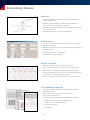
Current transformers are used for relaying and metering purposes in electrical power systems. They connect the high
power primary side to the protection and metering equipment on the secondary side. Depending on the application they
are used for, current transformers are designed differently.
Protection current transformers
Metering current transformers
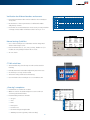
As it is used to feed protective relays, the CT must be accurate during normal and fault conditions. Failures in transformation could lead to misoperation of the relay along with
unwanted and costly outages. To test CTs according to the
requirements of modern protection systems, it is compulsory to consider transient components and auto-reclosure
systems.
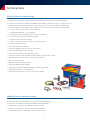
CTs for metering purposes must provide high accuracy
up to class 0.1 to guarantee correct billing. It is therefore
essential to test and calibrate the metering current transformer, as the entire metering chain is only as accurate
as the instrument transformers feeding the meter.
In contrast to protection CTs, metering CTs must go into
saturation directly above the nominal primary current level
to protect the connected metering equipment.
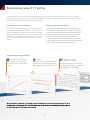
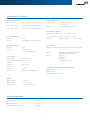
Automated testing procedure
1 Measurement of parameters
Measurement of CT parameters
like excitation curve, eddy current,
ratio, etc.
2 Modeling
Definition of CT model elements and
calculation of CT parameters through
embedded mathematical functions
3 Assessment according
to IEEE or IEC standard
Automated comparison of test results
with the defined values according to the
selected IEEE or IEC standard
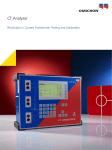
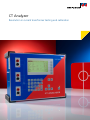
The CT Analyzer is designed to accurately measure all relevant CT parameters and compare them to the
requirements of the defined IEEE or IEC standard. Due to this automated assessment, testing engineers
receive the ‘pass or fail’ decision within seconds.
2