1
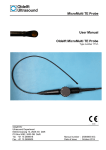
Multiplane TE Probe
User Manual
Oldelft Multiplane TE Probes
Type numbers 171R-, 17xT- and 17xV-
Oldelft BV
Ultrasound Department
Elektronicaweg 10, 2628 XG Delft
PO Box 5082, 2600 GB Delft
Tel. +31 15 2698916
Fax. +31 15 2698905
Manual number : 250M055 03D
Date of issue
: October 2014
WARNING / CAUTION
Before using the equipment, carefully study this manual.
Keep this manual at hand for quick reference.
Reread it periodically for warnings, safety precautions and maintenance requirements.
A damaged probe may cause an electrically hazardous condition when coupled to
the human body.
Do not use a damaged probe.
The multiplane TE probe is a precision instrument, which must be handled with care.
It may be damaged when dropped or abused.
In particular, do not allow the ultrasonic window in the tip to come into contact with a
sharp object.
Do not touch this window unnecessarily. Never exert force onto the window.
Only a qualified physician who has received appropriate training should perform
examinations with the probe.
The connector is not watertight, and should always be kept dry.
The control unit, although spray-watertight, should not be immersed.
This equipment contains no operator serviceable components.
To prevent electric shock, do not remove any covers or panels.
Inspect the probe for damage, cracks or bite-marks prior to each use.
Before introducing the probe: do not rub or spray the tip of the probe with an
anaesthetic agent.
Please, do use the bite-guard, supplied with the probe.
Only use water-based coupling gel.
As with all diagnostic ultrasound procedures keep exposure levels and duration to the
minimum necessary for the examination, especially in the Doppler modes.
Avoid forceful manipulations and excessive force in using the probe, which could
result in patient injury.
Withdraw the probe only with the deflection control in the unlock mode and with
the distal end of the probe straight.
Under normal conditions at full acoustic power the temperature of the tip does not
exceed 43°C. Follow the instruction in this user manual to check this regularly.
Clean and disinfect as described in this user manual.
Do not use methods not described in this user manual like Ethanol, Iodine,
Steam, Heat or Ethylene Oxide.
The up/down deflection may after prolonged use develop an unwanted amount of
free play. In that case, contact the service organization to re-adjust the steering of
the probe. In this way, the risk of "buckling" or "U-turning" of the probe in the
esophagus is minimized.
Warnings
User Manual 250M055 03D
Table of Contents :
1.
Introduction ..................................................................................................................... 1
1.1.
1.2.
1.3.
2.
Preparing the multiplane TE Probe for Use .................................................................. 2
2.1.
2.2.
2.3.
3.
Multiplane TE Probes ................................................................................................ 1
Intended use of the multiplane TE Probe. ................................................................. 1
Intention of this manual. ............................................................................................ 1
Visual examination .................................................................................................... 2
Safety precautions ..................................................................................................... 3
Preparation for Use ................................................................................................... 4
Use of the multiplane TE Probe ..................................................................................... 5
3.1.
3.2.
3.3.
Patient selection ........................................................................................................ 5
Deflection and scanplane rotation control .................................................................. 5
Examination ............................................................................................................... 8
4.
Cleaning and disinfecting the multiplane TE Probe .................................................... 9
5.
Storing the multiplane TE Probe ................................................................................. 10
6.
Specifications ............................................................................................................... 11
Annex A. Whom to Contact ................................................................................................ 12
User Manual 250M055 03D
Table of Contents
User Manual 250M055 03D
1.
Introduction
This document is written as such that it is conform the EN 1041:2008 standard.
1.1. Multiplane TE Probes
Oldelft manufactures several types of multiplane TE Probes with 64 or 48 elements.
All are phased array transducers, mounted in a sealed tip at the end of an gastroscope.
The probes are intended for imaging of the heart through the esophagus and the
stomach. The array can be rotated 180°. A manual rotation wheel on the handle of the
probe controls the rotation of the scan plane. The deflection control wheel on the handle
of the probe controls the deflection of the tip.
Control handle
Scanplane rotation wheel
Deflection lock
Distal tip with transducer
Deflection control
Deflection section
System
connector
Flexible shaft
1.2. Intended use of the multiplane TE Probe.
WARNING
The multiplane TE Probe should be used only by a qualified
physician who has received appropriate training in proper operation
of the probe and in endoscopic techniques as dictated by current
relevant medical practices.
The physician conducting the examination must exercise sound medical judgement in
the selection of patients for this probe and be skilled in interpreting the data obtained
from the examination with the multiplane TE Probe.
The probe can be used to form images of the heart to detect abnormalities, to evaluate
the velocity of the blood flowing in the heart and to obtain a color depiction of the
velocities of the blood flowing in the heart.
WARNING
The multiplane TE Probe is not intended for fetal imaging.
1.3. Intention of this manual.
This manual gives the user all information necessary to guarantee a safe and
satisfactory use of the multiplane TE Probe. It also describes how to handle the probe
during all stages : before, during and after the examination.
User Manual 250M055 03D
1
2.
Preparing the multiplane TE Probe for Use
2.1. Visual examination
Visually examine and feel all portions of the probe before use, especially the
gastroscope shaft and the flexible section at the distal end of the gastroscope. Perform
the inspection of the flexible section both with the probe deflection straight and
deflected. There should be no discontinuities, bumps, dents, holes, abrasions, bitemarks or any other evidence of wear or damage found.
The hard plastic section at the distal end of the probe should be smooth and firmly
attached to the gastroscope shaft.
The cable and the connector that attach the probe to the ultrasound console should be
free from evidence of damage.
Check the proper mechanical operation of the probe. Rotate the scanplane with the
scanplane rotation wheel on the handle (see §3.2). Make sure that the rotation is
smooth for all scanplanes. Deflect the tip in both up and down direction using the
deflection control wheel on the handle (see §3.2). Make sure the deflection operates
smoothly.
Electrical
Hazard
2
Any evidence of damage indicates the probe can not be used and
should be returned to Oldelft for evaluation and repair.
User Manual 250M055 03D
2.2. Safety precautions
a. The multiplane TE probe is a precision instrument, which must be handled with care.
It may be damaged when dropped or abused.
In particular, do not allow the ultrasonic window in the tip to come into contact with a
sharp object.
Do not touch this window unnecessarily. Never exert force onto the window.
b. Only a qualified physician who has received appropriate training should perform
examinations with the probe.
c. The connector is not watertight, and should always be kept dry.
The control unit, although spray-watertight, should not be immersed.
d. This equipment contains no operator serviceable components.
To prevent electric shock, do not remove any covers or panels.
e. Before introducing the probe: do not rub or spray the tip of the probe with an
anaesthetic agent.
f. Avoid forceful manipulations and excessive force in using the probe, which could
result in patient injury.
g. Withdraw the probe only with the deflection control in the unlock mode and with the
distal end of the probe straight.
h. Never manually deflect the distal tip of the probe ; use only the deflection control
wheel.
i. Do not kink, tightly coil, or apply excessive force on the probe cable or shaft.
Insulation failure may result.
j. Under normal conditions at full acoustic power the temperature of the tip does not
exceed 43°C. To check that the temperature increase of the tip is within limits:
Connect the probe to the Ultrasound system.
Daily
Adjust the Acoustic Power to the highest value possible.
Weekly
Select Color Doppler mode.
Monthly
Wait for 2 minutes.
Other
Feel at the distal end of the probe if there is a relevant temperature
increase, which could be harmful for the patient.
User Manual 250M055 03D
3
2.3. Preparation for Use
Inspect the probe as described in §2.1.
Clean and disinfect the probe and the bite-guard as described in §4.
Make sure the system connector is plugged into the Ultrasound system and is locked by
means of the locking handle on the connector.
For patient protection a sterile, single-use, latex sheath can be used.
CAUTION
Ensure that the sheath’s sterile surface is maintained.
Devices containing latex may cause severe allergic reaction in latex
sensitive individuals. Refer to FDA’s March 29, 1991, “Medical Alert on
Latex Products”.
Place the bite guard on the probe so that after insertion of the probe the bite guard can
easily be placed in the patient’s mouth. The bite guard can also be placed in the
patient’s mouth before inserting the probe.
WARNING
The use of a bite-guard is mandatory. Failure to use the bite-guard
may result in damage to the probe, which could result in a safety
hazard. Damage to the probe due to biting is not covered by the
probe’s warranty.
Apply a sufficient amount of water-soluble acoustic coupling gel on the probe acoustic
window.
CAUTION
Only use water-soluble acoustic coupling gel. Other coupling gels
containing ingredients like ethanol, mineral oil, Iodine, lotions, lanolin,
aloe vera or methyl or ethyl parabenzoic acid can cause probe damage.
If used, place the latex sheath over the probe and gastroscope shaft up to but not
covering the handle. Rub the tip carefully to ensure that all air bubbles have been
removed from the probe’s acoustic window area. In addition to the gel on the acoustic
window, apply a sufficient amount of acoustic coupling gel on the outside of the sheath
at the tip of the probe.
CAUTION
4
Do not exert force on the window area.
User Manual 250M055 03D
3.
Use of the multiplane TE Probe
3.1. Patient selection
Although the multiplane TE probe can provide clinical data not available from other
instruments, there are some considerations to be made in patient selection for safe use
of the probe.
CAUTION
The ability of a patient to swallow or accommodate the probe should be
considered.
Any history of gastro-esophageal diseases must be determined and
considered as well as the possible effects of other therapies the patient is
undergoing.
All gastro-esophageal abnormalities must be considered as well.
3.2. Deflection and scanplane rotation control
The control handle is designed for one-hand operation. Normally the operator takes the
control handle in his left hand. Thumb, first and second fingers control the deflection
and scanplane rotation control wheels.
The larger wheel on the handle is for controlling the probe tip deflection. This wheel has
a locked and freely moving mode. In the locked mode the movement of the deflection
wheel is restrained. This is used to hold the tip in a certain position. A metallic ring
around the body of the handle, which clicks on/off, controls the lock.
The wheel on top is the scanplane rotation control wheel.
Tip deflection control
The deflection control wheel found on the handle of the probe controls deflection of the
multiplane TE Probe tip.
Down
Up
Up
User Manual 250M055 03D
Deflection
Control
Down
5
Tip deflection control
WARNING
Check if the maximum deflection of the tip is 90° to 120° upward and
60° to 90° downwards. If the up/down deflection shows an unwanted
amount of free play or exceeds the maximal deflection angles given
above, do not use the probe. Contact the service organization to readjust the steering of the probe. In this way, the risk of "buckling"
or "U-turning" of the probe in the esophagus is minimized.
Lock operation
To protect the patient and the probe, unlock the deflection control when inserting or
withdrawing the probe.
White
Unlock
Red
Lock
6
User Manual 250M055 03D
Transducer scanplane rotation control
The transducer scanplane can be rotated from 0° (transversal plane) via 90°
(longitudinal plane) to 180° (transversal plane, left/right inverted). All planes in between
can also be chosen. This makes it possible to scan a conical imaging volume.
Short Axis
Angle = 0°
Long Axis
Angle = 90°
Short Axis
Angle = 180°
CAUTION
Do not use excessive force on the scanplane rotation control wheel at its
outer positions as this may damage the gastroscope mechanism.
User Manual 250M055 03D
7
3.3. Examination
The actual examination with the multiplane TE Probe is beyond the scope of this
manual. There are many medical articles and books, which very thoroughly address this
topic. There are however specific cautions that should be considered.
CAUTION
Long-term exposure to ultrasound should be minimized. Although there
have been no confirmed adverse effects produced by diagnostic levels of
ultrasound, unnecessary patient exposure to ultrasound energy should
be avoided, especially in the Doppler mode.
Prolonged pressure on the esophagus by the tip of the probe may lead to
a Pressure Necrosis phenomenon. Thus in monitoring applications the tip
should be removed from the esophagus wall when you are not scanning
by releasing it in the neutral position. If continuous monitoring is required
the probe tip should often be re-positioned.
Whenever active scanning is not desired ‘freeze’ the image and release
the deflection control.
Position the array such, that good acoustical contact is made. Before
rotating the array, actuate the friction ('brake') on the up/down movement.
If this is not done, rotating the array can mean loss of acoustical contact!
8
User Manual 250M055 03D
4.
Cleaning and disinfecting the multiplane TE Probe
Biological
Hazard
CAUTION
Adequate cleaning and, if necessary disinfection are carried out to
prevent disease transmission. It is the responsibility of the user to
verify and maintain the effectiveness of the procedure used. A
single-use, sterile disposable sheath for TE purposes can be used.
Keep the control handle and system connector out of any cleaning or
disinfection solutions. The control handle and cable may be cleaned with
a damp cloth, but only the distal end of the probe up to the 100cm marker
on the shaft (70cm for Oldelft’s miniMulti TEE probes) may be placed into
a disinfection solution.
Daily
Weekly
Monthly
Other
After each use
Probe cleaning
a. Clean the tip and flexible shaft with gauze pads soaked in mild soapy lukewarm
water (below 26°C is recommended). For other authorized cleaning agents, see
Oldelft’s website (www.oldelft.com).
b. Remove any materials that could interfere with the disinfection procedure.
c. Rinse the distal tip and shaft with lukewarm water, in which one can hold one's hand
without pain. Proceed until all visible soap residue has been removed.
CAUTION
Do not clean any portion of the probe with methanol or ethanol. Such
substance can cause irreparable damage to the probe.
d. Air-dry or dry with a soft cloth.
Probe disinfection
When necessary ultrasound probes can be disinfected using liquid chemical germicides.
For other authorized disinfection liquids which have been tested for compatibility with
the materials used to construct the probe, see Oldelft’s website (www.oldelft.com).
Follow the disinfectant manufacturer's recommendations for solution preparation,
immersion time and rinsing.
e. Place the cleaned and dried probe surface in contact with the disinfection solution.
Take care that only the distal end up to the 100cm marker is immersed (70cm for
Oldelft’s miniMulti TEE probes).
f. Rinse the probe tip and shaft with water and dry prior to storage.
CAUTION
The probe should never be left in the disinfection solution for more than 1
hour.
Do not forget to rinse the probe directly after disinfection.
WARNING
Do not use other disinfection methods like Iodine, Steam, Heat or
Ethylene Oxide.
User Manual 250M055 03D
9
5.
Labeling
The device should be labeled by our customer in such way that the labeling includes the
following items. Preferably the symbols used are conform the EN 980.
6.
CE mark of the vendor
Reference to the Instruction for use
Serial number
Catalog number
Date Of Manufacture
Manufacturer
BF applied part symbol
Warning symbol
Storing the multiplane TE Probe
The multiplane TE Probe is a sensitive and expensive instrument. Use great care when
storing the probe. Make sure the probe is adequately cleaned and disinfected prior to
storage.
The probe can be stored in its original case.
WARNING
Avoid damage to the probe by allowing nothing to protrude beyond
the case when closing the lid.
A wall mounted probe hanger can also be used for storage. Make sure the probe control
handle, cable and connector are adequately supported. The shaft should hang down
freely.
The storage environmental conditions must fall within the following range :
Temperature between –10°C and 45°C.
Humidity between 10% and 90%, non-condensing.
10
User Manual 250M055 03D
7.
Specifications
The probe is in conformity with the relevant provisions of the European Medical Device
Directive 93/42/EEC as amended by Directive 2007/47/EC. The probe is categorized in
Class IIa.
The probe is classified according to IEC 60601-1 as class I, type BF, defibrillator-proof.
Mechanical dimensions
17xR/T Shaft external diameter
11 mm
Shaft length
100 cm
Probe tip width
14 mm
Probe tip height
10.3 mm
Length of the inflexible distal
part of the probe tip
41 mm
Transducer
Center frequency
Type
Number of elements
Aperture
Focus
36 mm
5.0 MHz
5.0 MHz
phased array
64
48
9 mm
7.25 mm
50 mm
30 mm
Scanplane rotation
Tip deflection
Up
Down
17xV7 mm
70 cm
10.7 mm
8 mm
minimum 180°
120° ± 10°
90° ± 10°
120° ± 10°
90° ± 10°
Leakage current / Dielectric strength
Meet the requirements of IEC 60601.
Biocompatibility
All external materials of the multiplane TE Probe have passed relevant biocompatibility
tests according ISO 10993.
Environmental requirements
Operating temperature
Storage temperature
Relative Humidity
User Manual 250M055 03D
0 to 45°C.
-10 to 45°C.
10 to 90%, non-condensing.
11
Annex A. Whom to Contact
Manufacturer
Oldelft B.V.,
Elektronicaweg 10,
2628 XG Delft,
The Netherlands.
12
Tel.: +31 15 2698 916
Fax: +31 15 2698 905
E-mail: [email protected]
Website: www.oldelft.com
User Manual 250M055 03D