1
3
Cross synthesis
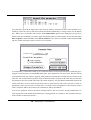
With AudioSculpt new sounds can be synthesized based on the analysis of one or two existing sounds. Cross
synthesis is the combination of two sounds at the level of the spectral representation. It is used in order to
create different types of mixes between two sounds, hybrid effects, overlap, etc. AudioSculpt permits two
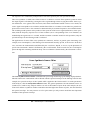
types of cross-synthesis: cross synthesis source-filter and generalized cross synthesis
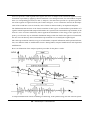
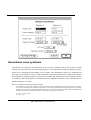
The two sounds’ parameters (window size and window step) can also differ according to the input channel.
If the window steps are different for each input, the time scales of the spectral representations will be different as well. Since during the synthesis stage, the time scale of the primary input is used as a reference,
the time scale of the secondary input will be automatically changed, giving a time expansion/compression.
For example, if sound 1 has a window step of 256 samples, then the time interval between the short-term
spectra is equally 256 samples. If sound 2 has a window step of 128 samples then the interval between the
spectra is 128 samples. In the cross synthesis, the first short-term spectrum of sound 1 is combined with the
short-term first spectrum of sound 2, the second spectrum is combined with the second spectrum, and so
on... Since the spectra of sound 2 has a time interval that was initially half the time interval of sound 1, the
spectral data of sound 2 will be stretched by a factor 2. This corresponds to a dilation by a factor 2.
The cross synthesis source filter
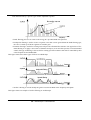
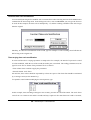
Cross synthesis source filter consists of multiplying the FFT spectrum from the primary input by a spectral
envelope resulting from linear predictive analysis on the secondary input. The first sound is thus filtered by
the spectral envelope of the second. This type of operation is very close to the source-filter synthesis model;
in AudioSculpt, the source is the first sound and the filter is the spectral envelope of the second. A common
application is the filtering of an instrumental sound by the voice, so as to give it a “speaking instrument”
effect.
One of the sounds is analyzed by the FFT and the other by linear prediction (LPC). Two parallel spectral
representations are obtained, one being a series of FFT spectra, the other a series of LPC spectral envelopes.
62 - AudioSculpt - Users Manual