1
STUK-A196
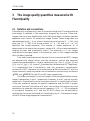
For the evaluation of the physical or technical quality of images or
imaging systems, the ICRU report (1996) suggests the measurement of the
large scale system transfer function (in linear systems the gain, K), the
modulation transfer function (MTF) and the noise power spectrum (NPS:
symbol W). These measurements are then combined to obtain the noise
equivalent quanta (NEQ), the detective quantum efficiency (DQE), or the ideal
observer’s signal-to-noise ratio (SNRideal) for a specified signal ∆s.
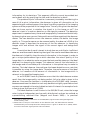
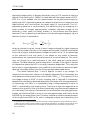
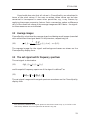
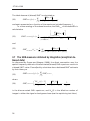
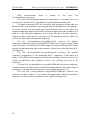
The NEQ of a linear imaging system is defined as
(2)
NEQ ( f x , f y ) =
K 2 ⋅ MTF 2 ( f x , f y )
W ( fx, fy )
.
Spatial frequency f is expressed here by its horizontal and vertical components,
fx and fy, because images are two-dimensional objects. NEQ can be interpreted
as the number of quanta (actually: photon fluence) at the input of a perfect
detector that would yield the same output noise, as a function of spatial
frequency, as the real detection system under consideration. In other words,
NEQ expresses the quality of the image data by the photon fluence that the
image is worth at each spatial frequency.
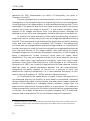
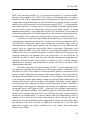
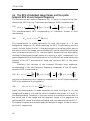
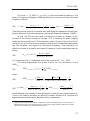
By comparing the NEQ with the actual photon fluence, Q, used for
forming the image, one obtains the DQE:
(3)
DQE ( f x , f y ) =
NEQ( f x , f y )
Q
,
which can be interpreted as expressing the efficiency with which the imaging
system has utilised the available photons: for a perfect system DQE = 1 for all
spatial frequencies. DQE expresses, therefore, rather the quality of the
equipment and the efficiency of radiation use than the quality of the image
itself: a low dose radiograph is bound to be noisy and, therefore, of not high
quality, although the DQE may be high.
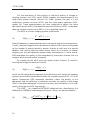
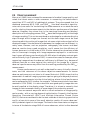
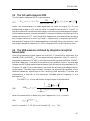
The SNRideal for a specified SKE/BKE-detection task, described by the
difference of the signal and background inputs, ∆s(x,y), can be calculated as
(4)
14
2
ideal
SNR
= ³³
K 2 MTF 2 ( f x , f y ) ∆S ( f x , f y )
W ( fx, f y )
2
df x df y ,