1
1.2 Limitations
A. Structure must be capable of meeting the anchorage strength requirements as set forth in section 2.4.
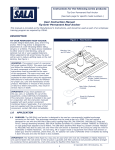
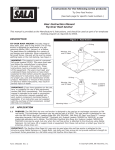
When properly attached, the roof top anchor is designed for use with a variety of roof types:
Ribbed Steel: The roof top anchor (2100075) is designed to accommodate rib spacing from 8 in. to
20 in. in 1 inch increments. The minimum material thickness for ribbed steel decking is 24 gauge
(.024 inch).
Membrane: The roof top anchor (2100076, 2100077) is designed to be used on single ply membrane
or built-up type roofs with a maximum total roofing material thickness (including insulation and
decking) of 5.5 in. (14.0 cm) for model 2100076 or 10.5 in. (27.0 cm) for model 2100077). Sheathing
under the membrane and/or built up material and insulation should be corrugated ribbed steel with a
minimum thickness of 24 gauge (.024 inch).
Concrete: The roof top anchor (2100075) is designed for use on concrete roof decks.
Plywood (temporary use only): The minimum thickness and material grade for plywood (wood
sheathing) is 5/8 inch (1.9 cm) CDX.
Consult DBI‑SALA before using this roof top anchor in any other application.
B.CAPACITY: This anchorage connector is designed for use by persons with a combined weight (person,
clothing, tools, etc.) of no more than 310 lbs . (141 kg). Only one personal fall arrest system (PFAS)
may be connected to the anchorage connector at a time.
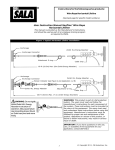
C.PERSONAL FALL ARREST SYSTEM: PFASs used with this roof anchor must meet applicable OSHA,
state, federal and ANSI requirements. PFASs incorporating a full body harness must be capable of
arresting a worker’s fall with a maximum arresting force of no greater than 1,800 lbs. (8 kN) [900 lbs.
(4kN)] maximum arresting force where used with a Sayfline Synthetic Horizontal Lifeline System] and
limit the free fall distance to 6 ft (1.8 m) or less. The deceleration distance for a PFAS must be 42 inches
(1.1 m) or less [47 inches (1.2 m) in Canada]. Reference ANSI Z359.1, OSHA and CSA Z259.11
requirements. If the maximum free fall distance of 6 feet (1.8 m) must be exceeded, the employer must
be able to document, based on test data, that the maximum permissible arresting forces will not be
exceeded, and that the personal fall arrest system will function properly.
When a free fall greater than 6 ft (1.8 m) and up to a maximum of 12 ft (3.7 m) is possible, DBI‑SALA
recommends using a personal fall arrest system incorporating a DBI‑SALA Force2 energy absorbing
lanyard. DBI‑SALA has performed testing using the Force2 energy absorbing lanyard in free falls up to
12 ft (3.7 m) to ensure the maximum arresting force does not exceed 1,800 lbs. (8 kN), and the system
functions properly. The results of these tests are listed in the user instruction manual provided with
Force2 shock absorbing lanyards.
D. LOCKING SPEED OF SRL: Situations which do not allow for an unobstructed fall path should be
avoided. Working in very confined or cramped spaces may not allow the body to reach sufficient speed
to cause the SRL to lock should a fall occur. Working on slowly shifting material such as loose shingles
may not allow enough speed build-up to cause the SRL to lock. A similar situation may occur on low
pitched roofs where a worker may slide instead of fall. A clear path is needed to assure positive locking
of the SRL.
E.CORROSION: Use near sea water or other corrosive environments may require more frequent
inspections or servicing (replacement) to assure corrosion damage is not affecting the performance of
the product.
F.CHEMICAL HAZARDS: Solutions containing acids, alkali, or other caustic chemicals, especially at
elevated temperatures may cause damage to this equipment. Consult DBI‑SALA if doubts exists
concerning installing this equipment where chemical hazards are present.
G.ELECTRICAL HAZARDS: Do not install the roof anchor where it or the user may come into contact with
electrical power lines.
H. TRAINING: This equipment must be installed and used by persons who have been properly trained in
its correct application and use. Installation and use of this equipment must be supervised by a qualified
person, as defined by OSHA fall protection standards.
I. SHARP EDGES: Avoid working where the lifeline will be in contact with or abrade against unprotected
sharp edges.
1.3 Refer to national Standards including ANSI Z359 (.0, .1, .2, .3, and .4) family of standards on fall protection,
ANSI A10.32, and applicable local, state and federal (OSHA) requirements governing occupational safety for
more information about fall arrest systems.
2