1
Solutions of versions of the ‘Countdown
numbers game’.
Elliot Fenner
Computer Science and Philosophy
2000/2001
(20 Credits)
The candidate confirms that the work submitted is their own and the appropriate credit
has been given where reference has been made to the work of others.
I understand that failure to attribute material which is obtained from another source may be
considered as plagiarism.
Signature____________________________
1
Summary
In this project I investigated the numbers game from the television programme “Countdown”. In this game,
a contestant is given six numbers from which they have to construct an arithmetic expression (using each
number at most once) using the four standard operators to obtain a given target number. I considered
different algorithms for solving the problem, both the Classical game as in the television programme, and a
generalised version. The aim of the project was to produce a working program to solve both versions of the
game. I produced a user-friendly version with a graphical interface (GUI) for the Classical game, and a
command line interface which can be used with both versions of the game. I also wrote a driver for the
command line version to obtain some statistical information about the game using random data. I also
looked at the run time complexity and compared this with actual run times for different sizes of the problem.
I then analysed my results to see if there were any interesting and significant trends.
2
Acknowledgements
I would like to thank my project supervisor Haiko Muller for his guidance, advice and support during the
project.
I would also like to thank all my housemates for their help with testing the program.
Special thanks go to my parents for their encouragement and love all these years.
3
Contents
Summary
ii
Acknowledgements
iii
1. Introduction
1
1.1 Reasons for choosing project
1.2 Description of the Problem
1
1
2. Background and Specification of the Problem
2.1
2.2
2.3
2.4
2.5
2.6
Background Information
Classical Problem
Generalised Problem
Complexity
Solution
Problem Scope
2
3
4
4
5
5
3. Project Objectives
7
3.1 Aim
3.2 Objectives
3.3 Minimum Requirements
7
7
7
4. Algorithm Design
8
4.1 Possible Techniques
4.1.1.
2
8
Subset Sum Problem
8
4.1.2. Countdown Problem
4.2 Choice of Algorithm
4.3 Optimisations
4.4 Other Issues
10
11
12
14
5. Program Design
18
5.1 General Issues
5.2 Command Line version
5.3 GUI version
18
20
21
6. Complexity Issues
22
6.1 Complexity of the Problem
6.2 Complexity of the Algorithms
22
22
6.2.1. Un-optimised version
22
6.2.2. Optimised version
23
4
7. Testing
27
7.1 Analysis of sample data
7.2 Conclusions from sample data
27
29
8. Results and Conclusion
32
8.1 Does the project meet the objectives?
8.2 Further Work
32
33
References
34
Appendices
Appendix A - Lessons Learnt
Appendix B – Tree Diagrams
Appendix C - Example runs of Countdown
Appendix D – Screen Shots
Appendix E – Graphs and Tables of Results
Appendix F – User manual
Appendix G – Program Listings
5
1.
Introduction
1.1
Reasons for choosing the project
I chose this project as I wanted to do a project which gave me scope to design and implement algorithms,
especially recursive ones. From my course ‘Functional Programming (CO21)’ last year, I saw that
recursion is a very elegant and powerful technique and I wanted to tackle a problem making use of it.
I had never constructed a GUI before, so I wanted to choose a project which gave me practice in
designing and creating a simple GUI. I also wanted to gain some experience in using JAVA as I had
learnt it in my ‘Object Oriented Programming (SO21)‘ course last year, but have never really had to
construct a large program using it. I thought that JAVA would also be a good platform to use for
creating the GUI.
I enjoy watching the Countdown programme on television, trying to solve the numbers game problems
faster than the contestants. I wanted to look at the efficiency of any algorithm I produced and see
whether there was scope for improving it.
I would also be able to use the knowledge learnt in the “Algorithms and Complexity (CO33)” course to
assist me in algorithm analysis and complexity.
1.2
Description of Problem
The problem is to design at least one algorithm to solve the Countdown problem: Given 6 positive
integers and a target integer, the question is whether it is possible to construct an arithmetic expression,
using just the standard four operators, which evaluates to the target and uses each of the 6 numbers at
most once.
6
2.
Background and specification of the problem
2.1
Background Information
There are several issues which I had to read up on to get a better understanding of the problem and its
complexity and possible methods for solving it:
•
The complexity classes P, NP and NP-C (where NP-C is the class of NP-complete problems)
•
The Subset sum problem
The complexity classes P, NP and NP-complete
The following definitions are essentially based on those in Baase. The complexity classes are all classes
of decision problems. A decision problem is a question that has two possible answers, yes and no. The
question is about some input. A problem instance is the combination of the problem and a specific input.
Usually the statement of a decision problem has two parts:
1. The instance description part defines the information expected in the input.
2. The question part states the actual yes-or-no question; the question contains variables defined in the
instance description.
A decision problem's output is either yes or no according to the correct answer to the question, as applied
to a given input. Thus a decision problem can be thought of abstractly as a mapping from inputs to the
set {yes, no}. An algorithm is said to be polynomially bounded if its worst case time complexity is
bounded by a polynomial function of the input size. A problem is said to be polynomially bounded if
there is a polynomially bounded algorithm for it. P is the class of problems that are polynomially
bounded. NP is more complicated to describe.
Many decision problems are phrased as existence questions: Does there exist a k-colouring of the graph
G? For a given input, a "solution" is an object that satisfies the criteria in the problem and hence justifies
a yes answer. NP is the class of decision problems for which there is a polynomially bounded
nondeterministic algorithm.
A nondeterministic algorithm has two phases and an output step.
1. The nondeterministic "guessing" phase. Some completely arbitrary string of characters, s, is written
... Each time the algorithm is run, the string written may differ. (...it may be thought of as a guess at a
solution for the problem, so this phase may be called the guessing phase, but s could just as well be
gibberish).
7
2. The deterministic "verifying" phase. A deterministic subroutine begins execution. In addition to the
decision problem's input, the subroutine may use s, or it may ignore s. Eventually it returns a value true
or false, or it may go in to an infinite loop and never halt (the verifying phase can be thought as checking
s to see if it is a solution for the decision problem's input, i.e., if it justifies a yes answer for the decision
problem's input.)
3. The output step. If the verifying phase returned true, the algorithm outputs yes. Otherwise, there is
no output.
NP-complete is the term used to describe decision problems that are the hardest ones in NP in the sense
that, if there were a polynomially bounded algorithm for an NP-complete problem, then there would be a
polynomially bounded algorithm for each problem in NP.
The Subset sum problem
The subset sum problem is defined as follows.
Instance: A positive integer T and n (not necessary distinct) positive integers whose sizes are s , s2, …s .
Question: Is there a subset I of the set {1, 2,…, n} such that ∑i∈I si = T?
It has been proved that the subset sum problem is NP-complete. This can be shown by transforming 3
Dimensional Matching, which is known to be NP-complete, to the subset sum problem (Garey and
Johnson).
2.2
Classical Problem
We will refer to the version of the numbers game used in the television programme as the Classical
problem. The Countdown numbers game is a kind of extension of the subset sum problem. In the
numbers game, you are given a positive target T and 6 other (not necessarily distinct) positive integers
s1,…, s6. The problem is to find an arithmetic expression in which you may use the four standard operators
{+, -, x, ÷} and the six numbers, s1, s2, …, s6, whose value is equal to the target T. The six numbers do
not all have to be used, but no number may be used more than once (unless the number occurs more than
once in s1, s2, …, s6).
The selection of the six numbers takes place as follows. There are 24 cards. Four contain the big
numbers 25,50,75,100. The remaining 20 cards contain the small numbers 1,2,3,4,5,6,7,8,9,10. Each of
8
the small numbers appears twice whereas the big numbers appear only once each. The player has to
choose 6 cards in total from either the small or big sets. Although they can decide whether to choose a
card from either the small or big set, they do not know what the number is (so the possible choices are, 6
small, 5 small 1 big, 4 small 2 big, 3 small 3 big, 2 small 4 big). A target integer, between 101 and 999
inclusive, is then chosen at random. Each player has to try to find an expression giving the desired
target.
If one contestant reaches the target but the other doesn’t then that contestant wins. If both contestants
reach the target, then it is a draw. If neither contestant can reach the target exactly, then the contestant
whose expression is closest to the target, either above or below, wins. If they are both the same distance
away from the target it is also a draw.
For example, if the target is 538 and the given numbers are 2, 3, 7, 9, 10 and 75.
One possible solution could be (((75+2) * 7) + 9) - 10.
However, if the target is 951 and the given numbers are 1, 3, 4, 5, 7 and 9, then there is no solution and
the nearest values attainable are 952 and 950.
There are some additional rules for the Countdown numbers game:
Only integers are allowed to be used, even as an intermediate result.
E.g. if the target is 850 and the numbers are, 100, 75, 50, 10, 3, 6.
It would not be possible to use the expression (((75/10) + (3/6)) * 100) + 50 to obtain 850.
Similarly, negative numbers are not allowed to be used as intermediate results.
2.3
Generalised Problem
As well as the classical problem I will look at a generalised version of the game, using n integers, s1, s2,
…, sn, as opposed to just the six which are used in the Classical game. I will also allow a wider range of
numbers to be chosen.
The subset sum problem is a restriction of the generalised problem, to the case where the only operator
that can be used is ‘+’; so the generalised problem is an extension of the subset sum problem. I will also
9
allow versions where the permitted operators are an arbitrary subset of the four standard operators. From
now on, we will refer to the generalised problem as the Countdown problem.
2.4
Complexity
At first sight it appears that the Countdown problem will be NP-complete as it is an extension of the
subset sum problem since by adding another 3 operators, the problem only gets larger and more
complicated. However, it could be argued that although there now exist many more possibilities which
have to be considered, there are many more ways by which it may be possible to reach the target.
I discovered that that the subset product problem (where only multiplication is allowed) is also NPcomplete (Garey & Johnson, although no proof is given in the text, a proof is included later in Section 6).
There does not seem to be any easy way to prove that the Countdown problem is NP-complete when all
four operators are allowed. However, it would be very surprising if it turned out that it is not NPcomplete.
2.5
Solution
On the assumption that the problem is NP-complete, the solution will have to be obtained essentially by
some kind of exhaustive search (i.e. every possibility has to be considered in some way).
Three techniques, which can be used to solve the subset sum problem, are
a) Recursion
b) Dynamic programming
c) Constraint Programming
I will describe these techniques in more detail later in Section 4 – Algorithm Design.
2.6
Problem Scope
I will be carrying out the following in order to solve and analyse the Countdown problem.
-
Producing a command line interface for the generalised version. This will allow users to decide how
many numbers they wish to use for the problem, as well as choosing whether they wish to select the
numbers and target themselves, or generate them randomly.
-
Producing a GUI for the Classical problem.
10
-
Investigating the Classical and various cases of the generalised problem by experimentation with
randomly generated data; for example, to find out how many solutions there are for different
combinations of large and small numbers. I will also try and find the probability of reaching the
target when it is reachable. Different cases will be considered, such as:
if all the numbers chosen are small (e.g., 6 small numbers);
if all the large numbers are chosen (e.g. 4 large numbers and 2 small numbers);
I will also investigate for randomly generated number sets, how many different targets can be
reached.
-
Optimisation; we will see later that using some methods the same sub-expression may be computed
several times. Therefore, if necessary, I will try to modify the algorithm to avoid repeated
computations where possible.
-
Analysing the complexity of the algorithm, or at least get an upper bound on the complexity, for both
the simple and improved versions of the algorithm.
-
Carrying out timing tests and comparing the results with the theoretical complexity.
11
3.
Project Objectives
3.1
Aim
The aim of this project is to provide a solution to both Classical and generalised versions of the
Countdown numbers game (from the television programme), and to provide both a command line and
GUI version of the program. Investigating the behaviour of the running time of the program, to
investigate the existence and number of solutions, using random problem instances.
3.2
Objectives
To write and implement one or more algorithms which attempt to find an exact solution of the numbers
game where one exists, or otherwise a best approximate solution (using a slightly ‘smaller’ version of the
problem if runtime considerations make the solution of the full version infeasible).
To analyse the complexity of the algorithms constructed, and if possible to analyse the complexity of
some versions – generalisations and/or restrictions – of the Countdown numbers game.
To make a simple user-friendly graphical front end for the program.
To run the program on various types of random data sets to find out the empirical probability that there
exists an exact solution, and to see if there is a difference in the likelihood of reaching that target
depending on how many numbers are used.
If time permits, to investigate possible heuristic methods for instances of the problem which are too long
for exhaustive search methods to be feasible.
3.3
Minimum Requirements
To write and implement one or more algorithms which attempt to find an exact solution of the numbers
game where one exists, or otherwise a best approximate solution (using a slightly ‘smaller’ version of the
problem if runtime considerations make the solution of the full version infeasible).
To analyse the complexity of the algorithms constructed, and if possible to analyse the complexity of
some versions – generalisations and/or restrictions – of the numbers game from the television
programme ‘countdown’.
To make a simple user-friendly front end for the program.
12
4.
Algorithm Design
4.1
Possible Techniques
4.1.1.
Subset Sum Problem
As mentioned in Chapter 2, there are at least 3 different possible approaches that one could use to
solve the subset sum problem. The first two are standard algorithms which people use to solve
problems of this sort. As I am currently doing a module in Constraint Satisfaction and Constraint
Programming, I also tried to think of a way to solve the problem using the skills that I had learnt on
that course.
I use the term number set or set of numbers to denote a multiset, i.e. where repeats are allowed.
Similarly a subset of a multiset may also be a multiset. I will denote the number set containing s1, s2,
.., sn by [s1, s2, .., sn].
Recursion
Suppose for the subset sum problem with target T and number set [s1, s2, .., sn], a solution Q exists,
i.e. the sum of the members of Q is T.
Consider the last number, sn. Either sn is one of the numbers in Q or not. If sn is in Q, then this
means that the remaining numbers add up to T-sn. So the subset sum problem with target T-sn and
number set [s1,.., sn-1]must have a solution. If on the other hand sn is not in Q, then the subset sum
problem with target T and number set [s1, .., sn-1]must have a solution.
We use this as a basis for a recursive algorithm to solve the subset sum problem. If the subset sum
problem has a solution then the function returns the value q, where q is the size of some subset Q,
which is a solution to the problem. If there is no solution we return the value –1. It also places the
elements of Q in the array term[1…q].
int sum(int[] s, int n, int target, int[] term)
int result;
if (target = 0) return 0; //solution where Q is empty set
if (target < 0) return -1; //no solution
if (n = 0) return -1; //no solutions
13
result = sum(s, n-1, target, term); //not using sn
if (result >= 0) return result; //not using sn
result = sum(s, n-1, target-s[n], term); // using sn
if (result < 0) return –1;
term[result+1] = s[n]; //solution using sn
return result+1;
It first tries to find a solution without using sn, then tries to find a solution using sn.
If we wanted to find all solutions, we would have to change the program so that both recursive calls
are always carried out even if a solution was found on the first recursive call (i.e. not using sn).
Dynamic Programming
In recursive programs, very often the same recursive call will be executed many times. The dynamic
programming approach overcomes this by storing the result of recursive calls on sub-problems rather
than re-computing them. For the subset sum problem we record the set Rj of all the targets which are
reachable as a sum of the subset [s1, …, sj]. We then find the set of targets Rj+1 reachable using [s1,
…, sJ+1]. This is simply all the elements of Rj together with all the integers r + sj+1 for all r ∈ Rj.
We start off with R0 equal to {0}. Then the subset sum problem has a solution if the target is in Rn.
An economical way of representing the set is to use an array of bits, where the length of the array is
at least the largest possible target, i.e. s1 + s2 +… + sn and the ith bit in the bit array is set to 1 if i is
in the set, or zero if i is not in the set.
Constraint Programming
It is also possible to think of the subset sum problem as a constraint problem. In the subset sum
problem a particular number is either used in the sum or not. We can represent a set by using an
array X of indicator variables, where X[i] = 1 if A[i] is included in the sum, otherwise X[i] = 0.
//All pseudo-code is based on Solver
//The variable m is the manager for handling input, output and memory allocation of
//constrained variables.
14
IlcIntArray A (m, n);
// A is an array of n integers in the set
IlcIntVarArray X (m, n, 0, 1);
// X is an array of n integers having values 0 or 1
IlcIntVar Sum;
// The sum of the included integers
IlcInt Target;
// The value of the target
Sum = IlcScalProd (A, X);
// Inner product i.e.
// A[0] ∗ X[0] + A[1] ∗ X[1] + …+ A[n-1] ∗ X[n-1]
m.add(Sum == Target); // add the constraint that Sum = Target
*
*
*
In all these three approaches, it would be easy to extend the above methods for dealing with
expressions with both ‘+’ and ‘-‘. For example, in the constraint programming approach you would
simply have to change the range that the values of X[i] take to be –1, 0 or 1, viz.
IlcIntVarArray X(m,n,-1,1).
However, there does not seem any obvious way to easily extend these approaches to adding
multiplication to the permissible operators in a similar manner. I am not sure if there exists a method
to extend the approach to cope with additional operators for the Constraint Programming method.
For both the recursion and Dynamic Programming approaches there are methods but they are
considerably more complicated, since the operators are no longer associative with each other which
makes the problem much harder. I now consider these methods.
4.1.2.
Countdown Problem
Recursion
There are two different types of recursive methods: “bottom-up” algorithms, and “top-down”
algorithms.
Bottom-up Algorithm
We pick an operator and two numbers from the set of numbers. We then evaluate the result obtained
by combining the two numbers using the operator. The result is then placed back into the set of
numbers, and the two numbers are removed from the set. If the result equals the target then we have
found a solution, otherwise we recursively try to find a solution with the same target and the new set
of numbers with n-1 elements. We repeat this for all possible choices of the operators and the pair of
numbers.
15
Top-down Algorithm
We pick an operator and a partition of the six numbers into two subsets (e.g. the set [1, 6, 3, 9, 15, 20]
might be partitioned into [1, 6, 9, 20] and [3, 15]). We recursively find all the targets attainable using
one subset, and similarly all the targets attainable using the other subset. We then find all the values
obtained by combining an attainable target from one subset and an attainable target from the other
subset using the chosen operator. We then repeat this for all possible choices of the operator and all
possible partitions of the original set of numbers.
Dynamic Programming
The dynamic programming approach for the Countdown problem is similar to the top-down
algorithm, only that in the top down algorithm you have to re-compute the values at each level of
recursion. For each subset of the set of numbers, it stores a list of all the targets attainable using the
specified subset. For a subset of size 1, the list contains just that number. For a subset of size 2, the
list contains the values you can get by combining the two numbers using one of the operators. In
general, for a subset of size ‘k’, it looks at every possible way of splitting the set of numbers into 2
subsets. For each operator, and for each element from the list of targets attainable for one subset and
for each element from the list of targets attainable from the other subset, it combines the two targets
using the operator and stores the result in the list of targets attainable for the set of k numbers.
4.2
Choice of Algorithm
I have chosen to implement the recursive “bottom-up” algorithm. I chose that algorithm over the others
for various reasons. Firstly, dynamic programming takes up a lot space as it stores the lists of targets
attainable using any subset of the numbers. Since the number of cases considered is large, even for siz
numbers, this could slow down the performance of the program quite considerably. Secondly, the topdown approach seems more complicated because you have to generate all the possible partitions. Also
you have to store all the targets attainable for each of the subsets.
I will now describe my chosen algorithm in more detail.
Suppose the array s[] stores the n numbers which are being used. Each pair of numbers si and sj is
chosen in turn. Each of the operators is considered and si and sj are combined using the operator. E.g.
we evaluate s* = si + sj. The result s* is then tested to see if it is equal to the target. If it is, it is stored as
a solution. If it is not, we remove si and sj from the array and add s* to the array. We then recursively
try to find a solution with the same target and the new array (which has only n-1 elements). We do this
16
for each pair of numbers and each operator. For reasons which will be explained in Section 4.4, we only
have to consider each unordered pair of numbers, si and sj, so we will only consider cases for which i<j.
In the algorithm below as in my program, instead of s1, …, sn, I will use nums[0] … nums[n-1].
The function combine searches for a possible solution using the array nums[0…n-1], and the given
target. Ops is an array of the possible operators.
combine(n)
{
for (int i = 0; i < n-1; i++)
for (int j = i+1; j < n; j++)
//choose i
//choose j
for (int opNum = 0; opNum < ops.length; opNum++){ //choose operator
int result = evaluate (ops[opNum], nums[i], nums[j]);
if (result == target)
//another solution found
{
solution++;
//increase solution count and store solution
}
//save old values nums[i] and nums[j] – see section 4.3
nums[i] = result; //place result in the place of nums[i]
nums[j] = nums[n-1]; //place the last element in the array in the place of nums[j]
combine(n-1); //call combine recursively with n-1
//restore values nums[i] and nums[j] – see section 4.3
}
4.3
Optimisations
There were inefficiencies which I spotted after having testing my program. I noticed that sometimes the
same solution was appearing more than once. I discovered I was separately counting solutions which
were essentially the same, but in which some of the subexpressions were evaluated in a different order.
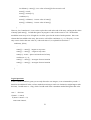
The following example illustrates what is happening to the nums array at each level of recursion.
Suppose the numbers are {3, 7, 1, 11, 20, 5} and the target is 72. The underlined numbers represent the
result of an evaluation and bold numbers represent the numbers which are chosen.
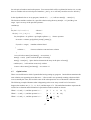
When i = 0, and j = 2, and the operator is ‘+’:
[3
7
1
11
20
When i = 1, and j = 3, and the operator is ‘+’:
[4
7
5
11
20]
When i = 0, and j = 1, and the operator is ‘*’:
[4
18
5
20]
[72 20 5]
17
5]
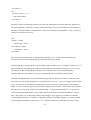
However, it is also possible to obtain the same elements in the array just by doing the operations in a
different order.
When i = 1, and j = 3, and the operator is ‘+’:
[3
7
1
11
20
When i = 1, and j = 3, and the operator is ‘+’:
[3
18 1
5
20]
When i = 1, and j = 3, and the operator is ‘*’:
[4
18 20 5]
[72 5
5]
20]
It is now clear that the same solution, (3+1) * (7+11), will arise in two different ways, producing
solutions which are not really distinct from one another.
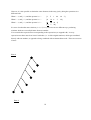
If we consider the expression tree corresponding to the expression (see Appendix B). In every
expression tree there must be at least 2 leaf nodes (i.e. 2 of the original numbers) which gets combined
directly with one another, as opposed to being combined with an intermediate result. There are two sorts
of trees:
Tree 1
Tree 2
18
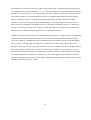
If the tree looks like tree 1, then the above problem will not affect it since there is only one pair of leaf
nodes. However, if the tree looks like tree 2 (where there are 3 such pairs of leaf nodes), then it is
possible for one pair of leaf nodes to be combined first and then get combined with another pair of leaf
nodes which were combined later. It is therefore possible for the second pair of leaf nodes to be
combined first and then be combined with the result of combining the other two leaf nodes. This of
course produces equivalent expressions.
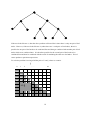
To solve the problem I envisaged all the pairs of i and j values as a matrix.
j
0
1
2
……
n-1
0
1
2
i
i≥j
n-1
19
Each square represents a pair of numbers which could be combined. No pairs of i and j values in the
shaded area could be combined as i ≥ j there, but we always have i less than j.
In order to avoid the above problem, I ensured that I always first combined the pair of leaves with the
least value of j. It would then follow that when I combined two numbers, I could be sure that this pair of
numbers had not previously been combined, in some call of combine(), at a higher level of recursion.
This is true as we never look at a value of j that we have already considered a higher level of recursion –
we always start from the value j+1. My optimised Countdown is called Countdown13, whereas the
unoptimised version is called Countdown12.
It turned out more convenient to swap i and j loops around (i.e. nest the i loop inside the j loop) and to
store the result of combining two numbers at the end of the array, removing the two numbers, rather than
inserting it in the middle of the array – see Section 4.4 below.
4.4
Other Issues
When writing the code for my program, there were several decisions that had to be made on how I
wanted the program to run. My decision would not be right or wrong, but sometimes I made the decision
on the basis of what I thought would make the code most intelligible.
Backtracking
One major decision which I had to decide upon was how I was going to ensure that at each recursive call
I had the correct values in the array. Since at each level of recursion the content of the array is different.
I could copy the array and pass the new array of numbers as a parameter in the recursive call.
Alternatively, I could use backtracking and save all the relevant values restoring the old values after the
recursive call. I decided that I was going to use the backtracking method as I didn’t think that it was
efficient to have a different array at each level of recursion and copy it each time. In retrospect I am
unsure whether it makes a difference with such a small value of n. If I had more time I would have
investigated to see if there was in fact any significant difference between the two methods.
The backtracking method I used for Countdown13 differed slightly from that I used for Countdown12.
For Countdown12, I stored the old values of nums[i] and nums[j] and then copied the result of evaluate()
into nums[i] and moved the last element of the array, nums[n-1] into nums[j]. I then made the recursive
call with n-1, i.e. nums[0…n-2].
combine(n, ){
…
int oldnumsi = nums[i]; //save value of nums[i] before recursive call
20
int oldnumsj = nums[j]; //save value of nums[j] before recursive call
nums[i] = result;
nums[j] = nums[n-1];
combine(n-1);
nums[i] = oldnumsi; //restore value of nums[i]
nums[j] = oldnumsj; //restore value of nums[j]
…
}
However, for Countdown13, it was easier to place the result at the end of the array, and negate the values
of nums[i] and nums[j]. I would then ignore any negative values in the recursive call. We therefore
needed the nums array to be of length 2n-1 to allow space for the result of each operation. Since one
element has been added to the array, the recursive call will be combine(n+1, j+1). We pass j+1 as we
only want to look at the next value of j with each value of i, as explained in Section 4.3.
combine(n, jNext){
…
nums[i] = - nums[i]; //negate to stop reuse
nums[j] = - nums[j]; //negate to stop reuse
nums[n] = result; // place result at the end of array
combine(n+1, j+1);
nums[i] = - nums[i]; // un-negate for next iteration
nums[j] = - nums[j]; // un-negate for next iteration
…
}
Legal Operations
In the Countdown numbers game you are only allowed to use integers, even as intermediary results. I
therefore decided that if in the evaluate method a non-integer result was obtained (as might happen with
division), I would return a –1 flag, which I would catch in the countdown method and ignore that value.
case '/': //division
if (num1 >= num2)
if (num1 % num2 == 0)
return num1/num2;
21
else return -1;
else
if (num2 % num1 == 0 )
return num2/num1;
else return -1;
Similarly, negative intermediate results are not allowed, although this wouldn’t make any difference to
the targets attainable. Therefore, I always returned the absolute value of the difference between the two
numbers. I also ensured that a zero difference could not be returned, and returned a –1 flag. This was in
order to prevent division by zero.
case ‘-‘:
if (num1 > num2)
return num1 – num2;
else if (num1 < num2)
return num2 – num1;
else return –1;
This obviously means that if an invalid operation took place, e.g. 1/5, then this would ignore this
selection of operator and operands and the recursion would not go deeper.
I also decided that I would stop the recursion when I found a solution (e.g. if it found a solution (3+4) *2,
then it would stop, even though it would be possible that there was another solution ((3+4) *2) * (9-8)).
I decided to do this as although there could be other solutions if the recursion unwound fully, I
considered them trivial solutions, as they are essentially the same as solutions already found.
Although I thought that this was the most natural thing to do, a problem arose when I wanted to count
how many cases the program might have to consider in the worst case. I was not counting all the possible
cases, as there were cases which I was ignoring, because the recursion wasn’t going to its maximum
depth - as soon as I found a solution it would stop on that level of recursion. Some of the cases will also
be ignored as a result of an ‘illegal’ operation returning a –1 flag (as described above). To get the true
value of all the maximum number of cases that could be considered, I needed to unwind the recursion
fully. The easiest way of doing this, with the least change to my program, was to make sure that the
recursion did unwind in every situation. Although I could have decided to change my evaluate method,
to ensure that all evaluations were legal, i.e. no –1 would be returned, I would then also have to make
22
sure that there was no division by zero, as this would cause an error. I therefore decided to specify the
set of operators to be all plus operators i.e. 4 ‘+’s - there was therefore no worry of producing an invalid
operation or a division by zero. I also had to make sure that a solution could never be reached, without
using all the numbers, so I chose the numbers to all be 1’s and the set the target to one more than the
number of numbers used (i.e. the target was therefore unreachable with those numbers and those
operators). In this way I was able to make a small change to my calling program in order to see how
many cases were considered, for different values of n, the number of numbers in the set. This would
provide a check on my analysis of the complexity of the algorithm, as I would be able to compare the
number of cases considered with the predictions of my theoretical analysis.
Another decision that I had to make was to decide how many solutions I would search for. I could either
stop searching as soon as I found one solution, or I could try and find all possible solutions with the
given set of numbers. Although the actual Countdown game only requires players to find one solution,
for my analysis of the algorithm and the game, I would need to see how many solutions there were
altogether. However, as I was storing the solutions in an array, I would need to specify an upper limit to
how many solutions I would store. I set the size of the array to 10,000, as in my test runs it was very
unusual for six numbers to produce more than 10000 solutions. However, if the program was run with
more than 6 numbers or the particular 6 numbers were ones which produced many solutions, then the
program would only store the first 10,000 solutions, although the solution count would continue to count
correctly even if there was over 10,000.
23
5.
Program Design
5.1
General Issues
There were several key issues which had to be considered when designing the program.
Firstly, I had to decide what data structure I would use to store the numbers. There were a few different
options available, such as a linked list or an array. I chose to store the numbers in an array, as although
linked lists have several benefits over arrays, such as easier insertion and deletion, the backtracking to
restore the list to its previous state could be quite tricky. Also, the process of doing the backtracking
with linked lists would have taken more computation time and slowed the program down. In hindsight,
it would not have been that much more complicated, and I would have needed fewer changes to my
program to convert it to the optimised form. Given more time I would have investigated the differences
in performance, if any, between using the two data structures.
A second design issue which had to be decided was the class structure I would use to implement the
program. As it turned out, I developed two very similar Countdown programs – the optimised version
and the un-optimised version. I therefore decided to have my two different versions of Countdown
extend an abstract Countdown class which contains the parts of the constructor which are the same as
well as the member variables and methods which are in common. I decided to implement it this way as I
wanted to make my program as object oriented as possible, and minimise the amount of repeated code.
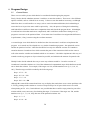
Thirdly I had to decide what the best way to store any solutions would be. In earlier versions of
Countdown I stored the solutions as a list of the arithmetical computational steps which had been carried
out to obtain the solution. For example, if the target was 518, and the numbers were [2, 3, 6, 10, 25,
100]. Then the target could be reached by the following steps.
Step 1: 25 * 2 = 50
Step 2: 50 * 10 = 500
Step 3: 3 * 6 = 18
Step 4: 500 + 18 = 518
Although this seemed like a natural and clear way to display the results there were various problems with
it. Firstly, printing out the solution as a series of steps took up a lot of space which wasn’t so useful
when printing to file. Also, I noticed that it was possible that there would be steps printed as part of the
solution which weren’t necessary for obtaining the target. For instance, if the target was 780, and the
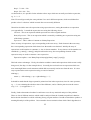
numbers were [2, 3, 7, 8, 10, 100], then one of the potential solutions was:
Step 1: 2 + 3 = 5
Step 2: 8 * 10 = 80
24
Step 3: 7 * 100 = 700
Step 4: 700 + 80 = 780
As shown above, it is possible for the solution to have steps which are not really used in the expression,
e.g. 2 + 3 = 5.
Note: We would get exactly the same problem if we used a different operator, which would therefore
produce a lot of “solutions” which in actual fact were not really different.
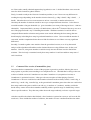
I therefore decided to store the expressions using expression trees, storing the numbers as expressions
(see Appendix B). I created the expression trees using the following classes.
Constant – This is an expression which represents one of the original numbers.
BinaryExpression – This is an expression which is created by combining two expressions using one
of the binary operators.
Expression – This is either a Constant or a BinaryExpression.
I have an array of expressions, expn, corresponding to the nums array. Each element in the nums array
has a corresponding expression which shows how the number was obtained. Initially the array of
expressions would contain six constants, i.e. the six chosen numbers. Every time two of the numbers are
combined, e.g. nums[i] + nums[j], and put back into the array, the corresponding elements of the
expression array are used to construct a new expression.
Expression expRes = new BinaryExpression(ops[opNum], expn[i], expn[j]);
This had various advantages. Firstly, the solution wouldn’t contain sub-expressions which weren’t really
being used ( like Step 1 in the example above). Secondly, the end result was an expression which was
more meaningful then several statements which didn’t necessarily lead on one from the next. It is also
easy to print out the entire expression using a recursive function.
toString(){
return “(“ + left.toString() + op + right.toString() + “)”;
}
It should be noted that the larger operand is printed out first in the expression, since for some operators,
e.g. ‘-‘, I was evaluating the absolute value of the difference, and so I had to print it out in the correct
way, i.e. 5 – 3, as opposed to 3 – 5.
Finally, I had to determine what data I would store to use for my statistical analysis of the problem.
There are lots of different statistics which could be analysed from the Countdown problem, I therefore
had to decide what data I would be collecting for my program and how I would use that data to produce a
meaningful analysis of the problem. I also wanted to choose statistics about which I had a hypothesis to
25
see if the results actually obtained supported my hypothesis or not. I decided that there were two main
areas for which I wanted to gather statistics.
Firstly, I wanted to analyse the Classical Countdown problem, to see if there was any difference in
reaching the target depending on the number selection chosen (E.g. 4 Big 2 Small, 3 Big 3 Small, …, 6
Small). I therefore have to have some measure as to how ‘successful’ a number selection was.
Obviously the number of solutions would be one way to compare different selections. I also chose to
record the number of targets obtainable (i.e. given 6 numbers, how many of the targets from 1 – 1000 are
obtainable). I represented this by an array of 1000 booleans, where the ith element of the array was set to
true if the program found a way of obtaining that number. With these statistics I would be able to
compare different number selections and generate some results indicating the best strategy that one
should employ in deciding how many big and small numbers to select. I also recorded the number of
cases tried, and the computational time taken to find all solutions to see if there were any significant
differences.
Secondly, I wanted to gather some statistics from the generalised version, to see if my theoretical
analysis of the algorithm reflected the results obtained from tests using different sizes for the set of
numbers. However, using more numbers would obviously increase the time it took to find all the
solutions. This obviously constrained exactly how many numbers I could use and how many runs of
each I could test.
5.2
Command Line version (CommandLine.java)
I tried to make the command line version of the program as general as possible, allowing the user as
many options as possible, but not making it too complicated to use. I decided that I would give the user
a choice of which version of Countdown to run, either Countdown 12 (un-optimised version) or
Countdown 13 (optimised version). I then gave the user an option of either playing Classical
Countdown i.e. the user would choose which number selection he/she wished (6 small, 5 small 1 big, 4
small 2 big, 3 small 3 big, 2 small 4 big), or the generalised Countdown game where the user could select
how many numbers the game would be run with (e.g. 2 numbers or 7 numbers), and they could also
decide if they want to choose those numbers randomly within a specific range or whether they want to
choose specific numbers. They then may either choose the target randomly or choose a specific target.
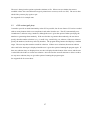
After the search for the solution has finished, a list of statistics is printed to screen (as well as to the file
results.txt). These include the number of solutions, the number of cases considered and the time taken.
26
The user is then given the option to print the solutions to file. If there was no solution, the nearest
reachable values above and below the target is printed out to screen (as well as to file). The user is then
asked if they want to play again or quit.
See Appendix C for example runs.
5.3
GUI version (gui3.java)
I wanted to provide as much functionality in the GUI as possible, but far too often a GUI can be crowded
with too many buttons which over-complicate it and make it hard to use. The GUI automatically uses
Countdown13, and runs using 6 numbers, although the user is given the option of either specifying the
numbers or generating them randomly. If the user decides to generate them randomly, the user has to
specify what the number selection is, e.g. 3 small 3 big, 4 small 2 big, etc, whereas, if the user wishes to
specify the numbers, he/she may enter any numbers. The program then generates and displays a random
target. The user may then start the search for solutions. If there are no solutions, the nearest solution
above and below the target is displayed and the user is given the option of running the program again. If
there are solutions, they are displayed one at a time is displayed at the bottom of the screen, and the user
is asked if he/she wishes to see the next solution. Once the user has seen all solutions or doesn’t wish to
see any more solutions, they are given the option of running the program again.
See Appendix D for screen shots.
27
6.
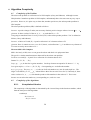
Algorithm Complexity
6.1
Complexity of the Problem
The subset sum problem is well known to be NP-Complete (Garey and Johnson). Although it seems
likely that the Countdown problem is NP-Complete, unfortunately there does not seem any easy way to
prove this. However, it is quite easy to show that, another special case, the subset product problem is
NP-Complete.
The subset product problem (SPP) is defined as follows.
Instance: A positive integer T and n (not necessary distinct) positive integers whose sizes are s , s2, …s .
Question: Is there a subset I of the set {1, 2,…, n} such that Πi∈I si = T?
I am going to transform Exact Cover by 3-Sets (X3C) to the subset product problem. X3C is defined as
follows (Garey and Johnson):
Instance: A finite set X with |X| = 3q and a collection C of 3-element subsets of X.
Question: Does C contain an exact cover for X, that is, a subcollection C’ ⊆ C such that every element of
X occurs in exactly one member of C’?
Theorem SPP is NP-Complete.
SPP is obviously in NP, since we can guess the subset and check it in polynomial time.
The proof is a similar transformation to that used for the subset sum problem.
Let X be a set with |X| = 3q and C be a collection of 3-element subsets of X.
Denote X = {X1, X2, …, X3q}
Let p1, p2, …, p3q be the first 3q prime numbers. Let the pi element correspond to Xi where 1 ≤ i ≤ 3q.
Let a given triple, c ∈ C be c = {Xe, Xf, Xg}. Corresponding to c we define the number
s(c) = pe ∗ pf ∗ pg. The set s1, s2, …, sn is the set of all such numbers s(c) one for each triple in c. The
target T is defined by T = Π1≤i≤3q pi. It then follows that C has an exact cover for X, if and only if, there
exists a subset of s1, s2, …, sn, such that the product of the numbers in the subset is T. This is true
because we can select the number s(c) corresponding to c, and vice versa.
6.2
Complexity of the Algorithms
6.2.1.
Un-optimised Version
The complexity of the algorithm is determined by the 3 nested loops in the function combine, which
form the main part of the algorithm:
combine(n)
for i=0 to n-2
for j=i+1 to n-1
28
for op=1 to 4
combine(n-1)
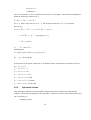
Let Tn be the number of cases or expressions tried for a set of numbers. Then from the algorithm we
obtain the following recurrence for Tn.
Tn = Σ0≤ i ≤ n-2
Σi ≤ j ≤ n-1 (4 ∗ Tn-1)
For n = 1, there is only one case so Tn = 1. The recurrence then gives, T2 = 4, as expected.
We now get
Tn = 4 Tn-1 Σ0≤ i ≤ n-2
Σi ≤ j ≤ n-1 (1) = 4 Tn-1 Σ0≤ i ≤ n-2 (n-i-1)
= 4 Tn-1 Σ1 ≤ p ≤ n-1 p,
by putting p = n-i-1
= 4 Tn-1 ∗ ½n(n-1)
i.e,
Tn = 2n(n-1)T n-1
Expanding this
Tn = [2n(n-1)] [2(n-1)(n-2)]….[2·3·2] [2·2·1]T1
So
Tn = 2n-1 n! (n-1)!
I can therefore work out the complexity Tn for different values of the number of numbers in the set
(e.g., 2, 3, 4, 5, 6).
T2 = 2 ∗ 2! ∗ 1! = 4
T3 = 4 ∗ 3! ∗ 2! = 48
T4 = 8 ∗ 4! ∗ 3! = 1,152
T5 = 16 ∗ 5! ∗ 4! = 46,080
T6 = 32 ∗ 6! ∗ 5! = 2,764,800
T7 = 64 ∗ 7! ∗ 6! = 232,243,200
6.2.2.
Optimised Version
Once again the complexity of the algorithm is determined by the 3 nested loops in the function
combine, which form the main part of the algorithm. Combine now has two parameters and the first
call is combine(n, 1).
combine(n, jNext){
29
for j = jNext to n
for i = 0 to j
for opNum = 1 to 4
combine(n,j+1)
}
Note: Although in the recursive call we pass j+1, we have in effect removed the ith and jth numbers,
as we have negated them so that we skip over them. Therefore the column we wish to start at is j-1
(not j+1) as in our matrix (see Section 4.3) we have deleted two columns and added one new
column. Therefore the column j+1 in the new matrix is column j-1.
From now on, I will use jx instead of jNext in this section. Let Tn, jx be the number of cases
considered in which no pair of numbers with I and j values less than jx are directly combined.
From the algorithm we obtain the following recurrence.
Tn,jx = 4 * Σjx ≤ j ≤ n-1
Σ0 ≤ i ≤ j-1
Tn-1,j-1
Since Tn-1,j-1 doesn’t depend on i:
Tn,jx = 4
Σjx ≤ j ≤ n-1 Tn-1,j-1 Σ0 ≤ i ≤ j-1 1
Tn,jx = 4 Σjx ≤ j ≤ n-1 j · Tn-1,j-1
so,
Tn,jx+1 = 4 Σjx+1 ≤ j ≤ n-1 j · Tn-1,j-1
Subtracting these two equations we get
∴ Tn,jx = Tn,jx+1 + 4 jx Tn-1,jx-1
If there are fewer than four operators used, say c operators, then the relevant recurrences in this and
the previous section will be the same but have the 4’s replaced by c.
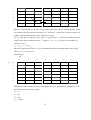
To find the values of Tn, jx we can envisage the following matrix (for n =6).
jx
0
n
0
1
2
3
0
30
4
5
6
1
0
2
0
3
0
4
a
0
5
.b
?
0
6
0
Since Tn,jx is the amount of work done, but only from starting from the jxth column onwards, if there
are n numbers, the last position in the array is n-1. So when j = n, there are no values as there is no
column j, therefore the diagonal can be considered as zero’s.
For Tn,0, since there is no pair of i and j, where j = 0, given that i < j. Therefore, starting from the 0th
column is the same as starting from the 1st column (i.e. Tn,0 = Tn,1). Writing c for the number of
operators, we get
Tn,jx = Tn,jx+1 + c * jx Tn-1,jx-1
The above diagram shows how Tn, jx can be calculated from the two neighbouring values a and b
where a is Tn-1,jx-1 and b is Tn,jx+1
Substituting in:
jx
0
n
1
2
3
4
5
0
0
1
1
0
2
1c
1c
0
3
3c2
3c2
2c2
0
4
15c3
15c3
12c3
6c3
0
5
105c4
105c4
90c4
60c4
24c4
0
6
945c5
945c5
840c5
630c5
360c5
120c5
6
0
When running the Countdown program, I am interested in jx=1, and with four operators (i.e. c= 4).
We therefore get the following results:
T2,1 = 4
T3,1 = 48
T4,1 = 960
T5,1 = 26,880
31
T6,1 = 967,680
T7,1 = 42,577,920 (not shown in the table)
I checked the values that I got from the number of cases considered, for both Countdown12 and
Countdown13, when allowing the recursion to fully unwind to see if they were the same as these
values. Checking the results obtained by my program, see Appendix C, they are exactly the same as
the values calculated here. This is encouraging as it means that the values obtained from my program
are consistent with the theoretical analysis of the algorithm. It should be noted that the value of
cases considered for 4 numbers is given by “cases considered for 4 numbers”, as opposed to
“Number of cases considered”. This is because the complexity analysis calculated for each number,
is how many cases have to be considered just using that number of numbers, e.g. 6. However, the
“Number of cases considered” is the total number of cases considered using 2 numbers, 3 numbers,
…, 6 numbers.
Tn and Tn,1 will be upper bounds on the number of cases considered for Countdown12 and
Countdown13 because in practice the recursion is stopped early, either because of an illegal
operation, or because the target is found without using all the numbers.
It is clear from the results above that the bounds for Countdown13 is significantly less than that for
Countdown12. Moreover, the ratio of the bounds increases with n, as shown below.
n
2
3
4
5
6
7
Tn/Tn,1
1
1
1.2
1.7
2.9
5.5
32
7.
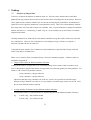
Testing
7.1
Analysis of Sample Data
I will use n to denote the number of numbers in the set. There are many statistics that I could have
gathered from my program, however due to lack of time I have not managed to do all of them. However,
I have gathered some statistics which I feel are relevant in analysing the performance of Countdown13
(optimised version) against Countdown12 (un-optimised version). I have also collected data to find out
how many times out of 100 runs a target was reachable. This is a good indicator to compare the different
number selections (i.e. 2 small 4 big, 3 small 3 big, etc.) to see whether one is more likely to reach the
target than the others.
I initially intended to do 1000 runs for each statistic and then average the results, which wasn’t too bad
for Countdown13. However, for Countdown12 it was taking too long (1.5 hours) to compute. I
therefore only did 100 runs for each case.
I collected the same statistics for Countdown12 and Countdown13, apart from the Targets Achieved
which I only did for Countdown13.
There were 5 statistics which I computed for my Classical Countdown program. All these results are
included in Appendix E.
•
Targets Achieved for the different number selections
I analysed the number of targets that were reached depending on how many of the six numbers were
used. I then plotted a graph of the number of targets that were achieved against how many numbers. For
instance, with 3 small 3 big number selection,
Using 2 numbers: 0 targets achieved
Using 3 numbers: 6 targets achieved
This means that just using 2 numbers out of the six, it wasn’t ever possible to reach the target.
Whereas using 3 numbers out of the six, it was possible to reach the target 6 times out of 100. I did
this for each different number selection.
•
Average number of solutions for the different numbers selections
I analysed the number of solutions that were found using each of the different number selections.
E.g.
3 small 3 big – 456 solutions found
4 small 2 big – 512 solutions found
33
Note that, as mentioned in Section 3, the number of solutions is not such a good indicator as this may
include repetitions.
•
Average running time for the different numbers selections
I analysed the running time for each of the different number selections
•
Average number of cases considered for the different numbers selections
I analysed the number of cases considered for each of the different number selections. I assumed
that this wouldn’t change much, as the only factor which causes the number of cases considered to
vary, is if the recursion breaks early, due to an illegal operation, or a target obtained using less than 6
numbers. Therefore, I suspected that there wouldn’t be much variation depending on the different
number selections.
•
Average number of targets obtainable for the different numbers selections
I analysed the number of targets obtainable, in the range of 1-1000, for each of the different number
selections.
E.g.
3 small 3 big – 890 targets obtainable
4 small 2 big – 920 targets obtainable
This means that when using 3 small and 3 big numbers, 890 targets out of the possible 1000 were
attainable with those numbers.
There were 4 statistics which I calculated for my generalised countdown program, for different values of
n (between 2-7).
•
Average number of solutions for each n
I analysed the number of solutions for different amount of numbers used.
•
Average running time for each n
I analysed the running time for different amount of numbers used.
I was hoping that there would be a strong relationship between the running time and the number of
cases considered. As you would assume that one would depend on the other.
•
Average number of cases considered for each n
34
I analysed the number of cases considered for different amount of number used.
•
Average number of targets obtainable for each n
I analysed the number of targets obtainable for different amount of numbers used. This was a good
indication of the range of targets that was generally attainable using that number of numbers.
Just to highlight the difference between Targets Achieved and Targets Obtainable. Targets achieved
specifies in how many of the 100 runs the target was reached. Targets obtainable means, how many
targets between 1 and 1000, can be reached using the specified n numbers, averaged over 100 runs.
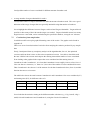
7.2
Conclusions from sample data
I used Microsoft Excel to plot graphs illustrating some of the results. The graphs can be found in
Appendix E.
There were several conclusions that I arrived at from studying the statistics produced by my sample
data.
Firstly, I anticipated from my complexity analysis of the algorithm that, for n=6, the optimised
version would run about 3 times as fast as the un-optimised version. I was able to check this with
the runs I did for both versions and compare the running time and the number of cases considered.
From looking at the graphs which compare the cases considered and the running times of
Countdown12 and Countdown13, it is clear that Countdown13 runs roughly 3 times as fast, for n=6.
I also saw that as n increases ( i.e. from 6 to 7) the ratio of the number of cases considered increases.
Thus Countdown13 does about 1/3 of the amount of work that Countdown12 does (for n=6) and this
fraction decreases as n increases.
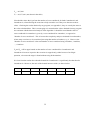
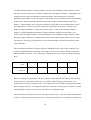
The table below shows the ratio between Countdown12 and Countdown13 for cases considered (CC)
and running time (RT), for different values of n.
n
2
3
4
5
6
CC12/CC13
1
1
1.2
1.7
2.8
RT12/RT13
1
1
1
1.7
3.1
I next looked at the statistics relating to the different number selections (e.g. 3 big 3 small, 4 big 2
small) for both Countdown12 and Countdown13, using the Classical Countdown.
35
I concluded that the number of solutions didn’t vary that much depending on the number selection.
The same was true for the cases considered, running time and targets obtainable. Although this was
surprising at first, after some thought it seemed reasonable. The running time is obviously
dependent on the number of cases considered. The number of cases considered will vary depending
on how many “illegal operations” and how many times it finds a solution without using all six
numbers. These probably won’t vary much whether 6 small numbers are used rather than 2 small
and 4 big numbers. However, what was surprising was that there wasn’t more variation in the
number of targets obtainable (i.e. how many targets, from 1 –1000, can be obtained with the 6
numbers). I had thought that the number of targets obtainable would be greater if there was a
mixture of big and small numbers, as if all the numbers were small then it might be hard to obtain
the larger targets. Similarly, it would be hard to achieve the smaller targets if there were too many
big numbers. Obviously, my hypothesis was false and the number selection chosen doesn’t make
such a difference.
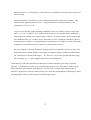
I then looked at the statistics for targets achieved, depending on how many of the 6 numbers were
used for the different number selections. There did not seem to be so much variation between the
different number selections. All of which gave roughly the same percentage as with the following
table.
Numbers
2
3
4
5
6
0%
7%
45%
70%
85%
used
Targets
Achieved
However, although in general there was not a radical variation between the results, I did notice that
at both extremes of the number selections (i.e. 6 small, 2 small and 4 big) fewer targets were
achieved for each value of ‘numbers used’. The central selection of 4 small 2 big seemed to produce
the most targets achieved. As explained earlier, this is what one would expect, as a balance of small
and big numbers would seem to have the best chance of reaching the target.
I then looked at the statistics for the runs of the generalised version. I obviously did expect that there
would be a significant variation between cases considered, running time, and number of solutions for
36
different values of n. Unfortunately, I wasn’t able to run Countdown12 for more than 6 numbers, as
it took too long.
As mentioned before, the number of cases considered includes those using fewer numbers. This
accounts for the apparent anomaly, for n = 3 using Countdown13 where the number of cases
considered is 52, but T3,1 is 48.
As you can see from the graph comparing Countdown13 for 2 to 6 numbers, there is a huge jump
from n = 5 to n = 6 numbers. For 5 numbers there are 21407 cases considered for Countdown13,
whereas there are 658924 cases considered for 6 numbers – 30 times as many. However, the graph
for Countdown13 for 2 to 7 numbers shows, the number of cases considered is 26028025, which is
40 times that for 6 numbers. Correspondingly the running time for 7 numbers is 57085 milliseconds,
as opposed to 1508 milliseconds for 6 numbers – almost 40 times as long.
We can see that for 7 numbers the number of targets which are obtainable is 981 out of 1000. This
implies that given 7 random numbers and a target, it is almost certainly possible to reach the target.
The 7 numbers were chosen in the range 1 – 10. However, it is of course possible that if the range
was a lot larger, e.g. 1 – 100, it might be difficult to reach small targets.
I think that my results show that when producing the Countdown numbers game, they designed it
perfectly. If 7 numbers were allowed, it would make the game too easy, and if only 5 numbers were
allowed then the game might be quite difficult. Also, the choice between small numbers and big
numbers is appropriate, as the big numbers allow you to reach the neighbourhood of high targets, whilst
the small numbers allow for fine tuning to reach the target exactly.
37
8.
Results and Conclusion
8.1
Does the project meet the objectives?
I had five objectives as outlined in Chapter 3. I believe that my project met 4 out of the five (although I
did state that I would like to achieve the fifth objective if time was available).
The first objective was met as I did write an algorithm which managed to find an exact solution of the
numbers game.
The second objective was achieved as I managed to analyse the complexity of both versions
(Countdown12 and Countdown13) of the numbers game, I couldn’t find a closed form for the
complexity of the optimised version. Although I wasn’t able to prove that the Countdown problem in its
general form is NP-complete, I managed to show that both the subset sum and subset product are both
NP-complete.
The third objective was met as I did provide a user-friendly GUI to run the program.
The fourth objective was accomplished as I ran both versions of the program with sample data, and
analysed those results, and I came up with some conclusions as to what those results mean.
As mentioned earlier, I didn’t have enough time to try and achieve the fifth objective, which was to try
and find some heuristic methods to solve the Countdown problem, when the set of numbers was too
large for an exhaustive search to be used. For example, one possible method could be along the
following lines; suppose the target is 649 and there is one big number which is 100. One would try to
find a multiplier of the large number, which is nearest to the target. Since 649 is in between 600 and
700, one would try and express the target in the form of either
649 = (100 + x) * 6 ± y
or
649 = (100 – x) * 7 ± y
Overall my project does solve the Classical Countdown problem (i.e. with 6 numbers). Although I am
sure my program could be optimised further, my optimised version (Countdown13) reduces the work by
a factor of 3 compared to the un-optimised version.
38
8.2
Further Work
Unfortunately there are several additional things that I would have liked to investigate and analyse, but
due to time constraints I have been unable to. Below are listed a few things that I would have liked to
investigate given the time.
Firstly, I noticed that my program was still producing repeated solutions, when the solution did not use
all of the numbers. It would be interesting to see if any more optimisations were possible to reduce all
repeated solutions, so that the solutions obtained were in actual fact all distinct solutions. For instance,
to try and deal with the associativity of addition and multiplication, to stop repeated solutions such as
(3 + 4) + 5), as well as (3 + (4 + 5) which are essentially the same solution.
Secondly, testing more than 7 numbers took too long with my program. One possible way to get round
this would be to this would be to stop the search when only one solution was found, this way it would be
possible to run countdown with many more numbers, provided enough solutions existed.
Thirdly, it would be interesting to compare different algorithms (such as top-down recursive version,
dynamic programming, constraint programming, etc.) for solving both the classical countdown and
generalized problem, and see how they fare in terms of time, number of cases considered, and to
investigate possible optimisations of the algorithms.
Fourthly, when there is no exact solution, it would be interesting to see how close on average the nearest
solution above and below is to the target.
Fifthly, I only had time to run the program with all the standard four operators (apart from when I ran it
with all ‘+’ for checking my theoretical analysis of the algorithm. However, it would be interesting to
see what would happen if only a subset of the four operators were allowed, e.g. only multiplication and
addition, and to see if that would have a significant effect on the statistics already obtained. From the
results of such experiments it might be possible to investigate what are the operators most commonly
used within a solution.
Finally, as mentioned in my objectives, as the Countdown problem seems to be NP-Complete, although I
haven’t managed to prove it, it would be interesting to investigate possible heuristic methods of finding a
solution in the general case when exhaustive search methods take too long.
39
References
Baase Sarah, Computer Algorithms: Introduction to design and analysis, Reading, MA: Addison Wesley
Longman, 2000.
Bishop Judith, Java Gently, Pearson Education, Third Edition, 2001.
Garey & Johnson, Computers and Intractability: A guide to the theory of NP-Completeness, W.H.Freeman
and Company, New York, 1979.
Prohl Ian & McDowell Charlie, Java by dissection: The essentials of Java programming, Addison-Wesley
Pub Co, 1999.
Web Sites
Eck David, Introduction to Programming Using Java, On-line textbook.
http://math.hws.edu/javanotes
http://www.channel4.com/entertainment/countdown_game/NumbersGame.html
http://www.neil.parkwaycc.co.uk/numbers
http://www.brothercake.com/games/countdown.shtml
40