1
Intended use
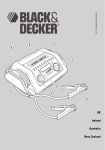
Your Black & Decker battery charger is designed to charge
lead-acid batteries. This product is intended for household,
consumer use only.
Safety instructions
Warning! When using mains-powered appliances, basic
safety precautions, including the following, should always be
followed to reduce the risk of fire, electric shock, personal injury
and material damage.
X
Read all of this manual carefully before using the
appliance.
X
The intended use is described in this manual. The use of
any accessory or attachment or the performance of any
operation with this appliance other than those
recommended in this instruction manual may present a risk
of personal injury.
X
Retain this manual for future reference.
Using your appliance
Always take care when using the appliance.
X
This appliance is not intended for use by young or infirm
persons without supervision.
X
The appliance is not to be used as a toy.
X
Use in a dry location only. Do not allow the appliance to
become wet.
X
Do not immerse the appliance in water.
X
Do not open body casing. There are no user-serviceable
parts inside.
X
Do not operate the appliance in explosive atmospheres,
such as in the presence of flammable liquids, gases or dust.
X
To reduce the risk of damage to plugs and cords never pull
the cable to remove the plug from a socket outlet.
After use
X
When not in use, the appliance should be stored in a dry,
well ventilated place out of the reach of children.
X
Children should not have access to stored appliances.
X
When the appliance is stored or transported in a vehicle it
should be placed in the boot or restrained to prevent
movement following sudden changes in speed or direction.
Inspection and repairs
X
Before use, check the appliance for damaged or defective
parts. Check for breakage of parts, damage to switches and
any other conditions that may affect its operation.
X
Do not use the appliance if any part is damaged or
defective.
X
Have any damaged or defective parts repaired or replaced
by an authorised repair agent.
X
Never attempt to remove or replace any parts other than
those specified in this manual.
Power cord safety
Warning! Never alter the ac power cord or plug. If it will not fit,
have a proper outlet installed by a qualified electrician. Improper
connection may result in an electric shock.
Specific safety instructions for battery chargers
The following symbols are marked on the appliance:
This appliance is double insulated; therefore no
earth wire is required. Always check that the
power supply corresponds to the voltage on the
rating plate.
Read these instructions before use:
If the supply cord is damaged, it must be replaced by the
manufacturer or an authorised Black & Decker Service
Centre in order to avoid a hazard.
X
Never attempt to charge non-rechargeable batteries.
X
Have defective cords replaced immediately.
X
Do not expose the battery charger to water.
X
Do not open the battery charger.
X
Do not probe the battery charger.
X
Never allow the red and black battery clamps (4) to touch
each other or another common metal conductor. This could
cause damage to the appliance and/or create a spark/
explosion hazard.
X
Always store the battery clamps (4) in the storage provided
when not in use.
X
Batteries
Warning! Never attempt to charge a frozen battery.
X
Under extreme conditions, battery leakage may occur.
When you notice liquid on the batteries, carefully wipe the
liquid off using a cloth. Avoid skin contact.
X
In case of skin or eye contact, follow the instructions below.
Warning! Battery fluid is a diluted sulphuric acid and may
cause personal injury or damage to property. In case of skin
contact, immediately rinse with water. If redness, pain or
irritation occurs seek medical attention. In case of eye contact,
rinse immediately with clean water and seek immediate
medical attention.
X
When disposing of batteries, follow the instructions given
in the section "Protecting the environment".
X
Add distilled water in each cell until the battery acid
reaches the level specified by the battery manufacturer.
This helps to purge excess gas from the cells. Do not
overfill. For a battery without cell caps (maintenance free),
carefully follow the manufacturer's charging instructions.
X
Study all the battery manufacturer's specific precautions,
such as removing or not removing cell caps while charging,
and the recommended charging rates.
X
Make sure that the initial charging rate does not exceed the
battery manufacturer's requirement.
3