1
Section 1
Overview
General Information
This manual will help you install and maintain these industrial Ethernet switches.
Installation of these switches is very easy and they will begin to operate as soon as they
are powered up. For the unmanaged models (denoted by ES in their part number) there
are no user settings so they are truly plug and play. The managed models (denoted by MS
in their part number) will act as unmanaged switches until they are configured otherwise.
Refer to the managed switch software manual for configuration of advanced network
functionality.
Note: This manual only covers the installation and wiring of these switches. For
the managed models refer to the separate Software User Manuals for details on
configuring and using any of the management functions such as SNMP, RSTP,
IGMP, VLANs, security, port mirroring and much more.
Operation
Unlike an Ethernet hub that broadcasts all messages out all ports, these industrial Ethernet
switches will intelligently route Ethernet messages only out the appropriate port. The major
benefits of this are increased bandwidth and speed, reduction or elimination of message
collisions, and deterministic performance when tied with real-time systems.
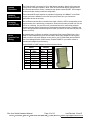
These industrial Ethernet switches can support 10BaseT (10 Mbps) and 100BaseT (100
Mbps) on their RJ45 ports. Each of these ports will independently auto-sense the speed
and duplex, allowing you to interface to legacy (10 Mbps) or fast (100 Mbps) Ethernet
devices. Some models also have one or two 100BaseF (100 Mbps) fiber optic ports.
Performance
Specifications
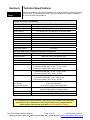
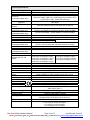
These general specifications apply to these industrial Ethernet switches. Refer to Section 7
for complete technical specifications.
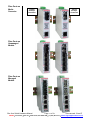
Number of ports
Ethernet Switch Type
Ethernet Protocols
RJ45 Ports (shielded)
Fiber optic port speed
Fiber optic wavelength
Safety
Standards
2, 5, 8 or 9 Ethernet ports
Unmanaged (ES models) or managed (MS models)
All standard IEEE 802.3
10/100 (with auto-negotiation, auto-crossover and autopolarity)
100 Mbps
1300 nm standard but special models are available
These industrial Ethernet Switches meet the following standards plus others:
Electrical safety - EN61010-1 (IEC1010)
EMI emissions - FCC part 15, ICES 003, EN55022; Class B
EMC immunity – IEC61326-1
Electrical safety – CUL (UL 508 & CSA C22); EN61010-1 (IEC1010)
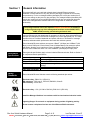
Install the Managed Switches in accordance with local and national electrical codes.
Lightning Danger: Do not work on equipment during periods of lightning activity.
Do not connect a telephone line into one of the Ethernet RJ45 connectors.
Slim Line Switch Hardware Manual
Page 3 of 15
Last Revised: 3-Jan-07
SIXNET • 331 Ushers • Box 767 • Clifton Park, NY 12065 USA • +1 (518) 877-5173 • mailto: [email protected]