1
PORTABLE PA
SYSTEMS
TM
TABLE OF CONTENTS
Glossary
2
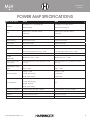
Power Amp Specifications
8
Important Safety Instructions
3
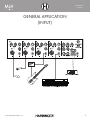
General Application (Input)
9
Input Channels
5
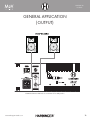
General Application (Output)
10
Master Section
6
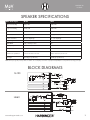
Speaker Specifications/Block Diagrams
11
Rear Panel
7
Warranty/FCC Statements
12
WELCOME
CONGRATULATIONS on your purchase of a
Harbinger 4-Channel PA System. Built with rugged,
carpet-covered wood enclosures, they are the ideal
choice for musicians looking for a PA that delivers
great sound night after night. This manual will
help you setup your new system. By following our
guidelines and suggestions, your new Harbinger
will provide many years of great sound and reliable
service.
Your new MüV Series portable PA
includes:
•One Powered Mixer
•Two Speaker Cabinets
•Two Speaker Cables
BRIEF GLOSSARY OF TERMS
BALANCED
A 2-conductor (plus shield), low-impedance
connection. Balanced cables are the preferred
method for hum-free interconnection of a given sound
system for their noise-rejection characteristics. (Also
see Unbalanced.)
CHANNEL
One of any number of signal paths in an audio
circuit, such as input channel, output channel,
recording channel, left channel, right channel, etc.
DECIBEL (dB)
A term representing the ratio between different audio
levels. For example, a ratio of 1000:1 = 60dB.
DELAY
Like an echo, this effect duplicates the original signal,
then plays it back at a rate you control. The rate at
which these repeats occur is the “delay time.”
EQUALIZATION
Electronic filters that adjust the level of certain
frequencies. Used for tone enhancement or to reduce
extraneous sounds. Two types of EQ shapes are Peak
and Shelving, described below.
2
IMPEDANCE
Resistance in an electrical circuit measured in Ohms
(Ω). Maintaining proper impedance (between
amplifier and speakers for example) is important to
prevent damage to the amp.
PEAK EQUALIZER CONTROL
Increase or decrease of a frequency range centered
at a specific point, resulting in an EQ curve that looks
like a hill (increase) or a valley (decrease). (Also see
Shelving Equalizer Control.)
SHELVING EQUALIZER CONTROL
Increase or decrease of all frequencies above or
below a specific point. (Compare to Peak Equalizer
Control.)
TRS (BALANCED)
Acronym for Tip-Ring-Sleeve — the three parts of a
two-conductor (plus shield) audio plug. TRS phone
plugs are often used for “balanced” connections.
TRS (UNBALANCED RES INSERT)
Another common TRS application is for “dual
unbalanced” connections, such as insert send/return
jacks or stereo Y-Cord. These are used for inserting
an external processor into a signal path. (See page 6
of this manual.)
TS
Acronym for Tip-Sleeve, the two parts of an
unbalanced, single-conductor (plus shield) phone
plug. TS connectors are sometimes called mono or
unbalanced plugs or jacks.
UNBALANCED
A single-conductor (plus shield), high-impedance
connection. Most commonly used for instrument
connections and cable runs of less than 20 feet.
XLR
The three-pin connector universally used for balanced
audio connections. A balanced connection reduces
outside noise and interference. (See Balanced
above.)
M60 and M120 Owner's Manuel