1
Introduction
3
1.2 The new paradigm of the distributed measuring systems
For the purpose of discussion, the large-scale dimensional measurement systems can be
classified into centralized and distributed systems. In the case of centralized instruments,
measurements may independently arise by a single stand-alone unit which is a centralized
complete system (i.e. a CMM, a laser-scanner or a Laser Tracker), while distributed instruments are made of two or more distributed units (i.e. MScMS or other innovative systems like the indoor-GPS, described in Chap. 6 [Metris, 2007]).
Distributed measurement systems introduce a new paradigm in the field of large-scale
metrology. Due to their nature, they are portable and can be easily transferred around the
area where the measurand is. Compared to centralized systems, distributed systems may
cover larger measuring areas, with no need for repositioning the instrumentation devices
around the measured object [Kang et Tesar, 2004].
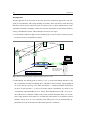
MScMS can be classified as a modular distributed measuring system for large volume
objects. Even if at present time MScMS is still a prototype and needs to be further developed, the system enables factory-wide location of multiple objects, applicable in manufacturing and assembly. Mainly, it can be used by aerospace manufacturers, but can also
be adopted by automotive and industrial manufacturers both for positioning and tracking
applications. Since MScMS main components are a number of wireless devices distributed around the measuring area, this not rigidly connected frame makes the system easy
to handle and to move, and gives the possibility of placing its components freely around
the workpiece, adapting to the environment and not requiring particular facilities. As a
consequence, MScMS is suitable for particular types of measurement, which can not be
carried out by traditional frame instruments, like conventional CMMs, because they are
bulky and cannot be comfortably moved.
The introduction of distributed measuring systems will probably have important effects
on simplifying the current measuring practices within large scale industrial metrology
[Maisano et al., 2007]. This tendency is confirmed by other recent distributed measuring
systems based on laser and optical technology: the indoor-GPS (iGPS), the PortableCMM and the Hi-Ball [ARC Second, 2004; Metris, 2007; Metronor, 2007; Welch et al.,
2001]. All these systems – even they use different technologies – are composed of a
number of sensors, arranged around the measuring area, which can be viewed by a sensor
probe measuring the object surface.