1
III.
MODULE FUNCTIONAL OVERVIEW
3.1
Modbus Slave Communications
The 2100 Flow Processor’s Modbus Slave port runs the RTU and ASCII
versions of the Modbus protocol. This capability allows the module to
communicate data to a Modbus Master (as available in most SCADA
Master packages), and vice-versa. The module supports both point-topoint implementations as well as multi-drop implementations.
The following discussion centers on the functional capabilities of the
Modbus Slave port.
3.1.1
Command/Reply Cycle
Successful communications between a Modbus Slave and a
Master will always consist of the following two transactions:
Command: Message from master giving instruction to slave.
Reply: Response to command.
A slave station will respond to a master issued command in several
ways.
Data Message: If the command was executed by the slave,
the response message will include the data requested, or an
acknowledgment that the command was executed.
Error Message: If the command could not be executed by
the slave, for whatever reason, an error response message
is transmitted to the master. The error response message
consists of the original function code (or'd with 80hex) and
an error code.
No Reply: If the master does not detect a reply within its
timeout period, the master should re-transmit the command,
before a time out error is issued. If the Slave could not
decode the message or an error occurred preventing the
Slave from recognizing the message, no response will be
issued.
3.1.2
Command Types
The Modbus Slave can respond to three types of commands from
the master; read data, write data, and a diagnostic command.
These are overviewed below and detailed in Appendix C.
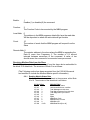
Read : The following data read commands are supported:
1
Read Output Status
2
Read Input Status
3
Read Multiple Registers
Revised 3/21/01
13