1
SCUBAPRO refuses all responsibility for damages caused by non-compliance with the
instructions contained in this manual. These instructions do not extend the warranty or the
responsibilities stated by SCUBAPRO terms of sales and delivery.
4. REGULATOR SYSTEM
A regulator system is required to reduce the pressure of the compressed air contained in
the cylinder to an ambient pressure in order to supply breathable air when needed. It is also
possible to connect pressure gauges (analog or digital), IP inflators to supply buoyancy
compensators, dry suits and other devices to this system. The regulator system is composed
of a pressure reduction device and one or more breathing devices. In this manual, the
pressure-reducing device and the breathing device will be indicated, respectively, by the
terms “first stage” and “second stage.”
4.1 First stage
A pressure-reducing mechanism that reduces the pressure of the compressed air contained
in the cylinder to an intermediate relative pressure of about 9.5 bars (138 psi). The first stage
uses a standard piston, balanced piston or diaphragm mechanism.
4.2 Second stage
This unit is supplied, with the intermediate pressure coming out of the first stage through the
low pressure hose. It reduces pressure further to balance air with the ambient pressure. The
second stage may be balanced or unbalanced and equipped with a Venturi effect control
(V.I.V.A.) and/or with an inhalation resistance control.
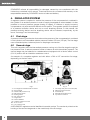
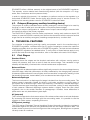
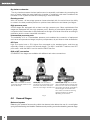
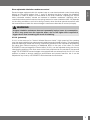
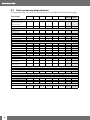
An example of a complete regulator and with either a DIN or INT connection first stage,
depending on the tank valve:
11
Img. 1
1
2
3
4
5
6
7
8
9
10
11
First stage with threaded DIN connection
Second stage
INT/DIN inlet protective cap
DIN retaining wheel
Rotating swivel
High pressure port
Purge button
Exhaust deflector
Inhalation resistance control
V.I.V.A. control
Low pressure hose
Img. 2
1
2
3
4
5
First stage with yoke connection (INT)
Retaining yoke and screw
Protective cap
INT/DIN inlet protective cap
Dry balance chamber
All SCUBAPRO regulators can be identified via a serial number. The number is printed on the
housing of the second stage and on the metal body of the first stage.
4