1
FAQ
Question
Answer
Why should the patient be 1 meter
from the fixation dot?
Having a very close target activates convergence, i.e. the eyes have to cross in order to look at the dot.
Activation of the convergence system may interfere with the VOR. In addition, a close target adds a linear
component, i.e. the eyes moves sideways relative to the dot (this effect becomes smaller with increasing
distance of the target). From a technical point of view, there may be some parallax of the laser (relative
movement of the laser dot in the field), because it is attached to the right side of the goggles. Therefore it
is a good idea to have at least 1 m of distance.
What happens if the frame rate
drops below 219?
If the frame rate drops below 219 during data collection the software will reject that head impulse. A frame
rate below 219 is problematic because the data collection will not be accurate (e.g. peak velocity, gain
measurements etc).
What is the difference between
overt and covert catch-up saccades?
• Overt – occur after the head movement and can sometimes be seen using visual observation
• Covert – occur during the head movement and cannot be seen using visual observation
Where did the default normative
data cutoffs come from?
MacDougal HG, Weber KP et al (2009) The video head impulse test: Diagnostic accuracy in peripheral
vestibulopathy. Neurology 73:1134-1141.
What is the difference between the
collected and accepted data?
These are 2 completely separate algorithms. The collected algorithm is on-line (during data collection) and
less detailed. These are the numbers that display in the collection window (left/right accepts and rejects)
and is displayed in the collected column in the test info window. All the data (not just the collected data)
goes thru a second algorithm - the Analysis algorithm and this is more detailed and off-line and the results
are displayed in the accepted column in the test info window and what is included in the 2D and 3D analysis. The numbers for the collected and accepted may not always add up to the same number because the
raw data is being analyzed twice by 2 different algorithms.
Why would the collection number
be larger than the analysis?
Due to the way impulses are found (peak detection in analysis vs velocity threshold in collection), if the
operator performs an impulse with a peak of around 50deg/sec, this impulse will be counted by collection,
but may not be counted by analysis.
Why would the analysis number be
larger than the collection?
Collection impulses are 250 samples and analyzed impulses are 175 samples, there is a small window
whereby if you perform two impulses quickly between 100 and 200 samples apart, the collection code will
see this as one impulse, and the analysis code might see it as two impulses. It is important to perform the
head impulse wait and look to verify that your head impulse matches the training curve and the operator
feedback is green.
Can I export data in a format I can
use for research?
Yes, you can export patients and choose ASCII Test Results or ASCII Raw Data. ASCII Test Results exports
the accepted data shown in the analysis windows. ASCII Raw Data exports all data collected even the data
rejected by the collection and analysis algorithms.
How many head impulses should I
perform?
The default is 20. This was recommended by Drs. Halmagyi and Curthoys as a starting point. Once the
tester is confident in their ability to perform proper head impulses with very few rejects then this number
can be reduced.
How large are the video files?
See Ch 4 in the manual Video Record/Playback for detailed information on eye video, room video, and
combined video sizes.
Can you test a patient that has
Strabismus?
Yes, as long as it’s not a paralytic strabismus. You need to cover one eye (the one that is not recorded) to
make sure the patient is always fixating with the same eye.
Gain vs 3D Tracing – What should I
look at?
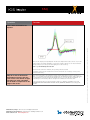
BOTH! Do not only rely on the gain graph to determine if the patient is within normal limits or has an abnormal VOR response. You must look at the traces. It is easier to see catch-up saccades in the 3D analysis.
If the gain is in the normal range but the 3D analysis clearly shows catch-up saccades then the patient is
exhibiting an abnormal response. This is sometimes seen with patients where their covert saccades are
right on top of the peak velocity of the head trace. See blog posts at www.headimpulse.com to learn more.
We tested a patient with right
vestibular neuritis but the gain was
normal on the left side. Why is this?
This is often seen and has been documented in published articles. The VOR gain to the healthy side does
decrease a bit but the normal range is large so you don’t detect that decrease. In Manzari L, Burgess AM,
MacDougall HG, Curthoys IS Objective verification of full recovery of dynamic vestibular function after
superior vestibular neuritis. Laryngoscope; 2001: Rapid Communication. In this article a patient when
in attack the VOR gain for the healthy side is ~0.8 (still in the normal range), but on recovery the VOR
returned to ~1.0.
Why are gains for head impulses to
one side higher than to the other
side?
There can be many reasons for that. The gain of each side can be affected by factors affecting just that
labyrinth. There will be natural variations. Another reason is since the data is recorded only from the right
eye, it is slightly biased (gains are higher on the right than on the left). Ian Curthoys calculated the asymmetry ratio for 90 healthy subjects (data collected by Manzari with prototype and unpublished) and found that
the difference was very small 2.7%. This difference was reported in coils (Prog Brain Res. 2008; 171:195-8.
Inter-ocular differences of the horizontal vestibulo-ocular reflex during impulsive testing Weber KP, Aw
ST, Todd MJ, McGarvie LA, Pratap S, Curthoys IS, Halmagyi GM. Department of Neurology, Royal Prince
Alfred Hospital, Sydney, Australia. [email protected]). In coils the difference was reported at 15%.
It is hypothesized that the slower velocity head impulses used with goggles results in a lower difference
between leftward and rightward head impulses. This effect most likely arises from physiology.