1
Bachelor thesis
Automation of a test setup to characterize
scientific CCDs
from:
Eric Müller
Date/ Place of birth:
17.09.1985, Jena
Matriculation number:
374118
Course of studies:
Precision Engineering (Ba)
Department:
SciTec
supervised by:
Dipl. Ing (FH) Sebastian Deiries
European Southern Observatory
Karl-Schwarzschild-Strasse, 2
D-85748 Garching bei München
and
Prof. Dr. Martin Schroeck
University of Applied Sciences Jena
Carl-Zeiss-Promenade, 2
07745 Jena
July 2009
Outline
I
During the forthcoming years the Optical Detector Team (ODT) will implement a large
number of CCDs in optical instruments for the Paranal and La Silla observatories. An
important step in this process is the CCD characterization and optimization that is done
after the device is received from the manufacturer. In order to accommodate the new CDDs
and to decrease the workload of the existing test bench, a new testing facility is build.
The chosen concept is the result of years of experience in detector testing at ESO.
Nevertheless new hardware and software is introduced and the opportunity is provided to
measure fundamental detector parameters namely quantum efficiency, conversion factor,
dark current, charge transfer efficiency, read out noise, and cosmetic quality in fully
automated modes.
It is possible to uniformly illuminate the optical detector over a 100mm diameter with
monochromatic light in the wavelength range from 300nm to 1100nm. Accessible
parameters are amongst others exposure time (shutter control), light intensity control and
measurement, wavelength, bandwidth, and several clock modes to control the charge
coupled devices.
Number of pages
57
Number of figures
34
Number of applicable documents
25
Table of contents
Numbering
II
Topic
Page
Outline
I
Table of contents
II
Acronyms
III
1
Introduction
2
2
Goal
3
3
The MUSE instrument project
4
3.1
Scientific goals
4
3.2
Technical challenges
5
4
The CCD test bench
7
4.1
Requirements
7
4.1.1
General
7
4.1.2
The illumination system
9
4.2
Considerations concerning the setup
11
4.2.1
Light source
11
4.2.2
Imaging optic
11
4.2.3
Optical filters
12
4.2.4
Monochromatic light
14
4.3
Hardware configuration
14
4.3.1
Additional components
19
4.3.2
Completion and fine adjustments
20
4.4
The light path
20
4.5
Software configuration
25
4.5.1
Functional principle
27
4.5.2
The PRiSM software
27
4.5.3
The LabVIEW software modules
28
4.5.3.1
General annotations
28
4.5.3.2
PowerSupply_standalone.vi
29
4.5.3.3
Filter_wheel_standalone.vi
30
Table of contents
II
4.5.3.4
MSH 301_standalone2.1.vi
31
4.5.3.5
Keythley_6514_standalone2.0.vi
33
4.5.3.6
Keithley 2100 Series Read Single.vi
33
4.5.3.7
ESP300_standalone.vi
34
4.5.3.8
Pulpo1_standalone2.0.vi
35
4.5.3.9
JUMO_standalone2.0.vi
38
4.5.3.10
USB Interface Board_standalone2.0.vi
39
4.5.3.11
FIERA_standalone.vi and NGC_standalone.vi
40
4.5.4
Automated data acquisition
43
4.5.5
Data reduction and results
48
5
Measurements and results
50
5.1
Wavelength accuracy
50
6
Discussion
55
6.1
Light performance
55
6.2
Additional shutter
55
6.3
Wavelength adjustments
56
6.4
Uniformity of illuminance
56
7
Conclusion
57
Applicable documents
Table of figures
Annex I: Custom-made products
Annex II: Characteristics of components
Annex III: Detector test report
Declaration on autonomy
Abstract
Acronyms
III
Acronyms
CAD
-
Computer Aided Design
CCD
-
Charge Coupled Device
CPA
-
Image file format for lossless compression of FITS images
DC
-
Direct Current
ESO
-
European Southern Observatory
FIERA
-
Fast Imager Electronic Readout Assembly
FITS
-
Flexible Image Transport System
GPIB
-
General Purpose Interface Bus
GUI
-
Graphical User Interface
IFU
-
Integral Field Unit
MUSE
-
Multi Unit Spectroscopic Explorer
NGC
-
New General detector Controller
NI
-
National Instruments
NPL
-
National Physical Laboratory (England)
OD
-
Optical Density
ODT
-
Optical Detector Team
PC
-
Personal Computer
PSF
-
Point Source Spread function
PTB
-
Physikalisch-Technische Bundesanstalt
SPARC
-
Scalable Processor Architecture
Telnet
-
Telecommunication network
USB
-
Universal Serial Bus
UV
-
Ultraviolet
VI
-
Virtual Instrument (a LabVIEW software module)
VLT
-
Very Large Telescope
VME
-
Virtual Machine Environment
Acronyms
III
E
-
Illuminance
B
-
Luminance
M
-
Magnification
k
-
F-number
kM
-
F-number of monochromator
f
-
Focal length
D
-
Aperture of lens
λ
-
Wavelength of incident light
m
-
Order of diffraction
RS
-
Radius of integrating sphere output port
RD
-
Radius of illuminated area at the CCD position
g
-
Grating constant
Introduction
1
2
Introduction
An important step in the process of implementing Charge Coupled Devices (CCDs) in
optical instruments for astronomy, is the characterization and optimization of the device
after it is received from the manufacturer. A number of measurements of CCD performance
involve the uniform illumination of the chip in question with light of a certain intensity
level, at a specific wavelength and with a certain spectral bandwidth.
In 1996 the introduction of the detector controller FIERA (Fast Imager Electronic Readout
Assembly), developed at ESO, as well as the growing size of the optical detectors, which
could not be handled by the existing testing facility at that time, has made the construction
of new test bench named Test and Measurement Evaluation Rig (TAMER). Several
improvements have been realized to optimize the turnaround time and the precision of the
measurements. New detector heads, each accommodating two CCDs, have been
manufactured and put in use.
In actual state the new general detector controller (NGC) can also be used to operate the
devices. The design provides the possibility to test large detector sizes of 8k x 8k pixels
(15µm pixels size) or around 200mm diameter. All major CCD parameters namely
quantum efficiency, photo response non uniformity (PRNU), readout noise (RON),
linearity, dark current, charge transfer efficiency (CTE) and cosmetic defects can be tested
in fully automated modes for the most part.
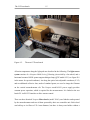
The detector is mounted in the cryostat head and placed behind a quartz window (see figure
3-1). A vacuum pump generates a vacuum of approximately 10-6mbar and the cryogenic
system cools the head down to a temperature of around -120°C. A constant temperature is
achieved by heaters operated by a control unit linked to the CCD controller.
Once the device is tested and qualified against the contractual specifications, the
configuration of detector and cryostat remains exactly the same and is mounted to the
foreseen optical instrument.
CCDs are the essential sensors for almost all astronomical instruments that operate in the
visible wavelength range today. An ambitious project, requiring all in all 24 CCD cryostats
should serve as an example and is briefly described in 4.
Goal
2
3
Goal
The intention of this thesis is the assembly and the automation of a test setup that allows to
characterize scientific CCDs. Therefore the elected hardware needs to be aligned and
several components have to be constructed and manufactured.
The determination of fundamental detector parameters requires the automated data
acquisition, data reduction and evaluation as well its clear summary. For this purpose
routines, that have been used at the existing test facility, needs to be adapted in the way that
they can be used to operate the new hardware.
This requires to develop driver software for the several controllers, which should also
provide the opportunity to access the test assembly interactively from a remote computer.
Furthermore the thesis should serve as documentation about the hardware and the software
modules in use.
The MUSE instrument project
3
4
The MUSE instrument project
The Multi Unit Spectroscopic Explorer (MUSE) is a panoramic integral-field spectrograph
in development for one of ESOs Very Large Telescopes (VLT) on Cero Paranal in Chile. It
combines a wide field of view with an improved spatial resolution, assisted by adaptive
optics and operates in the visible wavelength range.
3.1
Scientific goals
Using the unique capability to obtain up to ten thousands of spectra in one single exposure,
scientists aim to study the evolution of massive stars and intend to answer a number of key
questions about super massive black holes and their impact on the galaxy evolution.
Thanks to their strong hydrogen emission lines, MUSE will be able to detect and study
progenitor of galaxies similar to the Milky Way at a distance of more than 10 billion light
years. It is expected to discover around 15000 of all types of galaxies. The unique
homogeneous set of physical data will be a key element to understand the formation and
evolution of galaxies.
In the case of unpredictable events such as the apparition of a new comet and unlike space
missions which need to be programmed well in advance, MUSE shall be able to observe
the object without delay. Furthermore its spectrographic capabilities will be crucial to study
the complex chemical and physical evolution of the comets when they approach our sun.
The MUSE instrument project
3.2
5
Technical challenges
In contrast to classical spectrographs which provide a spectral information of one spatial
direction, an integral field spectrograph is designed to give a spectral information of a two
dimensional field of view. In order to preferably have a wide field of view, MUSE uses 24
integral field spectrographs that allow to observe an area of 1 x 1 arcmin². Each unit is
equipped with its own cryogenically cooled CCD head accommodating a detector with a
size of 4096x4096 pixels of 15 microns.
The VLT secondary mirror is equipped with more than one thousand actuators to remove
the distortion due to the atmosphere in real time. Therefore four artificial stars are created
by the smaller auxiliary telescopes, to have a reference. This system is part of the VLT
adaptive optics facility, developed separately from MUSE, by ESO.
The light gathered by the 8.2m mirror is focused on a field splitter and separator by the
adaptive secondary mirror, resulting in 24 different light paths that are directed to each
integral field unit (IFU). Within each IFU the field of view is again spilt into 48 slices by
the image slicer and finally a detector records the light signal, that has been dispersed by a
spectrograph. Each exposure taken by MUSE will have all in all 370 millions of pixels.
ESO is in charge of delivering 24 detector systems, that fulfil the high technological
requirements of this ambitious project. To assure highest instrument efficiency and best
image quality, each detector system needs to be tested to verify its usability, reliability and
stability.
The MUSE instrument CCDs are back-illuminated, deep depletion devices with a
graduated anti-reflection coating and manufactured by E2V. These science grade detectors
of type CCD231-84-4-D76 are customer specific grade chips that meet the ESO
requirements described in [1].
The MUSE instrument project
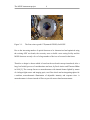
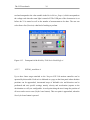
Figure 3-1:
6
The first science grade CCD (named CERES) for MUSE
Due to the increasing number of optical detectors to be characterized and optimized using
the existing ODT test bench, the necessity arose to build a new testing facility and the
MUSE detectors are only a few of a large number of devices to be tested in the future.
Therefore a design is chosen which is based on the test bench concept introduced, after a
long, but fruitful, process of considerations and tests, by Paolo Amico and Thorsten Böhm
in 1998 [2]. The concept foresees a monochromator with internal shutter lighted by means
of a halogen light source and imaging optic, two filter wheels and an integrating sphere for
a uniform, monochromatic illumination of adjustable intensity and exposure time. A
monochromator is chosen instead of filters to provide narrow band measurements.
.
The CCD test bench
4
The CCD test bench
4.1
Requirements
7
4.1.1 General
Apart from an acceptable price of all components, the general requirements can be
summarized as follows:
•
The whole test assembly is foreseen to be mounted on an optical bench in a small
laboratory of 5 x 6 m² area
•
To guarantee full automated data acquisition using appropriate software, each
device or rather controller needs a connection to the test bench PC via a common
interface (e.g. GPIB, Serial, USB)
•
Uniform control software needs to be developed and existing software modules
have to be integrated
•
All devices have to be operable in combination and by standalone software modules
•
It must be guaranteed that the light path is isolated from the lighting conditions in
the test bench room as good as possible and that these conditions do not change
(e.g. by turning on the room light) during the measurements
•
Both available CCD controllers must be supported
In order to test the fundamental CCD parameters it must be possible to take three different
types of exposures at different read out modes.
The readout mode defines the way the CCD is read out including the speed in kpix/s, the
ports used, the gain (0.5 e-/ADU for the high gain and 2.5 e-/ADU for the low gain) and in
some cases the number of lines to be read.
The CCD test bench
8
Flat field exposures require the CCD to be illuminated with uniform light of a specific
wavelength for a definable exposure time. Therefore a monochromatic and homogeneous
light source is needed as well as a shutter to exactly adjust the time of exposure.
The detector is intentionally not illuminated, if a bias exposure is taken. For this purpose
the integration time is set to zero seconds and the CCD read out procedure starts
immediately. Roughly speaking, this type of image is also a flat field image without having
an exposure time. The noise due to the temperature in the resulting image is insignificant.
The only recorded “signal” is the noise of the readout amplifier.
For the purpose of taking a dark acquisition (dark image) a cover has to be mounted onto
the CCD head to make sure that no light reaches the CCD. After a specific integration time
the detector is read out. This image contains information about the noise due to the
temperature as well as the readout noise of the amplifier. In addition disruptive events like
cosmic rays are detected.
A time delayed integration exposure starts by reading out the CCD with the shutter closed.
During the readout the shutter is opened to illuminate the CCD with uniform,
monochromatic light, as if a flat field image is taken. Taking the exposure ends, as soon as
the readout has finished. The resulting image is divided into three parts the bias area at the
bottom (where the output register is located), the area where the luminous gradient is
present and the saturated area at the top of the image.
The CCD test bench
Figure 4-1:
4.1.2
9
Time delayed integration (TDI) image of a 4096x2048 pixel detector
The illumination system
The requirements mainly depend on the chosen monochromator. The aperture ratio and the
size of its slits determine the parameters of the optic and the size of the light source.
The essential wavelength range of the broad band light source needed, is given by the
sensitivity of the CCDs to be tested. The lower wavelength limit is 300nm and the upper
limit is 1100nm. Furthermore a temporally and spatial stability of light intensity and a
smooth continuum without spectral lines is required as well as a sufficient light output
especially in the UV range, to be able to illuminate the detector over the whole range from
a few ADU to saturation at acceptable low exposure times. In addition the size of the light
source needs to be big enough, to have an image of sufficient size in the plane of the
monochromator input slit, when it is imaged by an additional optic.
The CCD test bench
10
The imaging optic must efficiently collect the light emitted by the source and image the
source (e.g. filament) magnified onto the monochromator input slit. Also the aperture ratio
of the imaging beam should meet the requirements of the chosen monochromator in order
to maximize the efficiency. The material of the lenses must transmit the whole spectrum
especially the weak UV light as already mentioned.
Furthermore the transmission needs to be adjustable in preferably small and equidistant
steps from 100% to 1%, to keep the exposure times in a reasonable range and disruptive
orders of light of certain wavelengths have to be disabled by optical filters in case a
diffraction grating is used to produce monochromatic light. Moreover the selected filter
glass must not delimit the wavelength range from 300nm to 1100nm.
The core of the test assembly, a monochromator, must have input port and output port
aligned, to ensure to have a compact test setup, which can be mounted on a preferably small
optical bench. In addition a second output port is required, to provide the opportunity to
couple light into a fibre, that allows to illuminate the detector punctual with monochromatic
light (PSF experiment). The gratings efficiency has to be optimized for the UV part of the
spectrum. A wavelength accuracy of ± 1 nm and a bandwidth adjustable to a minimum of
4nm is sufficient for the measurements to be done.
An uniform illumination over the whole chip (4kpix x 4kpix of 15µm size equals an
diameter of ~100mm) is intended to be achieved by an integrating sphere attached to the
monochromator output slit, where the uniformity should not vary by more than 3%.
Moreover there must be an opportunity to measure the photocurrent in the sphere (e.g. for
QE measurements). In order to illuminate the CCD for a definable period of time an
electronic shutter is suitable.
As mentioned above the opportunity is required, to illuminate the CCD with a point light
source at arbitrary positions and wavelengths within the mentioned range. For this purpose
a light tight work area between integrating sphere and detector is needed, which also has
the advantage to be able to mount an image projector in front of the chip.
For the purpose of absolute flux calibration of the system [3] or in other words, to be able
to monitor the photon flux at the CCD surface during a series of measurements (necessary
for QE measurements for example), you have to know the ratio between the flux at the
The CCD test bench
11
CCD surface position (can not be measured in this place when the detector is mounted) and
another location in the light path, preferably inside the integrating sphere. This requires two
photodiodes [3], one permanently mounted to the integrating sphere and a further one,
which is only used for the test bench calibration. Therefore the CCD cryostat is replaced by
this diode, which is attached to a special flange (already exists) for the duration of this
procedure.
4.2
Considerations concerning the setup
4.2.1 Light source
In order to get light into a monochromator and considering the spectrum to be covered by
the source, halogen lamps and arc lamps come into consideration. Halogen lamps have a
more stable intensity, considered over time, compared to arc lamps and an appropriate
power supply should allow to keep the power of the source constant, which contributes to
improve the stability. Furthermore halogen lamps are continuum radiation sources with a
relatively small spectral variance of intensity. The minimum size of the light source can
roughly be calculated, if the magnification of the optic and the size of the monochromator
input slit are known.
4.2.2 Imaging optic
Quality and quantity of the light leaving the monochromator tremendously depends on how
the light is coupled into the device. A maximum efficiency can be achieved by magnified
imaging (input port area is generally larger than the area of the spiral-wound filament) of
the filament onto the input slit, by a condenser optic and a collective lens, which provide a
light beam with an opening ratio equal to the required opening ratio of the monochromator.
The ratio is usually described by the F-number of the device.
The CCD test bench
12
Several manufacturers offer completely assembled kits for that purpose, but it is preferred
to have a modular and therefore easy expandable and modifiable assembly of commercial
products, that meet the requirements soonest. The relative aperture of a condenser is a good
measure for its efficiency to collect light and it equates to the focal over diameter ratio
(k=f/D) in a good approximation. One should not forget that it is essential to find a
compromise between a preferably small F-number, allowing to collect a bigger amount of
light and little spherical aberration, which increases by smaller F-numbers.
The minimum aperture of the additional collective lens equates the aperture of the
condenser or contrariwise and the focal length of the focusing lens is given by the
monochromators maximum angle of aperture ( f = D ⋅ k ). UV-grade fused silica is suitable
as a material for the lenses in order to not limit the desired spectrum.
4.2.3 Optical filters
An advantageous solution to remotely control the intensity level, is the use of neutral
density filters with different transmissions (optical densities) that are put into the light path
by means of a filter wheel with an appropriate controller. Very low light levels can be
achieved at respectable exposure times. The aperture must always remain the same,
independent from the filter position (also in case there is no filter mounted for a
transmission of 100%), to not additionally adjust the intensity by differing fading.
Since a reflexion grating mounted to a monochromator is intended to be used to produce
monochromatic light, it is possible that the light at the output slit is not monochromatic, but
a mixture of the desired wavelength (first order of diffraction) and a further second order
wavelength (and higher orders). This must be avoided and the disruptive wavelength must
be blocked by coloured glass filters, used as order sorting filters. According to the equation
of reflexion gratings [24]
The CCD test bench
13
⎛ m⋅λ
⎞
+ sin ε ⎟⎟
sin β = −⎜⎜
⎝ g
⎠
(4.1)
Variables:
β
- Angle of reflexion with respect to the grating normal
ε
- Angle of incidence with respect to the grating normal
λ
- Wavelength of incident light
m
- Order of diffraction
g
- Grating constant
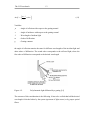
the angle of reflexion remains the same for different wavelengths of the incident light and
other orders of diffraction. The zeroth order corresponds to the reflected light, where the
first order of diffraction corresponds to the desired wavelength.
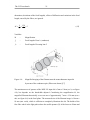
Figure 4-2:
Polychromatic light diffracted by a grating [14]
The outcome of this consideration is the following. It has to be verified that half the desired
wavelength is blocked either by the system (spectrum of light source) or by proper optical
filters.
The CCD test bench
14
4.2.4 Monochromatic light
Narrow band measurements at low stray light and adjustable bandwidth are intended to be
done in an automated way, different light paths (axial and lateral) are foreseen and the
complete setup needs to be isolated from the room light conditions. All these features are
combined in a monochromator.
An integrating sphere mounted at the monochromator output port affords to have diffuse
light output and a uniform intensity contribution in the plane where the detector is placed.
An iris shutter with a proper aperture (in case of dazzling effect) is suitable for the task, to
accurately determine the exposure time. A constant low light level inside the test bench
room can be achieved by reading and regulating the room light level, using a further
photodiode in combination with an electrometer and appropriate hardware and software to
control the room light.
4.3
Hardware configuration
All devices that have an impact on the light path are mounted on a Thorlabs 1800mm x
750mm optical table. Additional components allow to uplift the mentioned devices onto the
optical axis in 235mm height (see 4.3.1).
The CCD test bench
Figure 4-3:
15
The new CCD test bench
All main components along the light path are described in the following. The light source
system consists of a Newport 60000 Series Q Housing (air-cooled by a fan wheel) and a
horizontal mounted 100W quartz tungsten halogen lamp (QTH model 6333, see figure II-9
in the annex for spectral irradiance). An along the optical axis adjustable condenser (F/1.5)
and an additional collective lens, made of standard quartz, are used to image the filament
on the vertical monochromator slit. The Newport model 69931 power supply provides
constant power operation, which is required for the measurements. It is linked to the test
bench PC via RS-232 interface to allow remote control.
There are three identical Newport filter wheels (model 74041), one linked to and operated
by the monochromator and two of them operated by their own controller unit. Each wheel
can hold up to six filters of 25.4 mm diameter, but there is always one holder without a
The CCD test bench
16
filter (aperture stays the same) mounted, to afford unfiltered light throughput. The first two
filter wheels hold neutral density filters (ND-filters) from SCHOTT with transmissions of
71% (mounted twice), 50%, 25%, 10%, 5%, 2.5%, 0.5%, 0.1% and 0.025% to allow the
adjustment of the transmission from 100% to 0.00126% in 28 steps (see figure II-5 for
transmission curves and figure II-4 in the annex for detailed information about the mounted
filters). This is done by combining (adding) the optical densities of two filters that are put
into the light path one after another. The software automatically adjusts the filter wheel
position according to the chosen density. In the third filter wheel the SCHOTT order sorting
filters 305FG01-25, 550FG05-25 and FSR-RG1000 are mounted, having cut-off
wavelengths at 305nm, 550nm and 1000nm (see figures II-1, II-2 and II-3 in the annex for
transmission curves). The monochromator as well as the filter wheel control units are
connected to the test bench PC via GPIB interface.
The Newport MSH 301 ¼ M monochromator has a 600 l/mm plan grating mounted with a
blaze-wavelength of 400nm for increased efficiency in the UV range (see figure II-6 in the
annex for typical efficiency of ruled gratings with similar blaze wavelength). The device is
set up for a wavelength range from 250 to 1300 nm with 0.35 nm accuracy and a minimum
band pass of approximately 0.5nm and houses an internal shutter at its input port. A
motorized slit is mounted at each of the three ports (Newport models 74115, 74117, 74118).
The device is linked to the PC via GPIB interface.
The LOT-ORIEL K-200W-SP integrating sphere has a diameter of 200mm with two
aligned 40mm diameter main ports and an integrated stray light shield, avoiding the light
going directly from the input to the output. The internal BaSO4 coating ensures a
reflectance better than 96% in the range from 400nm to 1100nm and better than 95% in the
UV range from 320nm to 400nm (see figure II-7 and figure II-8 in the annex). A
Hamamatsu 1cm² silicon photo diode, calibrated by reference to NPL and PTB standards, is
connected to the first Keithley electrometer KE 6514 (used as ammeter) by a low noise triax
cable and mounted to an additional port near the output port to measure the flux in the
sphere. In the lower measurement range of 2nA the resolution of the KE 6514 is 10fA.
The CCD test bench
17
The Prontor Magnetic E/64 iris shutter has a custom made shutter housing and shutter
driver and is controlled by PULPO (via TTL signal), a temperature and pressure controller
developed at ESO. The maximum aperture of the shutter is 64mm and the minimum
exposure time 30ms.
A customized wooden light tight box with the mentioned shutter mounted inside, allows to
operate a XYZ linear stage in a light tight environment and to have direct access to the
entrance window of the CCD head (e.g. for cleaning purposes). An image projector can be
mounted onto the CCD head easily in this configuration.
The XYZ linear stage holds a point light source (light coming from second output port of
monochromator via fibre cable) and consists of three linear stages from Newport (MILS50CC, M-ILS150CC and M-ILS250CC) only differing in their travel range which is
50mm, 150mm and 250mm. The guaranteed accuracy of each translation stage is five
microns and all axes are controlled by the Newport ESP 300 motion controller, which is
connected to the test bench PC via GPIB interface. The translation stage and the point light
source are currently in use at another test setup and therefore not available at present.
A photo diode, linked to a Keithley electrometer of the type KE 2100, is used to make a
statement about the room light conditions from a remote site by reading the voltage and
comparing it with a predefined voltage, which is obtained at the light level limit. In the
100mV range the resolution of the KE 2100 is 0.1µV and it is linked to the test bench PC
via USB interface.
Using the USB interface board VM110 (Velleman Inc.) allows to control the room light
(turning on and off), the warning light at the entrance of the test bench room as well as the
lock status of the door (locked/ unlocked). It is wired with the electronics of the door latch
and the electronics of the lighting.
The CCD test bench
18
Finally there is the CCD cryostat which is linked to the CCD controller, either the FIERA
or the NGC. The controller generally consists of the detector head electronics, DC power
supplies and the embedded computer provided with a VME SPARC station, which allows
reading the CCD ports in serial and parallel at low noise and various speeds and gains.
There are two temperature and pressure controller available to control the temperature
and the vacuum inside the CCD head, which is absolutely necessary due to differing
behaviours of the CCD parameters at different ambient conditions. The JUMO Imago 500
is a commercial product, where PULPO is an ESO development as mentioned.
Figure 4-4:
CAD model of the test bench components with an impact on the light path
including their controllers
The CCD test bench
19
4.3.1 Additional components
Several custom-made products are installed at the test bench to align all devices on an
optical axis (number I, VIII, IX, see figure 4-5) and to guarantee the partition of the light
path from outside (number II, III, see figure 4-5). Furthermore a metallic cover (number VI,
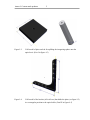
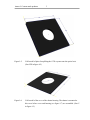
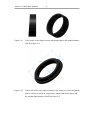
see figure 4-5) mounted onto the CCD head for dark exposures, a flange to mount an image
projector (number VII, see figure 4-5) and a wooden light tight box (number X, see figure
4-5) was built.
Figure 4-5:
Custom-made components at the test bench
Part IV in figure 4-5 consists of an outer ring, which is attached to the integrating sphere
and an inner ring holding the photodiode in position. Part VIII is designed to hold different
types of cryostats with varying positions of the screw threads. A CAD model of the
The CCD test bench
20
constructions, showing more details, can be found in the annex I. The incomplete
dimensioning of the CAD models should only reflect the proportions of the models.
4.3.2 Completion and fine adjustments
The light source system is preliminary adjusted in the way that the filament is imaged on
the monochromator input slit by means of the collective lens and the adjustable condenser,
where the lateral positioning of the image in the plane of the slit is done, using the
appropriate fine tuning screws at the housing of the light source. In assembled state (see
figure 4-3) the photocurrent is measured inside the integrating sphere and the condensers
position along the optical axis is varied to find the intensity maximum and therefore the
optimal filament image position. For this purpose the monochromator is adjusted to 630nm
and the bandwidth to its maximum (slit apertures at its maximum). Black tape is affixed to
critical areas, like the junctions between light tight box, the optical table and the cryostat
holder to prevent light entering the light tight zone from outside.
4.4
The light path
The light emitted by a 100W quartz tungsten halogen lamp with a coiled filament of 2.3 x
4.2 mm (width x height) in vertical orientation, is collimated by means of a condenser with
an aperture of 33mm and a focal length ( f1 ) of 50mm. A plano-convex lens of the same
aperture with a focal length of 150mm ( f 2 ) images the filament of the light source
magnified on the monochromator input slit. The transmission can be adjusted and
disruptive higher orders of light are blocked by the filters between the imaging optic and
the monochromator. The number of filters affecting the light path depends on the
wavelength of the light (order sorting filter) and the light level (neutral density filters)
needed. Since both lenses have the same aperture, the following equation gives a rough
estimation of the magnification (M) of the filament, where lens aberrations (spherical
The CCD test bench
21
aberrations, deviations of the focal lengths), effects of diffraction and variations in the focal
length, caused by the filters, are ignored:
M =
f 2 150
=
=3
f1
50
(4.2)
Variables:
M
-
Magnification
f1
-
Focal length of lens 1 (condenser)
f2
-
Focal length of focusing lens 2
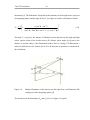
Figure 4-6:
Magnified imaging of the filament onto the monochromator input slit
by means of the condenser optic (Filters not drawn) [17]
The maximum area of aperture of the MSH 301 input slit is 3mm x 15mm (a x b, see figure
4-6), but depends on the bandwidth adjusted. Considering the magnification M, the
magnified filament theoretically covers an area of approximately 7 mm x 12.6 mm (mw x
mh, see figure 4-6) in the focal plane. The measured size of the filament image is 10 mm x
18 mm (mw x mh), which is sufficient to completely illuminate the slit. The holder of the
first filter wheel in the light path reduces the useful aperture (D) of the lenses to 30mm and
The CCD test bench
22
therefore reduces the opening of the beam coupled into the monochromator to
approximately
k=
f 2 150
=
= 5.
D
30
(4.3)
Variables:
k
-
F-number of imaging optic
f2
-
Focal length of focusing lens 2
D
-
Useful aperture of lens 1 and 2
The monochromators acceptance angle for light coupled into the device is given by the Fnumber (manufacturer information) k M = 3.9 . Thus the acceptance angle of the MSH 301 is
not completely filled. Its asymmetrical in-plane Czerny-Turner optical configuration is
shown in figure 4-7.
Figure 4-7:
The asymmetrical in-plane Czerny-Turner optical configuration of the
Newport MSH 301 monochromator [25]
The CCD test bench
23
The light entering the monochromator entrance is dispersed by means of a 600 l/mm plan
grating. Depending of its position (free to rotate in a given range), light of a specific
wavelength leaves the device either through the lateral exit or through the axial port
conditioned by the positioning of the output mirror. The input slit is imaged on the output
slit.
In case the light leaves the monochromator at its lateral exit, as shown in figure 4-7, it
enters the integrating sphere and is reflected multiple times before it leaves the sphere in
the direction to the detector. A tilted baffle prevents light directly passing through the
sphere from the input port to the output port as shown in figure 4-8.
At the exit port homogenous, diffuse and monochromatic light of a specific bandwidth is
emitted, where the aperture ratio of the light beam is limited by the maximum aperture
(64mm) of the shutter.
Figure 4-8:
The test bench light path
Assuming that the circular area of the exit port radiates according to Lambert's cosine law
(Lambertian emitter), the deviation of the illuminance on the chip can theoretically be
The CCD test bench
24
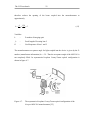
determined [4]. The illuminance E depends on the luminance B of the light source (exit port
of integrating sphere) and the angle Φ and U’ (see figure 4-9) and is calculated as follows:
E=
⎡
1 + tan 2 Φ − tan 2 U '
1−
2 ⎢
tan 4 Φ + 2 tan 2 Φ(1 − tan 2 U ' ) + (1 / cos U ' ) 4
⎣
π ⋅B ⎢
(
)
⎤
⎥
1
⎥
2
⎦
(4.4)
The angle U’ is given by the distance X (500mm) between detector (on the right) and light
source, and the radius of the circular source (RS=20mm), where angle Φ is given by the
distance X and the radius of the illuminated surface. Due to varying CCD dimensions a
radius of sufficient size (RD=50mm) for all 4k x 4k detectors in operation is considered for
the calculations.
Figure 4-9:
Oblique illuminance of the detector (on the right) from a self-luminous disk
(output port of the integrating sphere) [4]
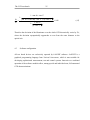
The ratio between the illuminance EΦ and E0 (Φ=0, see figure 4-9) equals
The CCD test bench
1−
EΦ
=
E0
25
1 + tan 2 Φ − tan 2 U '
(tan
4
Φ + 2 tan Φ (1 − tan U ' ) + (1 / cosU ' )
1 − tan 2 U '
1−
1
4 2
(1 / cosU ' )
2
2
(
)
1
4 2
= 0.98
(4.5)
)
Therefore the deviation of the illuminance over the whole CCD theoretically varies by 2%,
where the deviation asymptotically approaches to zero from the outer diameter to the
optical axis.
4.5
Software configuration
All test bench devices are exclusively operated by LabVIEW software. LabVIEW is a
graphical programming language from National Instruments, which is most suitable for
developing sophisticated measurement, test and control systems. Interactive or combined
operation of the software modules allow, among special and individual tests, full automated
CCD characterizations.
The CCD test bench
26
Automated data acquisition
PRiSM script - LightAc_All_030409_muse_NGCPc012473_PT.pgm
Instructions & feedback
Universal Interface to LabVIEW driver software –
NGC_LabVIEWPRiSM_New testbench.vi or LabVIEWPRiSM_New testbench2.0.vi
Operation
Standalone modules
Filter_wheel_standa
lone.vi MSH
301_standalone2.1.v
i
Keythley_6514_stan
dalone2.0.vi
ESP300_standalone.
Combined functionality
PowerSupply_stand
alone.vi
Pulpo1_standalone2
.0.vi
JUMO_standalone2.
0.vi
Keithley 2100
Series Read
Single.vi
USB interface board
NGC_standalone.vi
FIERA_standalone.v
i
Setup
Acquistion Setup.vi & DeviceDriver Setup.vi
Interface
GPIB
RS-232
USB
Telnet
Hardware
Electrometer KE
2100
Monochromator
MSH 301
PULPO
USB interface
board VM110
two ammeter KE
6514
JUMO Imago 500
Motion controller
ESP 300
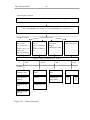
Figure 4-10:
Software hierarchy
CCD controller
FIERA
Lamp controller
69931
NGC
2 filter wheel
controller 74041
The CCD test bench
27
4.5.1 Functional principle
Each hardware unit can be operated separately by its standalone LabVIEW software module
as shown in figure 4-10. Two software units, the Acquistion_Setup.vi and the
DeviceDriver_Setup.vi, allow the user to configure the several interface and device specific
parameters such as the device address, the number of the sensor to be read out or the
password for a remote login as well as basic settings like default directories. The user is
asked to refer to the LabVIEW modules user manual [5] for a detailed description of these
modules.
For the purpose of automated data acquisition a universal piece of LabVIEW software
exists. It combines the functionality of all standalone units, including the initialization
procedure and error handling, reads an assignable text file for instructions and writes the
required data into a definable output file. This feature makes it universal, because the text
file can be created by any software that meets the requirements as they are described in
4.5.2. Operating two different kinds of software has its reason. In order to acquire data at
the existing test bench, PRiSM scripts have already been developed to perform all the
complex calculations and procedures that are necessary to extract the CCD specific
parameters from the raw data.
An automated data acquisition at the test bench is based on a master-slave principle, where
the PRiSM software acts as master that issues instructions to the LabVIEW software (slave)
to actuate the hardware. The LabVIEW programmes (VI’s) are sort of interface between
PRiSM and the controllers of the test bench devices.
4.5.2 The PRiSM software
PRiSM is astronomical software allowing to open and edit the FITS file format, which is
the format of the image files produced by the CCD controller, and save it lossless
compressed in the CPA format using unsigned 16 bit integer, where the resulting file is
only the half of the original file size of approximately 35 megabytes. Furthermore this
The CCD test bench
28
software allows to run scripts written in PRiSM syntax with the opportunity to take
advantage of all the software’s features, like image processing and statistical calculations.
The script which is used at the existing CCD test bench has been modified in the way that
all the time a test bench device (Filter wheel, monochromator, ammeter etc.) is to be
addressed, a text file (LabPrismin.txt), containing an appropriate command, is created in a
defined directory to access the devices via the LabVIEW driver software.
After the execution of a command, another text file (LabPrismout.txt), containing a
feedback of the success of the operation and the requested information, is created by the
LabVIEW module. In case an exposure is requested, the resulting image is saved in the
location specified in the Acquistion_Setup.vi. The types of exposures to be taken by the test
bench are mentioned in 4.1.1.
4.5.3 The LabVIEW software modules
The standalone modules enable the user to operate each device interactively by remotely
connecting to the desktop of the test bench PC. The following description summarizes the
functionality of these modules and the way they work. A detailed description of how to use
these modules can be found in the LabVIEW modules user manual [5].
4.5.3.1
General annotations
Before making use of any software module the user has to make sure that the parameters,
concerning the device which is intended to be used, are well-defined in the two existing
setup modules (DeviceDriver_Setup.vi and Acquistion_Setup.vi). When standalone modules
are intended to be used, it is necessary to specify the GPIB, RS232 or USB port, depending
on the interface of the device to be operated. Therefore the port is selected from a list of
available ports located on the respective graphical user interface (GUI). This has only to be
done once, if the selection is saved by default and the device address is not changed.
The CCD test bench
29
A VI is started by pressing the Run button in the upper left (see GUI’s). In the following
either the GPIB, RS232 or USB interface is configured automatically by applying bus
specific parameters, like baud rate or parity for RS232 connections for example.
Furthermore the software tries to talk to the addressed controller to verify it is well
configured and initializes the device. In case of errors a dialog box appears, providing
reasons for the malfunction, otherwise the software is ready to operate.
The red Abort Execution button next to the Run button should not be used to stop a VI
because it interrupts any action and stops the routine immediately. In order to stop it
properly the user is asked to press the STOP button, usually located in the lower right of the
front panel (GUI of a LabVIEW programme). A red busy indicator is displayed, if the
programme is busy. A help window appears when the question mark button is pressed ,
providing information on the functions of the controls and the values displayed.
4.5.3.2
PowerSupply_standalone.vi
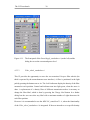
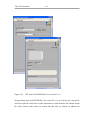
This module is used to operate the test bench lamp controller (Newport model 69931) and
therefore the power stability of the halogen lamp. Starting the lamp means to initiate a
gradual ramp-up to the preset current or power level (Set level button). A gradual rampdown from the preset current or power level is initiated by pressing the Stop lamp button.
The lamp status (on or off) is indicated by a bright (yellow) or dark (black) circular
indicator on the front panel. There is the opportunity to select between two modes, the
constant power mode and the constant current mode. All indicators are updated
isochronous, if the control Update is enabled.
The CCD test bench
Figure 4-11:
30
The front panel of the PowerSupply_standalone.vi (on the left) and the
dialog box to set the current and power level
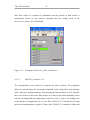
4.5.3.3
Filter_wheel_standalone.vi
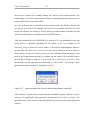
This VI provides the opportunity to move the two motorized Newport filter wheels (the
third is operated by the monochromator user interface). A filter is positioned in the light
path by pressing the buttons one to six. The Label indicators display the density of the filter
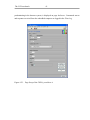
mounted at each position. Control and indicator turn into light green, when the move is
done. A replacement of a density filter of different transmission makes it necessary to
change the filter label, which is done by pressing the Change label button. In a further
dialog box the user can select any label with a maximum number of eight characters for
each filter position.
However it is recommended to use the MSH 301_standalone2.1.vi, where the functionality
of the Filter_wheel_standalone.vi is integrated. If the user intends to set a specific density
The CCD test bench
31
both filter wheels are operated in combination and the position of both wheels is
automatically chosen by the software (assuming that the settings made in the
DeviceDriver_Setup.vi are well-defined).
Figure 4-12:
Front panel of the Filter_wheel_standalone.vi
4.5.3.4
MSH 301_standalone2.1.vi
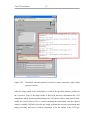
The monochromator can exclusively be operated by driver software. The programme
allows to read and adjust the wavelength, bandwidth, order sorting filter, optical density
(OD), output port, grating parameters and operating the internal shutter as well. Normally
there is no need to set the colour filter because it is done by the routine depending on the
selected wavelength and the settings made in the DeviceDriver_Setup.vi. According to the
current hardware configuration (see 4.3) the filter 305FG01-25 is inserted into the light
path at wavelengths greater or equal to 350nm, filter 550FG05-25 is inserted at 580nm and
The CCD test bench
32
filter FSR-RG1000 is inserted at 1050nm for the purpose of blocking the second-order of
diffraction (and higher) of half the desired wavelength (see also 4.2.3). All in all 29
different densities from OD 0 to OD 4.9 can be selected from a pull down menu. The two
motorized filter wheels, that hold the density filters, are then put in the correct position by
the routine.
The grating parameters are usually set by the manufacturer but in case of a memory error,
caused by a power outage for example, these parameters, including the number of lines and
the offset position of the grating, need to be set to their default values, stated in the
technical data sheet delivered with the device. Furthermore it is possible to set the label of
the colour filters if they are replaced or after a data loss.
Figure 4-13:
Front panel of the MSH 301_standalone2.1.vi, with page Basic located on
the left and page Expert (wrong settings can cause malfunction of the
device) on the right
The CCD test bench
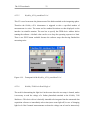
4.5.3.5
33
Keythley_6514_standalone2.0.vi
This VI is used to measure the photocurrent of the diode attached to the integrating sphere.
Therefore the Keithley 6514 electrometer is triggered to take a specified number of
measurements in series. The mean and its standard deviation are then displayed on the
interface in scientific notation. The user has to specify the GPIB device address before
running the software. A default value can be set to keep the operating expense in a limit.
There is no STOP button available because the software stops after having finished the
measuring series.
Figure 4-14:
Front panel of the Keythley_6514_standalone2.0.vi
4.5.3.6
Keithley 2100 Series Read Single.vi
The need for determining the light level in the room where the test setup is located, makes
it necessary to read the voltage of a further photodiode attached to the Keithley 2100
Multimeter. This device driver is basically intended to be integrated into the automated data
acquisition software to immediately take action (turns room light off) in case of changing
light levels. But if manual measurements are done the voltage can at least be interactively
The CCD test bench
34
read and compared to the value settable in the DeviceDriver_Setup.vi, which corresponds to
the voltage read when the room light is turned off. The USB port of the electrometer is set
before the VI is started as well as the number of measurement to be done. The user can
select from a list (Function) what kind of reading to perform.
Figure 4-15:
Front panel of the Keithley 2100 Series Read Single.vi
4.5.3.7
ESP300_standalone.vi
Up to three linear stages attached to the Newport ESP 300 motion controller can be
operated by this module. Each axis is dedicated to a page on the front panel where absolute
positions can be approached, incremental steps of definable size and direction can be
performed and axis specific settings, namely velocity and acceleration (equates to the
deceleration as well), are configurable. At each point along the travel range the position of
all axes can be reset to zero (Define home button). This zero point is approached, when the
Search for home button is pressed.
The CCD test bench
Figure 4-16:
35
The user interface of the ESP300_standalone.vi (on the left) and the window
to set axis velocity, acceleration and deceleration
4.5.3.8
Pulpo1_standalone2.0.vi
Using this software the temperature, pressure and shutter controller PULPO can be
actuated. On the page Table the parameter and values of all connected sensors (up to seven
sensors) and heaters (all in all three heaters attached) are displayed. On page Chart the
values are plotted with an update period specified on the Controls page, where the user can
also select to save the gathered data isochronous. Furthermore it is possible to set the
temperature trip point of all sensors for the alarm (audio signal in case temperature exceeds
this point) and the set point for the attached heaters. An initialisation of the controller
(comparable to power cycle the device) is performed, when the Init button is pressed.
The CCD test bench
Figure 4-17:
36
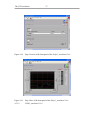
Page Table of the front panel of the Pulpo1_standalone2.0.vi
The CCD test bench
37
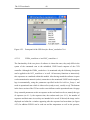
Figure 4-18:
Page Controls of the front panel of the Pulpo1_standalone2.0.vi
Figure 4-19:
Page Chart of the front panel of the Pulpo1_standalone2.0.vi
4.5.3.9
JUMO_standalone2.0.vi
The CCD test bench
38
Up to two JUMO Imago 500 multi-channel process and profile controller can be operated
in parallel using this piece of software. The data namely the vacuum and the temperature
inside the cryostat head is read, plotted and written to a data file if desired. On page
Controls the serial port and the slave address has to be specified before the software is
started. The update period of the indicators (located on page JUMO 1 and JUMO 2), and
therefore the period of time between to sets of data are saved to the specified file, is also
configurable. If required the device dependent set point parameters can be set on the pages
JUMO 1 and JUMO 2.
Figure 4-20:
Page Controls of the JUMO_standalone2.0.vi front panel
The CCD test bench
39
Figure 4-21:
Page JUMO 1 of the JUMO_standalone2.0.vi front panel which displays the
values of the sensors connected to the first unit
4.5.3.10
USB Interface Board_standalone2.0.vi
This software provides the features to operate the test bench warning light, to turn the room
light on and off, to lock and unlock the test bench door and the determination, if the door is
opened or closed. A dynamic link library (DLL) is provided by the manufacturer (Velleman
Inc.) to operate the USB interface board, which is embedded into the LabVIEW code. The
user selects the task from a list and runs the VI. The circular indicator on the front panel
shows if the door is opened (dark green) or closed (light green), after the Door closed? task
has been executed.
The CCD test bench
40
Figure 4-22:
Front panel of the USB Interface Board_standalone2.0.vi
4.5.3.11
FIERA_standalone.vi and NGC_standalone.vi
The functionality of the two pieces of software is almost the same, they only differ in the
syntax of the commands sent to the embedded, UNIX based computer of the CCD
controller. Although the FIERA_standalone.vi is mentioned only the following description
can be applied to the NGC_standalone.vi as well. All necessary functions to interactively
take exposures are combined within this module. After having started the software it opens
a telecommunication network (telnet) connection to the mentioned UNIX based computer,
logs in automatically, using the parameters specified in the DeviceDriver_Setup.vi, and
reads its operational state which is either online (ready to use), standby or off. The buttons
in the lower section of the GUI are used to exert influence on the operational state. On page
Setup essential parameters to take an exposure at the test bench can be set, namely the type
of exposure (see 4.1.1), the exposure time, the readout mode (see 4.1.1), the number of
exposures and their name in case they are intended to be saved. If desired, the image can be
displayed and edited in a window appearing after the exposure has been taken (see figure
4-25). In addition PULPO can be read out and the temperature as well as the pressure,
The CCD test bench
41
predominating in the detector system, is displayed on page Indicators. Commands sent to
and responses received from the embedded computer are logged in the Telnet log.
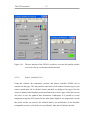
Figure 4-23:
Page Setup of the FIERA_standalone.vi
The CCD test bench
Figure 4-24:
42
Page Indicators of the FIERA_standalone.vi
Not only the image can be displayed but also the pixel table (containing the values of each
pixel) and the FITS image header (contains image specific information like exposure time,
number of pixels and recording time). Therefore an open source LabVIEW library named
GFITSIO, developed at the U.S. Naval Research Laboratory, was implemented into the
FIERA_standalone.vi.
The CCD test bench
Figure 4-25:
4.5.4
43
Window to display and process the FITS image
Automated data acquisition
Depending on the CCD controller in use, one has to choose between the two programmes
NGC_LabVIEWPRiSM_New testbench.vi and LabVIEWPRiSM_New testbench2.0.vi, where
the first one is the right one, if the New General Detector Controller is operated and the
second one, if the FIERA system is operated. The main difference between both is the
syntax that causes the controller to work. Thus the following description regards to both
modules.
The CCD test bench
Figure 4-26:
44
GUI of the LabVIEWPRiSM_New testbench2.0.vi
On page Setup in the LabVIEWPRiSM_New testbench2.0.vi (see 4-26) the user can specify
where the input file LabPrismin.txt (the instructions are read from this file) and the output
file LabPrismout.txt (the results are written into this file) are located. In addition the
The CCD test bench
45
directory for a further file is settable, namely the Constant.txt file and the Blink.txt file
,which triggers LabVIEW to operate the test bench warning light (indicates that tests are in
progress) placed above the entrance door.
On page Indicators the commands sent and received from the PRiSM software, the
Operational state of the CCD controller, the Exposure status and the Readout mode, used
to take the exposure, are displayed. The two telnet log windows allow to monitor the data
traffic between the detector controller and the LabVIEW software.
After having started the LabVIEWPRiSM_New testbench2.0.vi, an initialization of the test
bench devices is initiated. Depending on the shutter to be used (settable in the
Acquistion_Setup.vi) either the Prontor shutter or the internal monochromator shutter is
opened, where the other one is closed. In case the Prontor shutter is chosen it would be
closed and the second one would be opened, to allow unhindered light throughput to the
point of the Prontor shutter housing. In a further step the status of the test bench lamp is
queried and a dialog box appears, if it is turned off. It seems to be a trivial or even
questionable step, but experience has shown that it is most useful. The message can be
ignored if only dark exposures are intended to be taken.
Figure 4-27:
Appearing dialog box if the test bench halogen lamp is turned off
Afterwards the VI opens a telnet connection to the embedded computer of the NGC system
and logs in by applying the login parameters, specified in the DeviceDriver_Setup.vi. The
operational state of the system is read and displayed on the front panel of the application
software.
The CCD test bench
46
The following example intends to demonstrate the proceedings, when the PRiSM software
requests a flat field exposure of 1 second exposure time. Assuming that wavelength,
bandwidth and optical density has already been set the following steps take place.
At first the LabPrismin.txt file is created by the PRiSM software containing the command
to set the read out mode, or rather the clock mode (CCDF CL 10). The LabVIEW software
reads and deletes the file, interprets the command, and temporarily saves this setting. A
new LabPrismin.txt file created by PRiSM contains the command to take a flat field image
of one second exposure time (CCDF FF 1000). From this point on the LabVIEW software
carries out the requested actions. At first the lamp controller of the QTH lamp is queried, if
the lamp is still turned on. The procedure is aborted and a dialog box appears in case it is
turned off (lamp is most likely broken). Otherwise the KE 2100 electrometer is triggered to
read the voltage at the attached photodiode to make sure the room light level is below the
preset limit (settable in the Acquistion_Setup.vi). There are two possible reasons for an
increased room light level, either the light is turned on or the test bench door is opened. The
software automatically turns off the room light and brings up a window in case the door is
opened. If the door is closed and the light level is ok, the necessary commands are finally
sent to the embedded computer of the CCD controller. The CCD controller FIERA (CCDF)
is requested to set the clock mode (CL) to 10 and to take a flat filed exposure (FF) of
1000ms exposure time by sending the appropriate commands via telnet connection (see
figure 4-28 for the commands sent).
The CCD test bench
Figure 4-28:
47
Commands sent and responses received via telnet connection, when a light
exposure is taken
After the image named LabViewPRiSM.fits is saved in the specified directory (defined in
the Acquistion_Setup.vi) the image header is filled with necessary information like CCD
temperature and the pressure predominating in the CCD head, which is read from PULPO.
Finally the LabPrismout.txt file is created containing the information, that the required
image is available. PRiSM accesses the new image, performs the necessary calculations and
image processing and saves it lossless compressed (CPA file format) in the CCD type
The CCD test bench
48
specific directory model as shown in figure 4-29. Depending on the read out mode (read
out speed), the whole procedure takes around one or two minutes.
4.5.5 Data reduction and results
All the images acquired during the characterization process, the test scripts used, notes and
other necessary data like specifications and the manufacturers test result for the respective
detector are stored in a general CCD directory model (see figure 4-29). A painstaking
storage of the raw data is absolutely essential to be able to resort to it in the future.
Figure 4-29:
Directory model, where the raw data, the results of the characterization and
all other necessary data concerning the detector are stored
The CCD test bench
49
The results of quantum efficiency, photo response non uniformity (PRNU), readout noise
(RON), linearity, dark current, charge transfer efficiency (CTE) and cosmetic defects are
summarized in an Excel file, which gathers the necessary data and summarizes and
visualizes the outcome in a structured and well-arranged way, using the visual basic script
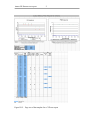
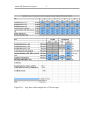
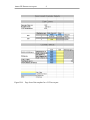
function in Excel. See the annex (figure III-1, III-2, III-3 and III-4) for the template of a
detector test report. The blue fields in the template are filled with data, which is read from
several directories in the directory model.
Measurements and results
5
Measurements and results
5.1
Wavelength accuracy
50
In order to verify, if the wavelength accuracy of the monochromator still meets the
requirements after having replaced the standard slit assembly by the motorized slit
assembly a random test is performed before the final assembly of the light source
(including imaging optic) and the monochromator. The intention is to detect strong
emission lines of a spectral lamp placed at the input, by measuring the photocurrent of the
diode, attached to the integrating sphere, at the monochromator output.
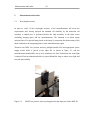
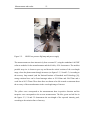
Therefore an ORIEL low pressure mercury penlight (model 6036 and appropriate power
supply model 6048) is placed at the input slit, as shown in figure 5-1, and the
monochromator bandwidth is set up to its minimum at 0.5nm. Furthermore the room light
is turned off and an aluminium bracket is placed behind the lamp to reduce stray light and
to avoid intervisibility.
Figure 5-1:
ORIEL low pressure mercury lamp placed at the input port of the MSH 301
Measurements and results
Figure 5-2:
51
ORIEL low pressure Hg lamp and power supply
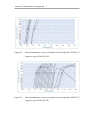
The measurements are done interactively from a remote PC, using the standalone LabVIEW
software modules for the monochromator and the Keithley 6514 electrometer. The smallest
possible step size is chosen to pace up and down the critical sections of the wavelength
range, where the photocurrent sharply increases (see figures 5-3, 5-4 and 5-5). According to
the mercury lamp manual (and the National Institute of Standards and Technology [6]),
strong emission lines can be found amongst others at 435.834nm and 546.074nm and a
weak line at 1013.976nm. These three lines are chosen to be able to make a statement about
the accuracy of the monochromator in the wavelength range of interest.
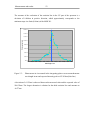
The yellow curve corresponds to the measurements done in positive direction and the
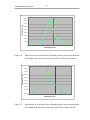
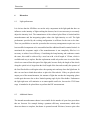
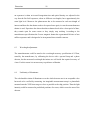
turquoise curve corresponds to the reverse measurements. The blue, green and red line in
the figures 5-3, 5-4 and 5-5 demonstrate the wavelength of the expected intensity peak,
according to the emission lines of mercury.
Measurements and results
52
The outcome of the evaluation of the emission line in the UV part of the spectrum is a
deviation of 0.086nm in positive direction, which approximately corresponds to the
minimum steps size limit (0.08nm) of the MSH 301.
1,61E-11
1,41E-11
Photocurrent in A
1,21E-11
1,01E-11
8,1E-12
6,1E-12
4,1E-12
2,1E-12
1E-13
433
433,5
434
434,5
435
435,5
436
436,5
437
437,5
438
438,5
Wavelength in nm
Figure 5-3:
Photocurrent in A measured in the integrating sphere versus monochromator
wavelength in nm and expected intensity peak at 435.834nm (blue line)
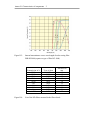
A deviation of -0.123nm is observed between the measured value and the expected value of
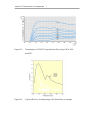
546.074nm. The largest aberration is obtained at the third emission line and amounts to
-0.677nm.
Measurements and results
53
1,8E-11
1,6E-11
Photocurrent in A
1,4E-11
1,2E-11
1E-11
8E-12
6E-12
4E-12
2E-12
0
543,5
544
544,5
545
545,5
546
546,5
547
547,5
548
Wavelength in nm
Figure 5-4:
Photocurrent in A measured in the integrating sphere versus monochromator
wavelength in nm and expected intensity peak at 546.074nm (green line)
1,9E-12
Photocurrent in A
1,7E-12
1,5E-12
1,3E-12
1,1E-12
8,5E-13
6,5E-13
4,5E-13
2,5E-13
1011,5
1012
1012,5
1013
1013,5
1014
1014,5
1015
1015,5
Wavelength in nm
Figure 5-5:
Photocurrent in A measured in the integrating sphere versus monochromator
wavelength in nm and expected intensity peak at 1013.976nm (red line)
Measurements and results
54
All the obtained values for the deviation of the wavelength adjustments are well inside the
specifications of ±1nm. Therefore there is no need to perform a wavelength calibration of
the MSH 301.
Discussion
6
Discussion
6.1
Light performance
55
It is obvious that the ND-filters are not the only components in the light path that have an
influence on the intensity of light reaching the detector, but it is not necessary to accurately
adjust the intensity level. The transmittance of the coloured glass filters is limited and the
monochromator and the integrating sphere reduce the light intensity as well. The light
performance provided by the existing configuration is sufficient for the tests to be done.
There are possibilities to tune the system but the necessary arrangements require new or at
least modified components to be reassembled and the additional benefit remains limited. As
mentioned the acceptance angle of the monochromator is not completely filled as it is
necessary to achieve best efficiency. Considering the lamp housing and condenser remain
the same, this could be achieved by a new lens with a focal length of 125mm, which is
available and easy to replace. But the replacement would only make sense in case the filter
wheels are removed from this part of the light path, because firstly the length of the wheels
along the optical axis is larger than the focal length of the lens and secondly the aperture of
the first filter holder would again reduce the opening ratio and stop down the light beam. In
this case one has to think about where to place the filter wheels. If they are placed at the
output port of the monochromator, the amount of light that reaches the integrating sphere
would again decrease due to the a limited opening angle by the filter holder. Furthermore
the light tight zone will minimize to an unacceptable small size, because the XYZ linear
stage is intended to be placed there to perform the PSF measurements.
6.2
Additional shutter
The internal monochromator shutter is not suitable for the number of open-close procedures
that are foreseen. For example during a quantum efficiency measurement, which takes
about two hours to complete, the shutter is operated around 200 times, because quite often
Discussion
56
an exposures is taken twice until integration time and optical density are adjusted in the
way that the flat field exposures, taken at different wavelengths, have approximately the
same light level. Moreover the photocurrent has to be measured at each wavelength of
interest and therefore the shutter needs to be opened once again, in case the monochromator
shutter is used. Experience has shown that these shutters break after a short period of time,
they remain open for some reason or they simply stop working. According to the
manufacturers specifications the Prontor magnetic shutter has a guaranteed life time of one
million exposures and is designed to be incorporated into scientific cameras.
6.3
Wavelength adjustments
The monochromator could be tuned to the wavelength accuracy specification of 0.35nm,
stated by the manufacturer, by calibrating the device with a spectral lamp and a photo
detector, but the measured wavelength deviations are well inside the required accuracy of
±1nm. For this reason it is not necessary to perform a calibration.
6.4
Uniformity of illuminance
The calculated deviation of illuminance over the whole detector area is an acceptable value
but needs to be verified by measuring. An imaginable measurement setup is a photodiode
mounted onto the XYZ linear stage as close as possible to the chip position. Then the light
intensity could be measured at predefined positions of a raster, which covers the area of the
detector.
Conclusion
7
57
Conclusion
The test assembly provides a diffuse, uniform and monochromatic illumination of 4k x 4k
pixel detectors with up to 100mm diameter mainly in the visible wavelength range.
Detectors can be illuminated at adjustable intensity, bandwidth and wavelength where all
necessary devices can be operated interactively or in fully automated procedures from a
remote location. The CCD cryostats can be exchanged in few steps without touching
critical components of the test setup. Except few custom-made parts, standard lab
components where used. This provides the opportunity for modifications and upgrades in
the future. The functionality of the software can easily be enlarged by editing the existing
modules or embedding new pieces of software. Both available CCD controllers are
supported by the software.
PSF experiments are virtually possible, but the necessary hardware is currently not
installed, because it is used at another measurement setup.
Applicable documents
Applicable documents
[1]
REISS, Roland: MUSE IDS Detectors Technical Specification, VLT-SPE- ESO14679-4377. Garching bei München, European Southern Observatory (April
2008)
[2]
AMICO, P., BÖHM, T. In Beletic, J. and Amico, P.: Optical Detectors for
Astronomy. Vol.1, Kluwer Academic Publishers (1998)
[3]
CAVADORE, C., Christen, F., and Darbon, S.: New Testbench Software User’s
Manual. Garching bei München, European Southern Observatory (2002)
[4]
KINGSLAKE, Rudolf: Applied Optics and Optical Engineering. Vol.2, Academic
Press Inc. (1965)
[5]
MÜLLER, Eric. <[email protected]>, DEIRIES, Sebastian <[email protected]>
MÜLLER E., Deiries S.: ODT Test-bench LabVIEW Modules User Manual, GENMAN-ESO-21110-0028. URL:<http://www.eso.org/projects/odt/ODTnew/
index.html>, available on 23.06.2009
[6]
National Institute of Standards and Technology. Unknown author: Basic Atomic
Spectroscopic Data - Strong Lines of Mercury (Hg). URL: <http://physics.nist.gov/
PhysRefData/Handbook/Tables/mercurytable2.htm>, available on 23.06.2009
[7]
BALESTRA, Andrea <[email protected]>, CUMANI, Claudio
<[email protected]>. Balestra, A., Cumani, C.: FIERA CCD Controller Software
User Manual, Doc.No. VLT-MAN-ESO-13640-1388. URL: < http://www.eso.org/
projects/vlt/sw-dev/wwwdoc/JAN2006/VLT-MAN- ESO-13640-1388/
Output/fro_.html>, available on 23.06.2009
Applicable documents
[8]
BALESTRA, Andrea <[email protected]>, CUMANI, Claudio
<[email protected]>. Balestra, A., Cumani, C.: Next Generation detector Controller
Optical DCS - User Manual, Doc.No. VLT-MAN-ESO-13660-4086.
URL: <http://www.eso.org/projects/odt/ODTnew/index.html>,
available
on
23.06.2009
[9]
GEIMER, C. < [email protected]>, CUMANI, Claudio <[email protected]>.
Geimer, C., Cumani, C.: PULPO-2 manual, VLT-TRE-ESO-13630-3490.
URL: <http://www.eso.org/tecarch/Documents/VLT/13000_optical_instruments/
13600_vlt_scientific_CCD_system/13630-pulpo/
VLT-TRE-ESO-13630-3490- 2.0.pdf>, available on 23.06.2009
[10]
WICHER Carola. <[email protected]>. Wicher C. Hinweise zur
Gestaltung von Bachelorarbeiten an der Fachhochschule Jena im Studiengang
Augenoptik. URL: <http://www.fh-jena.de/~wicher>, available on 23.06.2009
[11]
Keithley.
<[email protected]>.
Unknown
author:
Model
6514
System
Electrometer Instruction Manual. URL: <http://www.Keithley.com/products/
locurrhiresist/electrometers/?mn=6514> and <http://www.Keithley.com/
data?asset=52529>, available on 23.06.2009
[12]
Keithley. <[email protected]>. Unknown author: Model 2100 6 1/2-Digit
Resolution Digital Multimeter User’s Manual. URL: <http://www.Keithley.com/
products/dmm/dmms/?mn=2100120> and
<http://www.Keithley.com/
data?asset=50760>, available on 23.06.2009
[13]
Newport. <[email protected]>. Unknown author: Motorized Filter Wheel
System Model 74041 User Manual. URL: <http://search.newport.com/
?sku=74041>, available on 23.06.2009
Applicable documents
[14]
Newport. <[email protected]>. Unknown author: 1/4 M Monochromator
Model MSH 301 User Manual. URL: <http://www.LOT-ORIEL.com/site/
site_down/ms_101301_fren.pdf> and <http://search.newport.com/?sku=74100>,
available on 23.06.2009
[15]
Newport. <[email protected]>. Unknown author: 300W Radiometric Power
Supply Model 69931 User Manual.
URL: <http://search.newport.com/?sku=69931>, available on 23.06.2009
[16]
Newport. <[email protected]>. Unknown author: ESP300 Motion
Controller/Driver User’s Manual.
URL: <http://search.newport.com/?sku=ESP300-111112>, available on 23.06.2009
[17]
Newport. <[email protected]>. Unknown author: Unknown title.
URL:<http://www.newport.com/images/webclickthru-GR/images/2282.gif>,
available on 23.06.2009
[18]
Velleman Inc.. <export@Velleman Inc..be>. Unknown author: Introduction to the
DLL for the USB experiment interface board K8055. URL: <http://www.Velleman
Inc..be/downloads/0/user/usermanual_k8055_dll_uk.pdf>, available on 23.06.2009
[19]
Velleman Inc.. <export@Velleman Inc..be>. Unknown author: USB Experiment
interface board K8055. URL: <http://www.VellemanInc..be/downloads/0/
illustrated/illustrated_assembly_manual_k8055_uk_rev3.pdf>,
available on
23.06.2009
[20]
LOT-ORIEL.
<[email protected]>.
Unknown
author:
Standard-
Ulbrichtkugeln, BaSO4. URL: < http://www.LOT- ORIEL.com/site/site_down/
ul_baso4_dede.pdf>, available on 23.06.2009
Applicable documents
[21]
RUPPRECHT, G. <[email protected]>. Rupprecht, G.: CCD Characterization
Procedure, Doc.No. VLT-PRO-ESO-13600-4686.
URL: <http://www.eso.org/tecarch/Documents/VLT/13000_optical_instruments/
13600_vlt_scientific_CCD_system/VLT-PRO-ESO-13600-4686_i1.pdf>, available
on 23.06.2009
[22]
CHRISTEN, F (2003). Characterization of the OmegaCAM CCDs with the ESO
test bench. URL: <http://www.eso.org/projects/odt/ODTnew/index.html>, available
on 23.06.2009
[23]
PRONTOR. <[email protected]>. Unknown author: PRONTOR MAGNETIC
SHUTTER E/64 - Specifications. URL:<http://www.schneideroptics.com/pdfs/
industrial/Prontor_magnetic_shutter_E64.pdf>, available on 23.06.2009
[24]
SCHRÖDER, Gottfried: Technische Optik. Vol.7, Vogel, Würzburg (1990)
[25]
Newport. <[email protected]>. Unknown author: Unknown title.
URL:<http://www.newport.com/images/webclickthru-EN/images/1216.gif>,
available on 23.06.2009
Table of figures
Numbering
Title
Page
Figure 3-1:
The first science grade CCD (named CERES) for MUSE
6
Figure 4-1:
Time delayed integration (TDI) image of a 4096x2048 pixel
9
detector
Figure 4-2:
Polychromatic light diffracted by a grating [14]
13
Figure 4-3:
The new CCD test bench
15
Figure 4-4:
CAD model of the test bench components with an impact on
18
the light path including their controllers
Figure 4-5:
Custom-made components at the test bench
19
Figure 4-6:
Magnified imaging of the filament onto the monochromator
21
input slit by means of the condenser optic (Filters not drawn) [17]
Figure 4-7:
The asymmetrical in-plane Czerny-Turner optical configuration
22
of the Newport MSH 301 monochromator [25]
Figure 4-8:
The test bench light path
23
Figure 4-9:
Oblique illuminance of the detector (on the right) from a
24
self-luminous disk (output port of the integrating sphere) [4]
Figure 4-10:
Software hierarchy
26
Figure 4-11:
The front panel of the PowerSupply_standalone.vi (on the left)
30
and the dialog box to set the current and power level.
Figure 4-12:
Front panel of the Filter_wheel_standalone.vi
31
Figure 4-13:
Front panel of the MSH 301_standalone2.1.vi, with page Basic
32
located on the left and page Expert (wrong settings can cause
malfunction of the device) on the right
Figure 4-14:
Front panel of the Keythley_6514_standalone2.0.vi
33
Figure 4-15:
Front panel of the Keithley 2100 Series Read Single.vi
34
Figure 4-16:
The user interface of the ESP300_standalone.vi (on the left) and
35
the window to set axis velocity, acceleration and deceleration
Figure 4-17:
Page Table of the front panel of the Pulpo1_standalone2.0.vi
36
Table of figures
Figure 4-18:
Page Controls of the front panel of the Pulpo1_standalone2.0.vi
37
Figure 4-19:
Page Chart of the front panel of the Pulpo1_standalone2.0.vi
37
Figure 4-20:
Page Controls of the JUMO_standalone2.0.vi front panel
38
Figure 4-21:
Page JUMO 1 of the JUMO_standalone2.0.vi front panel which
39
displays the values of the sensors connected to the first JUMO
Figure 4-22:
Front panel of the USB Interface Board_standalone2.0.vi
40
Figure 4-23:
Page Setup of the FIERA_standalone.vi
41
Figure 4-24:
Page Indicators of the FIERA_standalone.vi
42
Figure 4-25:
Window to display and process the FITS image
43
Figure 4-26:
GUI of the LabVIEWPRiSM_New testbench2.0.vi
44
Figure 4-27:
Appearing dialog box if the test bench halogen lamp is turned off
45
Figure 4-28:
Commands sent and responses received via telnet connection,
47
when a light exposure is taken
Figure 4-29:
Directory model, where the raw data, the results of the
48
characterization and all other necessary data concerning the
detector are stored
Figure 5-1:
ORIEL low pressure mercury lamp placed at the input port of the
50
MSH 301
Figure 5-2:
ORIEL low pressure Hg lamp and power supply
51
Figure 5-3:
Photocurrent in A measured in the integrating sphere versus
52
monochromator wavelength in nm and expected intensity peak at
435.834nm (blue line)
Figure 5-4:
Photocurrent in A measured in the integrating sphere versus
53
monochromator wavelength in nm and expected intensity peak at
546.074nm (green line)
Figure 5-5:
Photocurrent in A measured in the integrating sphere versus
monochromator wavelength in nm and expected intensity peak at
1013.976nm (red line)
53
Annex I: Custom-made products
Figure I-1:
1
CAD model of plate and rod (all in all four rods) for uplifting the lamp
housing onto the optical axis. (Part I in figure 4-5)
Figure I-2:
CAD model of plate and rod (all in all four rods) for uplifting the
monochromator onto the optical axis. (Part I in figure 4-5)
Annex I: Custom-made products
Figure I-3:
2
CAD model of plate and rod for uplifting the integrating sphere onto the
optical axis. (Part I in figure 4-5)
Figure I-4:
CAD model of the bracket (all in all two) that holds the plate (see figure I-5)
in a rectangular position to the optical table. (Part IX in figure 4-5)
Annex I: Custom-made products
Figure I-5:
3
CAD model of plate for uplifting the CCD cryostat onto the optical axis.
(Part VIII in figure 4-5)
Figure I-6:
CAD model of the cover of the shutter housing. The shutter is mounted to
this cover before cover and housing (see figure I-7) are assembled. (Part V
in figure 4-5)
Annex I: Custom-made products
4
Figure I-7:
CAD model of the shutter housing. (Part V in figure 4-5)
Figure I-8:
CAD model of the flange where the image projector is attached to. It is
then mounted onto the CCD head. (Part VII in figure 4-5)
Annex I: Custom-made products
Figure I-9:
5
CAD model of the metallic cover which is attached to the CCD head when
dark exposures are taken. (Part VI in figure 4-5)
Figure I-10:
CAD model of the two rings that keep the photodiode attached to the
integrating sphere. (Part IV in figure 4-5)
Annex I: Custom-made products
Figure I-11:
6
CAD model of the flange between integrating sphere and monochromator.
(Part II in figure 4-5)
Figure I-12:
CAD model of the ring which mounted to the output port of the integrating
sphere. It allows to attach an opaque tissue which connects the sphere and
the wooden light-tight box. (Part III in figure 4-5)
Annex II: Characteristics of components 1
Figure II-1:
Internal transmittance versus wavelength of order sorting filter 305FG01-25
(equates to type of filter WG-305)
Figure II-2:
Internal transmittance versus wavelength of order sorting filter 550FG05-25
(equates to type of filter OG-550)
Annex II: Characteristics of components 2
Figure II-3:
Internal transmittance versus wavelength of order sorting filter
FSR-RG1000 (equates to type of filter RG-1000)
Transmission in %
70.79
70.79
50.11
25.11
10.00
5.01
2.51
0.5
0.1
0.025
Figure II-4:
Type of glass
NG11
NG11
NG11
NG4
NG4
NG4
NG9
NG9
NG9
NG9
Thickness in
mm
1.2
1.2
2.5
1.2
2.0
2.5
1.1
1.6
2.1
2.5
List of the ND-filters mounted in the filter wheels.
Annex II: Characteristics of components 3
Figure II-5:
Transmittance of SCHOTT neutral density filters of type NG4, NG9
and NG11
Figure II-6:
Typical efficiency of ruled gratings with 350nm blaze wavelength.
Annex II: Characteristics of components 4
Figure II-7:
Integrating sphere coating (BaSO4) reflectance as a function of wavelength
(320nm to 400nm).
Figure II-8:
Integrating sphere coating (BaSO4) reflectance as a function of wavelength
(400nm to 2000nm).
Annex II: Characteristics of components 5
Figure II-9:
Spectral irradiance of a 100 W halogen lamp in 0.5m distance
Figure II-10: Transmittance of 10mm thick standard quartz (material of lenses)
Annex III: Detector test report
Figure III-1:
1
Page one of the template for a CCD test report
Annex III: Detector test report
Figure III-2:
2
Page two of the template for a CCD test report
Annex III: Detector test report
Figure III-3:
3
Page three of the template for a CCD test report
Annex III: Detector test report
Figure III-4:
4
Page four of the template for a CCD test report
Declaration on autonomy
Declaration on autonomy
I declare that this bachelor thesis is the result of my own and independent work. I have not
used any other resources than the ones stated.
Garching bei München, 13.07.2009
________________________
Signature
Abstract
Abstract
Driven by the strong will to answer today’s questions of astronomy, ambitious projects in
development at the European Southern Observatory (ESO) require the implementation of a
large number of optical detectors in their instruments in the near future. Therefore the
Charge Coupled Devices (CCDs) have to be tested and qualified individually on a test
bench against the contractual specifications.
A new testing facility is described, designed to face the challenge of a rising number of
detectors to be characterized in an automated way. The miscellaneous requirements
concerning the setup are highlighted and the functionality of hard- and software as well as
the interactions between are explained.
Finally a compact assembly is introduced, providing the possibility to automatically
determine all major CCD parameters like quantum efficiency, conversion factor, dark
current, charge transfer efficiency, read out noise, and cosmetic defects as well as specific,
interactive measurements, that can be performed from a remote computer.
Keywords: CCD characterization, test bench, automation, optical detectors