1
2
W6VIO Calling
to the JPL MESA to check on the equipment status. Jim
Lux may be leading a repeater work party in the near
future.
A question was asked as to whether there was a
repository for past JPLARC presentations and, if so, is it
available for off lab access? The current answer is no but
that is a pending activity for the Internet Services
Committee once we find a leader for that committee.
We have all of the back presentations for the past year,
we just need a place to put them that has external access
(a Yahoo group?).
Guest Presentation:
Doug Millar K6JEY is ill and could not be here for his
previously scheduled talk on “Sidewalk EME”. We plan
to work with him to reschedule for a later date. [ed:
Done, now scheduled for September 26th.]
June 2014
the presentation via JPL’s large file transfer tool. The
corresponding symposium paper is available directly
from the author’s website at
http://cbduncan.duncanheights.com/HamRadio/Dsp1
0/PhaseFive/SDR_AMSAT_2006_Submitted.pdf
A brief summary of the presentation follows (just to
whet your appetite for asking Courtney for a copy!).
Courtney began by asking “What are Software Radios
good for? Why Bother? His answer: Audio filtering;
Speech processing; Noise reduction; “sound card”
modes; Modems; Mod/Demod schemes; Software
defined transponders; “arbitrary” protocols, adaptable;
ALE protocol; Autonomy; Ultra QRP; RADAR;
Navigation – direction finding.
For Courtney, he wanted to get away from ‘appliance’
type radios, to have detailed control of the radio, to have
the construction experience, and to explore unusual
capabilities.
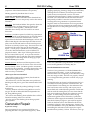
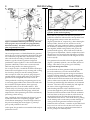
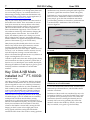
His adventure with the DSP-10 (Figure-2), a mostly
electronic (not mechanical) radio, began with building a
kit over the period 2002 to 2005, requiring about 50
hours of construction and about 25 hours of debugging.
Figure 2: N5BF’s DSP-10
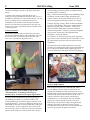
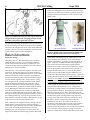
Figure 1: Courtney Duncan N5BF giving his talk:
“Software Radios, an Enabling Technology for
Satellite, Space, and Ultra-weak Signal Applications.”
Courtney Duncan N5BF filled in for Doug giving an
outstanding presentation on "Software radios, and
enabling technology for Satellite, Space, and Ultra weak
signal applications.” This was a talk that he had given at
an AMSAT Symposium in October 2006 that is still quite
relevant today. Even a compressed .pdf version of the
talk is too big to send via email so, for anyone interested,
please send an email to Courtney and he can send you
DSP-10 modes include CW, USB/LSB/FM, LHL-7,
PUA43, EME2, LTI, and whatever someone writes
(Google for explanation of the modes that you’re not
familiar with). Other DSP-10 features include: scrolling
waterfall with many modes and rates; all the usual
controls; numerous other controls; and DOS key
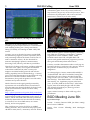
combinations (i.e., scrl-shift-F4). The user interface
(Figure-3) is entirely handled via the screen and
keyboard of a PC (at least a x386) running DOS and
talking to the radio via RS-232. The only control
available at the radio itself is PTT on the microphone,
when set up properly for QSOs from the PC.