1
TRANSMISSION ALIGNMENT (con’t.)
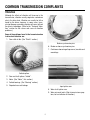
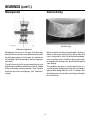
Flywheel Pilot Bore
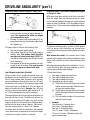
Transmission Clutch Housing
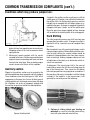
The transmission clutch housing face and pilot can not
be checked accurately in the field without special measuring tools. Recommended maximum runout for the
transmission clutch housing face and pilot is .003" with
SAE No.1 and No.2 housings.
Cut 8195E-11/86
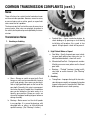
Dial indicate pilot bearing bore of flywheel. With indicator secured to flywheel housing, move gauge finger
to contact pilot bearing bore surface. Turn flywheel and
obtain readings. SAE maximum total run-out for the pilot bearing is .005".
DRIVELINE ANGULARITY
Torsional Vibration
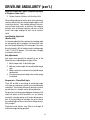
Checking Driveline U-Joint Operation Angles
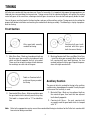
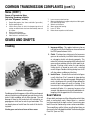
The action of a drive line with a universal joint at either
end working through an angle results in a peculiar motion. The drive line will speed up and slow down twice
for each revolution. If the working angles at either end
of the shaft are unequal, torsional vibration results. This
torsional vibration will tend to cancel itself out if both
joint working angles are equal.
Cut 8580A-11/86
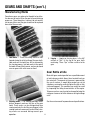
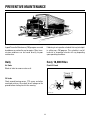
2. Drive line slip joints that do not have the arrows
or other markings pointing to each other will result in the drive line universal joints being out of
phase. In other words, the transmission universal
joint may be turned one spline or more to the right
or left of being aligned with the universal joint at
opposite end of the drive line. NOTE: Some computer designed drive lines are purposely built with
U-joints out of phase. Check manufacturers specifications for proper setting. Also, check closely to
make certain no twist has occured to the tubing,
causing these two joints to be out of phase.
Types of Noise
Noise or vibration which occurs only at certain road
speeds and diminishes as speed increases is generally
caused by unequal working angles of drive line joints.
Noise or vibration which is persistent throughout the
speed range and varies in intensity with change of speed
may be caused by unbalanced drive lines, unbalanced
brake drums or discs, or drive lines with universal joints
out of phase.
Make sure the slip joint works freely and is not bound
or seized. Slip joints must absorb axle housing movements.
3. Unbalanced drive lines can cause vibration that
occurs throughout the speed range of vehicle and
varies in intensity with change of speed. The drive
line may be at fault in respect to balance and concentricity. A quick field check to determine drive
line balance can be made by securing a small piece
of metal or similar weight with a hose
Preliminary Checks
Make checks of the following before taking angle readings:
1. Check companion flange or yoke nut for looseness and torque to proper specification if
necessary.
18