1
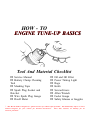
The object of a tune-up is to restore the engine to
the performance levels intended by the manufacturer.
It calls for the replacement of parts that are
approaching or have reached the end of their useful
life, and for servicing those that can be restored to
“new part” reliability. Adjustments must also be made
to the various engine systems so that they meet the
manufacturer’s specifications and thus can contribute
effectively to the car’s performance.
A complete tune-up should be performed at least
every 10,000 to 12,000 miles on cars with contact
ignition systems. On vehicles with lectronic ignition
systems, tune the engine ever 15,000 to 20,000
miles. Refer to a service manual, a tune-up
specification book, or the Vehicle Emissions Control
Information (VECI) decal located under the hood
for specifications pertaining to your vehicle.
REPLACING THE
SPARK PLUG
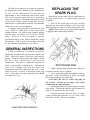
Spark plugs are the most critical replacement of
the tune-up procedure. To remove them, proceed
as follows:
1. Pull off the spark plug wires by carefully
grasping the boot and twisting it back and forth.
Work one plug at a time to avoid mixing up the wires
NOTE: Protect your eyes by wearing safety glasses
or goggles when doing this procedure.
GENERAL INSPECTIONS
A tune-up should be as complete as possible.
Change the oil and oil filter, the air filter, and the fuel
filter. Check the battery fluid level and specific
gravity. Clean the battery posts and clamps. Check
the PCV valve, vacuum hoses, and electrical
connections. The latter is especially important in
today’s electronically controlled cars. Diagrams in
your service manual will help you locate the
2. Label each plug with masking tape so that it is
components and their connectors and fuses. Also
check for loose, cracked, or hardened spark plug reinstalled on the correct cylinder.
3. Use a spark plug socket and ratchet to remove
wires. Every three years the spark plug wires should
the plugs. If they are difficult to reach, you might
be replaced as a set.
also need extensions and universals.
CAUTION: Be sure to center the plug in
the socket. If held at an angle, the socket
could break the plug insulator.
4. Set the gap on the new plugs using a wire spark
plug gauge. Consult the tune-up specifications for
your car to determine the correct gap.
5. Thread the plugs into the holes by hand.
Finger tighten them another 1/8 of a turn, using
the socket wrench. Do not over tighten.